Summary
Table of Content

Substation Monitoring System Market
Get a free sample of this report
Form submitted successfully!
Error submitting form. Please try again.
Thank you!
Your inquiry has been received. Our team will reach out to you with the required details via email. To ensure that you don't miss their response, kindly remember to check your spam folder as well!
Request Sectional Data
Thank you!
Your inquiry has been received. Our team will reach out to you with the required details via email. To ensure that you don't miss their response, kindly remember to check your spam folder as well!
Form submitted successfully!
Error submitting form. Please try again.
Substation Monitoring System Market Size
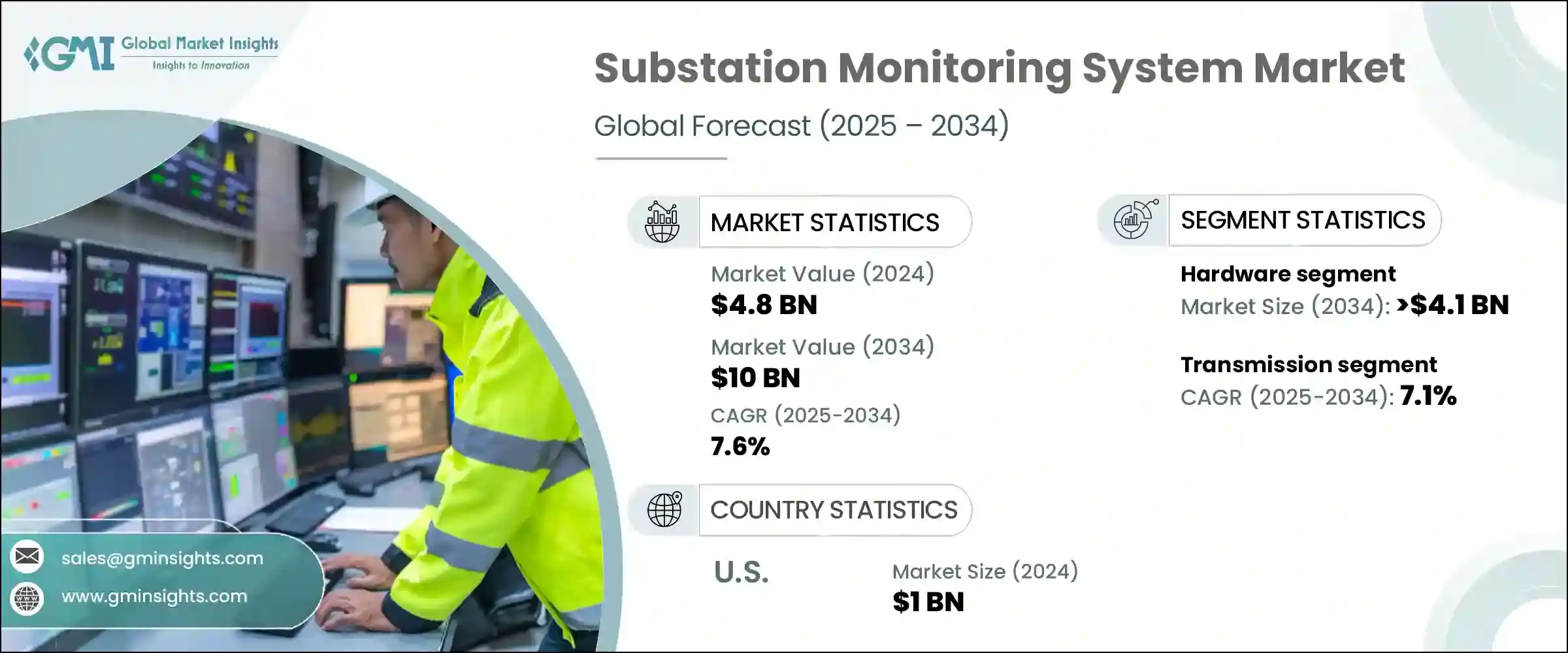
The global substation monitoring system market size was valued at USD 4.8 billion in 2024 and is estimated to reach the value of USD 10 billion by 2034, growing at a CAGR of 7.6% from 2025 to 2034. It is mainly driven by the rising demand for reliable and uninterrupted power supply, increasing grid modernization efforts, and the growing integration of renewable energy sources.
Substation Monitoring System Market Key Takeaways
Market Size & Growth
- 2024 Market Size: USD 4.8 Billion
- 2034 Forecast Market Size: USD 10 Billion
- CAGR (2025–2034): 7.6%
Key Market Drivers
- Stringent energy efficiency reforms.
- Expansion of smart grid networks.
Challenges
- High dependency on imports.
Get Market Insights & Growth Opportunities
Increasing in reliance on both wind and solar energy sources necessitates their refined management due to their sporadic nature. For instance, the report on solar PV development in China mentioned that the country had newly added solar capacity of 59.71 GW, with 20.24 GW added in March alone. The substation monitoring system aids real time supervision of substation assets, automating the processes needed for the flawless incorporation of renewables into the electricity grid.
Integration of IoT and AI technologies in substations enhances their predictive maintenance capabilities by improving failure monitoring and reducing both downtime and outage during IoT and AI technology integration. The implementation of the IEC 61850 standard further increases the interoperability of Intelligent Electronic Devices (IEDs), thereby improving data and information flow in substations.
Due to the developing countries and growing economies in the Asia Pacific region, there is a need for faster electric machine adoption and newer technologies along with infrastructure upgrades. For instance, India and China are adopting advanced substation supervision automation systems which enhance precision and automation in power grid measurement. China had intentions of spending billions on its smart grid infrastructure, having a set plan from 2021 to 2025 to spend 442 billion USD on modernizing and expanding their power grids.
As substations undergo modernization, their cyber vulnerabilities escalate with the transition to newer technologies. Due to these modern risks, advanced cybersecurity policies are put in place. One of them is enforcing SDN (Software Defined Networking) with machine learning for effective mitigation and detection of cyber-attacks on substations, thus preserving their cyber-physical systems. This ensures the operation of substations with their cyber-physical systems’ integrity and reliability.
To get key market trends
Substation Monitoring System Market Trends
- The adoption of Internet of Things (IoT) devices and Artificial Intelligence (AI) technologies facilitates improved real-time tracking and foreseeing maintenance needs within the substations. Smart sensors capture crucial data, and temperature and electrical loads. This data undergoes analysis via AI algorithms which make it possible to predict equipment failures, thus significantly improving the operational uptime and maintenance costs.
- The move towards newer technologies increases the cyber vulnerabilities of substations as they become more digitized. To counter such risks, sophisticated cybersecurity measures are being enforced. One of these is the use of Software-Defined Networking (SDN) along with Machine Learning (ML) which helps in the detection and mitigation of substations’ cyber-attacks, maintaining the integrity and reliability of substation operations.
- The utility companies are now able to access various datums and remotely monitor and control different locations after migrating to the cloud. This enhances collaboration and enables flexible scaling which meets the modern requirement of the data heavy substations.
- The integration of new wind and solar energy in Europe requires better monitoring systems for intermitting management. For instance, in 2024 Europe added 16.4 GW of wind power capacity, of which EU-27 alone contributed 12.9 GW.
- Similarly, South Africa had the largest wind energy capacity in Africa as of 2024, reaching just over 3.4 gigawatts. This corresponded to over 37 percent of Africa's total wind energy capacity that year. Substation monitoring system enables real-time tracking of substation equipment, facilitating the seamless integration of renewables into the power grid.
- The use of digital twins, virtual replicas of physical systems, allows for real-time simulation and analysis of substation operations. This technology aids in optimizing equipment performance and planning maintenance activities, thereby enhancing overall efficiency.
Substation Monitoring System Market Analysis
Learn more about the key segments shaping this market
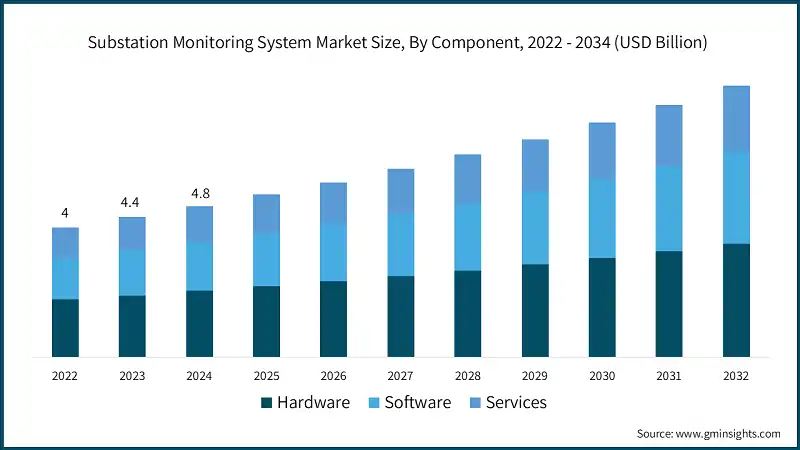
- The market was valued at USD 4 billion in 2022, USD 4.4 billion in 2023, and reached USD 4.8 billion in 2024 due to exacerbating need for grid dependability, increasing penetration of renewables, and rapid adoption of digital technologies in power infrastructure.
- Utilities and grid operators are investing significantly in real-time monitoring and predictive maintenance tools to reduce operational downtime, enhance asset management, and ensure uninterrupted power supply amid rising electricity consumption.
- In 2024, total spending toward the development of renewables in China surged to more than USD 940 billion with a pronounced focus on the energy segment. China solidified itself as a dominant player in the global renewable energy race due to electric vehicles, batteries, and solar.
- Furthermore, the increasing prevalence of power downtime and equipment malfunctions has driven utilities to implement smart fault monitoring and remote diagnostic systems. These are capable of early fault detection. Government initiatives like modernization of the grid as well as regulations like IEC 61850 for substation communication are accelerating implementation even further.
- The hardware segment is anticipated to exceed USD 4.1 billion by 2034 owing to the growing adoption of intelligent electronic devices (IEDs) within substations for real-time monitoring and control, alongside the need of high-performance hardware systems. The segment supporting advanced functionalities is expected to fuel the market for sensors, smart meters, communication modules, and other hardware systems during this period.
- Furthermore, the software segment holds the market share of 32.2% in 2024 owing to the rising need for advanced analytics, real-time data visualization, as well as automated control features within substations. With an increase in Substation Automation Software (SAS) systems and intelligent grid technology, predictive maintenance and asset optimization as well as automated fault management is actively enhancing SAS systems' overall efficiency through cloud services which is driving modernization of utilities.
Learn more about the key segments shaping this market
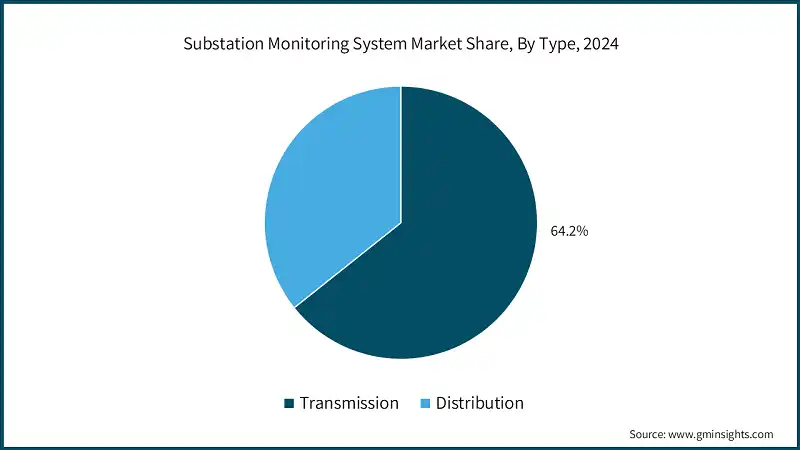
- Based on type, the substation monitoring system market from transmission segment is projected to grow with CAGR of 7.1% by 2034 owing to the real-time visibility and reliability requirements. It is spanning throughout the high voltage power networks. Utilities are focusing on enhanced monitoring of transmission substations in order to maintain grid stability and large scale outage prevention. Integrating renewable sources like large scale wind and solar, along with accommodating the increasing demand for electricity, has been driving power grid evolution.
- There is a growing need to link geographically distributed generation plants to centralized grids as use of cleaner solar, wind, and hydro energy increases. Europe’s new wind power capacity increased by 16.4 GW in 2024. The EU-27 installed a sum of 12.9 GW. Hence, there will be a rapid increase in the employment of HV power and control cables in the coming years.
- Distribution segment is also projected to exceed USD 3.8 billion by 2034 owing to the rapid expansion of urban infrastructure, rising electricity consumption across residential and commercial sectors. There is accelerating adoption of distributed energy resources (DERs) such as rooftop solar and battery storage systems. These trends are pushing utilities to enhance visibility and control over the last mile of power delivery, where the complexity of load patterns and grid congestion is significantly higher.
- There is rising concern for carbon emissions across the world, which is creating huge need for renewable energy projects. In 2024, global CO2 emissions reached a record high of 37.4 billion tons, a 0.8% increase from the previous year. This concern will also boost the demand for the substation monitoring control system market across the world.
Looking for region specific data?
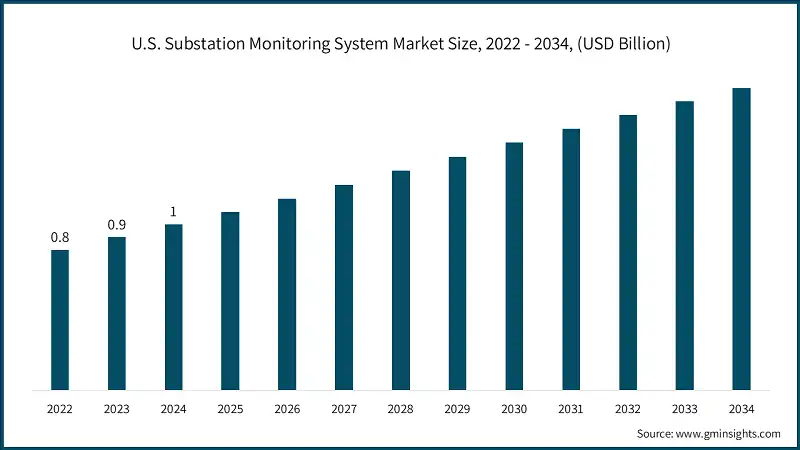
- The U.S. substation monitoring system market was valued at USD 800 million in 2022, USD 900 million in 2023 and USD 1 billion in 2024 respectively. In 2023, U.S. investment in the energy sector reached a significant USD 280 billion, with a notable increase in clean energy investments, particularly in renewables. Investments in clean energy, including solar and wind, surpassed those in fossil fuels.
- Additionally, in 2024, the solar industry generated over USD 70 billion of private investment in the U.S. economy. U.S. solar and storage companies had announced over USD 100 billion in private sector investments, helping bolster the U.S. economy. This surge in investment highlights the expanding confidence of the private sector in the long-term viability and profitability of solar energy projects, driven by favorable policies, technological advancements, and growing demand for sustainable energy solutions.
- The Asia Pacific region plays a pivotal role in the growth of the substation monitoring system market, driven by rapid industrialization, urbanization, and significant investments in power infrastructure modernization across emerging economies. National programs such as China’s Belt and Road Initiative, India’s Revamped Distribution Sector Scheme (RDSS), and Japan’s Smart Grid initiatives are emphasizing modernization and automation of substations, accelerating the adoption of monitoring systems.
- European countries, including Germany, France, the UK, and the Nordics, have some of the most mature and sophisticated power grids globally. Continuous efforts to modernize aging transmission and distribution infrastructure are driving significant demand for advanced substation monitoring systems that enable real-time monitoring, fault diagnostics, and predictive maintenance.
- The MEA region is becoming increasingly important within this sector as a result of higher energy requirements, continuous infrastructural advancement, and a concerted effort to diversify energy portfolios. The Middle East is expected to maintain a GDP growth of 2.2% in 2024, an increase from 1.8% in 2023. The World Bank credits this to the GCC countries, which are recovering with growth projected to improve from 0.5% in 2023 to 1.9% in 2024.
Substation Monitoring System Market Share
The market is significantly dominated by the firms Eaton, ABB, Siemens, General Electric, holding more than 20% market share. Their engineering advantage and unique know-how compellingly showcase their years of experience in the fields of energy systems, electrical power distribution, automation, and energy management solutions.
Substation Monitoring System Market Companies
- In 2024, ABB allocated 1.5 billion dollars on research and development and expanding capacity in the mid regions of USA along India. ABB's global investment in R&D reached approximately USD 1.5 billion, which is 4.5% of their consolidated revenues.
- In March 2023, Toshiba Energy Systems was ordered by Tohoku Electric Power to construct a STATCOM. This STATCOM will aid in the enhancement of the grid's smooth operation for the transmission of robust power and improves reliability during transmission system faults.
Major players operating in the substation monitoring system industry are:
- ABB Ltd.
- Cadillac Automation and Controls
- Cisco
- Eaton Corporation
- Emerson Electric
- GE Vernova
- Honeywell
- iGRID t&D
- Novatech
- Schneider Electric
- Schweitzer Engineering Laboratories, Inc.
- Sentient Energy
- Siemens
- Tekvel
- Trilliant Holdings Inc.
Substation Monitoring System Market Report Attributes
| Key Takeaway | Details |
|---|---|
| Market Size & Growth | |
| Base Year | 2024 |
| Market Size in 2024 | USD 4.8 Billion |
| Forecast Period 2025 – 2034 CAGR | 7.6% |
| Market Size in 2034 | USD 10 Billion |
| Key Market Trends | |
| Growth Drivers |
|
| Pitfalls & Challenges |
|
What are the growth opportunities in this market?
Substation Monitoring System Industry News
- In November 2024, through “Belt and Road” development program, China had installed 8 GW of solar in various countries. With Solar China stroking a number of developing countries with its cheaper Pakistan Clean solar energy technology, China has expanded its scope in aiding developing nations which previously lacked the modern renewable energy. Since the launch of BRI, China has undertaken 156 GW of global power projects which comprises 22 GW solar reflecting embrace for modern solar system energy.
- In April 2025, Revolve Renewable Power Corp., a North American owner, operator and developer of renewable energy projects, has announced project development work on the Company’s two utility scale wind projects in Mexico is being accelerated as a result of increased regulatory certainty. Development work on its two most advanced projects, which have a combined projected capacity of 531 megawatts, is intensifying following new electricity generation regulations that have been implemented in Mexico.
- In January 2023, partnering with Terna, Ansaldo Energia undertook a multimodal maritime and overland transport of a synchronous condenser and a transformer to Codrongiano di Sassari electric station in January 2023. As an electric machine that specializes in generating, the synchronous condenser will be integrated to Terna's transmission grid for reactive energy balance exchange as well as augmentation of short circuit strength.
Substation monitoring system market research report includes in-depth coverage of the industry with estimates & forecast in terms of “USD Million” from 2021 to 2034, for the following segments:
Market, By Component
- Hardware
- Software
- Services
Market, By Type
- Transmission
- Distribution
Market, By Technology
- Wired
- Wireless
Market, By Application
- Utility
- Mining
- Oil & gas
- Transportation
- Manufacturing
- Renewable energy
- Others
Market, By Deployment
- On-premises
- Cloud-based
The above information has been provided for the following regions and countries:
- North America
- U.S.
- Canada
- Mexico
- Europe
- UK
- France
- Germany
- Italy
- Russia
- Spain
- Asia Pacific
- China
- Australia
- India
- Japan
- South Korea
- Middle East & Africa
- Saudi Arabia
- UAE
- Turkey
- South Africa
- Egypt
- Latin America
- Brazil
- Argentina
Frequently Asked Question(FAQ) :
How big is the substation monitoring system market?
The global market size for substation monitoring system was valued at USD 4.8 billion in 2024 and is projected to reach USD 10 billion by 2034, growing at a CAGR of 7.6% from 2025 to 2034.
What is the growth outlook for the transmission segment in the substation monitoring system industry?
The transmission segment is projected to grow at a CAGR of 7.1% by 2034.
How much is the U.S. substation monitoring system industry worth?
The U.S. market was valued at USD 1 billion in 2024.
Who are some of the prominent players in the substation monitoring system market?
Key players in the sector include ABB Ltd., Cadillac Automation and Controls, Cisco, Eaton Corporation, Emerson Electric, GE Vernova, Honeywell, iGRID t&D, Novatech, Schneider Electric, Schweitzer Engineering Laboratories, Inc., Sentient Energy, Siemens, Tekvel, and Trilliant Holdings Inc.
Substation Monitoring System Market Scope
Related Reports