Summary
Table of Content

Stretchable Electronics Market
Get a free sample of this report
Form submitted successfully!
Error submitting form. Please try again.
Thank you!
Your inquiry has been received. Our team will reach out to you with the required details via email. To ensure that you don't miss their response, kindly remember to check your spam folder as well!
Request Sectional Data
Thank you!
Your inquiry has been received. Our team will reach out to you with the required details via email. To ensure that you don't miss their response, kindly remember to check your spam folder as well!
Form submitted successfully!
Error submitting form. Please try again.
Stretchable Electronics Market Size
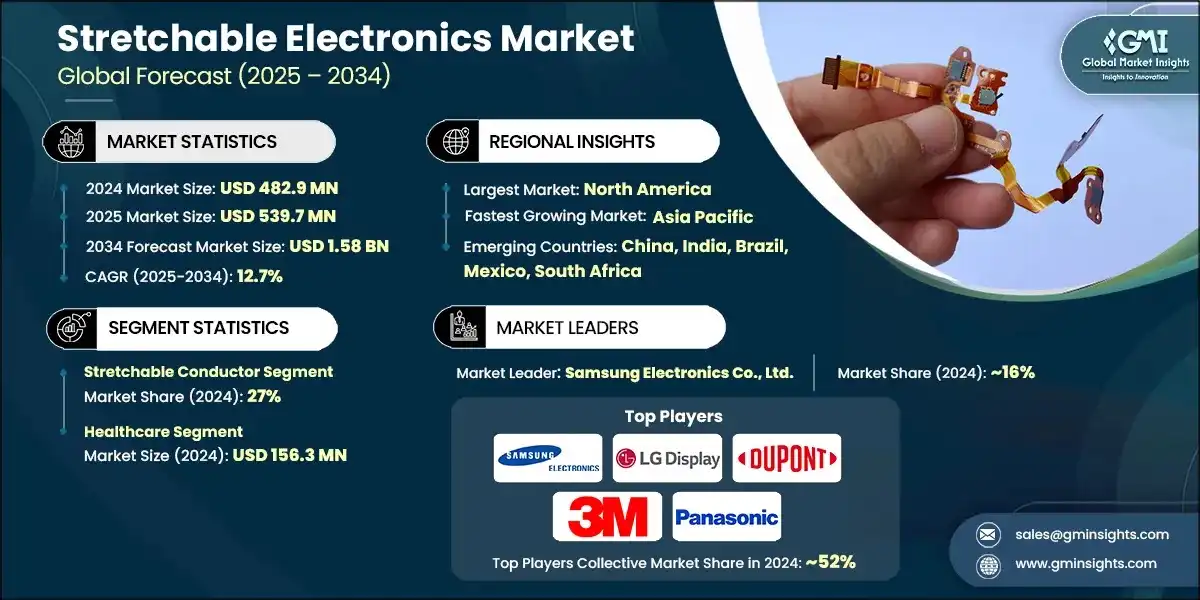
The global stretchable electronics market was valued at USD 482.9 million in 2024. The market is expected to grow from USD 539.7 million in 2025 to USD 1.58 billion in 2034, at a CAGR of 12.7% during the forecast period according to the latest report published by Global Market Insights Inc. This growth in the global Stretchable Electronics Market is driven by increasing demand for flexible, wearable, and skin-conformable devices across healthcare, consumer electronics, and automotive sectors. Stretchable electronics offer enhanced comfort, durability, and adaptability, making them ideal for smart textiles, biomedical sensors, and soft robotics. Advancements in materials science, such as stretchable conductive polymers and nanomaterials, are enabling more reliable and scalable production. Additionally, the rise of IoT and personalized health monitoring is accelerating adoption, positioning stretchable electronics as a key enabler of next-generation smart and connected technologies.
To get key market trends
The surge in fitness trackers, smart clothing, and health-monitoring devices is driving demand for stretchable electronics. Their flexibility and skin-like comfort make them ideal for continuous biometric sensing, enabling real-time health insights and personalized care, especially in medical and consumer wellness applications.
Between 2021 and 2023, the stretchable electronics market experienced significant growth, rising from USD 353.5 million in 2021 to USD 436 million in 2023. A major trend during this period was the integration of stretchable electronics into healthcare and fitness wearables. Innovations in skin-like sensors enabled continuous monitoring of vital signs, movement, and hydration levels. This trend was fueled by growing consumer interest in personalized health tracking and remote patient care, alongside advancements in biocompatible materials and flexible circuit design, which improved comfort, accuracy, and device durability across various applications.
Stretchable electronics support the miniaturization and adaptability needed for IoT devices. Their ability to conform to irregular surfaces and maintain performance under strain makes them ideal for smart homes, industrial monitoring, and connected environments, fueling widespread adoption across sectors. Moreover, in healthcare, stretchable electronics are revolutionizing diagnostics and treatment through skin-mounted sensors, implantable devices, and smart bandages. Their biocompatibility and flexibility allow seamless integration with the human body, enabling continuous monitoring and responsive therapies, which are critical for chronic disease management and elderly care.
Stretchable electronics are increasingly used in automotive interiors, flexible displays, and aerospace systems. Their lightweight, adaptable nature supports advanced human-machine interfaces, structural health monitoring, and embedded sensors, contributing to safer, smarter, and more efficient transportation technologies.
Stretchable Electronics Market Report Attributes
| Key Takeaway | Details |
|---|---|
| Market Size & Growth | |
| Base Year | 2024 |
| Market Size in 2024 | USD 482.9 Million |
| Market Size in 2025 | USD 539.7 Million |
| Forecast Period 2025 - 2034 CAGR | 12.7% |
| Market Size in 2034 | USD 1.58 Billion |
| Key Market Trends | |
| Drivers | Impact |
| Growing Demand for Wearable Health Devices | Stretchable electronics drive approximately 35% of market demand due to their unique ability to conform to dynamic surfaces while maintaining functionality. Their architecture supports seamless integration into wearables, biomedical devices, and smart textiles, enabling real-time data collection and enhanced user comfort. This versatility makes them ideal for next-gen health monitoring, sports tech, and human-machine interfaces across industries. |
| Advancements in Flexible and Conductive Materials | Innovations in artificial intelligence, automation, and IoT contribute around 30% to market growth by enabling smarter, more responsive stretchable systems. These technologies require flexible, low-power electronics that can operate reliably in diverse environments. Stretchable electronics meet these needs, supporting adaptive sensing, wireless communication, and embedded intelligence in applications ranging from smart homes to industrial automation. |
| Expansion of IoT and Smart Textiles | The market is also expanding due to a growing need for skilled professionals in flexible electronics design and integration, contributing roughly 25% to overall growth. As demand rises for wearable and embedded systems, expertise in material science, circuit miniaturization, and hybrid system development becomes critical for advancing stretchable electronics and ensuring reliable performance in real-world conditions. |
| Increasing Adoption in Automotive and Aerospace | Around 10% of growth is projected to come from advancements in material engineering and semiconductor design, including stretchable substrates, conductive inks, and ultra-thin chipsets. These innovations improve durability, elasticity, and energy efficiency, enabling better performance in biomedical sensors, e-textiles, and soft robotics while expanding the scope of stretchable electronics in emerging markets. |
| Pitfalls & Challenges | Impact |
| High Manufacturing Costs and Scalability Issues | Stretchable electronics require specialized materials and fabrication techniques, which significantly increase production costs. Scaling these technologies for mass-market applications remains difficult due to complex assembly processes and low yield rates. This limits widespread adoption, especially in cost-sensitive industries like consumer electronics and healthcare. |
| Limited Durability Under Repeated Stretching | Repeated mechanical stress can degrade the performance of stretchable electronics over time. Cracking, delamination, and loss of conductivity are common issues, especially in harsh environments. Improving material resilience and structural design is essential to ensure long-term reliability and functionality in wearable and flexible applications. |
| Opportunities: | Impact |
| Development of Biocompatible Medical Implants | Stretchable electronics enable the creation of biocompatible implants that conform to human tissue, allowing continuous monitoring and therapeutic functions. These devices improve patient comfort and reduce invasive procedures. Their flexibility and adaptability make them ideal for cardiac sensors, neural interfaces, and drug delivery systems, revolutionizing personalized healthcare solutions. |
| Smart Clothing for Sports and Military Applications | Stretchable electronics integrated into textiles offer real-time monitoring of physiological and environmental data. In sports, they enhance performance tracking and injury prevention. In military settings, they support soldier health, stress levels, and location awareness. Their durability and comfort make them ideal for demanding, high-mobility environments. |
| Market Leaders (2024) | |
| Market Leaders |
~16% market share. |
| Top Players |
Collective market share in 2024 is ~52% |
| Competitive Edge |
|
| Regional Insights | |
| Largest Market | North America |
| Fastest Growing Market | Asia-Pacific |
| Emerging Country | China, India, Brazil, Mexico, South Africa |
| Future Outlook |
|
What are the growth opportunities in this market?
Stretchable Electronics Market Trends
- A key trend shaping the stretchable electronics industry is the rising demand for flexible, skin-conformable devices in healthcare and wearables. Stretchable electronics enable continuous biometric monitoring with minimal discomfort, supporting applications in fitness tracking, chronic disease management, and rehabilitation. Their adaptability and comfort are driving widespread adoption across consumer and medical sectors.
- For instance, in October 2025, several leading material science firms partnered with wearable tech companies to integrate stretchable electronics into smart clothing and health-monitoring systems. These collaborations aim to enhance sensor accuracy, durability, and wireless connectivity, enabling real-time data collection and personalized insights for sports, wellness, and clinical applications.
- The emergence of smart textiles, soft robotics, and human-machine interfaces is driving adoption of stretchable electronics across diverse sectors. Their ability to conform to irregular surfaces and maintain functionality under strain makes them ideal for next-generation devices in defense, industrial automation, and interactive consumer products.
- As wearable devices become more advanced, stretchable electronics are being fabricated using innovative materials like conductive polymers, liquid metals, and nanocomposites. Developments in 3D printing, microfabrication, and encapsulation techniques are improving performance, stretchability, and biocompatibility, enabling deployment in sensitive environments such as skin, organs, and flexible surfaces.
- Major tech companies including Apple, Samsung, and Fitbit are investing in stretchable electronics to enhance user experience and device functionality. These investments are driving advancements in flexible circuit design, sensor integration, and power management, ensuring seamless operation and expanding the capabilities of wearable and embedded systems.
- The development of open-source platforms and modular design kits for stretchable electronics is accelerating adoption among researchers and startups. These tools simplify prototyping, promote innovation, and enable cross-disciplinary collaboration, fostering a vibrant ecosystem for flexible electronics in academic, commercial, and industrial domains.
- Ongoing collaborations between material scientists, electronics manufacturers, and healthcare providers are advancing the design and manufacturability of stretchable electronics. These partnerships are essential for improving reliability, reducing production costs, and scaling deployment across industries seeking smart, adaptive, and user-friendly solutions.
Stretchable Electronics Market Analysis
Learn more about the key segments shaping this market
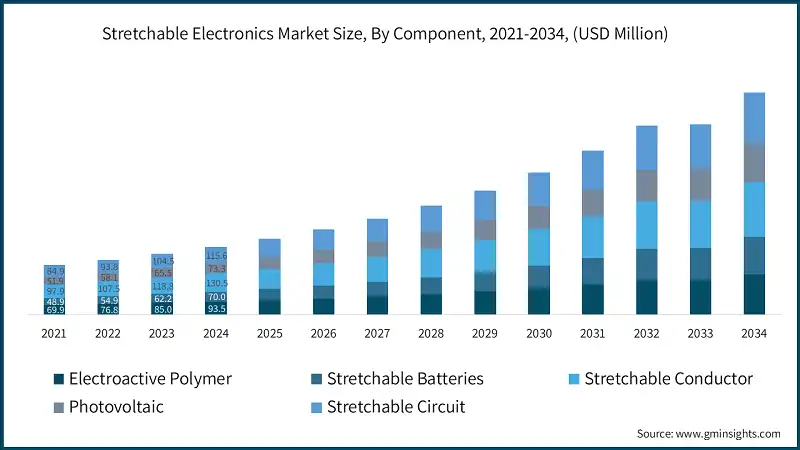
The global market was valued at USD 353.5 million and USD 391.1 million in 2021 and 2022, respectively. The market size reached USD 482.9 million in 2024, growing from USD 436 million in 2023.
Based on the component, the global stretchable electronics industry is divided into electroactive polymer, stretchable batteries, stretchable conductor, photovoltaic, and stretchable circuit. The stretchable conductor segment accounted for 27% of the market in 2024.
- The stretchable conductor segment holds the largest share in the stretchable electronics market due to its critical role in enabling flexibility and durability in electronic devices. These conductors maintain electrical performance even under mechanical deformation such as stretching, bending, or twisting. Their applications span across wearables, healthcare devices, and soft robotics, making them indispensable. Additionally, advancements in materials like graphene and silver nanowires have enhanced conductivity and stretchability, driving widespread adoption and market growth in various industries.
- Manufacturers focus on developing highly conductive, lightweight, and biocompatible materials to enhance the performance of stretchable conductors. They invest in research to improve elasticity without compromising electrical efficiency, enabling seamless integration into wearable and implantable devices. Innovations in nanomaterials like carbon nanotubes and liquid metals are also prioritized to meet the growing demand in healthcare, consumer electronics, and automotive sectors.
- The electroactive polymer segment of the stretchable electronics market, valued at USD 93.5 million in 2024 and projected to grow at a CAGR of 11.9%, is driven by its unique ability to change shape or size in response to electrical stimulation. These polymers offer excellent flexibility, lightweight properties, and biocompatibility, making them ideal for use in wearable devices, artificial muscles, and biomedical sensors. Their adaptability to dynamic environments and continuous innovation in material science are fueling demand across healthcare, robotics, and consumer electronics, contributing significantly to market expansion and technological advancement.
- Manufacturers focus on enhancing the performance and scalability of electroactive polymers by developing advanced formulations that offer greater sensitivity, durability, and responsiveness to electrical stimuli. They are investing in research to improve polymer conductivity, stretchability, and integration with flexible substrates for seamless use in wearable and biomedical devices. Emphasis is also placed on eco-friendly production methods and cost-effective manufacturing to support large-scale commercialization. Collaborations with healthcare and robotics industries further drive innovation, ensuring these materials meet evolving application demands and regulatory standards.
Learn more about the key segments shaping this market
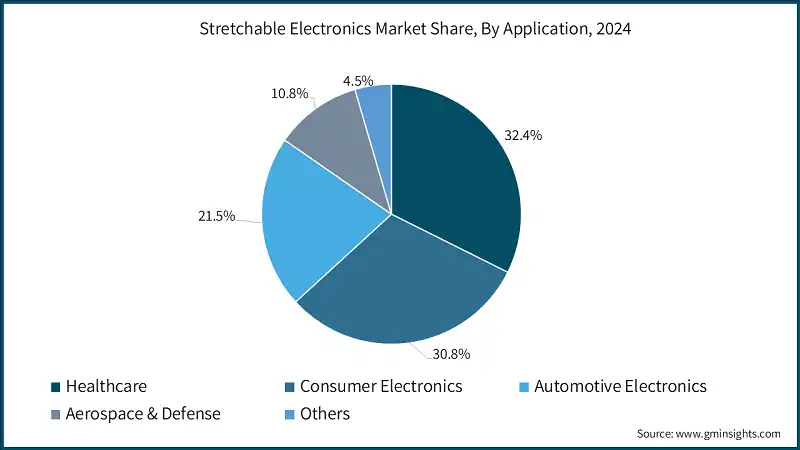
Based on the application, the market is segmented into healthcare, consumer electronics, automotive electronics, aerospace & defense, and others. The healthcare segment dominated the market in 2024 with a revenue of USD 156.3 million.
- Healthcare accounts for the largest share of the stretchable electronics market due to the growing demand for wearable medical devices, remote monitoring systems, and implantable sensors. Stretchable electronics offer superior comfort, biocompatibility, and flexibility, making them ideal for continuous health tracking and diagnostics. Their ability to conform to the human body enhances patient experience and data accuracy. Additionally, advancements in personalized healthcare and aging populations are driving innovation and adoption, positioning healthcare as the leading application segment in this rapidly evolving market.
- Manufacturers focus on creating advanced stretchable electronics for healthcare by improving material biocompatibility, durability, and sensitivity. They aim to develop ultra-thin, skin-like sensors and circuits that can monitor vital signs in real time without discomfort. Emphasis is placed on integrating these electronics into wearable patches, smart textiles, and implantable devices. Additionally, manufacturers invest in scalable production techniques and AI-powered health analytics to support personalized medicine, early diagnosis, and remote patient monitoring—making healthcare safer, more efficient, and accessible.
- Automotive Electronics are anticipated to witness significant growth at a CAGR of 13.9% over the analysis period, reaching USD 378.2 million by 2034. This growth is driven by the rising demand for advanced driver-assistance systems (ADAS), electric vehicles (EVs), and in-vehicle infotainment. Stretchable electronics enhance design flexibility, reduce weight, and improve integration in curved surfaces and interiors. Additionally, the push for smart, connected vehicles and safety innovations is accelerating adoption. Manufacturers are focusing on durable, heat-resistant materials and scalable production to meet evolving automotive standards and consumer expectations for smarter, safer, and more efficient vehicles.
- Manufacturers focus on integrating stretchable electronics into automotive systems by developing materials that can withstand extreme temperatures, vibrations, and mechanical stress. They prioritize innovations in flexible sensors, stretchable lighting, and embedded circuits for smart interiors and safety systems. Emphasis is placed on seamless integration with curved surfaces and dashboards, enhancing both aesthetics and functionality. Additionally, manufacturers are investing in scalable, cost-effective production methods and collaborating with automotive OEMs to meet evolving standards for electric and autonomous vehicles, ensuring reliability, performance, and long-term durability.
Looking for region specific data?
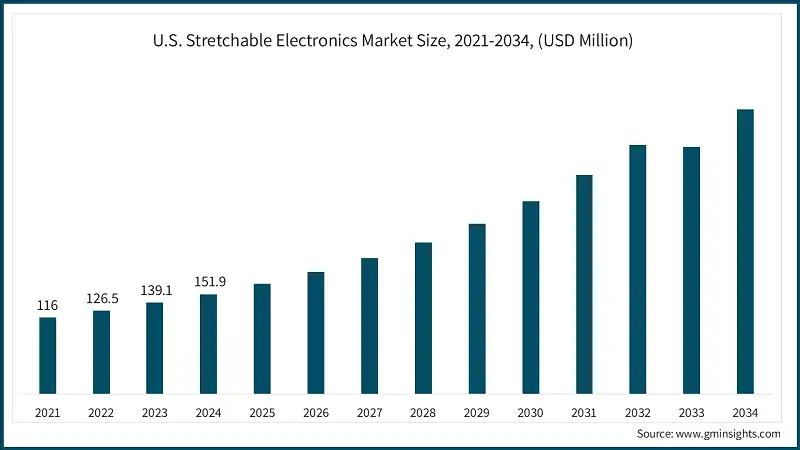
North America Stretchable Electronics Market The North America market dominated the global stretchable electronics industry with a market share of 35.9% in 2024. The U.S. stretchable electronics market was valued at USD 116 million and USD 126.5 million in 2021 and 2022, respectively. The market size reached USD 151.9 million in 2024, growing from USD 139.1 million in 2023. Europe market accounted for USD 124.1 million in 2024 and is anticipated to show lucrative growth over the forecast period. Germany dominates the Europe market, showcasing strong growth potential. The Asia-Pacific market is anticipated to grow at the highest CAGR of 15.1% during the analysis timeframe. China market is estimated to grow with a significant CAGR 15.9% from 2025 to 2034, in the Asia Pacific stretchable electronics industry. The Latin America stretchable electronics market, valued at USD 37.2 million in 2024, is driven by rising demand for wearable healthcare devices, smart textiles, and flexible consumer electronics. Government initiatives supporting digital health, growing tech adoption, and increased investment in innovation across Brazil, Mexico, and Argentina are fueling regional growth. The Middle East and Africa stretchable electronics market is projected to reach USD 64.6 million by 2034, driven by growing investments in smart healthcare, wearable technologies, and digital infrastructure. Government-led innovation programs, rising demand for remote monitoring, and expanding adoption of flexible electronics in energy and defense sectors are fueling regional growth. UAE stretchable electronics market to experience substantial growth in the Middle East and Africa market in 2024. The global stretchable electronics industry is characterized by rapid advancements in flexible materials, increasing demand for wearable healthcare devices, and widespread adoption in smart consumer and automotive applications. Key players such as Samsung Electronics Co., Ltd., LG Display Co., Ltd., DuPont de Nemours, Inc., 3M Company, and Panasonic Corporation collectively hold a significant share ~52% of the market. Strategic collaborations between electronics manufacturers, healthcare providers, and automotive OEMs are accelerating integration of stretchable components into wearables, soft robotics, and smart interiors. Emerging companies are contributing with ultra-thin, biocompatible designs optimized for real-time monitoring, motion sensing, and human-machine interfaces—driving global deployment and shaping the future of flexible electronics. In addition, niche players and specialized developers are strengthening the stretchable electronics market by introducing scalable, low-power architectures tailored for enterprise healthcare, IoT, and automotive systems. Their innovations in material durability, sensor sensitivity, and integration with wireless platforms are improving performance, reliability, and energy efficiency. Collaborations with smart city planners, medical institutions, and industrial automation firms are accelerating adoption across diverse sectors. These efforts are enhancing system comfort, reducing maintenance costs, and enabling widespread deployment of next-generation stretchable technologies in the global digital ecosystem. Prominent players operating in the stretchable electronics industry are as mentioned below: LG Display Co., Ltd. plays a pivotal role in the global stretchable electronics market through its expertise in flexible display technology and advanced material engineering. The company is actively developing ultra-thin, stretchable substrates for next-generation wearable devices, smart textiles, and biomedical applications. LG’s innovations in elasticity, transparency, and durability support seamless integration into curved surfaces and dynamic environments. Strategic collaborations with healthcare providers, consumer electronics firms, and automotive manufacturers further strengthen its position, driving adoption of stretchable electronics across multiple industries and enhancing user experience through advanced design capabilities. DuPont de Nemours, Inc. holds a significant share in the global stretchable electronics market due to its expertise in advanced materials and polymer science. The company specializes in developing durable, biocompatible, and flexible substrates used in wearable healthcare devices, soft robotics, and smart textiles. DuPont’s innovations in conductive inks, stretchable circuits, and elastomeric materials support scalable manufacturing and high-performance applications.Europe Stretchable Electronics Market
Asia Pacific Stretchable Electronics Market
Stretchable Electronics Market Share
Stretchable Electronics Market Companies
Samsung Electronics Co., Ltd. is a key player in the global stretchable electronics market, holding a dominant 16% position through its innovations in flexible displays, wearable devices, and advanced material integration. The company leverages its expertise in semiconductor design and smart consumer electronics to develop scalable, biocompatible stretchable components. Samsung’s strategic investments in R&D, healthcare technology, and smart textiles have strengthened its market presence. Collaborations with medical institutions and automotive OEMs further support its leadership in deploying stretchable electronics across diverse applications.Stretchable Electronics Industry News
The stretchable electronics market research report includes in-depth coverage of the industry with estimates and forecast in terms of revenue in USD Million from 2021 – 2034 for the following segments:
Market, By Component
- Electroactive Polymer
- Stretchable Batteries
- Stretchable Conductor
- Photovoltaic
- Stretchable Circuit
Market, By Application
- Healthcare
- Consumer Electronics
- Automotive Electronics
- Aerospace & Defense
- Others
The above information is provided for the following regions and countries:
- North America
- U.S.
- Canada
- Europe
- Germany
- UK
- France
- Spain
- Italy
- Netherlands
- Asia Pacific
- China
- India
- Japan
- Australia
- South Korea
- Latin America
- Brazil
- Mexico
- Argentina
- Middle East and Africa
- South Africa
- Saudi Arabia
- UAE
Frequently Asked Question(FAQ) :
Which region leads the stretchable electronics market?
The U.S. market reached USD 151.9 million in 2024, maintaining leadership with 35.9% of the global share. The U.S. industry’s dominance is driven by strong R&D infrastructure, innovation in biomedical devices, and growing integration of flexible electronics in healthcare and consumer products.
What are the upcoming trends in the stretchable electronics industry?
Key trends include development of skin-like, biocompatible sensors, expansion of smart textiles, integration of stretchable circuits in wearables, and innovations in materials such as graphene, conductive polymers, and nanocomposites for improved performance and durability.
What is the growth outlook for automotive electronics from 2025 to 2034?
The automotive electronics segment is projected to grow at a CAGR of 13.9% through 2034, reaching USD 378.2 million. Growth is driven by increasing adoption of stretchable sensors and circuits in electric vehicles, ADAS, and smart interiors.
Who are the key players in the stretchable electronics market?
Key players include Samsung Electronics Co., Ltd., LG Display Co., Ltd., DuPont de Nemours, Inc., 3M Company, Panasonic Corporation, Rogers Corporation, StretchSense Ltd, MC10, Inc., FlexEnable Ltd, and Royole Corporation.
What was the valuation of the electroactive polymer segment in 2024?
The electroactive polymer segment was valued at USD 93.5 million in 2024, supported by demand for lightweight, biocompatible materials used in wearable sensors, artificial muscles, and biomedical applications.
What is the market size of the stretchable electronics industry in 2024?
The global market size for stretchable electronics was valued at USD 482.9 million in 2024, with a CAGR of 12.7% expected through 2034, driven by rising demand for flexible, wearable, and skin-conformable devices in healthcare, consumer electronics, and automotive industries.
How much revenue did the stretchable conductor segment generate in 2024?
The stretchable conductor segment accounted for 27% of the market in 2024, driven by its vital role in ensuring flexibility, conductivity, and mechanical durability for wearables, healthcare devices, and soft robotics.
What is the projected value of the stretchable electronics market by 2034?
The market size for stretchable electronics is expected to reach USD 1.58 billion by 2034, fueled by advancements in materials science, IoT integration, and the growing adoption of biomedical sensors and smart textiles.
What is the current stretchable electronics market size in 2025?
The market size is projected to reach USD 539.7 million in 2025.
Stretchable Electronics Market Scope
Related Reports