Summary
Table of Content

Stolen Vehicle Recovery Market
Get a free sample of this report
Form submitted successfully!
Error submitting form. Please try again.
Thank you!
Your inquiry has been received. Our team will reach out to you with the required details via email. To ensure that you don't miss their response, kindly remember to check your spam folder as well!
Request Sectional Data
Thank you!
Your inquiry has been received. Our team will reach out to you with the required details via email. To ensure that you don't miss their response, kindly remember to check your spam folder as well!
Form submitted successfully!
Error submitting form. Please try again.
Stolen Vehicle Recovery Market Size
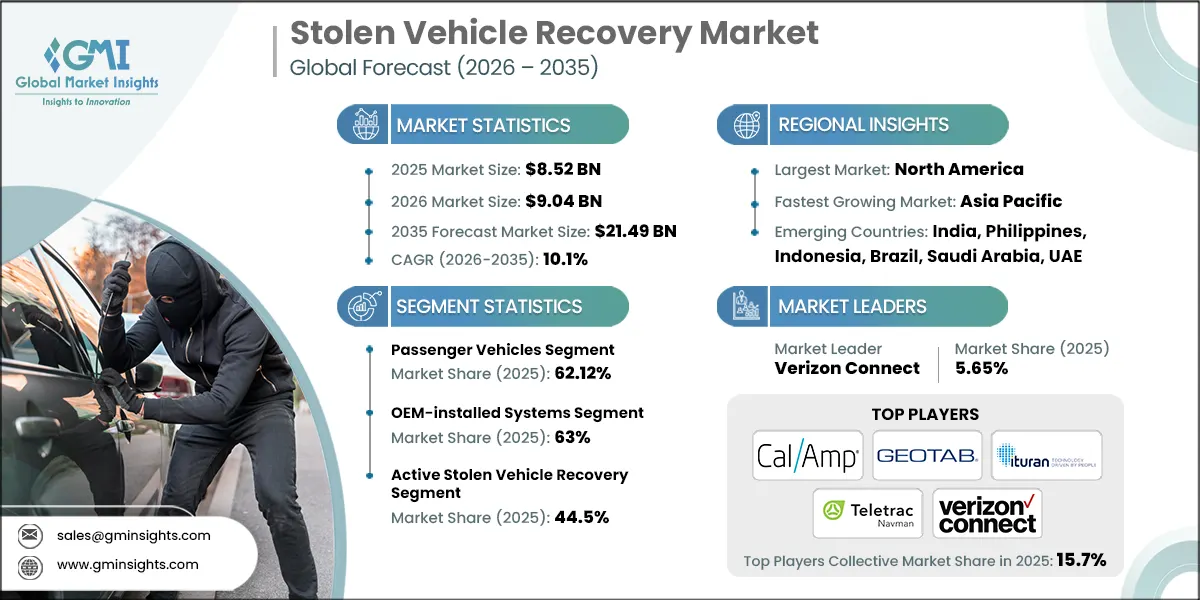
The global stolen vehicle recovery market size was estimated at USD 8.52 billion in 2025. The market is expected to grow from USD 9.04 billion in 2026 to USD 21.49 billion in 2035, at a CAGR of 10.1%, according to latest report published by Global Market Insights Inc.
Stolen Vehicle Recovery Market Key Takeaways
Market Size & Growth
- 2025 Market Size: USD 8.52 Billion
- 2026 Market Size: USD 9.04 Billion
- 2035 Forecast Market Size: USD 21.49 Billion
- CAGR (2026–2035): 10.1%
Regional Dominance
- Largest Market: North America
- Fastest Growing Region: Asia Pacific
Key Market Drivers
- Rise in vehicle theft rates and sophisticated auto-theft networks.
- Growing technological innovations (GPS, IoT, AI/ML).
- Growing fleet operations, ride-hailing, and logistics sectors.
- Rise in consumer awareness and regulatory support for vehicle security.
Challenges
- High cost of SVR installation and subscription.
- Data privacy and cybersecurity concerns.
Opportunity
- Expansion in emerging markets with growing vehicle ownership.
- Integration with smart-city initiatives and public-safety networks.
- Development of AI-powered predictive analytics and value-added services.
- strategic partnerships among OEMs, insurers, and fleet managers.
Key Players
- Market Leader: Verizon Connect led with over 5.65% market share in 2025.
- Leading Players: Top 5 players in this market include CalAmp, Geotab, Ituran Global, Teletrac Navman, Verizon Connect, which collectively held a market share of 15.7% in 2025.
Get Market Insights & Growth Opportunities
The rapid shift toward connected vehicle architectures, intelligent telematics, and embedded security modules is transforming the global SVR ecosystem. The contemporary SVR systems are a combination of GNSS positioning, cellular/IoT connectivity, and AI-based analytics to allow live vehicle tracking, geofencing, immobilization, and behavioral anomaly detection. OEMs, insurers, and fleet operators increasingly rely on integrated SVR solutions to reduce theft losses, accelerate recovery times, and enhance driver safety. This shift reduces manual intervention, supports continuous monitoring, and strengthens vehicle cybersecurity across passenger and commercial fleets.
For example, in November 2025, LoJack Italia announced a more advanced version of their telematics platform with AI-assisted theft detection and automatic recovery processes, enhancing the coordination of law-enforcement efforts through the country and minimizing the average recovery time on high-risk areas.
Strategic investments, platform consolidation, and multi-industry partnerships are reshaping the SVR landscape. Top telematics suppliers are increasing cloud-based command centers, implementing high-sensitivity GNSS modules, and incorporating next-generation IoT modem to enable cross-border vehicle tracking. Auto parts companies are working on anti-jamming sensors, encrypted communication chips, interoperable APIs, to speed up the use of SVR in the worldwide automotive, logistics, rental, and insurance industries.
In April 2025, the Hertz Italia (European operation of the world-renowned rental-car corporation) stated that it implemented the Targa Telematics-provided service called the Smart Vehicle Protector, which succeeded in securing its fleet and enhancing the efficiency of the stolen-vehicle recovery rates.
The high adoption of SVR is influenced by increasing levels of vehicle theft, growth in premium vehicle fleet, and an increase in urban mobility services. Connected vehicles, EVs, and shared mobility fleets require constant visibility of the assets, remote immobilization, and multi-layered monitoring to avoid revenue losses due to theft. Intelligent SVR solutions can now replicate theft conditions, identify suspicious behavior, and authenticate the recovery chances without involvement of physical danger.
SVR systems are also becoming popular in commercial fleets, heavy equipment, and cross-border logistics applications. A combination of ruggedized telematics units, RFID asset tagging, and cloud analytics dashboards is being integrated by logistics integrators, leasing companies, and insurance networks to ensure regulatory compliance, reduce fraudulent claims, and secure high-value cargo. This technology enhances business dependability and life cycle fleet safety.
North America and Europe are good expansion markets as they have high connectivity of vehicles, strict insurance policies and smart mobility programs that are supported by governments. Pioneering telematics vendors, sophisticated cybersecurity architectures, and car manufacturer alliances further boost implementation. The areas of attention are related anti-theft EV systems, encrypted network of devices, and the connection with law enforcement systems in smart-city services.
Asia-Pacific offers the most promising SVR market, with its growth due to the growing vehicle ownership, rising theft rates, the rapid urbanization and massive implementing low-cost IoT trackers. China and South Korea are the top high-volume SVR motorcycle, EV scooter and passenger car deployments, whereas India, Japan and South Korea boast of reliable, tamper-proof tracking solutions in two-wheelers, commercial fleets and ride-hailing applications.
To get key market trends
Stolen Vehicle Recovery Market Trends
The current SVR systems integrate telematics with IoT connectivity and AI analytics in order to provide real-time tracking, geofencing, behavioral monitoring, and prediction of theft. This integration enables the fleet operators and individuals to actively track the vehicles, minimize the likelihood of theft, and enhance recovery efforts in general and responsiveness in theft cases.
Automakers are starting to include SVR modules in new vehicles. Such systems that are installed in factories also guarantee standardized protection both in fleets and consumer-based cars, eliminating the use of aftermarket devices. Embedded solutions may also be used to provide enhanced functionality such as remote immobilization, law-enforcement integration and real-time analytics, increasing the vehicle recovery rate and improving overall security. Logistics, ride-hailing and rental vehicles are commercial fleets that are increasingly integrating SVR with telematics. Such systems make it possible to centralize control over numerous vehicles, detect behavioral abnormalities and respond quickly to theft. Connection with fleet management systems enhances efficiency in the operations, minimizes losses, and enhances overall protection of assets.
In June 2024, Monimoto released its Monimoto 9 GPS tracker with the features of compact size, real-time notifications and enhanced anti-theft / tracking services, following the tendency of more sophisticated anti-theft functions (geofencing / GPS + cellular + movement detection).
Geofencing, tamper alerts, and remote engine shutdown can now be found in the SVR systems as a proactive form of security. The features deter unauthorized access, give real-time alerts to operators, and improve the recovery chances. Ultra-wideband (UWB) and high-precision tracking are adopted to make the location identification faster and avoid excessive use of manual intervention during theft cases.
Stolen Vehicle Recovery Market Analysis
Learn more about the key segments shaping this market
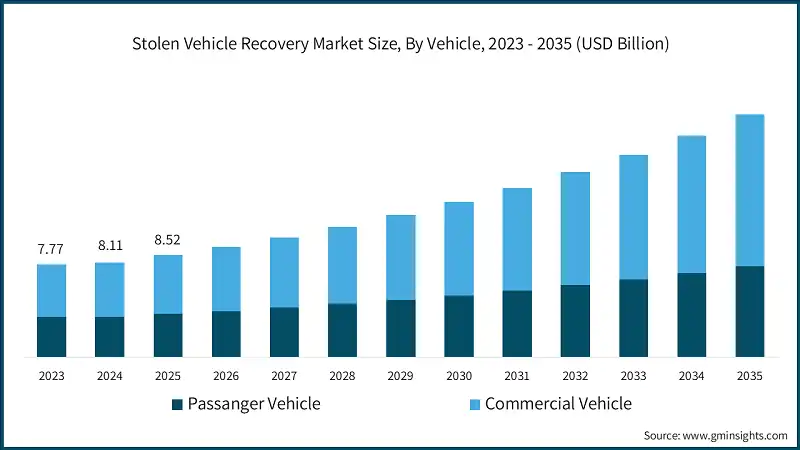
Based on vehicle, the stolen vehicle recovery market is divided into passenger vehicles, and commercial vehicles. The passenger vehicles segment dominated the market, accounting for around 62.12% in 2025 and is expected to grow at a CAGR of more than 9.8% through 2035.
- The passenger cars segment is the dominate the stolen vehicle recovery industry due to the huge international ownership base and the increasing concerns of vehicle theft in the urban areas. The rising number of connected cars, the growth of mid-income vehicles with ownership, and more sales of premium and luxury cars have also caused the need to advance security and real-time tracking systems. GPS tracking, geofencing, and remote immobilization are some of the features that consumers are increasingly using to protect their personal vehicles against theft and guarantee their quick recovery.
- The growing integration of OEM-embedded SVR modules in new passenger vehicles is significantly boosting adoption levels. Insurance companies usually give incentives to install SVR by giving reduced premiums to cars that have tracking technologies. Technological progress in telematics, IoT-based monitoring, as well as AI-assisted theft detection, has also boosted the efficiency of the system, and passenger cars were the leading drivers of the market expansion over the commercial and specialty cars.
- In January 2025, Geotab launched new Connected Vehicle Safety Suite and anti-theft/vehicle-tracking technologies presented at CES 2025 that included GPS tracking, geofencing, and real-time notifications. They are obviously targeted at both the passenger cars and commercial vehicles in general as the adoption of SVR in the daily vehicles is rising.
- The commercial vehicle segment will grow at over 10.5% CAGR due to the growing use of advanced telematics and SVR solutions by logistics companies, ride-hailing fleets, delivery operators and rental agencies to secure assets with high value. The increasing cases of vehicle theft of trucks, vans and commercial vehicles has compelled the operators to depend on real-time GPS positioning, geofencing, route deviation notifications as well as remote immobilization to secure the safety of assets. The necessity to minimize the downtime of operations, loss of cargo, and facilitate quick recovery also enhances the pace of implementation.
Learn more about the key segments shaping this market
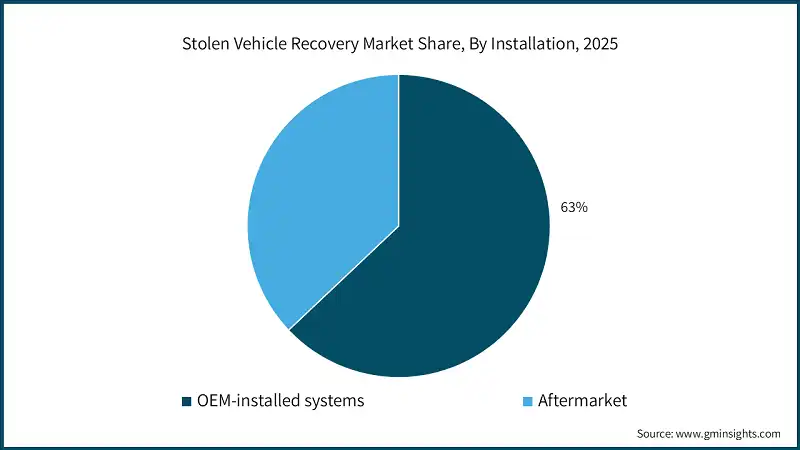
Based on installation, the stolen vehicle recovery market is segmented into OEM-installed systems, and aftermarket. The OEM-installed systems segment dominates the market accounting for around 63% share in 2025, and the segment is expected to grow at a CAGR of over 10.4% from 2026 to 2035.
- The OEM-installed systems segment is the most significant in terms of the market share in the stolen vehicle recovery market owing to the growing tendency by automakers to equip new vehicles with factory-fitted telematics, tracking modules, and connected-car platforms. These embedded solutions have provided a hassle-free security as days go by and there is no need to install them after-market and provide greater reliability, accuracy and compatibility with vehicle electronics. Other features advanced using OEM systems include remote immobilization, geofencing, tamper alerts and automated theft notifications straight through the connected-car ecosystem of the manufacturer.
- Moreover, increased popularity of integrated safety technologies and increased adoption of connected vehicles drive OEM infiltration faster. The use of OEM-installed tracking systems is also commonly offered with discounts by insurance companies because of their higher recovery rates and real-time accuracy of the data. Some areas are also enforcing the mandatory vehicle tracking of commercial fleets and vehicles at risk of being factory fitted. All these factors contribute to the popularization of OEM solutions, so they are the leading trends in the market for SVRs.
- In November 2023, Jaguar Land Rover (JLR) declared an increased investment of over USD 13.34 million into factory-fitted security patches and advanced electrical-architecture upgrades to its models (as of 2023) which will substantially trim theft rates within its SUVs and other high-end automotive offerings. The action promoted embedded manufacturer-led anti-theft investments as opposed to aftermarket retrofits.
- Aftermarket segment will grow at a higher rate of over 9.5% because of the increase in vehicle theft cases particularly among older vehicles and models which are not fitted with factory-fitted telematics or embedded security modules. There are many millions of vehicles in the current road that lack OEM-prepared recovery systems, which provides a high demand for retrofit GPS trackers, immobilizers, geofencing systems, and AI-enhanced telematics systems. Fleet owners and consumers are turning to aftermarket SVR solutions more often to enhance security, minimize losses that are associated with stealing, and to recover them more quickly.
Based on application, the stolen vehicle recovery market is segmented into active stolen vehicle recovery, fleet management & security, insurance telematics & UBI, automotive dealer solutions, asset & equipment tracking, and others. Active stolen vehicle recovery segment dominates with around 44.5% share in 2025.
- The active stolen vehicle recovery segment is the most dominant market segment as it offers real time tracking, instant alerts, remote immobilization and immediate law-enforcement response, which greatly enhances the possibility of recovering stolen vehicles in just a few minutes. As the rate of vehicle theft in the world keeps increasing and as connected-car ecosystems continue to expand, OEMs and aftermarket providers are combining innovative telematics, GPS, RFID, and cellular/IoT communication systems to provide 24/7 vehicle presence. This dependability is the reason why active SVR solutions are in the preferred list of consumers, insurers, and fleet operators.
- Moreover, there is an increasing trend in insurance companies which motivate active recovery solutions by promoting reduced premium rates, price according to risk and UBI (use-based insurance) benefits which also enhance the use. Protecting assets, operational uptime, and compliance are also available through active SVR to fleets. The active SVR is the most rapidly increasing application market in the stolen vehicle recovery sector, and its further expansion is supported by more and more accurate detectors through cloud analytics and AI-based alerting.
- For example, is that in November 2025, the company further extended its collaboration with hardware-provider Queclink Wireless Solutions, to gain better stolen-vehicle and property recovery capabilities through advanced telematics devices and tracking Hardware.
- The insurance telematics and UBI will grow with a CAGR of more than 12.4% due to increased use of driving-behavior analytics, crash-detection and mileage-based pricing models by insurers to cut the claims costs and fraud. The increasing cases of vehicle theft and accidents are forcing insurance companies to incorporate telematics devices that are capable of offer real-time location, driver scoring, as well as automated theft-recovery notifications, which leads to the improved accuracy of underwriting and reduced loss ratios. This is influencing the large insurers to incorporate telematics hardware as a part of policy bundles, hastening its implementation.
Based on technology, the stolen vehicle recovery market is divided into GPS-based tracking systems, radio frequency (RF) systems, cellular & telematics platforms, hybrid systems, and Others. The passenger train segment dominated the market.
- GPS-based tracking systems dominate the stolen vehicle recovery market due to their high accuracy, real-time location visibility, and reliability across urban, semi-urban, and remote environments. The ability to track vehicles in real-time, creating geofences, and getting live alerts, the recovery time will be shorter and save owners, insurers, and fleet operators significant financial losses. They are the choice as consumers and businesses have the advantage of their plug-and-play installation, a decline in the prices of their hardware, and the fact that they can be used with passenger and commercial vehicles.
- Additionally, automotive OEMs are also incorporating factory-fitted GPS modules as an option, which is further increasing the adoption. Insurance companies also encourage the use of GPS fitted vehicles by giving incentives in terms of reducing theft and reduced premiums. The growth in the application of GPS in telematics, fleet management systems and connected-car systems is still causing this segment to remain the biggest in the stolen vehicle recovery industry.
- The cellular and telematics platforms segment will grow by CAGR of 12.7% due to the fast growth of connected vehicle platforms, and the growing adoption of 4G/5G connectivity in new and existing vehicles. These systems can facilitate the real-time transmission of data, constant supervision of vehicles, remote diagnostics, and instant theft warnings which make it very useful to both consumers and commercial fleets. Telematics platforms enable the foundation of the provision of around-the-clock security, over-the-air (OTA) updates and theft-recovery functionality as vehicles continue to become more software-defined.
Looking for region specific data?
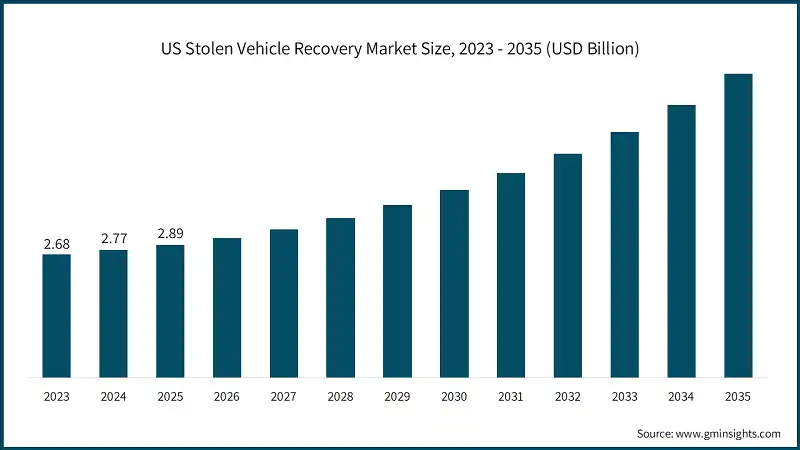
US dominated the stolen vehicle recovery market in North America with around 85% share and generated USD 2.89 billion in revenue in 2025.
- The US stolen vehicle recovery market is experiencing robust growth due to the rising incorporation of telematics, IoT connectivity, and AI-based analytics in contemporary vehicle security solutions. The issue of increased vehicle theft rates particularly in metropolitan regions and the complexity of criminal theft networks has increased the need to track vehicles in real-time, geofence crime areas, remotely immobilize vehicles, and monitor their behavior. Advanced SVR platforms are increasingly being implemented by fleet operators, insurance companies and OEMs to minimize financial losses, shorten recovery time and improve safety of the drivers. Additionally, insurance and regulatory incentives of theft- prevention technologies are also promoting their use in large numbers among passenger cars as well as commercial fleets.
- Technological advancements, including cloud-based monitoring, predictive analytics, and law-enforcement collaboration, are strengthening the effectiveness of SVR solutions in the US. Fleet telematics integration allows centralized management of commercial vehicles, improving operational efficiency while providing proactive theft detection. Additionally, the expansion of embedded OEM SVR systems ensures standardized, factory-installed protection, reducing reliance on aftermarket devices. Rising consumer awareness and growing demand for connected vehicle security continue to propel market growth, making the US one of the leading regions for innovation and adoption in the Stolen Vehicle Recovery ecosystem.
- For instance, in November 2025, Solera stated that its brand LoJack, which is part of the SVR/telematics, received the title of Vehicle Tracking Solution of the Year, and it explains the significance of connected-car telematics and embedded recovery systems in the contemporary SVR ecosystem.
- Canada is projected to grow at a CAGR of around 10.8% for the stolen vehicle recovery market due to increasing vehicle theft incidents and rising adoption of connected vehicle technologies. Urbanization and growing vehicle ownership in major Canadian cities, coupled with the proliferation of ride-hailing and commercial fleets, have heightened the need for real-time vehicle tracking, geofencing, and rapid recovery systems. Fleet operators, insurers, and individual consumers are investing in advanced SVR platforms to mitigate theft-related losses, enhance vehicle security, and comply with insurance and regulatory requirements.
The stolen vehicle recovery market in Germany is expected to experience significant and promising growth from 2026-2035.
- Europe accounts for over 30% of the stolen vehicle recovery market in 2025 and is expected to grow at a CAGR of around 10.5% by increasing vehicle thefts and the adoption of advanced vehicle security technologies. High vehicle density in urban centers, coupled with the expansion of commercial fleets, rental services, and ride-hailing operations, has amplified the demand for real-time vehicle tracking, geofencing, remote immobilization, and rapid recovery solutions.
- Germany is a strong stolen vehicle recovery (SVR) market leader due to its high vehicle density, advanced automotive industry, and early adoption of connected vehicle technologies. The country hosts major OEMs and a well-established automotive supply chain, driving the integration of factory-installed SVR modules in new vehicles. Rising vehicle theft incidents, especially in urban areas, have further fueled the demand for sophisticated recovery solutions, including real-time GPS tracking, geofencing, remote immobilization, and AI-based behavioral monitoring systems. Fleet operators, insurers, and private vehicle owners increasingly rely on these technologies to minimize losses, enhance security, and comply with regulatory and insurance requirements.
- Additionally, Germany’s robust telematics infrastructure, high smartphone penetration, and supportive regulatory environment contribute to SVR market growth. Advanced law-enforcement coordination, coupled with AI-enabled analytics and cloud-based monitoring platforms, enables faster recovery and better operational efficiency. Insurers often incentivize SVR adoption through premium reductions, while OEMs continuously innovate to offer enhanced, embedded security features. Collectively, these factors position Germany as a leader in Europe’s Stolen Vehicle Recovery ecosystem, with sustained growth projected over the coming years.
- For instance, In March 2025, LoJack announced a partnership with Mercedes?Benz Connectivity Services GmbH to integrate connected?car telematics data from Mercedes?Benz vehicles directly into LoJack’s recovery system enabling real?time tracking and more efficient theft recovery.
- The UK is a growing industry for the stolen vehicle recovery market due to rising vehicle theft rates, increasing adoption of connected vehicle technologies, and growing awareness of vehicle security among consumers and fleet operators. Urban centers such as London, Birmingham, and Manchester report higher incidences of vehicle theft, prompting demand for real-time tracking, geofencing, remote immobilization, and AI-driven recovery solutions. Fleet operators, rental companies, and insurers are increasingly deploying advanced SVR systems to minimize losses, ensure rapid recovery, and comply with insurance requirements.
The stolen vehicle recovery market in China is expected to experience significant and promising growth from 2026-2035.
- Asia Pacific accounts for over 18% of the stolen vehicle recovery market in 2025 and is expected to grow at a CAGR of around 11.9% owing to rapid urbanization, increasing vehicle ownership, and rising incidences of vehicle theft in the region. Countries such as China, India, Japan, and Australia are witnessing higher demand for real-time vehicle tracking, geofencing, remote immobilization, and AI-driven recovery solutions.
- China is the market leader in the stolen vehicle recovery (SVR) market because of its large and rapidly growing vehicle population, increasing urbanization, and rising incidences of vehicle theft. The expansion of commercial fleets, ride-hailing services, and logistics operations has intensified the demand for advanced SVR solutions, including real-time tracking, geofencing, remote immobilization, and AI-driven behavioral monitoring. Fleet operators, insurers, and individual consumers are increasingly adopting these technologies to minimize losses, improve recovery times, and enhance overall vehicle security.
- Furthermore, strong government support for connected-vehicle initiatives, investments in telematics infrastructure, and increasing OEM integration of embedded SVR modules are driving the market. Insurance incentives and growing consumer awareness of vehicle security reinforce adoption, while technological advancements in IoT, AI analytics, and cloud-based monitoring enhance system efficiency. Collectively, these factors position China as the global leader in the market, with continued growth projected in the coming years.
- India is becoming one of the fastest-growing markets in the Asia-Pacific stolen vehicle recovery market owing to rising vehicle ownership, rapid urbanization, and increasing incidences of vehicle theft. The expansion of commercial fleets, ride-hailing services, and logistics operations has intensified the demand for advanced SVR solutions, including real-time GPS tracking, geofencing, remote immobilization, and AI-driven behavioral monitoring. Fleet operators, insurers, and individual consumers are increasingly adopting these technologies to minimize losses, ensure rapid recovery, and enhance vehicle security.
The stolen vehicle recovery market in Brazil is expected to experience significant and promising growth from 2026 to 2035.
- Latin America holds around 8% of the stolen vehicle recovery market and is growing steadily at a CAGR of around 8.8% due to increasing vehicle theft rates and rising adoption of connected vehicle technologies. Countries such as Brazil, Mexico, and Argentina are witnessing higher demand for GPS-based tracking, geofencing, remote immobilization, and AI-driven recovery solutions.
- Brazil dominates the stolen vehicle recovery market in Latin America because its large vehicle population, high vehicle theft rates, and growing demand for connected vehicle security solutions. Urban centers such as São Paulo, Rio de Janeiro, and Brasília experience frequent vehicle thefts, prompting both consumers and fleet operators to adopt advanced SVR systems. These solutions include real-time GPS tracking, geofencing, remote immobilization, and AI-driven behavioral monitoring, enabling faster recovery and reduced financial losses. Insurance companies also incentivize the adoption of SVR systems through reduced premiums, further encouraging widespread use among individuals and commercial fleets.
- Additionally, Brazil has a well-established telematics and vehicle security infrastructure, with multiple local and global SVR providers offering services across passenger and commercial vehicles. OEMs are increasingly integrating embedded recovery modules into new vehicles, enhancing protection from the factory. Technological advancements in IoT, cloud-based monitoring, and predictive analytics further improve the effectiveness of SVR systems, positioning Brazil as the leading SVR market in Latin America with sustained growth prospects over the coming years.
- The market for stolen vehicle recovery in Mexico has a high growth rate because of rising vehicle theft incidents, increasing urbanization, and growing adoption of connected vehicle technologies. Cities like Mexico City, Guadalajara, and Monterrey report high vehicle-theft rates, prompting both individuals and fleet operators to invest in advanced SVR systems. These include real-time GPS tracking, geofencing, remote immobilization, and AI-based behavioral monitoring, which help reduce theft losses and improve vehicle recovery times.
The stolen vehicle recovery market in UAE is expected to experience significant and promising growth from 2026 to 2035.
- MEA holds around 4% of the stolen vehicle recovery market and is growing steadily at a CAGR of around 7.4% due to rising vehicle theft incidents, increasing vehicle ownership, and growing adoption of connected vehicle technologies. Countries such as the UAE, Saudi Arabia, South Africa, and Egypt are witnessing higher demand for advanced SVR solutions, including real-time GPS tracking, geofencing, remote immobilization, and AI-driven behavioral monitoring.
- The UAE dominates the MEA Stolen Vehicle Recovery (SVR) market owing to its high vehicle density, advanced automotive infrastructure, and rising vehicle theft concerns in urban centers such as Dubai and Abu Dhabi. The increasing adoption of luxury and connected vehicles has driven demand for sophisticated SVR solutions, including real-time GPS tracking, geofencing, remote immobilization, and AI-based behavioral monitoring. Fleet operators, rental companies, and individual consumers are investing in these systems to enhance vehicle security, minimize theft-related losses, and ensure faster recovery times.
- Additionally, supportive government initiatives, smart city development programs, and insurance incentives are encouraging widespread adoption of SVR solutions. OEMs are integrating embedded recovery modules into new vehicles, while advanced telematics, cloud-based monitoring, and predictive analytics further strengthen system efficiency and effectiveness. Collectively, these factors position the UAE as the leading market for stolen vehicle recovery in the MEA region, with sustained growth expected in the coming years.
- Saudi Arabia is expected to grow at the fastest CAGR in the MEA stolen vehicle recovery (SVR) market owing to rising vehicle ownership, increasing theft incidents, and rapid expansion of connected mobility infrastructure. Major cities such as Riyadh, Jeddah, and Dammam are experiencing higher adoption of GPS-based tracking, geofencing, remote immobilization, and AI-driven monitoring as consumers and fleet operators seek to minimize theft-related risks. Growing investment in commercial fleets, logistics, and ride-hailing platforms is further accelerating the demand for real-time vehicle recovery solutions.
Stolen Vehicle Recovery Market Share
- The top 7 companies in the stolen vehicle recovery industry are CalAmp, Spireon, Teletrac Navman, Ituran Global, Netstar, Verizon Connect, and Geotab contributed around 17.4% of the market in 2025.
- CalAmp Corp. focuses on IoT-enabled telematics, cloud-based vehicle tracking, and predictive analytics. It prioritizes real-time monitoring, remote immobilization, and alert systems to enhance stolen vehicle recovery. Strategic partnerships with OEMs, insurers, and fleet operators help the company expand its SVR offerings across passenger and commercial vehicles globally.
- Spireon, Inc. focuses on connected-vehicle platforms, GPS tracking, and data analytics for SVR. The company integrates recovery solutions with insurance telematics, fleet management, and vehicle finance programs, enabling proactive theft prevention, rapid recovery, and added value for commercial and individual vehicle owners.
- Teletrac Navman focuses on GPS tracking, geofencing, and immobilization solutions. Its SVR strategy targets commercial fleets and high-value vehicles, providing real-time monitoring, behavioral analytics, and mobile app integration to improve operational efficiency and reduce theft-related losses.
- Ituran Global focuses on active stolen vehicle recovery through GPS tracking, law enforcement coordination, and remote immobilization. Its strategy emphasizes high recovery rates, insurance partnerships, and fleet-focused solutions, making it a leader in global SVR services for both passenger and commercial vehicles.
- Netstar focuses on integrated vehicle tracking and recovery solutions, including real-time alerts, telematics reporting, and GPS monitoring. The company targets both passenger and fleet vehicles, leveraging partnerships with insurers, OEMs, and government agencies to strengthen SVR adoption.
- Verizon Connect focuses on cloud-based telematics, AI-powered analytics, and real-time vehicle tracking. Its SVR strategy centers on predictive monitoring, rapid theft response, fleet optimization, and integration with connected vehicle ecosystems for enhanced security and recovery.
- Geotab focuses on AI-driven telematics, driver behavior analytics, and connected vehicle solutions. Its SVR approach includes real-time tracking, predictive theft detection, fleet management, and insurance telematics integration, providing scalable recovery solutions for both commercial and passenger vehicles worldwide.
Stolen Vehicle Recovery Market Companies
Major players operating in the stolen vehicle recovery industry are:
- CalAmp
- Geotab
- Ituran Global
- Netstar (Altron)
- Samsara
- Spireon
- Teletrac Navman
- TomTom International
- Verizon Connect
- Manufacturers and solution providers in the stolen vehicle recovery market are increasingly adopting digital design, connected telematics, and cloud-based monitoring platforms to enhance vehicle security, operational efficiency, and recovery performance. Integration of IoT sensors, GPS tracking, AI-powered analytics, and predictive theft detection algorithms allows real-time monitoring of passenger cars, commercial fleets, and specialty vehicles. These technologies enable rapid detection of unauthorized usage, automated immobilization, route deviation alerts, and improved recovery rates, while also providing data-driven insights for fleet optimization and insurance risk management.
- Strategic collaborations and ecosystem partnerships are reshaping the SVR industry. Alliances between telematics providers, OEMs, insurers, and fleet operators accelerate innovations in high-precision GPS tracking, AI-driven behavioral analytics, and standardized connectivity protocols. These partnerships strengthen global supply chains, enhance service interoperability, and facilitate the integration of SVR into connected-vehicle ecosystems, smart fleet management platforms, and insurance telematics programs, driving the transition toward a fully data-driven, real-time vehicle security network worldwide.
Stolen Vehicle Recovery Market Report Attributes
| Key Takeaway | Details |
|---|---|
| Market Size & Growth | |
| Base Year | 2025 |
| Market Size in 2025 | USD 8.52 Billion |
| Market Size in 2026 | USD 9.04 Billion |
| Forecast Period 2026 - 2035 CAGR | 10.1% |
| Market Size in 2035 | USD 21.49 Billion |
| Key Market Trends | |
| Drivers | Impact |
| Rise in vehicle theft rates and sophisticated auto-theft networks | Increasing incidents of organized vehicle theft and advanced methods employed by criminals are driving demand for SVR solutions. Real-time tracking, behavioral monitoring, and rapid law-enforcement coordination help prevent losses and accelerate recovery. Higher theft risks in urban areas and developing regions amplify the necessity for robust SVR systems. |
| Growing technological innovations (GPS, IoT, AI/ML) | Advances in GPS tracking, IoT-enabled devices, and AI-powered analytics enhance vehicle monitoring, theft detection, and recovery speed. Smart alerts, predictive analytics, and remote immobilization improve system effectiveness. Continuous technological innovation enables companies to offer more efficient, automated, and intelligent SVR solutions, boosting market adoption globally. |
| Growing fleet operations, ride-hailing, and logistics sectors | Rapid growth in logistics, ride-hailing, and shared mobility services increases the demand for fleet-focused SVR solutions. Operators require centralized monitoring, real-time alerts, and theft-prevention features across large vehicle networks. SVR integration ensures asset protection, operational efficiency, and compliance with insurance or regulatory standards, supporting sustainable growth in these sectors. |
| Rise in consumer awareness and regulatory support for vehicle security | Consumers are increasingly aware of vehicle theft risks and the benefits of SVR solutions. Governments and regulatory bodies also encourage or mandate adoption of anti-theft measures in certain regions. Rising awareness and supportive policies drive adoption of connected SVR systems, improving vehicle safety and reducing losses for both individuals and fleets. |
| Pitfalls & Challenges | Impact |
| High cost of SVR installation and subscription | Premium SVR solutions often require significant upfront investment for hardware, installation, and subscription-based monitoring services. This high cost can be a barrier, particularly for individual vehicle owners or small fleets. Budget constraints may limit adoption in price-sensitive markets, reducing market penetration despite high demand for theft prevention solutions. |
| Data privacy and cybersecurity concerns | Connected SVR systems collect and transmit real-time vehicle data, raising concerns about data privacy and potential hacking. Unauthorized access to telematics or recovery systems could compromise security, creating risks for vehicle owners. Stringent regulations and cybersecurity threats slow adoption, requiring vendors to implement robust protection measures and compliance frameworks. |
| Opportunities: | Impact |
| Expansion in emerging markets with growing vehicle ownership | Emerging regions present high-growth potential due to rapid vehicle ownership and urbanization. Affordable SVR solutions tailored to local markets can capture a large customer base. Increased awareness of vehicle theft risks, coupled with rising disposable income, creates opportunities for both individual and fleet-focused SVR adoption in these markets. |
| Integration with smart-city initiatives and public-safety networks | SVR systems can be integrated with city-wide surveillance, public-safety programs, and law-enforcement networks. This integration improves real-time theft detection and accelerates recovery. Collaborative efforts with municipal authorities offer opportunities for scale, cross-sector partnerships, and enhanced value proposition for both public and private stakeholders. |
| Development of AI-powered predictive analytics and value-added services | Providers can leverage AI to predict theft risk, detect anomalies, and offer proactive interventions. SVR solutions can include usage-based insurance, maintenance alerts, and fleet optimization, creating additional revenue streams. Offering value-added analytics strengthens market positioning and differentiates solutions from traditional GPS-based recovery systems. |
| strategic partnerships among OEMs, insurers, and fleet managers | Collaborations between vehicle manufacturers, insurance companies, and fleet operators enable bundled solutions, combining embedded SVR, monitoring services, and insurance benefits. Partnerships enhance customer value, standardize deployment, and accelerate adoption. They also allow vendors to scale operations and expand into new markets efficiently. |
| Market Leaders (2025) | |
| Market Leaders |
5.65% market share |
| Top Players |
Collective market share in 2025 is 15.7% |
| Competitive Edge |
|
| Regional Insights | |
| Largest Market | North America |
| Fastest growing market | Asia Pacific |
| Emerging countries | India, Philippines, Indonesia, Brazil, Saudi Arabia, UAE |
| Future outlook |
|
What are the growth opportunities in this market?
Stolen Vehicle Recovery Industry News
- In April 2025, Geotab partnered with over 80% of leading OEMs including BMW, Ford, Mercedes-Benz, Renault, Stellantis, Volkswagen, and Volvo. The collaboration focuses on data harmonization, industry standards, and hardware-free SVR solutions, enhancing telematics integration, fleet monitoring, and recovery efficiency across mixed vehicle populations.
- In February 2025, Ford added Start Inhibit, insurance deductible reimbursement up to $2,500, 24/7 stolen vehicle services, and theft notifications to the F-150 and Super Duty Security Package. Owners can remotely disable vehicles via FordPass, improving recovery rates and driver protection, with services costing $7.99/month after the first year.
- In November 2024, Ituran Location & Control announced cumulative vehicle recoveries of $3 billion, maintaining an 80% success rate. The milestone highlights effectiveness of GPS, cellular, and RF tracking technologies across 2.2 million subscribers in 20 countries, combating modern theft methods like relay attacks.
- In September 2024, Geotab enabled hardware-free fleet management for Tesla vehicles (excluding older Model X/S), offering GPS tracking, safety data, and telematics integration. This cloud-to-cloud connection supports efficient SVR, standardized fleet management, and monitoring for electric and heterogeneous vehicle populations.
- In January 2024, Solera introduced LoJack LE, enabling law enforcement officers to access real-time theft alerts, GPS coordinates, speed, and direction. Nearly 10,000 agents joined the secure network. The solution maintains LoJack’s 90% vehicle recovery rate, strengthening law enforcement integration and operational efficiency.
The stolen vehicle recovery market research report includes in-depth coverage of the industry with estimates & forecasts in terms of revenue ($Bn) from 2022 to 2035, for the following segments:
Market, By Vehicle
- Passenger vehicles
- Hatchbacks
- Sedans
- SUV
- Commercial vehicles
- Light commercial vehicles (LCV)
- Medium commercial vehicles (MCV)
- Heavy commercial vehicles (HCV)
Market, By Installation
- OEM-installed systems
- Aftermarket
Market, By Technology
- GPS-Based Tracking Systems
- Radio Frequency (RF) Systems
- Cellular & Telematics Platforms
- Hybrid Systems (GPS + RF)
- Others
Market, By Application
- Active Stolen Vehicle Recovery
- Fleet Management & Security
- Insurance Telematics & UBI
- Automotive Dealer Solutions
- Asset & Equipment Tracking
- Others
Market, By Service Model
- Hardware + Subscription
- Integrated Service Plans
- One-Time Purchase
- Enterprise/Fleet Licensing
Market, By End Use
- Individual vehicle owners
- Fleet owners
- Insurance companies
- Government & law enforcement
- Others
The above information is provided for the following regions and countries:
- North America
- US
- Canada
- Europe
- Germany
- UK
- France
- Italy
- Spain
- Russia
- Nordics
- Asia Pacific
- China
- India
- Japan
- Australia
- South Korea
- Philippines
- Indonesia
- Latin America
- Brazil
- Mexico
- Argentina
- MEA
- South Africa
- Saudi Arabia
- UAE
Frequently Asked Question(FAQ) :
What was the market size of the stolen vehicle recovery in 2025?
The market size was USD 8.52 billion in 2025, with a CAGR of 10.1% expected through 2035. The growth is driven by advancements in connected vehicle architectures, intelligent telematics, and embedded security modules.
What is the projected value of the stolen vehicle recovery market by 2035?
The market is poised to reach USD 21.49 billion by 2035, fueled by the adoption of AI-based analytics, IoT connectivity, and GNSS positioning in SVR systems.
What is the expected size of the stolen vehicle recovery industry in 2026?
The market size is projected to reach USD 9.04 billion in 2026.
What was the market share of the passenger vehicles segment in 2025?
The passenger vehicles segment accounted for approximately 62.12% of the market in 2025 and is expected to grow at a CAGR of over 9.8% through 2035.
What was the valuation of the OEM-installed systems segment in 2025?
The OEM-installed systems segment held a 63% market share in 2025 and is set to expand at a CAGR of over 10.4% from 2026 to 2035.
What is the growth outlook for the active stolen vehicle recovery segment?
The active stolen vehicle recovery segment, which accounted for 44.5% of the market in 2025, due to features like real-time tracking, instant alerts, and remote immobilization.
Which region leads the stolen vehicle recovery sector?
The United States leads the North American market with an 85% share, generating USD 2.89 billion in revenue in 2025. Growth is driven by rising vehicle theft rates, especially in metropolitan areas.
What are the upcoming trends in the stolen vehicle recovery market?
Key trends include geofencing, tamper alerts, remote engine shutdown, UWB tracking, precise location detection, and fleet-management integration.
Who are the key players in the stolen vehicle recovery industry?
Key players include CalAmp, Geotab, Ituran Global, Netstar (Altron), Samsara, Spireon, Teletrac Navman, TomTom International, and Verizon Connect.
Stolen Vehicle Recovery Market Scope
Related Reports