Summary
Table of Content

Specialty Vegetable Seeds Market
Get a free sample of this report
Form submitted successfully!
Error submitting form. Please try again.
Thank you!
Your inquiry has been received. Our team will reach out to you with the required details via email. To ensure that you don't miss their response, kindly remember to check your spam folder as well!
Request Sectional Data
Thank you!
Your inquiry has been received. Our team will reach out to you with the required details via email. To ensure that you don't miss their response, kindly remember to check your spam folder as well!
Form submitted successfully!
Error submitting form. Please try again.
Specialty Vegetable Seeds Market Size
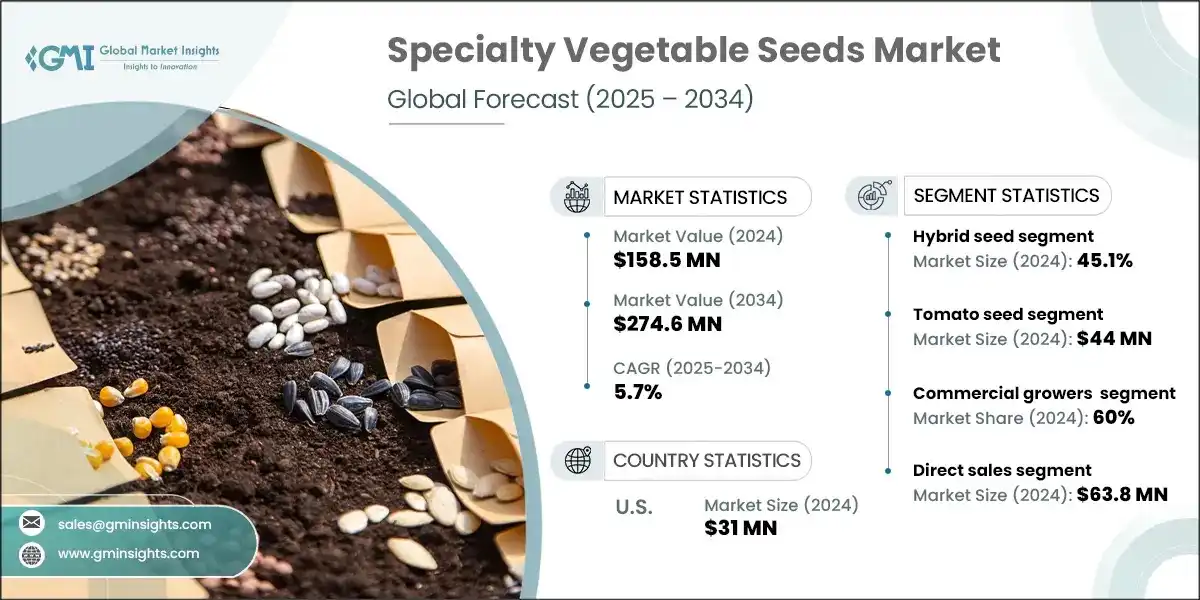
A comprehensive report by Global Market Insights Inc. projects the global specialty vegetable seeds market was estimated at USD 158.5 million in 2024. The market is expected to grow from USD 167 million in 2025 to USD 274.6 million in 2034, at a CAGR of 5.7%.
Specialty Vegetable Seeds Market Key Takeaways
Market Size & Growth
- 2024 Market Size: USD 158.5 million
- 2034 Forecast Market Size: USD 274.6 million
- CAGR (2025–2034): 5.7%
Key Market Drivers
- Rising consumer preference for organic and healthy food.
- Innovation in seed technology (hybrid and disease-resistant varieties).
- Growth of organic farming and sustainable agriculture.
Challenges
- High cost of specialty seeds.
- Limited awareness and knowledge among farmers.
Opportunity
- Expansion into emerging markets.
- Product diversification and customization.
- Partnerships with agricultural inputs companies.
Key Players
- Market Leader: Syngenta Group led with over 12.3% market share in 2024.
- Leading Players: Top 5 players in this market include Bayer AG (Crop Science Division), Syngenta AG, Corteva Agriscience, BASF SE (Agricultural Solutions), Limagrain Group, which collectively held a market share of 48.6% in 2024.
Get Market Insights & Growth Opportunities
- The specialty vegetable seeds market is widely growing due to the rising demand from consumers for healthy, organic, and specialty vegetable. Such seeds come in different varieties like heirloom, organic, hybrid, and high-yielding strains designed for culinary and nutritional characteristics. These seeds play a vital role in increasing crop diversity, enhancing the quality of yields, and promoting sustainable agricultural processes. They allow growers to grow vegetables of better taste, quality, and nutritional value, satisfying the changing tastes of health-oriented consumers.
- In agribusiness, they are used to grow high-value products such as heirloom tomatoes, organic peppers, and specialty leafy greens that have high price premiums in supermarkets and markets. The specialty seeds are also used by home gardeners and small farmers who use them for local markets and for personal use, advancing urban gardening and sustainability.
- In addition, the growing popularity of organic farming and health-conscious consumer awareness has driven the demand for specialty vegetable seeds. In total the specialty vegetable seed market is an important driver of new, green, and health-focused agricultural practices around the world.
- Asia Pacific takes the string position in specialty vegetable seeds market, holding a significant share of the market due to the growing agriculture sector in the region.
- For instance, Asia contributed 80% of total world production of vegetables or around 903 million tons in the year 2022. The leading vegetables produced around the were tomatoes, onions, and cucumbers.
- North America has the fastest growth rate among all region due to the growing demand in the nation like U.S. and Canada. This region is facing immense technological innovation and growing opportunities for market players for business expansion.
To get key market trends
Specialty Vegetable Seeds Market Trends
- The market is witnessing growth propelled by advanced technology and changing regulatory frameworks. Such advances in seed technology, including hybridization, gene editing, and disease-resistant crop types, improve crop yield, maintain quality, and are tolerant for farmers to grow more valuable vegetables. Therefore, these newer technologies are enhancing productivity as well as promoting sustainable agricultural practices through reduced chemical input demands and higher environmental resilience.
- Stricter regulatory frameworks also ensure adherence to the guidelines pertaining to the quality, safety, and organic certification of seeds to uphold high standards and independently boost the consumers' faith. At the same time, governments and industry associations have been lobbying for policies supporting organic production, raising special seed usage, and thereby increasing growth in specialty vegetable seeds market. Such types of regulations give confidence to consumers and consequently maintain the momentum for acceptance of superior seed types.
- Specialty vegetable seeds are being demanded more due to the changes in consumer preferences for organic healthy and novel produce. The growing interest within supermarkets, restaurants, and backyard gardens toward heirlooms, organic, and regionally specific vegetable types is the motive behind the demand. Food security and climate resilience concerns are further driving the farmers' preference toward innovative seed solutions for production, which can stand out under any environmental stress.
- For instance, in the year 2023, approximately 2.3 billion people around the globe had moderate or severe food insecurity. This concern shows the growing need for more specialty seeds around the world.
Specialty Vegetable Seeds Market Analysis
Learn more about the key segments shaping this market
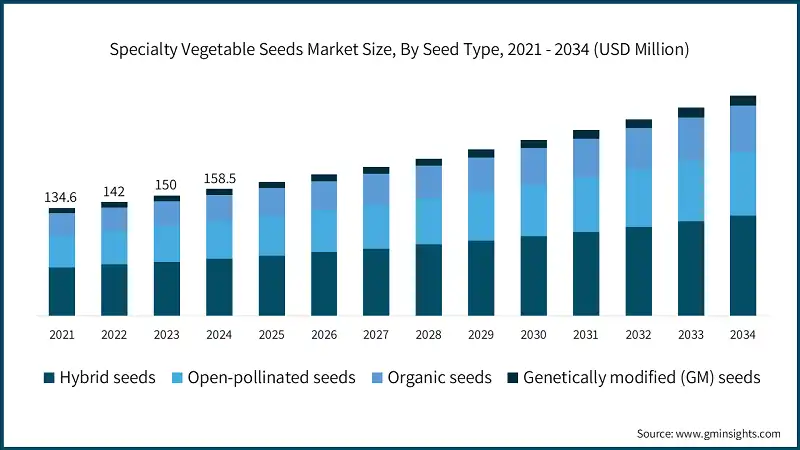
Based on seed type the specialty vegetable seeds market is segmented into hybrid seeds, open-pollinated seeds, organic seeds, genetically modified (GM) seeds. The hybrid seed accounted for 45.1% of the market share in 2024 and is expected to grow with the CAGR of 5.8% in 2034.
- Hybrid seeds are the most popular specialty vegetable seeds sold in the market. They got that popularity from their high yields, increased uniformity, and enhanced disease resistance. Vegetable growers turn to hybrid ones because these seeds give them reliable performance and superior characteristics that in turn lead to high profitability.
- Open-pollinated seeds have been regaining favor from organic farmers and home gardeners lately. This was made possible by their genetic stability and seed-saving features. Consumer knowledge about health, sustainability, and consumption of organic food contributes to the high growth rate in the organic seed market. As organic vegetables become everyday food, a great need arises for certified organic seeds that are produced by methods without synthetic chemicals.
- Genetically modified seeds are a hot topic of debate, but they are a sizeable and powerful niche in the specialty vegetable seed industry. They are aimed at introducing such features as tolerance against pests, herbicide, and additionally enriched nutrient content. Regulatory restrictions and negative consumer attitudes are still the main reasons why GM seeds are facing difficulties in gaining mainstream popularity in organic and some regional markets.
Learn more about the key segments shaping this market
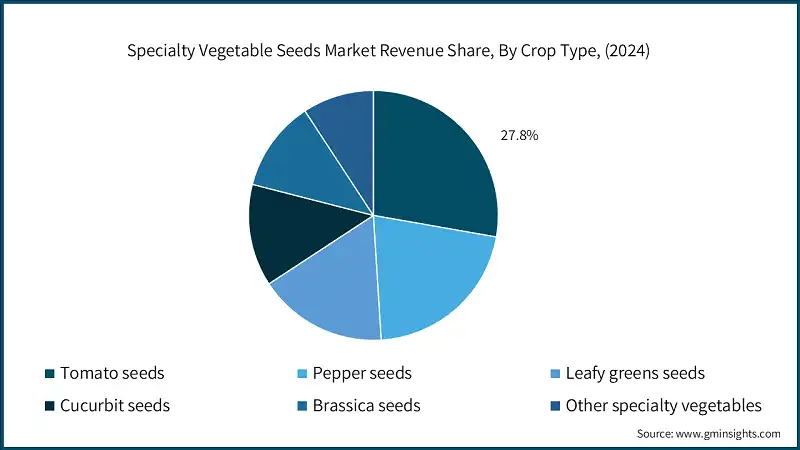
Based on crop type the specialty vegetable seeds market is segmented into food tomato seeds, pepper seeds, leafy greens seeds, cucurbit seeds, brassica seeds, other specialty vegetables. Tomato seed holds the market size of USD 44 million in 2024 and expected to grow at a faster rate of 5.4% CAGR in 2034.
- Tomato seeds dominate the vegetable seed market because of their demand from home gardeners, organic food eaters, and urban gardeners. Demand for organic, heirloom & non-GMO tomato varieties has improved because consumers are looking for fresh and sustainable products.
- For instance, in 2024, about 229.1 million cwt of tomatoes for fresh market were produced in California.
- Pepper seeds are becoming increasingly popular, specifically with those who like to consume hot and specialty peppers. The trend is an indicator of an increase in the variety of hot, sweet, and colored peppers on offer with customers seeking out the variety of tastes and cooking uses.
- Leafy greens seeds are taking off in the health-conscious community. Lettuce, spinach, kale and microgreens are what consumers are seeking out because they are full of antioxidants and are easy to use. The movement towards fresh, organic, and locally sourced greens is increasing particularly among urban growers and small-scale producers.
- Cucumbers, zucchini, and gourds are experiencing an increasing trend towards commitment particularly in organic farming. People are very eager to experiment with heirloom and specialty types that provide them with the ideal taste and appearance.
- Brassica seeds that mention cabbage, broccoli, cauliflower, and brussels sprouts are on the move nowadays because of their health value and the fact that they may be several tasty dishes. Organic and non-GMO brassicas are in great demand, driven by buyers who are looking for healthy foods to supplement their diets.
Based on end use the specialty vegetable seeds market is segmented into commercial growers, home gardeners, research and educational institutions. The commercial growers accounted for 60% of the market share in 2024 and is expected to grow with the CAGR of 5.7% in 2034.
- The specialty vegetables seeds market has shown some serious growth over recent times across the segments, with commercial growers being the leaders in this growth. These commercial growers, being the primary players, are weighing heavily on the high-quality and innovative seed varieties to satisfy the increasing consumer demand for exotic and nutritional vegetables. Their interests lay on large production and the adoption of newer agricultural technologies, thus keeping them at the forefront of all market trends and contributing to the general industry’s growth.
- Home gardening has been yet another reason for the development, especially around organic and sustainable produce. Specially adapted vegetable seeds for small-scale cultivation and urban gardening have enabled home gardeners to grow a variety of crops. The segment's increasing popularity is grounded in the desire for fresh produce from the organic garden and a healthier way of life.
Based on distribution channel the specialty vegetable seeds market is segmented into direct sales, retail channels, online sales, cooperatives and association. Direct sales hold the market size of USD 63.8 million in 2024 and expected to grow at a faster rate of 5.9% CAGR in 2034.
- The specialty vegetable seed market is witnessing major changes toward direct sales which have emerged as a primary distribution channel. Through direct sales, companies can also provide some specialized support and assistance for building loyalty and repeat business. Hence, many seed companies are putting up direct sales systems, such as a dedicated salesforce and personalized engagement programs.
- Retail channels continue to be important in the specialty vegetable seeds market, especially for small farmers, home gardeners, and local nurseries. Such retail outlets offer convenience and easy access to a wide array of seed varieties that promote urban gardening and a hobby of farming further. The rise of specialized gardening stores and garden centers has supported this channel further, making it a critical component in the entire market landscape.
- Online selling has seized rapidly with the beating of e-commerce into ease and preference. Consumers and growers can now book lengthy hours browsing large seed catalogs from their homes, gathering all relevant buying information, and proceeding with purchases. The pandemic has made many seed-related firms pay extra attention to their online presence and digital marketing programs, creating a momentum that will continue to affect the market in the years to come.
Looking for region specific data?
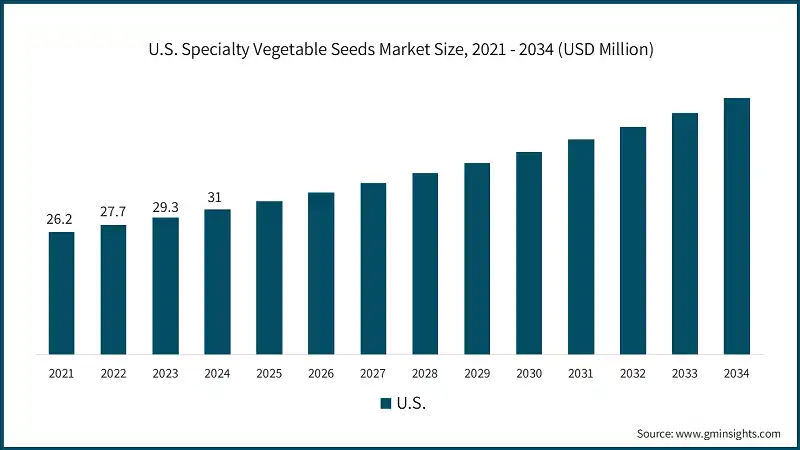
In the specialty vegetable seeds market, U.S. accounts the major share in North America by accounting USD 31 million in 2024 and is expected to grow at a CAGR of 4.7% in 2034.
- The specialty vegetable seed market in North America, has been promoting steady growth because consumers show greater interest in organic, heirloom, and unique varieties.
- In the U.S. and Canada, home gardening, urban farming, and the consumption of organic foods are growing in popularity. There is an increase in home gardening, urban farming, and consumption of organic foods in the U.S. and Canada.
- Consumers seek high-quality non-GMO seeds to cultivate specialty vegetables, in this way, seed companies have been pushed to innovate and introduce a larger number of products in the market. The growing consumer awareness of sustainable agriculture and the local food movement add to the stir of demand.
The specialty vegetable seeds market in China is expected to experience significant and promising growth from 2025 to 2034.
- Asia-Pacific specialty vegetable seed market with massive growth spurred by the rapid urbanization, growing health consciousness, and an increased preference for organic and home-grown food.
- Being the largest market in the region, China's demand for a wide range and high-quality vegetable seeds was driven by strong government initiatives for sustainable agriculture and food security.
- In India, trends are marked by household gardening, encouraging organic farming and adoption of hybrid as well as heirloom seeds, with increasing all such factors contributing to the rising level of middle classes in India and awareness about the nutritional benefits.
- Japan is always the leader with innovative, high-yield, and eco-friendly varieties that track well with their advanced agricultural practices. These also relate closely to the health-conscious Japanese consumer. Within these nations, online direct sales to the customer will gain traction, hence increasing the accessibility of specialty seeds. The whole Asia-Pacific market is poised to realize substantial growth as it requires developing consumer demand and advanced technology in seed development.
Specialty Vegetable Seeds Market Share
Top 7 companies include Bayer AG (Crop Science Division), Syngenta AG, Corteva Agriscience, BASF SE (Agricultural Solutions), Limagrain Group, Sakata Seed Corporation, Takii & Co., Ltd. These are prominent companies within the global market operating in their respective regions covers 48.64% of the market share. These companies hold strong positions globally because of their extensive experience in specialty vegetable seeds industry. Their diverse product portfolios backed by robust production capabilities and distribution networks, enable them to meet the rising demand for specialty vegetable seeds across various regions.
- Bayer Crop Science is one of the most prominent names in the industry that leverages its huge investment in research and development capabilities that can be complemented by a strong distribution network together. More, strategic acquisitions and collaborations add diversification through product portfolio and marketing scope, making it one of the significant players in the segment.
- The reputation of Syngenta is built upon the strengths of its research and breeding systems. The focus lies in the development of high yield varieties of vegetable seeds with the resistance of pests and diseases, ensuring adaptability to different climatic conditions. The key to Syngenta's continuing competitive advantage lies with its strategic partnership and with the emphasis on biotechnology, particularly for the emerging markets in the Asia-Pacific.
- Corteva boasts vegetable seed varieties produced by advanced breeding. Emphasizing innovation with customer-relevant solutions, Corteva has been growing quickly in the specialty vegetable seed business. Through organic and non-GMO seed culture with digital agriculture tools, Corteva has differentiated itself within a highly competitive area.
- BASF Agricultural Solutions presents solutions for vegetable seeds complimented often by crop protection products. The complete approach of the company is its charm: combining seed innovation plus crop protection with digital solutions.
- Limagrain is an otherworldly cooperative group, diverse in the vegetable seeds market and possessing specialty varieties. Due to strong breeding programs and stable dominance in both the European and North American markets, it easily lends itself to the manufacture of many different versions of high-quality vegetable seeds.
- Sakata Seed is known for its creativity in the use of modern breeding techniques to be applied in a wide range of vegetable seeds. The entire focus on research and development has made Sakata to release new high-yielding and disease-resistant seeds every year. Its regional distribution networks coupled with well-baked localization have positioned Sakata just right for markets that make it a strong competition in specialty vegetable seed arena.
- Takii is a major player in the Asian vegetable seed market, with an illustrious history of breeding high-quality specialty vegetable seeds for local as well as international markets. The company's innovation, quality, and sustainability agenda put together with strategic collaboration has firmly placed Takii in competition with larger multinationals.
Specialty Vegetable Seeds Market Companies
Major players operating in the specialty vegetable seeds industry are:
- Bayer AG (Crop Science Division)
- Syngenta AG
- Corteva Agriscience
- BASF SE (Agricultural Solutions)
- Limagrain Group
- Sakata Seed Corporation
- Takii & Co., Ltd.
- Johnny's Selected Seeds
- Stokes Seeds Ltd.
- Territorial Seed Company
- Burpee Seeds and Plants
- Semillas Fitó S.A.
Specialty Vegetable Seeds Market Report Attributes
| Key Takeaway | Details |
|---|---|
| Market Size & Growth | |
| Base Year | 2024 |
| Market Size in 2024 | USD 158.5 million |
| Forecast Period 2025 - 2034 CAGR | 5.7% |
| Market Size in 2034 | USD 274.6 million |
| Key Market Trends | |
| Drivers | Impact |
| Rising consumer preference for organic and healthy food | Increased demand for organic and nutrient-rich vegetables boosts sales of specialty seeds, encouraging farmers to adopt these seeds for premium produce. |
| Innovation in seed technology (hybrid and disease-resistant varieties) | Advanced seed traits improve crop yield and resilience, attracting farmers seeking reliable and high-quality produce, thus expanding market growth. |
| Growth of organic farming and sustainable agriculture | Government incentives and consumer awareness promote organic farming practices, elevating demand for specialty seeds tailored for eco-friendly cultivation. |
| Pitfalls & Challenges | Impact |
| High cost of specialty seeds | Elevated prices may limit adoption among small-scale farmers, restricting market expansion and profitability in certain regions. |
| Limited awareness and knowledge among farmers | Lack of technical knowledge hampers adoption rates, slowing the market growth, especially in developing regions. |
| Opportunities: | Impact |
| Expansion into emerging markets | Growing middle-class populations and increasing health consciousness in developing countries present new opportunities for specialty seed adoption. |
| Product diversification and customization | Developing region-specific and crop-specific seeds can cater to diverse consumer needs, enhancing market penetration and revenue streams. |
| Partnerships with agricultural inputs companies | Collaborations can facilitate wider distribution, training, and adoption of specialty seeds, accelerating market growth. |
| Market Leaders (2024) | |
| Market Leaders |
12.3% market share |
| Top Players |
Collective share of 48.6% in 2024 |
| Competitive Edge |
|
| Regional Insights | |
| Largest Market | Asia Pacific |
| Fastest Growing Market | North America |
| Emerging Country | India, China, Brazil, Mexico, Canada |
| Future Outlook |
|
What are the growth opportunities in this market?
Specialty Vegetable Seeds Industry News
- In July 2023, Pacific Seed introduced two new canola hybrid varieties to the Australian market-Hyola Defender CT and Hayola Continuum CL. These varieties provide the much sought-after high-yield performance alongside robust disease resistance, superior oil content, and improved weed control flexibility.
- May 17, 2022, Syngenta Crop Protections Seed care business introduces VICTRATO, a new technology with strong nematode and disease control for growers wishing to boost crop quality & yield while keeping long-term health of their soils in mind.
The specialty vegetable seeds market research report includes an in-depth coverage of the industry with estimates and forecast in terms of revenue in USD Million and Kilo Tons in volume from 2021 – 2034 for the following segments:
Market, By Seed Type
- Hybrid seeds
- Open-pollinated seeds
- Organic seeds
- Genetically modified (GM) seeds
Market, By Crop Type
- Tomato seeds
- Pepper seeds
- Leafy greens seeds
- Lettuce and salad green varieties
- Spinach and kale
- Microgreens and baby leaf categories
- Cucurbit seeds
- Cucumber varieties
- Squash and zucchini
- Melon and watermelon
- Brassica seeds
- Cabbage and cauliflower
- Broccoli and brussels sprouts
- Other specialty vegetables
- Eggplant and aubergine
- Herb and aromatic plant seeds
- Root vegetable specialties
Market, By End Use
- Commercial growers
- Large-scale agricultural operations
- Greenhouse and protected cultivation
- Home gardeners
- Residential gardening trends
- Urban and container gardening
- Seed packet and small quantity sales
- Research and educational institutions
Market, By Distribution Channel
- Direct sales
- Retail channels
- Garden centers and nurseries
- Agricultural supply stores
- Online sales
- E-commerce platform growth
- Direct-to-consumer models
- Cooperatives and associations
The above information is provided for the following regions and countries:
- North America
- U.S.
- Canada
- Europe
- Germany
- UK
- France
- Italy
- Spain
- Rest of Europe
- Asia Pacific
- China
- India
- Japan
- Australia
- South Korea
- Rest of Asia Pacific
- Latin America
- Brazil
- Mexico
- Argentina
- Rest of Latin America
- Middle East & Africa
- Saudi Arabia
- South Africa
- UAE
- Rest of Middle East & Africa
Frequently Asked Question(FAQ) :
What is the market size of the specialty vegetable seeds in 2024?
The market size was USD 158.5 million in 2024, with a CAGR of 5.7% expected through 2034, driven by the growth of organic farming and sustainable agriculture.
What is the projected value of the specialty vegetable seeds market by 2034?
The market size for specialty vegetable seeds is expected to reach USD 274.6 million by 2034, fueled by rising consumer preference for healthy, organic produce and advancements in seed technology.
How much market share did the hybrid seeds segment hold in 2024?
The hybrid seeds segment accounted for 45.1% of the market share in 2024 and is expected to grow at a CAGR of 5.8% through 2034.
What was the valuation of the tomato seeds segment in 2024?
Tomato seeds were valued at USD 44 million in 2024 and are projected to grow at a CAGR of 5.4% through 2034.
What is the growth outlook for the direct sales distribution channel from 2025 to 2034?
Direct sales segment are projected to grow at a 5.9% CAGR till 2034.
What was the market size of the U.S. specialty vegetable seeds market in 2024?
The market was valued at USD 31 million in 2024. It is expected to grow at a CAGR of 4.7% through 2034, driven by demand for high-quality and disease-resistant seeds.
What are the upcoming trends in the specialty vegetable seeds industry?
Key trends include increased demand for organic and heirloom varieties, innovations in hybrid and disease-resistant seeds, and expansion into emerging markets through digital and direct-to-consumer channels.
Who are the key players in the specialty vegetable seeds market?
Key players include Bayer AG (Crop Science Division), Syngenta AG, Corteva Agriscience, BASF SE (Agricultural Solutions), Limagrain Group, Sakata Seed Corporation, Takii & Co., Ltd., Johnny's Selected Seeds, Stokes Seeds Ltd., Territorial Seed Company, Burpee Seeds and Plants, and Semillas Fitó S.A.
Specialty Vegetable Seeds Market Scope
Related Reports