Summary
Table of Content

Specialty Legume Seeds Market
Get a free sample of this report
Form submitted successfully!
Error submitting form. Please try again.
Thank you!
Your inquiry has been received. Our team will reach out to you with the required details via email. To ensure that you don't miss their response, kindly remember to check your spam folder as well!
Request Sectional Data
Thank you!
Your inquiry has been received. Our team will reach out to you with the required details via email. To ensure that you don't miss their response, kindly remember to check your spam folder as well!
Form submitted successfully!
Error submitting form. Please try again.
Specialty Legume Seeds Market Size
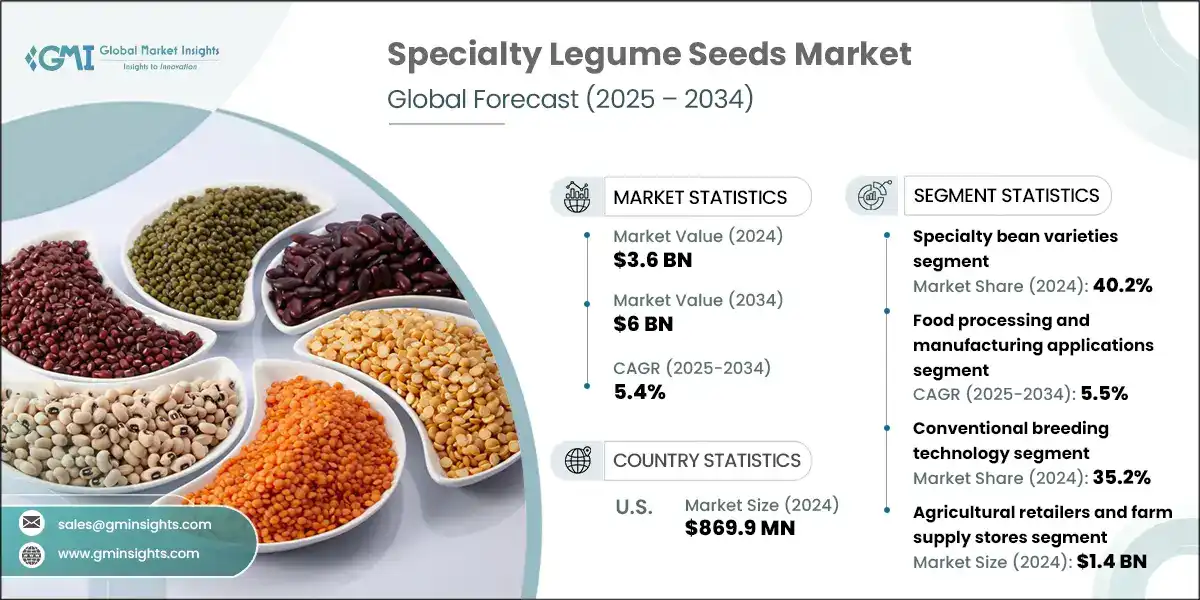
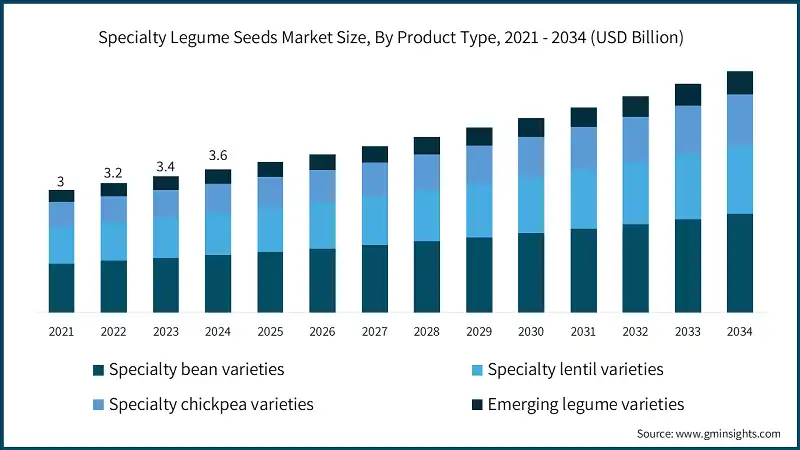
The global specialty legume seeds market was estimated at USD 3.6 billion in 2024. The market is expected to grow from USD 3.7 billion in 2025 to USD 6 billion in 2034, at a CAGR of 5.4%.
Specialty Legume Seeds Market Key Takeaways
Market Size & Growth
- 2024 Market Size: USD 3.6 Billion
- 2034 Forecast Market Size: USD 6 Billion
- CAGR (2025–2034): 5.4%
Regional Dominance
- Largest Market: North America
- Fastest Growing Region: Asia Pacific
Key Market Drivers
- Rising health consciousness.
- Sustainable agriculture practices.
- Population growth & food security needs.
Challenges
- Limited awareness & education.
- Supply chain challenges.
Opportunity
- Product innovation & diversification.
- Growing organic & sustainable food markets.
- Expansion in emerging markets.
Key Players
- Market Leader: Bayer Crop Science led with over 11.3% market share in 2024.
- Leading Players: Top 5 players in this market include Bayer Crop Science, Syngenta Group, BASF Agricultural Solutions, Corteva Agriscience, Limagrain Group, which collectively held a market share of 48.6% in 2024.
Get Market Insights & Growth Opportunities
- Specialty legume seeds have extensive nutrient composition supporting overall health through proteins, vitamins & minerals. They promote sustainable agriculture because they improve soil fertility through biological nitrogen fixation, thus reducing dependency on chemical fertilizers and encouraging eco-friendly farming practices. They also offer the additional benefit of long storability, which can ensure a reliable food source during any occurrence of food supply disruption.
- The demand for specialty legume seeds by countries worldwide is high and growing due to increasing population numbers and increasing health-conscious eating habits among people. With the ever-increasing world population, it has become imperative to create an environment in which diverse, nutritious, and sustainable food sources would secure food.
- For instance, India has the world's highest population, which is projected at over 1.64 billion by 2025. The highest population would mean a greater demand for nutritious and sustainable food sources, which, in turn, will trigger a boom in the specialty legume seed market.
- The market at large boasts great promises of rapid growth in an environment of increasing demand for nutritious foods, under integrated sustainable agricultural practices, which in turn also would be designed to meet the increasing demands of a large global population.
- North America takes the string position in this market, holding a significant share of the market due to the growing agriculture sector in the region.
- For instance, North America is anticipated to see increased demand for specialty legume seeds owing to the sustainability, crop yields, and food security initiatives that shall be driven by the projected USD722.54 billion to boost the agriculture market in 2025.
- Asia Pacific has the fastest growth rate among all region due to the growing demand in the nation like China, India, Japan and other countries. This region is facing immense technological innovation and growing opportunities for market players for business expansion.
To get key market trends
Specialty Legume Seeds Market Trends
- The market for specialty legume seeds has been growing dynamically driven by one or several key trends. People have come to understand what health and sustainability mean & are demanding more plant protein sources with a higher nutrient profile. Because of this, legumes are highly appealing in the context of healthy diets.
- Advances in technologies are yet another factor driving this market. For instance, in precision breeding interventions marketed with systems like marker-assisted selection and genomics editing, it is possible to produce a variety of legumes with very high yield coupled with resistance to diseases and resilience to climatic changes. New innovations in seed coating and delivering systems induce improved germination and crop performance; together with breeding, this development increases farmer profitability.
- The regulatory reforms towards improving the sustainable and safe application of legumes seeds adds many convictions to the entire market. Increasingly stringent certification standards for seeds, approvals for biotech and non-GMO varieties, ensure quality standards and traceability. Government support systems that enhance organic and sustainable farming practices help create an environment for uptake of specialty legume seeds.
- For instance, approx. 1.7 million kilo tons of lentils were produced by farmers in Canada in 2023. This is because of the aligned government support in both policy and regulatory frameworks.
- The thrust around product innovation is meant to create specialty varieties with an enhanced nutrition profile, e.g. higher protein levels, better digestibility. Another area that companies are investigating is biofortification of legumes as a strategy to help alleviate micronutrient deficiencies. Hence, the future for this market is bright indeed, with technological advances and enabling regulation and growing consumer demand for healthy, sustainable and innovative legume products.
Specialty Legume Seeds Market Analysis
Learn more about the key segments shaping this market
Based on product type the market is segmented into specialty bean varieties, specialty lentil varieties, specialty chickpea varieties and emerging legume varieties. The specialty bean varieties accounted for 40.2% of the market share in 2024 and is expected to grow with the CAGR of 5.6% in 2034.
- Specialty bean varieties consist primarily of those with higher yield, disease resistance, and nutritional content. The market is much more influenced by consumers' preference for plant-based proteins and sustainable foods demand, thus driving innovation and demand in this segment.
- For example, nutritious faba bean is grown in arid regions for both animal feed and human consumption. The faba bean seed contains protein (26%) and carbohydrate (56%).
- Cowpea is predominantly cultivated in dry areas such as Africa, Asia, Europe, the United States, and South America, and is mainly grown for use as animal feed and as food crops. Cowpea seeds serve as a regular source of protein (22-24%), carbohydrates (55-66%), iron (0.005%), and calcium (0.08-0.11%).
- Increased demand for specialty chickpea varieties, as consumers search for gluten-free high-protein food options. Innovations in drought resistance, pest resistance, and nutritional enhancement focus on expanding their market share.
- Emerging legume varieties, including biofortified and climate-resilient ones-the mung beans and the peas- have made great strides. These varieties meet the growing sustainable agriculture and consumption trends into health-consciousness.
Learn more about the key segments shaping this market
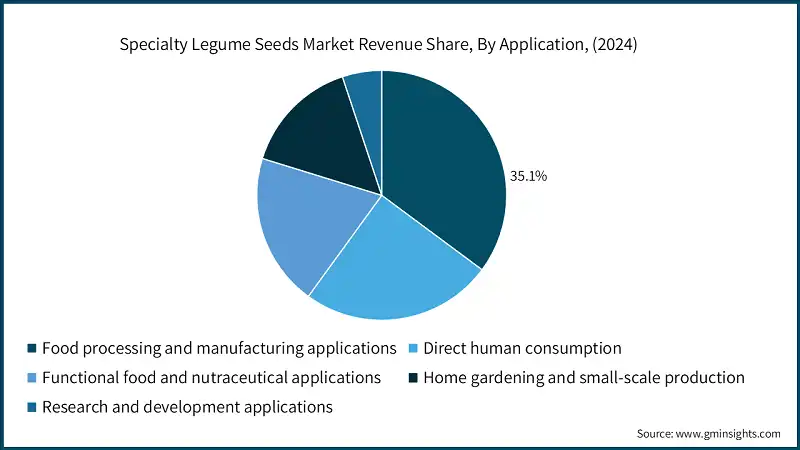
Based on application the specialty legume seeds market is segmented into food processing and manufacturing applications, direct human consumption, functional food and nutraceutical applications, home gardening and small-scale production and research and development applications. Food processing and manufacturing applications holds the market size of USD 1.2 billion in 2024 and expected to grow at a faster rate of 5.5% CAGR in 2034.
- Food processing and manufacturing applications currently dominate the specialty legume seed market because of the rising demand for convenience foods value-added products & enhanced shelf life and nutritional value through innovative processing technologies.
- Food trends with direct human consumption witness the spiral growth having CAGR of 5.2%. Its growth is driven by health-centric consumers looking to add nutritious and versatile ingredients to daily cooking and gourmet recipes into the mix.
- Functional food and nutraceutical applications are fast emerging as a sector because there is a demand from consumers for health benefits, such as balanced digestion and enhanced immune function. As a result, there has been much attention attracted toward fortified products and supplements based on legumes.
- Home gardening and small-scale production are widely regarded as trendy, mainly due to urbanization and health reasons for wanting organic foods grown at home. These trends motivated small farmers and hobbyists to grow specialty legumes for personal consumption and sell in the local market.
Based on technology the specialty legume seeds market is segmented into conventional breeding technology, advanced breeding technology, biotechnology and gene editing market analysis, seed production and processing technology. The conventional breeding technology accounted for 35.2% of the market share in 2024 and is expected to grow with the CAGR of 5.6% in 2034.
- Except for recent decades, the specialist legume seed industry has traditionally used conventional breeding techniques since they have reliable, proven, and cheap methods of trait improvement. Today, this platform is in competition with the newest advanced techniques, which are cutting-edge and precise.
- For instances, the use of biotechnology in seed development accounts for roughly 60% of all seed production innovations.
- Advanced breeding is becoming the new favorite, fast-forwarding the process by which some high-yield, disease-resistant varieties are developed. Its use becomes more widespread in combination with the traditional approaches for a more effective crop improvement.
- Rapid growth in the analysis of the biotechnology and gene editing market comes from the facility of modifying genes precisely. These technologies are revolutionizing the business in the specialty legume seed and enabling targeted improvements concerning traits such as drought tolerance or nutritional content. Emerging market demand to meet the growing market demand.
Based on distribution channel the specialty legume seeds market is segmented into agricultural retailers and farm supply stores, online and e-commerce platforms, specialty seed companies and catalogs, research institutions and universities, direct sales and farmer-to-farmer network. Agricultural retailers and farm supply stores holds the market size of USD 1.4 billion in 2024 and expected to grow at a faster rate of 5.5% CAGR in 2034.
- Agricultural retailers & farm supply stores lead the legume seed market and are reaching out to farmers commercially to sell products and develop more local distribution networks.
- Online platforms and E-commerce apps show the highest growth potential with CAGR 5.8%. This segment is gaining decent ground providing convenience, product diversity, and competitive prices. Such platforms are now becoming a favorite of farmers, especially the tech-savvy ones, for easy access and smooth purchase experience.
Looking for region specific data?
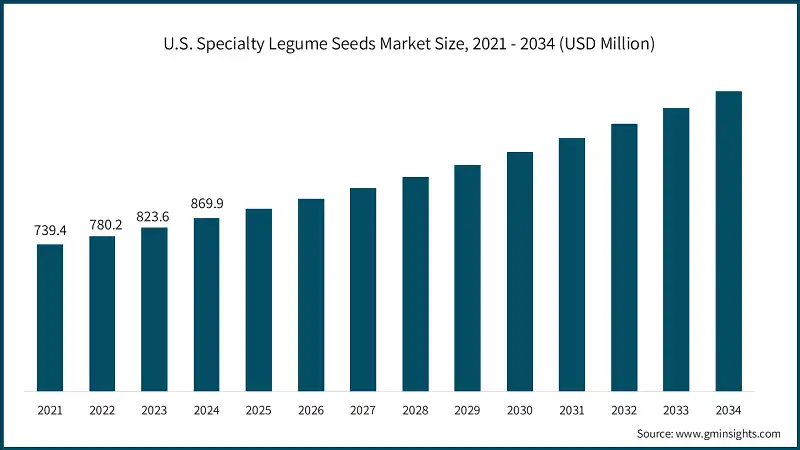
In the specialty legume seeds market, U.S. accounts the major share in North America by accounting USD 869.9 million in 2024 and is expected to grow at a CAGR of 4.6% in 2034.
- Increasing demand for plant-based proteins has propelled steady growth in the specialty legume seed market, especially innovations concerning organic farming practices gaining momentum in North America.
- In the U.S., markets are being propelled by increasing consumer awareness, government incentives for sustainable farming, and expanding organic agriculture, leading to more adoption of specialty legume seeds for diverse cropping systems.
- Specialty legumes seeds in Canada emphasize the encouragement of crop rotation and soil health benefits being placed on these seeds through government initiatives.
- For example, in 2023, lentil exports from Canada was amounted to approximately 2.0 million ton-or USD 2.3 billion which is an increase from the previous year's exports of about 1.9 million Kilo Tons.
The specialty legume seeds market in China is expected to experience significant and promising growth from 2025 to 2034.
- Asia-Pacific specialty legume seed market is showing high growth potential having CAGR of 6% due to rising demand for nutritious foods, government support, and modernization of agriculture, which is led by expansion in the markets of China and India.
- The growth of the Chinese market is assuredly supported by governmental initiatives to promote sustainable agriculture. The growth in consumer demand for quality specialty legumes seeds increases local production and imports.
- The Indian market is growing supported by health awareness and government initiatives for pulse cultivation. Specialty legumes are now gaining demand amongst farmers and consumers due to the need for better nutrition.
- In South Korea there is increasing interest in specialty legumes which are considered healthy & have applications in culinary arts. Sustained market growth is characterized by health trends and premium food markets which are accompanied by investments in sustainable agricultural practices.
Specialty Legume Seeds Market Share
Top 7 companies include Bayer AG , Corteva, Inc., Syngenta AG, BASF SE (Agricultural Solutions), Limagrain Group, DLF Seeds A/S, Protealis. These are prominent companies within the specialty legume seeds industry operating in their respective regions covers 48.64% of the market share. These companies hold strong positions globally because of their extensive experience in specialty legume seeds market. Their diverse product portfolios backed by robust production capabilities and distribution networks, enable them to meet the rising demand for specialty legume seeds across various regions.
- Bayer Crop Science is one of the most prominent names in the industry that leverages its huge investment in research and development capabilities that can be complemented by a strong distribution network together. More, strategic acquisitions and collaborations add diversification through product portfolio and marketing scope, making it one of the significant players in the segment.
- The Syngenta Group focuses on sustainability which covers crop protection seed innovation other integrated arms of the company. A well-built R&D facility gives the company strength to inject specific kinds of specialty legume seeds into corresponding climates and soil conditions.
- Integrated crop management with innovative seed traits is how BASF Agricultural Solutions captures a distinctive position in this market. With their massive investments in R&D, specialty legume seeds can now be developed to offer enhanced nutritional profiles and resilience traits for various climates and conditions.
- Corteva Agriscience keeps itself focused on innovation by combining advanced breeding technologies with seed traits to come up with high-performing varieties of legume.
- DLF Seeds A/S, the company, is thus favorably placed in niche and emerging markets, especially in Europe and Asia, given its emphasis on the production of high-quality and yield legume seeds resistant to disease.
- Protealis is a player in the field specializing in innovating seed solutions developing high-performance specialty legume seeds with improved attributes, such as stress tolerance and enriched nutrient profiles.
Specialty Legume Seeds Market Companies
Major players operating in the specialty legume seeds industry are:
- Bayer Crop Science
- Syngenta Group
- BASF Agricultural Solutions
- Corteva Agriscience
- Limagrain Group
- DLF Seeds A/S
- Protealis
- KWS SAAT SE & Co. KGaA
- Heritage Harvest Seed
- NuCicer Inc.
Specialty Legume Seeds Market Report Attributes
| Key Takeaway | Details |
|---|---|
| Market Size & Growth | |
| Base Year | 2024 |
| Market Size in 2024 | USD 3.6 Billion |
| Forecast Period 2025 – 2034 CAGR | 5.4% |
| Market Size in 2034 | USD 6 Billion |
| Key Market Trends | |
| Drivers | Impact |
| Rising health consciousness | Increased demand for nutritious, high-protein foods boosts consumption of specialty legume seeds, expanding the market. |
| Sustainable agriculture practices | Growing emphasis on eco-friendly farming promotes the use of legumes for soil health, encouraging adoption and market growth. |
| Population growth & food security needs | As the global population increases, the need for sustainable, nutrient-rich food sources drives demand and investment in legume seed production. |
| Pitfalls & Challenges | Impact |
| Limited awareness & education | Lack of consumer knowledge about benefits may hinder adoption, slowing market growth. |
| Supply chain challenges | Poor infrastructure and logistics can cause supply disruptions, affecting availability and profitability. |
| Opportunities: | Impact |
| Product innovation & diversification | Developing new legume varieties can meet diverse consumer preferences, expanding market reach. |
| Growing organic & sustainable food markets | Rising demand for organic products presents opportunities for premium-priced specialty legume seeds. |
| Expansion in emerging markets | Increasing urbanization and health awareness in emerging economies create new demand channels for specialty legumes. |
| Market Leaders (2024) | |
| Market Leaders |
11.3% Market Share |
| Top Players |
Collective market share 48.6% in 2024 |
| Competitive Edge |
|
| Regional Insights | |
| Largest Market | North America |
| Fastest Growing Market | Asia Pacific |
| Emerging Countries | India, China, Brazil, Mexico, Canada |
| Future outlook |
|
What are the growth opportunities in this market?
Specialty Legume Seeds Industry News
- In July 2023, Pacific Seed introduced two new canola hybrid varieties to the Australian market-Hyola Defender CT and Hayola Continuum CL. These varieties provide the much sought-after high-yield performance alongside robust disease resistance, superior oil content, and improved weed control flexibility.
- May 17, 2022, Syngenta Crop Protections Seed care business introduces VICTRATO, a new technology with strong nematode and disease control for growers wishing to boost crop quality & yield while keeping long-term health of their soils in mind.
The specialty legume seeds market research report includes an in-depth coverage of the industry with estimates and forecast in terms of revenue in (USD Million) and volume (Kilo Tons) from 2021 – 2034 for the following segments:
Market, By Crop Type
- Specialty bean varieties
- Heirloom and heritage bean varieties
- Colored and specialty appearance beans
- Specialty lentil varieties
- Red, black, and specialty color lentils
- Large-seeded and premium quality lentils
- Specialty chickpea varieties
- Kabuli and desi specialty varieties
- High-protein and large-seeded chickpeas
- Emerging legume varieties
- Lupin bean varieties
- Faba bean specialty varieties
Market, By Application
- Food processing and manufacturing applications
- Plant-based protein ingredient production
- Alternative meat and dairy product manufacturing
- Gluten-free and specialty food production
- Snack food and convenience product applications
- Direct human consumption
- Whole food and natural product retail
- Restaurant and food service applications
- Health food and specialty diet
- Functional food and nutraceutical applications
- Dietary supplement and powder production
- Functional beverage and smoothie applications
- Sports nutrition and performance products
- Medical food and therapeutic applications
- Home gardening and small-scale production
- Research and development applications
Market, By Technology
- Conventional breeding technology
- Advanced breeding technology
- Biotechnology and gene editing market analysis
- Seed production and processing technology
Market, By Distribution Channel
- Agricultural retailers and farm supply stores
- Online and E-commerce platforms
- Direct-to-consumer online sales
- Agricultural E-commerce marketplaces
- Specialty seed company websites
- Social media and digital marketing channels
- Specialty seed companies and catalogs
- Heirloom and heritage seed specialists
- Organic and sustainable seed companies
- Research institutions and universities
- Direct sales and farmer-to-farmer networks
The above information is provided for the following regions and countries:
- Key trends
- North America
- U.S.
- Canada
- Europe
- Germany
- UK
- France
- Italy
- Spain
- Rest of Europe
- Asia Pacific
- China
- India
- Japan
- Australia
- South Korea
- Rest of Asia Pacific
- Latin America
- Brazil
- Mexico
- Argentina
- Rest of Latin America
- Middle East & Africa
- Saudi Arabia
- South Africa
- UAE
- Rest of Middle East & Africa
Frequently Asked Question(FAQ) :
What is the market size of the specialty legume seeds market in 2024?
The market size was USD 3.6 billion in 2024, with a CAGR of 5.4% expected through 2034 driven by population growth and rising food security needs.
What is the projected value of the specialty legume seeds market by 2034?
The market is expected to reach USD 6 billion by 2034, supported by increasing health-conscious consumption and sustainable agricultural practices.
How much revenue did the food processing & manufacturing application segment generate in 2024?
Food processing and manufacturing applications generated USD 1.2 billion in 2024 and are projected to grow at a CAGR of 5.5%.
What was the valuation of the agricultural retailers and farm supply stores segment in 2024?
Agricultural retailers and farm supply stores generated USD 1.4 billion in 2024.
What is the growth outlook for the online and e-commerce platforms from 2025 to 2034?
Online and e-commerce platforms are projected to grow at a 5.8% CAGR through 2034.
What was the market size of the U.S. specialty legume seeds market in 2024?
The U.S. market was valued at USD 869.9 million in 2024. It is expected to grow at a CAGR of 4.6% through 2034.
What are the upcoming trends in the specialty legume seeds industry?
Key trends include adoption of gene editing and advanced breeding, demand for high-protein plant-based foods, and growing use of biofortified and climate-resilient legume varieties.
Who are the key players in the specialty legume seeds market?
Key players include Bayer Crop Science, Syngenta Group, BASF Agricultural Solutions, Corteva Agriscience, Limagrain Group, DLF Seeds A/S, and Protealis.
Specialty Legume Seeds Market Scope
Related Reports