Summary
Table of Content

Specialty Canned Foods Market
Get a free sample of this report
Form submitted successfully!
Error submitting form. Please try again.
Thank you!
Your inquiry has been received. Our team will reach out to you with the required details via email. To ensure that you don't miss their response, kindly remember to check your spam folder as well!
Request Sectional Data
Thank you!
Your inquiry has been received. Our team will reach out to you with the required details via email. To ensure that you don't miss their response, kindly remember to check your spam folder as well!
Form submitted successfully!
Error submitting form. Please try again.
Specialty Canned Foods Market size
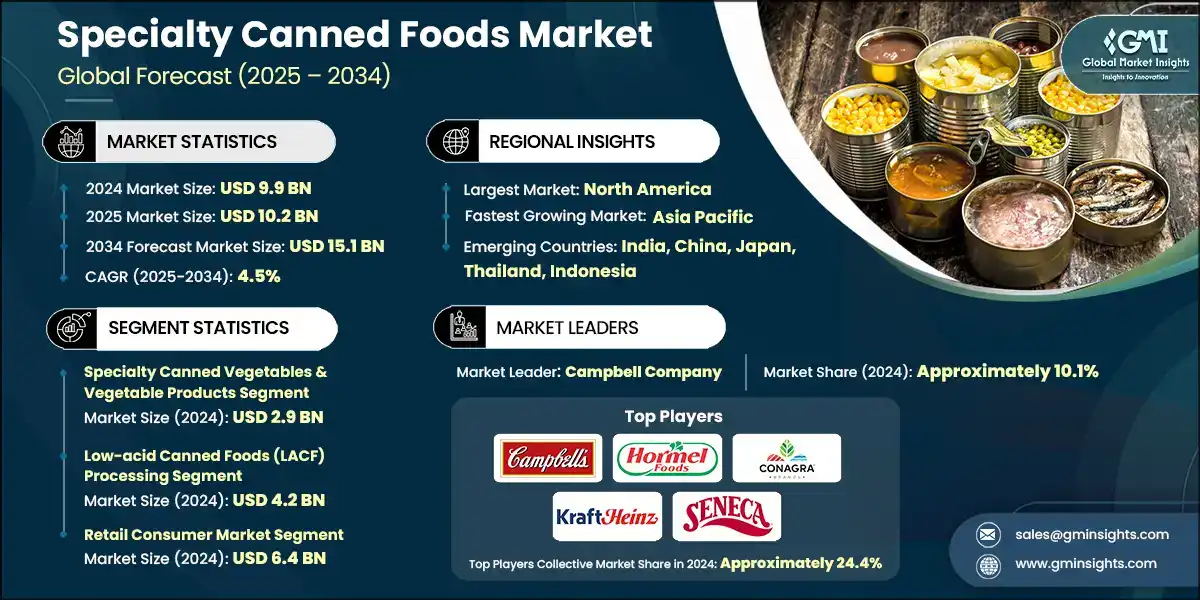
The global specialty canned foods market size was valued at USD 9.9 billion in 2024. It is projected to grow from USD 10.2 billion in 2025 to USD 15.1 billion by 2034, representing a 4.5% CAGR from 2025 to 2034, according to latest report published by Global Market Insights Inc.
Specialty Canned Foods Market Key Takeaways
Market Size & Growth
- 2024 Market Size: USD 9.9 Billion
- 2025 Market Size: USD 10.2 Billion
- 2034 Forecast Market Size: USD 15.1 Billion
- CAGR (2025–2034): 4.5%
Regional Dominance
- Largest Market: North America
- Fastest Growing Region: Asia Pacific
Key Market Drivers
- Rising consumer demand for premium and artisanal products.
- Growing ethnic food consumption and cultural diversity.
- Organic and clean label product trends.
- Convenience and shelf-stability requirements.
Challenges
- Process authority requirements and technical barriers.
- Container and packaging material cost volatility.
- Labor shortage and skilled workforce requirements.
Opportunity
- USDA trade program utilization (MAP, TASC, QSP).
- Private label and co-manufacturing growth.
- E-commerce and direct-to-consumer channels.
- International market penetration.
Key Players
- Market Leader: Campbell Company led with over 10.1% market share in 2024.
- Leading Players: Top 5 players in this market include Campbell Company, Hormel Foods Corporation, Conagra Brands Inc., Kraft Heinz Company, Seneca Foods Corporation, which collectively held a market share of 24.4% in 2024.
Get Market Insights & Growth Opportunities
- The canned foods niche market has been experiencing exponential growth due to the increasing consumer preference of high-end and handcrafted products. Modern consumers have grown highly demands in the gourmet, chef-inspired and quality canned foods that bring new flavors and quality ingredients. This transformative trend of mass-production to preimmunized products has attracted manufacturers to create their small-batches, craft-style canned foods that meet the tastes of the discerning audience, thus propelling the market growth in the developed regions.
- Consumption of ethnic foods and cultural diversity in the world markets is another major reason that has led to the growth of the market. The interest of consumers in world cuisines has increased significantly, and specialty canned foods, which represent international flavors, e.g. Mediterranean, Asian, and Latin American have become more demanded. This is trending manufacturers to diversify their products and serve multicultural palates that in turn expands the market base and increases market penetration.
- The market of specialty canned foods is also being driven by the increasing popularity of organic foods and clean-label products. Customers who care about their health are also becoming sensitive to canned products produced using natural, non-GMO, and preservative-free products. Producers are, in turn, re-inventing products to fit the clean-label profile and positioning them as health/sustainable substitutes. This change is in line with the global trends that require transparency, traceability, and ethical sourcing in food production.
- Also, the need for convenience and long shelf-life products remains one of the primary growth drivers. The current busy-life consumers are seeking ready-to-eat foods that are of quality and nutritious without reducing their appeal. Canned specialties offer the ideal combination of convenience, flavor and a longer shelf life. A combination of these, and the growing export potential, particularly in the new markets where westernized and high-quality food products are gaining more and more demand, all this combined together contributes to a very healthy growth momentum of the specialty canned foods industry across the globe.
To get key market trends
Specialty Canned Foods Market Trends
- One of the significant trends is the growing focus on sustainability and regenerated packaging on the value chain. Food manufacturers of cans are moving to the use of metal food packaging materials particularly aluminium and steel that can be recycled over and over without any diminished quality. The labels and outer packaging are also redesigned to have less waste: thinner gauges, lightweight cans, biodegradable labels, and less packaging in general. Firms are being compelled by regulatory forces and consumer demands to embrace closed-loop manufacturing and source materials in an ethical manner and report environmental measures in a transparent manner.
- The other upcoming trend is smart packaging and traceability as well as digital interaction. The use of technologies like QR codes, NFC tags, and even IoT-capable sensors is being introduced so that it could enable consumers to determine provenance, freshness or expiry, and get more detailed nutritional information.
- The companies also benefit in the form of a greater ability to manage supply chain transparency, prevent spoilage, and adhere to stricter food safety standards with the assistance of this digital layer. Stories about origin, sustainability, and ethical sourcing are brands that are using myths to create differentiation and trust in the saturating market.
- Health and wellness are a very powerful force, but what is changing is the type of health attributes the consumers require. Outside of low sugar or low sodium, there is rising interest in canned products that contain nutrients, that have functionality and are plant-based.
- Manufacturers are increasing whole food content, legumes, and alternative protein sources and adding functional ingredients in the form of vitamins, minerals, and probiotics to attract the wellness consumer. Besides, the focus on eliminating unwanted substances such as BPA in can lining is increased, and it is promoted to employ transparent sourcing and clean labels to enhance consumer confidence.
- Another trend that is altering the distribution of the specialty canned foods to the consumer is e-commerce, direct to consumer sales, and a change in distribution. As more consumers shop online, brands are increasing their presence through online grocery and marketplace retailers and are providing smaller pack sizes or assortment packs that are better suited to shipping. The specialty canned food producers are also finding a significant way to reach the niche and high-end consumer segments by brand discovery through social media, influencer marketing, and subscription boxes.
Specialty Canned Foods Market Analysis
Learn more about the key segments shaping this market
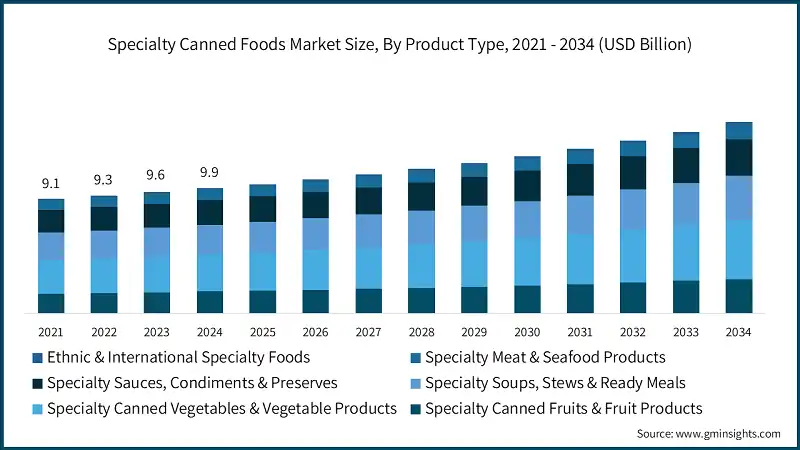
Specialty canned foods market based on product type segmented into specialty canned fruits & fruit products, specialty canned vegetables & vegetable products, specialty soups, stews & ready meals, specialty sauces, condiments & preserves, specialty meat & seafood products, and ethnic & international specialty foods. The specialty canned vegetables & vegetable products segment was valued at USD 2.9 billion in 2024, and it is anticipated to expand to 5% of CAGR during 2025 to 2034.
- Canned fruits and vegetables, which are of a special type, are experiencing an increase in growth with the increased health awareness and the demand of the natural and nutrient-rich product with long shelf life and flavor. Urban consumers seeking to add to their diets with a quick meal and areas with restricted access to fresh produce are especially susceptible to these products, which provide them with a stable and convenient substitute.
- Food Specialty soups, stews and ready meals are taking off as the number of single-person households and hectic lifestyles are on the increase. Novelty is being introduced in the market in terms of global flavors, vegetarian formulations, and food a la carte to cater to the demand of home-cooked restaurant-like meals. Equally, there is a growing demand of specialty sauces, condiments, and preserves as more people are cooking at home and as more people are experimenting with different cuisines, they can now easily indulge in global cuisines.
- Canned meat and seafood products of specialty are complementing the revolution in consumption patterns and internationalization of diets. Technological innovations in the packaging area that preserve the texture and taste of a product as well as the quality and security standards are sustaining these segments. In addition, the growth in popularity of international dishes and the fusion food has prompted manufacturers to increase their portfolios with region-specific recipes, to meet the changing taste of consumers and to enable uniform growth in the market in various product lines.
Specialty canned foods market based on processing technology, segmented into low-acid canned foods (LACF) processing, acidified foods processing, high-acid foods processing, and advanced processing technologies. The low-acid canned foods (LACF) processing segment was valued at USD 4.2 billion in 2024, and it is anticipated to expand to 4.6% of CAGR during 2025 to 2034.
- There is a growing trend in the low-acid canned food (LACF) processing, mostly meat, seafood, and vegetable-based foods that necessitate thorough thermal sterilization to achieve safety and shelf life. This has pushed the methods of LACF to a higher level, such as enhanced tracking of sterilization and sealing, which has enhanced the quality of the products and consumer trust, facilitating the expansion of the market in both the domestic and export markets.
- The processing of acidified and high-acid foods is also influencing market growth since it serves fruit, tomato, and pickled products, which have a natural inhibitory effect on bacterial growth. These operations are analogous to the clean-label trends as they do not depend on chemical food preservatives as much and instead depend on pH adjustment in nature. As more consumers show interest in eating minimally processed and still safe and tasty foods, manufacturers have been looking into more refined ways of acidifying their products in order to make them attractive and meet the changing food safety requirements.
- The next stage of industry development is being dictated by advanced processing technologies, including high-pressure processing (HPP) and the microwave-assisted thermal sterilization (MATS) as well as retort pouch systems. These inventions allow improved nutrient preservation, fresher flavor patterns, and reduced processing durations, which conform to the trend of the market with regard to high end and health conscious products.
Learn more about the key segments shaping this market
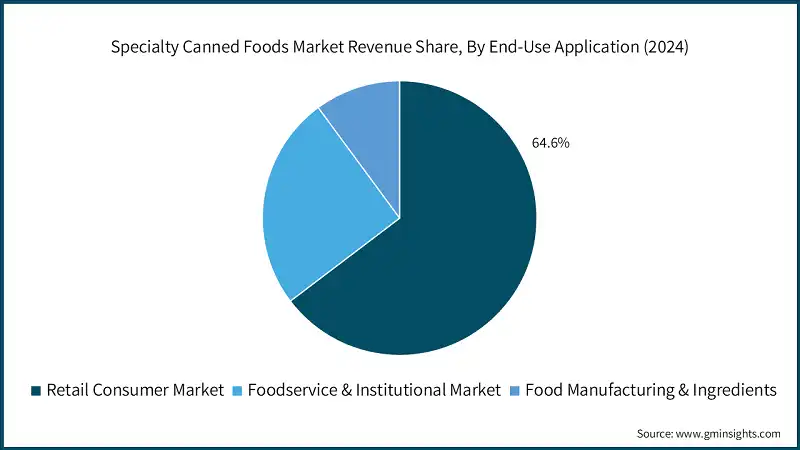
Retail consumer market application segment was valued at USD 6.4 billion and holding a market share of 64.6% in 2024 and is anticipated to expand with a CAGR of 4.3% during 2025 to 2034.
- Retail consumer market is growing since such consumer groups are more interested in convenient, ready-to-use, and nutrient-rich products. There is a growing shift towards specialty canned fruits, vegetables, ready meals, and sauces, which are better positioned to provide longer shelf life, convenient solutions to meals that can be fast and fit the busy urban living lifestyle.
- The use of specialty canned foods is increasing in the foodservice and institutional market because of its uniformity, safety, and efficiency in high operations. These products are also being used in restaurants, hotels and catering services to diversify menus, save time on preparation and ensure quality throughout high volume servings. This segment is also aiding in the development of ethnic and international specialty foods which allow an establishment to serve varied tastes of consumers without sourcing issues which have a far-reaching scope.
- Specialty canned foods are increasingly being incorporated as ingredients in packaged foods, sauces, ready-to-eat meals, and snacks in the food manufacturing and ingredients segment. Stability, uniformity, as well as convenience of these ingredients is an advantage to manufacturers because they facilitate the process of production and assure the quality of products. This segment is important in generating market growth as well as supporting the development of products both domestic and export based as demand to produce new flavors and value-added formulations increases.
Looking for region specific data?
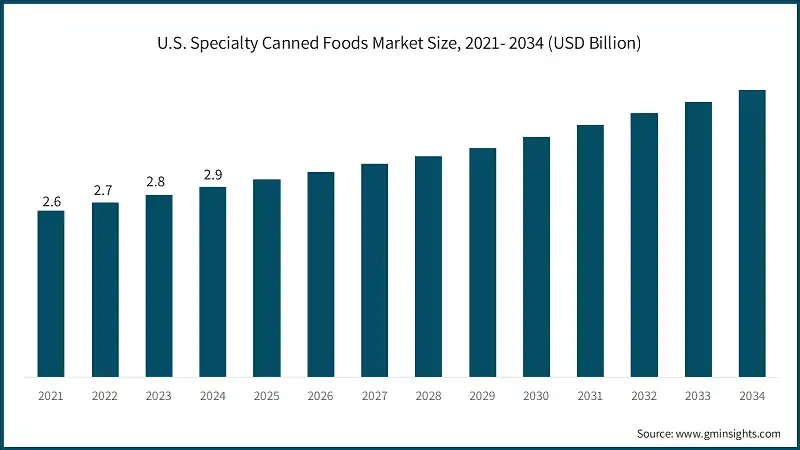
The North America specialty canned foods market dominated the market with a market share of 32.1% in 2024.
The North American market of specialty canned foods is expanding due to the rise in consumers using convenience, healthy and ready to eat food. The increased interest in artisanal and ethnic tastes promotes a variety of products in canned fruit, vegetables, sauces and ready meals. The lifestyles and single family households occurring in urban areas are creating demand for shelf-stable and high-quality products. The increase in retail and e-commerce platforms also increases accessibility, whereas the emphasis on organic and nutrient-rich food contributes to the stable growth in the market regionally.
U.S. dominates the North America specialty canned foods market, showcasing strong growth potential.
There is a tremendous growth in the U.S. driven by the increasing demand of the high-end and ethnic canned foods. Customers are investigating world cuisines and vegetarian items, whereas health-conscious clients prefer products with nutrients and devoid of preservatives. Distribution is growing through e-commerce, meal solutions through subscriptions, and sustainable packaging. Foodservice adoption also promotes volume growth; hence the U.S. contributes significantly towards the market in specialty canned foods in North America.
The Europe market accounted for USD 2.8 billion in 2024 and is anticipated to show lucrative growth over the forecast period.
Specialty canned foods market in Europe is growing and increasing consumer demand that is based on convenience, quality and new flavors. Organic and clean label canned fruits, vegetables, and ready meals are gaining popularity in Germany. Diversification of products is promoted by urbanization, changing family structures and hectic lifestyles. Food safety and sustainability regulatory standards are also enabling innovation in processing and packaging to encourage the growth throughout Germany and Europe.
Germany dominates the Europe specialty canned foods market, showcasing strong growth potential. Germany is also experiencing a significant increase in consumerism where health conscious people are after canned goods full of nutrients and of preservatives. The need for foreign and craft flavors is growing, and sustainable packaging and innovative processing increase the product attractiveness. The accessibility is growing supported by retail, e-commerce outlets and specialty stores making Germany one of the major forces in the growth of the specialty canned foods market in Europe.
The Asia Pacific specialty canned foods are anticipated to grow at a CAGR of 5.2% during the analysis timeframe.
The Asia Pacific market of specialty canned foods is expansion, as a result of urbanization, increased income, and consumption of convenience foods. Consumers in China are also becoming more demanding in high quality and nutrient-enriched canned fruits, vegetables, soups, sauces, and ethnic food. Contemporary retail and online shops increase the accessibility, and the need for foreign cuisines contributes to market growth.
China Asia Pacific specialty canned foods market is estimated to grow with a significant CAGR, in the Asia Pacific specialty canned foods.
China has a good growth trend with urban consumers converting to ready-to-eat, convenience and plant-based products. Online retail and adoption of foodservice is increasing access and manufacturers are utilizing sophisticated processing to support quality and shelf life. These are the reasons why China is a core growth market in Asia-Pacific of specialty canned foods.
The Latin America specialty canned foods market accounted for 8.5% in 2024 and is anticipated to show lucrative growth over the forecast period.
Latin America is a growing market in the specialty canned foods because people are demanding convenient, healthy, and ready to use foods. The demand of canned fruits, vegetables, sauces and ready-made meals is being influenced by urbanization, introduction to international cuisines and changing lifestyles in Brazil. Modernization of retail and e-commerce also contribute to growth.
Brazil leads the Latin America specialty canned foods market, exhibiting remarkable growth during the analysis period.
The Brazilian market is undergoing a high growth rate as more people are interested in the ethnic flavors and plant-based products and functional products. The contemporary retail, supermarkets, and internet offer better access to products, and the diversification of menus is supported by the adoption of the food service. The trends make Brazil strategic in terms of growth in Latin America market.
Middle East & Africa specialty canned foods market is anticipated to grow at a CAGR of 4% during the analysis timeframe.
The Middle East and African market of specialty canned foods are expanding due to the increased incomes, urbanization, and need of long-shelf life and convenience foods. Specialty canned fruits, vegetables, sauces and ready meals are growing in demand in Saudi Arabia due to its nutritional value and uniqueness. Accessibility through retail and e-commerce channels assists the further and exposure to foreign cuisines promotes the need of ethnic products.
Saudi Arabia specialty canned foods market to experience substantial growth in the Middle East and Africa market in 2024.
Saudi Arabia is enjoying faster development where people are demanding high-quality, convenient, and multi-canned food stuffs. Buyers who are health conscious prefer products that are nutritious as well as free of preservatives. Retail and online platforms expansion and adoption of foodservice help to increase accessibility and menu diversification, which makes Saudi Arabia an important driver of regional market development.
Specialty Canned Foods Market Share
- Campbell Company, Hormel Foods Corporation, Conagra Brands Inc., Kraft Heinz Company, and Seneca Foods Corporation constitute a larger part of the specialty canned foods industry and with the further standing of being moderately concentrated with the top five players steadily holding 24.4% market share as in the year 2024. In this market, the companies work towards product portfolio diversification to encompass high quality, organic and ethnic goods that appeal to the increasing health conscious and convenience seeking markets.
- Companies are able to invent new flavors and functional ingredients as well as clean-label solutions to attract the changing needs of consumers, but also in order to stand out in a saturated market. This focus on product innovation has assisted in forming consumer expectations and the broadening of the market on the whole, which impacted new entrants in developing specialty canned foods.
- The focus of keeping up with the competition in this market is operational efficiency and technological investment. The major players use modern processing techniques such as high-pressure processing and retort sterilization to safeguard product quality, shelf stability and product safety.
- The use of sustainable and recyclable packaging would also boost image and branding as well as match the world environmental expectations. Constant modernization of production facilities and best gains in quality control allow the companies to remain consistent and win the trust of retailers and consumers, as well as contribute to the national and global growth.
- The issue of marketing and distribution is also a key to maintaining the presence in the market. Modern retail, e-commerce, and foodservice partners all provide companies with a multi-channel distribution strategy to reach a wide range of consumer segments.
- Product origin, sustainability, and health benefits are strengthened through targeted marketing campaigns and storytelling to create brand equity and consumer loyalty. They keep up with this development in the specialty canned foods market because they position their brands in line with the emerging consumer preferences, such as global flavors and convenient meal solutions that keep them visible and relevant.
- Strategic collaborations, acquisitions and partnerships are also contributing factors to competitiveness. Firms frequently engage with their ingredient suppliers, local distributors or co-manufacturers to increase their presence and simplify their supply chains.
- Acquisitions enable them to reach new products lines, technologies or geographic markets so that they can respond more quickly to changes in consumer demand. These approaches strengthen their market footprint, in addition to influencing industry benchmarks, which facilitate innovation and operational performance throughout the specialty canned foods sector.
- Lastly, the participation of the consumers and their flexibility to the local tastes are the determinants that affect market dominance. Firms keep up with the trends on the market, the response of customers, and the regulations to ensure that their products are optimized.
- Localized flavor, format, and packaging can be used to create increased acceptance and brand loyalty in specific areas. Such an active orientation to the identification and reaction to consumer needs has assisted companies in shaping the purchasing behavior, determining the standard of products and convenience, and staying close to the dynamical specialty canned food market.
Specialty Canned Foods Market Companies
The major players operating in specialty canned foods industry include:
- Campbell Company
- Hormel Foods Corporation
- Conagra Brands Inc.
- Kraft Heinz Company
- Seneca Foods Corporation
- Others
- Campbell Company maintains its industry standing in its specialty canned food by specializing in innovation in its ready-to-eat soups, sauces and meal preparation to address the changing tastes of the consumer. The company focuses on clean-label and organic product lines and pays attention to the quality and consistency. Good brand recognition alongside strategic marketing and its wide retail and e-commerce distribution enable Campbell to recover consumer loyalty and remain pertinent in the competitive environment.
- Hormel Foods Corporation has retained its position by diversifying in canned meat, seafood and ready meals that are considered healthy and convenient in consumption by the same consumer segment. The company has utilized product innovations such as plant-based and ethnic products and strict quality control. Efficient distribution in retail, foodservice and international markets will assist Hormel to reach a large number of people and maintain market share.
- Conagra Brands Inc. is a competitive company that tends to provide diversified canned specialty foods such as ethnic and premium ready-made foods, sauces and condiments. The company focuses on product innovation, packaging enhancement and sustainability programs. Conagra remains visible through excellent marketing promotions and collaboration with retailers and expands its online shopping platforms to meet new consumer tastes and preferences.
- Kraft Heinz Company supports the market presence through consistent innovation in the areas of sauces, condiments, and ready meals, but at the same time, the company does not compromise the quality and taste standards. The company pays attention to clean-label products and global taste profiles in order to appeal to new consumers. The position and its influence in the specialty canned foods industry are supported by strategic marketing, world distribution and partnerships with foodservice channels.
- Seneca Foods Corporation also has a stronger presence in the market because of the emphasis on canned fruits, vegetables, and ethnic food products that have a more emphasis on freshness and quality. The company is investing in modern processing technologies and effective supply chain management in order to bring reliability to its products. Wide distribution of its products in retail, institutional and export markets has enabled Seneca to be competitive and increase its consumer base.
Specialty Canned Foods Market Report Attributes
| Key Takeaway | Details |
|---|---|
| Market Size & Growth | |
| Base Year | 2024 |
| Market Size in 2024 | USD 9.9 Billion |
| Market Size in 2025 | USD 10.2 Billion |
| Forecast Period 2025 - 2034 CAGR | 4.5% |
| Market Size in 2034 | USD 15.1 Billion |
| Key Market Trends | |
| Drivers | Impact |
| Rising consumer demand for premium and artisanal products | Boosts market value by encouraging innovation and premium pricing strategies. |
| Growing ethnic food consumption and cultural diversity | Expands product variety and market reach, catering to multicultural consumer bases. |
| Organic and clean label product trends | Drives reformulation and transparency, enhancing brand trust and appeal. |
| Convenience and shelf-stability requirements | Strengthens demand for ready-to-eat and long-lasting products, especially in urban and busy lifestyles. |
| Pitfalls & Challenges | Impact |
| Process authority requirements and technical barriers | Increases entry barriers and compliance costs, limiting small-scale innovation. |
| Container and packaging material cost volatility | Pressures profit margins and pricing strategies due to fluctuating input costs. |
| Labor shortage and skilled workforce requirements | Slows production scalability and raises operational costs. |
| Opportunities: | Impact |
| USDA trade program utilization (MAP, TASC, QSP) | Facilitate export growth and international brand visibility. |
| Private label and co-manufacturing growth | Opens new revenue streams and partnerships for niche producers. |
| E-commerce and direct-to-consumer channels | Enhance market access and consumer engagement beyond traditional retail. |
| International market penetration | Diversifies revenue sources and mitigates domestic market saturation. |
| Market Leaders (2024) | |
| Market Leaders |
Market Share Approximately 10.1% |
| Top Players |
Collective Market Share Approximately 24.4% |
| Competitive Edge |
|
| Regional Insights | |
| Largest Market | North America |
| Fastest growing market | Asia Pacific |
| Emerging countries | India, China, Japan, Thailand, Indonesia |
| Future outlook |
|
What are the growth opportunities in this market?
Specialty Canned Foods Industry News
- In June 2025, Conagra Brands Inc. launched more than 50 new frozen food items, such as single-serve and multi-serve food, vegetable-side products, and gluten-free and plant-based foods. This growth is in line with the growing consumer demand for convenient and healthy meal options and it places Conagra at the focal point to gain more market share of the frozen and canned food market.
- In January 2025, Nestle USA opened a new drink production and distribution center in Glendale, Arizona, where the creamers of Nestle brands such as Coffee mate and Starbucks will be made. The increase in this expansion serves Nestle better to satisfy the increasing demand of ready-to-use beverage products to supplement its current portfolio and satisfy consumer needs towards convenience.
- In November 2024, Campbell Soup Company renamed itself The Campbell’s Company, in line with its rebranding away from soups into snacks and beverages. The company has also introduced a new production line of its Goldfish snack crackers in Utah which is an effort to consolidate its presence in the fast expanding snacking market.
- In January 2024, The J.M. Smucker Company sold its fermented condiment brands in Canada including Bick pickles and Habitant pickled beets to TreeHouse Foods. This will enable Smucker to simplify its portfolio with the main brands such as Jif and Uncrustables, which increase the efficiency of operations and reflect consumer needs of convenient and high quality products.
The specialty canned foods market research report includes in-depth coverage of the industry with estimates & forecast in terms of revenue (USD Billion) & (Kilo Tons) from 2021 to 2034, for the following segments:
Market, By Product Type
- Specialty Canned Fruits & Fruit Products
- Gourmet fruit preparations
- Artisanal fruit salads and medleys
- Premium peach and pear varieties
- Exotic and tropical fruit collections
- Organic fruit products
- Fruit-based sauces and compotes
- Gourmet fruit sauces
- Dessert compotes and toppings
- Cooking and baking applications
- Gourmet fruit preparations
- Specialty Canned Vegetables & Vegetable Products
- Artisanal vegetable preparations
- Heirloom and heritage varieties
- Small-batch processing
- Chef-inspired preparations
- Organic and natural vegetables
- Certified organic products
- Non-GMO verified options
- Pesticide-free alternatives
- Ethnic vegetable preparations
- Mexican and Latino vegetables
- Asian vegetable specialties
- Mediterranean preparations
- Artisanal vegetable preparations
- Specialty Soups, Stews & Ready Meals
- Gourmet soup varieties
- Bisques and cream-based soups
- Broth-based premium soups
- Seasonal and limited edition varieties
- Ethnic cuisine soups
- Asian soup varieties (ramen, pho, miso)
- European soup traditions
- Latin American soup specialties
- Premium stews and complete meals
- Slow-cooked stew varieties
- Ready-to-eat meal solutions
- Single-serve and portion control
- Gourmet soup varieties
- Specialty Sauces, Condiments & Preserves
- Artisanal pasta and cooking sauces
- Gourmet marinara and tomato sauces
- Pesto and herb-based sauces
- International sauce varieties
- Premium salsas and dips
- Artisanal salsa varieties
- Specialty dips and spreads
- Hot sauce and spicy preparations
- Gourmet preserves and jams
- Small-batch fruit preserves
- Sugar-free and low-sugar options
- Savory preserves and chutneys
- Artisanal pasta and cooking sauces
- Specialty Meat & Seafood Products
- Premium canned meats
- Grass-fed and organic meat products
- Specialty chili and meat stews
- Gourmet pâtés and spreads
- Sustainable seafood products
- MSC certified seafood
- Wild-caught premium fish
- Specialty seafood preparations
- Ethnic meat and seafood preparations
- Asian-style seafood products
- European meat specialties
- Latin American preparations
- Premium canned meats
- Ethnic & International Specialty Foods
- Latino/Hispanic specialties
- Mexican authentic products
- Central American varieties
- South American specialties
- Asian cuisine preparations
- Chinese traditional foods
- Japanese specialty items
- Southeast Asian products
- European gourmet products
- Italian specialty foods
- French gourmet items
- Mediterranean preparations
- Latino/Hispanic specialties
Market, By Processing Technology and Regulatory
- Low-Acid Canned Foods (LACF) Processing
- Retort processing technology
- Steam retort systems
- Water immersion retorts
- Continuous retort processing
- Pressure processing applications
- Still retort operations
- Agitating retort systems
- Hydrostatic retorts
- FDA registration and process filing requirements
- Better Process Control School compliance
- Retort processing technology
- Acidified Foods Processing
- Controlled acidification methods
- Vinegar-based acidification
- Citric acid processing
- Lactic acid fermentation
- pH control and monitoring systems
- Equilibrium pH achievement protocols
- Process authority validation requirements
- Controlled acidification methods
- High-Acid Foods Processing
- Pasteurization technologies
- Water bath processing
- Steam processing
- Tunnel pasteurization
- Hot-fill processing methods
- Hot-fill and hold systems
- Inversion processing
- Vacuum sealing applications
- Pasteurization technologies
- Advanced Processing Technologies
- High-pressure processing (HPP)
- Cold HPP applications
- Thermal-assisted HPP
- Retort pouch processing
- Flexible pouch systems
- Stand-up pouch applications
- Aseptic processing and packaging
- UHT sterilization
- Sterile filling systems
- High-pressure processing (HPP)
Market, By End Use Application
- Retail Consumer Market
- Grocery chain distribution
- National grocery retailers
- Regional grocery chains
- Discount retail channels
- Specialty food stores
- Gourmet food retailers
- Health food stores
- Ethnic food markets
- E-commerce and direct-to-consumer
- Online marketplace sales
- Direct brand websites
- Subscription box services
- Grocery chain distribution
- Foodservice & Institutional Market
- Restaurant and catering applications
- Fine dining establishments
- Casual dining chains
- Quick service restaurants
- Institutional foodservice
- Healthcare facilities
- Educational institutions
- Corporate cafeterias
- Hospitality and travel
- Hotel and resort food service
- Airline catering
- Cruise line applications
- Restaurant and catering applications
- Food Manufacturing & Ingredients
- Food processor applications
- Ready meal manufacturers
- Sauce and condiment producers
- Bakery and snack food companies
- Private label manufacturing
- Retailer brand production
- Distributor private labels
- Co-manufacturing services
- Ingredient supply applications
- Bulk ingredient sales
- Food service ingredient supply
- Industrial food processing
- Food processor applications
The above information is provided for the following regions and countries:
- North America
- U.S.
- Canada
- Europe
- UK
- Germany
- France
- Italy
- Spain
- Rest of Europe
- Asia Pacific
- China
- India
- Japan
- South Korea
- Australia
- Rest of Asia Pacific
- Latin America
- Brazil
- Mexico
- Argentina
- Rest of Latin America
- MEA
- UAE
- Saudi Arabia
- South Africa
- Rest of Middle East and Africa
Frequently Asked Question(FAQ) :
What was the market size of the specialty canned foods in 2024?
The market size was USD 9.9 billion in 2024, with a CAGR of 4.5% expected from 2025 to 2034. The growth is driven by increasing consumer demand for high-end, handcrafted canned food products.
What is the projected value of the specialty canned foods market by 2034?
The market is projected to reach USD 15.1 billion by 2034, fueled by the rising popularity of gourmet, chef-inspired canned foods and the shift towards premium, small-batch products.
What is the expected size of the specialty canned foods industry in 2025?
The market size is projected to reach USD 10.2 billion in 2025.
What was the valuation of the specialty canned vegetables & vegetable products segment in 2024?
The specialty canned vegetables & vegetable products segment was valued at USD 2.9 billion in 2024 and is anticipated to witness over 5% CAGR from 2025 to 2034.
What was the valuation of the low-acid canned foods (LACF) processing segment in 2024?
The low-acid canned foods (LACF) processing segment was valued at USD 4.2 billion in 2024 and is set to expand at a CAGR of 4.6% till 2034.
What was the market size of the retail consumer market application segment in 2024?
The retail consumer market application segment was valued at USD 6.4 billion in 2024, holding a market share of 64.6%, and is projected to showcase around 4.3% CAGR up to 2034.
Which region dominated the specialty canned foods sector?
North America dominated the market with a 32.1% share in 2024. The region's growth is driven by increasing demand for convenient, healthy, and ready-to-eat food options, as well as a preference for artisanal and ethnic flavors.
What are the upcoming trends in the specialty canned foods market?
Key trends include sustainable packaging, smart traceable cans, health-focused and plant-based products, BPA-free linings, and growing e-commerce sales.
Who are the key players in the specialty canned foods industry?
Key players include Campbell Company, Hormel Foods Corporation, Conagra Brands Inc., Kraft Heinz Company, and Seneca Foods Corporation.
Specialty Canned Foods Market Scope
Related Reports