Summary
Table of Content

Southeast Asia igaming Market
Get a free sample of this report
Form submitted successfully!
Error submitting form. Please try again.
Thank you!
Your inquiry has been received. Our team will reach out to you with the required details via email. To ensure that you don't miss their response, kindly remember to check your spam folder as well!
Request Sectional Data
Thank you!
Your inquiry has been received. Our team will reach out to you with the required details via email. To ensure that you don't miss their response, kindly remember to check your spam folder as well!
Form submitted successfully!
Error submitting form. Please try again.
Southeast Asia igaming Market Size
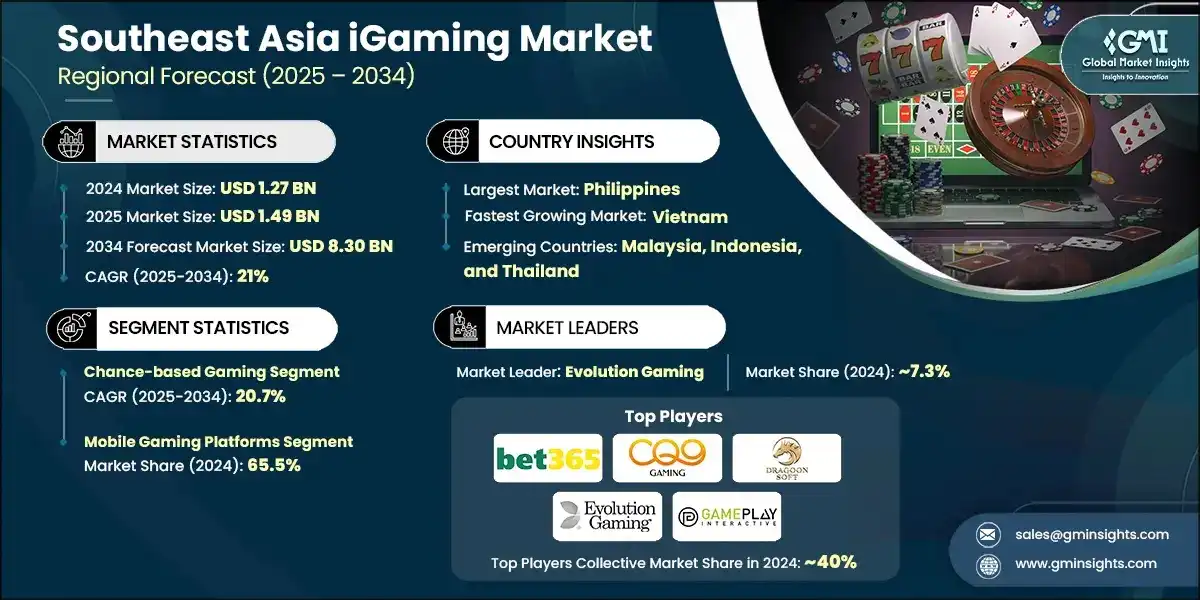
The Southeast Asia igaming market was estimated at USD 1.27 billion in 2024. The market is expected to grow from USD 1.49 billion in 2025 to USD 8.30 billion in 2034 at a CAGR of 21%, according to latest report published by Global Market Insights Inc.
Southeast Asia igaming Market Key Takeaways
Market Size & Growth
- 2024 Market Size: USD 1.27 Billion
- 2025 Market Size: USD 1.49 Billion
- 2034 Forecast Market Size: USD 8.30 Billion
- CAGR (2025–2034): 21%
Regional Dominance
- Largest Market: Philippines
- Fastest Growing Region: Vietnam
Key Market Drivers
- Regulatory expansion and state-level legalization.
- Shift toward digital and mobile gaming ecosystems.
- Economic contribution and tax revenue generation.
Challenges
- Presence of unlicensed and illegal operators.
- Labor Volatility and Talent Shortages.
Opportunity
- Integration of Blockchain and Web3 Technologies.
- Expansion into Emerging Markets (Southeast Asia).
Key Players
- Market Leader: Evolution Gaming led with over 7.3% market share in 2024.
- Leading Players: Top 5 players in this market include Bet365, CQ9 Gaming, Dragoon Soft, Evolution Gaming, Gameplay Interactive, which collectively held a market share of 40% in 2024.
Get Market Insights & Growth Opportunities
The iGaming industry in Southeast Asia has significant regulatory fragmentation, as well as differing governmental regulatory approaches, from full mental legislation to outright ban, leading to a difficult operating environment for licensed operators who must contend with fragmentation of compliance, while regulators are fighting allures of the large illegal gambling markets. The Philippines has one of the most comprehensive regulatory frameworks in the region through the Philippine Amusement and Gaming Corporation (PAGCOR) with the authority in Presidential Decree No. 1869 and its amendments, such as Republic Act 11590, which describe the licensing, supervision, and enforcement system for gaming whether domestic or offshore.
Singapore is the opposite regulatory extreme, as it highly controls the ability to participate in the market through the Casino Regulatory Authority, established through both the Casino Control Act 2006 and Remote Gambling Act 2014, which broadly prohibits remote gambling with two licensed exceptions - Singapore Pools and the Singapore Turf Club - and implements multiple social safeguards, including entry levies, exclusion orders and mandatory responsible gambling measures. Indonesia has adopted the most restrictive approach in the region, with the Ministry of Communications and Informatics blocking nearly one million gambling websites while implementing Electronic System Operators (PSE) registration requirements that effectively prevent unauthorized gaming platforms from operating within Indonesian digital infrastructure.
Emerging trends in iGaming in Southeast Asia are heavily influenced by transnational criminal organizations and the “escape routes” provided by technology and regional cooperation to deal with online wagering as a transnational security threat. Legitimate operators are focused on mobile optimization, responsible gambling technology, and automated compliance processes to manage over jurisdictional and legal arrangements.
At the 27th ASEAN-China Summit in October 2024, ASEAN and China announced their Joint Statement on Combatting Telecommunication Network Fraud and Online Gambling, a framework for regional cooperation to address online gambling - a form of transnational insecurity threat which can incorporate money laundering, drug smuggling, and human trafficking. The framework for cooperation is to establish full anti-fraud and anti-gambling centers, mechanisms for information sharing, coordination for border management and joint enforcement against cross-border of organized crime organizations.
Future growth scenarios for Southeast Asian iGaming will be primarily determined by the success or otherwise of cooperation doggedly pursued by the region in their intrusion into combating illegal operations, the degree to which national regulatory frameworks evolve into a more harmonized practice and the degree of success operators of the legitimate market have in demonstrating effective responsible gambling and consumer protection initiatives that meet governments’ overarching needs and policy objectives.
The establishing of ASEAN working groups tasked with addressing money laundering in relation to illegal online gambling that was announced at the ministerial meeting of January 2025 held in Langkawi demonstrates a deliberate regional approach to combating the whole financial infrastructure that supports illegal operations, and an added momentum is provided by China’s undertaking to provide technical aid and enforcement resources in relation to cross-border investigations and prosecutions. Simultaneously, the introduction of Thailand’s Entertainment Complex Act will provide a real test to market liberalization being carefully controlled in Southeast Asia.
The Act’s steep barriers to entry and tax obligations are designed to be premised on possible high-net-worth tourism markets while providing no significant prospect of local gambling expansion; all the same, it could serve as a bellwether for other countries in the region looking to establish a framework for regulated gaming. Investment patterns in the legitimate iGaming sector will concentrate in jurisdictions offering clear regulatory pathways and robust consumer protection frameworks, while technological development focuses on compliance automation, cross-border regulatory reporting, and advanced responsible gambling tools that can satisfy diverse national requirements.
To get key market trends
Southeast Asia iGaming Market Trends
- The development of robust ASEAN-China cooperation frameworks is slowly disrupting cross-border crime networks that previously exploited regulatory arbitrage, fundamentally transforming illegal gambling operations while bolstering legitimate operators' competitive positions from clarity of regulation and consistent law enforcement. The ASEAN-China Joint Statement agreed to in October 2024 established anti-fraud/anti-gambling centers, robust information sharing, and an operational command for coordinated enforcement actions that have already demonstrated success with the return of over 31,000 telecom fraud suspects from Myanmar to China in 2023 and the dismantling of large scam networks in northern Myanmar being used to support forced labor and human trafficking.
- The establishment of specialized ASEAN working groups to address money laundering from illegal online gambling at the January 2025 ministerial meeting now includes shared anti-money laundering frameworks and reinforced Customer Due Diligence regulations that are disrupting the financial infrastructure that supports these illegal operations.
- Southeast Asian governments are implementing sophisticated regulatory frameworks that enable controlled iGaming market access through premium positioning strategies and substantial entry barriers designed to capture high-net-worth segments while minimizing social risks and maximizing government revenue generation. Thailand's Entertainment Complex Act approval in March 2025 exemplifies this approach with a USD 1.5 million minimum bank account requirement for Thai nationals and a 17% tax rate on gaming operations, creating a framework that targets international tourists and wealthy domestic consumers rather than facilitating mass market gambling expansion.
- Singapore's regulatory model is still regarded as the regional model, enjoying a supporting ecosystem of consumer protections, including daily entry levies ($100 to $150 daily), exclusion systems (187,361 self & family exclusions by December 2023), and mandatory responsible gambling measures that reduced the problem gambling prevalence from 4.1% in 2005 to 2.6% in 2011. This controlled liberalization has changed the market perception of gambling and built high-value, low-volume gaming markets that generate significant revenue to support the Government of Singapore. Simultaneously, the social acceptability of gambling has been increased through this comprehensive suite of tools and measures which provide consumer protection.
- The implications of this development involve a significant shift in operator business models, to premium pricing, luxury hospitality experience, and the use of sophisticated responsible gambling technologies, and competitively enhance the business practices of operators that can attract high-net-worth clientele and meet strict regulatory obligations.
Southeast Asia iGaming Market Analysis
Learn more about the key segments shaping this market
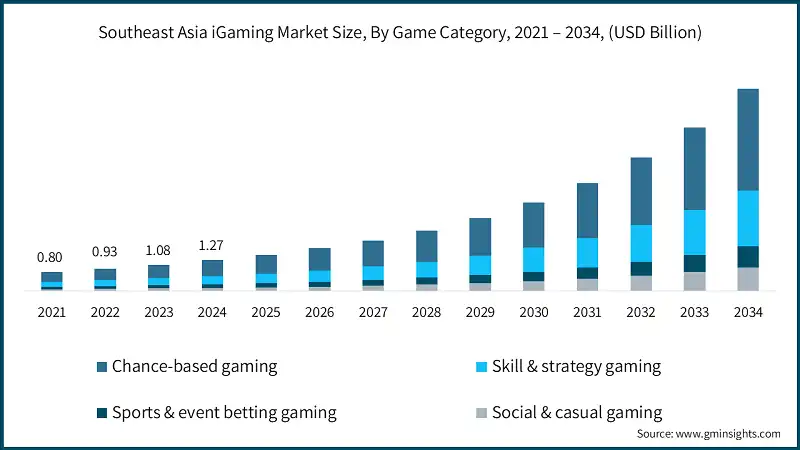
- Based on game category, the market is segmented into chance-based gaming, skill & strategy gaming, sports & event betting gaming, and social & casual gaming. In 2024, the chance-based gaming segment dominated the market and generated a revenue of USD 0.66 billion and is expected to grow at CAGR of around 20.7% during the forecast period 2025 to 2034.
- Chance-based games such as slots, roulette, and lottery-style formats do not necessitate prior skill, experience, or strategy. This creates an instant engagement with the game, increasing the likelihood of casual or first-time players getting involved.
- Traditional chance-based games like Bu Cua Cá Cp and Tài Xu are some of the most culturally salient forms of gambling for many gamblers in Boston, MA, especially Vietnamese, Thai, and Malaysian gamblers. Therefore, trust in the products is implicit, which leads to more regular engagement with online games and trust as a participant. These chance-based games provide an engaging, fast-paced, visual experience that is rewarding often and when you hit a jackpot. This aligns perfectly with the need for frivolous and entertaining games for mobile-first consumers who do not want to put a lot of effort into finding alternatives of entertainment.
- Top-shelf companies, such as Pragmatic Play, CQ9, and Habanero, market heavily in chance-based games through bonuses, free spins, and local themes that engage worthers but are also fun and ability-based. More often than not, these companies have established their businesses in situational online markets related to gambling where skill-based regulated, or sports-based gambling is less regulated or in some cases illegal (but more acceptable as a social norm), allowing them some sort of repetitive legality and UX strategy to network users that helps harvest legal status while later monetizing its products.
Learn more about the key segments shaping this market
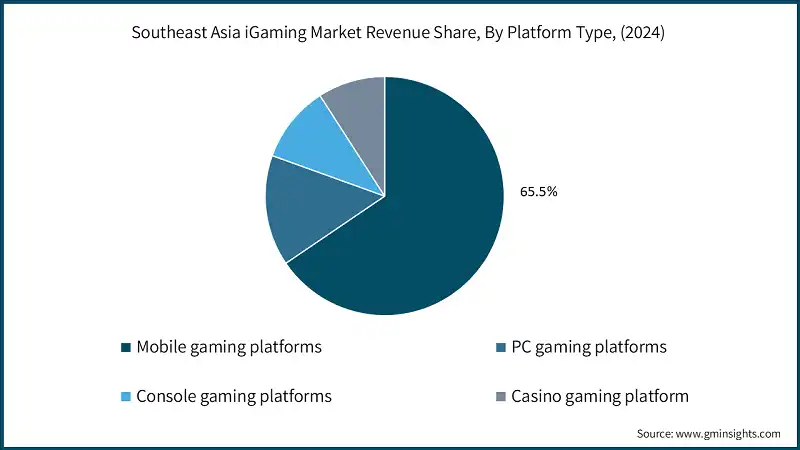
The Southeast Asia iGaming market by platform type is segmented into mobile gaming platforms, PC gaming platforms, console gaming platforms, and casino gaming platforms. The mobile gaming platforms segment was the leading segment in this market in 2024 with a revenue of USD 0.83 billion and has a market share of around 65.5%.
- As smartphones have become widely used across the globe, mobile games have become available to the largest number of users in history. With billions of mobile device owners, gaming is a cheap, convenient and on-the-go activity, which results in increased users' engagement and increased user monetization when compared to traditional gaming.
- Technological advancements in mobile processors, graphics, and networks (5G has recently helped this) have vastly improved the mobile gaming experience to compare favorably to PC and console gaming in both performance and visuals. Mobile games tend to use the freemium model where they let users play the game for free, while still making revenue from in-app purchases, advertisements, and microtransactions. This pricing model has many successes, considering game developers have had an incredible ability to monetize across large user bases.
- Mobile platforms also have the advantage of catering to the considerable number of casual gamers and social gaming experiences, which are not as prevalent on PC and console platforms. Games like online slots, card games, and fantasy sports work better on mobile than on PC or console due to their simple nature and social features. Centralized app stores (Google Play and the Apple App Store) give all developers their own distribution channel and marketing tools, and allow developers a way to potentially acquire users immensely faster and at a global scale all while unlocking revenue.
Looking for region specific data?
Philippines iGaming Market
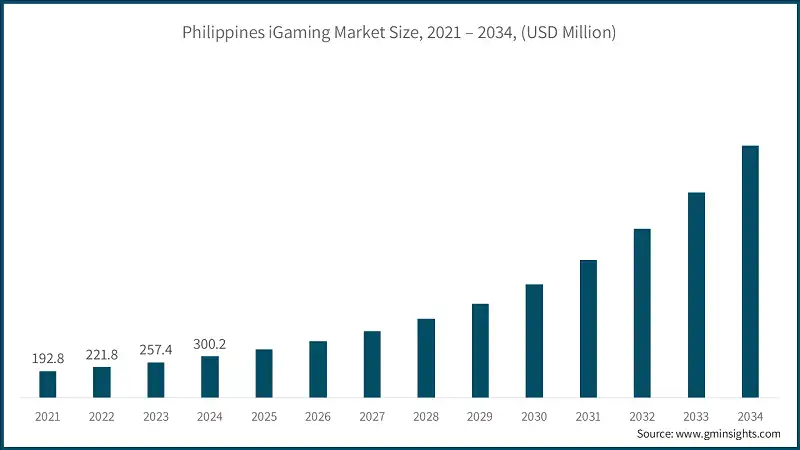
The Philippines igaming market was valued at around USD 300.2 million in 2024 and is anticipated to register a CAGR of 20.2% between 2025 and 2034.
- PAGCOR offers a well-defined governance framework that permits licensed operators to safely provide iGaming domestically and internationally.
- Philippines has positioned itself as the regional headquarters for offshore gaming businesses (POGOs) attracting worldwide businesses and creating jobs and infrastructure.
- Data show that the population is English fluent and tech-savvy, lending an ease of access for global operators to run localized content and customer service from the Philippines.
- Similarly, the government, as a revenue generator, has historically been favorable to the iGaming sector in terms of country and public policies, which provide relative stability compared to nearby countries.
- The combination of internet penetration and mobile usage provides the capacity for substantial access to online gaming, which leads to user engagement and market growth.
Vietnam iGaming Market
Vietnam witnessed fastest growing demand in the igaming market with a share of around 22.5% in 2024 and is expected to grow at a robust CAGR of 22.5% during the forecast period.
- Vietnam has a young population (average age ~32.8) and a prominent level of digital literacy with more than 79% of the population online and over 80% mobile utilization: demonstrating a large segment of the population who are active and likely to use iGaming sites.
- Mobile gaming is considered the core of the gaming ecosystem in Vietnam because everyone owns smartphones and data costs are extremely low. Notable games such as Free Fire and PUBG Mobile are among others, with mobile users averaging about 2.5 hours of play per day. Mobile has become the primary platform for any iGaming activity.
- The legal status of iGaming has recently changed with a full legal status on (Decree 147/2024) which bodes well for future legal iGaming within Vietnam, and it reflects the government's interest in liberalizing regulation to promote economic growth through liberalization and regulation, while protecting consumers and regulations that open the market to local and international operators.
- In years prior, developers in Vietnam have contributed more than 4.2 billion downloads across the world in mobile games, with the United States having the highest number of downloads ranking Vietnam as one of the top 5 mobile game producing countries in the world today. This kind of growth from local developers is also contributing the market that domestic producers are engaging in, and foreign investment in establishing iGaming activities.
Southeast Asia iGaming Market Share
- The top 5 companies in the igaming market, such as Evolution Gaming, SBOBET, Dafabet, Allbet Gaming, and Bet365 hold a market share of 40%.
- Evolution Gaming has solidified a base built on three strong pillars: product innovation, improved customer experience, and operational excellence. The company has disrupted the experience of online gambling through its focus on developing Live Casino products and the presentation values of game-show look and streaming technology sophistication. Acquiring companies like NetEnt and Red Tiger has only further strengthened its content library, and establishing partnerships with U.S. based operators like Bally’s has pushed Evolution Gaming quickly into new markets without relying on an existing infrastructure. Evolution Gaming has even set up a scalable technology infrastructure to reduce the friction of establishing studios around the world while still offering first-mover advantages in newly regulated markets.
- SBOBET's success can be attributed to its adoptability of technology and range of options. It originally started as a sports betting site and has since evolved into an all-encompassing iGaming site with consumer options that include casino games, live betting, and eSports. Engagement has skyrocketed through its mobile-first technology, live streaming, and real-time odds. SBOBET adds a level of trust and credibility against its competitors, through responsible gaming tools and regulatory compliance measures. When you add in AI and blockchain, SBOBET will be future-proof while expanding to new jurisdictions, new player bases and issuing options, and offering multi-currency and multi-language capabilities.
- Dafabet's strategy is based on regional customization and aggressive sponsorship strategies. The company has developed strong brand equity in Asia and Europe by sponsorship of football and cricket teams, including Celtic FC and the South African National Cricket Team. Esports-sponsored campaigns during big tournaments have attracted the younger generation, and the company uses data-driven betting technologies and financial tools, live streaming, and mobile apps to improve user experience. The company's expansion in India and Africa is predicated on localized payment systems and regulatory adaptation models so it can enter high-growth markets while keeping the platform safe and user friendly.
Southeast Asia iGaming Market Companies
Major players operating in the igaming market are:
- 888Casino
- Allbet Gaming
- Bet365
- CQ9 Gaming
- Dragoon Soft
- Evolution Gaming
- Gameplay Interactive
- Habanero Systems
- Maxbet
- Oriental Game
- Pinnacle Sports
- Playtech
- Pragmatic Play
- Sbobet
- Spade Gaming
Allbet Gaming benefits from its relationships in technology and flexible platform. The good partnership with METASOFT has made API integration and various wallets possible for operators looking for quick scalability. Allbet’s multi-play Baccarat platform, VIP tables and squeeze card function appeal to high rollers in markets that exhibit player preferences for Asia. The Platform also provides language options and 24 hour technical support, which appeals to B2B clients. Allbet’s resiliency stems from centers around customizing its offering, being optimally mobile, and the development of a growth strategy, which allows Allbet to pivot depending on each market conditions or consumer preferences.
Bet365's success comes from its early move to digital, its own technology stack, and its constant focus on the user experience. It started out as a physical betting shop in 2000, but it quickly moved to a fully online model. It has set the standard for in-play betting, cash-out options, and parlay boosts. Bet365 stays on top because it is privately owned, which lets it make long-term strategic investments without worrying about shareholders. It has grown into the U.S. by offering localized services and has set up a headquarters in Denver to help with this growth. Bet365 has more than 90 million users and is always producing innovative ideas. It is also looking into going public to raise money for more growth.
Southeast Asia igaming Market Report Attributes
| Key Takeaway | Details |
|---|---|
| Market Size & Growth | |
| Base Year | 2024 |
| Market Size in 2024 | USD 1.27 Billion |
| Market Size in 2025 | USD 1.49 Billion |
| Forecast Period 2025 – 2034 CAGR | 21% |
| Market Size in 2034 | USD 8.30 Billion |
| Key Market Trends | |
| Drivers | Impact |
| Regulatory expansion and state-level legalization | Legalization at the state level has legitimized iGaming, attracting investment and enabling operators to scale securely. It fosters consumer trust and encourages innovation under structured compliance |
| Shift toward digital and mobile gaming ecosystems | Mobile-first platforms have boosted user engagement and monetization. Enhanced accessibility and personalization drive retention, making mobile the dominant channel for growth. |
| Economic contribution and tax revenue generation | iGaming generates substantial tax revenue and employment, strengthening its role in public finance. This economic impact incentivizes further legalization and institutional partnerships. |
| Pitfalls & Challenges | Impact |
| Presence of unlicensed and illegal operators | Unlicensed platforms erode user trust and divert revenue from legitimate businesses. They increase fraud risks and force licensed operators to spend more on compliance and security. |
| Labor Volatility and Talent Shortages | Talent shortages and high turnover disrupt innovation and regulatory adaptation. Smaller firms struggle to compete for skilled professionals, slowing growth and increasing operational risk. |
| Opportunities: | Impact |
| Integration of Blockchain and Web3 Technologies | If adopted at scale, blockchain could enhance user trust, especially in markets plagued by fraud and opaque practices. It would also reduce dependency on centralized payment systems, lowering transaction fees and improving accessibility in underbanked regions. Moreover, tokenized reward systems could drive long-term user engagement and open up new monetization models through NFTs and digital assets. |
| Expansion into Emerging Markets (Southeast Asia) | Strategic entry into these markets could yield high-volume user acquisition at low cost. Localization of content, payment systems, and language support would allow operators to build brand loyalty and capture early-mover advantages. Additionally, partnerships with local telecoms and fintech firms could accelerate distribution and compliance, ensuring sustainable growth. |
| Market Leaders (2024) | |
| Market Leaders |
7.3% |
| Top Players |
Collective market share in 2024 is 40% |
| Competitive Edge |
|
| Regional Insights | |
| Largest Market | Philippines |
| Fastest growing market | Vietnam |
| Emerging countries | Malaysia, Indonesia, and Thailand |
| Future outlook |
|
What are the growth opportunities in this market?
Southeast Asia iGaming Industry News
- In March 2025, Thailand's Cabinet approved the Entertainment Complex Act. This was a momentous change from the country's long-standing ban on gambling activities. The new law allows gambling in a controlled way to bring in wealthy tourists and make money for the government through high taxes and entry barriers. The law sets strict standards, such as requiring Thai citizens to have at least $1.5 million in their bank accounts to enter a casino.
- It also imposes a 17% tax on gaming operations and requires full responsible gambling measures, such as self-exclusion programs and spending limits. The Entertainment Complex framework is meant to combine casino operations with high-end hotels, stores, and entertainment venues. Its goal is to attract wealthy domestic consumers and international tourists, not to make it easier for more people to gamble. The timeline for putting the plan into action includes a long licensing process run by a new group called the Entertainment Complex Regulatory Authority. The first licensed facilities are expected to open in late 2025 or early 2026, but only after the regulatory infrastructure has been built and the operators have been chosen. The law includes rules for sharing money between national and local governments, assessing the effects on communities, and requiring people to pay for programs that treat and prevent problem gambling.
- In January 2025, at a ministerial meeting in Langkawi, Malaysia, ASEAN member countries reinforced their commitments to address the problem of illegal online gambling. China committed to enhanced collaboration with ASEAN and to provide technical assistance to dismantle criminal syndicates operating in the region across national borders. The Chinese Foreign Minister Wang Yi, announced stronger relationships among law enforcement in China and foreign countries that would improve information sharing capabilities, cooperation in the investigation of cases, and the execution of operations against fraud networks with ties to human trafficking and forced labor, particularly along the Myanmar-Thailand border.
- The ministers agreed to form specialized ASEAN Working Groups to deal with money laundering associated with online gambling, agreed to harmonize anti-money laundering legislation, and made it more difficult for financial institutions to process gambling-related transactions through more rigorous Customer Due Diligence practices. This enhanced cooperative framework builds upon the October 2024 ASEAN-China Joint Statement on illegal online gambling, and provides mechanisms to facilitate the sharing of information in real time, coordinated border management, and joint prosecution of cross-border gambling offences.
- In October 2024, the ASEAN-China Joint Statement on Combating Telecommunication Network Fraud and Online Gambling was signed at the 27th ASEAN-China Summit, representing a comprehensive and collaborative regional framework to tackle the issue of online gambling as a transnational security threat, which can entail other transnational crimes, such as money laundering, drug trafficking, and human trafficking. The framework will include the establishment of dedicated anti-fraud and anti-gambling centers in each participating country to facilitate coworking on anti-fraud and anti-gambling efforts, quick communication mechanisms to share information electronically between law enforcement bodies in their respective countries, and improved transnational border management and coordination to prevent the migrant networks that support criminal operations, as well as joint police operations against multimillion-dollar cross-border criminal empires.
- China committed itself to developing technical assistance, training programs, and the ability to share intelligence with ASEAN member states to combat illegal gambling, specifically associated with the targeting of Chinese nationals and the involvement of Chinese payment systems. The cooperation framework is an important step up for regional coordination to counter cross-border gambling crimes, already producing early successes such as the repatriation of more than 31,000 telecom fraud suspects from Myanmar back to China in 2023 (deemed by some media outlets as the largest repatriation of its kind) and taking down multiple scams by dismantling one of the largest scam operations in northern Myanmar associated with forced labor and human trafficking.
- In July 2024, President Ferdinand Marcos Jr. declared the full ban of Philippine Offshore Gaming Operators (POGOs) in his State of the Nation Address, effectively ending an era of POGO generated revenue that peaked at USD 1.8 billion in 2019, but with untold association with extensive criminal acts including torture, human trafficking, and suspected espionage by CSIS. By the second half of 2024, POGOs were systematically closed down, with investigations by the government revealing that of the total POGO cash flows of USD 930 million, USD 240 billion were tagged as suspicious transactions and linked to organized crime networks by CSIS.
- The ban, initiated a change in the policy of the Philippines by switching from valuing offshore gaming as a source of Chinese investment and tourism revenue to adopting a national situation priority based on national security, given the network connection that authorities documented between POGO operations and crime networks that threatened the integrity of the country's finances and social stability. Once the ban was in process, a process of shutdown began that coordinated the efforts of several government agencies including the Bureau of Internal Revenue, Bangko Sentral ng Pilipinas, and law enforcement agencies to coordinate proper tax collection, asset recovery, and prevent their migration to other jurisdictions and infiltrating crime networks to move to other jurisdictions.
The Southeast Asia iGaming market research report includes in-depth coverage of the industry, with estimates & forecasts in terms of revenue (USD Billion) from 2021 to 2034, for the following segments:
Market, By Game Category
- Chance-based gaming
- Traditional dice games
- Bu Cua Cá Cp
- Tài Xu
- Other Dice Games
- Traditional card games
- Localized live dealer games
- Modern digital casino games
- Traditional dice games
- Skill & strategy gaming
- Regional skill-based games
- Tongits
- Pusoy
- Ti Lên
- Thai Card Variants
- Others
- Poker and international card games
- Other (Skill-based tournaments, etc.)
- Regional skill-based games
- Sports & event betting gaming
- Traditional sports
- Football
- Basketball
- Badminton
- Others
- Esports and virtual sports
- Cultural event betting
- Xóca
- Sabong
- Muay Thai
- Others
- Traditional sports
- Social & casual gaming
Market, By Platform Type
- Mobile gaming platforms
- PC gaming platforms
- Console gaming platforms
- Casino gaming platform
Market, By Participant Tier
- VIP/High Rollers
- Regular Players
- Casual Players
- Micro Players
The above information is provided for the following countries:
- Philippines
- Vietnam
- Thailand
- Malaysia
- Indonesia
- Singapore
- Rest of Southeast Asia
Frequently Asked Question(FAQ) :
What was the market size of the Southeast Asia iGaming market in 2024?
The market size was USD 1.27 billion in 2024, with a CAGR of 21% expected through 2034, driven by regulatory clarity and the expansion of mobile gaming platforms.
What is the projected value of the Southeast Asia iGaming market by 2034?
The market is expected to reach USD 8.30 billion by 2034, fueled by advancements in mobile gaming, increased internet penetration, and robust enforcement against illegal gambling operations.
What is the projected size of the Southeast Asia iGaming market in 2025?
The market is expected to reach USD 1.49 billion in 2025.
How much revenue did the chance-based gaming segment generate in 2024?
The chance-based gaming segment generated USD 0.66 billion in 2024, dominating the market and is projected to grow at a CAGR of approximately 20.7% from 2025 to 2034.
What was the valuation of the mobile gaming platforms segment in 2024?
The mobile gaming platforms segment generated USD 0.83 billion in 2024, holding a market share of around 65.5%.
What was the valuation of the Philippines iGaming market in 2024?
The Philippines iGaming market was valued at approximately USD 300.2 million in 2024 and is anticipated to register a CAGR of 20.2% between 2025 and 2034.
What are the upcoming trends in the Southeast Asia iGaming industry?
Key trends include the establishment of ASEAN-China anti-fraud and anti-gambling frameworks, the dismantling of illegal gambling networks, and the growing dominance of mobile gaming platforms.
Who are the key players in the Southeast Asia iGaming market?
Key players include 888Casino, Allbet Gaming, Bet365, CQ9 Gaming, Dragoon Soft, Evolution Gaming, Gameplay Interactive, Habanero Systems, Maxbet, Oriental Game, Pinnacle Sports, Playtech, and Pragmatic Play.
Southeast Asia igaming Market Scope
Related Reports