Summary
Table of Content

Solid-State LiDAR Semiconductor Components Market
Get a free sample of this report
Form submitted successfully!
Error submitting form. Please try again.
Thank you!
Your inquiry has been received. Our team will reach out to you with the required details via email. To ensure that you don't miss their response, kindly remember to check your spam folder as well!
Request Sectional Data
Thank you!
Your inquiry has been received. Our team will reach out to you with the required details via email. To ensure that you don't miss their response, kindly remember to check your spam folder as well!
Form submitted successfully!
Error submitting form. Please try again.
Solid-State LiDAR Semiconductor Components Market Size
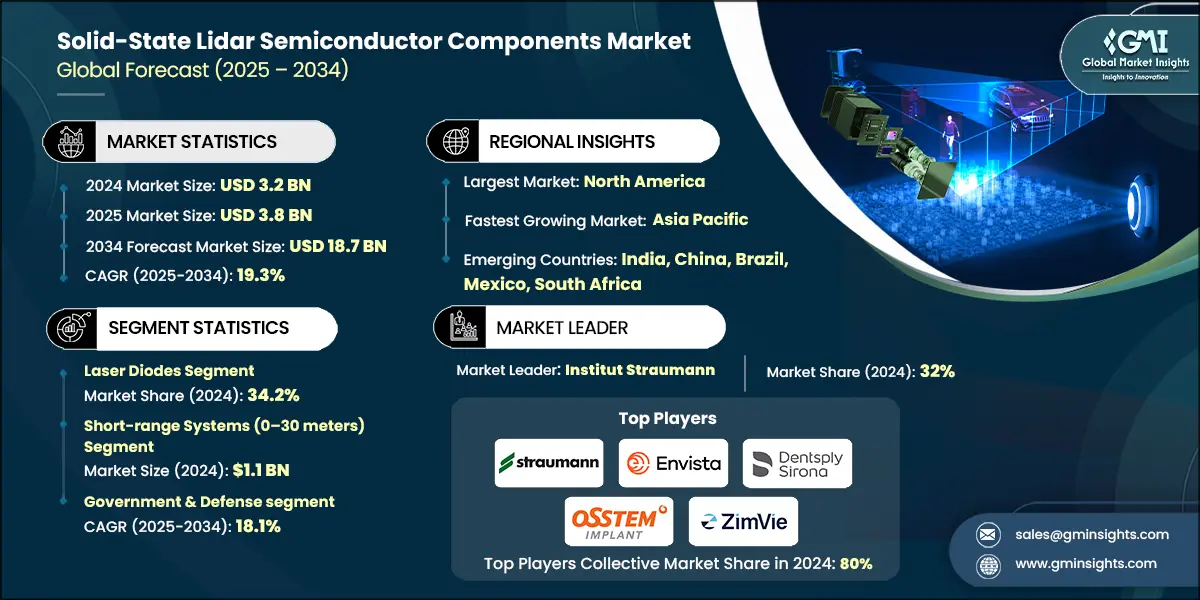
The global solid-state LiDAR semiconductor components market was valued at USD 3.2 billion in 2024. The market is expected to grow from USD 3.8 billion in 2025 to USD 18.7 billion in 2034, at a CAGR of 19.3% during the forecast period, according to the latest report published by Global Market Insights Inc. The growing need for solid-state LiDAR semiconductor components is driven by the rising adoption of autonomous vehicles, advanced driver-assistance systems (ADAS), and industrial automation. Solid-state LiDAR offers higher reliability, compact size, and lower cost compared to mechanical systems. Its semiconductor-based design enables faster data acquisition, better durability, and easier integration into vehicles and robots, supporting precise 3D mapping, object detection, and navigation in complex environments.
Solid-State LiDAR Semiconductor Components Market Key Takeaways
Market Size & Growth
- 2024 Market Size: USD 3.2 Billion
- 2025 Market Size: USD 3.8 Billion
- 2034 Forecast Market Size: USD 18.7 Billion
- CAGR (2025–2034): 19.3%
Regional Dominance
- Largest Market: North America
- Fastest Growing Region: Asia Pacific
Key Market Drivers
- Increasing elderly population worldwide.
- Growing prevalence of dental disorders across the globe.
- Rising demand for cosmetic dentistry.
- Advancements in implant technologies in developed countries.
Challenges
- Limited reimbursement policies.
- High cost of dental implant treatment.
Opportunity
- Shift towards minimally invasive procedures.
- Expansion of dental tourism in emerging countries.
Key Players
- Market Leader: Institut Straumann led with over 32% market share in 2024.
- Leading Players: Top 5 players in this market include Institut Straumann, Envista Holdings Corporation, Dentsply Sirona, Osstem Implant, ZimVie, which collectively held a market share of 80% in 2024.
Get Market Insights & Growth Opportunities
The growing adoption of autonomous and semi-autonomous vehicles is fueling the demand for solid-state LiDAR semiconductor components. These components offer precise object detection and mapping, enabling safe navigation in complex environments. For instance, in March 2024, Semilux International Ltd. announced the launch of a strategic R&D collaboration program focused on developing solid-state automotive LiDAR modules, aiming to advance autonomous driving technology. This initiative is designed to enhance LiDAR performance by improving detection accuracy, range, and integration with vehicle sensors, as automakers are increasingly integrating solid-state LiDAR for Level 3–5 automation, driving large-scale semiconductor demand across global automotive supply chains.
The expansion of ADAS in modern vehicles is boosting the use of solid-state LiDAR semiconductor components. Their compact design, low power consumption, and high-resolution sensing make them ideal for lane detection, collision avoidance, and adaptive cruise control. OEMs are integrating these semiconductors to enhance real-time environmental perception accuracy and safety. For instance, in April 2025, LeddarTech, a leading provider of sensing technology for ADAS and autonomous driving applications from Level 1 to Level 5, launched Leddar Sight, a durable and cost-effective 2D solid-state LiDAR sensor. The new sensor is designed with a windproof and rainproof housing, ensuring reliable operation in harsh environmental conditions.
Between 2021 and 2023, the solid-state LiDAR semiconductor components market experienced significant growth, rising from USD 1.8 billion in 2021 to USD 2.6 billion in 2023. A major trend during this period was that growing investments in industrial automation and robotics are driving the use of solid-state LiDAR semiconductor components. For instance, in December 2024, SOLiDUE launched the high-resolution LiDAR sensor IC, the SL-2.2, designed for integration into autonomous vehicles, drones, and robotics. The SL-2.2 offers enhanced detection accuracy, faster data processing, and improved power efficiency, enabling precise 3D mapping and obstacle detection in dynamic environments. Moreover, robots equipped with LiDAR sensors use these semiconductors for obstacle detection and spatial awareness, improving operational efficiency. Demand from sectors like logistics, warehousing, and manufacturing is increasing, supported by advancements in compact and cost-effective solid-state designs.
Rapid urbanization and smart city projects are fueling the need for accurate 3D mapping and surveillance systems powered by solid-state LiDAR semiconductors. These components enable high-speed, detailed spatial data collection for traffic management, construction monitoring, and environmental assessment, enhancing infrastructure planning and real-time urban intelligence systems globally. For instance, in April 2025, The Government of India has implemented aircraft-mounted LiDAR technology under its “3-D Urban Spatial Digital Twin” project to improve urban planning and disaster management. By mapping around 160 square kilometers, the system identifies flood-prone areas and vulnerable structures, enabling efficient relief planning and supporting smart city infrastructure development.
Continuous innovations in semiconductor fabrication, including silicon photonics and MEMS-based LiDAR, are reducing production costs and improving reliability. Manufacturers such as Velodyne, Luminar, and Innoviz are introducing compact, scalable solid-state LiDAR units, making them more accessible across automotive, drone, and consumer electronics markets, driving widespread market penetration and adoption. For instance, in December 2024, Luminar acquired the laser module unit from Gooch & Housego (G&H) to strengthen its semiconductor business arm. This acquisition enables vertical integration of key optoelectronic components such as laser modules, photodetectors, and chips, supporting Luminar’s expansion into the semiconductor segment of its solid-state LiDAR operations and enhancing production efficiency.
To get key market trends
Solid-State LiDAR Semiconductor Components Market Trends
- A key trend shaping the solid-state LiDAR semiconductor components industry is the integration of artificial intelligence (AI) and machine learning (ML) for advanced perception and object recognition. These technologies enable LiDAR systems to process real-time 3D spatial data with higher precision, improving detection accuracy, navigation safety, and decision-making in autonomous and connected vehicles.
- For instance, in 2025, Hesai Technology collaborated with NVIDIA to develop AI-powered LiDAR systems that enhance environmental perception for autonomous vehicles. The partnership focuses on integrating high-performance semiconductor components such as laser diodes, photodetectors, and ASICs to improve data processing speed, range accuracy, and energy efficiency in real-time driving scenarios.
- Regulatory initiatives promoting road safety, emission reduction, and intelligent transport systems are supporting the adoption of LiDAR-based sensing technologies. Governments worldwide are encouraging the use of solid-state LiDAR components in next-generation vehicles to enhance collision avoidance, adaptive cruise control, and pedestrian detection, fostering innovation in semiconductor manufacturing.
- Growing deployment of LiDAR in robotics, drones, and industrial automation is expanding market reach. Solid-state LiDAR semiconductor components are increasingly used for 3D mapping, area surveillance, and logistics operations, where lightweight design, low power consumption, and high durability are critical for reliable performance across diverse environmental conditions.
- Another major trend is the miniaturization of LiDAR modules using semiconductor integration technologies. Manufacturers are leveraging silicon photonics and compound semiconductors like GaN and InP to produce compact, cost-efficient, and scalable LiDAR sensors, enabling broader adoption across automotive, consumer electronics, and smart infrastructure applications.
- Investment in semiconductor fabrication and packaging innovation is accelerating the development of high-speed, thermally stable LiDAR components. Companies are focusing on hybrid integration of laser transmitters, photonic ICs, and signal processors to improve sensing range, resolution, and cost efficiency, positioning LiDAR as a mainstream technology for autonomous systems.
- Continuous collaboration between semiconductor firms, automotive OEMs, and LiDAR technology developers is strengthening product reliability and performance consistency. Joint efforts are leading to standardization in LiDAR component design, enhancing interoperability and fostering the development of high-volume, automotive-grade LiDAR semiconductor platforms.
- Thus, with growing demand for intelligent sensing, autonomous navigation, and advanced safety systems, the solid-state LiDAR semiconductor components market is poised for robust growth. Its integration across vehicles, drones, and smart infrastructure will redefine spatial intelligence, efficiency, and safety in next-generation mobility ecosystems.
Solid-State LiDAR Semiconductor Components Market Analysis
Learn more about the key segments shaping this market
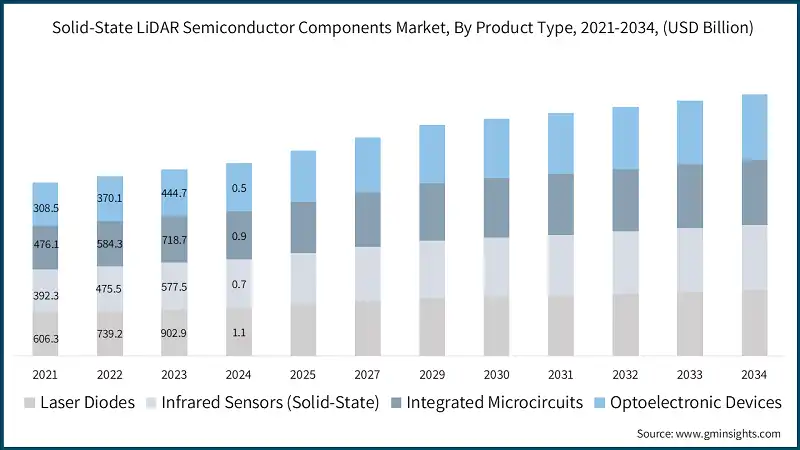
The global market was valued at USD 1.8 billion and USD 2.2 billion in 2021 and 2022, respectively. The market size reached USD 3.2 billion in 2024, growing from USD 2.6 billion in 2023.
Based on the product type, the global solid-state LiDAR semiconductor components market is divided into laser diodes, infrared sensors (solid-state), integrated microcircuits, and optoelectronic devices. The laser diodes segment accounted for 34.2% of the market in 2024.
- The laser diodes segment holds the largest share in the solid-state LiDAR semiconductor components industry due to their critical role in light emission and distance measurement. Their ability to deliver precise, high-intensity beams enables accurate 3D mapping and object detection, making them essential for automotive, robotics, and industrial LiDAR applications.
- Manufacturers should focus on developing high-efficiency, cost-effective laser diodes with improved thermal stability, compact design, and longer operational life. Investing in advanced materials like gallium nitride (GaN) and indium phosphide (InP) can enhance performance, reduce energy loss, and meet the growing demand for reliable LiDAR systems in autonomous vehicles and smart infrastructure.
- The infrared sensor (solid-state) segment of the solid-state LiDAR semiconductor components market, valued at USD 700 million in 2024 and projected to grow at a CAGR of 18.9%, is driven by the increasing adoption of LiDAR systems in autonomous vehicles, robotics, and smart infrastructure. Infrared sensors play a vital role in detecting objects, measuring distance, and enhancing spatial awareness in low-light and challenging weather conditions. Their solid-state design offers durability, faster response times, and reduced maintenance compared to mechanical systems. Growing demand for high-resolution imaging, advanced driver assistance systems (ADAS), and precise environmental mapping further accelerates the adoption of infrared sensors.
- Manufacturers should focus on advancing infrared sensor efficiency through improved wavelength sensitivity, miniaturization, and integration with AI-based signal processing. Investing in innovative semiconductor materials and packaging can enhance accuracy, range, and energy efficiency, enabling reliable performance in autonomous vehicles, drones, and smart city applications where precision and durability are critical.
Based on the performance tier / range class, the solid-state LiDAR semiconductor components market is segmented into short-range systems (0–30 meters), medium-range systems (30–150 meters), long-range systems (150–300 meters), and ultra-long-range systems (300+ meters). The short-range systems (0–30 meters) segment dominated the market in 2024 with a revenue of USD 1.1 billion.
- Short-range systems (0–30 meters) account for the largest share of the market due to their widespread use in advanced driver assistance systems (ADAS), robotics, and industrial automation. These systems are ideal for applications requiring precise object detection, collision avoidance, and navigation in confined or urban environments. Their compact design, lower power consumption, and cost-effectiveness make them suitable for integration into mass-produced vehicles and drones. The increasing deployment of parking assistance, blind-spot detection, and pedestrian safety systems further supports their adoption. Continuous advancements in semiconductor miniaturization and optical integration are enhancing short-range LiDAR system accuracy and reliability.
- Manufacturers should focus on developing cost-efficient, miniaturized semiconductor components that enhance short-range LiDAR performance. Emphasis should be placed on improving detection precision, response time, and integration with ADAS platforms. Advancing chip design, optical alignment, and power efficiency will help meet the growing demand for compact, high-performance LiDAR in automotive and robotics applications.
- Medium-range systems (30–150 meters) are anticipated to witness significant growth at a CAGR of 20.9% over the analysis period, reaching USD 6 billion by 2034. This growth is driven by the rising adoption of LiDAR technology in autonomous vehicles, smart traffic management, and industrial automation. Medium-range LiDAR provides optimal balance between detection distance and resolution, enabling reliable obstacle detection and adaptive cruise control in varied driving conditions. Increasing demand for mid-range sensing in logistics robots, drones, and infrastructure monitoring is further fueling adoption. Continuous improvements in semiconductor lasers, photodetectors, and signal processing ICs are enhancing system efficiency and cost-effectiveness.
- Manufacturers should focus on advancing semiconductor integration and optimizing optical design to improve medium-range LiDAR performance. Efforts should emphasize enhancing detection range, resolution, and energy efficiency while reducing production costs. Developing scalable, automotive-grade LiDAR components will support broader deployment across autonomous vehicles, drones, and intelligent infrastructure applications worldwide.
Learn more about the key segments shaping this market
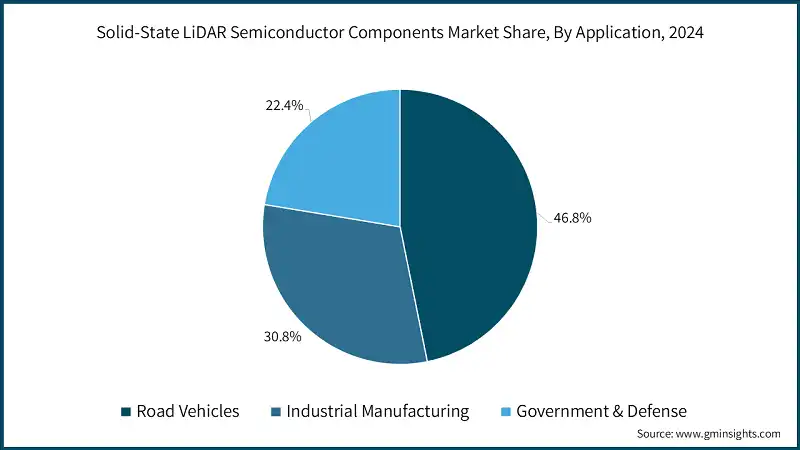
- Road Vehicles dominate the solid-state LiDAR semiconductor components market due to the rapid adoption of advanced driver assistance systems (ADAS) and autonomous driving technologies. LiDAR enables precise 3D mapping, object detection, and real-time navigation, which are essential for vehicle safety and automation. Increasing integration of LiDAR in electric and premium vehicles for features like adaptive cruise control, collision avoidance, and lane-keeping systems further boosts demand. Continuous advancements in semiconductor lasers, detectors, and processing ICs are enhancing system reliability and cost efficiency.
- Manufacturers should focus on developing high-performance, cost-effective LiDAR semiconductor components optimized for automotive applications. Emphasis should be on enhancing range accuracy, signal processing speed, and sensor durability. Collaborations with automakers and research institutions can accelerate innovation in compact, energy-efficient LiDAR modules tailored for next-generation ADAS and autonomous driving systems.
- On the other hand, the government & defense segment in the solid-state LiDAR semiconductor components market is anticipated to grow at a CAGR of 18.1% during the forecast period. This growth is driven by increasing adoption of LiDAR technology for surveillance, mapping, and target detection. Governments are integrating LiDAR into defense vehicles, drones, and border monitoring systems for enhanced situational awareness and threat detection. The need for high-precision terrain mapping, mission planning, and infrastructure security is further boosting demand. Advancements in semiconductor-based laser diodes, photodetectors, and signal processors are improving data accuracy, reliability, and durability, making LiDAR essential for modern defense and homeland security applications.
- Manufacturers should focus on developing rugged, high-performance LiDAR semiconductor components tailored for defense and government applications. Priorities include enhancing sensor range, reliability, and resistance to extreme environments. Investing in advanced semiconductor materials and AI-integrated signal processing can strengthen LiDAR performance for surveillance, mapping, and security operations in mission-critical conditions.
Looking for region specific data?
North America Solid-State LiDAR Semiconductor Components Market
The North America market dominated the global market with a industry share of 29.4% in 2024.
- The North America solid-state LiDAR semiconductor components market is driven by the growing adoption of autonomous vehicles, advanced driver assistance systems (ADAS), and smart infrastructure projects. Strong investments in automotive innovation, robotics, and defense technologies are fueling demand for high-performance LiDAR components. Additionally, supportive government regulations, technological advancements in semiconductor manufacturing, and presence of key LiDAR developers strengthen the region’s market growth and commercialization potential.
- Manufacturers in North America are focusing on developing compact, energy-efficient, and cost-effective semiconductor components to meet the rising demand for solid-state LiDAR systems. They are investing in R&D to enhance laser precision, detector sensitivity, and signal processing speed, while collaborating with automakers and defense agencies to accelerate large-scale deployment and commercialization.
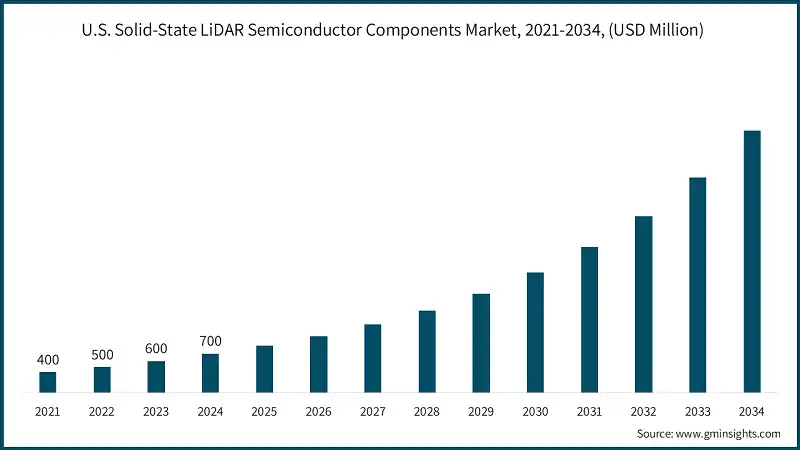
The U.S. market was valued at USD 400 million and USD 500 million in 2021 and 2022, respectively. The market size reached USD 700 million in 2024, growing from USD 600 million in 2023.
- The U.S. continues to dominate the solid-state LiDAR semiconductor components market, driven by strong investments in autonomous vehicle development, defense modernization, and smart city projects. The presence of leading semiconductor and LiDAR manufacturers, along with government support for safety and automation technologies, further strengthens the country’s market leadership.
- Manufacturers in the U.S. are focusing on advancing semiconductor integration, improving laser diode efficiency, and enhancing sensor durability to meet the growing demand from automotive and defense sectors. They are also investing in R&D collaborations and expanding production capabilities to support large-scale deployment of high-performance, cost-effective solid-state LiDAR solutions.
Europe Solid-State LiDAR Semiconductor Components Market
Europe market accounted for USD 700 million in 2024 and is anticipated to show lucrative growth over the forecast period.
- Europe holds a significant share of the global solid-state LiDAR semiconductor components industry, driven by the growing adoption of autonomous vehicles, smart mobility initiatives, and industrial automation. Strong government regulations promoting vehicle safety and sustainability, along with technological advancements in semiconductor fabrication, further support the region’s expanding LiDAR deployment across multiple sectors.
- Manufacturers in Europe are concentrating on developing compact, energy-efficient, and cost-effective solid-state LiDAR components to meet rising demand from automotive and industrial sectors. They are partnering with automakers and research institutes to enhance sensor integration and performance, while expanding local production capabilities to align with regional safety and automation standards.
UK dominates the Europe market, showcasing strong growth potential.
- Within Europe, the U.K. holds a substantial share of the solid-state LiDAR semiconductor components market due to its strong focus on autonomous vehicle testing, defense modernization, and smart infrastructure development. Government initiatives supporting advanced mobility technologies and R&D funding for semiconductor innovation are accelerating adoption. The presence of key LiDAR startups and collaborations between universities and industry players further boost technological advancement and commercialization in the country.
- Manufacturers in the U.K. are focusing on developing cost-efficient and compact LiDAR semiconductor components optimized for autonomous vehicles and defense systems. They are collaborating with research institutions and government programs to enhance sensor accuracy, range, and integration capabilities, ensuring reliable performance across mobility, surveillance, and infrastructure applications in evolving market conditions.
Asia Pacific Solid-State LiDAR Semiconductor Components Market
The Asia-Pacific market is anticipated to grow at the highest CAGR of 19.6% during the analysis timeframe.
- The Asia-Pacific region is experiencing rapid growth in the global solid-state LiDAR semiconductor components industry, driven by the expanding adoption of autonomous vehicles, advanced driver assistance systems (ADAS), and robotics across China, Japan, and South Korea. Strong government support for smart mobility initiatives, increasing investment in semiconductor manufacturing, and the rise in industrial automation and infrastructure mapping projects are further fueling market expansion across the region.
- Manufacturers should focus on developing cost-efficient, high-performance semiconductor solutions tailored for regional automotive and industrial applications. Collaborating with local OEMs, investing in R&D centers, and strengthening supply chain partnerships in Asia-Pacific can enhance competitiveness. Emphasizing miniaturization, reliability, and energy efficiency will further align with the region’s growing demand for LiDAR integration.
China solid-state LiDAR semiconductor components market is estimated to grow with a significant CAGR 20.1% from 2025 to 2034, in the Asia Pacific market.
- China dominates the Asia-Pacific solid-state LiDAR semiconductor components industry, driven by its strong automotive manufacturing base, rapid adoption of autonomous and electric vehicles, and significant government initiatives supporting smart transportation and AI integration. The country’s expanding semiconductor ecosystem, coupled with heavy investments in LiDAR R&D and local production, enables cost-effective innovation, making China a key hub for advanced sensing technologies across automotive, industrial, and infrastructure applications.
- Manufacturers should focus on partnering with Chinese automakers and technology firms to co-develop LiDAR-enabled systems optimized for local vehicle platforms. Establishing regional R&D centers, leveraging government incentives, and ensuring supply chain localization can enhance competitiveness. Emphasizing scalability, affordability, and integration with AI-based sensing platforms will strengthen their position in China’s evolving mobility market.
The Latin America solid-state LiDAR semiconductor components market, valued at USD 200 million in 2024, is driven by growing adoption of smart mobility, autonomous systems, and infrastructure modernization initiatives across major economies.
The Middle East and Africa market is projected to reach USD 250 million by 2034, driven by increasing investment in smart city projects, autonomous transportation systems, industrial automation, and infrastructure monitoring initiatives supported by regional governments and technology collaborations.
UAE solid-state LiDAR semiconductor components market to experience substantial growth in the Middle East and Africa market in 2024.
- The UAE is demonstrating significant growth potential in the Middle East and Africa solid-state LiDAR semiconductor components market, driven by government-led smart city initiatives, adoption of autonomous mobility solutions, and investments in AI and digital infrastructure. Expanding use of LiDAR in construction, logistics, and surveillance, along with partnerships between global semiconductor firms and local tech innovators, further boosts market development.
- Manufacturers should focus on collaborating with UAE-based mobility and infrastructure developers to design LiDAR semiconductor components suited for regional applications. Establishing local partnerships, demonstration projects, and R&D collaborations can strengthen market presence. Prioritizing compact, energy-efficient, and cost-effective designs will align with the country’s vision for smart mobility and urban innovation.
Solid-State LiDAR Semiconductor Components Market Share
The competitive landscape of the solid-state LiDAR semiconductor components industry is marked by technological advancement, strategic alliances, and continuous product innovation. Leading companies such as Velodyne LiDAR, Inc., Luminar Technologies, Inc., Hesai Technology Co., Ltd., Innoviz Technologies Ltd., and Aeva Technologies, Inc. together account for nearly 63% of the market share. These players focus on developing high-performance, cost-efficient solid-state LiDAR semiconductor components that enhance range, resolution, and reliability for automotive, industrial, and infrastructure applications. They are investing heavily in research and development to improve integration with ADAS and autonomous driving systems. Strategic partnerships with automakers, semiconductor foundries, and system integrators are enabling faster commercialization and scalability. Companies are also expanding manufacturing capabilities and adopting chip-level integration to reduce production costs.
In addition, emerging players and niche semiconductor developers are strengthening the solid-state LiDAR semiconductor components market by introducing compact, energy-efficient, and cost-effective chip solutions optimized for automotive and industrial sensing. Their innovations in laser emitters, photodetectors, and signal-processing ICs are driving higher accuracy and faster response rates. Collaborations with automakers, robotics firms, and smart infrastructure developers are accelerating large-scale deployment of LiDAR systems in autonomous vehicles, drones, and urban mobility projects, fostering technological advancement, safety, and intelligent navigation capabilities across multiple industries while enhancing overall system reliability and reducing production costs for next-generation sensing applications.
Solid-State LiDAR Semiconductor Components Market Companies
Prominent players operating in the solid-state LiDAR semiconductor components industry are as mentioned below:
- Velodyne LiDAR, Inc.
- Luminar Technologies, Inc.
- Aeva Technologies, Inc.
- Innoviz Technologies Ltd.
- Ouster, Inc.
- Quanergy Systems, Inc.
- LeddarTech Inc.
- Hesai Technology Co., Ltd.
- RoboSense (Suteng Innovation Technology Co., Ltd.)
- Sony Semiconductor Solutions Corporation
- Hamamatsu Photonics K.K.
- ams OSRAM AG
- STMicroelectronics N.V.
- Infineon Technologies AG
- ON Semiconductor Corporation (onsemi)
- Broadcom Inc.
- Texas Instruments Incorporated
- Analog Devices, Inc.
- II-VI Incorporated (now Coherent Corp.)
- Renesas Electronics Corporation
- Velodyne LiDAR, Inc.
Velodyne LiDAR, Inc. is a prominent player in the solid-state LiDAR semiconductor components market, holding an estimated 25% market share. The company focuses on developing high-performance semiconductor-based LiDAR systems that deliver precise 3D sensing, extended range, and superior spatial resolution for autonomous vehicles and smart infrastructure. Through extensive R&D and collaborations with global automakers, Velodyne continues to enhance semiconductor laser design, photodetector integration, and signal processing efficiency. Its innovations in solid-state architecture, reliability, and cost optimization strengthen its position in the expanding markets for automotive safety, robotics, and industrial automation applications. - Luminar Technologies, Inc.
Luminar Technologies, Inc. is a leading player in the solid-state LiDAR semiconductor components market, known for its advanced long-range sensing and high-resolution perception technologies. The company designs semiconductor solutions that enable accurate detection, object classification, and mapping for autonomous and electric vehicles. Luminar’s focus on low-power laser emitters, ASIC-based signal processing, and compact optical packaging improves system efficiency and scalability. Through partnerships with automakers and chip manufacturers, Luminar continues to drive LiDAR commercialization, offering enhanced safety, navigation accuracy, and cost-effective integration for next-generation mobility systems.
Hesai Technology Co., Ltd. holds a significant share of around 10% in the solid-state LiDAR semiconductor components market. The company specializes in developing reliable, cost-effective, and compact LiDAR semiconductors for automotive and industrial applications. Hesai’s advancements in laser transmitter modules, photodiode arrays, and signal processing ICs enable high-speed scanning and real-time perception in complex environments. Through strong R&D initiatives and collaborations with leading OEMs and Tier 1 suppliers, Hesai enhances LiDAR performance, supporting applications in autonomous vehicles, robotics, and infrastructure monitoring while contributing to the growth of intelligent sensing ecosystems.
Solid-State LiDAR Semiconductor Components Market Report Attributes
| Key Takeaway | Details |
|---|---|
| Market Size & Growth | |
| Base Year | 2024 |
| Market Size in 2024 | USD 3.2 Billion |
| Market Size in 2025 | USD 3.8 Billion |
| Forecast Period 2025 - 2034 CAGR | 19.3% |
| Market Size in 2034 | USD 18.7 Billion |
| Key Market Trends | |
| Drivers | Impact |
| Increasing elderly population worldwide | Fuels demand for dental implants due to age-related tooth loss and increased need for restorative dental care. |
| Growing prevalence of dental disorders across the globe | Drives adoption of implant as a long-term solution for missing or damaged teeth. |
| Rising demand for cosmetic dentistry | Boosts interest in aesthetically pleasing implant solutions. |
| Advancements in implant technologies in developed countries | Encourages uptake of innovative implant systems with improved osseointegration and minimally invasive placement techniques. |
| Pitfalls & Challenges | Impact |
| Limited reimbursement policies | Restricts access to implant treatments, especially in regions with low insurance coverage for dental procedures. |
| High cost of dental implant treatment | Hampers market growth in price-sensitive regions and among lower-income populations. |
| Opportunities: | Impact |
| Shift towards minimally invasive procedures | Promotes adoption of advanced implant systems and digital workflows that reduce surgical complexity and recovery time. |
| Expansion of dental tourism in emerging countries | Dental tourism opens new markets for affordable implant systems and boosts demand for high-quality yet cost-effective solutions. |
| Market Leaders (2024) | |
| Market Leaders |
32% market share |
| Top Players |
Collective market share in 2024 is 80% |
| Competitive Edge |
|
| Regional Insights | |
| Largest Market | North America |
| Fastest Growing Market | Asia Pacific |
| Emerging Countries | India, China, Brazil, Mexico, South Africa |
| Future outlook |
|
What are the growth opportunities in this market?
Solid-State LiDAR Semiconductor Components Industry News
- In February 2023, Luminar announced the launch of its new Iris+ LiDAR sensor, which features improved range and a slimmer design. The Iris+ sensor is specifically designed to enhance the capabilities of autonomous vehicles by providing them with precise and detailed 3D mapping of their surroundings.
- In May 2025, Aeva, a leader in next-generation sensing and perception systems, collaborated with a technology-focused affiliate of a Global Fortune 500 company. The aims of this collaboration is to expand the reach of Aeva’s 4D LiDAR technology into new industrial and consumer markets.
- In September 2025, Constellis, a leading provider of risk management and security services, has recently integrated Ouster's Gemini LiDAR technology and AI software into its LEXSO platform. This new partnership aims to enhance Constellis' capabilities in surveillance, threat detection, and security operations by leveraging Ouster's advanced LiDAR sensors for accurate and real-time 3D mapping.
The solid-state LiDAR semiconductor components market research report includes in-depth coverage of the industry with estimates and forecast in terms of revenue in USD Billion from 2021 – 2034 for the following segments:
Market, By Product/Component Type
- Laser Diodes
- Edge-Emitting Laser Diodes (EEL)
- Vertical-Cavity Surface-Emitting Lasers (VCSEL)
- Distributed Feedback (DFB) Laser Diodes
- Infrared Sensors (Solid-State)
- Single Photon Avalanche Diodes (SPAD)
- Avalanche Photodiodes (APD)
- Silicon Photomultipliers (SiPM)
- InGaAs Photodetectors
- CMOS Image Sensors
- Integrated Microcircuits
- Time-to-Digital Converters (TDC)
- Analog-to-Digital Converters (ADC)
- Transimpedance Amplifiers (TIA)
- Laser Driver Circuits
- Others
- Optoelectronic Devices
Market, By Performance Tier / Range Class
- Short-Range Systems (0–30 meters)
- Medium-Range Systems (30–150 meters)
- Long-Range Systems (150–300 meters)
- Ultra-Long-Range Systems (300+ meters)
Market, By Holographic Applications
- Road vehicles
- Industrial manufacturing
- Government & defense
The above information is provided for the following regions and countries:
- North America
- U.S.
- Canada
- Europe
- Germany
- UK
- France
- Spain
- Italy
- Netherlands
- Asia Pacific
- China
- India
- Japan
- Australia
- South Korea
- Latin America
- Brazil
- Mexico
- Argentina
- Middle East and Africa
- South Africa
- Saudi Arabia
- UAE
Frequently Asked Question(FAQ) :
What is the market size of the solid-state LiDAR semiconductor components industry in 2024?
The market size was USD 3.2 billion in 2024, with a CAGR of 19.3% expected through 2034 driven by the rising adoption of autonomous vehicles, ADAS, and industrial automation that rely on high-performance solid-state LiDAR sensors.
What is the current solid-state LiDAR semiconductor components market size in 2025?
The market size is projected to reach USD 3.8 billion in 2025.
What is the projected value of the solid-state LiDAR semiconductor components market by 2034?
The market is expected to reach USD 18.7 billion by 2034, driven by advancements in semiconductor fabrication, growing use of LiDAR in robotics and smart infrastructure, and increasing demand for compact, energy-efficient sensing solutions.
How much revenue did the laser diodes segment generate in 2024?
The laser diodes segment generated 34.2% market share in 2024, leading the market due to its critical role in precise light emission and distance measurement for autonomous and industrial LiDAR systems.
What was the valuation of the infrared sensor (solid-state) segment in 2024?
The infrared sensor segment was valued at USD 700 million in 2024, driven by growing use in autonomous vehicles and robotics for accurate detection and mapping even under low-light or adverse weather conditions.
What is the growth outlook for medium-range systems from 2025 to 2034?
The medium-range LiDAR systems (30–150 meters) segment is projected to grow at a CAGR of 20.9% through 2034, supported by adoption in autonomous driving, logistics, and smart traffic management applications.
Which region leads the solid-state LiDAR semiconductor components market?
North America held 29.4% share in 2024, dominating the global market. Growth is fueled by rapid development of autonomous vehicles, strong semiconductor R&D infrastructure, and major investments in ADAS and defense LiDAR systems.
What are the upcoming trends in the solid-state LiDAR semiconductor components industry?
Key trends include miniaturization of LiDAR modules using silicon photonics, AI-powered perception and mapping systems, and integration of LiDAR-on-chip architectures for enhanced range, precision, and energy efficiency.
Who are the key players in the solid-state LiDAR semiconductor components market?
Key players include Velodyne LiDAR, Luminar Technologies, Hesai Technology, Innoviz Technologies, Aeva Technologies, LeddarTech, Ouster, onsemi, STMicroelectronics, Infineon Technologies, and Hamamatsu Photonics.
Solid-State LiDAR Semiconductor Components Market Scope
Related Reports