Summary
Table of Content

Solid Carbide Tools Market
Get a free sample of this report
Form submitted successfully!
Error submitting form. Please try again.
Thank you!
Your inquiry has been received. Our team will reach out to you with the required details via email. To ensure that you don't miss their response, kindly remember to check your spam folder as well!
Request Sectional Data
Thank you!
Your inquiry has been received. Our team will reach out to you with the required details via email. To ensure that you don't miss their response, kindly remember to check your spam folder as well!
Form submitted successfully!
Error submitting form. Please try again.
Solid Carbide Tools Market Size
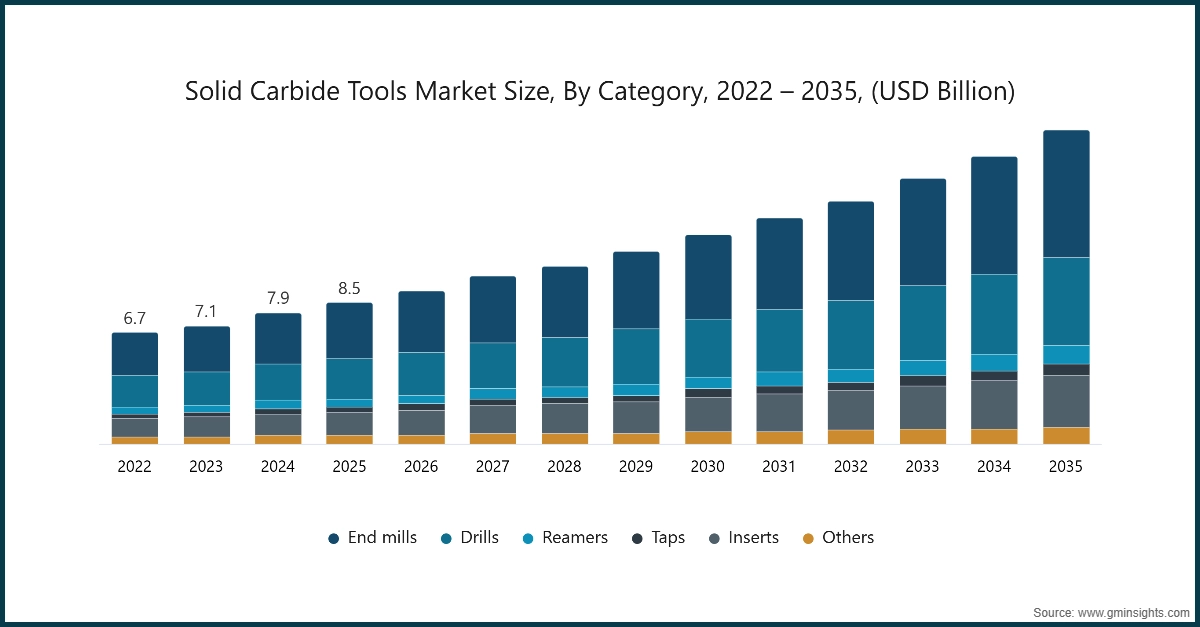
The solid carbide tools market was estimated at USD 8.5 billion in 2025. The market is expected to grow from USD 9.2 billion in 2026 to USD 18.8 billion in 2035, at a CAGR of 8.2%, according to latest report published by Global Market Insights Inc.
Solid Carbide Tools Market Key Takeaways
Market Size & Growth
- 2025 Market Size: USD 8.5 Billion
- 2026 Market Size: USD 9.2 Billion
- 2035 Forecast Market Size: USD 18.8 Billion
- CAGR (2026–2035): 8.2%
Regional Dominance
- Largest Market: Asia Pacific
- Fastest Growing Region: Asia Pacific
Key Market Drivers
- Rising adoption of CNC and advanced machining technologies.
- Expansion of industrial automation and smart factories.
- Increase in production of lightweight materials.
Challenges
- High cost of carbide tool materials and manufacturing.
- Availability of low-cost alternatives.
Opportunity
- Growth in additive manufacturing hybrid machining systems.
- Development of advanced coatings and surface treatments.
Key Players
- Market Leader: ISCAR led with over 11% market share in 2025.
- Leading Players: Top 5 players in this market include ISCAR, Walter Tools, Mitsubishi, Fullerton Tool, Harvey Tool, which collectively held a market share of 38% in 2025.
Get Market Insights & Growth Opportunities
- Rising adoption of CNC and advanced machining technologies is driving solid carbide tools market growth. Manufacturing industries increasingly implement precision machining systems to improve production accuracy and efficiency. CNC machines require high-performance cutting tools capable of maintaining dimensional consistency. Solid carbide tools provide superior hardness and wear resistance under high-speed machining conditions. Advanced machining operations demand tools that withstand elevated temperatures and continuous cutting cycles. Aerospace and automotive sectors rely on carbide tools for complex component fabrication. Precision engineering applications require consistent tool performance to minimize material waste. Automated machining environments increase demand for durable tools with longer operational lifespan. Manufacturers prioritize tooling solutions that support tighter tolerances and enhanced surface finish quality. Expansion of multi-axis machining centers strengthens procurement of specialized carbide cutting tools. Technology-driven manufacturing modernization accelerates replacement cycles for high-efficiency tooling systems.
- Expansion of industrial automation and smart factories is driving solid carbide tools market growth. Manufacturers are upgrading facilities with automated machining systems to enhance productivity and consistency. Automated production lines require precision cutting tools capable of delivering repeatable performance. Solid carbide tools support high-speed operations essential for digitally controlled manufacturing environments. Smart factories emphasize reduced downtime, increasing demand for durable and long-lasting tooling solutions. Integrated monitoring systems track tool wear, encouraging timely replacement and optimized machining efficiency. Industrial automation increases production volumes, strengthening consumption of cutting tools across facilities. Advanced robotics applications rely on precise machining supported by carbide tooling. Manufacturers prioritize tooling solutions compatible with sensor-enabled and data-driven production systems. Continuous process optimization encourages adoption of tools that maintain tight tolerances. Smart manufacturing investments accelerate procurement of high-performance carbide cutting solutions.
- End mills represent a major segment within the solid carbide tools market due to precision machining requirements. High hardness and wear resistance enable efficient cutting across metals and composites. Manufacturers rely on end mills for milling, slotting, and contouring operations. Superior heat resistance improves tool life during high-speed machining processes. Compatibility with CNC machines enhances productivity and dimensional accuracy. Automotive and aerospace industries drive strong demand for carbide end mills. Continuous advancements in coating technologies further improve performance and durability.
To get key market trends
Solid Carbide Tools Market Trends
- The solid carbide tools industry is expanding due to growing need for high-precision machining in advanced manufacturing industries. Manufacturers in aerospace, automotive, and medical device sectors require tools that deliver tight tolerances and excellent surface finishes. Solid carbide’s rigidity and wear resistance help machines operate at higher speeds with consistent accuracy. This performance focus increases adoption of carbide tools in precision-oriented production environments.
- Automation and smart manufacturing initiatives are driving demand for solid carbide tools that perform reliably in digitalized production lines. Automated machining centers depend on durable tooling that can sustain continuous operation with minimal human intervention. Carbide tools withstand high cutting speeds and reduce the frequency of tool changes during unattended cycles. This synergy between tooling performance and automation improves overall operational efficiency.
- Emerging economies in Asia-Pacific, Latin America, and Eastern Europe are contributing to rising consumption of solid carbide tools. Expanding industrial bases and investments in metal-cutting facilities increase the need for robust cutting tools. Local manufacturers adopt carbide tooling to improve productivity and compete with global standards. This regional market growth broadens the overall global landscape for carbide tool suppliers.
- Advanced coatings and material treatments are becoming key differentiators in the carbide tools market. Coatings such as TiAlN and nano-layered surfaces enhance tool life by reducing friction and resisting abrasion. These innovations help tools maintain sharp cutting edges even under severe machining conditions. Enhanced performance features support greater efficiency and lower overall tooling costs for end users.
- Tool suppliers are expanding aftermarket services that include regrinding, maintenance, and performance optimization. Customers benefit from extended tool life and reduced replacement expenses through professional refurbishment. Technical support teams also provide application advice to maximize tool performance in specific machining tasks. This service-oriented approach strengthens customer loyalty and supports long-term business relationships.
Solid Carbide Tools Market Analysis
Based on category, the market is categorized into end mills, drills, reamers, taps, inserts, and others. The end mills segment accounted for revenue of around USD 3.4 billion in 2025 and is anticipated to grow at a CAGR of 8.7% from 2026 to 2035.
- End mills dominate the solid carbide tools market by product type due to extensive machining applications. These tools support milling, slotting, profiling, and contouring operations across industries. High hardness and wear resistance improve performance under demanding cutting conditions. Compatibility with CNC machining centers enhances production accuracy and efficiency.
- Automotive and aerospace sectors rely heavily on end mills for precision components. Advanced coating technologies extend tool life and reduce operational costs. Consistent demand from high-speed manufacturing environments reinforces segment leadership globally.
Based on end use industry market consists of aerospace, automotive, medical devices, electronics & semiconductors, general engineering, and others. The automotive emerged as leader and held 45.42% of the total market share in 2025 and is anticipated to grow at a CAGR of 8.6% from 2026 to 2035.
- The automotive industry emerged as the leading end use segment in the solid carbide tools market due to high precision manufacturing needs. Vehicle production requires accurate machining of engine, transmission, and structural components. Solid carbide tools deliver superior hardness and wear resistance under continuous operations.
- High-speed machining capabilities improve productivity and dimensional accuracy. Increasing demand for lightweight and electric vehicles expands complex component manufacturing. Advanced coating technologies enhance tool life in automotive applications. Strong global vehicle production volumes reinforce automotive segment leadership.
Learn more about the key segments shaping this market
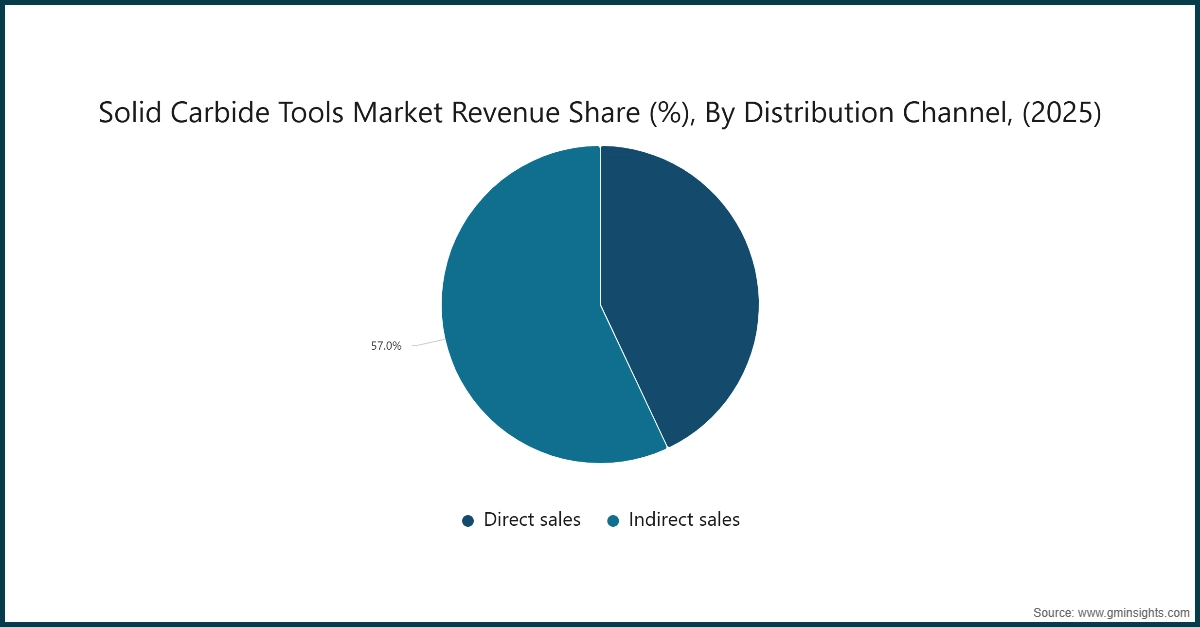
Based on distribution channel, the solid carbide tools market consists of direct sales and indirect sales. The indirect sales emerged as leader and held 57% of the total market share in 2025 and is anticipated to grow at a CAGR of 8.6% from 2026 to 2035.
- Indirect sales emerged as the leading distribution channel in the market due to extensive supplier and distributor networks. Distributors provide ready access to a wide range of tools across regions and industries. Technical support from channel partners ensures accurate product selection for specific machining requirements. Bulk procurement simplifies supply chain management for manufacturers and workshops.
- Established relationships with OEMs and industrial buyers enhance trust and reliability. Local inventory availability reduces lead times for maintenance and replacement needs. Consistent support and accessibility reinforce the dominance of indirect sales globally.
Asia Pacific Solid Carbide Tools Market
Learn more about the key segments shaping this market
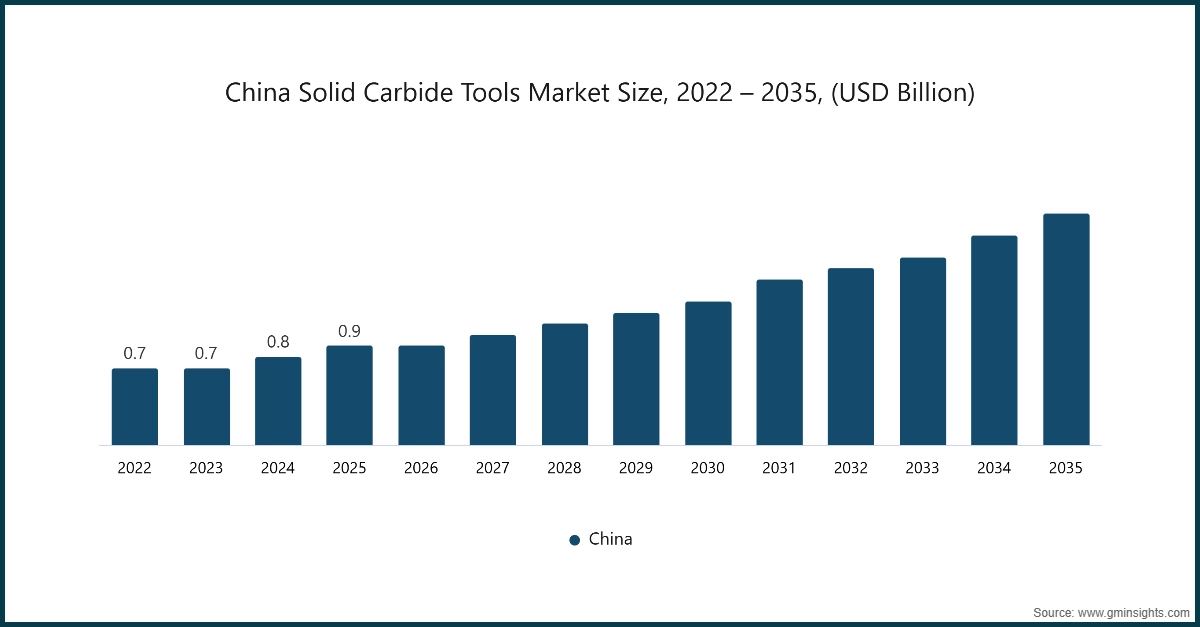
China dominates an overall Asia Pacific solid carbide tools industry and was valued at USD 900 million in 2025 and is estimated to grow at a CAGR of 9% from 2026 to 2035.
- The China market benefits from large-scale automotive and machinery manufacturing. Rising demand for high-precision metal cutting drives adoption of carbide end mills and drills. Domestic tool manufacturers strengthen market competitiveness through advanced production capabilities. Growth in export-oriented machinery production increases requirement for durable tooling solutions.
- CNC machine penetration accelerates adoption of high-performance solid carbide tools. Emphasis on productivity and operational efficiency supports frequent tool replacement cycles. Technological innovation enables specialized coatings and geometry for enhanced performance. Government initiatives promoting industrial modernization encourage consistent adoption of advanced tools.
North America Solid Carbide Tools Market
In the North America the U.S. held 79.5% market share in 2025 and is anticipated to grow at a CAGR of 8.5% from 2026 to 2035.
- The North America market growth is driven by advanced automotive and aerospace manufacturing. High demand for precision machining increases adoption of durable carbide end mills and drills. CNC machine proliferation supports consistent tooling consumption across factories. Metalworking industries prioritize high-performance tools for efficiency and extended service life. Replacement demand is sustained by aging industrial infrastructure.
- Local and international manufacturers offer specialized solutions for heavy-duty applications. Research and development activities enhance tool coatings and geometries. Emphasis on quality standards supports premium product adoption. Industrial automation drives integration of carbide tooling in advanced production lines
Europe Solid Carbide Tools Market
In the Europe solid carbide tools market, Germany is expected to experience significant and promising growth from 2026 to 2035.
- The Europe solid carbide tools industry benefits from established precision engineering and machinery sectors. Automotive, aerospace, and machinery production drives demand for high-accuracy cutting tools. Industry 4.0 adoption encourages integration of carbide tools in automated machining systems. Strict quality and safety standards influence material selection and tool design. Export-oriented manufacturing sustains steady tool consumption across industrial clusters.
- Continuous innovation in coatings and geometries enhances tool performance and longevity. Demand for energy-efficient and high-speed machining supports advanced carbide tooling adoption. Regional suppliers maintain consistent availability for replacement and aftermarket needs.
Middle East and Africa Solid Carbide Tools Market
In the Middle East and AfricaUAE held a significant market share in 2025.
- The Middle East and Africa solid carbide tools market grows through industrial expansion and infrastructure projects. Oil and gas operations require durable and heat-resistant cutting tools. Construction and heavy machinery production increase demand for carbide drilling and milling solutions. Import reliance supports availability of international premium tooling brands.
- Harsh operating conditions drive preference for high-strength and wear-resistant materials. Industrial modernization initiatives promote adoption of CNC-compatible carbide tools. Limited local manufacturing encourages reliance on specialized suppliers. Ongoing maintenance and replacement cycles sustain steady market demand across industries.
Solid Carbide Tools Market Share
- In 2025, the prominent manufacturers in solid carbide tools industry are ISCAR, Walter Tools, Mitsubishi, Fullerton Tool, and Harvey Tool collectively held the market share of ~38%.
- ISCAR is a leading global manufacturer of solid carbide cutting tools and precision machining solutions. The company provides end mills, drills, inserts, and custom tooling for aerospace, automotive, and heavy industry applications. ISCAR emphasizes advanced carbide grades, coating technologies, and productivity-enhancing designs. Its strong global distribution network and integration within a larger industrial tooling group strengthen its competitive leadership in high-performance machining markets.
- Walter Tools is a major supplier of solid carbide tools, specializing in milling, drilling, and turning solutions. The company focuses on high-efficiency machining, advanced coatings, and precision engineering. Walter serves industries such as automotive, aerospace, and energy. Its emphasis on technical support, digital tooling solutions, and strong European manufacturing presence supports sustained market competitiveness.
Solid Carbide Tools Market Companies
Major players operating in the solid carbide tools industry include:
- Accuromm
- Accusharp
- Birla Precision Technologies
- DIC Tools
- Fullerton Tool
- Garr Tool
- Hannibal Carbide Tool
- Harvey Tool
- ISCAR
- Johnson Carbide
- Mitsubishi
- Orient Tools
- Samtec Tools
- SwiftCARB
- Tixna Tools
- Walter Tools
Mitsubishi participates in the solid carbide tools market through its precision cutting tool division, offering end mills, drills, and indexable tools. The company focuses on durability, heat resistance, and optimized chip control technologies. Mitsubishi serves automotive, mold & die, and industrial manufacturing sectors globally. Its strong presence in Asia-Pacific and established engineering capabilities contribute to stable market share.
Fullerton Tool specializes in solid carbide end mills and custom cutting tools for precision machining applications. The company focuses on aerospace, medical, and high-performance industrial sectors. Fullerton emphasizes innovative geometries, advanced coating technologies, and application-specific customization. Its strong presence in North America and focus on technical collaboration with customers support steady growth in specialized machining segments.
Harvey Tool is known for its extensive portfolio of miniature and specialty solid carbide cutting tools. The company serves precision machining markets, including medical devices and aerospace components. Harvey Tool emphasizes tight tolerances, specialty geometries, and fast product availability. Its strong distribution network and focus on niche tooling applications support competitive positioning in high-precision manufacturing sectors.
Solid Carbide Tools Market Report Attributes
| Key Takeaway | Details |
|---|---|
| Market Size & Growth | |
| Base Year | 2025 |
| Market Size in 2025 | USD 8.5 Billion |
| Market Size in 2026 | USD 9.2 Billion |
| Forecast Period 2026-2035 CAGR | 8.2% |
| Market Size in 2035 | USD 18.8 Billion |
| Key Market Trends | |
| Drivers | Impact |
| Rising adoption of CNC and advanced machining technologies | Increased use of CNC machines and automated manufacturing systems drives the need for high-performance cutting tools that deliver speed, accuracy, and durability. |
| Expansion of industrial automation and smart factories | Integration of solid carbide tools into automated and robotics-based machining systems supports seamless production workflows and predictive maintenance. |
| Increase in production of lightweight materials | Growing use of advanced and lightweight materials requires specialized solid carbide tooling solutions that can withstand higher abrasion and heat. |
| Pitfalls & Challenges | Impact |
| High cost of carbide tool materials and manufacturing | Premium raw materials and precise manufacturing processes increase product costs, which can limit adoption among price-sensitive mid-tier manufacturers. |
| Availability of low-cost alternatives | Lower-priced tools from regional manufacturers can undercut premium carbide tool prices, intensifying competition and margin pressure for established producers. |
| Opportunities: | Impact |
| Growth in additive manufacturing hybrid machining systems | Integration of carbide tools into hybrid machining technologies, combining additive and subtractive processes opens new application areas and demand streams. |
| Development of advanced coatings and surface treatments | Innovative coatings (e.g., nano-structured, PVD/CVD) that enhance tool life and performance create premium product segments and justify higher pricing. |
| Market Leaders (2025) | |
| Market Leader |
Market share of ~11% |
| Top Players |
Collective market share of ~38% |
| Competitive Edge |
|
| Regional Insights | |
| Largest Market | Asia Pacific |
| Fastest growing market | Asia Pacific |
| Emerging countries | India, Brazil, UAE |
| Future Outlook |
|
What are the growth opportunities in this market?
Solid Carbide Tools Machine Industry News
- In June 2025, Walter Tools introduced the HeliCUT Advanced solid carbide milling series featuring optimized flute geometry and advanced coatings for high performance in steel and hard metal machining. The launch supports precision tool users in automotive and precision engineering sectors.
- In January 2025, Accusharp introduced a new solid carbide reamer series with enhanced geometry for improved chip evacuation and longer tool life. The launch supports precision hole-making in automotive and general engineering sectors.
- In 2025, Accuromm expanded its product portfolio with a new range of high-performance solid carbide micro-end mills designed for aerospace and mold-making applications. These tools offer tighter tolerances and improved surface finish performance for precision machining operations.
- In mid-2025, ISCAR introduced the MELTEM Solid Carbide Mill Series with Helimax variable flute design, targeting high performance in stainless and high-temp alloys. The launch includes upgraded coatings and edge preparation techniques for improved chip control.
The solid carbide tools market research report includes in-depth coverage of the industry, with estimates & forecast in terms of revenue (USD Billion) and volume (Thousand Units) from 2022 to 2035, for the following segments:
Market, By Category
- End mills
- Drills
- Reamers
- Taps
- Inserts
- Others
Market, By Coating Type
- TiN (Titanium nitride)
- TiCN (Titanium carbonitride)
- TiAlN (Titanium aluminium nitride)
- AlCrN (Aluminum chromium nitride)
- Diamond coatings
- Uncoated carbide
- Standard grades
- Micro-grain grades
- Nano-grain grades
Market, By End Use Industry
Aerospace
- Automotive
- Medical devices
- Electronics & semiconductors
- General engineering
- Others
Market, By Distribution Channel
Direct sales
Indirect sales
The above information is provided for the following regions and countries:
- North America
- U.S.
- Canada
- Europe
- Germany
- UK
- France
- Italy
- Spain
- Asia Pacific
- China
- Japan
- India
- South Korea
- Australia
- Latin America
- Brazil
- Mexico
- Argentina
- MEA
- Saudi Arabia
- UAE
- South Africa
Frequently Asked Question(FAQ) :
What is the market size of the solid carbide tools in 2025?
The market size was USD 8.5 billion in 2025, with a CAGR of 8.2% expected through 2035 driven by rising adoption of CNC technologies and expanding industrial automation across key manufacturing sectors.
What is the projected value of the solid carbide tools market by 2035?
The solid carbide tools market is expected to reach USD 18.8 billion by 2035, propelled by advanced machining technologies, smart factory adoption, and growing demand from aerospace, automotive, and medical device industries.
What is the solid carbide tools industry size in 2026?
The market size is projected to reach USD 9.2 billion in 2026.
How much revenue did the end mills segment generate in 2025?
The end mills segment generated approximately USD 3.4 billion in 2025, leading the market as the dominant product category due to extensive use in milling, slotting, and contouring operations across industries.
What was the market share of the automotive segment in 2025?
The automotive segment held 45.42% of the total market share in 2025, driven by high-precision machining requirements for engine, transmission, and structural components.
What is the growth outlook for the end mills segment from 2026 to 2035?
The end mills segment is projected to grow at a CAGR of 8.7% from 2026 to 2035, supported by continued demand from automotive and aerospace sectors and advancements in coating technologies that extend tool life.
Which region leads the solid carbide tools market?
Asia Pacific leads the solid carbide tools market, with China valued at USD 900 million in 2025 and growing at a CAGR of 9%.
What are the upcoming trends in the solid carbide tools market?
Key trends include expansion of smart factory and Industry 4.0 integration, growth of aftermarket regrinding and tool refurbishment services, and rising demand from emerging economies in Asia-Pacific and Latin America.
Who are the key players in the solid carbide tools market?
Key players include Accuromm, Accusharp, Birla Precision Technologies, DIC Tools, Fullerton Tool, Garr Tool, Hannibal Carbide Tool, Harvey Tool, ISCAR, Johnson Carbide, Mitsubishi, Orient Tools, Samtec Tools, SwiftCARB, Tixna Tools, and Walter Tools.
Solid Carbide Tools Market Scope
Related Reports