Summary
Table of Content

Self-Healing Polymers Market
Get a free sample of this report
Form submitted successfully!
Error submitting form. Please try again.
Thank you!
Your inquiry has been received. Our team will reach out to you with the required details via email. To ensure that you don't miss their response, kindly remember to check your spam folder as well!
Request Sectional Data
Thank you!
Your inquiry has been received. Our team will reach out to you with the required details via email. To ensure that you don't miss their response, kindly remember to check your spam folder as well!
Form submitted successfully!
Error submitting form. Please try again.
Self-Healing Polymers Market Size
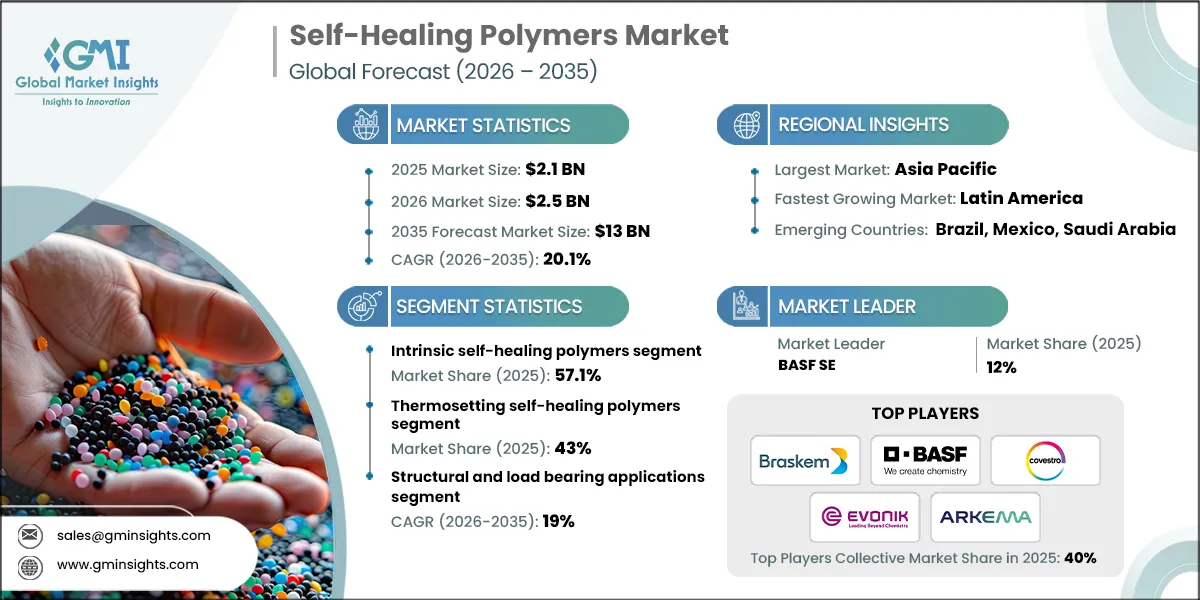
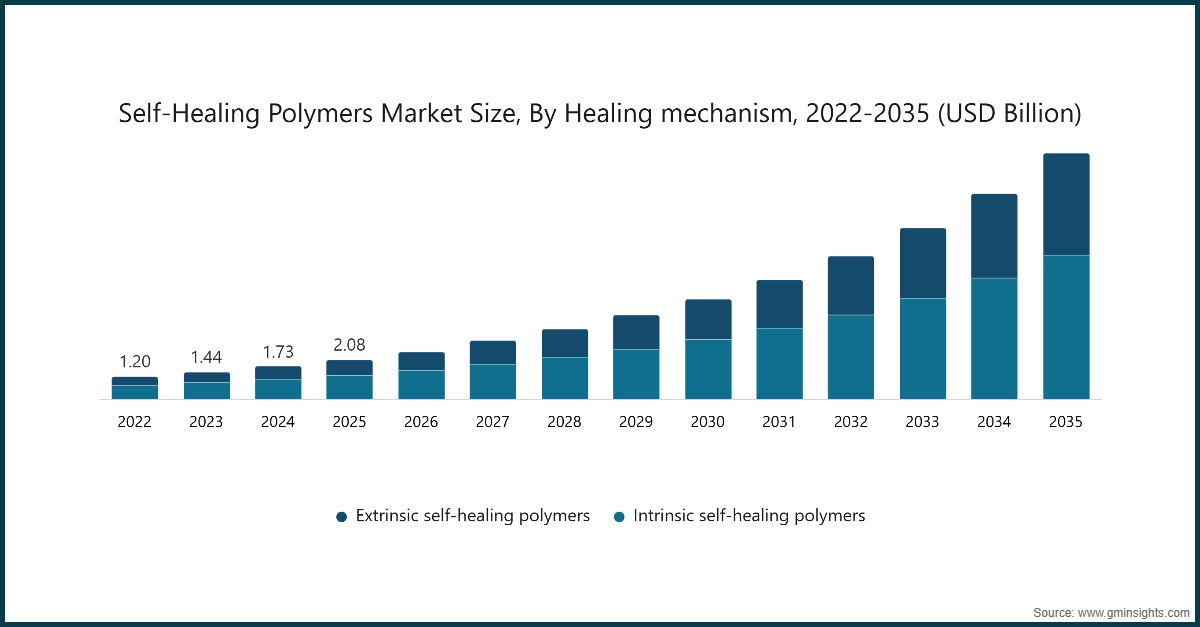
The global self-healing polymers market was valued at USD 2.1 billion in 2025. The market is expected to grow from USD 2.5 billion in 2026 to USD 13 billion in 2035, at a CAGR of 20.1% according to latest report published by Global Market Insights Inc.
Self-Healing Polymers Market Key Takeaways
Market Size & Growth
- 2025 Market Size: USD 2.1 Billion
- 2026 Market Size: USD 2.5 Billion
- 2035 Forecast Market Size: USD 13 Billion
- CAGR (2026–2035): 20.1%
Regional Dominance
- Largest Market: Asia Pacific
- Fastest Growing Region: Latin America
Key Market Drivers
- Growing demand for durable, low-maintenance materials.
- Expansion of flexible and wearable electronics.
- Sustainability and circular economy regulations.
Challenges
- High production costs and complex synthesis.
- Limited long-term field performance validation.
Opportunity
- Integration in smart, connected device ecosystems.
- Bio-based and vitrimer self-healing innovations.
Key Players
- Market Leader: BASF SE led with over 12% market share in 2025.
- Leading Players: Top 5 players in this market include Braskem S.A, BASF SE, Covestro AG, Evonik Industries, Arkema S.A., which collectively held a market share of 40% in 2025.
Get Market Insights & Growth Opportunities
- Self-healing polymers went from being limited experimental technologies in laboratories to seeing increased commercialization primarily within coatings, electronics, and structural composites between 2022-2025. There has been a significant increase in academic publishing that includes the terms "self-healing polymer" within the major journal sites. The increase in self-healing polymer publications suggests an acceleration of innovative thought regarding intrinsic dynamic network structures and stimuli-responsive chemistries used for healing.
- In the industrial sector, repetitive issues were addressed through the adoption of self-healing polymers, which allow OEMs to create self-healing coatings and composites to provide long-term longevity for parts in the automotive and aerospace industries.
- Patent filing activity increased between 2022-2025. There has been an increase in the number of patents filed regarding Diels-Alder networks, disulfide exchanges, and microcapsule-based repairs as tracked by WIPO and USPTO, with a significant amount of activity from the regions of Asia, Europe, and North America. The increase in IP activity shows companies are preparing for future licensing agreements, platform technologies, and protected application dominance in high-value market segments.
To get key market trends
Self-Healing Polymers Market Trends
- The use of self-healing polymer materials is increasing to include conductivity, sensing, and shape memory functionality combined into single materials, or "multi-functional" materials. For example, stretchable self-healing conductive materials (conductors) used in flexible electronics restore both the electrical and the mechanical integrity of the material after being damaged. Research has shown soft robotics prototypes and health monitoring patches that can undergo several healing cycles without losing their accuracy in sensing or the continuity of their circuits.
- In addition, this market is shifting from systems having extrinsic healing capabilities (e.g., microcapsules containing a specific amount of healing catalysts that could only be used once) toward systems with intrinsic dynamic networks capable of multiple healings. Induction of healing via dynamic covalent chemistries (Diels–Alder, disulfide exchange) or the use of supramolecular bonds allows for increased reversibility in the repair process by using lower intensity heat or light. Examples of automotive clear coats and consumer electronic device coatings using reversible crosslinks illustrate this shift from a disposable type of material use to a type of material that is reconfigurable and designed for a longer service life.
- With sustainability and circular strategies, self-healing polymers enable longer product life cycles, fewer product replacements, and a reduced amount of material consumed (i.e., through reusing). Vitrimers are a type of epoxy material that is repairable and can be reprocessed and/or welded, aligning with OEM strategies to increase the repairability and modularity of their products. Bio-based self-healing polyurethanes and hydrogels are examples of the combining of high durability and minimal environmental impacts into future product formulations, as they are produced from partially renewable feedstock sources.
Self-Healing Polymers Market Analysis
Learn more about the key segments shaping this market
Based on healing mechanisms, the self-healing polymers market is segmented into intrinsic self-healing polymers and extrinsic self-healing polymers. Intrinsic self-healing polymers held the largest market share of 57.1% in 2025 and are expected to grow at a CAGR of 19.9% during 2026‑2035.
- Convergence of intrinsic and extrinsic mechanisms is reshaping business strategies. Intrinsic systems—reversible covalent, supramolecular, dynamic.
- crosslinked, and thermally reversible networks—are gaining traction because they enable multiple healing cycles under mild triggers, fitting premium coatings, electronics, and elastomers. At the same time, microcapsule and vascular concepts remain attractive for retrofitting self-healing into established thermoset platforms.
- Commercial focus is shifting from proof-of-concept to scalable, application-tailored formulations. Producers bundle healing chemistries with rheology, adhesion, and weather performance, targeting automotive clearcoats, construction sealants, composites, and flexible devices. Shape-memory and stimulus-triggered systems support “smart maintenance” strategies, where localized heating, light, or electrical input activates repair, aligning with predictive maintenance and digital twin initiatives in infrastructure and mobility.
Based on polymer matrix type, the self-healing polymers market is segmented into thermosetting self-healing polymers, thermoplastic self-healing polymers, elastomeric self-healing polymers, and polymer blends and interpenetrating networks. Thermosetting self-healing polymers held the largest market share of 43% in 2025 and are expected to grow at a CAGR of 19.6% during 2026‑2035.
- Thermosetting, thermoplastic, elastomeric, and blend/IPN self-healing systems are converging toward application-specific design rather than generic platforms. Thermosets dominate structural composites and protective coatings, while thermoplastics and elastomers lead to flexible electronics, soft robotics, and consumer goods. Blends and interpenetrating networks enable hybrid performance, balancing stiffness, toughness, processability, and repeatable healing.
- Business activity centers on integrating self-healing into existing resin families—epoxies, polyurethanes, silicones, and engineering thermoplastics—so customers can upgrade without requalifying entire processes. Suppliers emphasize compatibility with standard curing cycles, additive packages, and recycling schemes. Dynamic networks and vitrimers are increasingly marketed as “reprocess able thermosets,” blurring matrix boundaries and supporting circularity and repair-focused business models.
Learn more about the key segments shaping this market
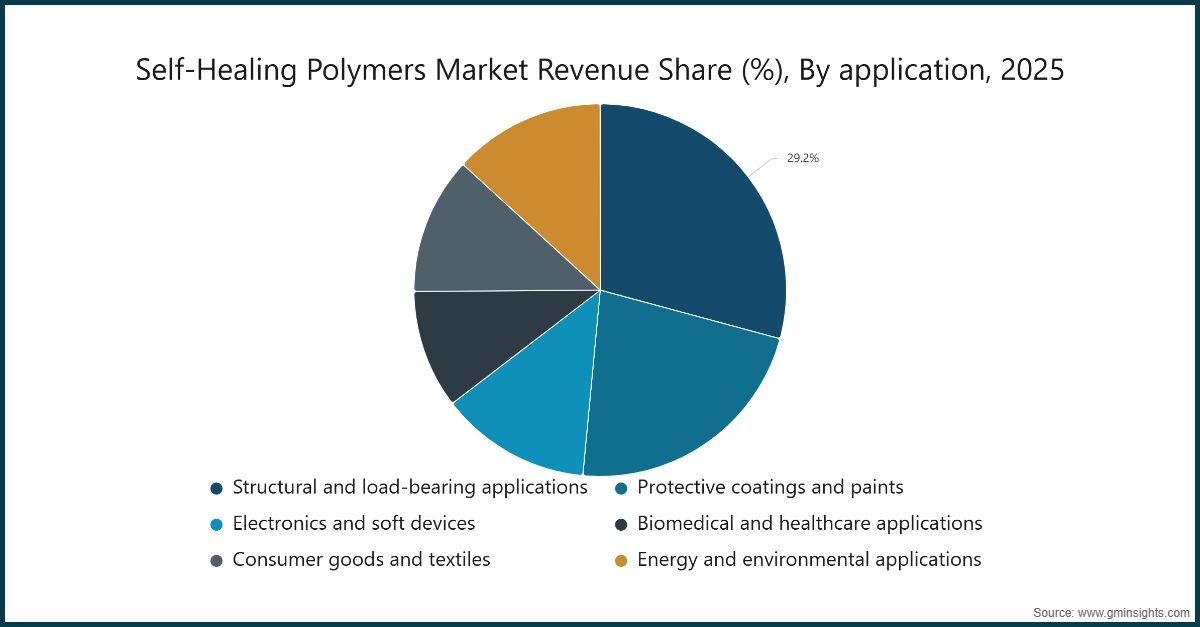
Based on applications, the self-healing polymers market is segmented into structural and load-bearing applications, protective coatings and paints, electronics and soft devices, biomedical and healthcare applications, consumer goods and textiles, and energy and environmental applications. Structural and load‑bearing applications held the largest market share of 29.2% in 2025 and are expected to grow at a CAGR of 19% during 2026‑2035.
- Structural, protective, electronic, biomedical, consumer, and energy applications are progressively integrating self-healing to cut lifecycle costs and downtime. Structural and load‑bearing composites, wind blades, and infrastructure elements use healing to delay crack propagation. Protective coatings and paints emphasize autonomous scratch and corrosion repair, particularly in automotive, marine, and industrial assets exposed to harsh conditions.
- Electronics, soft devices, and biomedical segments prioritize flexibility, reliability, and safety. Self-healing conductors, dielectrics, and encapsulants support durable wearables, foldable displays, and soft robotics. Hydrogels and polymer networks in medical devices, dressings, and tissue scaffolds enable in situ repair. Consumer goods, textiles, and energy systems adopt healing for scratch‑resistant displays, smart fabrics, and longer‑lasting batteries or seals.
Looking for region specific data?
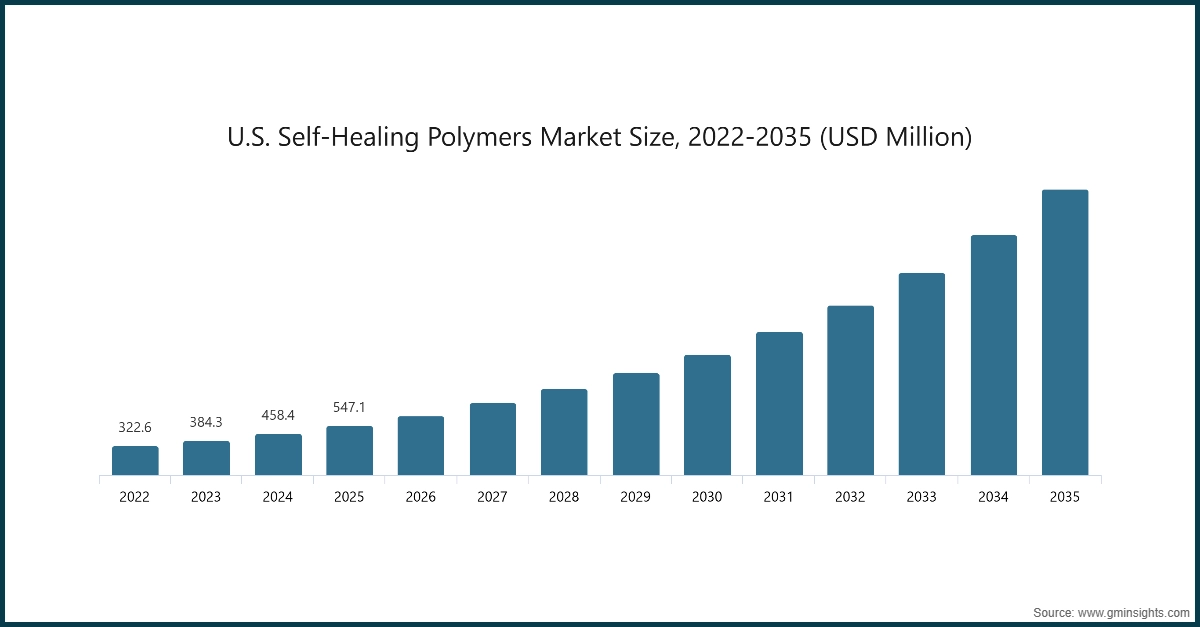
North America self-healing polymers market accounts for a significant share in Value, growing from USD 652.5 million in 2025 to USD 1.9 billion in 2035, supported by strong adoption in coatings, aerospace composites, and electronics, with a healthy CAGR of 19.3%. Regional growth is reinforced by leading chemical producers and robust innovation ecosystems across the U.S. and Canada.
- The U.S. is the primary hub for self-healing polymer innovation and commercialization. Strong collaboration between materials companies, national labs, aerospace, automotive, and electronics OEMs accelerate qualification and early deployment, especially in protective coatings, structural composites, and advanced packaging applications.
Europe self-healing polymers market shows steady expansion in Value from USD 600.1 million in 2025 to about USD 1.80 billion in 2035, underpinned by sustainability regulations and high-performance materials demand across automotive, construction, and industrial coatings, with a solid CAGR of 19.9%. EU green policies favor durable, repairable materials, accelerating self-healing adoption.
- Germany remains a core European market for engineered self-healing solutions. Its advanced automotive, machinery, and chemical sectors drive demand for long-life coatings and composites, while strong R&D institutions and Tier‑1 suppliers help integrate self-healing chemistries into existing resin systems and high-specification engineering components.
Asia Pacific self-healing polymers market emerges as both the largest and fastest-growing region in value, rising from USD 585.5 million in 2025 to around USD 1.80 billion in 2035, at a robust CAGR of 20.3%. Rapid industrialization, electronics manufacturing, and infrastructure spending in China, India, and Southeast Asia fuel significant demand for advanced functional polymers.
- China leads Asia Pacific in scaling self-healing materials across electronics and infrastructure. Extensive manufacturing capacity, strong government support for advanced materials, and integration into flexible electronics, EV components, and protective infrastructure coatings underpin rapid adoption and cost-down trajectories in regional and export-oriented applications.
Latin America remains a smaller but highest growing market, expanding in Value from USD 137.3 million in 2025 to roughly USD 493 million in 2035, driven by a high CAGR of 23.3%. Growth is linked to infrastructure rehabilitation, oil and gas, and protective coatings for industrial and marine assets exposed to harsh environments.
- Brazil is the primary demand center for self-healing polymers in Latin America. Its construction, offshore, and transportation sectors benefit from coatings and sealants that reduce maintenance cycles, while academic–industry collaborations begin to localize formulations for tropical climates and corrosive environments.
MEA shows gradual yet meaningful progression in Value from USD 104.6 million in 2025 to about USD 321.7 million in 2035, supported by a 20.3% CAGR. Demand is concentrated in protective coatings for energy infrastructure, pipelines, and construction, where reduced maintenance and extended asset lifetimes are key priorities.
- Saudi Arabia anchors regional opportunity for self-healing polymers in MEA. Large investments in petrochemicals, industrial facilities, and mega-infrastructure projects create demand for high-durability coatings and composites, while national diversification strategies open pathways for local production and advanced materials R&D collaborations.
Self-Healing Polymers Market Share
The market is moderately concentrated, led by diversified chemical majors with strong coatings, polyurethanes, and specialty polymers portfolios. BASF SE, Covestro AG, Evonik Industries, Arkema S.A., and Huntsman Corporation together hold about 40% share, leveraging integrated R&D, application labs, and partnerships with automotive, aerospace, electronics, and construction OEMs to co-develop customized self-healing formulations and scale pilot solutions toward commercial volumes.
BASF SE: With around 12% market share, BASF leverages its broad coatings, polyurethanes, and functional materials portfolio to integrate intrinsic and extrinsic self-healing chemistries into automotive, construction, and industrial applications. The company emphasizes collaborative development with OEMs and has reported R&D on self-healing clearcoats, and structural composites aligned with durability and sustainability demands.Covestro AG: Holding about 10% share, Covestro focuses on self-healing polyurethanes and specialty coatings, particularly for mobility, electronics, and protective applications. Its R&D highlights scratch-healing coatings for electronics and automotive exteriors, and the company increasingly positions self-healing systems within circularity and durability roadmaps, including low-VOC and recyclable solutions.Evonik Industries: With roughly 8% share, Evonik addresses self-healing through specialty additives, crosslinkers, and advanced polymer platforms.
The company targets high-performance coatings, composites, and 3D printing materials, and has highlighted research collaborations on self-healing elastomers and dynamic networks that enhance service life while maintaining processability in existing customer manufacturing lines.Arkema S.A.: At about 6% share, Arkema exploits its expertise in specialty resins, elastomers, and the Diels–Alder-based vitrimers platform. It actively promotes reprocessable, repairable thermoset systems and self-healing coatings, linking them to circular economy strategies. Arkema’s collaborations with composites and mobility customers focus on easier repair, welding, and extended component lifetimes.
Huntsman Corporation: With near 4% share, Huntsman leverages its polyurethane and epoxy systems to introduce self-healing capabilities into coatings, adhesives, and structural composites. The company emphasizes tailored chemistries for transportation, aerospace, and industrial markets, and has pursued joint development projects where self-healing supports reduced maintenance and improved durability in demanding operating environments.
Self-Healing Polymers Market Companies
Major players operating in the self-healing polymers industry include:
- BASF SE
- Covestro AG
- Evonik Industries AG
- Arkema S.A.
- Huntsman Corporation
- The Dow Chemical Company
- 3M Company
- AkzoNobel N.V.
- Henkel AG & Co. KGaA
- DSM-Firmenich (formerly Royal DSM)
- LG Chem Ltd.
- SABIC
- Mitsubishi Chemical Group
- Toray Industries, Inc.
- Sumitomo Chemical Co., Ltd.
- Nippon Paint Holdings Co., Ltd.
Self-Healing Polymers Market Report Attributes
| Key Takeaway | Details |
|---|---|
| Market Size & Growth | |
| Base Year | 2025 |
| Market Size in 2025 | USD 2.1 Billion |
| Market Size in 2026 | USD 2.5 Billion |
| Forecast Period 2026-2035 CAGR | 20.1% |
| Market Size in 2035 | USD 13 Billion |
| Key Market Trends | |
| Drivers | Impact |
| Growing demand for durable, low-maintenance materials | Boosts adoption in infrastructure and mobility sectors |
| Expansion of flexible and wearable electronics | Drives need for repairable, stretchable polymers |
| Sustainability and circular economy regulations | Encourages recyclable, long-life self-healing systems |
| Pitfalls & Challenges | Impact |
| High production costs and complex synthesis | Limits large-scale commercialization and pricing |
| Limited long-term field performance validation | Slows qualification in safety-critical applications |
| Opportunities: | Impact |
| Integration in smart, connected device ecosystems | Enabling self-monitoring, self-repairing product platforms |
| Bio-based and vitrimer self-healing innovations | Opens premium, eco-focused specialty polymer segments |
| Market Leaders (2025) | |
| Market Leader |
12% Market Share |
| Top Players |
Collective Market Share of 40% in 2025 |
| Competitive Edge |
|
| Regional Insights | |
| Largest Market | Asia Pacific |
| Fastest growing market | Latin America |
| Emerging countries | Brazil, Mexico, Saudi Arabia |
| Future outlook |
|
What are the growth opportunities in this market?
Self-Healing Polymers Industry News
- In October 2025, Covestro AG announced expanded R&D trials of self-healing polyurethane coatings for automotive and consumer electronics, focusing on scratch repair under mild heat. The program included pilot collaborations with Asian OEMs to validate durability and optical performance in high-volume applications.
- In March 2025, BASF SE reported progress in integrating self-healing functionalities into automotive clearcoats and industrial coatings platforms. The company highlighted lab-scale systems based on dynamic bonding, aimed at improving scratch resistance and extending repainting intervals, especially for high-end mobility and infrastructure assets.
- In September 2024, Arkema S.A. expanded its vitrimer-based portfolio with new reprocess able, self-healing epoxy systems targeting wind energy and structural composites. These materials were positioned to enable easier in-service repair, welding, and component life extension, supporting recyclability and maintenance cost reduction for large composite structures.
- In May 2023, Evonik Industries presented advances in self-healing elastomer and coating additives at a major European coatings conference. The company showcased dynamic crosslinking technologies designed to autonomously close microcracks in protective layers, addressing corrosion protection needs for marine, industrial, and energy infrastructure applications.
- In August 2023, Corbion and TotalEnergies announced capacity expansion plans for their PLA joint venture in France, responding to growing demand from packaging and textile applications. The expansion aimed to increase capacity by 50%, with completion targeted for 2026.
This Self-Healing polymers market research report includes in-depth coverage of the industry, with estimates & forecasts in terms of revenue (USD Billion) and volume (Kilo Tons) from 2026 to 2035, for the following segments:
Market, By Healing mechanism
- Intrinsic self-healing polymers
- Reversible covalent bond-based systems
- Supramolecular (non-covalent) interaction-based systems
- Dynamic crosslinked networks
- Thermally reversible networks
- Extrinsic self-healing polymers
- Microcapsule-based systems
- Vascular or microchannel-based systems
- Particulate or phase-separated healing agents
- Embedded shape-memory or stimulus-triggered systems
Market, By Polymer matrix type
- Thermosetting self-healing polymers
- Thermoplastic self-healing polymers
- Elastomeric self-healing polymers
- Polymer blends and interpenetrating networks
Market, By Application
- Structural and load-bearing applications
- Protective coatings and paints
- Electronics and soft devices
- Biomedical and healthcare applications
- Consumer goods and textiles
- Energy and environmental applications
The above information is provided for the following regions and countries:
- North America
- U.S.
- Canada
- Europe
- Germany
- UK
- France
- Spain
- Italy
- Rest of Europe
- Asia Pacific
- China
- India
- Japan
- Australia
- South Korea
- Rest of Asia Pacific
- Latin America
- Brazil
- Mexico
- Argentina
- Rest of Latin America
- Middle East and Africa
- Saudi Arabia
- South Africa
- UAE
- Rest of Middle East and Africa
Frequently Asked Question(FAQ) :
What was the market size of the self-healing polymers market in 2025?
The market size was USD 2.1 billion in 2025, with a CAGR of 20.1% expected through 2035, driven by advancements in multi-functional materials and increasing adoption across various applications.
What is the projected value of the self-healing polymers market by 2035?
The market is expected to reach USD 13 billion by 2035, fueled by innovations in intrinsic healing mechanisms and growing demand in sectors like electronics, automotive, and healthcare.
What is the projected size of the self-healing polymers market in 2026?
The market is expected to reach USD 2.5 billion in 2026.
What was the market share of intrinsic self-healing polymers in 2025?
Intrinsic self-healing polymers held the largest market share of 57.1% in 2025 and are projected to grow at a CAGR of 19.9% during 2026?2035.
What was the market share of thermosetting self-healing polymers in 2025?
Thermosetting self-healing polymers accounted for 43% of the market share in 2025 and are expected to grow at a CAGR of 19.6% during 2026?2035.
Which application segment led the self-healing polymers market in 2025?
Structural and load-bearing applications held the largest market share of 29.2% in 2025 and are projected to grow at a CAGR of 19% through 2035.
Which region leads the self-healing polymers market?
North America led the market with USD 652.5 million in 2025 and is expected to grow to USD 1.9 billion by 2035, supported by strong adoption in coatings, aerospace composites, and electronics, along with a robust innovation ecosystem in the U.S. and Canada.
What are the upcoming trends in the self-healing polymers industry?
Key trends include the shift from extrinsic to intrinsic healing mechanisms, advancements in dynamic covalent chemistries, and increasing use of multi-functional materials in flexible electronics, soft robotics, and healthcare applications.
Who are the key players in the self-healing polymers market?
Key players include BASF SE, Covestro AG, Evonik Industries AG, Arkema S.A., Huntsman Corporation, The Dow Chemical Company, 3M Company, AkzoNobel N.V., Henkel AG & Co. KGaA, and DSM-Firmenich (formerly Royal DSM).
Self-Healing Polymers Market Scope
Related Reports