Summary
Table of Content

RPA Platform Training Market
Get a free sample of this report
Form submitted successfully!
Error submitting form. Please try again.
Thank you!
Your inquiry has been received. Our team will reach out to you with the required details via email. To ensure that you don't miss their response, kindly remember to check your spam folder as well!
Request Sectional Data
Thank you!
Your inquiry has been received. Our team will reach out to you with the required details via email. To ensure that you don't miss their response, kindly remember to check your spam folder as well!
Form submitted successfully!
Error submitting form. Please try again.
RPA Platform Training Market Size
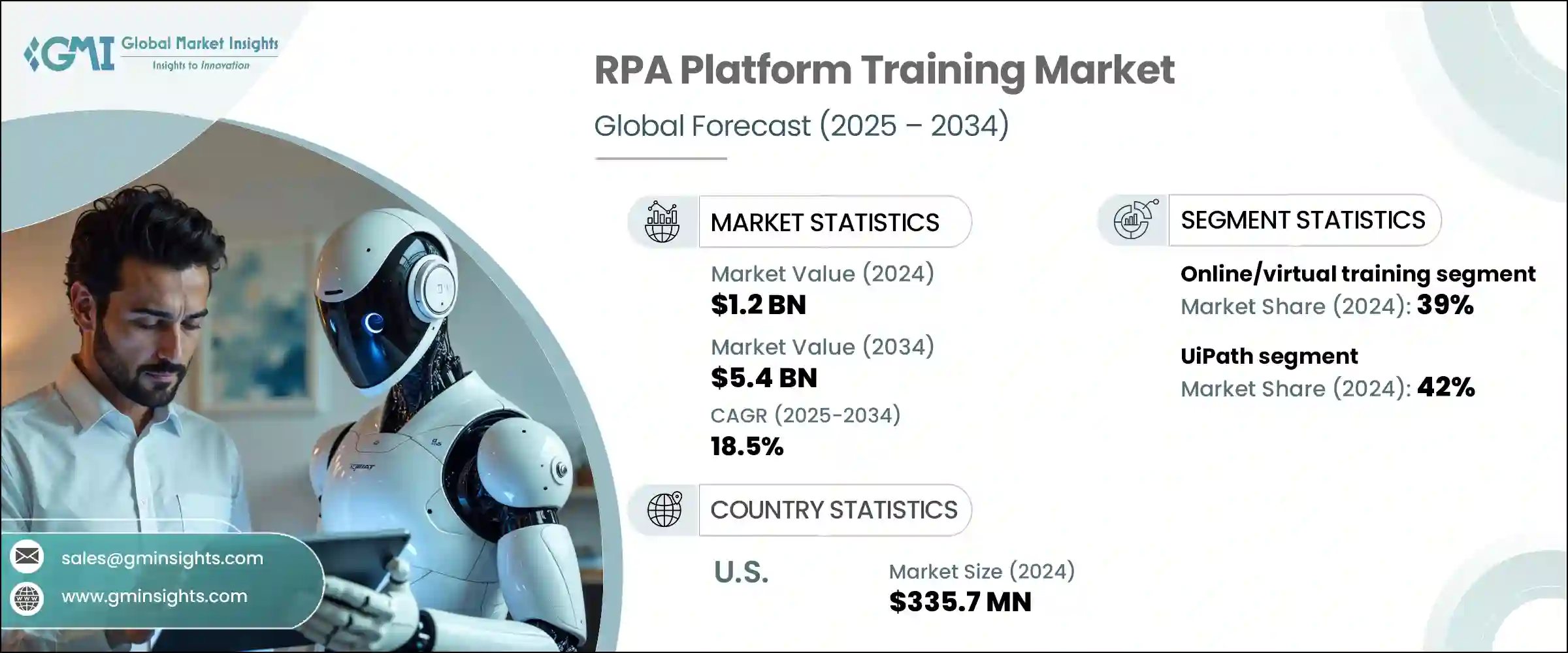
The global RPA platform training market size was estimated at USD 1.2 billion in 2024. The market is expected to grow from USD 1.4 billion in 2025 to USD 5.4 billion in 2034, at a CAGR of 18.5%.
To get key market trends
- The rapid evolution of RPA platforms is transforming training from a technical skill set into a strategic enterprise capability. As tools increasingly integrate AI, OCR, and natural language processing, professionals require multi-domain expertise. This has made continuous, advanced training a necessity, not an option, for ensuring automation success on a scale.
- Public-private skilling initiatives and vendor-led ecosystems are boosting market momentum. In February 2024, India’s Ministry of Skill Development partnered with EdTech providers to launch a national RPA training drive. Simultaneously, platforms such as UiPath Academy and Automation Anywhere University continue to expand structured certification tracks tailored to enterprise needs.
- The RPA platform training market was valued at USD 410 million in 2019 and grew at a CAGR of approximately 23.7% through 2024. This growth reflects a shift from isolated automation pilots to enterprise-wide deployment strategies across industries such as BFSI, healthcare, and retail, which demanded trained, certified professionals.
- The COVID-19 pandemic accelerated the adoption of virtual training formats, making RPA education more scalable and accessible. Enterprises moved swiftly to remote, on-demand modules, ensuring uninterrupted upskilling. As of 2024, most training programs are offered through hybrid models combining live sessions, labs, and certifications.
- Platform-specific training holds the dominant market share due to strong enterprise demand for certified professionals. Organizations prioritize certifications from leading platforms such as UiPath and Automation Anywhere to ensure deployment accuracy, tool standardization, and internal compliance across automation initiatives.
- Role-based and citizen developer training programs are gaining traction, expanding the learner base beyond IT teams. In April 2024, Automation Anywhere launched a role-specific path for business users, enabling non-technical staff to automate processes using no-code tools aligning with the industry’s move toward democratized automation.
- North America leads the market, supported by mature automation ecosystems and strong institutional partnerships. In September 2023, UiPath expanded its Automation Education Alliance, integrating RPA curricula into over 40 U.S. universities solidifying the region’s leadership in talent development and platform alignment.
- Asia-Pacific is the fastest-growing region, driven by national digital skilling missions and enterprise adoption in emerging economies. Countries such as India, Singapore, and the Philippines are prioritizing automation readiness, with government-funded training programs and vendor partnerships driving large-scale workforce transformation.
RPA Platform Training Market Report Attributes
| Key Takeaway | Details |
|---|---|
| Market Size & Growth | |
| Base Year | 2024 |
| Market Size in 2024 | USD 1.2 Billion |
| Forecast Period 2025 - 2034 CAGR | 18.5% |
| Market Size in 2034 | USD 5.4 Billion |
| Key Market Trends | |
| Drivers | Impact |
| Rising adoption of RPA across industries | Increased enterprise demand for trained RPA professionals, expanding the customer base for training providers. |
| Digital transformation initiatives | Organizations are prioritizing automation upskilling as part of their modernization strategies. |
| Growing demand for RPA certifications | Certifications are becoming hiring prerequisites, prompting learners to pursue structured, vendor-aligned training. |
| Integration of AI with RPA | Training programs are expanding to include AI concepts such as NLP, machine learning, and cognitive automation. |
| Rise of low-code/no-code RPA platforms | Expands training demand among business users and citizen developers seeking hands-on, practical RPA skills. |
| Public-private skilling partnerships | National upskilling programs are boosting RPA training adoption, especially in emerging economies. |
| Pitfalls & Challenges | Impact |
| Lack of standardized curriculum | Inconsistent training quality across providers leads to varied skill levels and enterprise. |
| Limited awareness among non-tech professionals | Many business users are unaware of RPA learning opportunities, reducing training uptake. |
| Opportunities | Impact |
| Micro-certifications and skill badging | Will drive personalized, stackable learning models, making RPA education scalable and continuous. |
| AI integration into learning platforms | AI-driven platforms will optimize learner outcomes and automate training workflows, increasing efficiency and retention. |
| Industry-specific RPA training tracks | Enables targeted learning paths for sectors like healthcare, BFSI, and logistics, increasing training relevance and adoption. |
| Game and simulation-based learning | Enhances engagement and practical understanding, leading to higher course completion rates and skill application. |
| Market Leaders (2024) | |
| Market Leader |
|
| Top Players |
Collective market share in 2024 is 20% |
| Competitive Edge |
|
| Regional Insights | |
| Largest Market | North America |
| Fastest growing market | Asia Pacific |
| Emerging countries | India, UAE, Singapore, Brazil, Philippines |
| Future outlook |
|
What are the growth opportunities in this market?
RPA Platform Training Market Trends
- The convergence of AI and RPA is reshaping training paradigms, as enterprises now demand professionals skilled in both rule-based automation and cognitive intelligence. This trend started in late 2022 with the launch of UiPath’s AI Center, enabling ML and NLP integration into workflows. It is driven by the need to process unstructured data and automate decision-making. This technology may further shift training from bot-building to intelligent workflow design. The trend is expected to reach mainstream adoption by 2026, making AI-infused RPA skills essential.
- Role-based, modular learning paths are becoming the norm in RPA training, enabling tailored upskilling for developers, business users, and analysts. This trend gained visibility in early 2021, driven by platforms such as Automation Anywhere and UiPath offering job-aligned paths. It is fueled by a broader workforce participation and faster onboarding. An example is UiPath Academy’s modular tracks for solution architects and citizen developers. The trend is set to dominate training models through 2027, supporting enterprise-wide adoption.
- Certification-based learning ecosystems are solidifying as a benchmark for RPA proficiency, with over 60% of enterprises requiring them for hiring or advancement. Gaining momentum post-2020, global programs such as UiPath Certified Professional and Automation Anywhere’s Advanced RPA Professional drive this trend. It’s driven by the need for skill standardization and deployment reliability. UiPath certifications see tens of thousands of enrollments annually. This trend will shape the RPA platform training market through 2028, reinforcing credential-based hiring.
- The rise of no-code/low-code tools is transforming RPA training delivery, making automation accessible to non-technical users. This trend took off in 2022, powered by tools such as Microsoft Power Automate and UiPath StudioX for “citizen developers.” Organizations now train teams to automate tasks without coding. Coca-Cola Bottling uses Power Automate to train field staff. These technologies may further expand user bases, with the trend expected to grow through 2027.
- Government-backed national skilling programs are accelerating access to RPA education, especially in emerging economies. Scaling since 2023, nations such as India are training 100,000+ professionals by 2025 under initiatives such as the Digital Skilling Program. Driven by digital economy goals and public-private partnerships, this trend boosts affordable access. For instance, UiPath and NASSCOM are training Indian students. It’s expected to grow through 2026, enhancing global workforce capacity.
RPA Platform Training Market Analysis
Learn more about the key segments shaping this market
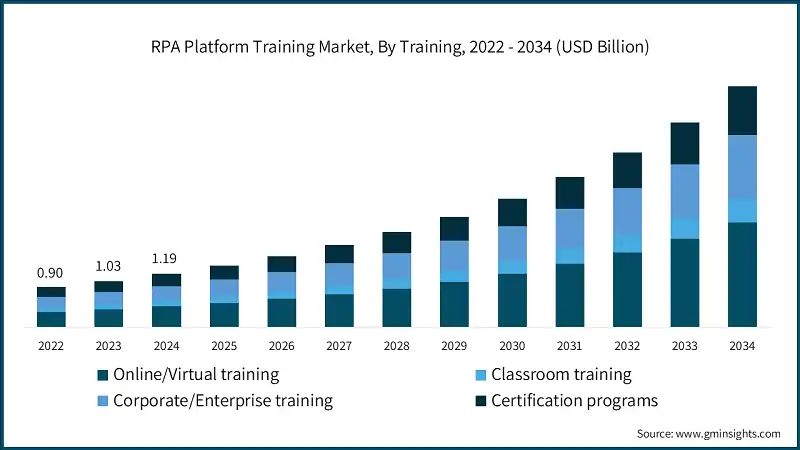
Based on training, the RPA platform training market is divided into online/virtual training, classroom training, corporate/enterprise training, and certification programs. The online/virtual training segment dominated the RPA platform training market accounting for around 39% in 2024 and is expected to grow at a CAGR of over 20% through 2034.
- Online/virtual training serves as the primary mode of skill development across industries and roles, offering accessible, on-demand learning. Platforms such as UiPath Academy, Automation Anywhere University, and Coursera provide structured, scalable content. These include bot development, orchestration, and compliance training modules. The format supports real-time access, global reach, and continuous upskilling, especially in hybrid environments.
- Corporate/enterprise training grows at 18% CAGR, limited by geography and logistics. Modern online platforms integrate with corporate LMS systems and offer virtual labs and cloud sandboxes. This enables immersive learning without physical constraints, supporting fast onboarding and certification.
- Online training’s faster growth is fueled by AI integration, adaptive assessments, and real-time learner feedback. These platforms support role-based learning paths, allowing content to evolve with organizational needs. Unlike classroom-based models, they enable cross-time-zone delivery and greater learner retention. As enterprises digitize operations, scalable training becomes a necessity. This gives online platforms a structural advantage in future automation talent development.
- For instance, in August 2023 Mayo Clinic partnered with Medtronic to launch a cloud-based, AI-powered RPM training platform for clinicians and care teams. The initiative emphasized personalized, adaptive learning paths tailored to different clinical roles and incorporated real-time performance analytics. This platform allowed Mayo to train dispersed staff efficiently, reflecting how leading healthcare providers are leveraging AI-driven online training to scale RPM workforce capabilities across time zones and specialties.
- The top three segments, Online/Virtual training, corporate/enterprise training, and certification programs collectively account for over 89% of the total market value, signaling a highly concentrated structure. These categories cater to both individual upskilling and institutional training needs, marginalizing slower formats such as classroom-based models.
Learn more about the key segments shaping this market
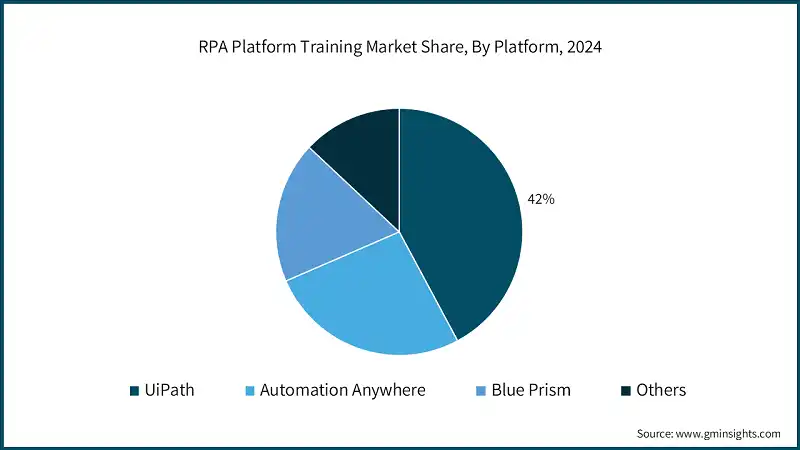
Based on platform, the RPA platform training market is segmented into UiPath, Automation Anywhere, Blue Prism, and others. The UiPath segment dominates the market with 42% share in 2024, and the segment is expected to grow at a CAGR of over 20% from 2025 to 2034.
- UiPath continues to dominate the RPA platform training market, acting as the foundational engine for large-scale automation upskilling across enterprises, educational institutions, and individual learners. Through its comprehensive and freely accessible UiPath Academy, the company provides structured learning paths tailored to developers, business analysts, infrastructure engineers, and citizen developers. With globally recognized certifications and scalable content delivery, UiPath plays a central role in powering the workforce transformation that underpins digital automation initiatives. For instance, in May 2024, UiPath launched the “Automation Cloud Certification Track” to upskill developers on GenAI-integrated bots, underscoring its aggressive talent ecosystem expansion.
- Automation Anywhere holds 26% market share with over 18% CAGR, reinforcing its position as a strong challenger. Its Automation Anywhere University provides multilingual, cloud-hosted training for business users and IT staff. The platform’s tight integration with enterprise-grade LMS systems supports corporate deployment. It particularly benefits multinational organizations deploying RPA at scale, where consistent workforce enablement across geographies is key.
- Others collectively make up just 13% of the market, with a slower CAGR of 13%, highlighting a fragmented long tail of vendors with limited training scale or ecosystem integration. These typically include region-specific or vertical-focused players whose training content may lack standardization, cloud delivery, or enterprise LMS compatibility. This segment is such to face acquisition or attrition pressure as dominant players expand further.
Based on enterprise size, the RPA platform training market is segmented into SMEs and large enterprises. The large enterprises segment is expected to dominate as the ability to train thousands of employees across varying technical backgrounds, languages, and regulatory environments demands scalable, secure, and customizable training solutions.
- Large enterprises continue to dominate the RPA platform training market, acting as the primary drivers of structured, high-scale automation skilling across global operations. These organizations are at the forefront of digital transformation and rely on formalized training ecosystems to equip diverse workforces including developers, analysts, and business users with the skills needed to design, deploy, and manage software bots effectively. Training investments are increasingly tied to enterprise-wide Centers of Excellence (CoEs), where standardized learning paths and certifications are integrated into broader automation strategies.
- SMEs contribute a significant 36% market share but trail slightly in growth with an 18% CAGR, limited by tighter budgets and slower technology adoption. However, the rise in affordable, subscription-based training platforms and plug-and-play RPM solutions is closing this gap. Many startups and mid-sized clinics are adopting these models for quick staff onboarding, especially in underserved or rural healthcare settings where remote care is critical.
- Despite lower growth, SMEs remain a key opportunity area for RPM training providers offering freemium models, pay-per-user pricing, and mobile-first learning interfaces. Platforms such as Coursera for Business and Zoho Learn are tailoring products specifically for this segment. As regulatory pressures expand and remote care models mature, SMEs will increasingly seek standardized training, especially those targeting niche specialties or telehealth-first business models.
Looking for region specific data?
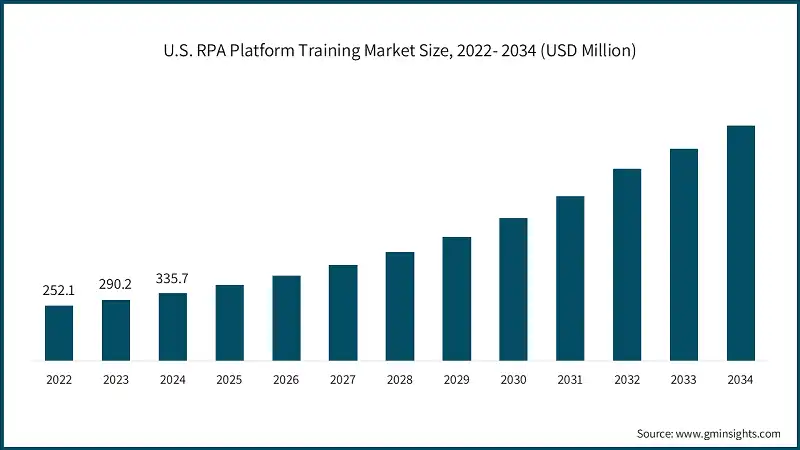
U.S. dominated the RPA platform training market in North America with around 82% share in 2024 and generated USD 335.7 million in revenue.
- U.S. leads the market, driven by its robust enterprise automation adoption, dominance of RPA software vendors, and highly developed digital learning infrastructure. As one of the most advanced automation ecosystems globally, the U.S. market is shaped by the strong presence of large enterprises, government-backed workforce reskilling programs, and a thriving ecosystem of EdTech and AI-driven training platforms.
- Institutions are investing in scalable education for nurses and care teams. For instance, Ascension Health’s September 2023 rollout of an AI-based RPM training program across 19 states reflects how major systems are advancing national-scale skilling initiatives.
- Canada holds 16.2% CAGR, supported by public digital health funding and provincial telehealth expansion. Bilingual training needs and regional disparities in care access make customized, cloud-based modules attractive. Initiatives such as Canada Health Infoway enable e-learning deployment in underserved and Indigenous communities, offering long-term market potential.
- The U.S. market also benefits from a mature ecosystem of AI startups, cloud infrastructure providers (such as AWS, Azure), and academic institutions partnering with RPA vendors to deliver cutting-edge automation training. With widespread digital literacy, a strong emphasis on certification, and growing demand for low-code/no-code talent, the United States remains the epicenter of the global RPA training landscape setting the benchmark for scalable, personalized, and outcome-driven automation learning.
The RPA platform training market in the UK is expected to experience significant and promising growth from 2025 to 2034.
- Europe holds second-largest share of the global RPM platform training market in 2024 with a CAGR of 17.5%, driven by rising demand for remote care training, data compliance, and cross-border workforce certification. EU funding programs and digital health initiatives are accelerating platform adoption across member states, particularly in public healthcare systems.
- The UK leads the European market, backed by NHS-driven digital transformation programs and a strong emphasis on clinical staff training for virtual wards and RPM tools. In June 2023, the NHS partnered with BMJ Learning to launch a nationwide training platform on digital monitoring and remote diagnostics for general practitioners and nurses, reinforcing institutional-level demand.
- Germany and France follow the UK, with strong hospital digitalization initiatives and growing reliance on AI-enabled training platforms. Both countries emphasize data governance and localized compliance modules, making them key markets for vendors offering GDPR-compliant, multilingual RPM content with integrated analytics dashboards.
- Eastern and Nordic Europe present emerging opportunities, where telehealth expansion and workforce shortages are pushing investment into scalable training formats. Countries such as Sweden and Poland are piloting remote monitoring programs for elderly care and chronic disease management, which require structured, certified training solutions delivered remotely.
The RPA platform training market in India is expected to experience significant and promising growth from 2025 to 2034.
- Asia Pacific accounts for over 20% of the global RPM platform training market in 2024 and is the fastest-growing region with a CAGR of around 21%. Growth is driven by increasing digital health investments, mobile-first learning adoption, and a large, distributed healthcare workforce needing scalable, low-cost training solutions.
- India leads the RPA platform training market in the Asia-Pacific region, driven by its expansive IT services sector, strong talent pool, and rapid enterprise adoption of automation technologies. As a global hub for digital transformation and business process outsourcing (BPO), India has become a focal point for large-scale RPA workforce development, supported by both domestic demand and offshoring automation projects from global clients.
- India leads the regional RPA platform training market, backed by government telehealth programs such as Ayushman Bharat Digital Mission (ABDM) and rapid expansion of RPM use in rural care delivery. In February 2024, Apollo Hospitals partnered with Coursera and Microsoft to train over 10,000 paramedics and nurses in remote patient care protocols, reflecting the push for hybrid training formats nationwide.
- China and Japan are also major contributors, with China emphasizing telehealth expansion in Tier 2/3 cities and Japan investing in RPM workforce training for elderly care. Both countries demand AI-integrated and compliance-focused platforms that support remote diagnostics, population health management, and chronic disease monitoring.
- Emerging markets such as Indonesia, Vietnam, and the Philippines are fueling regional momentum, driven by mobile penetration, public-private partnerships, and healthcare decentralization. Training platforms offering multilingual content, offline access, and microlearning formats are well-positioned to capture demand in these high-need, underserved regions.
The RPA platform training market in UAE is expected to experience significant and promising growth from 2025 to 2034.
- MEA accounts for 13% of the global RPM platform training market in 2024, reflecting steady growth driven by digital health adoption, public sector initiatives, and increasing healthcare investments in Gulf nations. Infrastructure limitations in parts of Africa, however, restrain widespread training platform penetration.
- The UAE leads the MEA region, fueled by national digital health strategies, smart hospital initiatives, and heavy investment in telemedicine workforce training. In March 2024, the Dubai Health Authority launched an AI-enabled RPM training platform in collaboration with Siemens Healthineers to upskill over 2,000 clinicians across public hospitals in remote monitoring protocols.
- Saudi Arabia and South Africa follow as key regional markets, with the former advancing its RPM workforce capacity under Vision 2030 and the latter focusing on training health workers in rural telehealth delivery. Localized, cloud-based training tools with offline access and compliance support are increasingly in demand.
- Emerging opportunities lie in countries such as Egypt, Kenya, and Nigeria, where health ministries and NGOs are piloting mobile-based RPM programs. Scalable training platforms that offer multilingual content, certification, and integration with local health systems can bridge the digital skill gap and support long-term care delivery expansion.
- The United Arab Emirates (UAE) leads the RPA platform training market in the Middle East & Africa region, driven by its ambitious national digital transformation goals, enterprise automation initiatives, and strong investment in workforce upskilling. With a forward-thinking government and a rapidly modernizing private sector, the UAE has positioned itself as a regional hub for intelligent automation and future-ready digital talent.
The RPA platform training market in Brazil is expected to experience significant and promising growth from 2025 to 2034.
- Latin America grows with a CAGR of 14.8%, reflecting gradual adoption driven by urban healthcare digitization, rising chronic disease burden, and growing interest in telehealth. Infrastructure disparities and funding constraints limit broader regional scale.
- Brazil leads the region, supported by strong public healthcare investment and telemedicine policy expansion. In January 2024, Hospital Sírio-Libanês launched a virtual RPM training program in partnership with Google Health, offering Portuguese-language modules for over 5,000 clinicians across São Paulo and surrounding regions—showing Brazil’s move toward large-scale digital skilling.
- Mexico and Colombia follow, with growing support for RPM use in remote and underserved areas. Government-backed telehealth pilots and rising mobile health usage are encouraging hospitals and clinics to seek cost-effective training platforms, particularly those supporting hybrid care delivery and chronic disease management.
- Emerging growth pockets exist in Argentina, Chile, and Peru, where universities and private healthcare groups are experimenting with e-learning modules for RPM protocols. Vendors offering mobile-first, Spanish-language training with offline accessibility are best positioned to address workforce gaps in fragmented health systems.
RPA Platform Training Market Share
- The top 7 companies in the RPA platform training industry are UiPath, Automation Anywhere, SS&C Blue Prism, Simplilearn, Coursera, Edureka, Udemy contributing around 21.5% of the market in 2024.
- SS&C Blue Prism leads the RPA training market in 2024, having steadily increased its share over the past three years through deeper penetration into highly regulated sectors such as banking and government. Its competitive edge lies in offering structured, compliance-focused certifications via Blue Prism University, and its global expansion strategy includes enhanced multilingual training and industry-specific learning paths. The acquisition by SS&C Technologies strengthened its enterprise reach and stability across North America and Europe.
- UiPath, once the undisputed leader, now holds the second position, still commanding influence through its expansive UiPath Academy, robust enterprise adoption, and global training partnerships. However, its market share has experienced minor contraction as newer platforms and edtech alliances gain traction. Recent investments in AI-based learning paths and deeper integration with university curricula are part of its strategy to retain dominance in developer and analyst skilling.
- Coursera has emerged as a top 3 player, growing steadily due to its partnerships with universities and major tech firms offering RPA-centric certifications. Over the last two years, Coursera has expanded its enterprise learning solutions and localized content for emerging markets. However, it faces pressure from corporate L&D platforms offering more interactive, role-specific simulations, making content differentiation and platform engagement key strategic priorities.
- Automation Anywhere, although still a recognized brand, has seen limited growth in RPA platform training market share, constrained by competition from flexible, vendor-neutral platforms. Its strategic focus has shifted toward enterprise workflow automation, which may dilute its RPA training emphasis. To maintain relevance, the company launched virtual labs and real-time sandboxes in 2023, but newer entrants offering low-code/no-code training are emerging as credible threats.
- Simplilearn maintains consistent visibility, largely due to its multi-vendor curriculum and alignment with global certification bodies. While it lacks proprietary RPA platforms, its agility in updating course content and focus on career-switching professionals give it resilience. Nonetheless, the growing number of free microlearning providers and budget-conscious learners in emerging markets could present challenges to its premium pricing model.
- Edureka holds a niche stronghold, especially in India and Southeast Asia, offering live instructor-led RPA courses tailored for early-career professionals. Its real-world project emphasis appeals to working professionals, but geographic concentration and lack of platform partnerships may hinder global scale. Rising competition from scalable, asynchronous learning platforms adds further pressure.
- Udemy remains influential in the informal and long-tail segment, relying on its massive instructor network and low-cost, on-demand RPA courses. However, with increasing scrutiny around content quality and lack of certification standardization, Udemy faces threats from structured training ecosystems. New edtech startups with interactive learning models and formal recognition are encroaching on its market share.
RPA Platform Training Market Companies
Major players operating in the RPA platform training industry are:
- Automation Anywhere
- Codecademy
- Coursera
- Edureka
- Intellipaat
- LinkedIn Learning
- Simplilearn
- SS&C Blue Prism
- Udemy
- UiPath
- SS&C Blue Prism, UiPath, and Automation Anywhere have strategically invested in robust training ecosystems tailored to enterprise users. Blue Prism continues to enhance its Blue Prism University offerings by aligning content with heavily regulated sectors, and post-acquisition by SS&C, has focused on expanding its global compliance-ready modules.
- UiPath has launched AI-assisted learning paths through UiPath Academy and deepened collaborations with universities to support automation career tracks. Automation Anywhere has partnered with global enterprises and launched virtual labs and sandbox environments, reinforcing real-time, hands-on learning for corporate teams.
- Coursera, Codecademy, and LinkedIn Learning bring platform-driven, academic-aligned, and modular training strategies to the RPA landscape. Coursera’s partnerships with institutions such as the University of London and Google have helped create university-backed certification tracks for RPA and automation. Codecademy, under Skillsoft, has added low-code automation content and interactive RPA modules to meet demand from self-paced learners. LinkedIn Learning leverages its Microsoft ecosystem integration to deliver role-based RPA training via career-relevant playlists and enterprise LMS integration.
- Simplilearn, Edureka, Intellipaat, and Udemy serve the career-switcher and early-career professional market through instructor-led training, capstone projects, and certification-focused courses. Simplilearn has launched multi-vendor bootcamps with global certification bodies, while Edureka focuses on real-time mentoring and market-specific live classes.
- Intellipaat has recently introduced project-based RPA training tracks bundled with interview prep, and Udemy maintains its edge with a flexible content library and frequent updates across UiPath, Blue Prism, and Automation Anywhere tools. These players thrive on affordability, accessibility, and localized training relevance.
RPA Platform Training Industry News
- In November 2024, Automation Anywhere entered into a strategic alliance with PwC India to co-develop GenAI-powered RPA training programs. The initiative focused on delivering enterprise-ready automation certifications tailored to industries such as BFSI, retail, and manufacturing.
- In October 2024, UiPath expanded its Academy with new AI-specialized training paths and micro-certifications, including modules on document understanding, communication mining, and AI Center. These updates supported enterprise learners in aligning RPA skills with emerging intelligent automation requirements.
- In July 2024, Automation Anywhere deepened its collaboration with Microsoft, embedding Azure OpenAI features into its platform and launching new training content for intelligent document processing and generative AI integration. The initiative aimed to future-proof enterprise automation capabilities through AI-enhanced skill development.
- In June 2024, Edureka introduced its RPA Career Track initiative, offering structured learning paths, project-based modules, and integrated job assistance. The program targeted India’s rapidly growing pool of automation professionals, supporting both fresh graduates and working professionals.
- In February 2024, Coursera broadened its automation learning catalog by partnering with UiPath to offer curated training bundles for enterprise users. The bundles included career-track pathways for developer, business analyst, and infrastructure-focused learners.
The RPA platform training market research report includes in-depth coverage of the industry with estimates & forecasts in terms of revenue ($ Mn/Bn) from 2021 to 2034, for the following segments:
Market, By Training
- Online/Virtual training
- Classroom training
- Corporate/enterprise training
- Certification programs
Market, By Platform
- UiPath
- Automation Anywhere
- Blue Prism
- Others
Market, By Enterprise Size
- SME
- Large enterprises
Market, By Delivery Mode
- Self-paced learning
- Instructor-Led Training (ILT)
- Blended learning
- Workshops & bootcamps
Market, By End Use
- Students
- IT Professionals
- Enterprise employees
- Freelancers/consultants
The above information is provided for the following regions and countries:
- North America
- U.S.
- Canada
- Europe
- Germany
- UK
- France
- Italy
- Spain
- Russia
- Nordics
- Asia Pacific
- China
- India
- Japan
- Australia
- South Korea
- Southeast Asia
- Latin America
- Brazil
- Mexico
- Argentina
- MEA
- South Africa
- Saudi Arabia
- UAE
Frequently Asked Question(FAQ) :
Who are the key players in the RPA platform training industry?
Key players include UiPath, Automation Anywhere, SS&C Blue Prism, Coursera, Simplilearn, Edureka, Udemy, Codecademy, Intellipaat, and LinkedIn Learning.
What are the upcoming trends in the RPA platform training market?
Trends include AI-driven learning paths, role-based modular upskilling, certification-focused ecosystems, low-code/no-code training, and public-private partnerships for skill development.
What is the growth outlook for corporate/enterprise training from 2025 to 2034?
The corporate/enterprise training segment is set to expand at a CAGR of 18% between 2025 and 2034.
Which region leads the RPA platform training sector?
North America leads the market, with the U.S. contributing 82% of the regional revenue, amounting to USD 335.7 million in 2024.
What is the market size of the RPA platform training in 2024?
The market size was USD 1.2 billion in 2024, with a CAGR of 18.5% expected through 2034. The growth is driven by increasing enterprise automation, AI integration, and demand for hybrid skills.
What was the valuation of the UiPath platform training segment in 2024?
UiPath accounted for 42% of the market share in 2024, dominating the market with its structured learning paths and globally recognized certifications.
How much revenue did the online/virtual training segment generate in 2024?
The online/virtual training segment generated approximately 39% of the market revenue in 2024.
What is the projected value of the RPA platform training market by 2034?
The market for RPA platform training is poised to reach USD 5.4 billion by 2034, supported by advancements in AI, enterprise automation, and the need for upskilling in hybrid roles.
RPA Platform Training Market Scope
Related Reports