Summary
Table of Content

Retail Packaging and Display Boxes for Consumer Products Market
Get a free sample of this report
Form submitted successfully!
Error submitting form. Please try again.
Thank you!
Your inquiry has been received. Our team will reach out to you with the required details via email. To ensure that you don't miss their response, kindly remember to check your spam folder as well!
Request Sectional Data
Thank you!
Your inquiry has been received. Our team will reach out to you with the required details via email. To ensure that you don't miss their response, kindly remember to check your spam folder as well!
Form submitted successfully!
Error submitting form. Please try again.
Retail Packaging and Display Boxes for Consumer Products Market Size
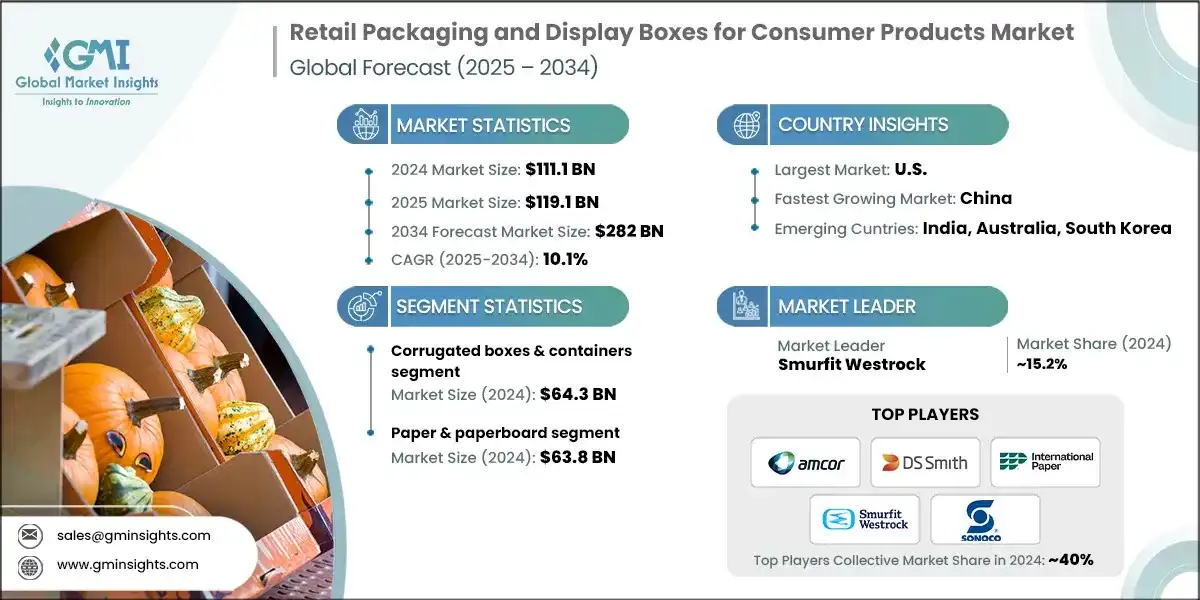
The global retail packaging and display boxes for consumer products market was estimated at USD 111.1 billion in 2024. The market is expected to grow from USD 119.1 billion in 2025 to USD 282 billion in 2034 at a CAGR of 10.1%, according to latest report published by Global Market Insights Inc.
Retail Packaging and Display Boxes for Consumer Products Market Key Takeaways
Market Size & Growth
- 2024 Market Size: USD 111.1 Billion
- 2025 Market Size: USD 119.1 Billion
- 2034 Forecast Market Size: USD 282 Billion
- CAGR (2025–2034): 10.1%
Regional Dominance
- Largest Market: U.S.
- Fastest Growing Region: China
Key Market Drivers
- E-commerce Growth & Omnichannel Retail Expansion.
- Sustainability Mandates & Consumer Environmental Consciousness.
- Smart Packaging Technology Adoption & ROI Realization.
Challenges
- Raw Material Price Volatility & Supply Chain Disruptions.
- Stringent Environmental Regulations & Compliance Costs.
Opportunity
- Emerging Markets Penetration & Urbanization Trends.
- Personalization & Mass Customization Technologies.
Key Players
- Market Leader: Smurfit Westrock led with over 15.2% market share in 2024.
- Leading Players: Top 5 players in this market include Amcor, DS Smith, International Paper Company, Smurfit Westrock, Sonoco Products Company, which collectively held a market share of 40% in 2024.
Get Market Insights & Growth Opportunities
The sector of retail packaging and display boxes for consumer products is already going through changes we have never seen before. These changes are rooted in new environmental regulations, changes in consumer expectations, and technology developments. The packaging industry is taking shape and developing against a backdrop of complex regulations, exemplified by the European Union's Packaging and Packaging Waste Directive requiring that member states establish recycling targets and implement various extended producer responsibility arrangements, and U.S. Food and Drug Administration is intensifying oversight of packaging materials in direct contact with food products requiring new guidelines in chemical migration testing and safety assessments.
Through Internet of Things technology and smart packaging, traditional packaging is transforming into interactive communication vehicles providing real-time data information throughout the supply chain. Raw material suppliers are in the process of producing 'conductive inks', flexible electronics, and substrates that are compatible for use with sensors and with digital connections yet maintain packaging properties and value through affordability. Manufacturers are developing packaging designs that include near-field communication (NFC) chips, QR codes, sensors, etc., and leading-edge companies are identifying that smart packaging features have only added 5-10% to the total cost of production yet deliver significant added value and product/packaging ability.
Distributors have begun using smart packaging data for real-time tracking inventory and temperature monitoring for products to further optimize the logistics process, leading to 25 to 30% efficiencies in logistics processes and significant reductions in product loss due to product damage from environmental conditions. End users potentially purchase the products who are similarly being able to access smart packaging to engage consumers on behalf of the brands they are purchasing, like product assurance and marketing and analytics efforts, with brands that utilize smart packaging achieving 40 to 50% higher levels of consumer engagement and usable data about consumer engagement and preferences. Consumers can potentially benefit from smart packaging with more information about the product, assurance of authenticity, and experiences can be interactive experiences planned with brands with smart packaging data that can also include freshness indicators, usage group or instructions, and can link the consumer directly to the brand. This trend started recently as technology has advanced, the cost of electronic components dropped, and some consumers have led to a demand for more transparency and interactive experiences with products, including trust in authenticity and food safety.
The transition to localized supply chains and improved resilience has profoundly affected worldwide sourcing practices in packaging. These changes have resulted from supply chain disruptions due to the pandemic, challenges generated by geopolitical conflicts' impact on supply, and a desire for more sustainability. Raw material suppliers are investing in building regional manufacturing plants and expanding their supplier networks to reduce reliance on single-source materials. The larger suppliers said that they allocate 15-20% of annual capital expenditure on regional capacity expansion. Manufacturers are utilizing dual-sourcing approaches and are more frequently working with local suppliers. Surveying different aspects of the industry, within the packaging industry over the last 30 months, 65% of packaging manufacturers have expanded their supplier network, and 45% have built regional production capacity for operational continuity. Distributors are reengineering logistics networks for shorter supply networks and developing advanced inventory management systems to improve visibility and flexibility which mitigates supply chain risk exposure by 20%-25%. End-users are prioritizing relationships with suppliers more by geographic proximity and continuity of supply over cost. Major retailers are developing preferred supplier programs based on continuity of supply chain often focused on regional suppliers for risk mitigations. Overall, consumers indirectly benefit from supply chain resilience, improved availability, and fewer supply chain disruptions while at the same time seeing increases in price as companies optimize prices with supply chain resilience.
The competitive environment for the retail packaging and display boxes industry has evolved into a comprehensive ecosystem of strategic or deliberate consolidation, technological partnerships, and vertical integration strategies. The current focus is on companies dedicated to purposefully sustainable solutions and digital printing technologies. Moreover, we see a range of partnerships formed between traditional manufacturing companies and technology companies for the purpose of developing smart packaging with Internet of Things (IoT) sensors, near-field communication capabilities, and blockchain for supply chain tracking. As a result, a new competitive landscape has emerged in which technological innovation and sustainability credentials have served as the main differentiators over traditional cost pressures to competition. In addition, automation has become another key source of competitive advantage in our industry and leading companies are now heavily investing in artificial intelligence-based design optimization, robotic production lines, and predictive maintenance systems for improved efficiency and reducing waste. Finally, we have also noted the emergence of specialized packaging service providers that are offering full-service packaging or end-to-end packaging services, meaning services are provided for design, manufacturing, and logistics all under one roof increasing competition for traditional manufacturing companies while also developing more opportunity for partners to collaboratively develop joint product.
The retail packaging and display boxes industry will experience a substantial change towards a future characterized by circular economy, smart manufacturing technology and enhanced supply chain resilience. According to predictions about the future of the retail packaging industry, sustainability will take the lead as the primary motivator of innovation and investment, with companies developing life-cycle assessments to understand environmental impact at every touchpoint in the value chain. The industry is investing in workforce development to close the skills gap caused by technological advancements with an emphasis on competencies in digital manufacturing, sustainability design, and supply chain management. Patterns of investment spending are moving toward researching and developing sustainable materials, automation technologies, and supply chain carbon digital technologies; and investing in growth in environmental, social, governance criteria through government investment and private equity. International trade dynamics are shifting to take advantage of regional supply chains for their benefits in reducing transportation costs, and where sustainability of goods anywhere in the supply chain is a new consideration, it requires a focus on shorter supply chains or sourcing locally. Industry forecasts suggest more consolidation of market position by long established firms who will be challenged in the future by technology firms who will focus on the design of products made from sustainable materials and increase collaboration with packaging manufacturers and their customers to develop new integrated solutions that meet both functional and sustainability requirements while remaining cost competitive in the global marketplace.
To get key market trends
Retail Packaging and Display Boxes for Consumer Products Market Trends
- The transition to sustainability across the retail packaging sector is a radical transformation influenced by regulation, consumer activism, and corporate commitments. Raw material suppliers have answered through the development of bio-based polymers and expansion of sourceable recycled content. International Paper reports that more than 38% of their fiber input is now from recycled sources. Manufacturers are shifting how they design their production process to use less material, and large manufacturers are implementing closed-loop manufacturing systems to salvage and reuse production waste, resulting in 5%-15% construction waste savings annually. Distributors are redesigning their distribution network to reduce transportation emissions and are using reverse logistics for packaging recovery, with some large distributors reporting carbon footprint decreases of 20%-30% from their logistics routes, including using electric vehicles. End use customer types, typically large retailers and consumer brands, are developing sustainability goals, such as Unilever, which has committed to making its plastic packaging reusable, recyclable, or compostable by 2025. Additionally, consumers are more aware of the packaging that they use, and surveys show that 73% of global consumers will pay more for sustainable packaging alternatives putting further market pressure through the full value chain.
- Digital printing technology has changed the packaging industry by offering time- and cost-efficient short runs and personalized packaging options, altering the economics of traditional manufacturing. Raw material suppliers have developed specific substrates for digital printing, such as heat-resistant papers or films that will hold the original color quality of offset printing while there is 20-25% less ink. Manufacturers are investing heavily in digital printing equipment with industry leaders positioned at 35-40% of their production capacity in digital printing. Digital printing reduces lead times and removes minimum order quantity limitations, which have traditionally prevented packaging from being customized.
- Distributors may keep fewer items in stock due to the digital printing method and improve accuracy on demand forecasting by using digital printing as just-in-time production; this method also cuts the cost of warehousing obsolete inventory in goods and materials by 30% approximately as well. The end-user uses digital printing as a marketing model since seasonal promotions and localized customization would appeal to a target audience. Consumer goods companies find that personalized packaging models to engage consumers increase engagement 15-20% as well. The expectation of personalization is growing from many consumer-product industries, and the idea of personal preference or localization continues to demand customized packaging. In e-commerce, the idea of unboxing has become an experience that a brand can easily differentiate from the rest in the packaging.
- The implementation of automation and artificial intelligence technologies is making packaging manufacturing into smart responsive production systems that optimize efficiency, quality, and sustainability. The use of AI-supported quality control systems and predictive analytics for inventory control is being utilized by raw material suppliers to achieve 30-35% improvement in consistency of materials, while being able to eliminate as much as 20% of waste by utilizing better scheduling of the production materials. Manufacturers are investing in robotic production lines mounted with machine learning algorithms for improved process control as well as predictive maintenance systems that can reduce downtime by 25-30% and boost production flexibility and customization. Distributors are utilizing automated sorting and packaging that realize throughput peaks of 40-50%, while decreasing labor and improving accuracy in order fulfillment and inventory management. End-users receive better, more consistent product quality, faster shipping times, and increased flexibility in production which rapidly respond to market conditions and seasonal changes with brands boasting 15-20% improvement in time to market for new packaging designs. However, consumers may have to pay more for better product quality, more consistent packaging performance, and new features enabled through precision manufacturing.
Retail Packaging and Display Boxes for Consumer Products Market Analysis

Learn more about the key segments shaping this market
Based on product type, the market is segmented into corrugated boxes & containers, folding paperboard boxes, rigid set-up boxes, display-ready packaging, and die-cut display containers. In 2024, the corrugated boxes & containers segment dominated the market and generated a revenue of USD 64.3 billion and is expected to grow at CAGR of around 9.7% during the forecast period 2025 to 2034.
- Corrugated boxes & containers dominated the market, due to their versatility, cost-effectiveness, and wide applicability across retail and e-commerce sectors.
- The segment is projected to grow at a CAGR of around 9.7% from 2025 to 2034, driven by rising demand for durable and sustainable packaging solutions.
- Increasing online retail and last-mile delivery needs are fueling the adoption of corrugated packaging for safe and efficient product transport.
- Corrugated materials are highly recyclable and biodegradable, aligning with global sustainability goals and consumer preferences.
- Advancements in printing and die-cutting technologies are enabling brands to use corrugated packaging for impactful shelf presence and personalized consumer experiences.

Learn more about the key segments shaping this market
The retail packaging and display boxes for consumer products market by material type is segmented into plastic, paper & paperboard, glass, metal, and others (sustainable alternatives, etc.). The paper & paperboard segment was the leading segment in this market in 2024 with a revenue of USD 63.8 billion and has a market share of around 57.4%.
- Paper & paperboard materials are widely recognized for their recyclability and biodegradability, making them the preferred choice amid growing environmental awareness and sustainability mandates. This aligns with both consumer preferences and regulatory pressures, giving the segment a strong competitive edge.
- These materials offer excellent adaptability for various packaging formats from folding cartons to rigid boxes and display-ready packaging, making them suitable for a wide range of consumer products including food, cosmetics, electronics, and apparel.
- Compared to alternatives like glass or metal, paper & paperboard are more cost-efficient to produce and easier to scale, especially for high-volume retail applications. Their lightweight nature also reduces transportation costs, further enhancing their appeal to manufacturers and retailers.
- Paper-based packaging supports high-quality printing and finishing techniques, enabling brands to create visually compelling designs that enhance shelf appeal and consumer engagement. This makes it a strategic tool for marketing and brand differentiation.
Looking for region specific data?
U.S. Retail Packaging and Display Boxes for Consumer Products Market
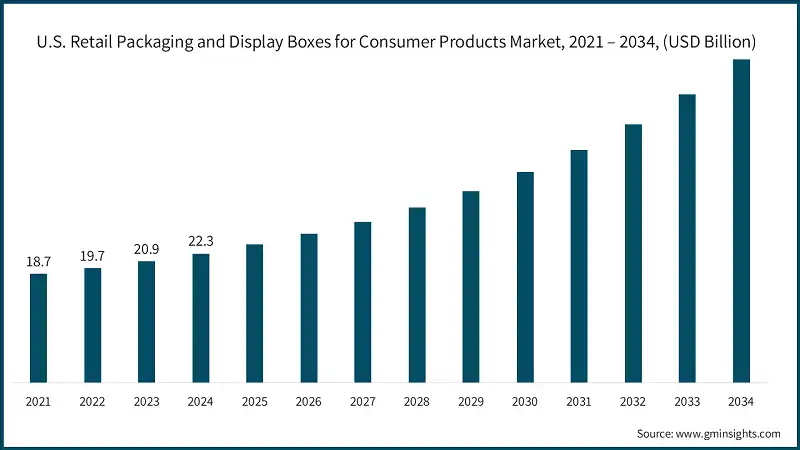
The U.S. market was valued at around USD 22.3 billion in 2024 and is anticipated to register a CAGR of 9.9% between 2025 and 2034.
- The market for U.S. retail packaging and display boxes used in the consumer market is thriving – fueled in large part by the country's strong e-commerce and retail infrastructure. As reported by the U.S. Census Bureau, retail e-commerce is $304.2 billion dollars (16.3%) of total retail sales for second quarter 2025, a 5.3% increase year-over-year. The increase in online shopping means growing demand for protective, branded, and sustainable packaging that supports both shipping durability and consumer experience, driving further demand for packaging products. The U.S. size, scale and maturity in omnichannel retailing have made it a leader in packaging innovation and volume for packaging formats like corrugated boxes and display-ready packaging.
- The U.S. consumer base, meanwhile, is also highly responsive to sustainability and personalization trends that impact packaging choices. According to the EPA, containers and packaging materials accounted for over 82 million tons of municipal solid waste in 2018 - with paper and paperboard being among the most recycled materials in municipal solid waste. Driven by both regulations and consumers, the push towards eco-friendly materials in the packaging industry is prompting manufacturers to invest in recyclable and compostable packaging formats.
Europe Retail Packaging and Display Boxes for Consumer Products Market
Europe witnessed promising demand in the market and is the second fastest growing region after Asia Pacific, with a share of around 19.8% in 2024 and is expected to grow at a robust CAGR of 10.1% during the forecast period.
- Europe is showing encouraging demand in the retail packaging and display boxes market because of its strong regulatory push toward sustainability and circular economy principles. Eurostat reported that paper and cardboard were responsible for 40.4% of the EU's packaging waste in 2023, representing the preferred material across Member States. The region's strong preference for recyclable and biodegradable packaging solutions is especially evident in the retail sector. The recent EU Packaging and Packaging Waste Regulation (PPWR) requires new design criteria to support recyclability, reuse quotas, and minimum content requirements for recycled materials, which will likely revolutionize the way packaging is designed and create a real demand and markets for compliant materials and packaging types. Not only are these policies stimulating innovation, but they are also creating new opportunities for manufacturers in this area across Europe.
Asia Pacific Retail Packaging and Display Boxes for Consumer Products Market
Asia Pacific is fastest growing as well as leading the market at a growth rate of 10.4% during the forecast period.
- Retail packaging and display boxes market is the fastest growing demand in the Asia Pacific, due to its quick growth in e-commerce and urbanization. It is cited by the U.S. International Trade Administration that the Asia-Pacific is the largest e-commerce market in the world, and it has projected the market value of e-commerce will rise from USD 23.4 trillion in 2022 to exceed USD 28.9 trillion by 2026 and will grow annually at 15% above the world's average rates. Countries like China, India, Indonesia, and Vietnam are seeing fast and exponential growth in online retail, which means increased demand for protective packaging, branded packaging, and sustainable packaging solutions. In addition, per the research report a report jointly developed by Google and Temasek Holdings, Southeast Asia's internet economy is projected to increase from USD 194 billion to over USD 330 billion by 2025, with Indonesia alone contributing more than USD 82 billion of that growth. This growth in digital commerce will create demand for corrugated boxes, folding cartons, and display-ready products across an array of consumer sectors.
Retail Packaging and Display Boxes for Consumer Products Market Share
- The top 5 companies in the retail packaging and display boxes for consumer products industry, such as Amcor, DS Smith, International Paper Company, Smurfit Westrock, and Sonoco Products Company, collectively hold a market share of 40%.
- Amcor is capitalizing on its unrivalled global scale and innovation leadership to protect its competitive advantage. The company's merger with Berry Global in 2025 significantly diversified Amcor’s existing portfolio, especially in rigid packaging and closures, as well as unlocking more than USD 650 million in synergy opportunities by 2028. Amcor continues to invest in sustainability R&D, and now approximately 88% of its revenue comes from recyclable products and functionality. In addition, Amcor continues to invest aggressively in AI-based operational efficiency and predictive maintenance programs across more than 210 plants worldwide. The company's strategy now focuses primarily on high-value markets, including healthcare and emerging markets, underpinning this approach with long-term contracts with blue-chip leaders including Nestlé and PepsiCo.
- DS Smith continues to lead with its circular economy-based business model. The company has eliminated over 1.7 billion pieces of plastic since 2020, and it achieves an impressive 99.6% recyclability across its packaging volume. DS Smith's business strategy is focused on designing out waste, optimizing fiber use, and decarbonizing operations. DS Smith has now developed its own Circular Design Metrics with the Ellen MacArthur Foundation, which are helping customers to both reduce their environmental impact, while gaining even more impactful performance from its packaging. The merger with International Paper will only enhance its stature and sustainability leadership position on the global stage, especially in Europe and North America.
- International Paper is undertaking a strategic shift, becoming exclusively focused on packaging by divesting itself of non-core assets such as its Global Cellulose Fibers division. The company is rearranging its U.S. and European operations to divest underperforming assets and is reinvesting in its higher-return facilities like Riverdale, Alabama. The company intends to be a fully integrated packaging company, and its cost-based optimization is addressing issues to ultimately enhance service quality and win higher-value customers. Its disciplined capacity management and asset quality process positions it profitably in the long term - even with a macroeconomic headwind.
Retail Packaging and Display Boxes for Consumer Products Market Companies
Major players operating in the retail packaging and display boxes for consumer products industry are:
- Amcor
- Ashtonne Packaging
- Barry-Wehmiller Corporation
- Bennett Packaging
- BW Packaging Systems
- DS Smith
- Georgia-Pacific
- Graphic Packaging International
- International Paper Company
- Karl Knauer Group
- Mondi Group
- Smurfit Westrock
- Sonoco Products Company
- Stora Enso
- Weedon Direct
After combining Smurfit Kappa and WestRock, Smurfit Westrock now has USD 34 billion in revenue (combined), making it the number 1 corrugated packaging company in the world. As it embarks on realizing USD 400 million+ in annual synergies, improving operations, and increasing its leadership position in fiber-based alternatives to plastic; the company’s vertically integrated model from forests to recycle ensures control over supply chain and costs. Its strategic priorities center on aggressive deleveraging of balance sheet, pushing the envelope on technology in smart packaging, and cross-selling and upselling across the legacy customer base- all with the objective of dominating the sustainable packaging space.
Sonoco is evolving into a relevant sustainability powerhouse by reducing its footprint through segment disaggregation, and, via investment into more efficiently growing business segments like metal packaging. As represented by its acquisition of Eviosys, and divestiture of non-core business units (like ThermoSafe), Sonoco's strategy is about getting back to its prime business of Consumer and Industrial Paper Packaging. Sonoco is presently utilizing AI for predictive maintenance, optimizing its cost structure, and developing platforms for more recyclable and compostable packaging. Lastly, with its deep relationships with leading and emerging CPGs, along with its recycled paperboard operations and vertical integration, the company has a resilience to notwithstanding competitive pressures and deliver on ESG-based opportunities.
Retail Packaging and Display Boxes for Consumer Products Market Report Attributes
| Key Takeaway | Details |
|---|---|
| Market Size & Growth | |
| Base Year | 2024 |
| Market Size in 2024 | USD 111.1 Billion |
| Market Size in 2025 | USD 119.1 Billion |
| Forecast Period 2025 – 2034 CAGR | 10.1% |
| Market Size in 2034 | USD 282 Billion |
| Key Market Trends | |
| Drivers | Impact |
| E-commerce Growth & Omnichannel Retail Expansion | Drives global demand for visually appealing, durable, and brand-consistent packaging solutions across digital and physical retail channels. |
| Sustainability Mandates & Consumer Environmental Consciousness | This accelerates the shift toward recyclable, biodegradable, and minimalistic packaging designs, influencing global material sourcing and innovation. |
| Smart Packaging Technology Adoption & ROI Realization | Boosts investment in interactive and data-driven packaging formats, enhancing consumer engagement and supply chain efficiency worldwide. |
| Pitfalls & Challenges | Impact |
| Raw Material Price Volatility & Supply Chain Disruptions | Increases production costs and delays delivery timelines, straining profitability and market responsiveness globally. |
| Stringent Environmental Regulations & Compliance Costs | Raise operational and material sourcing expenses, limiting flexibility and innovation for packaging manufacturers worldwide. |
| Opportunities: | Impact |
| Emerging Markets Penetration & Urbanization Trends | Expands the consumer base and retail infrastructure, driving demand for localized and scalable packaging solutions globally. |
| Personalization & Mass Customization Technologies | Enables brands to enhance consumer engagement and loyalty through tailored packaging experiences, boosting premium product sales worldwide. |
| Market Leaders (2024) | |
| Market Leaders |
15.2% Market share |
| Top Players |
Collective market share in 2024 ~40% |
| Competitive Edge |
|
| Regional Insights | |
| Largest Market | U.S. |
| Fastest growing market | China |
| Emerging countries | India, Australia, South Korea |
| Future outlook |
|
What are the growth opportunities in this market?
Retail Packaging and Display Boxes for Consumer Products Industry News
- In October 2025, Amcor announced strategic advancements in its sustainability and innovation roadmap. The company highlighted in its 2025 annual report that 88% of its revenue now comes from products designed to be recyclable or reusable, reinforcing its commitment to circular packaging solutions. Amcor also emphasized its investment in digital transformation and operational efficiency, including AI-driven manufacturing and predictive analytics, to enhance productivity across its global footprint. These initiatives, combined with its strong customer partnerships and expanding portfolio in healthcare and consumer goods, position Amcor to maintain competitive resilience and drive long-term growth in the global retail packaging and display boxes market.
- In October 2025, Walmart and Avery Dennison announced a strategic collaboration to enhance product freshness and operational efficiency across Walmart’s fresh food supply chain using RFID technology. The initiative aims to improve inventory accuracy, reduce food waste, and streamline stock replenishment by enabling real-time visibility into product movement and shelf life. Avery Dennison’s intelligent labeling solutions will be integrated into Walmart’s distribution and store-level operations, marking a significant step toward digitized, data-driven retail packaging systems. This partnership reflects the growing role of smart packaging in optimizing logistics and elevating consumer experience in the retail sector.
- In October 2025, DS Smith partnered with Queen Flowers to introduce fibre-based packaging solutions for retail flower bouquets, replacing traditional plastic wraps with recyclable paper formats. This collaboration reflects DS Smith’s commitment to circular design and sustainability, offering packaging that is not only eco-friendly but also enhances product presentation and shelf appeal. The initiative supports broader industry efforts to reduce single-use plastics in retail and aligns with consumer demand for environmentally responsible packaging in everyday products.
- In October 2025, Reedbut Group announced the expansion of its Milton Keynes facility to meet rising demand for sustainable corrugated packaging solutions. The investment includes new machinery and increased production capacity, aimed at supporting both existing and new retail clients with faster turnaround and enhanced customization capabilities. This strategic move reflects Reedbut’s commitment to environmentally responsible manufacturing and positions the company to better compete in the growing retail packaging and display boxes market across the UK and Europe
The retail packaging and display boxes for consumer products market research report includes in-depth coverage of the industry, with estimates & forecasts in terms of revenue (USD Billion) and volume (Million Units) from 2021 to 2034, for the following segments: Market, By Product Type- Corrugated boxes & container
- Single-wall corrugated boxes
- Double-wall corrugated boxes
- Triple-wall heavy-duty containers
- Specialty flute configurations (E, F, micro-flute)
- Folding paperboard boxes
- Tuck-end cartons
- Auto-bottom cartons
- Reverse-tuck configurations
- Specialty closure systems
- Rigid set-up boxes
- Telescopic boxes
- Magnetic closure systems
- Drawer-style boxes
- Book-style & clamshell boxes
- Display-ready packaging
- Shelf-ready packaging (SRP)
- Retail-ready packaging (RRP)
- Point-of-purchase displays
- Free-standing display units (FSDU)
- Die-cut display containers
- Counter displays
- Floor displays
- Promotional fixtures
- Seasonal display solutions
- Single-wall corrugated boxes
- Double-wall corrugated boxes
- Triple-wall heavy-duty containers
- Specialty flute configurations (E, F, micro-flute)
- Tuck-end cartons
- Auto-bottom cartons
- Reverse-tuck configurations
- Specialty closure systems
- Telescopic boxes
- Magnetic closure systems
- Drawer-style boxes
- Book-style & clamshell boxes
- Shelf-ready packaging (SRP)
- Retail-ready packaging (RRP)
- Point-of-purchase displays
- Free-standing display units (FSDU)
- Counter displays
- Floor displays
- Promotional fixtures
- Seasonal display solutions
Market, By Material Type
- Plastic
- Paper & paperboard
- Glass
- Metal
- Others (sustainable alternatives, etc.)
Market, By Price
- Economy
- Mid-range
- Premium
Market, By End Use
- Food & beverages
- Fresh produce & perishables
- Processed foods & snacks
- Beverages & liquid products
- Dairy & refrigerated products
- Cosmetics & personal care
- Beauty & skincare products
- Fragrances & luxury cosmetics
- Personal hygiene products
- Professional beauty tools
- Pharmaceuticals & healthcare
- Over-the-counter medications
- Medical devices & equipment
- Health supplements & nutraceuticals
- Diagnostic & testing kits
- Electronics & consumer goods
- Small appliances & gadgets
- Consumer electronics accessories
- Technology products & components
- Gaming & entertainment products
- Others (apparel and fashion, tools and hardware, etc.)
Market, By Distribution Channel
- Direct sales
- Indirect sales
The above information is provided for the following regions and countries:
- North America
- U.S.
- Canada
- Europe
- Germany
- U.K.
- France
- Italy
- Spain
- Netherlands
- Asia Pacific
- China
- Japan
- India
- South Korea
- Australia
- Latin America
- Brazil
- Mexico
- Argentina
- MEA
- UAE
- Saudi Arabia
- South Africa
Frequently Asked Question(FAQ) :
What is the market size of the retail packaging and display boxes industry in 2024?
The market size was USD 111.1 billion in 2024, with a 10.1% CAGR expected through 2034 driven by e-commerce growth, omnichannel retail expansion, and rising demand for sustainable and brand-enhancing packaging.
What is the current retail packaging and display boxes market size in 2025?
The market size is projected to reach USD 119.1 billion in 2025.
What is the projected value of the retail packaging and display boxes market by 2034?
The market size for retail packaging and display boxes is expected to reach USD 282 billion by 2034, supported by digital printing adoption, sustainability-driven material innovation, and strong demand for protective and display-ready formats in global retail.
How much revenue did the corrugated boxes & containers segment generate in 2024?
The corrugated boxes & containers segment generated USD 64.3 billion in 2024, maintaining leadership due to high durability, versatility, and strong usage across e-commerce, retail, and logistics applications.
What was the valuation of the paper & paperboard material segment in 2024?
The paper & paperboard segment recorded USD 63.8 billion in 2024, driven by its recyclability, biodegradability, cost efficiency, and rising preference for sustainable packaging materials.
Which region leads the retail packaging and display boxes market?
The U.S. leads the market with a valuation of USD 22.3 billion in 2024 and is expected to grow at a 9.9% CAGR from 2025 to 2034. Growth is fueled by strong e-commerce penetration, sustainability-driven material adoption, and widespread use of corrugated and display-ready packaging formats across retail sectors.
What are the upcoming trends in the retail packaging and display boxes industry?
Key trends include smart packaging integration, rapid growth in digital printing, expansion of circular economy initiatives, automation-driven manufacturing, and rising adoption of recyclable and compostable packaging materials.
Who are the key players in the retail packaging and display boxes market?
Major players include Amcor, DS Smith, International Paper Company, Smurfit WestRock, Sonoco Products Company, Georgia-Pacific, Mondi Group, Graphic Packaging International, Stora Enso, Karl Knauer Group, and Weedon Direct.
Retail Packaging and Display Boxes for Consumer Products Market Scope
Related Reports