Summary
Table of Content

Renewable Energy Carbon Credit Market
Get a free sample of this report
Form submitted successfully!
Error submitting form. Please try again.
Thank you!
Your inquiry has been received. Our team will reach out to you with the required details via email. To ensure that you don't miss their response, kindly remember to check your spam folder as well!
Request Sectional Data
Thank you!
Your inquiry has been received. Our team will reach out to you with the required details via email. To ensure that you don't miss their response, kindly remember to check your spam folder as well!
Form submitted successfully!
Error submitting form. Please try again.
Renewable Energy Carbon Credit Market Size
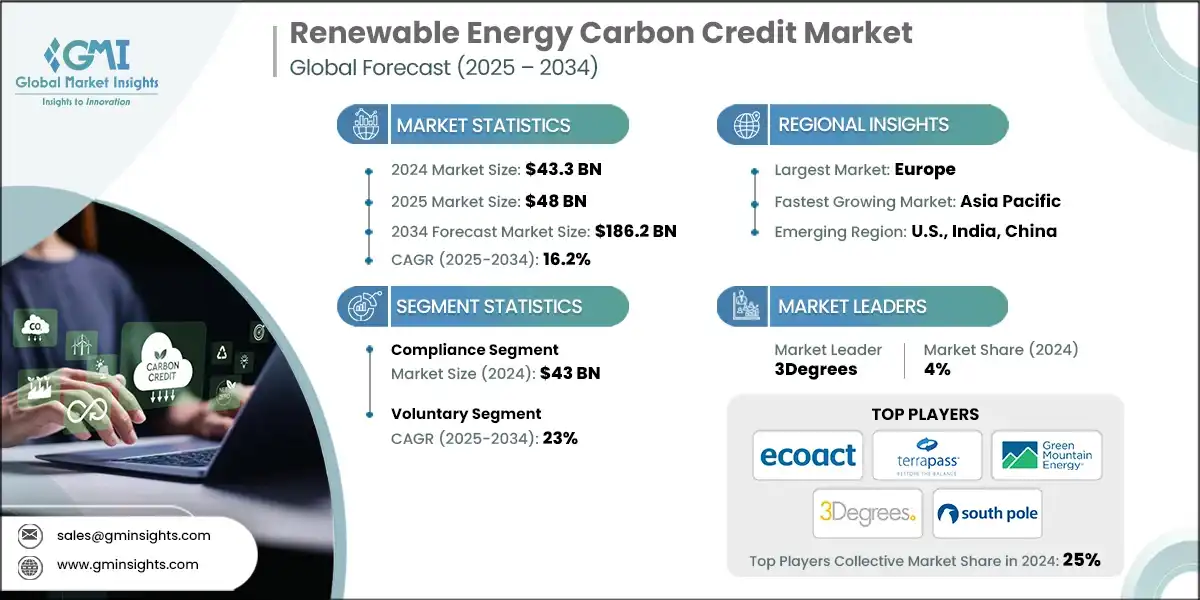
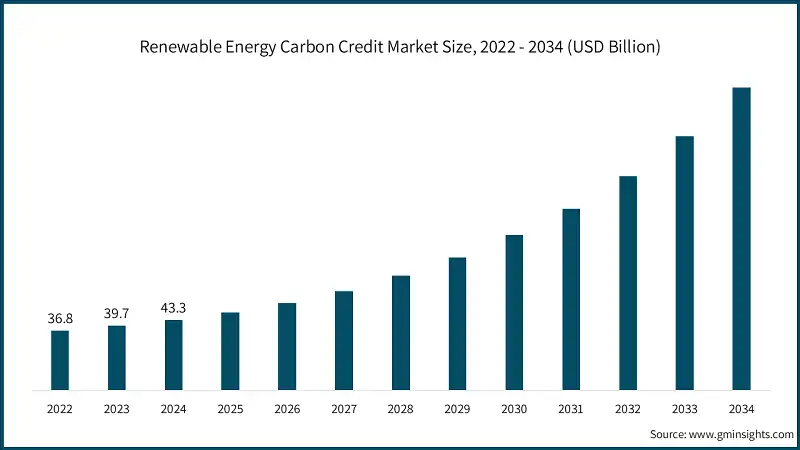
The global renewable energy carbon credit market was valued at USD 43.3 billion in 2024. The market is expected to grow from USD 48 billion in 2025 to USD 186.2 billion by 2034, at a CAGR of 16.2%, according to Global Market Insights Inc.
Renewable Energy Carbon Credit Market Key Takeaways
Market Size & Growth
- 2024 Market Size: USD 43.3 Billion
- 2034 Forecast Market Size: USD 186.2 Billion
- CAGR (2025–2034): 16.2%
Regional Dominance
- Largest Market: Europe
- Fastest Growing Region: Asia Pacific
Key Market Drivers
- Increasing regulatory regimes towards carbon offsetting.
- Rising integration in renewable sector.
Challenges
- Lack of consumer awareness.
Opportunity
- Expansion of digital verification platforms.
- Growing demand for high-integrity offsets.
Key Players
- Market Leader: 3Degrees led with over 4% market share in 2024.
- Leading Players: Top 5 players in this market include Eco Act, TerraPass, Green Mountain Energy, 3Degrees, South Pole, which collectively held a market share of 25% in 2024.
Get Market Insights & Growth Opportunities
- Strengthening regulatory framework along with rising corporate sustainability & ESG integration is augmenting market growth. Governments and international bodies are increasingly implementing carbon pricing mechanisms, emissions trading systems, and renewable energy mandates to combat climate change. These regulatory instruments are compelling industries to reduce their carbon footprints and invest in renewable energy projects.
- For instance, in September 2024, the U.S. Commodity Futures Trading Commission approved the first guidelines for trading voluntary carbon credit derivative contracts in the country. These financial instruments will derive their value from carbon credits, which represent the right to emit one metric ton of carbon dioxide, which is an equivalent amount of greenhouse gases.
- Carbon credits have become a vital compliance tool, encouraging broader participation in the market and fostering a more structured and accountable emissions reduction ecosystem. A growing number of corporations are embedding sustainability into their core strategies, driven by stakeholder expectations and environmental, social, and governance (ESG) commitments.
- Carbon credits derived from renewable energy projects are being used as a strategic instrument to meet internal decarbonization targets and demonstrate climate leadership. This trend is particularly pronounced among multinational corporations seeking to align with global net-zero initiatives. The integration of carbon credits into corporate sustainability frameworks will contribute to brand value and renewable energy carbon credit market growth.
- Rapid innovation in renewable energy technologies is playing a pivotal role in expanding the carbon credit market. Improvements in solar, wind, hydro, and bioenergy systems are making renewable energy more efficient, scalable, and cost-effective. For instance, in October 2024, the U.S. retired over 267 million carbon credits to push the voluntary & compliance carbon credit industry.
- The advancements are enabling a higher volume of clean energy generation, which in turn increases the issuance of carbon credits. As technology continues to evolve, it is expected to unlock new opportunities for credit generation, particularly in regions with untapped renewable potential, thereby supporting the market’s long-term growth.
- For instance, in June 2025, the Environment and Climate Change Canada (ECCC) issued their first federal carbon offset credits to a landfill methane project in Nova Scotia for both voluntary & compliance types. In addition, the government introduced non-taxability of Canada carbon rebates for small businesses, which in turn will influence the industry's growth.
- Rising efforts to harmonize carbon credit standards and trading systems across countries and regions are contributing to a more integrated and transparent global market. Cross-border collaboration is facilitating the development of unified verification protocols and trading platforms, which are essential for ensuring the credibility and fungibility of carbon credits.
To get key market trends
Renewable Energy Carbon Credit Market Trends
- Carbon credits offer renewable energy projects an additional revenue stream that acts as a prominent market driving factor. The measure assists in offsetting the initial investment costs associated with renewable energy projects, which are higher than traditional fossil fuel-based power plants.
- The revenue generated from carbon credits improves the project's financial viability and makes renewable energy more competitive with traditional sources of electricity. Moreover, the potential for carbon credit revenue will incentivize investment in new renewable energy projects, accelerating the transition towards a cleaner energy future.
- For instance, in April 2025, the UK government launched plans to strengthen voluntary carbon and nature markets, which will assist in leveraging the finance needed to address the scale of the climate emergency. These markets support the trading of carbon credits, where a business can reduce their emissions by investing in environmentally friendly projects, including renewable energy.
- Stringent climate policies enacted by governments across the globe, along with ambitious sustainability goals set by corporations, are creating a strong demand for carbon credits. This directly benefits renewable energy sources, such as solar, wind, and geothermal, that generate electricity with minimal carbon emissions, which in turn is promoting the growth of the renewable energy end use market.
- Various countries strive to meet their emissions targets, and companies look to offset their carbon footprints through private & public investments, the demand for high-quality carbon credit is expected to continue rising in the foreseeable future. For instance, in July 2025, the government of Germany, through its cabinet budget, allocated over USD 5 million for voluntary carbon removal certificates.
- The expansion of renewable energy sources contributes to reducing the carbon intensity of the energy sector and thus creates opportunities for generating renewable energy certificates (RECs) as carbon credits, complementing the industry growth. For instance, in July 2025, the government of Sweden, through its state-funded support for carbon removal research and development, decided to allocate over USD 545 million for 2024 to 2030.
Renewable Energy Carbon Credit Market Analysis
Learn more about the key segments shaping this market
- Increasing regional leadership along with policy innovation to promote the carbon offset initiatives is complementing the market scenario. Different regions are emerging as leaders in the renewable energy carbon credit space, driven by proactive policy measures and environmental priorities.
- For illustration, regions are pioneering innovative carbon pricing models and renewable energy incentives that are setting benchmarks for others to follow. These localized policy innovations are creating fertile ground for renewable energy investments and credit generation. Regional leadership is also fostering knowledge exchange and best practices, which are essential for scaling the renewable energy carbon credit market globally.
- Continuous & exponential growth of the compliance market, along with rising digitalization & trading platform development, is further adding to the industry growth. The compliance segment of the carbon credit market is expanding as more jurisdictions incorporate renewable energy credits into their regulatory frameworks.
- Cap-and-trade programs and carbon taxation schemes are increasingly recognizing renewable energy projects as eligible sources of compliance credits. In addition, the structured nature of the compliance market also fosters greater accountability and transparency, which are critical for long-term market credibility.
- For instance, in January 2025, the Carbon Forward Middle East 2025 event in Abu Dhabi, UAE, introduced efforts to adopt the carbon-setting initiatives through compliance methods. This development is encouraging regulated entities to invest in or purchase credits from renewable energy initiatives to meet their legal obligations.
- Increasing adoption of technologies including blockchain, artificial intelligence, and big data analytics are being deployed to improve the traceability, verification, and security of carbon credit transactions. These tools address long-standing challenges such as double counting and lack of transparency, which in turn will spur renewable energy carbon credit market growth.
- For instance, AECOM’s ScopeX is an AI tool that reduces embodied carbon in construction projects by up to 50%. The use of AI to model and simulate infrastructure against flood, heat, and climate risks will further aid to the business growth. By streamlining the issuance and trading processes, digital platforms are attracting a broader range of participants, including small-scale renewable energy producers and institutional investors, thereby democratizing access to the market.
- Strategic partnerships and innovative product offerings are reshaping the renewable energy carbon credit landscape. Collaborations between project developers, technology providers, and financial institutions are enabling the creation of diversified credit portfolios and tailored solutions for different market segments.
- For reference, in June 2024, 3Degrees launched its Carbon Removal Suite, a portfolio of products designed to facilitate corporate engagement with carbon dioxide removal (CDR) initiatives. Similarly, Ecosecurities’ partnership with Chemsain Konsultant in Malaysia aims to develop decarbonization solutions across multiple sectors.
Learn more about the key segments shaping this market
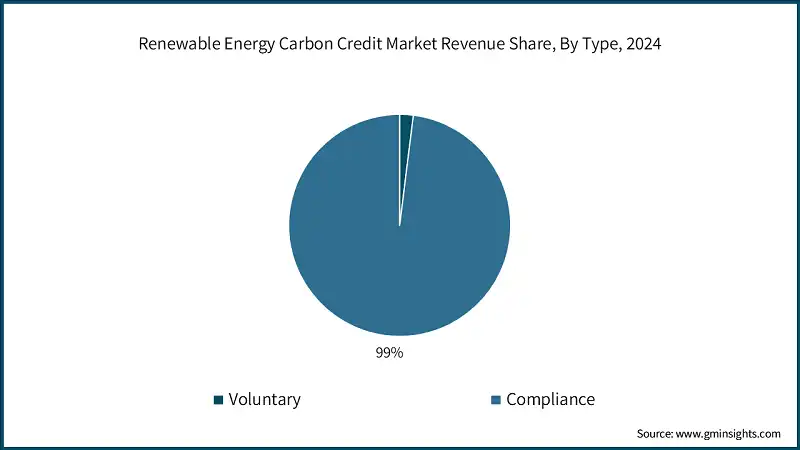
- Based on type, the renewable energy carbon credit market is segmented into voluntary & compliance. Compliance carbon credit market showcased a 99% revenue share in 2024 and stood at USD 43 billion. The compliance carbon credit market is experiencing steady growth, primarily driven by the expansion of regulatory frameworks and emissions trading systems (ETS) across jurisdictions.
- Governments and intergovernmental bodies are increasingly adopting cap-and-trade programs and carbon taxation schemes to enforce emission reduction targets. These mechanisms require entities to either reduce their emissions or purchase carbon credits to remain compliant, thereby creating a structured and enforceable demand for credits.
- For reference, in August 2025, the government of China decided to expand their carbon emissions trading schemes to all sectors by 2027 and further reforms including shifting to an absolute cap on emissions by 2030. This in turn will augment the adoption of compliance credit platforms across the country, in turn adding to the overall market growth.
- The compliance market is characterized by rigorous oversight, standardized methodologies, and formal verification processes, which contribute to its credibility and stability. Recent developments include the integration of international carbon markets, allowing for cross-border credit trading and improved market liquidity.
- The compliance market is also witnessing increased participation from emerging economies, which are establishing national ETS programs and aligning with global climate agreements. As regulatory pressure intensifies and climate targets become more ambitious, the compliance carbon credit market is expected to play an increasingly central role in facilitating cost-effective emissions reductions and supporting the transition to a low-carbon economy.
- The voluntary carbon credit market will grow at a CAGR of 23% through 2034. The industry growth is driven by increasing corporate responsibility, stakeholder expectations, and global sustainability commitments. Organizations across sectors are proactively investing in carbon offset projects to demonstrate climate leadership and align with net-zero goals.
- The growing trend is particularly pronounced among emerging economies, multinational corporations, financial institutions, and consumer-facing brands seeking to enhance their ESG profiles. The market is also benefiting from growing public awareness and pressure from investors and consumers, thereby encouraging companies to go beyond regulatory requirements and voluntarily offset their emissions.
- For instance, in April 2025, China announced since January 2024, they have reopened their voluntary carbon credit market after a gap of over eight years. China’s Certified Emission Reduction (CCER) program promotes investments in clean energy and emission reduction projects, which in turn will further augment in the future owing to increasing concern towards emission reduction projects.
Looking for region specific data?
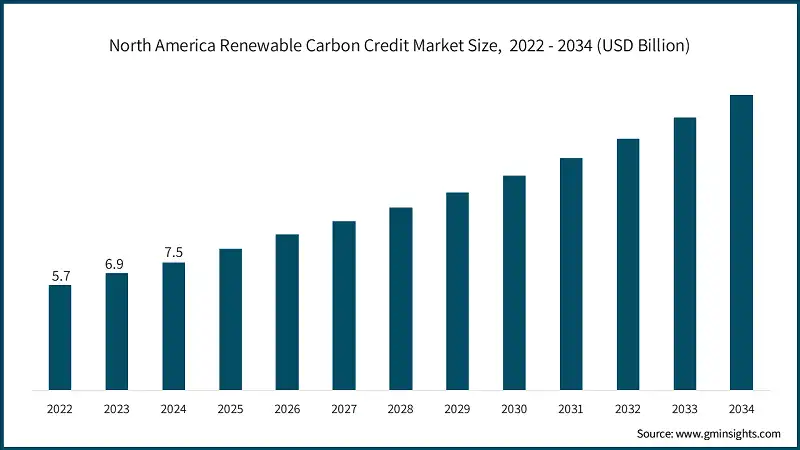
- The North America renewable energy carbon credit market size surpassed USD 7.5 billion in 2024 and will grow at a CAGR of 16% till 2034. The availability of extensive industrial infrastructure along with the introduction of economical carbon capture technologies will positively impact the carbon credit industry across North America.
- For instance, in January 2025, the U.S. DOE announced an investment of USD 101 million in federal funding for five projects to support the development of carbon dioxide (CO2) capture, removal, and conversion test centers for cement manufacturing facilities and power plants. This in turn will create a favorable scenario for the energy industries, thereby adding to the overall industry growth.
- The U.S. has emerged as a key stakeholder in the carbon credit development on account of its large carbon emissions footprint. Furthermore, public & private investments in research and development supported by the government to develop pilot projects across various industries will enhance the market share.
- Europe dominated the renewable energy carbon credit market with a 78% share in 2024 and generated USD 34.2 billion in revenue. Europe's carbon credit industry is experiencing dynamic growth driven by regulatory developments, corporate commitments to sustainability, technological innovation, and increasing awareness of climate risks.
- In addition, the EU, along with respective federal administrations, has been implementing reforms to strengthen the system, including adjustments to the cap on emissions, the introduction of the market stability reserve, and stern net zero commitment goals.
- For instance, in March 2024, the German government launched the first phase of bidding for a climate contract funding initiative worth over USD 4.3 billion to facilitate heavy-duty industry verticals in shifting towards eco-friendly alternatives over the duration of 15 years. The program enables the companies recognized under the EU-ETS to avail themselves of the funding to support large-scale green transformation projects.
- The Asia Pacific renewable energy carbon credit market will grow at a CAGR of 21% through 2034. The region is emerging as a dynamic hub for renewable energy carbon credit development, driven by rapid industrialization, evolving climate policies, and increasing corporate sustainability commitments.
- Countries including China, India, Japan, and Australia are actively expanding their renewable energy portfolios, which in turn is generating a growing supply of carbon credits. For instance, in August 2025, the government of India stated that the country had increased its solar power capacity by 4000% in the half year itself. The rapidly growing renewable industry across the country will further add to the market growth.
- The region is witnessing a surge in voluntary market participation, particularly among corporations aiming to align with global net-zero targets. For reference, in March 2025, the government of India approved eight methodologies for generating voluntary carbon credits, including renewable energy. This in turn will further favor the carbon trade across the renewable energy sector in the country, adding to market growth.
- The Middle East & Africa renewable energy carbon credit market will grow at a CAGR of 19% through 2034, owing to the growing environmental awareness and strategic diversification efforts. Countries including the UAE, Saudi Arabia, and South Africa are investing heavily in solar and wind energy infrastructure, which is contributing to the generation of renewable carbon credits.
- The Latin America renewable energy carbon credit market will surpass over USD 890 million in 2034. This growth will be driven by its rich natural resources, progressive climate policies, and increasing international demand for nature-based solutions. Countries like Brazil, Colombia, and Chile are spearheading large-scale reforestation, land restoration, and renewable energy projects that generate tradable carbon credits.
Renewable Energy Carbon Credit Market Share
- The top 5 companies in the renewable energy carbon credit industry are Eco Act, TerraPass, Green Mountain Energy, 3Degrees, and South Pole, that collectively contribute around 25% of the market in 2024. Eco Act is recognized for its involvement in both voluntary & compliance market, providing carbon offset solutions aligned with international standards including Verra & Gold Standard.
- Green Energy Mountain, a subsidiary of NRG Energy Inc., is one of the major clean energy solution providers, especially, across the U.S. Its streamline Renewable Energy Certificate (REC) platform for businesses and individuals displays its commitment towards expanding access to renewable energy offsets industry.
Renewable Energy Carbon Credit Market Companies
Major players operating in the renewable energy carbon credit industry are:
- 3Degrees
- Atmosfair
- ALLCOT
- Carbon Better
- Carbon Credit Capital, LLC.
- Carbon Direct
- ClimeCo LLC.
- Climate Impact Partners
- CarbonClear
- Ecosecurities
- EcoAct
- Green Mountain Energy Company
- Native Energy
- PwC
- Sterling Planet Inc.
- South Pole
- The Carbon Trust
- The Carbon Collective Company
- TerraPass
- WayCarbon
- EcoAct, a subsidiary of Atos SE, is one of the major players in the carbon credit market, particularly in Europe. EcoAct’s market share is supported by its credibility, technical expertise, and participation in high-integrity carbon offset projects, positioning it as a mid-tier but influential player in the renewable carbon credit space.
- TerraPass is a U.S.-based provider of carbon offsets and renewable energy credits, with a strong focus on voluntary markets. It is known for offering accessible offset solutions to individuals and businesses, including landfill gas capture, wind energy, and farm power projects. Its inclusion in multiple industry reports as a key vendor underscores its relevance and reliability in the renewable energy offset segment.
- 3Degrees is a well-established U.S.-based company specializing in renewable energy certificates, carbon offsets, and climate consulting. It operates across both voluntary and compliance markets, serving Fortune 500 companies, utilities, and government agencies. The company is known for its high integrity offset sourcing, including renewable energy projects and carbon removal initiatives.
Renewable Energy Carbon Credit Market Report Attributes
| Key Takeaway | Details |
|---|---|
| Market Size & Growth | |
| Base Year | 2024 |
| Market Size in 2024 | USD 43.3 Billion |
| Forecast Period 2025 – 2034 CAGR | 16.2% |
| Market Size in 2034 | USD 186.2 Billion |
| Key Market Trends | |
| Drivers | Impact |
| Increasing regulatory regimes towards carbon offsetting | Stricter climate policies and carbon pricing mechanisms are accelerating demand for renewable carbon credits as a compliance tool. |
| Rising integration in renewable sector | The expansion of renewable energy infrastructure is generating a larger supply of high-quality carbon offsets, reinforcing the market’s growth. |
| Pitfalls & Challenges | Impact |
| Lack of consumer awareness | Limited understanding of carbon offset mechanisms among consumers hampers demand growth and slows adoption of renewable carbon credit solutions. |
| Opportunities: | Impact |
| Expansion of digital verification platforms | This will enhance transparency and attract institutional investment in renewable carbon offsets. |
| Growing demand for high-integrity offsets | This will open new avenues for innovation in renewable energy project development and certification. |
| Market Leaders (2024) | |
| Market Leaders |
4% market share |
| Top Players |
Collective market share in 2024 is 25% |
| Competitive Edge |
|
| Regional Insights | |
| Largest Market | Europe |
| Fastest Growing Market | Asia Pacific |
| Emerging Countries | U.S., India, China |
| Future outlook |
|
What are the growth opportunities in this market?
Renewable Energy Carbon Credit Industry News
- In May 2025, South Pole launched carbon credit methodology designed to enable the early retirement of coal power plants and their replacement with renewable energy. Approved by Verra, this will offer a high-integrity, market-based pathway to accelerating the global energy transition through transition credits.
- In April 2025, 3Degrees launched a Community Action Portfolio (CAP) that will enable companies to assist the rapid deployment of cost-effective and resilient renewable energy in North America region. This will enable the companies to take urgent action on climate change through renewable energy sources, thereby spurring growth.
- In February 2025, WayCarbon came into a strategic partnership with Verde to bolster the development and monetization of its carbon removal project. The partnership extends its scope to encompass Verde's origination and utilization of other minerals capable of carbon capture through Enhanced Rock Weathering.
This renewable energy carbon credit market research report includes in-depth coverage of the industry with estimates & forecasts in terms of revenue (USD Billion) from 2021 to 2034, for the following segments:
Market, By Type
- Voluntary
- Compliance
The above information has been provided for the following regions:
- North America
- Europe
- Asia Pacific
- Middle East & Africa
- Latin America
Frequently Asked Question(FAQ) :
What is the market size of the renewable energy carbon credit in 2024?
The market size was USD 43.3 billion in 2024, with a CAGR of 16.2% expected through 2034 driven by strengthening regulatory frameworks and rising corporate sustainability commitments.
What is the projected value of the renewable energy carbon credit market by 2034?
The renewable energy carbon credit market is expected to reach USD 186.2 billion by 2034, propelled by regulatory expansion, technological innovation, and increasing demand for verified offsets.
What is the current renewable energy carbon credit market size in 2025?
The market size is projected to reach USD 48 billion in 2025.
How much market share did the compliance carbon credit segment hold in 2024?
The compliance segment dominated with 99% market share and generated USD 43 billion in 2024, fueled by expanding regulatory frameworks and emissions trading systems.
What is the growth outlook for the voluntary carbon credit segment from 2025 to 2034?
The voluntary carbon credit market is projected to grow at a 23% CAGR through 2034, led by increasing corporate responsibility and stakeholder expectations.
Which region leads the renewable energy carbon credit market?
Europe held 78% share with USD 34.2 billion in 2024. Strong regulatory frameworks and EU-ETS reforms fuel the region's dominance.
What are the upcoming trends in the renewable energy carbon credit market?
Key trends include expansion of digital verification platforms, blockchain integration for transparency, AI-driven verification tools, and increasing harmonization of carbon credit standards globally.
Who are the key players in the renewable energy carbon credit market?
Key players include 3Degrees, Atmosfair, ALLCOT, Carbon Better, Carbon Credit Capital, Carbon Direct, ClimeCo, Climate Impact Partners, CarbonClear, Ecosecurities, EcoAct, Green Mountain Energy, Native Energy, PwC, Sterling Planet, South Pole, Carbon Trust, Carbon Collective, TerraPass, WayCarbon.
Renewable Energy Carbon Credit Market Scope
Related Reports