Summary
Table of Content

Remote Automotive Exhaust Sensing Market
Get a free sample of this report
Form submitted successfully!
Error submitting form. Please try again.
Thank you!
Your inquiry has been received. Our team will reach out to you with the required details via email. To ensure that you don't miss their response, kindly remember to check your spam folder as well!
Request Sectional Data
Thank you!
Your inquiry has been received. Our team will reach out to you with the required details via email. To ensure that you don't miss their response, kindly remember to check your spam folder as well!
Form submitted successfully!
Error submitting form. Please try again.
Remote Automotive Exhaust Sensing Market Size
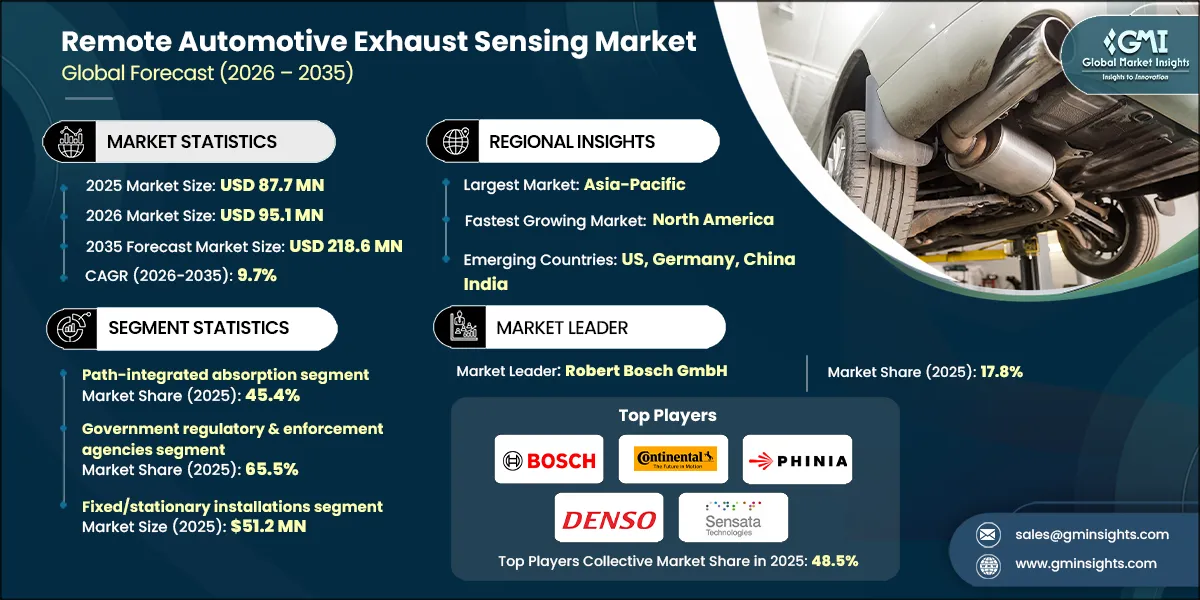
The global remote automotive exhaust sensing market was valued at USD 87.7 million in 2025. The market is expected to grow from USD 95.1 million in 2026 to USD 147.4 million in 2031 & USD 218.6 million in 2035, at a CAGR of 9.7% during the forecast period according to the latest report published by Global Market Insights Inc.
Remote Automotive Exhaust Sensing Market Key Takeaways
Market Size & Growth
- 2025 Market Size: USD 87.7 Million
- 2026 Market Size: USD 95.1 Million
- 2035 Forecast Market Size: USD 218.6 Million
- CAGR (2026–2035): 9.7%
Regional Dominance
- Largest Market: Asia-Pacific
- Fastest Growing Region: North America
Key Market Drivers
- Stricter vehicle emission rules by governments globally.
- Government investment in roadside remote sensing programs.
- Rising urban air quality compliance monitoring needs.
- Need for fast on-road vehicle emission checks.
- Advances in infrared spectroscopy and data analytics.
Challenges
- Accuracy variability under weather and traffic conditions.
- High installation and system maintenance costs.
Opportunity
- Support for smart city air monitoring programs.
- Use by fleet operators for emission tracking.
Key Players
- Market Leader: Robert Bosch GmbH led with over 17.8% market share in 2025.
- Leading Players: Top 5 players in this market include Robert Bosch GmbH, Continental AG, PHINIA Inc., Denso Corporation, Sensata Technologies, which collectively held a market share of 48.5% in 2025.
Get Market Insights & Growth Opportunities
The market for remote automotive exhaust sensing is expanding owing to the strict standards for automotive emissions in prominent automotive markets around the globe. This is leading to the adoption of real-world monitoring solutions for automotive emissions on roads. Governments are investing heavily in developing solutions for remote automotive exhaust sensing, which is leading to fast adoption, especially in urban areas and high-traffic zones.
The market for remote automotive exhaust sensing is increasing as the government of various countries is focusing on actual vehicle emissions, as opposed to laboratory testing or random checks. The government is aware of the fact that laboratory testing may not always reflect actual emissions. In April 2024, for instance, the European Union introduced the Euro 7 regulation, which lays down much tighter limits for emissions from cars, vans, buses, and trucks in daily driving conditions. Under road safety regulations, EU countries are allowed to use remote sensing technologies to spot those vehicles with high pollution or noise levels while they are on the road. This allows authorities to take focused action without disrupting traffic flow.
Growth is further supported as urban air quality concerns are pushing cities to adopt better emissions monitoring tools, because traditional methods do not capture real‑time pollution from vehicles and other sources. According to the European Environment Agency, approximately 96% of urban population within the EU are exposed to levels of fine particulate matter that exceed the WHO limits despite existing standards and regulations. Thus, the increasing problem of air quality within the EU is also contributing to the demand for remote automotive exhaust sensing solutions.
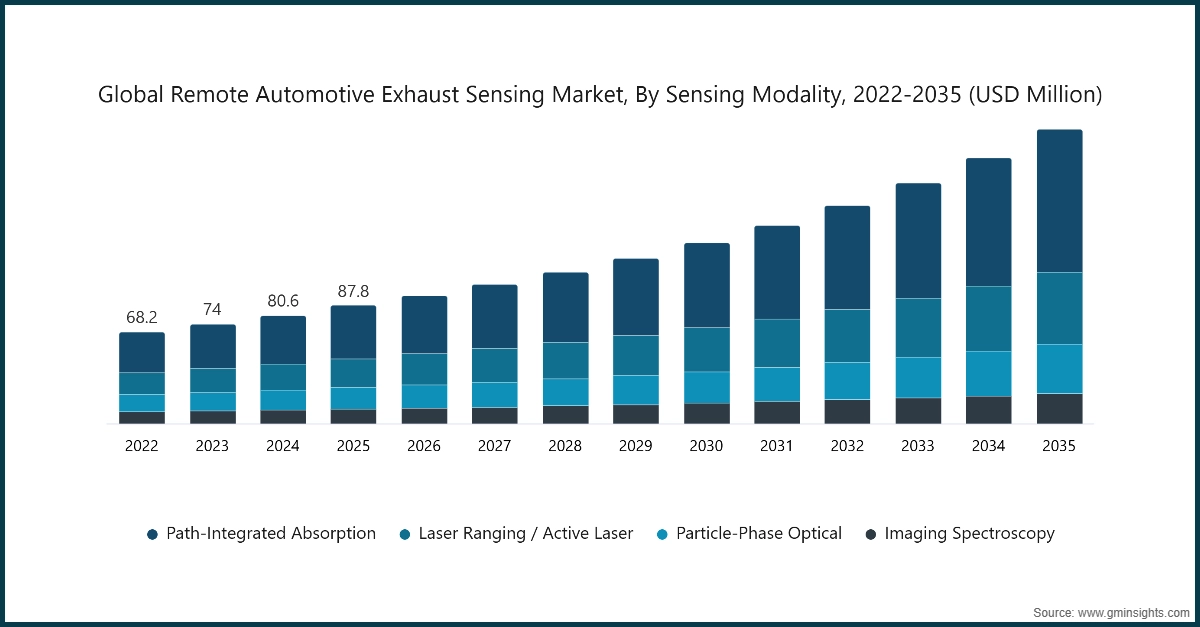
Between 2022 and 2024, the remote automotive exhaust sensing market experienced steady expansion, increasing from USD 68.2 million in 2022 to USD 80.5 million in 2024 as regulators shifted focus from laboratory-based testing toward real-world emission measurement. Market penetration was further supported by increased public funding for urban air quality programs and early integration of exhaust sensing into smart transportation initiatives. Improvements in sensing accuracy and data processing during this phase also reduced operational skepticism, allowing transport and environmental authorities to adopt these technologies more widely.
To get key market trends
Remote Automotive Exhaust Sensing Market Trends
- The use of remote automotive exhaust sensing in conjunction with enforcement and compliance solutions is also on the rise. This is in their efforts to make violation processing easier and reduce the need for manual vehicle checks along roads. This transition began in approximately 2021 when all enforcement agencies started digitally transforming workflows in emissions due to the growing vehicle population. Adoption is expected to continue through 2030 as compliance systems mature. The result is faster enforcement, consistent rule application, and better use of sensing infrastructure.
- Remote automotive exhaust sensing is transitioning from short-term pilot projects to permanent roadside installations in major traffic corridors and urban hotspots. This change started in 2022 after successful validation of system accuracy and operational reliability. Deployment is likely to expand through 2029 as cities prioritize continuous emissions visibility. The implication is long-term emissions trend tracking, stronger data continuity, and deeper integration into transport and environmental planning.
- The use of remote exhaust sensing to monitor commercial vehicles like trucks, buses, and delivery fleets is rising because they contribute significantly to urban emissions. The adoption sped up around 2020 as regulators focused on effective oversight of high-impact vehicles. This trend is expected to continue until 2030 alongside freight growth and urban logistics expansion. It enables targeted enforcement and more efficient allocation of regulatory resources.
Remote Automotive Exhaust Sensing Market Analysis
Learn more about the key segments shaping this market
The global remote automotive exhaust sensing market was valued at USD 68.2 million and USD 74 million in 2022 and 2023, respectively. The market size reached USD 87.7 million in 2025, growing from USD 80.5 million in 2024.
Based on the sensing modality, the global market is segmented into path-integrated absorption, laser ranging or active laser systems, particle-phase optical sensing, and imaging spectroscopy technologies.
- The path-integrated absorption segment accounted for 45.4% of the market in 2025. These sensors lead the market because they provide precise, real-time measurements of vehicle emissions over long distances. This allows authorities to continuously monitor NOx, CO, and particulate levels on busy roads. Their ability to work with roadside monitoring stations and provide automated reporting is crucial for meeting regulations and managing fleet programs.
- the laser ranging / active laser segment is anticipated to grow at a CAGR of 9.7% over the forecast period. These sensors enable quick, high-resolution detection of exhaust plumes from moving vehicles, which improves accuracy in heavy traffic. Their fast response time and ability to support mobile or temporary deployments drive adoption in urban air quality programs, toll roads, and commercial fleet monitoring applications.
Learn more about the key segments shaping this market
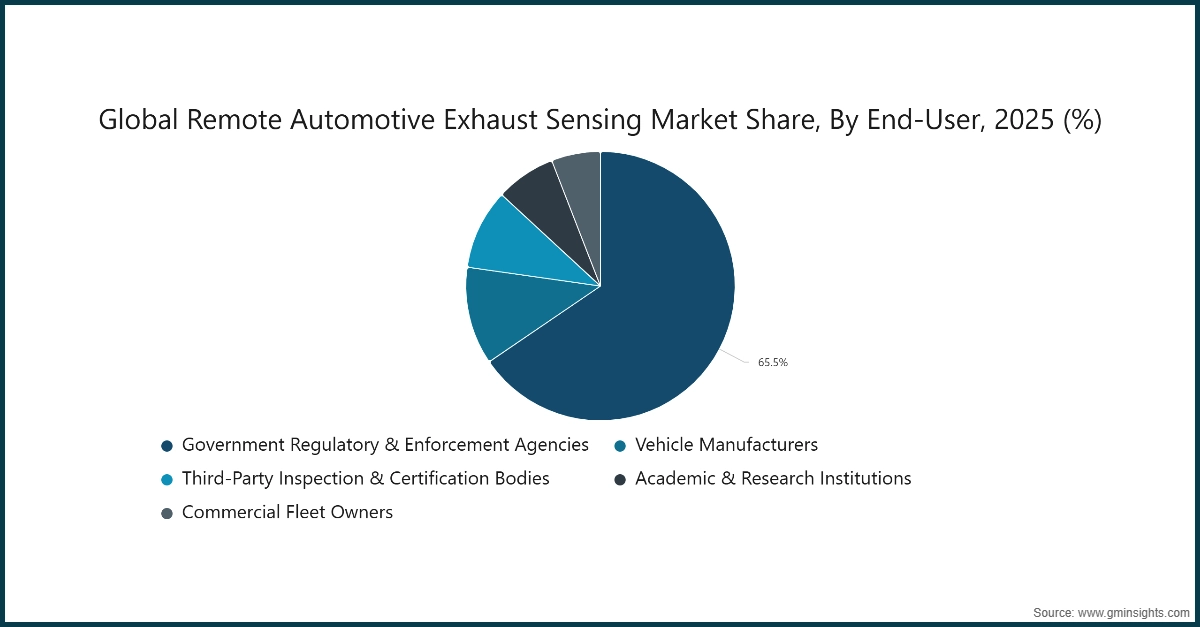
Based on the end-user, the remote automotive exhaust sensing market is categorized into government regulatory and enforcement agencies, vehicle manufacturers, third-party inspection and certification bodies, academic and research institutions, and commercial fleet owners.
- The government regulatory & enforcement agencies segment led the market in 2025 with a market share of 65.5% as authorities are the primary users of remote exhaust sensing for enforcing emission standards, implementing Euro 7 or EPA compliance programs, and tracking urban air quality. Adoption is driven by the need for continuous monitoring, automated reporting, and integration with wider environmental and traffic management systems.
- The vehicle manufacturers segment is expected to grow at a CAGR of 9.6% during the forecast period. OEMs and commercial fleet operators are using sensors to check real-world emissions performance, improve engine calibration, and ensure compliance with local standards. Increasing regulatory pressure and corporate sustainability commitments drive manufacturers to adopt on-road sensing solutions, particularly in Europe, North America, and East Asia.
Based on the deployment configuration, the remote automotive exhaust sensing market is divided into fixed or stationary installations, mobile enforcement platforms, portable handheld or field devices, and networked sensor arrays.
- The fixed/stationary installations segment dominated the market in 2025 and was valued at USD 51.2 million as roadside and urban infrastructure monitoring requires permanent sensor networks. These installations provide continuous, high-precision data on vehicle emissions. They support regulatory enforcement, public reporting, and integration with traffic management systems. Their reliability, durability, and compatibility with IoT and cloud analytics make them the top choice for government agencies and large municipal monitoring programs.
- The mobile enforcement platforms segment is expected to witness growth at a CAGR of 10.5% during the forecast period. Mounted on inspection vans or traffic patrol vehicles, these sensors enable on-the-go emission checks across highways and urban roads. Their flexibility, rapid deployment, and ability to capture real-world driving emissions make them ideal for targeted enforcement campaigns, commercial fleet compliance, and temporary monitoring programs.
Looking for region specific data?
North America Remote Automotive Exhaust Sensing Market
The North America held a market share of 18.9% of market in 2025.
- In North America, the market is expanding due to stricter EPA emission standards, urban air quality programs, and rising demand for real-world vehicle emissions monitoring. Adoption of roadside sensing units is growing in cities such as Los Angeles, New York, and Chicago, where traffic-related NOx and PM exceedances are closely monitored.
- Federal and state governments, alongside private fleet operators, are investing in IoT-enabled sensors and AI-driven analytics to track emissions in real time, enabling rapid intervention and policy compliance. The region is expected to lead in technology deployment, with municipal, commercial fleet, and regulatory use driving consistent market growth through 2035.
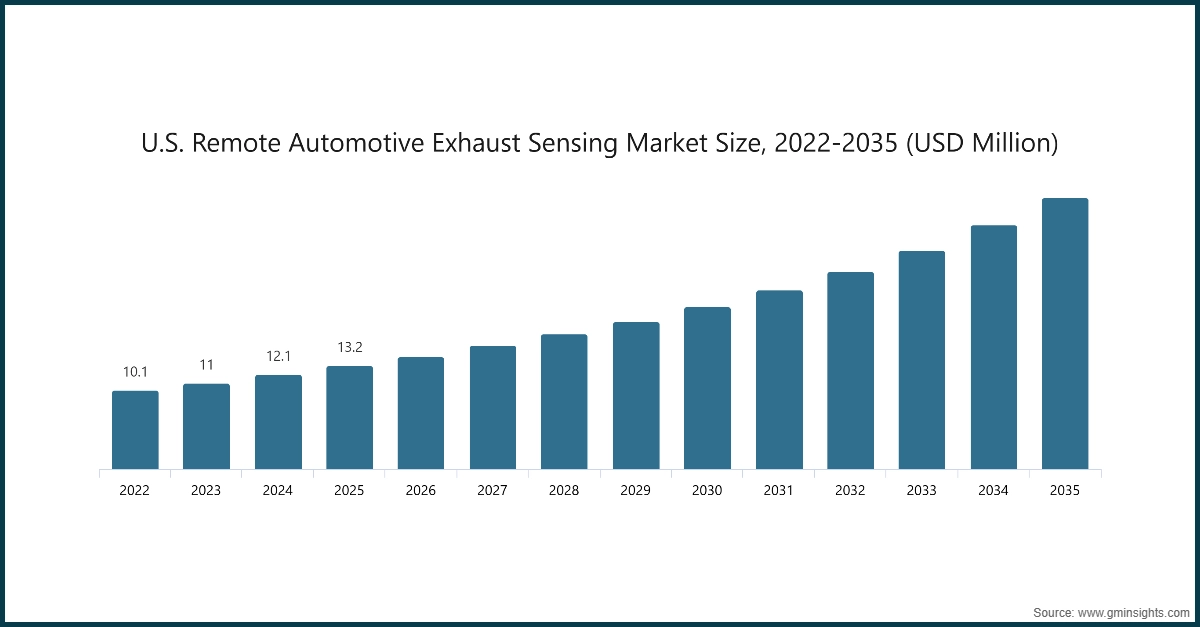
The U.S. remote automotive exhaust sensing market was valued at USD 10.1 million and USD 11 million in 2022 and 2023, respectively. The market size reached USD 13.2 million in 2025, growing from USD 12.1 million in 2024.
- The growth of the market in the U.S. is being driven by tightening air quality regulations under the Clean Air Act and the increasing emphasis on real‑world emissions monitoring, particularly to bridge gaps between laboratory tests and in‑use emissions performance. In California, the California Air Resources Board (CARB) actively uses remote sensing and related measurement technologies to understand in‑use emissions from on‑road vehicles, especially heavy‑duty fleets, and to guide state regulatory and enforcement decisions.
- Alongside state initiatives, the U.S. Environmental Protection Agency continues to support research and development of air sensor technologies, including mobile and real‑time monitoring systems under its air monitoring and emissions research programs. These efforts improve the availability of air sensing technologies and support local and regional air quality decision‑making.
Europe Remote Automotive Exhaust Sensing Market
Europe market accounted for USD 19.3 million in 2025 and is anticipated to show lucrative growth over the forecast period.
- Europe’s market is expanding due to the implementation of Euro 6/7 emission standards, EU Green Deal targets, and city-level low-emission zone (LEZ) initiatives. Countries are deploying roadside sensing networks to monitor NOx, CO, and PM emissions in real time, particularly in urban hubs like Paris, Milan, and London.
- Investments by governments and city authorities in connected sensing platforms, predictive analytics, and regulatory compliance tools are ensuring sustained adoption. European automotive OEMs are also collaborating with regulators to integrate exhaust sensing into fleet compliance and reporting systems, supporting policy enforcement and urban air quality management.
Germany dominates the Europe remote automotive exhaust sensing market, showcasing strong growth potential.
- Germany leads Europe in remote automotive exhaust sensing adoption due to strict real-driving emissions regulations and extensive low-emission zones in cities like Berlin, Frankfurt, and Munich. Industrial hubs and freight corridors deploy fixed and mobile sensing platforms to ensure diesel truck compliance under Euro 7 standards.
- Federal programs, including the German Environment Agency’s (UBA) nationwide roadside sensing network, provide grants for infrastructure and analytics software. Integration with IoT and AI platforms allows precise detection of high-emitting vehicles, while the government’s focus on clean transportation, energy efficiency, and urban air monitoring reinforces Germany as the continent’s fastest-growing market.
Asia Pacific Remote Automotive Exhaust Sensing Market
The Asia Pacific market is anticipated to grow at the highest CAGR of 10.9% during the forecast period.
- The Asia-Pacific market is growing rapidly due to urban traffic congestion, rising vehicular emissions, and stringent national pollution control regulations. Smart city projects in Singapore, Seoul, and Tokyo are deploying roadside sensing platforms for continuous NOx and PM monitoring.
- India’s National Clean Air Programme and Japan’s Vehicle Emissions Regulation Program fund large-scale sensor installations along highways and urban centers. Combined with industrial emission tracking and fleet compliance initiatives, rising government and private sector investments, along with integration with IoT and AI analytics, are driving significant regional market growth.
China remote automotive exhaust sensing market is estimated to grow with a significant CAGR, in the Asia Pacific market.
- China is seeing strong growth in remote automotive exhaust sensing driven by tough national air quality goals, like the "Air Pollution Prevention and Control Action Plan," and low-emission policies in cities like Beijing, Shanghai, and Shenzhen. Roadside monitoring networks are being set up along major highways and freight routes to track actual NOx and PM emissions.
- The government's push for green logistics, the shift to electric hybrids in urban fleets, and real-time enforcement efforts have created new market opportunities. Combined with smart city integration and collaboration with domestic automotive OEMs, China is the fastest-growing market in the Asia-Pacific region for remote automotive exhaust sensing solutions.
Middle East and Africa Remote Automotive Exhaust Sensing Market
South Africa market to experience substantial growth in the Middle East and Africa market.
- The market is expanding in Saudi Arabia as large cities such as Riyadh, Jeddah, and Dammam are employing mobile environmental monitoring vehicles with sophisticated systems for measuring pollution levels. The vehicles provide real-time data on emissions as well as ambient conditions from different locations. They act as real-time roadside monitoring units, enabling one to identify high emitters quickly.
- Rising concerns about NOx and particulate matter levels from increasing vehicle volumes, together with Vision 2030‑aligned sustainability goals that emphasize smart transport and pollution tracking, are pushing public and private investment into connected sensing systems tailored to real‑world vehicle emissions oversight throughout Saudi Arabia.
Remote Automotive Exhaust Sensing Market Share
The market is led by Robert Bosch GmbH, Continental AG, PHINIA Inc., Denso Corporation, and Sensata Technologies. These companies collectively account for 48.5% share of global deployment due to their strong automotive knowledge and networking with several original equipment manufacturers. They offer diverse product solutions that enable comprehensive emissions testing capabilities through their products, which include high-precision sensors, roadside enforcement solutions, as well as data analytics solutions.
These companies continue to gain a competitive market position through their emphasis on research and development, interoperability with internet of things platforms, government regulations, and innovative infrared solutions, which enable their brands to capitalize on increasingly growing demands in urban, government, and commercial fleets. Furthermore, strategic partnerships with municipalities and transportation agencies help them to increase their actual market deployment.
Remote Automotive Exhaust Sensing Market Companies
Prominent players operating in the remote automotive exhaust sensing industry are as mentioned below:
- Amphenol Advanced Sensors
- AVL List GmbH
- Continental AG
- Denso Corporation
- Hager Environmental & Atmospheric Technologies (HEAT)
- HELLA GmbH & Co. KGaA
- Korea Environment Corporation (K-eco)
- Niterra India PVT. LTD.
- Opus Group AB
- PHINIA Inc.
- Robert Bosch GmbH
- Sensata Technologies, Inc.
- Valeo SA
Robert Bosch GmbH provides automotive sensors and emission control technologies. It uses infrared detection, data analysis, and IoT-enabled platforms to help ensure regulatory compliance around the world.
Continental AG focuses on intelligent transportation systems and vehicle electronics. Its work in real-time emissions detection and analysis supports city air quality programs and fleet management solutions.
PHINIA Inc. develops advanced combustion and emission monitoring technologies, supplying precision sensing solutions for both light and heavy-duty vehicles. Its offerings are designed for regulatory compliance, real-driving emission verification, and integration with automated roadside enforcement systems.
Denso Corporation provides reliable automotive sensors that are scalable. The company builds intense collaborations with manufacturers to create a positive influence for enhanced sensor longevity and real-time data analyses to aid in monitoring activities for highways and cities.
Sensata Technologies provides ruggedized, high-performance sensors to measure vehicle emissions in real-time. It provides modules for detection, data acquisition solutions, and connectivity capabilities to help with fleet compliance and air quality analysis in cities.
Remote Automotive Exhaust Sensing Market Report Attributes
| Key Takeaway | Details |
|---|---|
| Market Size & Growth | |
| Base Year | 2025 |
| Market Size in 2025 | USD 87.7 Million |
| Market Size in 2026 | USD 95.1 Million |
| Forecast Period 2026-2035 CAGR | 9.7% |
| Market Size in 2035 | USD 218.6 Million |
| Key Market Trends | |
| Drivers | Impact |
| Stricter vehicle emission rules by governments globally | Drives 24% growth by forcing regular on-road checks and increasing demand for remote exhaust sensing systems to identify high-emitting vehicles without stopping traffic. |
| Government investment in roadside remote sensing programs | Supports 21% growth through direct government funding for roadside remote sensing installations, especially for urban compliance programs and real-driving emission enforcement. |
| Rising urban air quality compliance monitoring needs | Contributes 19% growth due to rising pressure on cities to meet air quality standards, pushing authorities to adopt continuous vehicle emission monitoring instead of periodic inspections. |
| Need for fast on-road vehicle emission checks | Adds 21% growth by enabling quick, non-intrusive emission checks of large vehicle volumes, helping regulators and transport agencies screen thousands of vehicles daily at low operating cost. |
| Advances in infrared spectroscopy and data analytics | Accounts for 15% growth as improvements in infrared sensing and data analytics increase measurement accuracy, system reliability, and confidence among regulators, accelerating wider deployment. |
| Pitfalls & Challenges | Impact |
| Accuracy variability under weather and traffic conditions | Restrains market growth as exhaust measurement accuracy can drop during rain, fog, high winds, or heavy traffic, requiring repeated measurements and limiting enforcement reliability in certain locations. |
| High installation and system maintenance costs | Limits adoption due to high costs related to roadside installation, calibration, software updates, and regular maintenance, which can strain municipal and regional monitoring budgets. |
| Opportunities: | Impact |
| Support for smart city air monitoring programs | Presents strong growth opportunity by supporting smart city air monitoring programs where vehicle emission data is combined with traffic and pollution systems to guide policy decisions and urban planning. |
| Use by fleet operators for emission tracking | Offers opportunity through use by fleet operators to track real-world vehicle emissions, identify poorly performing vehicles, reduce compliance risks, and optimize maintenance schedules. |
| Market Leaders (2025) | |
| Market Leader |
17.8% Market Share |
| Top Players |
Collective Market Share in 2025 is 48.5% |
| Competitive Edge |
|
| Regional Insights | |
| Largest Market | Asia-Pacific |
| Fastest growing market | North America |
| Emerging countries | US, Germany, China, India |
| Future outlook |
|
What are the growth opportunities in this market?
Remote Automotive Exhaust Sensing Market Industry News
- In November 2025, PHINIA Inc. expanded its North American operations by opening a regional testing and calibration center for remote automotive exhaust sensing systems, enhancing system accuracy, regulatory validation, and rapid deployment capabilities for fleet operators.
- In October 2025, Continental AG partnered with a leading European city authority to deploy a network of mobile exhaust sensing platforms for real-time NOx and PM monitoring on high-traffic highways, supporting compliance with Euro 7 emission standards.
- In September 2025, Robert Bosch GmbH launched a next-generation roadside exhaust sensor with improved infrared sensitivity and AI-driven data analytics, enabling faster detection of high-emitting vehicles in urban traffic corridors and integration with smart city air quality platforms.
The remote automotive exhaust sensing market research report includes in-depth coverage of the industry with estimates and forecast in terms of revenue (USD Million) and volume (Units) from 2022 – 2035, for the following segments:
Market, By Sensing Modality
- Path-integrated absorption
- Laser ranging / active laser
- Particle-phase optical
- Imaging spectroscopy
Market, By Target Pollutant
- Gas-Phase
- NOx (NO, NO₂)
- CO
- CO₂
- HC/VOC
- NH₃
- SO₂
- Other regulated/target gases (HCHO, CH₄)
Market, By Offering
- Hardware
- Software & analytics
- Services
Market, By Deployment Configuration
- Fixed/stationary installations
- Mobile enforcement platforms
- Portable handheld/field devices
- Networked sensor arrays
Market, By Vehicle Type
- Light-duty vehicles
- Heavy-duty vehicle
- Two-wheelers
- Non-road engines & off-highway equipment vehicle
Market, By End-use Industry
- Government regulatory & enforcement agencies
- Vehicle manufacturers
- Third-party inspection & certification bodies
- Academic & research institutions
- Commercial fleet owners
The above information is provided for the following regions and countries:
- North America
- U.S.
- Canada
- Europe
- Germany
- UK
- France
- Spain
- Italy
- Asia Pacific
- China
- India
- Japan
- Australia
- South Korea
- Latin America
- Brazil
- Mexico
- Argentina
- Middle East and Africa
- South Africa
- Saudi Arabia
- UAE
Frequently Asked Question(FAQ) :
What was the market size of the remote automotive exhaust sensing market in 2025?
The market size was USD 87.7 million in 2025, with a CAGR of 9.7% projected through 2035, driven by increasing adoption of compliance systems, permanent roadside installations, and advancements in sensing infrastructure.
What is the projected value of the remote automotive exhaust sensing industry by 2035?
The market is expected to reach USD 218.6 million by 2035, fueled by the expansion of permanent installations, integration with environmental planning, and advancements in IoT and cloud analytics.
What is the projected size of the remote automotive exhaust sensing market in 2026?
The market is expected to grow to USD 95.1 million in 2026.
What was the market share of the government regulatory and enforcement agencies segment in 2025?
The government regulatory and enforcement agencies segment held the largest share, accounting for 65.5% of the market in 2025, driven by the need for continuous monitoring, automated reporting, and integration with broader environmental and traffic management systems.
What was the market share of the fixed/stationary installations segment in 2025?
The fixed/stationary installations segment dominated the market with a valuation of USD 51.2 million in 2025, driven by their reliability, durability, and compatibility with IoT and cloud analytics for continuous emissions monitoring.
Which region led the remote automotive exhaust sensing market in 2025?
North America held a market share of 18.9% in 2025, supported by strong regulatory frameworks and advancements in emissions monitoring technologies.
Who are the key players in the remote automotive exhaust sensing market?
Major players include Amphenol Advanced Sensors, AVL List GmbH, Continental AG, Denso Corporation, Hager Environmental & Atmospheric Technologies (HEAT), HELLA GmbH & Co. KGaA, Korea Environment Corporation (K-eco), and Niterra India PVT. LTD.
Remote Automotive Exhaust Sensing Market Scope
Related Reports