Summary
Table of Content

Rehabilitation Robots Market
Get a free sample of this report
Form submitted successfully!
Error submitting form. Please try again.
Thank you!
Your inquiry has been received. Our team will reach out to you with the required details via email. To ensure that you don't miss their response, kindly remember to check your spam folder as well!
Request Sectional Data
Thank you!
Your inquiry has been received. Our team will reach out to you with the required details via email. To ensure that you don't miss their response, kindly remember to check your spam folder as well!
Form submitted successfully!
Error submitting form. Please try again.
Rehabilitation Robots Market Size
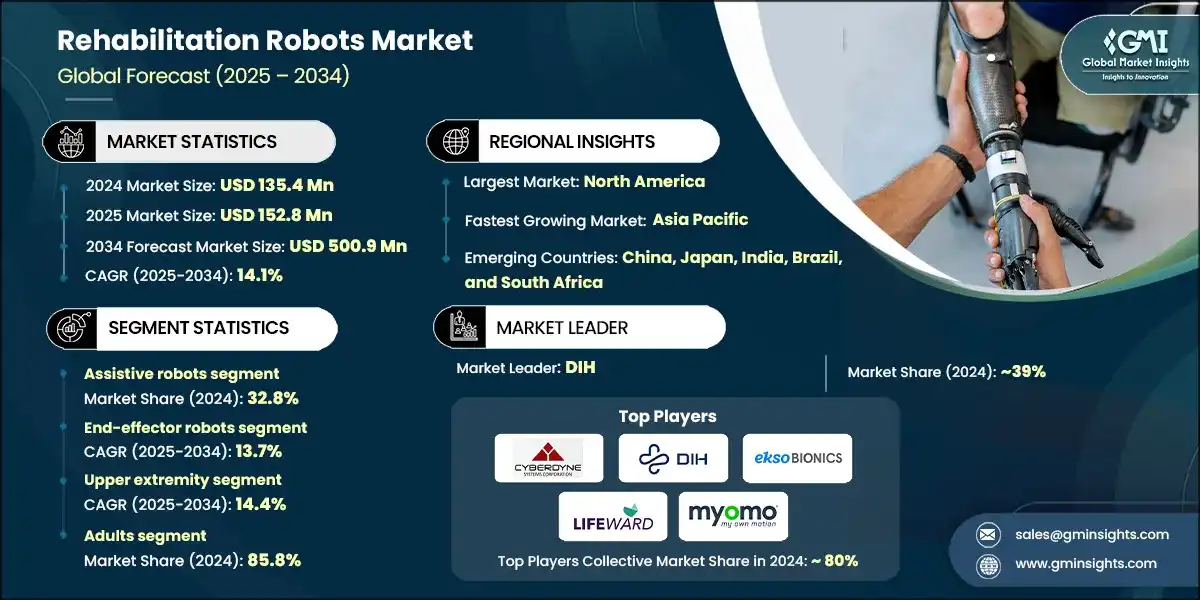
The global rehabilitation robots market size was valued at USD 135.4 million in 2024. The market is expected to grow from USD 152.8 million in 2025 to USD 500.9 million in 2034, at a CAGR of 14.1% during the forecast period, according to the latest report published by Global Market Insights Inc. The high market growth is attributed to the rising prevalence of brain-related disorders, increase in the number of patients with physical disabilities, and surging geriatric population coupled with increasing trauma cases globally, among others.
Rehabilitation Robots Market Key Takeaways
Market Size & Growth
- 2024 Market Size: USD 135.4 Million
- 2025 Market Size: USD 152.8 Million
- 2034 Forecast Market Size: USD 500.9 Million
- CAGR (2025–2034): 14.1%
Regional Dominance
- Largest Market: North America
- Fastest Growing Region: Asia Pacific
Key Market Drivers
- Rising prevalence of brain-related disorders.
- Increase in the number of patients with physical disabilities.
- Technological advancements.
- Surging geriatric population, coupled with increasing trauma cases globally.
Challenges
- High device cost.
- Lack of awareness in developing countries.
Opportunity
- Expansion into emerging markets.
- Integration of AI.
Key Players
- Market Leader: DIH led with over 39% market share in 2024.
- Leading Players: Top 5 players in this market include Cyberdyne, DIH, Ekso Bionics, LIFEWARD, myomo, which collectively held a market share of 80% in 2024.
Get Market Insights & Growth Opportunities
Rehabilitation robots are revolutionary technologies transforming physical therapy, neurorehabilitation, and postoperative rehabilitation. These systems are installed in hospitals, outpatient clinics, and homecare environments to provide support to patients with motor disabilities, stroke rehabilitation, spinal cord injury, and mobility problems associated with aging. Top manufacturers like DIH, Ekso Bionics, Cyberdyne, myomo, and LIFEWARD have a wide range of robotic products to address the different needs of patients, ranging from exoskeletons to robot end-effector-based therapy systems and wearable assistive devices. These devices utilize high-end technologies like AI-based motion control, sensor-based feedback loops, data analytics in the cloud, and ergonomic and biocompatible materials. Integration with electronic health records (EHRs) and telemedicine platforms ensures personalized therapy, clinical accuracy, and streamlined rehabilitation workflows.
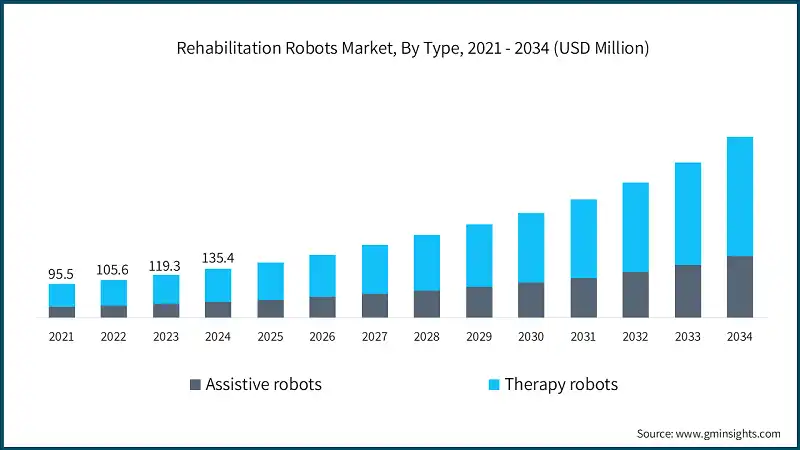
The market has increased from USD 95.5 million in 2021 and reached USD 119.3 million in 2023, with a historic growth rate of 23.9%. This expansion has been driven by the rising prevalence of neurological and musculoskeletal disorders, the growing demand for personalized rehabilitation therapies, and rapid advancements in robotic technologies.
Rehabilitation robots are increasingly being adopted in clinical settings, senior care facilities, and homecare environments due to their ability to deliver consistent, precise, and adaptive therapy. Integration of AI-powered motion control, sensor-based feedback systems, and cloud-connected platforms has further enhanced the clinical efficacy and accessibility of these devices. As healthcare systems worldwide shift toward value-based care and remote rehabilitation, the market is expected to witness sustained growth across both developed and emerging economies.
Rehabilitation robots are advanced robotic devices designed to assist in the rehabilitation process of patients recovering from various physical and neurological conditions. These robots aid in the restoration of motor functions, improvement of physical mobility, and enhancement of cognitive abilities through repetitive, precise, and controlled exercises.
To get key market trends
Rehabilitation Robots Market Trends
The field of rehabilitation robotics is experiencing significant growth, driven by a series of technological advancements.
- Innovations in artificial intelligence, sensor fusion, and real-time motion analysis have enabled robots to deliver highly personalized and adaptive therapy tailored to individual patient needs. These systems can now interpret bio-signals such as electromyography (EMG) and electroencephalography (EEG), allowing for more intuitive and responsive control mechanisms, especially in neurorehabilitation.
- Cloud-based platforms and IoT integration are transforming rehabilitation robots into connected devices capable of remote monitoring, data sharing, and predictive analytics. This not only enhances clinical decision-making but also supports tele-rehabilitation models, making therapy accessible beyond traditional healthcare settings. Advances in soft robotics and lightweight exoskeletons are improving patient comfort, mobility, and usability, especially for elderly and pediatric populations.
- Moreover, the convergence of robotics with virtual reality (VR), augmented reality (AR), and gamified therapy environments is fostering greater patient engagement, motivation, and adherence to treatment protocols. These immersive technologies stimulate neuroplasticity and accelerate functional recovery, particularly in stroke and spinal cord injury patients.
Rehabilitation Robots Market Analysis
Learn more about the key segments shaping this market
The global market was valued at USD 95.5 million in 2021. The market size reached USD 119.3 million in 2023, from USD 105.6 million in 2022.
Based on the component, the market is segmented into assistive robots and therapy robots. The assistive robots segment accounted for 32.8% of the market in 2024 due to its widespread adoption in clinical and homecare settings, driven by mature clinical evidence, increasing demand for mobility support, and growing use in neuro-orthopedic therapy. The segment is expected to exceed USD 170.9 million by 2034, growing at a CAGR of 14.6% during the forecast period.
On the other hand, the therapy robots segment held a dominant market share of 67.2% in 2024, and its growth can be attributed to the increasing demand for intensive, repetitive, and data-driven rehabilitation therapies. The segment continues to benefit from strong clinical validation and integration with advanced technologies like AI and virtual reality, which enhance treatment precision and patient engagement.
- The significant market share of the assistive robots segment is further reinforced by their versatility across a wide range of conditions, including stroke, spinal cord injuries, and age-related mobility impairments. These robots not only support physical movement but also promote cognitive engagement through interactive interfaces and feedback mechanisms. Their increasing use in homecare settings, driven by advancements in portability and remote connectivity, is helping reduce hospital readmissions and improve long-term patient outcomes. As healthcare systems prioritize cost-effective and scalable rehabilitation solutions, assistive robots are emerging as a cornerstone of modern therapeutic care.
Based on robotic structure, the rehabilitation robots market is segmented into end-effector robots and exoskeleton robots. The end-effector robots segment dominated the market in 2024 and is growing with a CAGR of 13.7% during the forecast period.
- The growth of this segment is driven by their precision in delivering repetitive, controlled movements essential for motor recovery in stroke and spinal cord injury patients. Their relatively simpler mechanical structure and adaptability across various therapy protocols make them a preferred choice in clinical rehabilitation settings.
- The exoskeleton robots segment is expected to grow with a 14.8% CAGR during the analysis period. This growth is primarily driven by rising demand for wearable mobility solutions, increasing cases of stroke and spinal cord injuries, and continuous innovation in lightweight, AI-powered rehabilitation systems. Additionally, expanding applications in geriatric care and military rehabilitation programs are further accelerating adoption across global healthcare markets.
Based on extremity, the rehabilitation robots market is segmented into upper extremity and lower extremity. The upper extremity segment dominated the market in 2024 and is growing with a CAGR of 14.4% during the forecast period.
- The growth is fueled by advancements in robotic-assisted therapy systems, which offer personalized and intensive rehabilitation solutions for upper limb recovery. These systems are increasingly being adopted in hospitals, rehabilitation centers, and homecare settings due to their effectiveness in improving patient outcomes and reducing recovery time. Moreover, the rising geriatric population and growing awareness of robotic rehabilitation technologies are expected to further boost market expansion in this segment.
- The lower extremity segment is expected to grow with a 13.9% CAGR during the analysis period. This growth is driven by the increasing adoption of robotic gait trainers and wearable exoskeletons for post-stroke and spinal cord injury rehabilitation. Technological advancements such as AI-powered adaptive systems and sensor-integrated devices are enhancing therapy outcomes by enabling real-time gait correction and personalized rehabilitation protocols.
Based on the patient, the rehabilitation robots market is segmented into adults and pediatrics. The adults segment held a market share of 85.8% in 2024 and is expected to grow at a 14.2% CAGR during the forecast period.
- The growth of this segment is driven by the rising incidence of stroke, spinal cord injuries, and orthopedic conditions among working-age populations. Increasing awareness and access to advanced rehabilitation technologies are further supporting growth in this segment. Additionally, the growing emphasis on early intervention and return-to-work programs is boosting demand for robotic rehabilitation solutions tailored to adult patients.
- The pediatric segment accounted for a 14.2% share in 2024. The growth is driven by the rising prevalence of neurological and musculoskeletal disorders among children, increasing demand for early intervention therapies, and the adoption of gamified, interactive robotic systems that enhance engagement and therapy adherence.
Based on the application, the rehabilitation robots market is segmented into neurological rehabilitation, spinal cord injuries, and other applications. The neurological rehabilitation segment held a market share of 63.2% in 2024 and is expected to grow at a 14.3% CAGR during the forecast period.
- The growth of this segment is driven by the rising prevalence of stroke, Parkinson’s disease, spinal cord injuries, and other neurological conditions. Increasing adoption of AI-powered neurorehabilitation systems and brain-computer interface technologies is further enhancing therapy precision and patient outcomes in this segment.
- The spinal cord injuries segment accounted for a 29.5% share in 2024. The growth is driven by the rising incidence of trauma-related injuries from road accidents, falls, and sports activities, along with increasing demand for high-intensity, precision rehabilitation solutions. Rehabilitation robots, particularly exoskeletons, play a critical role in restoring mobility and independence for patients with spinal cord damage.
- The market for the other applications segment is expected to expand rapidly, driven primarily by the increasing demand for rehabilitation solutions in areas such as post-surgical recovery, orthopedic therapy, and pediatric developmental disorders. The versatility of robotic systems in addressing diverse therapeutic needs beyond neurological and spinal conditions is opening new avenues for innovation and adoption across specialized clinical domains.
Learn more about the key segments shaping this market
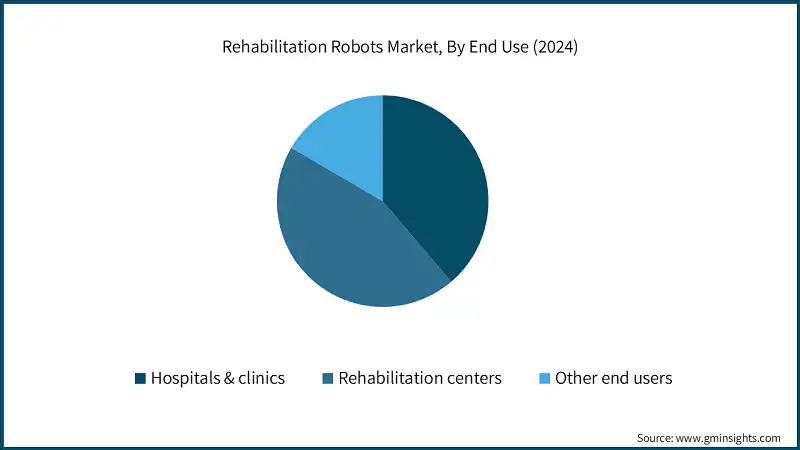
Based on end use, the rehabilitation robots market is segmented into hospitals & clinics, rehabilitation centers, and other end users. The hospitals & clinics segment held a market share of 38.8% in 2024 and is expected to reach USD 191.6 million within the forecast period.
- This significant market share is primarily driven by the widespread adoption of robotic rehabilitation systems in structured clinical environments. Increasing investments in advanced therapy infrastructure, favorable reimbursement policies, and the need for consistent, high-intensity rehabilitation are further fueling growth in this segment.
- The rehabilitation centers segment accounted for a 44.6% share in 2024 and is expected to grow at a 14.5% CAGR. This growth is primarily driven by the increasing demand for specialized, high-intensity therapy programs and the growing integration of robotic systems into structured rehabilitation protocols. These centers are increasingly adopting advanced technologies to improve patient outcomes, reduce recovery time, and address therapist shortages.
- The other end users segment is expected to grow with a 13.2% CAGR during the analysis period. This growth is primarily driven by the rising adoption of rehabilitation robots in non-traditional settings such as academic research labs, sports medicine centers, and military rehabilitation programs, where advanced therapy technologies are being used to accelerate recovery and enhance performance.
Looking for region specific data?
North America Rehabilitation Robots Market
North America dominated the global market with the highest market share of 43.8% in 2024.
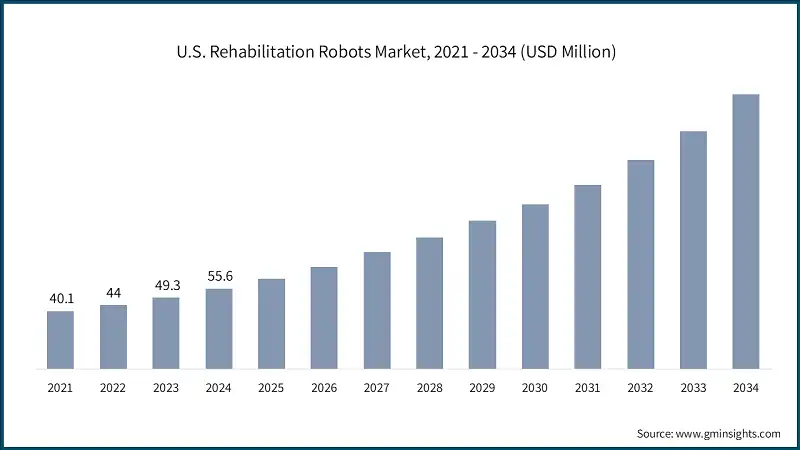
- The U.S. market was valued at USD 40.1 million and USD 44 million in 2021 and 2022, respectively. The market size reached USD 55.6 million in 2024, growing from USD 49.3 million in 2023, and is anticipated to grow at a CAGR of 13.2% between 2025 and 2034.
- North America remains the largest market for rehabilitation robots, driven by advanced healthcare infrastructure, high healthcare spending, and strong adoption of robotic technologies in clinical settings. The U.S. leads the region, supported by favorable reimbursement policies, a growing elderly population, and a high incidence of neurological and musculoskeletal disorders. Major hospitals and rehabilitation centers across the country are integrating robotic systems into standard therapy protocols, while collaborations between tech companies and research institutions continue to push innovation.
- Canada also contributes significantly, with increasing investments in assistive technologies and a focus on inclusive healthcare. The region benefits from a well-established regulatory framework and a tech-savvy medical workforce, which supports the deployment of AI-powered and cloud-connected rehabilitation solutions. The presence of leading manufacturers and early adopters makes North America a hub for both innovation and commercialization in the rehabilitation robotics space.
Europe Rehabilitation Robots Market
Europe market accounted for USD 40 million in 2024 and is anticipated to show lucrative growth over the forecast period.
- Europe holds a substantial share of the market, supported by progressive healthcare policies, strong public funding, and a growing emphasis on patient-centric care. Countries like Germany, France, and the UK are leading adopters, with rehabilitation robots widely used in hospitals and specialized therapy centers. The region is also home to several pioneering companies and academic institutions that are actively involved in R&D and clinical trials.
- The European Union’s support for digital health transformation and cross-border research initiatives has accelerated the integration of robotics into rehabilitation programs. Moreover, the aging population and increasing prevalence of stroke and Parkinson’s disease are driving demand for advanced therapeutic solutions. Europe’s focus on quality care, combined with its regulatory clarity, makes it a fertile ground for scaling robotic rehabilitation technologies.
Asia Pacific Rehabilitation Robots Market
The Asia Pacific market is anticipated to grow at a CAGR of 16.1% during the analysis timeframe.
- Asia Pacific is the fastest-growing region in the market, fueled by rising healthcare investments, expanding middle-class populations, and increasing awareness of robotic therapy. Japan stands out as a global leader in robotics, with a strong focus on wearable exoskeletons and neuro-assistive technologies. The country’s aging population and government support for elder care innovation have made it a key market for rehabilitation robots.
- China and India are emerging as high-potential markets due to their large patient populations and growing healthcare infrastructure. In China, domestic manufacturers are rapidly innovating and scaling robotic solutions, while India is seeing increased adoption in urban hospitals and rehabilitation centers. The region’s push toward digital health and telemedicine is also creating new opportunities for remote and home-based robotic therapy.
Latin America Rehabilitation Robots Market
The Latin America market is experiencing robust growth over the analysis timeframe.
- The growth in the region is driven by improving access to healthcare and rising demand for affordable therapeutic technologies.
- Brazil and Mexico are the primary contributors, with increasing investments in public health and rehabilitation services. These countries are adopting robotic systems in urban hospitals and pilot programs, particularly for stroke and trauma recovery.
Middle East & Africa Rehabilitation Robots Market
The Middle East & Africa (MEA) market is experiencing notable growth over the analysis timeframe.
- The MEA region is gradually embracing rehabilitation robotics, with growth driven by rising awareness, expanding private healthcare facilities, and increasing prevalence of trauma-related injuries.
- UAE and Saudi Arabia are leading the region, investing heavily in advanced medical technologies and rehabilitation infrastructure as part of their national healthcare transformation agendas.
Rehabilitation Robots Market Share
Leading industry players such as Cyberdyne, DIH, Ekso Bionics, LIFEWARD, and myomo collectively hold around 80% of the market share in the highly consolidated market. These companies maintain their leadership through robust product portfolios that span therapy robots, wearable exoskeletons, and sensor-integrated rehabilitation platforms. Their strategic focus on clinical validation, AI-powered therapy systems, and integration with hospital IT infrastructure has enabled them to stay ahead in a rapidly evolving therapeutic landscape.
Other notable players in the market include BIONIK, BioXtreme, FOURIER, and KINOVA, each contributing to the industry. These companies are actively involved in developing specialized applications such as tissue engineering, dental prosthetics, and surgical planning tools. The competitive landscape is shaped by continuous technological advancements, growing demand for personalized medical solutions, and increasing adoption of point-of-care 3D printing. As the industry matures, collaborations between technology providers and healthcare institutions are expected to play a key role in driving innovation and expanding the scope of 3D printing in clinical settings.
Rehabilitation Robots Market Companies
A few of the prominent players operating in the rehabilitation robots industry include:
- BIONIK
- BioXtreme
- Cyberdyne
- DIH
- Ekso Bionics
- FOURIER
- KINOVA
- LEADERS REHAB ROBOT
- LIFEWARD
- myomo
- Rehab-Robotics
- REX BIONICS
- tyromotion
- Cyberdyne
Cyberdyne is a global pioneer in neuro-assistive robotics, best known for its Hybrid Assistive Limb (HAL) technology, which uses bioelectric signals to support voluntary movement in patients with neurological impairments. The company’s systems are deeply integrated with brain-machine interfaces, enabling real-time feedback and adaptive control that enhances motor recovery and neuroplasticity. Cyberdyne’s strong academic collaborations and clinical research foundation position it as a leader in next-generation rehabilitation solutions.
DIH stands out as a rehabilitation technology integrator, bringing together leading brands such as Hocoma and Motek under one umbrella to offer a comprehensive ecosystem of robotic and sensor-based therapy solutions. Its strength lies in combining immersive virtual environments, real-time motion tracking, and data analytics to deliver personalized, high-intensity rehabilitation programs across neurological and orthopedic conditions.
Ekso Bionics is a leading developer of wearable exoskeletons designed to assist individuals with spinal cord injuries, stroke, and other mobility impairments. Its FDA-cleared EksoNR device is widely used in top-tier hospitals and rehabilitation centers, offering real-time gait analysis and adaptive support to improve walking ability and functional independence. The company’s deep expertise in biomechanics and robotics enables it to deliver clinically validated solutions that enhance recovery outcomes.
Rehabilitation Robots Market Report Attributes
| Key Takeaway | Details |
|---|---|
| Market Size & Growth | |
| Base Year | 2024 |
| Market Size in 2024 | USD 135.4 Million |
| Market Size in 2025 | USD 152.8 Million |
| Forecast Period 2025 - 2034 CAGR | 14.1% |
| Market Size in 2034 | USD 500.9 Million |
| Key Market Trends | |
| Drivers | Impact |
| Rising prevalence of brain-related disorders | Increases demand for neurorehabilitation technologies to restore motor and cognitive functions. |
| Increase in the number of patients with physical disabilities | Fuels adoption of robotic therapy systems for mobility and functional recovery. |
| Technological advancements | Enhances precision, adaptability, and accessibility of rehabilitation robots across clinical and homecare settings. |
| Surging geriatric population, coupled with increasing trauma cases globally | Expands the user base for assistive robotic solutions in aging and post-injury care. |
| Pitfalls & Challenges | Impact |
| High device cost | Limits adoption in resource-constrained healthcare systems and among individual users. |
| Lack of awareness in developing countries | Slows market penetration and utilization of robotic rehabilitation technologies. |
| Opportunities: | Impact |
| Expansion into emerging markets | Unlocks new growth avenues through rising healthcare investments and unmet rehabilitation needs. |
| Integration of AI | Enables personalized therapy, predictive analytics, and smarter rehabilitation outcomes. |
| Market Leaders (2024) | |
| Market Leaders |
~39% Market Share |
| Top Players |
Collective market share in 2024 is ~80% |
| Competitive Edge |
|
| Regional Insights | |
| Largest Market | North America |
| Fastest Growing Market | Asia Pacific |
| Emerging Countries | China, Japan, India, Brazil, and South Africa |
| Future outlook |
|
What are the growth opportunities in this market?
Rehabilitation Robots Industry News:
- In September 2023, Bionik Laboratories received a U.S. patent for its innovative rehabilitation technology, particularly for those with upper-extremity mobility issues. This patent further strengthens Bionik's intellectual property portfolio and highlights the company's commitment to developing cutting-edge solutions to improve the lives of patients through innovative technology.
- In June 2022, Ekso Bionics Holdings, Inc. received the 510(k) clearance from the U.S. Food and Drug Administration (FDA) to market its EksoNR robotic exoskeleton for use with multiple sclerosis (MS) patients. This approval expanded the device’s indication to a broader group of patients, resulting in an increased customer base and enhanced company reputation in the market.
The rehabilitation robots market research report includes an in-depth coverage of the industry with estimates and forecasts in terms of revenue in USD Million from 2021 - 2034 for the following segments:
Market, By Type
- Assistive robot
- Therapy robot
Market, By Robotic Structure
- End-effector robots
- Exoskeleton robots
Market, By Extremity
- Upper extremity
- Lower extremity
Market, By Patient
- Adults
- Pediatric
Market, By Application
- Neurological rehabilitation
- Spinal cord injuries
- Other applications
Market, By End Use
- Hospitals & clinics
- Rehabilitation centers
- Other end use
The above information is provided for the following regions and countries:
- North America
- U.S.
- Canada
- Europe
- Germany
- UK
- France
- Italy
- Spain
- Netherlands
- Asia Pacific
- China
- Japan
- India
- Australia
- South Korea
- Latin America
- Brazil
- Mexico
- Argentina
- Middle East and Africa
- South Africa
- Saudi Arabia
- UAE
Frequently Asked Question(FAQ) :
What is the market size of the rehabilitation robots market in 2024?
The global market size for rehabilitation robots was valued at USD 135.4 million in 2024, driven by rising cases of neurological and physical disabilities and growing adoption of robotic therapy systems.
What is the projected market value of rehabilitation robots by 2034?
The market is expected to reach USD 500.9 million by 2034, growing at a CAGR of 14.1% from 2025 to 2034, supported by advancements in AI, sensor technologies, and tele-rehabilitation platforms.
What is the estimated market size for 2025?
The rehabilitation robots market is projected to reach USD 152.8 million in 2025, reflecting increasing adoption in hospitals, rehabilitation centers, and homecare environments.
How much revenue did the therapy robots segment generate in 2024?
The therapy robots segment accounted for 67.2% of the market in 2024, driven by the rising need for data-driven, repetitive rehabilitation therapy and strong clinical validation across neurological disorders.
What was the valuation of the assistive robots segment in 2024?
The assistive robots segment held 32.8% market share and was valued at approximately USD 44.4 million in 2024, supported by its extensive use in clinical and homecare mobility assistance.
What is the growth outlook for exoskeleton robots from 2025 to 2034?
The exoskeleton robots segment is projected to grow at a 14.8% CAGR through 2034, fueled by innovations in lightweight wearable designs, AI-powered motion control, and increased use in spinal cord and stroke rehabilitation.
Which region leads the rehabilitation robots market?
North America led the market with a 43.8% share and generated USD 55.6 million in 2024, supported by advanced healthcare infrastructure, high investment in assistive technologies, and a strong presence of key players like Ekso Bionics and DIH.
Which region is the fastest-growing in the rehabilitation robots industry?
The Asia Pacific region is the fastest-growing market, expanding at a 16.1% CAGR, driven by rising healthcare investments, aging populations, and rapid adoption of robotic and wearable rehabilitation systems in countries like Japan, China, and India.
Who are the key players in the rehabilitation robots market?
Key players include Cyberdyne, DIH, Ekso Bionics, LIFEWARD, myomo, BIONIK, BioXtreme, FOURIER, KINOVA, LEADERS REHAB ROBOT, Rehab-Robotics, REX BIONICS, and tyromotion.
Rehabilitation Robots Market Scope
Related Reports