Summary
Table of Content

Processed Fruits and Vegetables Market
Get a free sample of this report
Form submitted successfully!
Error submitting form. Please try again.
Thank you!
Your inquiry has been received. Our team will reach out to you with the required details via email. To ensure that you don't miss their response, kindly remember to check your spam folder as well!
Request Sectional Data
Thank you!
Your inquiry has been received. Our team will reach out to you with the required details via email. To ensure that you don't miss their response, kindly remember to check your spam folder as well!
Form submitted successfully!
Error submitting form. Please try again.
Processed Fruits and Vegetables Market Size
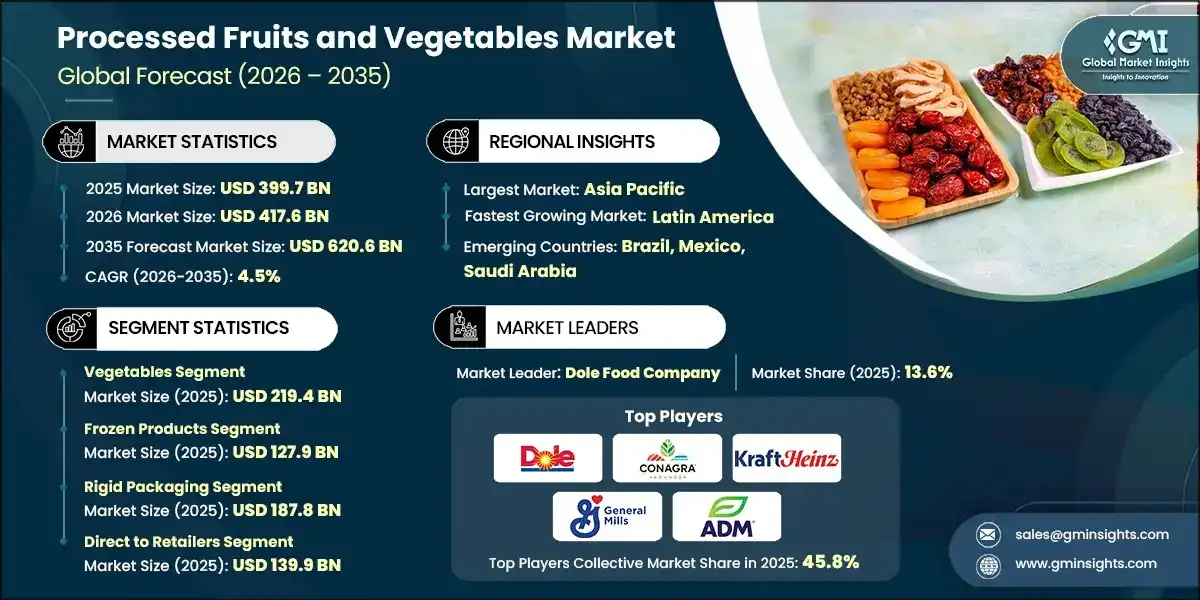
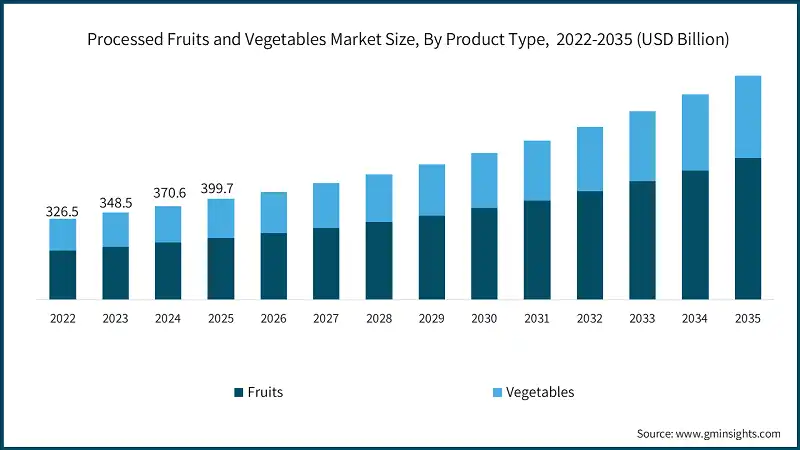
The global processed fruits and vegetables market was estimated at USD 399.7 billion in 2025. It is expected to grow from USD 417.6 billion in 2026 to USD 620.6 billion by 2035, at a CAGR of 4.5%, according to latest report published by Global Market Insights Inc.
Processed Fruits and Vegetables Market Key Takeaways
Market Size & Growth
- 2025 Market Size: USD 399.7 Billion
- 2026 Market Size: USD 417.6 Billion
- 2035 Forecast Market Size: USD 620.6 Billion
- CAGR (2026–2035): 4.5%
Regional Dominance
- Largest Market: Asia Pacific
- Fastest Growing Region: Latin America
Key Market Drivers
- Rising consumer demand for convenience foods.
- Growing health & wellness consciousness.
- Expansion of organized retail & E-commerce.
Challenges
- High Dependency on Seasonal Raw Materials.
- Stringent Food Safety and Quality Regulations.
Opportunity
- Expansion into Plant-Based and Functional Products.
- Export potential to regions with limited local production.
Key Players
- Market Leader: Dole Food Company led with over 13.6% market share in 2025.
- Leading Players: Top 5 players in this market include ADM (Archer Daniels Midland), General Mills, Inc., The Kraft Heinz Company, Conagra Brands, Inc., Dole Food Company, which collectively held a market share of 45.8% in 2025.
Get Market Insights & Growth Opportunities
- The processed fruits and vegetables business is growing with a steady pace with consumers taking an interest in convenience in eating habits. Increase in urban lifestyles, extended working hours and the shifting household arrangements have caused a decrease in the time in which individuals can prepare meals and have fueled the demand of ready-to-use and ready-to-eat food formats. The processed fruits and vegetables help satisfy this requirement by providing longer shelf life, uniform quality and convenience in many occasions of consumption. Consequently, these products have entered into household and foodservice operations as a result of creating a continuum in the markets.
- Increased attention towards health and nutrition and healthy diets are impacting the demand of processed fruits and vegetables positively. Consumers are also considering these products as viable substitutes to fresh produce especially after being processed in a way that does not damage nutritional value. Minimally processed and frozen fruit and vegetable products have increasingly been accepted by the growing popularity of plant-based diets, portion control, and clean-label foods. This consumer perception is increasing the market addressable base and strengthening the long term growth prospects.
- The rapid growth of the organized retail networks and e-commerce platforms is substantially contributing to the distribution and visibility of processed fruits and vegetables. Supermarkets, hypermarkets, and online grocery platforms offer more product assortment, dependable availability, and also better cold chain, which allow expanded consumer access. Simultaneously, the emergence of private labeling and direct supplier-retailer connections are enhancing the price competitiveness and the consistency of supply. These distribution enhancements have been improving and speeding up market penetration and making significant contributions to the overall market growth of processed fruits and vegetables.
To get key market trends
Processed Fruits and Vegetables Market Trends
- The market of processed fruits and vegetables is becoming more influenced by the change of clean-label and transparent processing. To meet the changing labeling demand, manufacturers are making ingredient formulae easier and less dependent on artificial preservatives. The trend is affecting the product reformulation cycles and promoting investments in sophisticated processing practices that preserve the freshness and quality. Bands are modifying the packaging and communication to increase trust as transparency emerges as a competitive differentiator.
- The trend of product innovation is shifting towards the value-added and functional products placing processed fruits and vegetables on high consumption. Firms are also enhancing products that are easier to use with products that offer better nutritional value; this could include fortified blends and pre-cooked ingredients to build meals. This is increasing the application area in snacks, prepared food and foodservice formats. Consequently, the differentiation based on functionality is becoming one of the competitive josticks.
- Sustainability in processing and supply chain is also being tightly concentrated on in the market not only in packaging but also in sourcing efficiency and production efficiency. Manufacturing plants are also optimizing the use of energy, water management, and reducing of waste materials by processors. Such efforts are getting entrenched in the corporate strategies as the sustainability expectations of all stakeholders are increasing. These practices should ultimately affect the cost structures and long-term operating strength.
- The processing operations are undergoing changes as a result of digitalization and automation that enhance efficiency, consistency and traceability throughout the value chain. The implementation of intelligent systems of manufacturing can be used to control the quality, predict demand and monitor inventory. This tendency has a strong influence in the large-scale processing setting where precision in operations is essential. Improved visibility of data is making decision-making stronger and minimizing operational risks.
Processed Fruits and Vegetables Market Analysis
Learn more about the key segments shaping this market
Based on product type, the market is segmented into fruits, and vegetables. The vegetables segment was worth USD 219.4 billion in 2025.
- In the processed fruit and vegetable market, vegetables are the most prevalent product in the product-type segmentation and this is backed up by the comprehensive foodservice usage, household consumption, and industrial food processing usage. Frozen meals, soups, sauces, snacks and ready-to-eat products are some of the wide uses of processed vegetables that offer demand all year round. The fact that they have longer storage life, contain less sugar than fruits and that they are versatile in all cuisines further establishes their market penetration.
- Increased health awareness and a dietary change towards balanced and plant-based meals, in which processed vegetables are seen as a necessity, also contributes to the strong stance of vegetables. The constant advancements in processing technologies such as freezing, blanching, and minimal processing have promoted a retention of quality and convenience, making them more acceptable. Since the demand in functional, convenient, and healthy food solutions is on the increase, the percentage of vegetables in the volumes of processed products is increasing as compared to fruits.
Based on process form, the market is segmented into canned / jarred products, frozen products, dried & dehydrated, fresh-cut / minimally processed, juices & concentrates, preserves, jams & jellies, purees & sauces, and others. The frozen products holds a significant share at a valuation of USD 127.9 billion in 2025.
- Frozen products make up the highest proportion in the processing-form segmentation in the processed fruits and vegetables market because of their preservative properties that retain nutritious value, texture, and flavor and provide long shelf life. Frozen fruits and vegetables can also be used in a retail or foodservice application because of the development of freezing technology like Individually Quick Frozen (IQF) that has led to the enhancement of product quality.
- The increasing trend of convenience and minimization of food waste is remaining to favor the growth of frozen products compared with other processing systems of canned, dried or fresh-cut. Cold-chain infrastructure and automated freezing facilities have increased scalability and cost efficiency to reinforce the competitive advantage of frozen products. Also the increased emphasis on clean-label and minimally processed foods goes well with the frozen format, since many of them have fewer preservatives than canned or jarred versions.
Based on packaging type, the market is segmented into rigid packaging, flexible packaging, bulk packaging, and others. The rigid packaging exceeded USD 187.8 billion in 2025.
- Rigid packaging in the processed fruits and vegetables market occupies the highest market share under the packaging-type segmentation, especially where the market has a high usage of the package in packing vegetables in cans, jars and bottles. Rigid packages contain better protection against contamination, moisture and physical damage and promote high shelf life and integrity of products during transport and storage. It is a popular source of thermal-processed vegetable products to be supplied in grocery and institutional markets due to its ability to be compatible with thermal processes like canning and retorting.
- The prevalence of rigid packaging is further endorsed by the fact that the packaging is highly trusted by consumers in terms of durability, ease of storage and recyclability particularly in the developed nations where recycling systems are well established. As a manufacturer, rigid containers can be used to impose uniform portioning, labeling and brand distinction, which are essential in competitive retail settings. Although the use of more flexible formats is rising, the rigid type of packaging still takes the upper hand in that it is very reliable, accepted by the regulations and also applicable in processing a lot of vegetables.
Learn more about the key segments shaping this market
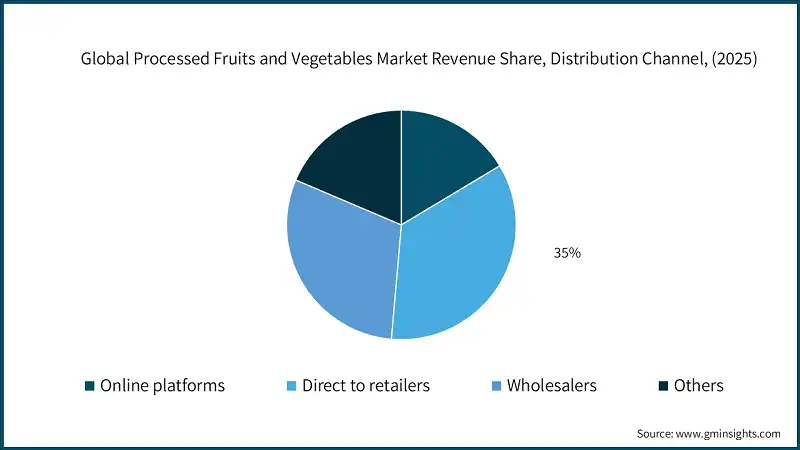
Based on distribution channel, the market is segmented into online platforms, direct to retailers, wholesalers, and others. Direct to retailers is estimated to grasp a value of USD 139.9 billion in 2025 and is expected to grow at 3.7% of CAGR during the forecast period.
- Direct-to-retailers channels in the processed fruits and vegetables market have the highest proportion within the distribution channel segmentation and this is backed by the good relationship between manufacturers and organized retail chains. Through this channel producers are able to maintain stable supply of products, enhanced inventory management and expedited replenished products throughout supermarkets and hypermarkets as well as the specialty food stores. Direct distribution also enables the manufacturers to exercise pricing discipline and have a better visibility of shelf placement and promotions.
- The power of direct-to-retailers is also supported by the growth of own-label products and central purchasing patterns of giant retailers. With retailers ever-growing need to be assured of the dependable supply, and traceability, the manufacturers are consolidating direct distribution chains to enhance operational efficiency and responsiveness. The online channel and the wholesalers are still expanding but direct retail distribution is still the preferred channel of delivery of high-volume processed fruits and vegetable because of its magnitude, consistency and predictability.
Looking for region specific data?
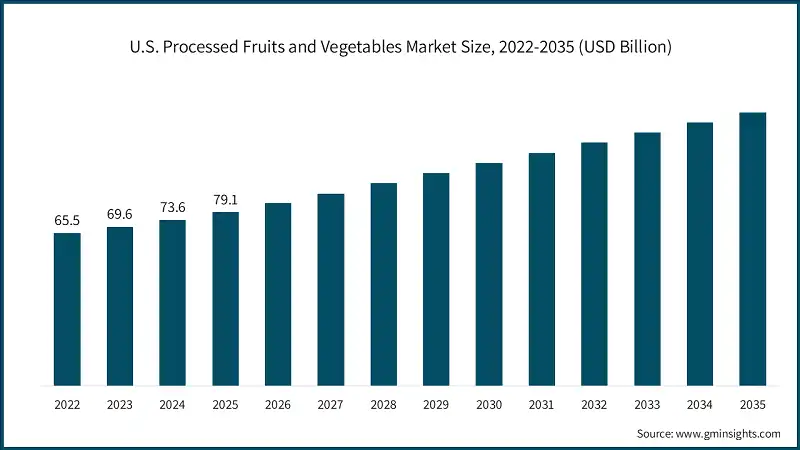
North America accounted for USD 85.6 billion in 2025 and is anticipated to show lucrative growth over the forecast period.
- North America fruits and vegetables market has an estimated market share of about 23% of the global market in the year 2025, which is supported by a well-established processing infrastructure, well-developed cold chains, and advanced food safety systems to facilitate year-round production and distribution. U.S. holds the largest share of the processed production of North America as it has a large manufacturing base, an advanced consumption of convenience and value-added goods (per-capita) and developed retail and foodservice outlets serving processed lines of fruit and vegetables.
- Canada is evolving well on health driven requirements of organic and nutrient-rich products. Increased consumer demand of clean-label, ready-to-eat, and fortified processed foods also drives the development of the region, as evidenced by continuous investments in automation and packaging development and the advancement of logistics to improve shelf life and product quality.
Europe accounted for USD 97 billion in 2025 and is anticipated to show lucrative growth over the forecast period.
- The market share of Europe in the global processed fruits and vegetables market reaches approximately 26% in year 2025, due to the fact that the country's processing industries, which include Germany, France, Italy, Spain, and Poland, have been well established and they deal in large amounts of canned, frozen, and dehydrated products.
- The high demand of high quality, organic and clean-label processed produce, strict food safety and quality laws that maintain high standards, and an aggressive export market that distributes products to neighboring regions contribute to the growth of the region. Robotic packaging lines and high-technology processing facilities have been persistently improving the efficiency of operations and product consistency, and sustainability policies and local free trade dynamics have facilitated the competitive positioning in the global trading flows.
Asia Pacific market accounted for USD 138.8 billion in 2025 and is anticipated to show lucrative growth over the forecast period.
- APAC region holds about 37.6 % of the global processed fruits and vegetable market share in 2025, with China and India leading the pack in terms of having enormous processing infrastructure and high output growth. The growth of APAC is being driven by urbanization, growth in disposable incomes, growth in cold-chain logistics, and growth in exports, especially frozen and canned forms. Massive investment in new processing plants and the influx of new technologies is increasing capacity although the increasing middle class is developing demand in convenient, packaged, and nutrition-oriented items.
Latin America market accounted for 5% market share in 2025 and is anticipated to show steady growth over the forecast period.
- Latin American processed fruits and vegetables market is showing a stable and steady growth due to the rich agricultural foundation in the region and availability of cost-effective raw material especially in Brazil, Mexico, and Argentina. These nations are characterized as major suppliers of tropical fruits, tomatoes and other vegetables which are processed locally and sent to export markets.
- The processes supporting growth include the expansion of cold-chain logistics, the government efforts to enhance food processing infrastructure, growing demand of convenient and shelf-stable products among urban customers. As more advanced technology of the process is lagged to more developed markets, increasing export and trade integration in the region supports a strong growth momentum in LATAM..
Middle East and Africa market accounted for 4% market share in 2025 and is anticipated to show steady growth over the forecast period.
- The Middle East and Africa processed fruits and vegetables market shows stable developmental growth, based on the gradual development of food processing capacity and changing consumption trends towards packaged and convenience foods. The incremental demand is being driven by key markets (South Africa, Egypt and the Gulf Cooperation Council (GCC) countries) and processors are increasing their offers in canned, frozen and dehydrated form to meet local demand and re-exports.
- Investments in the refrigerated distribution channels, and consumer changes towards ready-to-eat items help growth in MEA but logistical problems and increasing reliance on imports are limiting accelerated growth. With the ongoing infrastructure improvement and the growing knowledge about nutrition and food safety, MEA will continue to be a consistent player in the world market of processed fruits and vegetables.
Processed Fruits and Vegetables Market Share
Processed fruits and vegetables industry is moderately concentrated having top five companies, Dole food Company, Conagra Brands, the Kraft Heinz Company, General Mills, and ADM (Archer Daniels Midland Company) comprise of 45.8 % market share in 2025, due to their dominance in volume, branding, processing power, and distribution coverage across various major geographical locations. These companies control major product lines that are canned, frozen, purees, concentrates and ingredient solutions using a large manufacturing network and long-established customer bases in retail and foodservice outlets. Competitive advantage based on their size and diversification of their portfolio is supported in a market that is expected to expand consistently in the shifting consumer preferences towards convenience and health conscious products.
In this competitive environment, industry participants are step-up efforts on numerous strategic fronts to be competitive: modernizing processing technologies to enhance efficiency and product quality, diversifying product portfolios to healthier and clean-label products, entering and expanding in high-growth geographical markets, and enhancing supply chain resiliency. Sustainable sourcing, innovated packaging solutions, and digitalization of production and logistics are becoming the focus of differentiation as well as partnerships and focused innovation more and more serve as the means to meet the changing consumption desires and regulatory requirements with no mention of the respective company name.
Processed Fruits and Vegetables Market Companies
Major players operating in processed fruits and vegetables industry are:
- Dole Food Company
- Conagra Brands, Inc.
- Del Monte Foods, Inc.
- Nestlé S.A.
- The Kraft Heinz Company
- General Mills, Inc.
- B&G Foods, Inc.
- ADM
- ABC Fruits
- Conagra
- Vebzy Nature
- Grofresh Agrofoods Pvt Ltd
Dole Food Company is a large producer, marketer, and distributor of fresh fruits, vegetables in the world, with a portfolio that consists of bananas, pineapples, berries, salads and value-added fresh produce offered through retail, wholesale, foodservice and processes channels in over 75 countries. It operates in the fresh fruit and fresh vegetable segments with a growing value-added products division, such as juices and packaged salads, which is backed by a strong global supply network and end-to-end value chain.
Conagra Brands is a large food processing organization in the U.S. with large base in processed fruit and vegetable products in the form of shelf-stable fruit cups, dessert topping, fillings, and a limited number of licensed brands such as Del Monte and Hunts. It operates a retail business, foodservice and institutional business with a network of manufacturing plants in North America. Conagra is an aggressive company that is constantly reinventing its product portfolio by acquiring and selling brands to suit changing consumer tastes.
Kraft Heinz is a major processed food corporation that operates in the United States specializing in the production of sauces, condiments and prepared meals that use processed vegetables and fruit products in their production (e.g. tomato sauces and vegetable blends). The company is repositioning its portfolio as the industry is changing to healthier and cleaner label products. The extensive brand coverage and developed manufacturing size are factors that have led Kraft Heinz to play its part in the processed fruits and vegetables segment and more so in the retail grocery.
General Mills is a food manufacturer and branded food manufacturer based in the United States that participates in the processed categories of fruits and vegetables via branded products and ingredient applications (e.g. fruit inclusions in cereals, snacks and bakery mixes). It sells numerous well-known consumer brands in the international market and also continues to innovate on health-related products in the light of the growing need of cleaner and functional food stuffs. Sustainability programs and renewal of portfolios are also practiced by the company in order to be competitive in processed food segments.
ADM is a multinational agricultural product processor and supplier of ingredients, which participates in the processed fruit and vegetable market with a huge role in transforming raw products into concentrates, purees, powders and pastes which are utilized in the food industry across the globe. It has a large B2B business, which involves providing core ingredients of juices, bakery, dairy alternatives, and snack products. The value-added solutions and wide commodity processing foundation offer ADM a strategic role in the value chain of fruit and vegetable processing as an upstream collaborator.
Processed Fruits and Vegetables Market Report Attributes
| Key Takeaway | Details |
|---|---|
| Market Size & Growth | |
| Base Year | 2025 |
| Market Size in 2025 | USD 399.7 Billion |
| Market Size in 2026 | USD 417.6 Billion |
| Forecast Period 2026-2035 CAGR | 4.5% |
| Market Size in 2035 | USD 620.6 Billion |
| Key Market Trends | |
| Drivers | Impact |
| Rising consumer demand for convenience foods | Boosts adoption of ready-to-eat, frozen, and canned products across retail and foodservice channels. |
| Growing health & wellness consciousness | Encourages development of organic, low-sugar, and nutrient-rich processed options to meet consumer expectations. |
| Expansion of organized retail & E-commerce | Expands product reach and accelerates sales through improved accessibility and digital platforms. |
| Pitfalls & Challenges | Impact |
| High Dependency on Seasonal Raw Materials | Creates uncertainty in production costs and supply chain stability, impacting profitability. |
| Stringent Food Safety and Quality Regulations | Leads to higher compliance costs and delays in product launches, limiting market agility. |
| Opportunities: | Impact |
| Expansion into Plant-Based and Functional Products | Expansion into Plant-Based and Functional Products |
| Export potential to regions with limited local production | Opens large-scale opportunities in international markets with growing demand for processed foods. |
| Market Leaders (2025) | |
| Market Leaders |
13.6% market share |
| Top Players |
|
| Competitive Edge |
|
| Regional Insights | |
| Largest Market | Asia Pacific |
| Fastest growing market | Latin America |
| Emerging countries | Brazil, Mexico, Saudi Arabia |
| Future outlook |
|
What are the growth opportunities in this market?
Processed Fruits and Vegetables Market News
- In March 2025, Bonduelle Group sold its vegetable processing plant in Kristalina, Brazil, to Stella d’Oro Alimentos as part of its operations streamlining and refocusing its business activities to the core European markets.
- In March 2024, Mother Dairy launched two new dairy and fruit and vegetable processing plants by investing INR 750 crore in line with the increasing consumer demand. Also the company invested INR100 crore in increasing the capacities of its already existing processing plants.
The processed fruits and vegetables market research report includes in-depth coverage of the industry with estimates & forecast in terms of revenue (USD Billion) & volume (Kilo Tons) from 2022 to 2035, for the following segments:
Market, By Product Type
- Fruits
- Citrus fruits
- Berries
- Stone fruits
- Tropical fruits
- Other fruits
- Vegetables
- Leafy & cruciferous vegetables
- Root & bulb vegetables
- Other vegetables
Market, By Processing Form
- Canned / jarred products
- Frozen products
- Dried & dehydrated
- Fresh-cut / minimally processed
- Juices & concentrates
- Preserves, jams & jellies
- Purees & sauces
- Others
Market, By Packaging Type
- Rigid packaging
- Metal cans
- Glass jars
- Rigid plastic containers
- Flexible packaging
- Stand-up pouches
- Retort pouches
- Bags, films & wraps
- Bulk packaging
- Drums & pails
- Totes & IBC containers
- Aseptic bulk containers
- Others
Market, By Distribution Channel
- Online platforms
- Direct to retailers
- Wholesalers
- Others
The above information is provided for the following regions and countries:
- North America
- U.S.
- Canada
- Europe
- UK
- Germany
- France
- Italy
- Spain
- Rest of Europe
- Asia Pacific
- China
- India
- Japan
- South Korea
- Australia
- Rest of Asia Pacific
- Latin America
- Brazil
- Mexico
- Argentina
- Rest of Latin America
- MEA
- UAE
- Saudi Arabia
- South Africa
- Rest of Middle East and Africa
Frequently Asked Question(FAQ) :
What was the market size of the processed fruits and vegetables market in 2025?
The market size was USD 399.7 billion in 2025, with a CAGR of 4.5% expected through 2035 driven by increasing health and wellness consciousness.
What is the projected value of the processed fruits and vegetables market by 2035?
The processed fruits and vegetables market is expected to reach USD 620.6 billion by 2035, growing at a CAGR of 4.5% during the forecast period.
What is the current market size of the processed fruits and vegetables market in 2026?
The market size is projected to reach USD 417.6 billion in 2026.
What was the valuation of the vegetables segment in 2025?
The vegetables segment was valued at USD 219.4 billion in 2025, dominating the product-type segmentation.
Processed Fruits and Vegetables Market Scope
Related Reports