Summary
Table of Content

Prefabricated Bathroom Pods Market
Get a free sample of this report
Form submitted successfully!
Error submitting form. Please try again.
Thank you!
Your inquiry has been received. Our team will reach out to you with the required details via email. To ensure that you don't miss their response, kindly remember to check your spam folder as well!
Request Sectional Data
Thank you!
Your inquiry has been received. Our team will reach out to you with the required details via email. To ensure that you don't miss their response, kindly remember to check your spam folder as well!
Form submitted successfully!
Error submitting form. Please try again.
Prefabricated Bathroom Pods Market Size
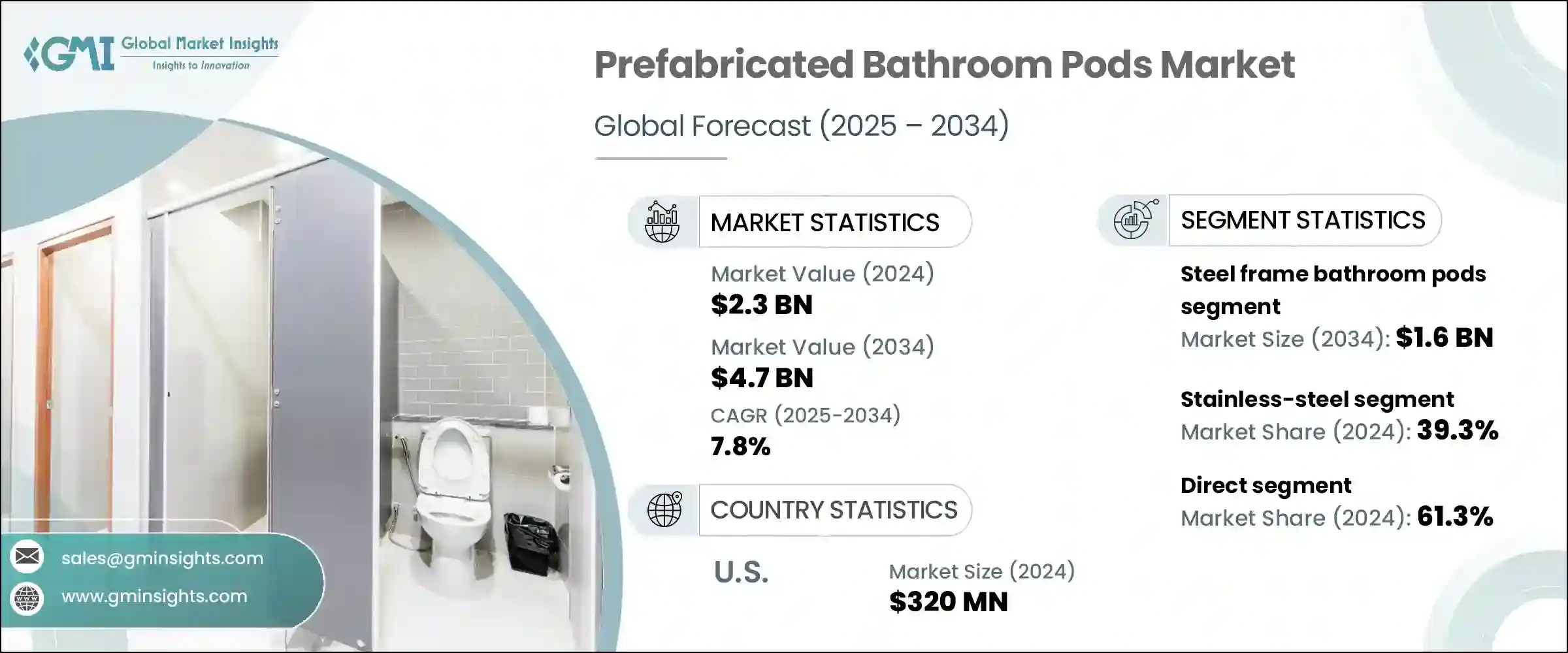
The global prefabricated bathroom pods market size was valued at USD 2.3 billion in 2024 and is projected to grow at a CAGR of 7.8% between 2025 and 2034. Bathroom pods cut down on hard-site labor and assembly time, making them the go-to choice for projects on fast tracks. Because each unit is built in a controlled factory, quality remains steady, and delivery to the building site happens quickly. The Modular Building Institute notes that modular approaches, pods included, can shorten overall schedules by 30-50% compared with stick-frame methods. That speed matters in hospitality, healthcare, and student housing, where rooms must open as soon as possible to meet rising occupancy needs.
Prefabricated Bathroom Pods Market Key Takeaways
Market Size & Growth
- 2024 Market Size: USD 2.3 Billion
- 2034 Forecast Market Size: USD 4.7 Billion
- CAGR (2025–2034): 7.8%
Key Market Drivers
- Rising demand for modular and time-efficient construction.
- Labor shortages in the construction industry.
- Increasing adoption in healthcare and hospitality sectors.
Challenges
- High initial investment and customization limitations.
- Logistics and transportation constraints for large pods.
Get Market Insights & Growth Opportunities
The global construction sector is facing a deep skills gap that is pushing up expenses and slowing work on conventional sites. The U.S. Chamber of Commerce Commercial Construction Index shows that in 2023 a striking 91% of contractors struggled to recruit qualified tradespeople, and that shortage is likely to carry into 2024. Off-site bathroom pods help ease the pinch because they are built in a factory instead of on-the-job site, cutting the amount of labor needed outdoors. Factory assembly also trims waste and sharpens cost forecasts, features that appeal to builders working on large projects. Soaring prices for steel, lumber, and other basic materials make these off-site units even more attractive. The National Association of Home Builders, for instance, notes that material costs have climbed roughly 35% in the last three years, pushing developers to seek prefabricated solutions that protect budgets without sacrificing quality.
To get key market trends
Prefabricated Bathroom Pods Market Trends
- Manufacturers are integrating smart tech and green materials into nearly every module. Today, units often come with Internet-of-Things (IoT) gadgets, from taps that turn on with a motion sensor to lighting that adjusts with occupancy and water dashboards that monitor leaks. On the environmental side, LED lamps, low-flow valves, and recycled composites have shifted from optional extras to standard fare. Such features help builders earn top scores from green-label programs like LEED and satisfy their own Environmental, Social, and Governance (ESG) targets.
- The healthcare and hospitality industries are quickly becoming the largest users of prefabricated bathroom pods, motivated by goals of speed, cleanliness and dependable workmanship. Hospitals, hotels and assisted-living centers increasingly choose factory-built units because these pods shorten build schedules and uphold strict hygiene standards.
- Although off-the-shelf bathroom pods still dominate the market, clients now routinely ask for tailored layouts and finishes that suit their particular taste. In response, manufacturers have begun producing hybrid units that merge glass-reinforced plastic, steel and cast concrete. The blend gives builders room to make limited changes on site while keeping most assembly work in the factory, so projects neither stall nor stretch budgets.
Prefabricated Bathroom Pods Market Analysis
Learn more about the key segments shaping this market
Based on type, the market is segmented into steel frame bathroom pods, concrete bathroom pods, GRP (glass reinforced plastic) bathroom pods and hybrid bathroom pods. The steel frame bathroom pods segment exceeded USD 800 million in 2024 and is expected to reach USD 1.6 billion by 2034.
- Steel-frame bathroom pods have quickly grown into a key piece of the larger prefabricated bath market, mostly because they combine hard-wearing strength with a light overall weight and a look that can change to fit almost any project. That blend works well in tall apartment towers, upscale hotels, or student blocks, where every extra kilogram counts and every inch of floor space must be planned.
- On top of that, steel resists corrosion, impact, and many of the small knocks that aging bathrooms collect, making these pods a sound choice for builds that need to last without constant upkeep.
Learn more about the key segments shaping this market
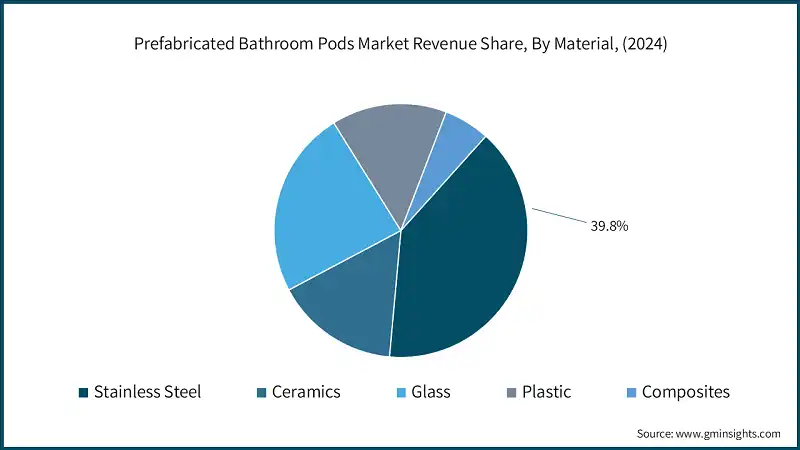
Based on material, the prefabricated bathroom pods market is segmented into stainless steel, ceramics, glass, plastic and composites. The stainless-steel segment accounted for a market share of around 39.3% in 2024 and is projected to grow at CAGR of 6.7% through 2034.
- In the manufacture of these prefabricated baths, stainless steel has emerged as a go-to material thanks to its excellent resistance to rust, its easy-clean hygiene, and its sleek, contemporary appearance.
- Engineers deploy the alloy in both visible elements-sinks, grab bars, and shower panels-and hidden frame members, allowing every part of the pod to withstand humid abuse over decades. That capability matches the demands of commercial and institutional clients-hospitals, hotels, and schools-for fixtures that endure heavy use yet remain spotless and serviceable for the long haul.
- The solid, non-porous layer of stainless steel actively deters bacteria, which is why hospitals, restaurants, and similar facilities routinely adopt it to meet strict hygiene rules. The International Stainless-Steel Forum (ISSF) reports that producers made roughly 58 million metric tons of the alloy in 2022, a clear sign that industries-from kitchen equipment to prefabricated buildings-are turning to it in ever-larger volumes.
Based on distribution channel, the prefabricated bathroom pods market is segmented into direct and indirect. The direct segment accounted for a market share of around 61.3% in 2024.
- The direct distribution channel remains the clear leader in the prefabricated bathroom pod sector, especially for major construction and infrastructure ventures. Developers and contractors typically choose to deal straight with makers so they can secure custom designs, meet strict code requirements, and receive seamless after-sales help. Such a setup permits tighter coordination during design, manufacturing, and installation-critical stages for time-sensitive projects like hospitals, hotels, and large apartment blocks.
- Moreover, direct contact enables producers to deliver a complete package that covers transport, on-site assembly support, and ongoing customization, reinforcing the appeal of channels across the industry.
Looking for region specific data?
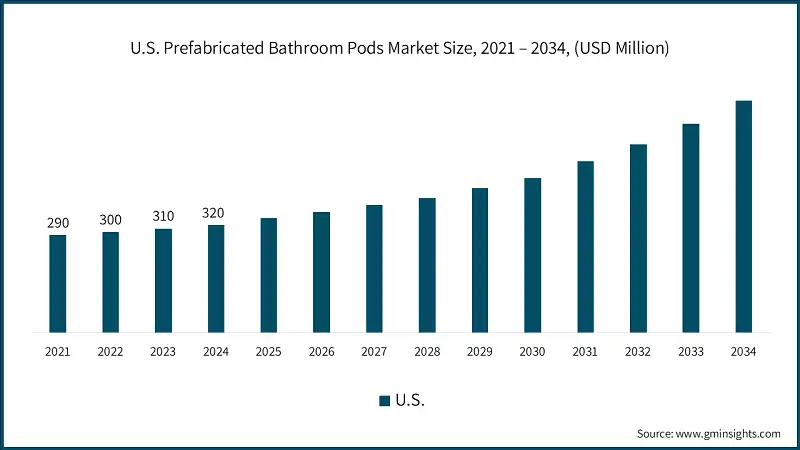
U.S. prefabricated bathroom pods market was valued at USD 320 million in 2024 and is projected to grow at CAGR of 8.3% from 2025 to 2034.
- Demand for prefabricated bathroom pods in the United States is accelerating, spurred by fast-growing cities, labor shortages, and a concerted push for building methods that save both time and money. Hospitality projects, multifamily residences, and healthcare facilities are leading adopters, quickening the overall market pace. As the domestic construction sector embraces modular and off-site build models, developers increasingly look to bathroom pods when planning large developments.
- In Canada and Mexico, the pod market remains young yet steadily expands. Canadian builders install pods in senior-living complexes and student residences, taking advantage of brief construction seasons and the speed prefabrication provides. In Mexico, emerging off-site methods promise quicker, lower-cost homes, and bathroom pods appeal because they cut waste and shorten site work.
Germany prefabricated bathroom pods market was valued at USD 100 million in 2024 and is projected to grow at CAGR of 9% from 2025 to 2034.
- Strict energy rules and high construction codes push developers to seek factory-produced pods that guarantee quality and efficiency. Demand is further fueled by new healthcare facilities, refurbishment projects, and standardized hotel brands that require uniform, quick-install solutions.
- In Europe, UK, France, and several Nordic nations rank as leading adopters. The UK takes the largest share of volume, with bathroom pods appearing in student halls and high-rise residential towers. Meanwhile, French and Scandinavian projects prioritize energy savings and compact living, arenas in which off-site pods excel.
In 2024, China holds 34.4% share of the prefabricated bathroom pods market across the Asia Pacific region, which is projected to grow at a CAGR of 8.1% till 2034.
- China is seeing a strong jump in demand for off-site bathroom pods, pushed by rapid city building, higher labor bills, and government support for modular methods. The drive for tall apartment blocks and big new hospitals-especially after recent health crises-has spread pod use across almost every major project.
- Nations such as Japan, South Korea, India, and Australia are becoming fresh markets for prefab bath units. In Japan and South Korea, the pods fit neatly into space-starved urban flats, while India and Southeast Asia test them in hotels and roads.
The Saudi Arabia quick change tooling system market is projected to grow at a CAGR of 8.4% through 2034.
- In Saudi Arabia, activity is booming, following the Vision 2030 roadmap and headline projects such as NEOM and a string of smart cities. Builders now seek fast, quality pods for hotels, worker camps, and government work. Harsh desert weather adds to the push and factory-made modules simply stand up better and last longer on the ground.
- Beyond Saudi borders, Gulf, luxury hotels and new hospitals pull volume, while broader infrastructure and low-cost housing schemes drive orders across Africa.
Prefabricated Bathroom Pods Market Share
The prefabricated bathroom pods industry is moderately fragmented, with prominent players, such as Walker Modular, Offsite Solutions, Bathsystem, Oldcastle SurePods, and Interpod led the market holding a market share of 20%-25% in 2024.
- Walker Modular: Walker Modular runs large-volume assembly lines, supplying UK and European hotels, student blocks, and health facilities. By keeping everything in-house from welding to delivery, it keeps costs tight and scales easily.
- Offsite Solutions: Its lean, modular setup allows fast and short lead times. Steady contracts and public-sector ties give the firm a broad influence on housing and healthcare
- Bathsystem: Digital tools streamline manufacturing and logistics, and multilingual teams support cross-border builds, making Bathsystem a sought-after global ally.
- SurePods: The unit delivers premium steel-framed units with upscale fittings, full U.S. code sign-off, and practical value-engineering advice.
- Interpod: It manufactures sharp, ready-to-use bathroom pods made from light-gauge steel and water-resistant boards.
Prefabricated Bathroom Pods Market Companies
Major players operating in the prefabricated bathroom pods industry are:
- B&T Manufacturing
- Bathsystem
- Buildom Prefab Systems
- Elements Europe
- Hellweg Badsysteme
- Hydrodiseno
- Interpod
- Modulart
- Offsite Solutions
- Oldcastle SurePods
- Pivotek
- StercheleGroup
- SurePods
- Taplanes
- Walker Modular
Manufacturers in the prefabricated bathroom pods industry compete primarily on product customization, turnaround time, installation efficiency, material durability, and compliance with regional building codes. Innovations in lightweight, corrosion-resistant materials and integration of smart bathroom technologies are also gaining importance.
Prefabricated Bathroom Pods Market Report Attributes
| Key Takeaway | Details |
|---|---|
| Market Size & Growth | |
| Base Year | 2024 |
| Market Size in 2024 | USD 2.3 Billion |
| Forecast Period 2025 – 2034 CAGR | 7.8% |
| Market Size in 2034 | USD 4.7 Billion |
| Key Market Trends | |
| Growth Drivers |
|
| Pitfalls & Challenges |
|
What are the growth opportunities in this market?
Prefabricated Bathroom Pods Industry News
- In May 2024, Offsite Solutions announced a 50% increase in production capacity at its Highbridge facility, which produces upto 15,000 pods annually.
- In January 2023, Elements Europe introduced a new bathroom pod designed specifically for healthcare environments, which included antimicrobial coatings and hygienic surfaces specific to hospital and care facility standards.
- In September 2023, Offsite Solutions secured a USD 2.4Million contract to supply 761 GRP shower pods for Greystar’s 20-storey student housing development at Wembley Park.
The prefabricated bathroom pods market research report includes in-depth coverage of the industry, with estimates & forecasts in terms of revenue (USD Billion) and Volume (Thousand Units) from 2021 to 2034, for the following segments:
Market, By Type
- Steel frame bathroom pods
- Concrete bathroom pods
- GRP (glass reinforced plastic) bathroom pods
- Hybrid bathroom pods
Market, By Material
- Stainless steel
- Ceramics
- Glass
- Plastic
- Composites
Market, By Application
- New construction
- Renovation/retrofit
Market, By End use
- Residential
- Commercial
- Industrial
Market, By Distribution channel
- Direct
- Indirect
The above information is provided for the following regions and countries:
- North America
- U.S.
- Canada
- Europe
- UK
- Germany
- France
- Italy
- Spain
- Asia Pacific
- China
- Japan
- India
- South Korea
- Australia
- Latin America
- Brazil
- Mexico
- MEA
- Saudi Arabia
- UAE
- South Africa
Frequently Asked Question(FAQ) :
How big is the prefabricated bathroom pods market?
The prefabricated bathroom pods market was valued at USD 2.3 billion in 2024 and is expected to reach around USD 4.7 billion by 2034, growing at 7.8% CAGR through 2034.
What will be the size of Steel frame bathroom pods segment in the prefabricated bathroom pods industry?
The Steel frame bathroom pods segment is anticipated to cross USD 1.6 billion by 2034.
How much is the U.S. prefabricated bathroom pods market worth in 2024?
The U.S. prefabricated bathroom pods market was worth over USD 320 million in 2024.
Who are the key players in prefabricated bathroom pods market?
Some of the major players in the prefabricated bathroom pods industry include B&T Manufacturing, Bathsystem, Buildom Prefab Systems, Elements Europe, Hellweg Badsysteme, Hydrodiseno, Interpod, Modulart, Offsite Solutions.
Prefabricated Bathroom Pods Market Scope
Related Reports