Summary
Table of Content

Predictive Maintenance for Vehicles Market
Get a free sample of this report
Form submitted successfully!
Error submitting form. Please try again.
Thank you!
Your inquiry has been received. Our team will reach out to you with the required details via email. To ensure that you don't miss their response, kindly remember to check your spam folder as well!
Request Sectional Data
Thank you!
Your inquiry has been received. Our team will reach out to you with the required details via email. To ensure that you don't miss their response, kindly remember to check your spam folder as well!
Form submitted successfully!
Error submitting form. Please try again.
Predictive Maintenance for Vehicles Market Size
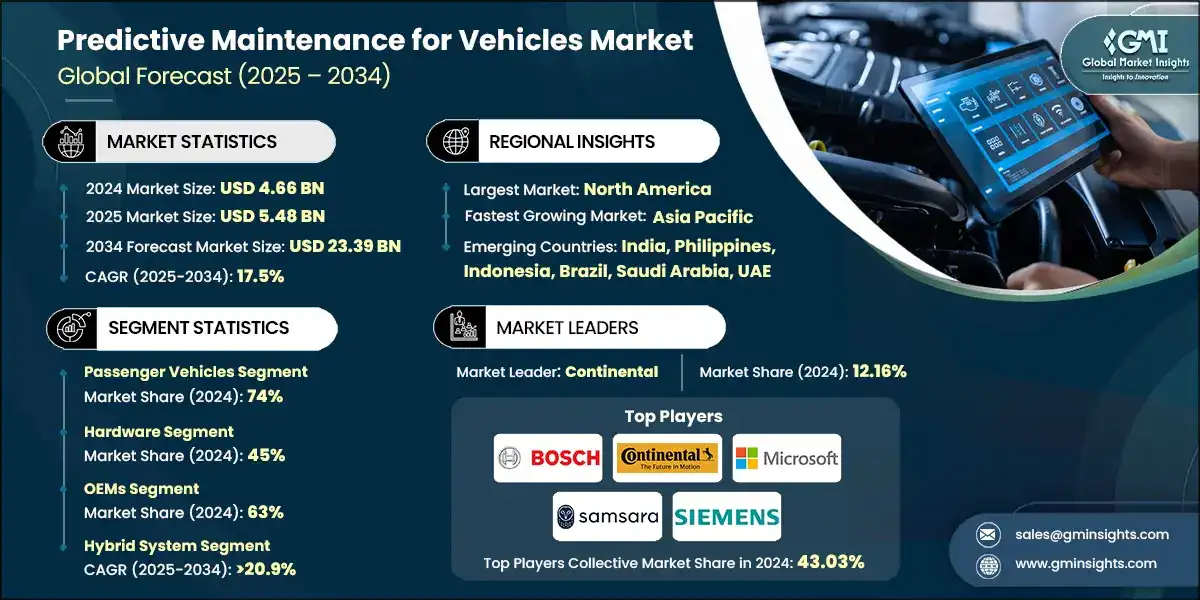
The global predictive maintenance for vehicles market size was estimated at USD 4.66 billion in 2024. The market is expected to grow from USD 5.48 billion in 2025 to USD 23.39 billion in 2034, at a CAGR of 17.5%, according to latest report published by Global Market Insights Inc.
Predictive Maintenance for Vehicles Market Key Takeaways
Market Size & Growth
- 2024 Market Size: USD 4.66 Billion
- 2025 Market Size: USD 5.48 Billion
- 2034 Forecast Market Size: USD 23.39 Billion
- CAGR (2025–2034): 17.5%
Regional Dominance
- Largest Market: North America
- Fastest Growing Region: Asia Pacific
Key Market Drivers
- Increasing Vehicle Complexity & Sensorization.
- Regulatory Pressure for Safety & Emissions Compliance.
- Rising Maintenance & Repair Costs.
- Expansion of Telematics & 5G Connectivity.
Challenges
- High Integration Costs & Legacy Fleet Limitations.
- Restricted Access to OEM Diagnostic Data.
Opportunity
- Predictive Maintenance for EV Batteries.
- Fleet-Centric AI Diagnostic Platforms.
- Digital Twin Modeling for Vehicle Components.
Key Players
- Leading Players: Top 5 players in this market include Bosch, Continental, Microsoft, Samsara, Siemens, which collectively held a market share of 43.03% in 2024.
Get Market Insights & Growth Opportunities
The rapid digitalization of the global automotive and fleet ecosystem is creating a transformative shift in how vehicles are monitored, serviced, and maintained. Predictive maintenance for vehicles powered by telematics, onboard diagnostics, IoT sensors, AI/ML analytics, and cloud platforms are emerging as a core pillar of modern mobility systems. Technology enables real-time health assessment, early fault detection, and remaining-useful-life (RUL) prediction for components such as engines, batteries, braking systems, tires, and power electronics. As vehicles become increasingly software-defined, data-driven maintenance models are replacing traditional reactive and scheduled service across commercial fleets, passenger vehicles, and EVs.
In October 2025, Intelematics introduced its FailSafe AI-driven battery predictive maintenance tool on the Geotab Marketplace in Australia and New Zealand. This solution helps fleet operators detect early battery degradation, identify potential failures before they occur, and reduce downtime by enabling proactive maintenance and improved vehicle reliability.
Strategic investments and ecosystem partnerships between telematics providers, cloud platforms, OEMs, Tier-1 component suppliers, and AI/ML analytics companies are accelerating the deployment of predictive maintenance solutions. Companies such as IBM, Geotab, Microsoft, PTC, Bosch, Continental, and ZF are building advanced vehicle-health monitoring systems that integrate real-time sensor data, high-resolution diagnostics, and cloud-native analytics models. These collaborations are optimizing data integration, reliability of predictions, cybersecurity, and cost efficiency especially for software-defined vehicles and EV platforms.
For instance, in July 2025, Penske Truck Leasing is leveraging its proprietary Catalyst AI and Fleet Insight platform to analyze telematics data (300 million points daily) and predict maintenance issues before failures occur. This proactive approach helps prevent costly breakdowns, reduce downtime, and optimize servicing for its 433,000-truck leased fleet.
The COVID-19 pandemic acted as a catalyst, pushing OEMs and fleet operators to accelerate remote diagnostics, over-the-air (OTA) updates, contactless servicing, and digital fleet-health solutions. As supply chains have tightened, the need to extend vehicle lifespan and avoid unplanned downtime boosted demand for predictive maintenance technologies across commercial fleets and public transportation.
North America and Europe currently lead market adoption due to the presence of major telematics companies, strong fleet-management ecosystems, advanced regulatory requirements, and high penetration of connected vehicles. Commercial fleets, particularly in logistics, e-commerce, and passenger transport are the primary adopters. OEMs such as GM, Ford, Mercedes-Benz, BMW, and Tesla are also expanding factory-integrated predictive maintenance capabilities through connected-vehicle platforms and OTA-enabled diagnostics.
Asia-Pacific is the fastest-growing region, propelled by large-scale vehicle production, adoption of connected-car platforms in China and South Korea, rapid expansion of EV fleets, and strong investments from companies like BYD, Toyota, NIO, and Hyundai. Regional telematics and AI companies are scaling predictive maintenance technologies into mass-market vehicles, two-wheelers, and electric buses. The region’s strength in sensor manufacturing, automotive electronics, and embedded software is positioning Asia-Pacific as a global hub for predictive vehicle-health technologies.
To get key market trends
Predictive Maintenance for Vehicles Market Trends
Predictive maintenance is replacing traditional reactive and scheduled servicing as fleets prioritize uptime, asset longevity, and safety. AI models analyze telematics, fault codes, vibration patterns, temperature data, and historical repair logs to predict failures before they occur. This shift improves operational efficiency, reduces emergency repairs, and enables fleets to plan maintenance around peak utilization, driving strong adoption worldwide.
For example, in February 2025, Geotab launched Work Order Management and Fault Code Enrichment in its Maintenance Center to help fleets predict vehicle issues more accurately. The enriched fault-code data (powered by Noregon) provides severity ratings and recommended actions, enabling a shift from reactive to predictive maintenance.
Automakers are embedding predictive diagnostics directly into factory-installed connected car systems. OEMs now monitor component health, battery performance, thermal loads, and fault risks in real time. This creates a service ecosystem around warranty optimization, post-sales revenue, and enhanced customer experience. OEM-level integration significantly accelerates market penetration because the technology becomes standard in every new vehicle.
Cloud analytics allows real-time vehicle health monitoring without requiring physical inspections. Fleets and automakers use remote diagnostics to detect anomalies, manage software updates, and schedule repairs based on real-time conditions. Cloud-backed platforms simplify multi-location fleet maintenance and allow centralized decision-making. As 5G expands, cloud-based predictive maintenance becomes faster, more accurate, and more cost-effective.
EV batteries, inverters, motors, and thermal systems require predictive tools to maintain performance and safety. Battery degradation modeling, charging pattern analysis, and thermal load forecasting are becoming essential. As EV adoption surges, high-risk components demand continuous monitoring to avoid expensive failures. This trend is accelerating the development of specialized EV-focused predictive platforms and analytics tools.
Predictive Maintenance for Vehicles Market Analysis
Learn more about the key segments shaping this market
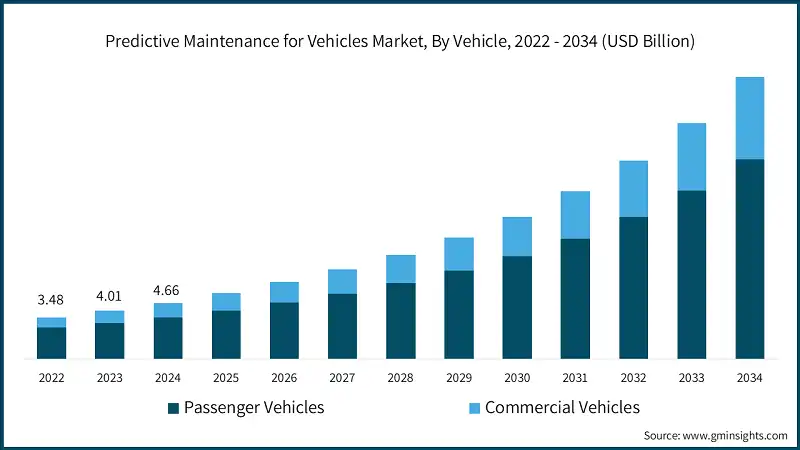
Based on vehicle, the predictive maintenance for vehicles market is divided into passenger vehicles, and commercial vehicles. The passenger vehicles segment dominated the market, accounting for around 74% in 2024 and is expected to grow at a CAGR of more than 17% through 2034.
- The passenger vehicle segment dominates the predictive maintenance for vehicles market due to its massive global fleet size, rapid adoption of connected-car technologies, and rising consumer demand for safety, reliability, and lower maintenance costs. Modern passenger cars are increasingly equipped with telematics control units, onboard sensors, and AI-enabled diagnostic systems that continuously monitor engine health, battery performance, brake conditions, and overall vehicle status. This widespread integration of smart technologies accelerates the use of predictive maintenance solutions.
- Additionally, automakers are prioritizing predictive maintenance as part of their after-sales strategy to enhance customer experience and reduce warranty costs. Growing adoption of electric and hybrid passenger vehicles has further boosted demand, as EVs require continuous monitoring for battery management and system optimization. Fleet-based mobility services, ride-hailing, leasing, and subscription models also push passenger vehicle owners and operators to rely heavily on predictive maintenance tools to avoid downtime and extend vehicle life.
- For example, in September 2023, BMW launched Proactive Care, an AI-powered service that monitors vehicle health via the My BMW app and onboard systems. It predicts maintenance needs such as brake wear, tire issues, and engine faults allowing preemptive diagnostics and service scheduling to avoid breakdowns.
- The commercial vehicle segment in the predictive maintenance for vehicles market is expected to grow at a CAGR of over 19% due to the rising demand for fleet efficiency, cost optimization, and reduced unplanned downtime across logistics, freight, and public transportation sectors. Large-scale fleet operators are increasingly deploying telematics, AI-driven diagnostics, and predictive analytics to monitor engine health, tire conditions, braking systems, and battery performance, enabling proactive maintenance planning and reducing operational interruptions.
Learn more about the key segments shaping this market
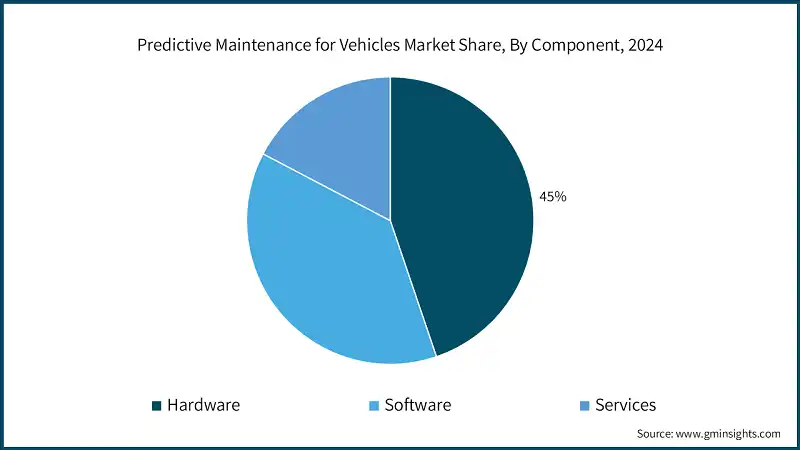
Based on component, the predictive maintenance for vehicles market is segmented into hardware, software, and services. The hardware segment dominates the market accounting for around 45% share in 2024, and the segment is expected to grow at a CAGR of over 16.8% from 2025 to 2034.
- The hardware segment holds the largest market share in the predictive maintenance for vehicles market due to the critical role of sensors, telematics devices, OBD-II gateways, and IoT-enabled modules in enabling predictive analytics. Hardware components collect real-time data on engine performance, vibration, temperature, braking systems, and battery health, forming the foundation for AI and machine learning models to forecast failures accurately. The demand for reliable and robust hardware is particularly high in both passenger and commercial vehicles, as fleet operators and OEMs require continuous monitoring to avoid unplanned downtime and optimize maintenance schedules.
- Additionally, the growth of connected and electric vehicles is fueling hardware adoption. Advanced sensors, edge computing modules, and in-vehicle gateways are increasingly integrated into modern vehicles to support real-time fault detection and predictive diagnostics. Manufacturers such as Bosch, Continental, NXP, and Infineon are leading in producing high-precision hardware devices, which are indispensable for predictive maintenance solutions, solidifying the hardware segment’s dominant market position.
- In June 2024, Continental partnered with Samsara to share in tire sensor data (tire pressure and mileage) via Samsara’s telematics platform, giving fleets richer, hardware-driven insights for predictive maintenance.
- The service segment in the predictive maintenance for vehicles market is expected to grow with a CAGR of more than 19.1% due to the increasing demand for professional monitoring, analytics, and maintenance support by fleets and individual vehicle owners. Predictive maintenance services encompass AI-driven diagnostics, telematics data analysis, condition monitoring, software updates, and remote alerts, enabling proactive scheduling of repairs and minimizing unplanned downtime. Companies providing these services help fleets optimize operational efficiency, extend vehicle life, and reduce overall maintenance costs.
Based on end use, the predictive maintenance for vehicles market is segmented into OEMs and Aftermarket. In 2024, OEMs segment dominated the market with around 63% share due to its widespread availability, compatibility with most EVs, cost-effectiveness, and ability to significantly reduce charging times compared to standard chargers.
- The OEMs segment dominates the predictive maintenance for vehicles market with due to the integration of predictive maintenance technologies directly into new vehicles during manufacturing. OEMs embed sensors, telematics modules, and AI/ML-driven diagnostic systems into passenger and commercial vehicles, enabling real-time monitoring of engine health, battery performance, braking systems, and other critical components. This factory-installed approach ensures consistent data quality, reliability, and seamless integration with onboard vehicle systems, giving OEMs a competitive advantage in enhancing customer satisfaction and reducing warranty claims.
- Additionally, automotive manufacturers leverage predictive maintenance as part of their connected vehicle and aftersales service strategies. Leading OEMs such as BMW, Mercedes-Benz, Tesla, Hyundai, and Volkswagen provide proprietary telematics and cloud-based services to monitor vehicle health, forecast failures, and schedule preemptive maintenance, reinforcing the dominance of the OEM segment in this market.
- The Aftermarket segment is expected to expand at a CAGR of more than 18.9% due to the growing demand for retrofitting predictive maintenance solutions in existing passenger and commercial vehicles. Fleet operators, logistics companies, and individual vehicle owners are increasingly adopting telematics devices, sensors, and cloud-based analytics platforms to monitor engine performance, battery health, braking systems, and other critical components. This enables proactive maintenance planning, reduces unplanned downtime, and optimizes operational costs without requiring new vehicle purchases.
Based on deployment mode, the predictive maintenance for vehicles market is divided into on-premise, cloud-based, and hybrid. The on-premise segment dominated the market.
- The on-premise segment holds the largest market share in the predictive maintenance for vehicles market due to its reliability, data security, and control advantages. Fleet operators, OEMs, and large enterprises often prefer on-premise solutions to manage sensitive vehicle and operational data locally, avoiding potential cloud-related cybersecurity risks. On-premise systems allow real-time processing of telematics, sensor, and engine data without relying on continuous internet connectivity, making them ideal for commercial fleets, logistics, and critical transportation services.
- Additionally, on-premise deployments offer greater customization and integration with existing enterprise IT infrastructure, enabling advanced predictive analytics, condition monitoring, and AI-driven failure forecasting. Companies like PTC, IBM, Siemens, and GE Digital provide robust on-premise predictive maintenance platforms that support fault detection, remote diagnostics, and predictive scheduling, solidifying this segment’s dominant market position.
- The hybrid system segment is expected to expand at a CAGR of more than 20.9% due to the growing need for flexible predictive maintenance solutions that combine the advantages of both cloud-based and on-premise deployments. Hybrid systems allow fleets, OEMs, and service providers to process critical vehicle data locally for real-time fault detection while leveraging cloud computing for advanced analytics, AI-driven insights, and centralized monitoring across multiple locations. This flexibility is particularly beneficial for large commercial fleets and automotive OEMs operating in regions with variable network connectivity.
Looking for region specific data?
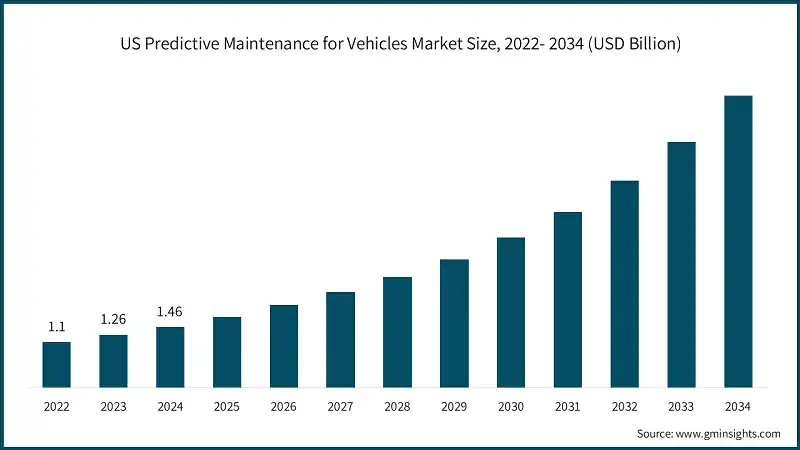
US dominated the predictive maintenance for vehicles market in North America with around 86% share and generated USD 1.46 billion in revenue in 2024.
- The United States dominates the market because it has the world’s most advanced ecosystem for connected fleets, telematics adoption, and AI-driven vehicle analytics. U.S. commercial fleets trucking, logistics, last-mile delivery, rental, and ride-hailing widely rely on telematics platforms from companies like Geotab, Samsara, Verizon Connect, and Trimble. These companies invest heavily in cloud analytics, real-time diagnostics, and AI-powered maintenance systems, making predictive maintenance a core operational tool across the transportation sector.
- In addition, the U.S. has strong OEM integration capabilities, high EV adoption in commercial vehicles, and strict regulatory frameworks for fleet safety, vehicle uptime, and emissions compliance. Major technology players IBM, Microsoft, GE Digital, and Oracle provide sophisticated cloud and AI infrastructure that accelerates predictive maintenance innovation. This combination of advanced technology, regulatory pressure, and large commercial fleet density keeps the U.S. at the forefront of global market leadership.
- In June 2025, Samsara launched new AI-powered maintenance tools during its BEYOND 2025 event, enabling fleets to automatically generate work orders and predict repairs using real-time vehicle data.
- In North America, Canada’s predictive maintenance market is gaining momentum because of its rapid deployment of telematics across commercial and government fleets. Canadian fleet operators are increasingly adopting advanced telematics systems to track vehicle performance, optimize routes, and reduce downtime. According to Mobility Foresights, Canada’s telematics market is projected to grow strongly through 2031 as fleets increasingly rely on AI-powered analytics for predictive diagnostics.
The predictive maintenance for vehicles market in Germany is expected to experience significant and promising growth from 2025 to 2034.
- Europe accounts for over 25% of the market in 2024 and is expected to grow at a CAGR of around 16% during analysis timeframe due to strict vehicle safety regulations, rapid connected-car adoption, strong OEM digitalization, and expanding EV fleets requiring advanced diagnostics.
- Germany dominates the Predictive maintenance for vehicles market due to its strong automotive manufacturing base, extensive R&D activity, and early adoption of Industry 4.0 technologies. Leading OEMs such as BMW, Mercedes-Benz, Volkswagen, and Audi are integrating predictive diagnostics into connected vehicle platforms to enhance reliability, reduce warranty costs, and strengthen after-sales services. This technology-first approach accelerates deployment across passenger and commercial fleets.
- Additionally, Germany’s advanced EV ecosystem, stringent safety regulations, and thriving telematics and software engineering capabilities drive rapid adoption of predictive maintenance solutions. The country’s logistics and fleet operators increasingly rely on AI-driven health monitoring to improve uptime and reduce operational costs. Government initiatives supporting digital mobility and smart manufacturing further reinforce Germany’s leadership in this market.
- In September 2025, ZF announced a new Vehicle Health Monitoring service that continuously evaluates driving data to forecast maintenance needs. The system monitors critical subsystems like chassis and drivetrain and provides recommendations to avoid vehicle breakdowns.
- The U.K. market is expanding steadily due to the country’s rapid adoption of connected-vehicle technologies, especially across commercial fleets. Fleet operators in logistics, public transportation, and leasing services are increasingly deploying telematics, AI-based diagnostics, and real-time monitoring tools to reduce vehicle downtime, control maintenance costs, and extend asset life. This creates strong, recurring demand for predictive maintenance platforms.
The predictive maintenance for vehicles market in China is expected to experience significant and promising growth from 2025-2034.
- Asia Pacific accounts for over 30% of the market in 2024 and is expected to grow at a CAGR of around 19.5% during analysis timeframe owing to strong EV production, rapid telematics adoption, large commercial fleets, and government-led intelligent mobility programs. OEMs in China, Japan, and South Korea increasingly integrate built-in predictive diagnostics, accelerating mass-market deployment.
- China leads the Predictive maintenance for vehicles market because of its massive, connected vehicle ecosystem, strong telematics penetration, and rapid electrification across both passenger cars and commercial fleets. The government mandates data-sharing through platforms like the National Monitoring and Management Center for New Energy Vehicles, giving OEMs and fleet operators access to large-scale real-time vehicle health data ideal for AI-driven predictive diagnostics. Major OEMs such as BYD, NIO, SAIC, and Geely integrate predictive systems directly into factory-built connected platforms.
. - Additionally, China’s logistics sector operates one of the world’s largest commercial fleets, increasing the need for uptime optimization and predictive maintenance tools. Local tech giants including Huawei, Baidu, and Alibaba Cloud provide AI, cloud, and edge-computing infrastructure that accelerates adoption. Strong government support for smart mobility, low-cost sensor manufacturing, and rapid EV production make China the global leader in deploying predictive maintenance solutions at scale.
- For instance, in April 2024, Stellantis has revealed its new “STLA Frame” electric-vehicle platform incorporating an 800 V architecture, enabling pure EV models with up to 500 miles of battery-only range and support for ultra-fast charging at up to 350 kW). The system is designed for large trucks and SUVs, offering flexibility to also use gas extenders or hydrogen in future variants.
- India’s predictive maintenance for vehicles market is expanding steadily due to the rapid adoption of telematics in commercial fleets, increasing digitalization in logistics, and rising fuel and maintenance cost pressures. Fleet operators are shifting from reactive servicing to predictive analytics to reduce breakdowns, improve asset utilization, and meet tight delivery timelines in e-commerce, long-haul transport, and last-mile mobility. The strong uptake of AIS-140–compliant telematics devices has created a large flow of real-time vehicle data essential for predictive modeling.
The predictive maintenance for vehicles market in Brazil is expected to experience significant and promising growth from 2025 to 2034.
- Latin America holds around 5% of the market and is growing steadily at a CAGR of around 15.6% during analysis timeframe driven by expanding commercial fleet telematics adoption, rising logistics digitalization, government mandates for vehicle tracking, and increasing demand for cost-efficient maintenance to reduce breakdown-related losses.
- Brazil leads the Latin American predictive maintenance for vehicles market due to its large and highly active commercial fleet base, strong adoption of telematics, and rapid digital transformation across logistics, mining, public transport, and agriculture. The country has over 3.5 million connected fleet vehicles, driven by federal regulations for tracking, safety, and compliance. This widespread connectivity generates continuous real-time vehicle data ideal for AI-driven predictive diagnostics. Major fleet operators and transport companies increasingly use predictive tools to reduce downtime, optimize fuel use, and maintain delivery efficiency across vast interstate routes.
- Additionally, Brazil hosts several key automotive manufacturing plants (Volkswagen, Stellantis, Mercedes-Benz, Scania), which actively integrate connected vehicle technologies and predictive maintenance into production and aftersales services. Strong investments from local telematics leaders like Sascar, Cobli, and Omnilink, combined with government support for digital fleet management and rising EV adoption in major cities, further reinforce Brazil’s leading position in the region.
- For example, in July 2023, The International Finance Corporation (IFC) has announced an USD 8 million investment in Brazilian telematics firm Cobli, supporting its AI-powered fleet platform to improve vehicle maintenance, reduce breakdowns, enhance road safety, and optimize logistics efficiency across Brazil.
- Mexico’s Predictive maintenance for vehicles market is expanding rapidly due to the strong growth of commercial fleets serving manufacturing, cross-border logistics, and e-commerce distribution. As Mexico strengthens its position as a nearshoring and automotive production hub, fleet uptime, cost efficiency, and regulatory compliance have become critical. Telematics penetration driven by logistics companies, long-haul trucking operators, and cross-border transporters provides continuous vehicle health data that fuels predictive analytics and remote diagnostics. Rising fuel costs and high maintenance-related downtime are pushing transport operators toward AI-based predictive solutions.
The predictive maintenance for vehicles market in UAE is expected to experience significant and promising growth from 2025-2034.
- MEA holds around 4% of the market and is growing steadily at a CAGR of around 13.8% due to expanding commercial fleets, rising telematics adoption, logistics digitalization, government mandates for vehicle tracking, and increased demand for maintenance optimization across mining, oil & gas, and long-haul transport sectors.
- The UAE leads the MEA predictive maintenance for vehicles market due to its advanced connected-mobility infrastructure, high telematics penetration, and rapid digitalization of transportation and logistics. The country has aggressively adopted AI-driven fleet solutions across commercial transport, public mobility, taxis, and last-mile delivery services. Government initiatives such as Smart Dubai, RTA’s Smart Mobility Strategy, and mandatory tracking for commercial fleets generate large volumes of real-time vehicle data, enabling widespread adoption of predictive diagnostics. Fleet operators rely increasingly on analytics to avoid breakdowns, improve asset utilization, and maintain service efficiency.
- Additionally, the UAE hosts regional headquarters for major telematics and IoT providers, including Geotab, Siemens, Huawei, and Trimble, which accelerates technology adoption. Strong investment in EVs, autonomous vehicle pilots, and smart-city platforms further enhances the demand for predictive maintenance tools. Large logistics, oil & gas, and industrial fleets rely on predictive analytics to reduce downtime and operating costs, solidifying the UAE as the MEA leader in this market.
- Saudi Arabia is set to record the fastest growth in the MEA Predictive maintenance for vehicles market driven by national digital-transformation initiatives, rapid fleet modernization, and large-scale investments in smart mobility under Vision 2030. The expansion of logistics, freight movement, and industrial transportation, especially across oil & gas, mining, and construction creates substantial demand for predictive analytics to reduce downtime and improve asset health.
Predictive Maintenance for Vehicles Market Share
- The top 7 companies in the predictive maintenance for vehicles industry are Continental, Siemens, Bosch, Samsara, Microsoft, IBM, and Geotab, contributed around 51.8% of the market in 2024.
- Continental focuses on IoT-enabled sensor systems, tire pressure monitoring, and telematics solutions. They integrate AI-driven analytics with fleet management platforms, enabling predictive maintenance for passenger and commercial vehicles. Partnerships with fleet operators and software providers enhance real-time data collection, fault detection, and maintenance optimization, emphasizing reliability and operational efficiency across global markets.
- Siemens leverages its industrial and automotive expertise to provide AI and digital twin-based predictive maintenance solutions. Their Senseye platform and cloud analytics monitor vehicle components, enabling early fault detection and performance optimization. Siemens focuses on OEM partnerships and integration with connected vehicle systems to deliver end-to-end maintenance insights for fleets and commercial applications.
- Bosch combines sensor technology, telematics, and AI analytics for predictive maintenance. Their Connected Vehicle Solutions track engine health, battery performance, and braking systems, offering both OEM-integrated and aftermarket solutions. Bosch prioritizes digital services, cloud-enabled analytics, and collaborations with OEMs and fleets to improve vehicle uptime and reduce maintenance costs.
- Samsara focuses on telematics, IoT devices, and cloud-based predictive analytics for fleet management. Their platform collects vehicle and driver data in real time to forecast maintenance needs, optimize routes, and reduce downtime. The company emphasizes ease of deployment, scalable subscription services, and integration with commercial vehicle fleets to maximize operational efficiency.
- Microsoft offers Azure-based connected vehicle and IoT solutions for predictive maintenance. Their AI and machine learning models analyze sensor and telematics data in real time to forecast component failures. Microsoft collaborates with OEMs and fleet operators, integrating Azure IoT, Azure Machine Learning, and cloud analytics to provide scalable, secure, and enterprise-grade predictive maintenance solutions.
- IBM leverages Watson IoT and Maximo Application Suite to provide AI-driven predictive maintenance. Their solutions integrate sensor data, telematics, and historical performance logs to forecast failures, optimize maintenance schedules, and reduce downtime. IBM targets both OEMs and fleets, emphasizing edge computing, cloud analytics, and comprehensive asset management for passenger, commercial, and industrial vehicles.
- Geotab delivers cloud-connected telematics and AI-driven predictive maintenance for fleets. Their platform collects engine, battery, and operational data to forecast maintenance needs and optimize vehicle uptime. Geotab emphasizes scalable subscription services, data-driven insights, and integration with third-party analytics providers, enabling fleet operators to proactively manage costs and improve reliability.
Predictive Maintenance for Vehicles Market Companies
Major players operating in the predictive maintenance for vehicles industry are:
- Bosch
- Continental
- GE
- Geotab
- IBM
- Microsoft
- PTC
- Samsara
- Siemens
- Timble
- Manufacturers and technology providers in the predictive maintenance for vehicles market are increasingly focusing on AI-powered diagnostics, IoT-enabled sensors, edge computing modules, and telematics platforms. These innovations enable real-time monitoring of engine health, battery performance, brake systems, and vehicle components, allowing predictive failure detection, optimized maintenance scheduling, reduced downtime, and lower operational costs across passenger and commercial vehicles.
- Collaborations between automotive OEMs, fleet operators, and technology providers are reshaping the market landscape. Partnerships aim to integrate predictive maintenance platforms directly into connected vehicle ecosystems, fleet management software, and cloud-based analytics. These joint efforts enhance data accuracy, streamline maintenance workflows, enable scalable fleet monitoring, and drive adoption across passenger vehicles, commercial trucks, and electric vehicles worldwide.
Predictive Maintenance for Vehicles Market Report Attributes
| Key Takeaway | Details |
|---|---|
| Market Size & Growth | |
| Base Year | 2024 |
| Market Size in 2024 | USD 4.66 Billion |
| Market Size in 2025 | USD 5.48 Billion |
| Forecast Period 2025 - 2034 CAGR | 17.5% |
| Market Size in 2034 | USD 23.39 Billion |
| Key Market Trends | |
| Drivers | Impact |
| Increasing Vehicle Complexity & Sensorization | Advanced vehicles now generate vast amounts of data from sensors monitoring engine load, brake wear, temperature, vibration, pressure, and battery health. This sensor ecosystem enables highly accurate failure predictions. As vehicles become more electronic and software-defined, predictive maintenance becomes essential to manage component complexity and prevent failures that traditional inspection schedules can no longer anticipate. |
| Regulatory Pressure for Safety & Emissions Compliance | Governments worldwide are enforcing stricter safety, emissions, and vehicle uptime regulations. Fleets must now ensure well-maintained, emissions-compliant, and road-safe vehicles. Predictive maintenance helps them avoid breakdowns, emissions faults, and regulatory penalties. Compliance-driven maintenance automation is pushing transport companies, municipal fleets, and commercial operators to adopt AI-based health monitoring systems at a record pace. |
| Rising Maintenance & Repair Costs | Unplanned breakdowns are among the costliest expenses for fleet operators, involving towing, emergency repairs, and operational delays. As repair labor and parts prices rise globally, predictive maintenance becomes a financial strategy to contain costs. AI-driven models help identify early component stress signals, enabling planned repairs at lower cost and reducing total cost of ownership for commercial vehicle fleets. |
| Expansion of Telematics & 5G Connectivity | Widespread adoption of telematics devices and the rollout of 5G networks enable high-frequency data transfer from vehicles to cloud analytics systems. Faster, richer, real-time data improves diagnostic accuracy and enhances predictive models. Connectivity improvements are particularly critical for EVs and advanced driver-assistance systems (ADAS), making predictive maintenance an essential layer in the connected-vehicle ecosystem. |
| Pitfalls & Challenges | Impact |
| High Integration Costs & Legacy Fleet Limitations | Older vehicles lack the necessary sensors and connectivity required for effective predictive maintenance. Retrofitting these assets with telematics hardware, diagnostics modules, and connectivity systems is expensive. For cost-sensitive operators or smaller fleets, the upfront investment becomes a barrier. As a result, market adoption is slower in regions with older fleet profiles or limited digital infrastructure. |
| Restricted Access to OEM Diagnostic Data | Many automakers restrict deep diagnostic data, making third-party platforms dependent on limited or proprietary vehicle information. This slows the development of advanced predictive models and increases integration challenges. Without uniform data-sharing standards, predictive maintenance providers struggle to deliver accurate cross-OEM solutions. This fragmentation remains a key bottleneck, especially for multi-brand commercial fleets. |
| Opportunities: | Impact |
| Predictive Maintenance for EV Batteries | Battery health monitoring is the largest emerging opportunity. Predictive models can detect early degradation, thermal anomalies, charging inefficiencies, and safety risks. As EV adoption accelerates globally, fleet operators and OEMs require continuous battery insights to extend lifespan and reduce warranty costs. This segment will become a multi-billion-dollar opportunity due to the high value of EV batteries. |
| Fleet-Centric AI Diagnostic Platforms | Large commercial fleets require reliable up time, making them strong adopters of predictive tools. AI-driven fleet platforms can forecast component wear, optimize shop scheduling, and reduce fuel consumption linked to mechanical inefficiencies. Companies offering full-stack solutions, telematics + AI + repair management can capture significant value. Logistics growth and e-commerce expansion further strengthen this opportunity. |
| Digital Twin Modeling for Vehicle Components | Digital twins simulate the real-time behavior of engines, batteries, brakes, and other critical components, enabling highly accurate predictions. As automotive systems become software-defined, digital twin adoption will accelerate. Vendors offering component-level or full-vehicle replica models can deliver superior accuracy and premium analytics services, opening new revenue streams within OEM and fleet ecosystems. |
| Market Leaders (2024) | |
| Market Leaders |
12.16 % market share |
| Top Players |
Collective market share in 2024 is 43.03% |
| Competitive Edge |
|
| Regional Insights | |
| Largest Market | North America |
| Fastest growing market | Asia Pacific |
| Emerging countries | India, Philippines, Indonesia, Brazil, Saudi Arabia, UAE |
| Future outlook |
|
What are the growth opportunities in this market?
Predictive Maintenance for Vehicles Industry News
- In August 2025, Force Motors introduced iPulse, which is a connected vehicle platform powered by AI-driven fleet intelligence and predictive analytics, as being standard in its commercial vehicles. It provides real time vehicle information developed with Intangles, which improves efficiency and saves expenses. The platform has remote monitoring and 24/7 support command center, which enhances the maintenance process and decision-making process.
- In April 2025, PTC and Schaeffler advanced their collaboration by adopting Windchill+, PTC’s cloud-native PLM platform with integrated AI capabilities. This transition enables Schaeffler to speed up predictive maintenance workflows, improve component lifecycle management, and leverage cloud-driven analytics across automotive systems to enhance reliability and development efficiency.
- In October 2024, automotiveMastermind announced significant changes to its Behavior Prediction Score (BPS) system, making it more powerful in its predictive capabilities through state-of-the-art machine learning technology. Alongside these enhancements, the company also introduced an updated Customer Deal Sheet interface that simplified access to crucial customer data that supports effective sales outreach by car dealers.
- In September 2024, COMPREDICT partnered with Renault Group to roll out predictive maintenance technology with virtual sensors. These virtual sensors of COMPREDICT will be incorporated in the present generation of vehicles as well as the new Software-Defined Vehicles (SDVs). By collaborating with this, not only does Renault Group embrace the latest, data-centric solutions, but also establishes a position as a leader in the innovation of vehicles maintenance.
The predictive maintenance for vehicles market research report includes in-depth coverage of the industry with estimates & forecasts in terms of revenue ($Bn), Shipment (Units) from 2021 to 2034, for the following segments:
Market, By Vehicle
- Passenger vehicles
- Hatchbacks
- Sedans
- SUV
- Commercial vehicles
- Light commercial vehicles (LCV)
- Medium commercial vehicles (MCV)
- Heavy commercial vehicles (HCV)
Market, By Component
- Hardware
- Software
- Services
Market, By Technology
- IoT & telematics
- Artificial intelligence (AI)
- Machine learning (ML)
- Edge computing
- Cloud computing
- Big data analytics
- Others
Market, By End Use
- OEMs
- Aftermarket
Market, By Deployment mode
- On-Premise
- Cloud-Based
- Hybrid
Market, By Maintenance
- Condition-based maintenance
- Predictive diagnostics
- Remote monitoring
- Real-time fault detection
- Others
The above information is provided for the following regions and countries:
- North America
- US
- Canada
- Europe
- Germany
- UK
- France
- Italy
- Spain
- Russia
- Nordics
- Asia Pacific
- China
- India
- Japan
- Australia
- South Korea
- Philippines
- Indonesia
- Latin America
- Brazil
- Mexico
- Argentina
- MEA
- South Africa
- Saudi Arabia
- UAE
Frequently Asked Question(FAQ) :
What is the market size of the predictive maintenance for vehicles in 2024?
The market size was USD 4.66 billion in 2024, with a CAGR of 17.5% expected through 2034. The rapid digitalization of the automotive and fleet ecosystem is driving market growth.
What is the projected value of the predictive maintenance for vehicles market by 2034?
The market is poised to reach USD 23.39 billion by 2034, driven by advancements in telematics, IoT sensors, AI/ML analytics, and cloud platforms.
What is the expected size of the predictive maintenance for vehicles industry in 2025?
The market size is projected to reach USD 5.48 billion in 2025.
How much revenue did the passenger vehicles segment generate in 2024?
The passenger vehicles segment accounted for approximately 74% of the market in 2024 and is expected to grow at a CAGR of over 17% through 2034.
What was the valuation of the hardware segment in 2024?
The hardware segment held a 45% market share in 2024 and is set to expand at a CAGR of over 16.8% from 2025 to 2034.
What is the growth outlook for the OEMs segment till 2034?
The OEMs segment, which dominated the market with a 63% share in 2024, due to its compatibility with EVs and cost-effectiveness.
Which region leads the predictive maintenance for vehicles sector?
The United States leads the market in North America, accounting for 86% of the regional revenue and generating USD 1.46 billion in 2024. This dominance is fueled by advanced telematics adoption, connected fleet ecosystems, and AI-driven vehicle analytics.
What are the upcoming trends in the predictive maintenance for vehicles market?
Trends include AI-based fault detection, cloud real-time diagnostics, predictive EV component tools, OEM-integrated predictive systems, and growing 5G use for faster, more accurate maintenance.
Who are the key players in the predictive maintenance for vehicles industry?
Key players include Bosch, Continental, GE, Geotab, IBM, Microsoft, PCT, Samsara, Siemens, and Trimble.
Predictive Maintenance for Vehicles Market Scope
Related Reports