Summary
Table of Content

Prebiotics Market
Get a free sample of this report
Form submitted successfully!
Error submitting form. Please try again.
Thank you!
Your inquiry has been received. Our team will reach out to you with the required details via email. To ensure that you don't miss their response, kindly remember to check your spam folder as well!
Request Sectional Data
Thank you!
Your inquiry has been received. Our team will reach out to you with the required details via email. To ensure that you don't miss their response, kindly remember to check your spam folder as well!
Form submitted successfully!
Error submitting form. Please try again.
Prebiotics Market Size
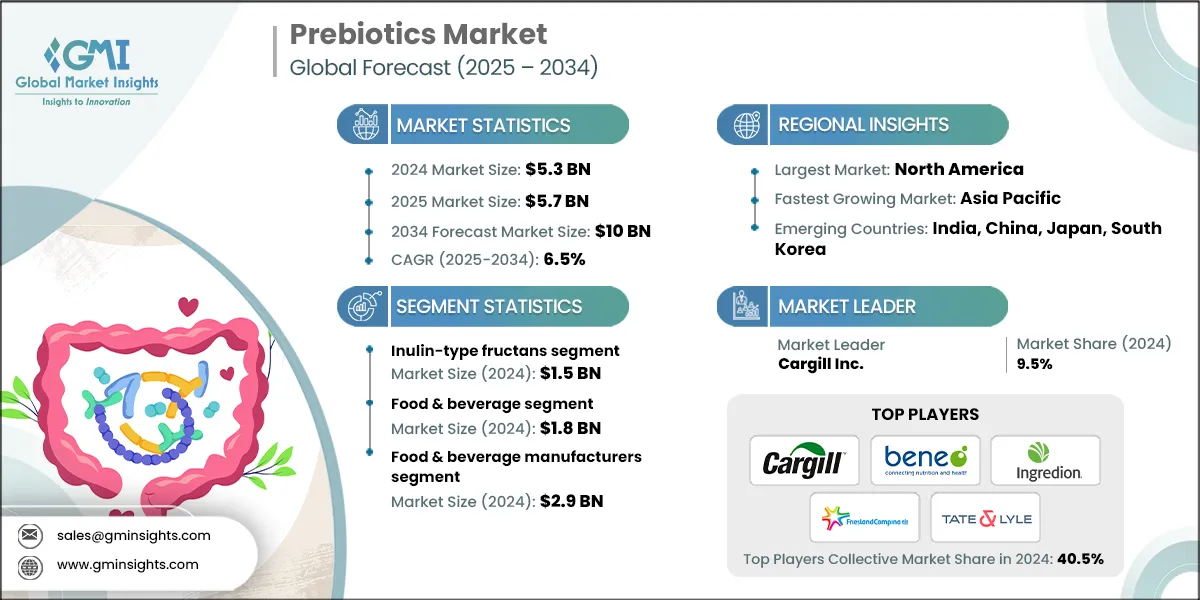
The global prebiotics market size was valued at USD 5.3 billion in 2024. The market is expected to grow from USD 5.7 billion in 2025 to USD 10 billion in 2034, at a CAGR of 6.5% according to the latest report published by Global Market Insights Inc.
Prebiotics Market Key Takeaways
Market Size & Growth
- 2024 Market Size: USD 5.3 Billion
- 2025 Market Size: USD 5.7 Billion
- 2034 Forecast Market Size: USD 10 Billion
- CAGR (2025–2034): 6.5%
Regional Dominance
- Largest Market: North America
- Fastest Growing Region: Asia Pacific
Key Market Drivers
- Increasing consumer focus on health and wellness.
- Expansion of functional food & beverage sector.
- Technological advancements in extraction & formulation.
Challenges
- High production and processing costs.
- Regulatory and labeling challenges.
Opportunity
- Growing vegan and plant-based market.
- Integration with synbiotic products.
- Use in infant formula and elderly nutrition.
Key Players
- Market Leader: Cargill Inc. led with over 9.5% market share in 2024.
- Leading Players: Top 5 players in this market include Cargill Inc., Beneo GmbH, Ingredion Inc., FrieslandCampina Ingredients, Tate & Lyle PLC, which collectively held a market share of 40.5% in 2024.
Get Market Insights & Growth Opportunities
- Prebiotics refer to non-digestible food ingredients that selectively stimulate the growth and activity of beneficial gut bacteria, hence promoting digestive health and overall wellbeing. These are naturally present in chicory root, garlic, onions, and whole grains. They are increasingly being added as ingredients into functional foods, beverages, and dietary supplements. Prebiotics are positioned as major component within the entire health and nutrition market due to increased consumer awareness about gut health, immunity, and preventive.
- Technological innovations in prebiotics for extraction, purification, and formulation have improved prebiotic efficacy, stability, and applicability in various products. Enzymatic processing and microencapsulation allow prebiotics with higher potency and better stability for applications in a wider spectrum of food, beverage, and supplement products. Advances such as plant-based, clean-label, and functional nutrition trends increased the adoption of innovation in product development and the growth of the market.
- The increasing preventive health care and the demand for natural ingredients have expanded the prebiotics markets. The shifting focus on the digestive system, immunity, and overall lifestyle health leads the brands to launch products enhanced with prebiotics. Furthermore, consumer awareness surrounding the gut-brain connection has impacted understanding the role of microbiome balance in overall wellbeing thus, there is continuous demand for the products, especially in developed and urbanized areas.
To get key market trends
Prebiotics Market Trends
- Prebiotics is increasing the demand for prebiotics as consumers today overemphasize on digestive health as well as overall wellness. People tend to look for natural ways to balance immunity and metabolism to support gut health. Such awareness on health increases demand as more consumers adopting products enriched with prebiotics.
- The functional food and beverage area is rapidly growing to meet consumer demands outside basic nutrition. The functional industry is availing prebiotics in its various forms of products such as snacks, drinks, and dairy offerings, to regulate the emerging segment while taking advantage of an increasing consumer awareness.
- The prebiotic integration in pet foods and cattle feeds is increasing with an increasing gut health awareness, so as to enhance the animal performance. This results in increasing demand for prebiotics due to diversification of its application hence growing the prebiotics market.
- Food, beverage, and nutraceutical organizations are forming partnerships with biotech and ingredient companies increasingly. This collaboration is accelerating innovations in advanced prebiotic formulations and widening market reach.
- The demand for prebiotics is growing from niche markets into more mainstream grocery stores, restaurants, cafe and thus the market is growing.
Prebiotics Market Analysis

Learn more about the key segments shaping this market
The prebiotics market by product type is segmented into inulin-type fructans, fructooligosaccharides (FOS), galactooligosaccharides (GOS), human milk oligosaccharides (HMOs), resistant starch, mannan-oligosaccharides (MOS) and others. Inulin-type fructans hold the largest market value of USD 1.5 billion in 2024.
- Inulin-type fructans, along with Fructooligosaccharides, are growing due to their digestive health benefits and assisting in gut microbiota balance. Resistant starch and mannan-oligosaccharides (MOS) are gaining favor as prebiotics for human and animal nutrition due to its metabolic benefits and MOS for immune support of livestock and pets. Together, they create an untapped natural area in functional food, and thus, important for increasing adoption in the various segments.
- Meanwhile, Galactooligosaccharides and Human milk oligosaccharides are fast becoming important for infant nutrition and dairies, as they reflect some breast milk properties and assist in gut mass development and immunity. Other types of prebiotics are also being adopted in some applications, due to innovation in extraction, formulation, and product integration.
Learn more about the key segments shaping this market
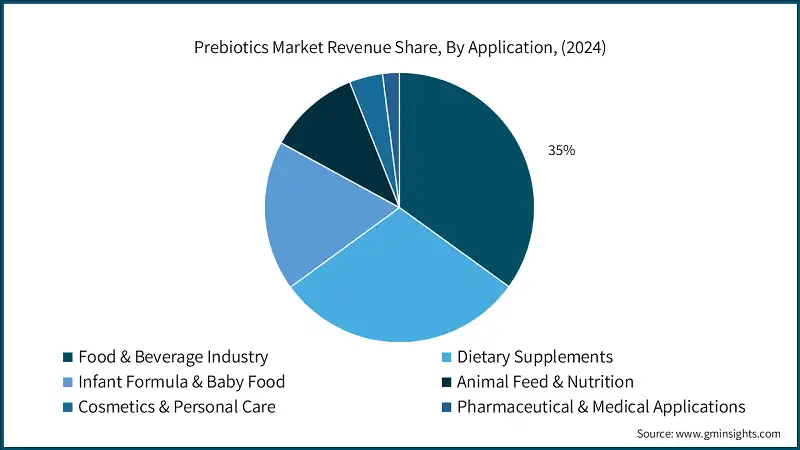
The prebiotics market by application is segmented into food & beverage industry, dietary supplements, infant formula & baby food, animal feed & nutrition, cosmetics & personal care, pharmaceutical & medical applications. Food & beverage industry holds the largest market value of USD 1.8 billion in 2024.
- Food and beverage industry is the largest application area for prebiotics. Products that support digestive health, immunity, and general well-being remain the focus for the consumer. Dietary supplements have also had a strong growth run, with preventive health and personalized nutrition trends driving the daily intake of functional ingredients. Infant formula and baby foods are an ever-expanding segment, given prebiotic benefits for gut development and immune support in infants.
- Animal feed and nutrition is an emerging segment associated with increasing realization of gut health and immunity in pets and livestock. Prebiotics are gradually being used in the field of cosmetics and personal care preparations to support skin microbiome balance and skin health in general. In the pharmaceutical and medical areas prebiotics are recognized for the importance of their roles in supporting digestive tract health and immunity, as well as their therapeutic benefits. All these applications put together justify the diversification and sustained growth of the prebiotic market.
Based on End-User Industry, the prebiotics market is segmented into food & beverage manufacturers, pharmaceutical companies, animal feed manufacturers, cosmetics & personal care companies. Food & beverage manufacturers accounts for USD 2.9 billion in 2024.
- The end-user segment is largely comprised of food and beverage manufacturers, which in turn demand increased functional foods and beverages for the purposes of digestion, immunity, and overall wellness. Pharmaceutical companies are also important, developing therapeutic products, dietary supplements, and medical nutrition applications containing prebiotics and increasing awareness and interest in preventive and gut-focused healthcare solutions.
- Animal feed producers increasingly adopting prebiotics to their feed formulations to ensure better gut health and immunity from disease and nutrient absorption in livestock and pets. Personal care industries also using prebiotics as a ingredient to maintain skin microbiome balance and promote skin health.
Looking for region specific data?
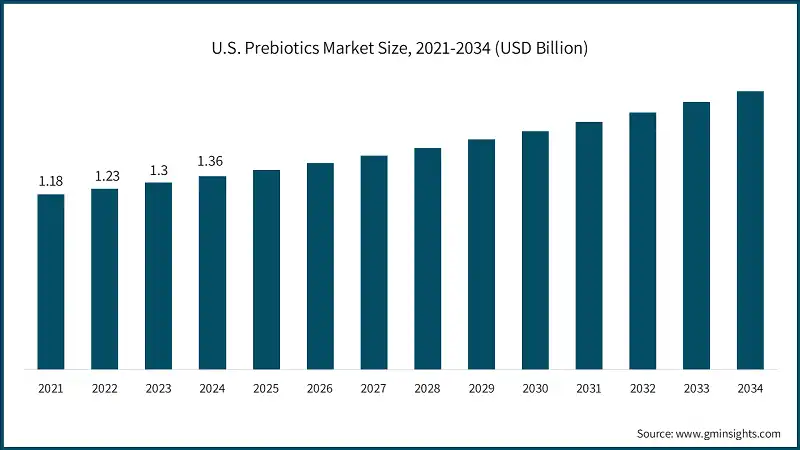
The U.S. prebiotics market accounted for market share of 82.2% and market value of USD 1.36 billion in 2024.
- Prebiotics markets in North America are growing due to high consumer awareness around gut health, immunity, and preventive wellness. In the U.S., rising demand for functional foods, dietary supplements, as well as personalized nutrition solutions, contributes to the growing acceptance of prebiotics. Simultaneously, manufacturers are innovating on their products, as well as on clean-label formulations to tap into health-conscious consumers across the region.
The market in the Germany is expected to experience significant and promising growth from 2025 to 2034.
- The prebiotics market in Europe is growing, mainly because consumers are now focuses on digestive health and overall wellbeing. In Germany there is a strong market because of the already existing functional food market, people's growing interests in preventive healthcare and due to high income people are adopting health-promoting food and supplement products.
The prebiotics market in China is expected to experience significant and promising growth from 2025 to 2034.
- The Asia-Pacific prebiotics market is growing due to public health awareness, increasing urbanization, and changing food preferences. In China, the increase in disposable income, fast adoption of functional foods, and a greater focus on infant nutrition and dietary supplements serve as significant facilitators of the current high growth momentum witnessed in the market.
UAE market is expected to experience significant and promising growth from 2025 to 2034.
- In the Middle East & Africa (MEA), the demand keeps growing due to increased government interest in and public health campaigns addressing better nutrition and gut health. Added to that, international food and beverage brands having started launching functional products increased the awareness and availability of the products attracting the market to them.
Brazil is expected to experience significant and promising growth from 2025 to 2034.
- In Latin America, prebiotics market is a rising trend because of its use in many traditional local food and drink products. People are showing interests in natural and culturally familiar sources of nutrition for healthy gut conditions. The market is also driven by modern retail chains and e-commerce platforms which helps in ease access of functional foods and supplements for a broader audience. Interest among consumers on preventive health care rising and social media influencing wellness trends, consumers of different ages are also being encouraged to adopt prebiotics.
Prebiotics Market Share
- Prebiotics industries are moderately consolidated with players like Cargill Inc., Beneo GmbH, Ingredion Inc., FrieslandCampina Ingredients, and Tate & Lyle PLC holding 40.5% market share and Cargill Incorporated being the market leader holding the market share of 9.5% in 2024.
- The leading companies of prebiotics tend to retain their position because of constant investment into research and development. The goal is to produce ingredients that effectively support gut health while being easily incorporated into a wide range of foods and beverages. Such innovations can be done by using plant sources like chicory root, oats, and legumes, thereby allowing manufacturers to offer varieties that cater to functional as well as nutritional needs.
- Sustainability also plays a huge role in influencing competitive strategies employed by firms besides innovation. Efficient production processes that reduce environmental impact and have an element of scalability are being adopted by many companies. These firms appeal to a growing range of consumers who cherish food products with better sensory quality and sustainable practices through the optimization of their manufacturing processes by implementing greater environmental responsibility.
- Compliance with changing food safety and labeling regulations is yet another crucial parameter where market leaders create an edge for themselves. Regulatory requirements inspire consumer confidence and ensure an easy entry into new markets. Transparent labeling and higher safety standards mean that products conform to the expectations of a growing base of informed consumers actively looking for trustworthy plant-based alternatives.
Prebiotics Market Companies
Major players operating in the prebiotics industry are:
- ADM (Archer Daniels Midland)
- BAOLINGBAO Biology
- Beneo GmbH
- Cargill Inc.
- CJ CheilJedang
- Clasado Biosciences
- Cosucra
- DSM Nutritional Products
- FrieslandCampina Ingredients
- Ingredion Inc.
- Jarrow Formulas
- Jennewein Biotechnologie
- Kerry Group plc
- Meiji Holdings
- Nexira
- OptiBiotix Health
- Prenexus Health
- Quantum Hi-Tech
- Roquette Frères
- Samyang Holdings
- Sensus (Royal Cosun)
- Tate & Lyle PLC
- Tereos Group
- Tata Chemicals
- Yakult Honsha Co., Ltd.
Cargill, Incorporated., is an edible ingredients company that have diverse portfolio of functional ingredients, including prebiotic fibers and soluble fibers. Cargill is about innovation in nutrition, gut health, and clean-label solutions, which it markets globally to the food-, beverage-, and dietary supplement industries. The extensive supply-chain and R&D capabilities confer the company an advantage in developing increasingly versatile ingredients capable of meeting changing consumer demands.
Beneo GmbH is based in Germany, specializes in functional ingredients like inulin and oligofructose and other prebiotics from natural sources. The company focuses on gut health, digestive well-being, and low-glycemic nutrition by offering ingredients for food and beverages and dietary supplements. The company also uses further advanced technology and sustainable sources to maintain quality and stimulate innovation across world markets.
Ingredion Inc., is a significant provider of ingredient systems focusing on starches, fibers, and prebiotic ingredients for applications in food, beverage, and nutrition. It invests heavily in R&D for functional, clean-label, and plant-based solutions that improve product performance and consumer health. Unique in its global operations and technical expertise to react to local market trends.
FrieslandCampina Ingredients is part of the Dutch cooperative FrieslandCampina and offers high-quality, dairy-based and functional ingredients including prebiotics for infant formula and other dairy and nutritional applications. The general research innovation, sustainability, and nutrition science of the company are used to formulate ingredients for people around the world that would improve gut health, immunity, and overall wellness.
Tate & Lyle PLC which is headquartered in the United Kingdom, deals in functional ingredients like fibers, sweeteners, and prebiotics. The company designs solutions for gut health, metabolic wellness, and clean label in food and beverage products. Moreover, it has a completely integrated research network across global production capabilities that allows it to respond well to changing consumer preferences and dietary trends.
Prebiotics Market Report Attributes
| Key Takeaway | Details |
|---|---|
| Market Size & Growth | |
| Base Year | 2024 |
| Market Size in 2024 | USD 5.3 Billion |
| Market Size in 2025 | USD 5.7 Billion |
| Forecast Period 2025 - 2034 CAGR | 6.5% |
| Market Size in 2034 | USD 10 Billion |
| Key Market Trends | |
| Drivers | Impact |
| Increasing consumer focus on health and wellness | Increasing consumer focus on gut health and immunity is boosting demand for functional foods containing prebiotics. |
| Expansion of functional food & beverage sector | Manufacturers are integrating prebiotics into snacks, drinks, and dairy products to meet consumer demand for wellness-oriented products. |
| Technological advancements in extraction & formulation | Innovations in prebiotic ingredient processing enhance efficacy, stability, and product variety. |
| Pitfalls & Challenges | Impact |
| High production and processing costs | Complex extraction and purification processes increase product prices, limiting mass-market penetration. |
| Regulatory and labeling challenges | Varying international standards for health claims hinder smooth global trade and product approvals. |
| Opportunities: | Impact |
| Growing vegan and plant-based market | Prebiotics from plant sources align well with vegan and clean-label trends, offering strong growth potential. |
| Integration with synbiotic products | Combining prebiotics with probiotics (synbiotics) offers enhanced digestive benefits and opens new premium product categories. |
| Use in infant formula and elderly nutrition | Prebiotics such as human milk oligosaccharides (HMOs) are gaining traction in infant and senior nutrition products. |
| Market Leaders (2024) | |
| Market Leaders |
9.5% Market share |
| Top Players |
Collective market share of 40.5% in 2024 |
| Competitive Edge |
|
| Regional Insights | |
| Largest Market | North America |
| Fastest growing market | Asia Pacific |
| Emerging country | India, China, Japan, South Korea |
| Future outlook |
|
What are the growth opportunities in this market?
Prebiotics Industry News
- On June 2025, Beneo GmbH, a manufacturer of functional ingredients, has partnered with Wacker, a biotech company, to launch the human milk oligosaccharide (HMO) 2-fucosyllactose (2'-FL) globally. 2'-FL is a prebiotic that helps in the development of an infant's microbiome. 2'-FL will be produced via precision fermentation by Wacker in Europe, while Beneo will be responsible for commercialization. The main goal of this collaboration is to cater to the increasing demands of the infant nutrition field and to extend HMO applications beyond infancy into such things as sports nutrition, healthy aging, and possible anti-obesity effects. In this way, the move strengthens the positions of both companies in the prebiotics market.
- On February 2025, Coca-Cola has stepped into the growing prebiotic beverage by developing its first prebiotic soda line, simply Pop. The drinks mix six grams of prebiotic fiber with real fruit juice, vitamin C, and zinc to support gut health, appealing to wellness-minded consumers, particularly Gen Z and Millennials. Available in five different flavors, the Simply Pop launch illustrates Coca-Cola's strategy to innovate beyond traditional sodas to meet the rising demand for functional beverages. The move places the company in an increasingly competitive market for prebiotic drinks, which are growing in popularity and value.
The prebiotics market research report includes an in-depth coverage of the industry with estimates and forecast in terms of revenue in USD Million and volume in terms of kilo tons from 2021–2034 for the following segments:
Market, By Product Type
- Inulin-Type Fructans
- Fructooligosaccharides (FOS)
- Galactooligosaccharides (GOS)
- Human Milk Oligosaccharides (HMOs)
- Resistant Starch
- Mannan-oligosaccharides (MOS)
- Others
Market, By Application
- Food & Beverage Industry
- Dietary Supplements
- Infant Formula & Baby Food
- Animal Feed & Nutrition
- Cosmetics & Personal Care
- Pharmaceutical & Medical
Market, By End Use Industry
- Food & Beverage Manufacturers
- Pharmaceutical Companies
- Animal Feed Manufacturers
- Cosmetics & Personal Care Companies
The above information is provided for the following regions and countries:
- North America
- U.S.
- Canada
- Europe
- Germany
- UK
- France
- Spain
- Italy
- Rest of Europe
- Asia Pacific
- China
- India
- Japan
- Australia
- South Korea
- Rest of Asia Pacific
- Latin America
- Brazil
- Mexico
- Argentina
- Rest of Latin America
- Middle East and Africa
- Saudi Arabia
- South Africa
- UAE
- Rest of Middle East & Africa
Frequently Asked Question(FAQ) :
What is the market size of the prebiotics in 2024?
The market was valued at USD 5.3 billion in 2024, with a CAGR of 6.5% projected through 2034. Increasing consumer awareness about gut health, immunity, and preventive care is driving market growth.
What is the projected value of the prebiotics market by 2034?
The market is expected to reach USD 10 billion by 2034, fueled by rising demand for functional foods, beverages, and dietary supplements enriched with prebiotics.
What is the expected size of the prebiotics industry in 2025?
The market size is projected to grow to USD 5.7 billion in 2025.
How much revenue did the inulin-type fructans segment generate in 2024?
The inulin-type fructans segment generated USD 1.5 billion in 2024, driven by its digestive health benefits and role in balancing gut microbiota.
What was the valuation of the food & beverage industry segment in 2024?
The food & beverage industry segment accounted for USD 1.8 billion in 2024, making it the largest application area for prebiotics.
Which region leads the prebiotics sector?
North America leads the market, with the U.S. accounting for 82.2% of the regional market share and a valuation of USD 1.36 billion in 2024. High consumer awareness and demand for functional foods and dietary supplements drive growth in the region.
What are the upcoming trends in the prebiotics market?
Key trends include prebiotic integration into functional foods, growing use in pet and cattle feeds, biotech partnerships for advanced formulations, and expansion into mainstream retail and food service.
Who are the key players in the prebiotics industry?
Major players include Archer Daniels Midland, BAOLINGBAO Biology, Beneo GmbH, Cargill Inc., CJ CheilJedang, Clasado Biosciences, Cosucra, Ingredion Inc., Jarrow Formulas, Jennewein Biotechnologie, Kerry Group plc, and Meiji Holdings.
Prebiotics Market Scope
Related Reports