Summary
Table of Content

Potato Processing Market
Get a free sample of this report
Form submitted successfully!
Error submitting form. Please try again.
Thank you!
Your inquiry has been received. Our team will reach out to you with the required details via email. To ensure that you don't miss their response, kindly remember to check your spam folder as well!
Request Sectional Data
Thank you!
Your inquiry has been received. Our team will reach out to you with the required details via email. To ensure that you don't miss their response, kindly remember to check your spam folder as well!
Form submitted successfully!
Error submitting form. Please try again.
Potato Processing Market Size
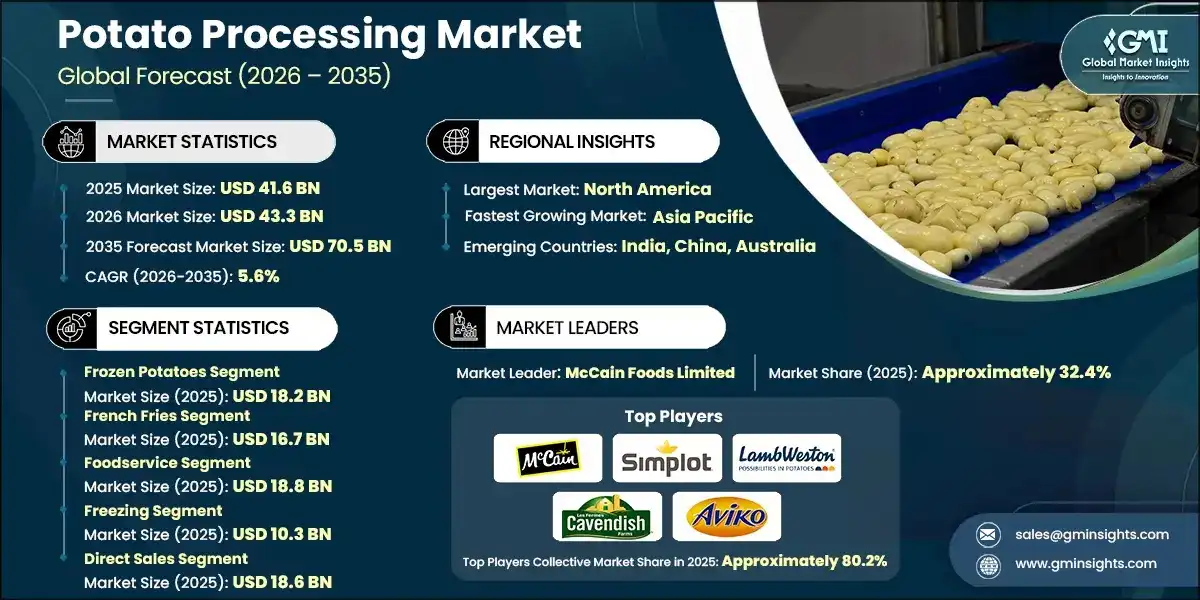
The global potato processing market size was valued at USD 41.6 billion in 2025. It is projected to grow from USD 43.3 billion in 2026 to USD 70.5 billion by 2035, representing 5.6% CAGR from 2026 to 2035, according to latest report published by Global Market Insights Inc.
Potato Processing Market Key Takeaways
Market Size & Growth
- 2025 Market Size: USD 41.6 Billion
- 2026 Market Size: USD 43.3 Billion
- 2035 Forecast Market Size: USD 70.5 Billion
- CAGR (2026–2035): 5.6%
Regional Dominance
- Largest Market: North America
- Fastest Growing Region: Asia Pacific
Key Market Drivers
- Rising demand for convenience and ready-to-eat foods.
- Expansion of quick-service restaurants globally.
- Increasing urbanization and changing dietary habits.
- Technological advancements in processing and packaging.
Challenges
- Volatility in raw potato prices.
- High energy and operational costs in processing.
- Stringent food safety and regulatory compliance requirements.
Opportunity
- Growing popularity of frozen and dehydrated potato products.
- Emerging markets with rising disposable incomes.
- Development of healthier and low-fat potato snacks.
- Expansion of online retail and e-commerce channels.
Key Players
- Market Leader: McCain Foods Limited led with over 32.4% market share in 2025.
- Leading Players: Top 5 players in this market include McCain Foods Limited, J.R. Simplot Company, Lamb Weston Holdings, Inc., Cavendish Farms Corporation, Aviko B.V., which collectively held a market share of 80.2% in 2025.
Get Market Insights & Growth Opportunities
- There is strong market growth in the potato processing market that can be attributed to the growing demand of the world for convenience and ready-made food products. The lifestyles of consumers who are shifting, especially in the urban areas, are demanding more processed forms of potato food like chips, frozen fries and snacks.
- The rise in disposable incomes and the expansion of modern retail formats are the factors that contribute to this change as it has allowed to provide a greater variety of products and provide consumers with easier access to them. Also, the growing foodservice industry such as quick-service restaurants and casual dining chains are playing a major role in driving the demand for processed potato products.
- The market is also expanding due to technological innovations in processing and packaging. High-pressure processing, better freezing methods and longer shelf-life packaging are some of the innovations that are increasing the quality of products and reducing wastages. Such advances have enabled manufacturers to provide consistent taste, feel and safety that subsequently promotes repetitive buying pattern in consumers. In addition to this, automation and enhanced integration of supply chains are lowering the cost of operation and enhancing scalability in the manufacturing sector to facilitate competitive prices and market penetration.
- The trend of increased concern with health and nutrition is also influencing the development of potato processing market. To comply with the changing consumer preferences, manufacturers are re-engineering products to contain less fat, sodium and nutrient fortified foods. The increased consciousness regarding clean labels and transparency in the source of food is influencing brands to implement the use of natural ingredients and sustainable practices, and it is finding favor among environmentally conscious consumers.
- Market expansion in emerging markets is increasingly being contributed by regional growth in the economy. The availability of the products in these regions is being enhanced by the investment by the key players in the industry in the production plants and the distribution channels in these areas. Moreover, consumer awareness is being strengthened by the strategic relationship and advertising of key brands, and this will boost long-term prospects of expansion in potato processing industry.
To get key market trends
Potato Processing Market Trends
- There is an evident trend in the potato processing industry whereby there is a shift towards the high-end and healthier product positioning. Consumers also favor the low-oil, baked, air-fried, and low-salt varieties of potato products more than the traditional fried products. The use of clean-label formulations, organic ingredients, and allergens-free are on the rise in snacks and frozen potato. This is slowly changing product portfolio and brand communication strategies in the market.
- Processing efficiency and product differentiation are being transformed by technological advancement. There has been adoption of automation, artificial intelligence grading, and precision cutting to enhance yield consistency and minimize raw material wastages. Such advanced methods like vacuum frying and improved freezing are allowing improved texture, extended shelf life, and enhanced sensory quality. These inventions are enabling companies to have value added products and still remain efficient in their operations.
- Sustainability is a structural trend that affects the operations and packaging. The processors are dedicating themselves to recyclable and biodegradable packaging so as to conform to environmental demands. The use of potato waste as a feed to animals, starch reuse or bio-based is also taking notice.
- Digital and omnichannel distribution is revolutionizing the distribution of processed potato products to consumers. E-grocery retail systems and direct to consumer are becoming more applicable to frozen and specialty potato products. Digital marketing and data analytics are used by brands to tailor or advertise new flavors. This change is enhancing customer interest and speeding up product development processes in the market.
Potato Processing Market Analysis
Learn more about the key segments shaping this market
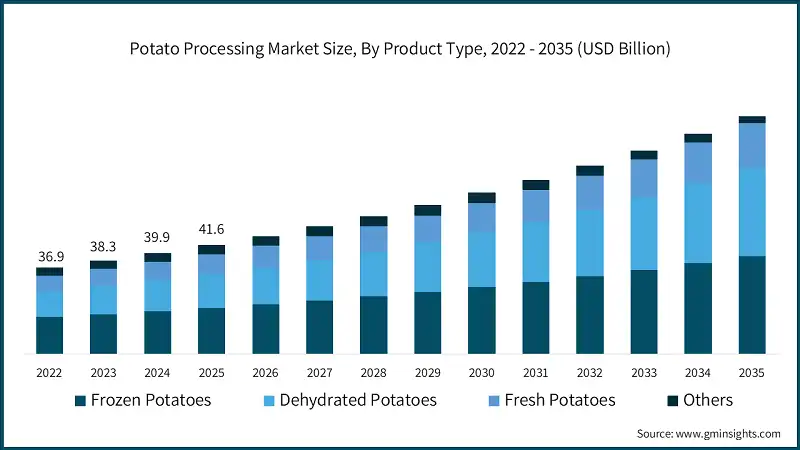
Potato processing market based on product type is segmented into frozen potatoes, dehydrated potatoes, fresh potatoes, and others. The frozen potatoes segment was valued at USD 18.2 billion in 2025, and it is anticipated to expand to 5.4% of CAGR during 2026 to 2035.
- Frozen potatoes find more applications in the areas where consistent quality, extended shelf life, and fast preparation are needed, especially in the areas of organized foodservice and modern retail. In industrial food production, dehydrated potatoes like flakes, granules, and powders are aiding growth due to the ease in storing, efficient transport, and formulation. Fresh potatoes remain core source of processing volumes with the on-site cutting, blanching and freezing, which are most likely to be accepted. New forms of other processed forms are coming out to suit customized requirements of texture and formulation.
- Expansion in product types is being done by parallel, but not substitution expansion. Frozen and dehydrated products are being developed to be operational efficient, and fresh potatoes are still imperative in the upstream processing operations. The processors are modifying capacity to match bulk processing and the value-added products. The segmentation facilitates consistent market growth by diversified product management and usage patterns.
Potato processing market based on application is segmented into French fries, hash browns, potato wedges, potato flakes, potato granules, potato powder, snacks, and others. The French fries segment was valued at USD 16.7 billion in 2025, and it is anticipated to expand to 5.8% of CAGR during 2026 to 2035.
- In foodservice and the increase in the acceptance of frozen meal formats in retail. Snack products are growing with flavor innovations and other processing techniques like baked or low-oil recipes. Potato flakes, granules and powder are common functional ingredients in the processed food that are utilized in soups and bakery. Composite and ready-meal formulations are applications which are developing.
- Application-based growth is the aspect that indicates how easily processed potatoes can be utilized at various instances of consumption. Ready to eat and to cook foods cater to the foodservice and retail markets, and ingredient applications to industrial processing. Processors can cater to multiple needs in application with variations in cut, form and moisture content. The flexibility has been enabling the market to expand in both consumption as well as manufacturing fronts.
Potato processing market based on end use is segmented into foodservice, retail, and industrial use. The foodservice segment was valued at USD 18.8 billion in 2025, and it is anticipated to expand to 5.7% of CAGR during 2026 to 2035.
- The foodservice segment is growing as there is increasing number of quick-service restaurants, institutional catering and standardized kitchen processes depending on processed potato items. The retail applications are also rising because consumers are buying frozen and packaged potato products to cook at home. The industrial application is increasing by increasing use of potato as ingredients in the processed and packaged foods. The end-use segments need various specifications and packaging design.
- Differentiation of demand patterns enhance market growth by end use instead of depending on one channel. Foodservice encourages repeat and bulk usage; retail promotes branded and packed products and industrial use guarantees continuous volume usage. Processors are matching production to satisfy such diverse demands. This multi-end-use building promotes the stability of the market in the long run.
Potato processing market based on processing type is segmented into washing & peeling, cutting & slicing, blanching, drying & dehydration, freezing, and packaging. The freezing segment was valued at USD 10.3 billion in 2025, and it is anticipated to expand to 6.5% of CAGR during 2026 to 2035.
- An expansion in the areas of washing and peeling, cutting and slicing is associated with additional throughput needs and the standardization of sizes and shapes of products. Blanching is highly being streamlined to enhance texture, color and shelf stability of frozen and dehydrated foods. Drying & dehydration procedures are also growing in support of flakes, granules and powders in order to be more efficient. Freezing and packaging is being modified to accommodate long shelf life and easy handling.
- Processing-type growth indicates that there is constant investment in production optimization and not process replacement. Every step of the processing process adds value to the quality of the products and their purpose of use. Multi-step processing enables the processors to alternate between product format. This is operational flexibility that is enabling scalable market growth.
Learn more about the key segments shaping this market
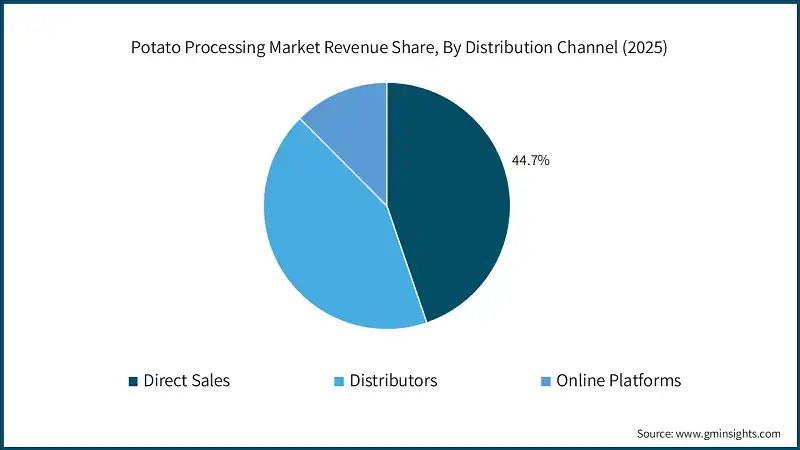
Potato processing market based on distribution channel is segmented into direct sales, distributors, and online platforms. The direct sales segment was valued at USD 18.6 billion with a market share of 44.7% in 2025, and it is anticipated to expand to 5.4% of CAGR during 2026 to 2035.
- Direct sales are growing with institutional supply relations with foodservice operators and industrial purchasers with bulk and regular supply needs. Distributors facilitate expansion by enhancing the regional coverage and serving the outlets with fragmented retail and foodservice. Retail sales of frozen and packaged potatoes products are slowly being facilitated by online platforms. This change is being assisted by advancements in logistics and cold storage.
- Expansion via distribution channel is taking place via channel diversification as opposed to channel migration. Direct sales offer stability of volume; distributors aid market penetration and online platforms offer accessibility and visibility. Processors are matching channel plans for product type and end use requirements. The balanced channel structure is enhancing the general market reach.
Looking for region specific data?
The North America potato processing market accounted for USD 14.2 billion in 2025 and is anticipated to show lucrative growth over the forecast period.
North American market is increasing with the potato products consumption rate being high in both foodservice and retail frozen and ready-to-cook products. High concentration of fast-food restaurants developed cold-chain supply chain and automated processing systems facilitate mass production. Innovation of products in frozen fries, wedges, and snacks, as well as the need to have consistency and portion control, still plays out in the growth of the market in the region.
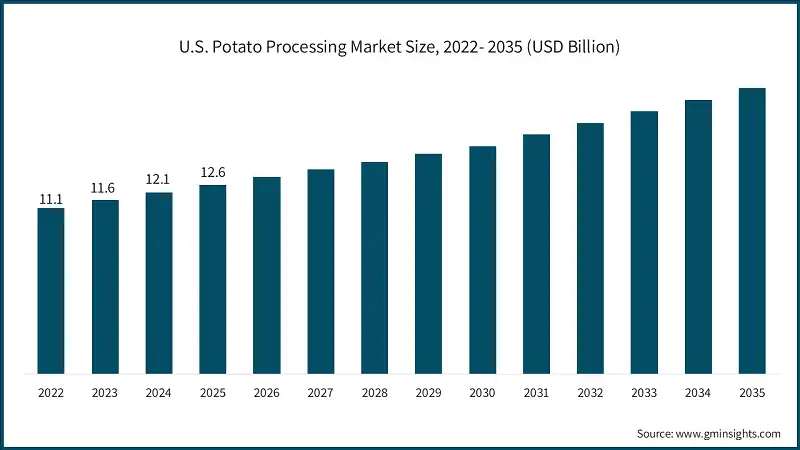
U.S. dominates the North America potato processing market, showcasing strong growth potential.
U.S. has large domestic potato production and established processing capacity that helps in supporting growth. Through the high demand by the fast-food chains, institutional catering and packaged food manufacturers, on-going capacity utilization is being generated. Frozen and seasoned potato products are being demanded in retail business because of convenience-based consumption trends. Long-term growth opportunities are being reinforced by investments in processing efficiency, packaging innovation and supply chain optimization.
The Europe potato processing market accounted for USD 12.4 billion in 2025 and is anticipated to show lucrative growth over the forecast period.
Potential market in Europe potato processing market is growing owing to high demand of frozen, chilled, and dehydrated potato items in foodservice and industrial usage. The area enjoys coordinated agricultural supply, contract farming and good processing standards. The growing intake of processed food, demand of homogenous quality and longer shelf life are sustaining growth in fries, snacks and potato bases application.
Germany dominates the Europe potato processing market, showcasing strong growth potential.
Germany is one of the European markets that are also among the fastest growing because of high consumption of frozen potato products and also has a vibrant food processing market. The company has high retail penetration, foodservice demand, and export- focused processing facilities that help support growth. The consumption of potato flakes and potato granules in bakery and convenience foods is on the rise. The focus on the efficiency of processing and environmentally friendly operations is also influencing the development of the market.
Asia Pacific potato processing market accounted for 24.4% market share in 2025 and is anticipated to show lucrative growth over the forecast period.
Asia Pacific market of potato processing is expanding at a high rate owing to urbanization, changing food habits, and the adoption of the western type of food products. The increase in the demand for frozen fries, snacks, and prepared meals is resulting in the development of investments in processing and cold-chain infrastructure. The market is becoming more accessible because the number of quick-service restaurants and modern forms of retail is expanding. Growth of dehydrated potato as industrial food ingredients is also being experienced in the region.
China potato processing market is estimated to grow with a significant CAGR, in the Asia Pacific market.
China is one of the major growth markets due to the rise in consumption of fast-food and growing domestic processing capacity. The increasing disposable income and the exposure to international food trends are favoring the demand for frozen and snack products of potato products. Local processors are making investments in technologies of freezing, dehydration, and packaging. Increasing consumption of potato-rich processed foods products and institutional food also contributes to growth.
Latin America potato processing market is anticipated to grow at a CAGR of 4.5% during the analysis timeframe.
The market in Latin America is emerging, and the market is experiencing rising demands for frozen and snack potato products. Expansion of organized foodservice, enhancement of cold-chain infrastructure, and the increase in consumption of convenience foods are growth facilitators. The local processing capacity is also picking up to limit the quantity of imports. Dry potato products are equally becoming significant in the industrial production of food in the region.
Brazil leads the Latin America potato processing market, exhibiting remarkable growth during the analysis period.
Brazil boasts of one of the most vibrant markets because it has a huge number of consumers, and the foodservice market is growing. The increase in the demand for frozen fries and potato snacks is positively influencing investments in processing plants. The packaged potato products are sold in retail stores through better distribution. The country is also experiencing growth in the industrial application of potato flakes and powders, which is contributing to the growth of the market.
Middle East & Africa potato processing market is expected to grow at a CAGR of 3% during the analysis timeframe.
The Middle East and Africa market is on the increase based on the increasing foodservice activity, urban population growth, and consumption of frozen foods. Reliance on the imported frozen potato goods is slowly stimulating investments in the region. Hotel, restaurant, and catering services are also enjoying a constant boost in their demand. The market penetration is being improved in the region by the availability of good cold storage and logistics.
Saudi Arabia Potato Processing Market to experience substantial growth in the Middle East and Africa market in 2025.
Saudi Arabia is one of the major growth markets as the country is experiencing a rapid growth in the number of quick-service restaurants as well as the institutional food consumption. The high dependence on imports of frozen potatoes is opening possibilities to the local processing and packaging. The needs of the retail market within frozen and ready to cook potato products are on the rise with the changing lifestyle. The emphasis on food security and local production by the government is also helping to create markets.
Potato Processing Market Share
- McCain Foods Limited, J.R. Simplot Company, Lamb Weston Holdings, Inc., Cavendish Farms Corporation, and Aviko B.V. are a significant part of the global market and with further standing of being highly consolidated with the top five players steadily holding 80.2% market share in the year 2025.
- The potato processing market businesses sustain their stance by large scale and integrated operations which combine contract farming, processing, storage and distribution. This integration provides stability in quality of the raw materials, cost management and dependability in supplies, which directly affect stability in pricing and product availability in the regions.
- Diversification has become popular in terms of product portfolio. Several formats are offered by companies in order to achieve success in all three foodservice, retail and industrial segments at once, which include frozen fries, wedges, flakes, powders, granules, and snacks.
- Good ties with foodservice chains and industrial customers are very important in sustaining the market. The long-term supply contracts provide the guarantee of stability in the demand volumes, predictability of the capacity utilization and the possibility of the co-development of the tailored potato products according to the specifications of clients.
- Retail presence is being enhanced by brand positioning and packaging innovation. To suit the changing consumer trend, companies emphasize on convenience-oriented package, portion control, and value addition variants to enhance shelf appeal in channel stores that are well organized.
- The strategy of geographic expansion and localization assists the companies in enhancing their competitive presence. The location of regional processing plants nearer to the sources of raw materials and to the markets also lowers the logistics expenses and enhances the sensitivity to local demand trends.
- Efficiency in operations and reduction of costs are considered a priority to ensure that one stays competitive in a price sensitive market. Firms are emphasizing on efficient processing, waste exploitation and by-product valorization to enhance the margin besides enhancing sustainable functioning.
- The diversified sourcing and cold-chain investments are used to strengthen supply chain resilience. This will reduce seasonal risks, uniformity the supply of inputs and also provide continuous supply of frozen and dehydrated potato products to the downstream customers.
- Continued product formulation and innovation in the processes of production enables a firm to affect the development of the market. Some new cuts, textures and processing methods allow us to increase the areas of application, as well as contribute to the further expansion of the market.
Potato Processing Market Companies
The major players operating in potato processing industry include:
- McCain Foods Limited
- J.R. Simplot Company
- Lamb Weston Holdings, Inc.
- Cavendish Farms Corporation
- Aviko B.V.
- Others
- McCain Foods Limited maintains its status by vertically approaching its operations which include sourcing of potatoes, processing and distribution. The company specializes in frozen potato products catered to foodservice and retail with ongoing commitment to processing effectiveness, product innovation and long term mutual relationships with international quick service restaurant chains.
- Lamb Weston Holdings, Inc. is a company that has been able to retain its market share through specialization in frozen potato products targeting large foodservice customers. The company focuses on the scale of operations, high-level freezing technology, and product customization to customers; this will allow the company to supply to the international markets at a consistent level and at equal quality.
- J.R. Simplot Company is also competitive due to its excellent sourcing capabilities of agriculture and food diversified processing. The company combines potato processing with agricultural innovation, optimization of supply chains, and product development to aid constant production and custom solutions to foodservice and industrial clients.
- Aviko B.V. maintains its presence through the diversification of its products and specializes in a large variety of frozen potato products and ingredients. The company focuses on diversification of products, flexible processing plants and regional manufacturing units that enable it to efficiently cater to foodservice, retail, and industrial clients across various markets.
- Cavendish Farms Corporation has been able to maintain its market share because of specialization in frozen potato products that have been supported by high levels of agricultural integration. The company is dedicated to the reliability of supplies, consistency in processing and relationships between foodservice with strategic functionality that allows the company to grow and sustain itself in the market dealing with potato processing.
Potato Processing Market Report Attributes
| Key Takeaway | Details |
|---|---|
| Market Size & Growth | |
| Base Year | 2025 |
| Market Size in 2025 | USD 41.6 Billion |
| Market Size in 2026 | USD 43.3 Billion |
| Forecast Period 2026-2035 CAGR | 5.6% |
| Market Size in 2035 | USD 70.5 Billion |
| Key Market Trends | |
| Drivers | Impact |
| Rising demand for convenience and ready-to-eat foods | Boosts processed potato consumption across retail and foodservice channels |
| Expansion of quick-service restaurants globally | Increases bulk demand for frozen fries and potato snacks |
| Increasing urbanization and changing dietary habits | Drives preference for packaged and easy-to-cook potato products |
| Technological advancements in processing and packaging | Enhances product quality, shelf life, and operational efficiency |
| Pitfalls & Challenges | Impact |
| Volatility in raw potato prices | Creates cost instability and margin pressure for processors |
| High energy and operational costs in processing | Reduces profitability and raises production expenses significantly |
| Stringent food safety and regulatory compliance requirements | Increases compliance costs and operational complexity for manufacturers |
| Opportunities: | Impact |
| Growing popularity of frozen and dehydrated potato products | Expands market share in retail and export segments |
| Emerging markets with rising disposable incomes | Opens new growth avenues for processed potato products |
| Development of healthier and low-fat potato snacks | Attracts health-conscious consumers and premium product demand |
| Expansion of online retail and e-commerce channels | Improves product accessibility and accelerates sales growth globally |
| Market Leaders (2025) | |
| Market Leaders |
Market Share Approximately 32.4% |
| Top Players |
|
| Competitive Edge |
|
| Regional Insights | |
| Largest Market | North America |
| Fastest growing market | Asia Pacific |
| Emerging countries | India, China, Australia |
| Future outlook |
|
What are the growth opportunities in this market?
Potato Processing Industry News
- In November 2025, McCain Foods Limited settled on the purchase of Penobscot McCrum LLC which would provide the company with a frozen potato plant, based in Washburn, Maine, to expand its network of outlets in North America. This increases capacity to process more and also consolidate regional supply chains within the frozen and specialty potato segment.
- In October 2025- J.R. Simplot Company purchased Clarebout Potatoes, and this acquisition added 23 production plants to the frozen potato processing holding, which now covers a larger area of Europe. This enhances the international supply chain of Simplot and assists in cross-regional product supply.
- In October 2024, Lamb Weston reduced its old Connell, Washington plant and downsized its workforce to reorganize to reduce costs and match the output to softer restaurant and retail demand. This is an indicator of operation change when dealing with market cycles and cost pressure.
- In 2024, Lamb Weston Holdings, Inc. increased its production capacity by approximately 40 percent at the American Falls, Idaho plant, which was needed to meet the increasing demand in the global market in frozen fries and specialty potato cuts. This growth contributes to the resiliency of supply and addresses growing foodservice demand.
The potato processing market research report includes in-depth coverage of the industry with estimates & forecast in terms of revenue (USD Billion) & volume (Kilo Tons) from 2022 to 2035, for the following segments:
Market, By Product Type
- Frozen Potatoes
- Dehydrated Potatoes
- Fresh Potatoes
- Others
Market, By Application
- French Fries
- Hash Browns
- Potato Wedges
- Potato Flakes
- Potato Granules
- Potato Powder
- Snacks
- Others
Market, By End Use
- Foodservice
- Quick Service Restaurants (QSR)
- Full-Service Restaurants
- Retail
- Supermarkets/Hypermarkets
- Convenience Stores
- Online Retail
- Industrial Use
- Ingredient for Packaged Foods
- Bakery & Confectionery
Market, By Processing Type
- Washing & Peeling
- Cutting & Slicing
- Blanching
- Drying & Dehydration
- Freezing
- Packaging
Market, By Distribution Channel
- Direct Sales
- Distributors
- Online Platforms
The above information is provided for the following regions and countries:
- North America
- U.S.
- Canada
- Europe
- UK
- Germany
- France
- Italy
- Spain
- Rest of Europe
- Asia Pacific
- China
- India
- Japan
- South Korea
- Australia
- Rest of Asia Pacific
- Latin America
- Brazil
- Mexico
- Argentina
- Rest of Latin America
- MEA
- UAE
- Saudi Arabia
- South Africa
- Rest of Middle East and Africa
Frequently Asked Question(FAQ) :
What was the market size of the potato processing in 2025?
The market size was USD 41.6 billion in 2025, with a CAGR of 5.6% expected from 2026 to 2035. The growth is driven by increasing demand for convenience and ready-made food products.
What is the projected value of the potato processing market by 2035?
The market is poised to reach USD 70.5 billion by 2035, fueled by urbanization, shifting consumer lifestyles, and rising demand for processed potato products.
What is the expected size of the potato processing industry in 2026?
The market size is projected to reach USD 43.3 billion in 2026.
How much revenue did the frozen potatoes segment generate in 2025?
The frozen potatoes segment generated USD 18.2 billion in 2025 and is anticipated to expand at a CAGR of 5.4% till 2035.
What was the valuation of the French fries segment in 2025?
The French fries segment was valued at USD 16.7 billion in 2025 and is expected to grow at a CAGR of 5.8% up to 2035.
What is the growth outlook for the direct sales segment from 2026 to 2035?
The direct sales segment, valued at USD 18.6 billion with a 44.7% market share in 2025, is set to witness over 5.4% through 2035.
Which region leads the potato processing sector?
North America leads the market, accounting for USD 14.2 billion in 2025. The region's growth is supported by high consumption rates of potato products, a developed cold-chain supply system, and automated processing technologies.
What are the upcoming trends in the potato processing market?
Key trends include healthier snack options, clean-label and organic ingredients, advanced processing technologies, sustainability initiatives, and digital distribution via e-grocery and D2C channels.
Who are the key players in the potato processing industry?
Key players include McCain Foods Limited, J.R. Simplot Company, Lamb Weston Holdings, Inc., Cavendish Farms Corporation, and Aviko B.V.
Potato Processing Market Scope
Related Reports