Summary
Table of Content

Plant-based Casein Analogs Market
Get a free sample of this report
Form submitted successfully!
Error submitting form. Please try again.
Thank you!
Your inquiry has been received. Our team will reach out to you with the required details via email. To ensure that you don't miss their response, kindly remember to check your spam folder as well!
Request Sectional Data
Thank you!
Your inquiry has been received. Our team will reach out to you with the required details via email. To ensure that you don't miss their response, kindly remember to check your spam folder as well!
Form submitted successfully!
Error submitting form. Please try again.
Plant-based Casein Analogs Market Size
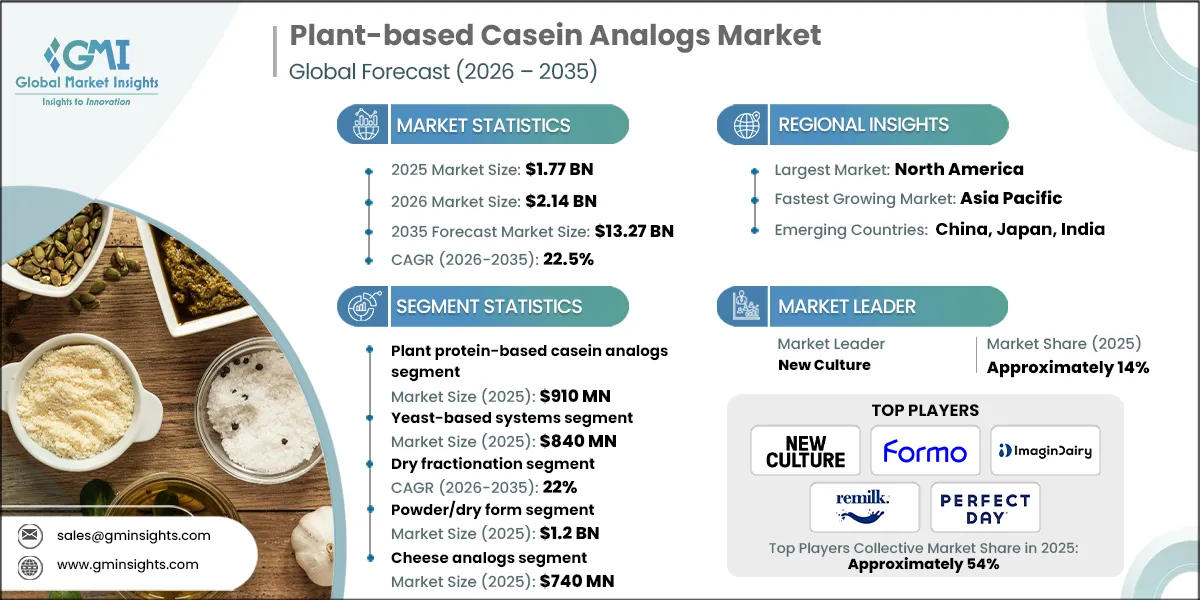
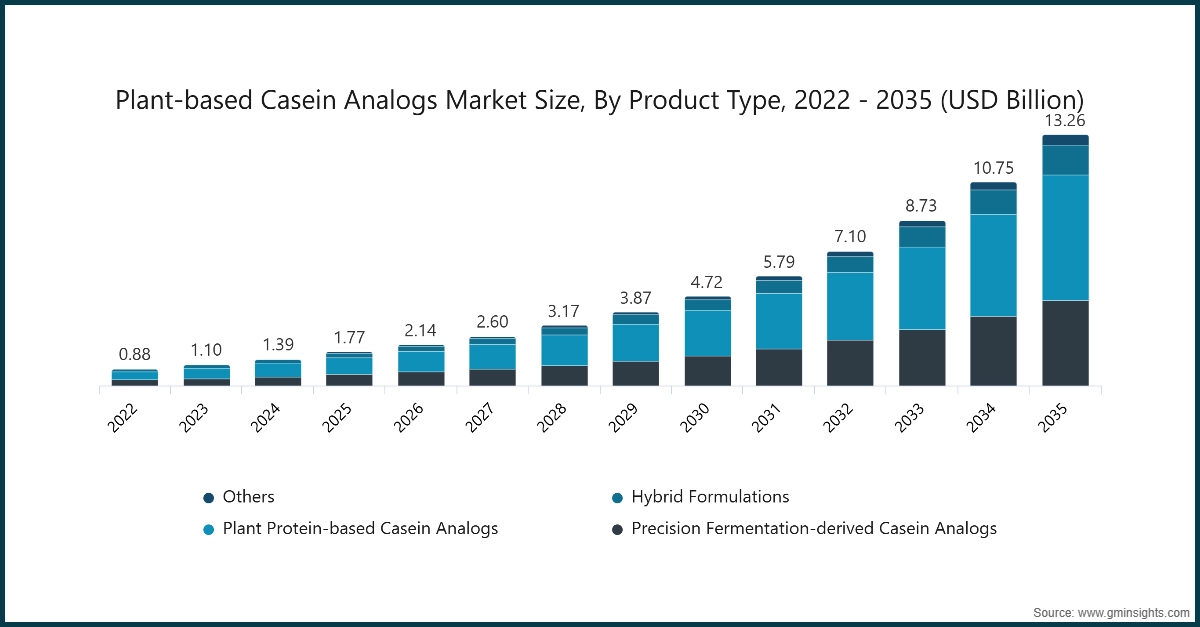
The global plant-based casein analogs market was valued at USD 1.77 billion in 2025. It is projected to grow from USD 2.14 billion in 2026 to USD 13.27 billion by 2035, representing 22.5% CAGR from 2026 to 2035, according to latest report published by Global Market Insights Inc.
Plant-based Casein Analogs Market Key Takeaways
Market Size & Growth
- 2025 Market Size: USD 1.77 Billion
- 2026 Market Size: USD 2.14 Billion
- 2035 Forecast Market Size: USD 13.27 Billion
- CAGR (2026–2035): 22.5%
Regional Dominance
- Largest Market: North America
- Fastest Growing Region: Asia Pacific
Key Market Drivers
- Rising demand for dairy-free cheese and yogurt.
- Growth of vegan and flexitarian populations.
- Foodservice shift toward plant-based menus.
- Advances in protein structuring technologies.
Challenges
- Sensory gap versus animal casein.
- High formulation and processing costs.
- Clean-label and allergen perception issues.
Opportunity
- Application in premium plant‑based cheese.
- Use in functional and fortified foods.
- Demand from lactose‑intolerant consumers.
- Expansion in coffee and beverage whiteners.
Key Players
- Market Leader: New Culture led with over market share approximately 14% in 2025.
- Leading Players: Top 5 players in this market include New Culture, Formo, Imagindairy, Remilk, Perfect Day, which collectively held a market share of 54% in 2025.
Get Market Insights & Growth Opportunities
- Plant-based casein analogs market is experiencing a consistent growth due to the surge in the popularity of the plant-based and vegan diets in the whole world. Increased awareness of consumers regarding issues of animal welfare, environmental sustainability, and reduction of carbon footprint is hastening the move away of dairy-derived proteins. To satisfy clean-label and ethical product positioning, food manufacturers are replacing animal-derived casein analogs with plant-based analogs.
- Market growth is further being fueled by health-related aspects since lactose intolerance, milk protein allergies and cholesterol issues are gaining momentum across the regions. Plant-based casein analogs are a viable functional protein solution that does not develop the digestive and allergen issues that are linked to traditional casein. Also, the trend in high-protein, functional and sports nutrition products is increasing usage in protein powders and fortified foods. These health preferences are widening the consumer group to include vegans and flexitarians and health-conscious groups.
- The functional performance of casein analogs is being enhanced greatly by the technological innovations in the extraction of plant proteins, their fermentation and formulation. Improved emulsification, gelation, and texture characteristics are making it possible to use it in more complex dairy-analogs, such as meltable and stretchable cheese alternatives. The gap in functionality between animal casein and plant-based casein is closing because of constant research and development by ingested product manufacturers. This is an innovation-based enhancement that is aiding in the further infiltration into mainstream food processing applications.
- Commercially, market scalability is increasing faster with growing investments by food and ingredient firms, as well as an increasing involvement of private labels. Better supply chains on the major primary sources of plant protein including pea and soy are contributing to stabilized prices and uniform quality. Moreover, great advances in Asia-Pacific and emerging markets, which are substantiated by urbanization and dietary changes, is expanding the pool of global demand.
To get key market trends
Plant-based Casein Analogs Market Trends
- A trend that is influencing the plant-based casein analogs marketplace is the movement toward functionality-driven ingredient choices where the food industry is moving towards proteins that best mimic the behavior of dairy casein as opposed to plant-based generic proteins. There is a shift in demand to a direction that provides ingredients that provide meltability, stretch, emulsification and creaminess in the finished products. This tendency is forcing suppliers to market plant-based casein analogs as specialty functional ingredients, as opposed to commodity proteins. Consequently, the value realization is also becoming better in premium dairy-alternative formulations.
- The other interesting trend is the combination of accuracy fermentation and advanced protein engineering to increase structural similarity with animal-derived casein. Firms are paying attention to molecular level customization to enhance textural-performance and sensory characteristics of cheese and cultured products. This is transforming competitive forces by increasing the technical barriers to entry and changing differentiation to process based innovation. The trend endorses the hookup of plant-based analogs of caseins to the next-generation dairy alternatives.
- There is also the simplification and clean-label optimization trend in the market whereby manufacturers are interested in having multifunctional proteins that will minimize the use of stabilizers and emulsifiers. Plant-based casein analogs are also becoming more popular in order to reduce the lists of ingredients without impacting the performance. This tendency coincides with regulatory control and the pressure on the labeling made transparent by consumers. This is leading suppliers of ingredients to make refinements to provide better functionality per unit of inclusion.
- Tendency is obvious towards B2B cooperation between ingredient developers and dairy-alternative brands in initial stages of product development. Instead of off-the-shelf sourcing, the models of co-development are also becoming widespread in order to customize the performance of proteins to fit particular applications. Through this teamwork, commercialization cycles are being shortened, and product-market fit is being enhanced. It is also consolidating the long term supply agreements thus enhancing demand visibility to plant-based casein analog producers.
Plant-based Casein Analogs Market Analysis
Learn more about the key segments shaping this market
Plant-based casein analogs market based on source type is segmented into precision fermentation-derived casein analogs, plant protein-based casein analogs, hybrid formulations, and others. The plant protein-based casein analogs segment was valued at USD 0.91 billion in 2025, and it is anticipated to expand to 22.1% of CAGR during 2026 to 2035.
- The increase in the number of precision fermentation-derived casein analogs is indicative of a definite transition to more structurally similar alternatives to dairy casein especially where functionality must be enforced. This market is growing with the food producers aiming at better melting, stretching, and stability of the complex dairy analogs. Meanwhile, regulatory certainty and fermentation-scale-up platforms are enhancing business feasibility. These are slowly transforming formulation approach in high-end product lines.
- Casein analogs made of plant proteins are continuing to expand via wider usage in cost-effective and clean labelling. New advances in blending, fractionation and functional optimization are taking them out of their simple application in basic protein fortification. Hybrid formulations are also emerging because they are able to strike a balance between performance, cost, and flexibility of labelling by using plant proteins along with the components fermented. The rest of the sources are application-specific, which aid in niche innovation and experimentation.
Plant-based casein analogs market based on microbial host is segmented into yeast-based systems, bacterial systems, fungal systems, and others. The yeast-based systems segment was valued at USD 0.84 billion in 2025, and it is anticipated to expand to 21.9% of CAGR during 2026-2035.
- Yeast-based systems are gaining more and more popularity as they are compatible with food-grade production and well-known fermentation infrastructure. Process predictability and scalability is benefiting this segment and aids in reliable protein quality. The change in manufacturing methods is also being diversified through the use of bacteria systems to produce goods quicker and to express specific proteins, which helps in producing goods in a faster fashion. The systems are affecting the way suppliers develop cost and yield optimization strategies.
- The role of fungal systems is increasingly becoming important in areas where complex protein structures and textural outcomes are facilitated by filamentous systems. Their application is consistent with the need to make end products stronger. Other MIC hosts are also being developed under the R&D based programs, which are more of experimental and not mass commercialization. Altogether, the diversification of microbial hosts is broadening technological paths in the development of casein analogs.
Plant-based casein analogs market based on processing technology is segmented into dry fractionation, wet extraction, enzymatic treatment & modification, supercritical CO₂ extraction, and others. The dry fractionation segment was valued at USD 0.66 billion in 2025, and it is anticipated to expand to 22% of CAGR during 2026-2035.
- Dry fractionation contributes to the growth of the market by reducing water consumption and simplifying the process, and this corresponds to the production models, which are going towards sustainability. This is applied more in a place where moderate functionality is needed, particularly in blended formulations. Wet extraction still serves in applications which demand greater purity and functional refinement to allow greater application compatibility. Its development is linked with increase in efficiency of the processes and waste management.
- Enzyme modification and treatment are growing in use as the means to customize solubility, emulsification and digestibility. This technology is assisting the suppliers in refining the plant-based proteins to act more like dairy casein. Supercritical CO 2 extraction is also selective, which favors clean processing and solvent-free positioning of certain applications. The other technologies are involved in incremental innovation and process customization.
Plant-based casein analogs market based on form is segmented into powder/dry form, liquid concentrate, and ready-to-use formulations. The powder/dry form segment was valued at USD 1.2 billion in 2025, and it is anticipated to expand to 22.2% of CAGR during 2026-2035.
- Dry and powder forms are increasing gradually because of their convenience in storage, transportation and incorporation into the current production lines. This type helps to provide scalability and cross-regional distribution, which is why it is appropriate among the ingredient suppliers with numerous applications. Enhanced usability is further developed through the emergence of instantization and enhancement of solubility. These are elements that are favoring wider commerce.
- Liquid concentrates are gaining uses where high processing speed and consistent dispersion is needed especially in beverages and cultured products. Ready-to-use formulations are becoming popular because food brands are looking to simplify the formulation and shorten formulation development times. This trend marks a growing cooperation between suppliers and manufacturers of end-products as far as ingredients are concerned. Flexibility in various production environment is being made possible through form diversification.
Learn more about the key segments shaping this market
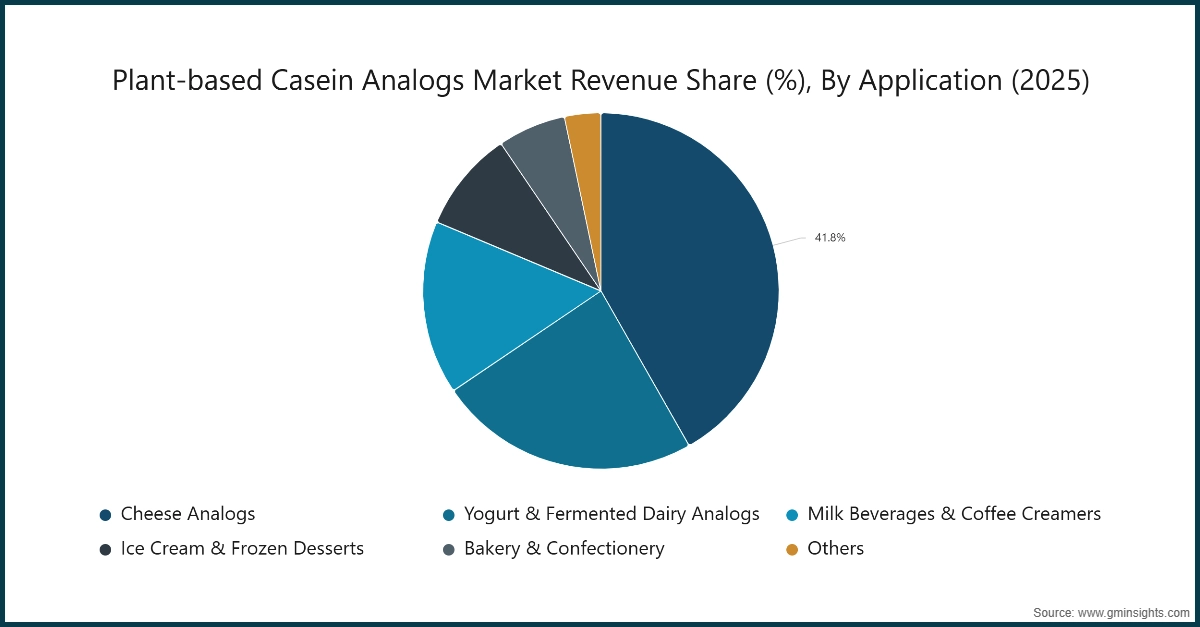
Plant-based casein analogs market based on application is segmented into cheese analogs, yogurt & fermented dairy analogs, milk beverages & coffee creamers, ice cream & frozen desserts, bakery & confectionery, and others. The cheese analogs segment was valued at USD 0.74 billion with a market share of with a market share of 41.8% in 2025, and it is anticipated to expand to 22.2% of CAGR during 2026-2035.
- Increased cheese analogs have a strong association with enhancement of functional performance, especially melt, stretch and mouthfeel. This usage is influencing the need for more precise analogs of casein and sophisticated formulation techniques. Fermented dairy analogs and yogurt are growing in the area of better protein stability at acidic and cultured conditions through improved stability. The applications are affecting protein processing and selection needs.
- Milk drinks and coffee creamers are aiding the growth of volume because of the growing customer approval of plant-based daily-use items. The frozen desserts and ice cream have been enjoying the improved protein behavior of freeze thaw conditions. The bakery and confectionary segments are growing with casein analogs playing a role in the texture, binding and nutritional development. Combined, application diversification is widening the commercial foundation and frequency of usage of the market.
Looking for region specific data?
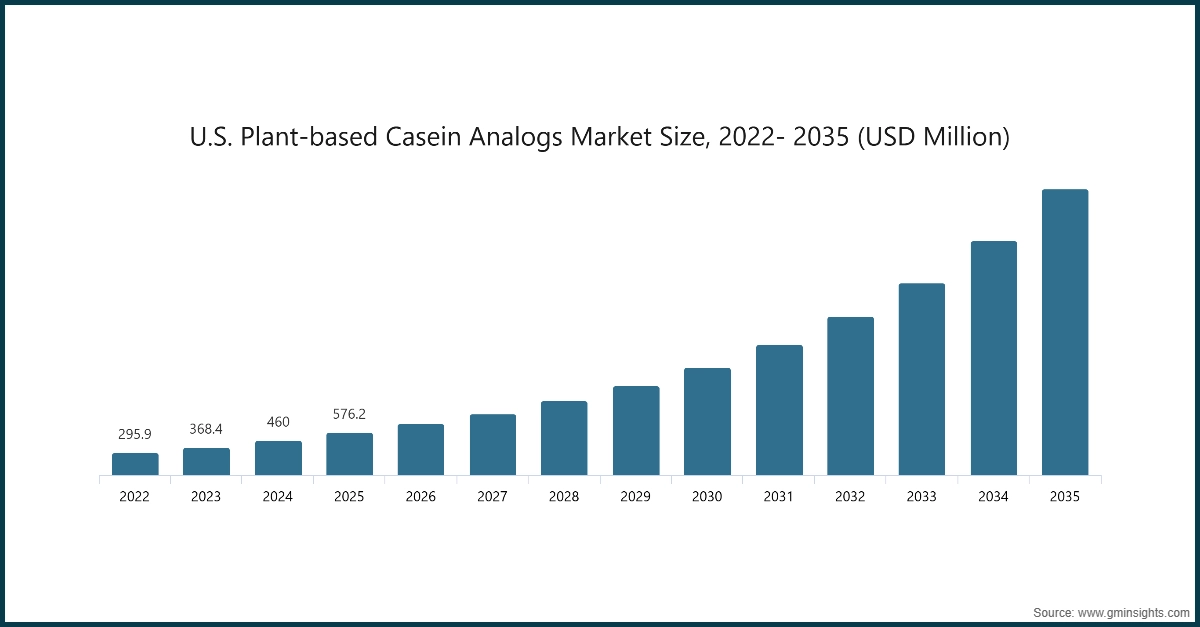
The North America plant-based casein analogs market accounted for USD 0.65 billion in 2025 and is anticipated to show lucrative growth over the forecast period.
The market of the North American plant-based casein analogs is growing steadily because of a high innovation potential, sophisticated food processing facilities, and a high level of using dairy alternatives. The market records rising application of functional proteins in cheese, beverage and nutrition oriented products, which is conducive to steady demand of ingredients. Growth in the U.S. is being influenced by product re-engineering to enhance texture and parity with dairy in terms of sensory. Food brands are incorporating casein analogs that have been obtained through fermentation processes and casein hybrids to manage performance gaps. The close liaisons between ingredient developers and food manufacturers are speeding up commercialization and creating a self-perpetuating market evolution.
The Europe plant-based casein analogs market accounted for USD 0.51 billion in 2025 and is anticipated to show lucrative growth over the forecast period.
The market expansion in Europe is anchored by organized regulatory systems, food policies that are focused on sustainability, and high consumer acceptance of alternative foods produced using plants. Plant-based casein analogs are increasingly being demanded in processed dairy substitutes where functionality is needed. Germany is also becoming a major growth country as it has a strong base of plant-based food production and focus on innovating clean labels. The suppliers of ingredients are paying attention to the advanced processing and fermentation technologies in order to reach the standards of formulations. The orientation of the region in environmental impact minimization and diversification of protein products is strengthening the long-term adoption in most food categories.
Asia Pacific plant-based casein analogs market accounted for 25.3% market share in 2025 and is anticipated to show lucrative growth over the forecast period.
The Asian Pacific market is expanding fast because of the shifting dietary habits, urbanization, and consumption of alternatives of dairy products. Plant-based casein analogs are becoming interesting as the manufacturers are searching functional proteins to fit into localized product forms. The rising interest in nutrition-enhanced foods and the investments in fermentation and protein technologies within the domestic market support the growth in China. Local firms are incorporating casein analogs into soft drink, desserts and hybrid dairy products. Increasing production capacities and innovation programs supported by the government are allowing them to scale-up faster, making the region a significant contributor to growth.
Latin America plant-based casein analogs market is anticipated to grow at a CAGR of 23.9% during the analysis timeframe.
Plant-based casein analogs are being gradually adopted in Latin America, and this can be attributed to growing awareness of the existence of alternative proteins and the growing capacity of food processing plants. The market is emerging in the drinks, bakery, and new dairy analog markets. Brazil is gaining more momentum because it has a good agricultural base and increased investments in the plant protein processing. The manufacturers are looking into the locally sourced inputs in order to produce economically viable formulations. With the growing knowledge of consumers on plant-based products, there is the addition of functional ingredients like casein analogs to enhance texture and nutritional values.
Middle East & Africa plant-based casein analogs market is expected to grow at a CAGR of 17.4% during the analysis timeframe.
MEA market is changing because dietary diversification and food security plans are increasing in importance in the region. The use of the plant-based casein analogs is in demand to make processed foods and dairy substitutes based on the local demand. Saudi Arabia is one of the major growth countries, which can be reinforced by investments in food production and alternative proteins, as well as the ability to produce them locally. The market is enjoying the positive outcome of paying more attention to sustainable food systems and less dependence on imports. Adoption is progressing slowly because manufacturers are working towards viable protein solutions, which are consistent with nutritional and economic policies over the long run.
Plant-based Casein Analogs Market Share
- New Culture, Formo, Imagindairy, Remilk, and Perfect Day are a significant part of the plant-based casein analogs industry and with further standing of being highly consolidated with the top five players steadily holding 54% market share in the year 2025.
- Firms continuously work on the development of R&D to improve plant-based casein analogs in terms of functional performance, improving the textural property, solubility and heat stability to address the application needs of dairy alternatives.
- The application of newer technologies including precision fermentation, enzyme modification, and better extraction processes enable companies to provide proteins that are more functional to dairy caseins, which enhance product portfolios.
- Organizations are constantly expanding products in various forms (powder, liquid, ready-to-use) and customized products to specific applications so that they can meet niche needs in cheese, beverages and cultured foods.
- Food manufacturing strategic partnerships and ingredient innovation make co-development efforts faster, enhance product optimization, and incorporate such plant-based proteins at the beginning of product innovation streams.
- Good quality control system and scalable production processes assure consistent functional activity and supply chain, which builds confidence among brand partners and repeat business.
- Specific business penetration to the emerging markets and a localized ability to gain business acceptance serves to expand its business to new markets other than the traditional ones and grow its presence internationally.
- The focus on lower environmental impact manufacturing and clean-label credentials appeal to end consumers and B2B customers and ingredient positioning can be aligned with overarching corporate sustainability goals.
- Strong application support departments help manufacturers in formulation troubleshooting and optimization, reduced development cycles and long life collaborations.
Plant-based Casein Analogs Market Companies
The major players operating in plant-based casein analogs industry include:
- New Culture
- Formo
- Imagindairy
- Remilk
- Perfect Day
- Others
• New Culture maintains its standby remaining solely in the business of precision fermentation-derived casein optimized to be used in cheese, more specifically, in melt and stretch performance. The company places major emphasis on application specific functionality and works in close association with foodservice and ingredient players to confirm commercial usage. This acute application orientation reinforces its competence to the market of the plant based casein analogs.
• Formo is keeping its position in the market due to its high level of R&D to replicate the traditional dairy casein behavior in substitutes of cheese. The company also matches product development to the requirements of European regulations and cooperates with the local manufacturers of food. This area-based approach helps to achieve gradual adoption and scalability of the market in the long run.
• Imagindairy focuses on efficiency and cost reduction in the precision fermentation process to enable large-scale production of casein analogs. The company does spend money on development of microbial strains to enhance yield and functional consistency. This emphasis on industrial scalability makes it competitive on the supply of ingredients to formulations of dairy analogs.
• Remilk is growing on the platform of fermentation using yeasts which closely mimic the composition of dairy proteins. The firm focuses on increased capacity development and regulatory clearances as a way of facilitating extensive business applications. The strategic partnerships with food and dairy-alternative brands assist in integrating its proteins in various application possibilities.
• Perfect Day has early experience of commercialization and robust B2B ingredient supply model help to hold onto its place. The ongoing development of fermentation technology and formulation facilitating allows the incorporation of different dairy-alternative products. Its wide-ranging system of partnership strengthens impact in the plant-based casein analogs industry.
Plant-based Casein Analogs Market Report Attributes
| Key Takeaway | Details |
|---|---|
| Market Size & Growth | |
| Base Year | 2025 |
| Market Size in 2025 | USD 1.77 Billion |
| Market Size in 2026 | USD 2.14 Billion |
| Forecast Period 2026-2035 CAGR | 22.5% |
| Market Size in 2035 | USD 13.27 Billion |
| Key Market Trends | |
| Drivers | Impact |
| Rising demand for dairy-free cheese and yogurt | Accelerates adoption of casein-mimicking proteins in formulations |
| Growth of vegan and flexitarian populations | Expands consistent consumer base for plant protein alternatives |
| Foodservice shift toward plant-based menus | Increases bulk demand from restaurants and QSR chains |
| Advances in protein structuring technologies | Improves melt, stretch, and texture performance |
| Pitfalls & Challenges | Impact |
| Sensory gap versus animal casein | Limits repeat purchase and brand loyalty |
| High formulation and processing costs | Restricts penetration in price-sensitive markets |
| Clean-label and allergen perception issues | Creates regulatory and consumer trust challenges |
| Opportunities: | Impact |
| Application in premium plant‑based cheese | Improves acceptance in high‑value retail segments |
| Use in functional and fortified foods | Enables protein enrichment with dairy‑like functionality |
| Demand from lactose‑intolerant consumers | Unlocks stable, health‑driven consumption volumes |
| Expansion in coffee and beverage whiteners | Strengthens recurring demand from beverage manufacturers |
| Market Leaders (2025) | |
| Market Leader |
Market Share Approximately 14% |
| Top Players |
Collective Market Share Approximately 54% |
| Competitive Edge |
|
| Regional Insights | |
| Largest Market | North America |
| Fastest growing market | Asia Pacific |
| Emerging countries | China, Japan, India |
| Future outlook |
|
What are the growth opportunities in this market?
Plant-based Casein Analogs Industry News
- On December 15, 2025, Perfect Day announced that its Gujarat, India precision fermentation plant is expected to start operations by the end of 2026, and the introduction will be gradual and controlled through 2027. The geographic extension to the APAC is an important strategic move, as it will allow the company to diversify the supply of its products in the region, as well as to bring fermented whey protein to the dairy alternative markets, which are in the process of development and will provide the company with a better global capacity to produce.
- On January 18, 2024, Imagindairy acquired and put into operation an industrial scale precision fermentation plant with a capacity of over 100,000 L and intends to increase capacity to three times the existing one, reducing past production bottlenecks. This milestone growth signifies your market since it indicates an expansion of manufacturing facilities, which allow the provision of casein and other dairy proteins at competitive prices and facilitate the food brand-wide adoption.
The plant-based casein analogs market research report includes in-depth coverage of the industry with estimates & forecasts in terms of revenue (USD Billion) & (Kilo Tons) from 2022 to 2035, for the following segments:
Market, By Source Type
- Precision Fermentation-derived Casein Analogs
- Plant Protein-based Casein Analogs
- Pea Protein
- Soy Protein
- Whey Protein
- Other plant proteins
- Hybrid Formulations
- Others
Market, By Microbial Host
- Yeast-based Systems
- Bacterial Systems
- Fungal Systems
- Others
Market, By Processing Technology
- Dry Fractionation
- Wet Extraction
- Enzymatic Treatment & Modification
- Supercritical CO₂ Extraction
- Others
Market, By Form
- Powder/Dry Form
- Liquid Concentrate
- Ready-to-use Formulations
Market, By Application
- Cheese Analogs
- Mozzarella Analogs
- Cheddar Analogs
- Cream Cheese Analogs
- Specialty Cheese Analogs
- Yogurt & Fermented Dairy Analogs
- Milk Beverages & Coffee Creamers
- Ice Cream & Frozen Desserts
- Bakery & Confectionery
- Others
The above information is provided for the following regions and countries:
- North America
- U.S.
- Canada
- Europe
- UK
- Germany
- France
- Italy
- Spain
- Rest of Europe
- Asia Pacific
- China
- India
- Japan
- South Korea
- Australia
- Rest of Asia Pacific
- Latin America
- Brazil
- Mexico
- Argentina
- Rest of Latin America
- MEA
- UAE
- Saudi Arabia
- South Africa
- Rest of Middle East and Africa
Frequently Asked Question(FAQ) :
What was the market size of the plant-based casein analogs in 2025?
The market size was USD 1.77 billion in 2025, growing at a CAGR of 22.5% from 2026 to 2035. The market is driven by the rising popularity of plant-based and vegan diets globally.
What is the projected value of the plant-based casein analogs market by 2035?
The market is poised to reach USD 13.27 billion by 2035, fueled by increasing consumer awareness of animal welfare, environmental sustainability, and clean-label products.
What is the expected size of the plant-based casein analogs industry in 2026?
The market size is projected to reach USD 2.14 billion in 2026.
How much revenue did the plant protein-based casein analogs segment generate in 2025?
The plant protein-based casein analogs segment generated USD 0.91 billion in 2025 and is expected to grow at a CAGR of 22.1% till 2035.
What was the valuation of the yeast-based systems segment in 2025?
The yeast-based systems segment was valued at USD 0.84 billion in 2025 and is set to expand at a CAGR of 21.9% through 2035.
What is the growth outlook for the cheese analogs segment from 2026 to 2035?
The cheese analogs segment, valued at USD 0.74 billion in 2025 with a 41.8% market share, is anticipated to observe around 22.2% up to 2035.
Which region leads the plant-based casein analogs sector?
North America leads the market, accounting for USD 0.65 billion in 2025. The region's growth is supported by high innovation potential, advanced food processing facilities, and increasing adoption of dairy alternatives.
What are the upcoming trends in the plant-based casein analogs market?
Key trends include functional ingredient selection, molecular protein customization, clean-label focus, B2B co-development, and demand for multifunctional proteins.
Who are the key players in the plant-based casein analogs industry?
Key players include New Culture, Formo, Imagindairy, Remilk, and Perfect Day.
Plant-based Casein Analogs Market Scope
Related Reports