Summary
Table of Content

Photonic Integrated Circuits for LiDAR Market
Get a free sample of this report
Form submitted successfully!
Error submitting form. Please try again.
Thank you!
Your inquiry has been received. Our team will reach out to you with the required details via email. To ensure that you don't miss their response, kindly remember to check your spam folder as well!
Request Sectional Data
Thank you!
Your inquiry has been received. Our team will reach out to you with the required details via email. To ensure that you don't miss their response, kindly remember to check your spam folder as well!
Form submitted successfully!
Error submitting form. Please try again.
Photonic Integrated Circuits for LiDAR Market Size
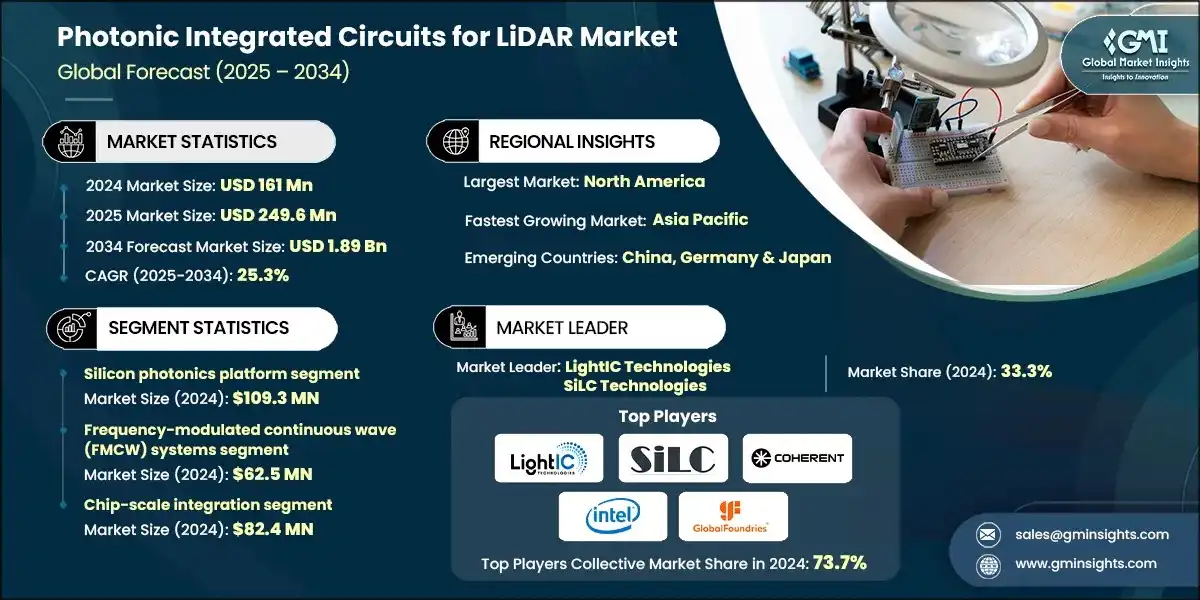
The global photonic integrated circuits for LiDAR market was estimated at USD 161 million with a volume of 3,582 thousand units in 2024. The market is expected to grow from USD 249.6 million in 2025 to USD 1.16 billion in 2030 and USD 1.89 billion by 2034 with a volume of 40,914 thousand units, at a value CAGR of 25.3% and volume CAGR of 24.9% during the forecast period of 2025–2034, according to Global Market Insights Inc.
Photonic Integrated Circuits for LiDAR Market Key Takeaways
Market Size & Growth
- 2024 Market Size: USD 161 Million
- 2025 Market Size: USD 249.6 Million
- 2034 Forecast Market Size: USD 1.89 Billion
- CAGR (2025–2034): 25.3%
Regional Dominance
- Largest Market: North America
- Fastest Growing Region: Enter metric value
Key Market Drivers
- Growing Demand for Autonomous Vehicles.
- Advancements in Laser Technology.
- Introduction of 5g Network.
- Miniaturization of LiDAR Systems.
- Cost Reduction in LiDAR Manufacturing.
Challenges
- High Initial Cost of LiDAR Systems.
- Complexity in Integration with Existing Infrastructure.
Opportunity
- Advancements in Solid-State LiDAR Technology.
- Integration with Artificial Intelligence (AI) and Machine Learning.
Key Players
- Market Leader: LightIC Technologies led with over 33.3% market share in 2024.
- Leading Players: Top 5 players in this market include LightIC Technologies, SiLC Technologies, Coherent Corporation, Intel Corporation, GlobalFoundries, which collectively held a market share of 73.7% in 2024.
Get Market Insights & Growth Opportunities
- The growth in the photonic integrated circuits for LiDAR market is driven by the rise of demand for autonomous vehicles, developments in laser technology, introduction of 5g network, miniaturization of LiDAR systems, and reduced cost of LiDAR systems.
- The increased demand for autonomous vehicles is growing market demand, especially the need for advanced LiDAR for precision navigation and vehicle safety. World Economic Forum states the autonomous vehicle market size was valued at USD 208 billion in 2023 and is estimated to grow to USD 4.2 trillion by 2032, showing that demand and investment is accelerating globally. Autonomous vehicles will directly create demand for photonic integrated circuits for LiDAR, which will improve sensor features.
- The introduction of 5G networks promotes the demand for photonic integrated circuits (PICs) in the LiDAR market because it allows faster and low-latency data to be transmitted, which enhances the performance of autonomous vehicles and in industrial use cases that require real-time data processing. As by the GSM Association, the 5G rollout has grown to be the fastest ever for any mobile generation, with connections over 1.6 billion by the end of 2023, and forecasted to reach over 5.5 billion by 2030. it will be the dominate connectivity technology in the future.
- The North America region dominated with over 39.8% market share in 2024. North America's position of dominance in the photonic integrated circuits for LiDAR market occurs primarily due to their large R&D segment, with many leading tech companies being in the region, as well as their early adopter advantage in autonomous vehicles. According to AVIA data, by mid-2023 U.S. autonomous vehicles had driven over 44 million public road miles - demonstrating real-world deployment of their innovation and technology leadership in both mobility and sensing.
To get key market trends
Photonic Integrated Circuits for LiDAR Market Trends
- Advancements in silicon photonics is a significant trend in the market. This facilitates the merging of photonic devices onto silicon chips resulting in faster and more efficient data processing. The NIST reported in 2021 that silicon photonics integration improved data communication rates by 10 times (in the last 5 years) to 400 Gbps/channel. This has allowed for greater bandwidth, reduced cost, and developed other enhanced high-performance solutions in sectors such as telecommunications, data centers, and autonomous systems. It experienced growth starting from 2015 through 2017 and is expected to reach its peak by approximately 2025 through 2030 in terms of furnishing fast, scalable communication capabilities.
- Rising demand for 3D imaging and mapping in the photonic integrated circuits for LiDAR market started to gain traction between 2015 and 2018, when resolution was an issue with the need for high resolution spatial data. In addition, it is becoming more popular because of the speed, costs, and precision we can achieve with autonomous systems. This is expected to peak around 2025 -2030, as well, and is further promoted by the USGS 3DEP initiative that has provided a USD 13.5 billion return on investment across 1,352 applications as a key driver of the growing role of PICs in developing LiDAR systems that innovate and improve efficiencies within any industry.
- Advancement of AI and machine learning integration into LiDAR systems is a major trend that started in 2018 and peaked at the 2023 – 2025 timeframe. This allows for smarter, faster, and very precise geospatial analysis with accuracy in flood mapping at 89% with good results in forestry and species classification. Commonly used in government and commercial applications, it promotes automation, decision-making, and operational efficiency in mapping and navigation.
Photonic Integrated Circuits for LiDAR Market Analysis
Learn more about the key segments shaping this market
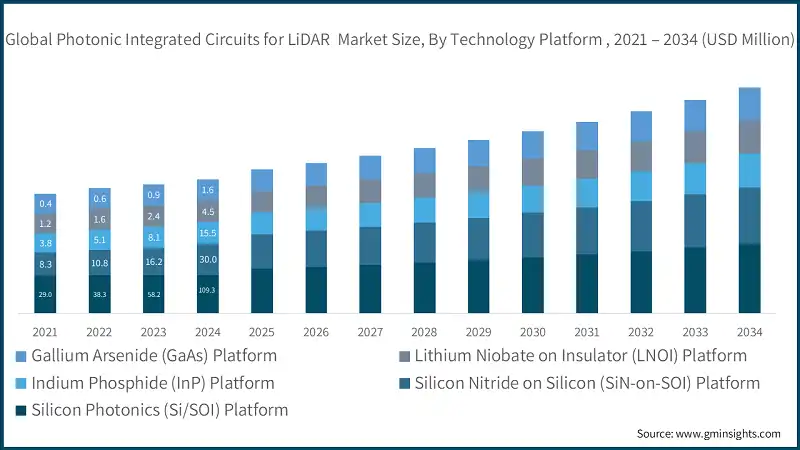
Based on the technology platform, the market is bifurcated into silicon photonics (si/soi) platform, silicon nitride on silicon (sin-on-soi) platform, indium phosphide (inp) platform, lithium niobate on insulator (lnoi) platform and gallium arsenide (gaas) platform.
- The silicon photonics platform segment was the largest market and was valued at USD 109.3 million in 2024, is driven by a growing need for high-speed data transmission, optical communication systems, and small form factor devices. Trends in integrated circuits, low-cost manufacturing, and telecommunications are other drivers of market growth.
- Device manufacturer should focus on advancing silicon photonics integration for high-speed data transmission, small form factor designs, and cost-effective manufacturing. Invest in telecommunications infrastructure and optical communication systems to meet the market's growing demand for speed and efficiency.
- The indium phosphide (InP) platform segment is anticipated to grow with a CAGR of 28.3% during the forecast period of 2025 – 2034. This growth is driven by an ever-increasing demand for high performance optical devices, especially in telecommunications, data centers, and LiDAR systems. The indium phosphide (InP) platform enables high efficiency, high speed data transmission, and small form factor integration, making it an enabling technology for the next generation of photonic devices.
- Manufacturer of devices should make it a primary focus to advance InP-based technology platforms and improve their integration into existing technology and increase the data transmission speeds. Investments into the telecommunications, LiDAR, and high-performance optics markets will meet the growing demand for high-speed efficient optics.
Learn more about the key segments shaping this market
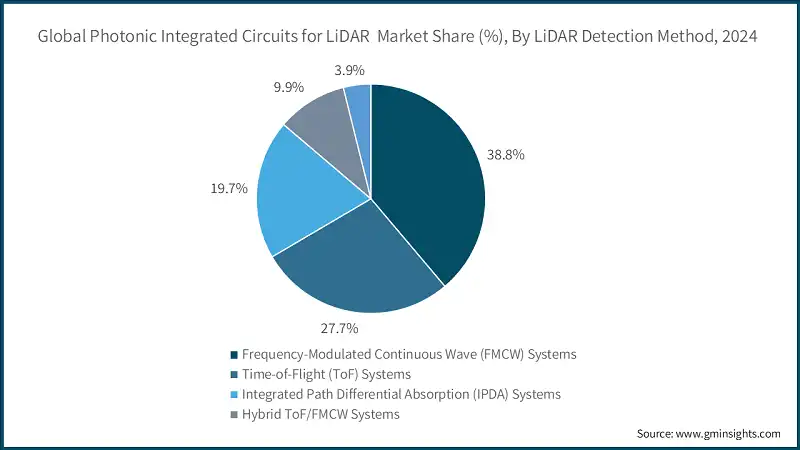
On the basis of LiDAR detection method, the photonic integrated circuits for LiDAR market is segmented into frequency-modulated continuous wave (fmcw) systems, time-of-flight (tof) systems, integrated path differential absorption (ipda) systems, hybrid tof/fmcw systems and others.
- The frequency-modulated continuous wave (FMCW) systems segment was the largest market and was valued at USD 62.5 million in 2024. This expansion is due primarily to the increasing demands for high-resolution LiDAR systems, automotive safety, and autonomous vehicles. So-called FMCW systems supply accurate measurements of distance, have extended measurement ranges, and have low power consumption which makes them excellent candidates for advanced sensing applications.
- Companies should invest in developing FMCW LiDAR technologies, ensuring mission critical objectives concerning range accuracy, miniaturization, and cost effectiveness are prioritized. Investments will continue to be made for applications in autonomous vehicles, automotive safety systems of function in much larger growing markets as demand increases
- The time-of-flight (ToF) systems segment is the fastest growing market and is anticipated to grow with a CAGR of 23.2% during the forecast period of 2025 – 2034. This market is driven by the increasing demands for high-accuracy 3D imaging, LiDAR systems for autonomous vehicles, and smart devices. The capability of time-of-flight (ToF) sensors allow for accurate distance measurement, real-time sensing, and a higher overall performance from various applications.
- Manufacturers need to work on ToF sensor performance, especially in terms of accuracy and range but have very much to do to bring costs down. Chips for an autonomous vehicle and smart devices may also want to consider applications to provide the real-time 3D imaging that is coming into demand.
On the basis of integration level, the photonic integrated circuits for LiDAR market is categorized into chip-scale integration, multi-chip module integration and hybrid assembly integration.
- The chip-scale integration segment was the largest market and was valued at USD 82.4 million in 2024. This field is being driven by the increasing need for compact, high-performance systems to allow for better cost-effective production and increased integration of systems in LiDAR, telecommunications, and consumer electronics. With chip-scale integration, compact sizes will lead to better efficiency via better system design.
- Companies need to continue to advance chip scale integration to allow smaller form factors, increase safety and increase cost efficiencies. Any advance with better performance, scalable, or wireless features of existing technologies will help mitigate increased needs in LiDAR, telecommunication, and consumer electronics.
- The hybrid assembly integration is anticipated to grow with a CAGR of 25.5% during the forecast period of 2025 – 2034. Growth opportunity in this field is driven by increasing demand for sophisticated, compact, and high-performance systems. Integration of hybrid assemblies help provide cost-effective designs by integrating many components into one fully functioning and efficient unit and it covers several categories namely LiDAR systems, automotive and consumer electronics, respectively.
- Companies need to look at improving hybrid assembly integration to enhance the viability of the component, increase cost, and performance. Addressing seamless integration, cost effectiveness, or miniaturization will support growing needs in LiDAR, automotive, or consumer electronics.
Looking for region specific data?
North America market was valued at USD 64 million in 2024 and is anticipated to grow with a CAGR of 25% during the forecast period of 2025 – 2034. The dominance of North America in the photonic integrated circuits for LiDAR market is primarily due to the massive R&D segment, with many leading tech companies located in the region, and an early adopter advantage with respect to autonomous vehicles.
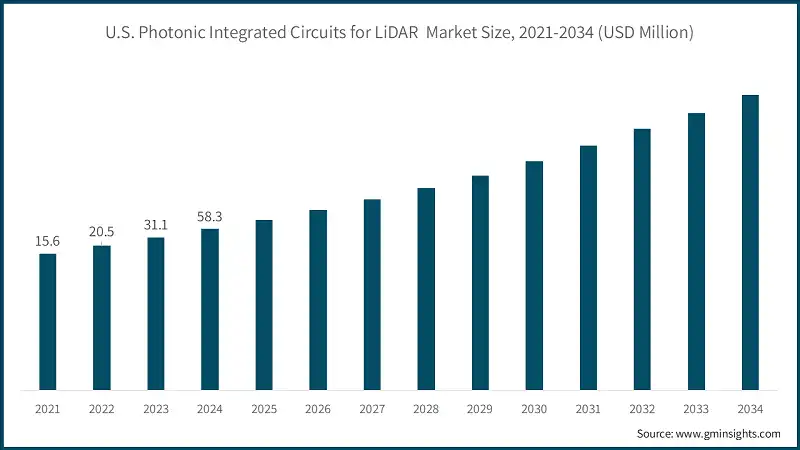
- U.S. dominated the photonic integrated circuits for LiDAR industry and was valued at USD 58.3 million in the year 2024, is driven by high demand for autonomous vehicles, leading semiconductor companies, smart infrastructure, and increased data centre demands, with a specific focus on innovation and next generation sensing technologies.
- Manufacturers must push forward photonic technology advancement, scale technologies for smart infrastructure, develop data centres solutions, and leverage strong relationships with semiconductor companies to meet the increased demand and stay competitive.
- The photonic integrated circuits for LiDAR market in Canada is anticipated to surpass USD 57.9 million by 2034. The Canadian market is particularly benefitting the rollout of 5G networks that promote more connectivity, demand for precision agriculture, and government support for photonic technologies in conjunction with universities and technology companies. All of this is leading to an increased rate of innovation and advanced LiDAR systems adoption.
- Companies should focus on developing advanced LiDAR systems for 5G enabled, maximizing government investments, expanding precision agriculture technologies, and developing solid collaboration with universities and, technology companies to accelerate innovations and meet industry demand.
The photonic integrated circuits for LiDAR market in Europe is anticipated to grow with a CAGR of 24.6% during the forecast period of 2025 – 2034. The European market is growing by a heightened demand in industrial automation, emphasis on urban mobility and transportation, increased IoT-enabled smart devices, and the momentum from governments incentivizing green technologies which are fostering innovation and adoption in several industries.
- Germany photonic integrated circuits for LiDAR market was valued at USD 8.2 million in the year 2024, is being driven by solid automotive demand, advancements in industrial automation, integration with robotics, and substantial investments to develop autonomous vehicle and Smart infrastructure.
- Manufacturers should focus on advance LiDAR technology for automotive applications, accelerate industrial automation solutions, advancements with robotics, and will want to align with Germany’s increased push for smart infrastructure, and proliferation of autonomous vehicles, to remain competitive.
- UK photonic integrated circuits for LiDAR market is anticipated to surpass USD 73.9 million by 2034. UK market growth is occurring due to the emergence of UK based technology startups, increased market adoption of smart infrastructure technology, increased demand for environmental monitoring systems, and an increased focus on precision agriculture and robotics.
- Companies should prioritize collaborating with UK tech startups, developing smart infrastructure solutions, expanding environmental monitoring applications, and advancing precision agriculture and robotics to capitalize on market growth and innovation opportunities.
The photonic integrated circuits for LiDAR market in Asia Pacific is the largest market was valued at USD 57.6 million in 2024. The growing demand for electric vehicle production, increased military/defense applications, and growing demand for precision monitoring technologies contribute to the growth of the market in the Asia-Pacific region.
- China market is projected to reach USD 285.9 million by the year 2034. The photonic integrated circuits for LiDAR market in China is benefitting from large investment in AI and automation, growing demand for 3D mapping technologies, increased urban surveillance needs and an expanding smart manufacturing and robotics market.
- Chinese manufacturers should align their strategic direction to exploit the rising popularity of autonomous vehicles, AI-focused automation, advance 3D mapping, and smart infrastructure development of cities. Invest in R&D, expand production capabilities, and build strategic partnerships for greater market share in the global LiDAR market.
- The photonic integrated circuits for LiDAR market in Japan was valued at USD 8.1 million in 2024, is growing, stemming from the growing demand for robotic automation systems, growing interest in sustainable transport solutions, and the growth of space exploration initiatives in Japan.
- Manufacturers should leverage Japan's advanced robotics, sustainable transportation, and space exploration initiatives. By increasing R&D and innovation in LiDAR for automation applications, enhancing precision manufacturing initiatives, and anticipating government-backed initiatives.
- India photonic integrated circuits for LiDAR market is anticipated to grow with a CAGR of over 27.3% during the forecast period of 2025-2034. The India Market for photonic integrated circuits for LiDAR is also experiencing rapid growth due to an increase in manufacturing of electric vehicles, expansion of monitoring of renewable energy initiatives, significant growth in traffic and surveillance systems, and enhancements in efficiency in the supply chain and warehousing.
- Manufacturers should support development of LiDAR solutions for electric vehicle applications, increased functionality of monitoring applications for renewable energy, enhance traffic and surveillance systems, and support automation in the logistics and warehousing sector in order to capitalize on India's rapid growth in photonic integrated circuits for LiDAR.
The photonic integrated circuits for LiDAR market in Latin America was valued at USD 2.7 million in 2024. Growth of the Latin America market is driven by the expansion of smart grid and energy management systems, increased implementation of automated agricultural techniques and precision farming technology, and the advancement of drones for agricultural practices.
MEA photonic integrated circuits for LiDAR market is projected to surpass USD 34.5 million by 2034. The increase in the region is being fueled by a growing demand for smart infrastructure solutions, a boom in urban construction and development, the rise of 5G and IoT, and increased demand for high-precision mapping solutions.
- South Africa photonic integrated circuits for LiDAR market was valued at USD 0.6 million in 2024. The growth in South Africa's market is being driven by the expansion of precision agriculture technology being adopted, the rising use-case for 3D mapping solutions, and a push to upgrade public transportation infrastructure.
- Companies to focus on developing LiDAR solutions for precision agriculture, work toward enhancing 3D mapping technologies, and provide support for public transportation infrastructure. Further, there are also opportunity for companies to place a heavy emphasis on R&D for mine applications and engage with government initiatives to leverage growth opportunities in the South African market.
- The photonic integrated circuits for LiDAR market in Saudi Arabia is projected to grow with a CAGR of 25.1% during the forecast period of 2025-2034. Saudi Arabia's market growth is being driven by Government-backed Vision 2030 initiatives, an increased uptake of renewable energy projects, growth in defence and surveillance technologies, and a focus on automation and robotics for industrial development.
- Companies should make advanced LiDAR solutions for smart cities, autonomous vehicles, and defence technologies a priority in their alignment with Saudi Arabia's Vision 2030 program. It'll also be suitable for them to make investments in renewable energy projects, robotics, and industrial automation projects, to take advantage of new opportunities.
- The photonic integrated circuits for LiDAR market in UAE is anticipated to surpass USD 10.4 million by 2034. The growth of the photonic integrated circuits for LiDAR industry in the UAE will be supported by futuristic urban city developments, aerospace and aviation developments, and the increased need for smart logistics as well as the increased adoption of 5G and IoT across multiple user segments.
- Manufacturers should place a priority on advanced LiDAR technologies for use in autonomous transport and smart cities that support precision in aerospace applications, facilitate smart logistics implementation and support the adoption of the UAE’s 5G and IoT infrastructure to remain viable.
Photonic Integrated Circuits for LiDAR Market Share
- The photonic integrated circuit market for LiDAR is highly fragmented and competitive with multiple exhibiting complaints. The key players within the photonic integrated circuits for LiDAR market include LightIC Technologies, SiLC Technologies, Coherent Corporation, Intel Corporation, and GlobalFoundries. The combined total market share for these corporations is 73.7% in 2024.
- LightIC Technologies leads the photonic integrated circuits (PICs) for LiDAR market with an 18.2% share in 2024. Their advanced, high-performance PIC solutions offer superior efficiency, range, and precision, driving innovation in autonomous vehicles and industrial applications. LightIC’s cost-effective, scalable solutions position them as a key market leader.
- SiLC Technologies holds a 15.1% share in 2024 in the photonic integrated circuits (PICs) for LiDAR market. These sensors can deliver higher resolution and improved accuracy, particularly for autonomous vehicles and 3D imaging. SiLC's innovative technology will provide real-time sensing capabilities, thus establishing them as an important player in emerging industries such as automotive and robotics.
- Coherent Corporation also holds a 14.8% market share in the PICs for LiDAR sector in 2024. Their strategy focuses on delivering high-precision lasers and photonic devices for LiDAR systems, emphasizing long-range, accurate sensing capabilities. With applications spanning automotive, industrial, and scientific sectors, Coherent’s advanced laser technology enhances system performance, offering superior range and reliability, making them a major competitor in the LiDAR market.
- Intel Corporation captures 14.2% market share in 2024, through their silicon photonics platform development and foundry services, they signify the interface of advanced semiconductor manufacturing and photonic technology. Intel’s position in the market reflects its large investment in the research and development of silicon photonics technology and its ability to leverage its existing semiconductor manufacturing supply chain to mitigate photonic solutions. This company places an emphasis on platform scalability with a commitment to lower the manufacturing cost by utilizing a high-volume manufacturing process.
- GlobalFoundries secured an 11.4% market share in the photonic integrated circuits (PICs) for LiDAR market in 2024, providing specialized foundry services. Their expertise in semiconductor fabrication ensures reliable, high-performance PIC production, supporting miniaturization and scalability. By focusing on cost-effective manufacturing and robust supply chains, GlobalFoundries plays a crucial role in driving the mass adoption of advanced LiDAR technologies across automotive and industrial sectors.
Photonic Integrated Circuits for LiDAR Market Company
The top prominent companies operating in the photonic integrated circuits for LiDAR industry include:
- LightIC Technologies
- SiLC Technologies
- Coherent Corporation
- Intel Corporation
- GlobalFoundries
- X-FAB Silicon Foundries
- LIGENTEC
- Rockley Photonics
- Ayar Labs
- Scintil Photonics
- IBM
- TSMC
- STMicroelectronics
- Tower Semiconductor
- AMS (Osram)
- Effect Photonics
- VLC Photonics (Hitachi High-Tech)
- Hamamatsu Photonics
- Infinera Corporation
- Cisco Systems (Acacia)
Coherent Corporation, Intel Corporation, GlobalFoundries, TSMC, and STMicroelectronics are the market leaders who innovate the industry through a combination of robust manufacturing scale and advanced research and development (R&D). These companies control large market share, create industry standards, and consistently demonstrate advancements in performance, power, and integration. Their goal is to protect their current market share, market position, and future market share through the development and introduction of novel technology for telecommunications, LiDAR, optical communications, and positioning of these solutions in strategic high-growth markets.
SiLC Technologies, Ayar Labs, Rockley Photonics, X-FAB Silicon Foundries, and IBM are the challengers to the market leader for innovation, research and development (R&D), price performance, and new technology. They are focused on differentiation and aggressive market share expansion into new market segments such as photonic integrated circuits (PICs) and autonomous vehicle applications.
LightIC Technologies, LIGENTEC, Effect Photonics, VLC Photonics (Hitachi High-Tech), and Hamamatsu Photonics operate as niche players, specializing in high-performance, custom photonic solutions for specific industries. Their focus is on LiDAR, high-precision optical sensing, and other specialized fields. They excel in providing innovative products tailored to specific market needs, offering advanced technologies that push the envelope of optical performance for select applications.
Photonic Integrated Circuits for LiDAR Market Report Attributes
| Key Takeaway | Details |
|---|---|
| Market Size & Growth | |
| Base Year | 2024 |
| Market Size in 2024 | USD 161 Million |
| Market Size in 2025 | USD 249.6 Million |
| Forecast Period 2025-2034 CAGR | 25.3% |
| Market Size in 2034 | USD 1.89 Billion |
| Key Market Trends | |
| Drivers | Impact |
| Growing Demand for Autonomous Vehicles | Drives 25% of market growth as the rise of autonomous vehicles accelerates the need for LiDAR in navigation and obstacle detection systems. |
| Advancements in Laser Technology | Drives 22% of market growth as improved laser performance enhances LiDARs accuracy and range, boosting its adoption in various sectors. |
| Introduction of 5g Network | Drives 20% of market growth by enabling real-time data transmission for LiDAR, boosting the performance of autonomous vehicles and industrial applications with faster, low-latency processing capabilities. |
| Miniaturization of LiDAR Systems | Drives 18% of market growth as smaller, lighter, and more cost-effective LiDAR systems expand their use across diverse applications. |
| Cost Reduction in LiDAR Manufacturing | Drives 15% of market growth as lower manufacturing costs make LiDAR more affordable, leading to wider deployment in commercial and consumer markets. |
| Pitfalls & Challenges | Impact |
| High Initial Cost of LiDAR Systems | Restrains 18% of market growth due to significant capital investment needed for system acquisition, setup, and ongoing maintenance, hindering adoption in cost-sensitive sectors like transportation and logistics. |
| Complexity in Integration with Existing Infrastructure | Limits 15% of growth as challenges in adapting legacy systems to advanced LiDAR and 5G technologies slow down deployment in industries like automotive and industrial automation. |
| Opportunities: | Impact |
| Advancements in Solid-State LiDAR Technology | Enable compact, durable, and affordable sensors with no moving parts, enhancing reliability and mass production. This drives wider adoption in autonomous vehicles, robotics, and smart infrastructure, boosting market growth and innovation. |
| Integration with Artificial Intelligence (AI) and Machine Learning | Creates new opportunities by enhancing LiDAR’s ability to process complex data in real-time, improving autonomous driving, robotics, and industrial automation, leading to more efficient and intelligent systems across multiple sectors. |
| Market Leaders (2024) | |
| Market Leaders |
Top 2 company accounts for 33.3% |
| Top Players |
Collective market share in 2024 is 73.7% |
| Competitive Edge |
|
| Regional Insights | |
| Largest Market | North America |
| Fastest Growing Market | Enter metric value |
| Emerging Countries | China, Germany & Japan |
| Future outlook |
|
What are the growth opportunities in this market?
Photonic Integrated Circuits for LiDAR Industry News
- In 2024, SiLC Technologies closed its Series B raise, securing assets to spur the commercialization of automotive LiDAR systems, and use proceeds to scale up manufacturing operations, and support more automotive OEM qualification programs as part of SiLC’s involvement in the development of the autonomous vehicle market.
- In 2024, LightIC Technologies made important progress in the Photonic Integrated Circuits (PICs) for LiDAR market announce the general availability of its silicon photonics FMCW LiDAR technology for automotive applications.
- In 2021, SiLC Technologies introduced the Monolithic CMOS Photonic Integrated Circuits for high-performance, long-range LiDAR applications. The intended applications are autonomous vehicles and robots where 3D sensing and distance measurement are fundamental.
The photonic integrated circuits for LiDAR market research report includes in-depth coverage of the industry with estimates and forecasts in terms of revenue (USD Million) and volume (Thousand Units) from 2021 – 2034 for the following segments:
Market, By Technology Platform
- Silicon photonics (SI/SOI) platform
- Silicon nitride on silicon (SIN-ON-SOI) platform
- Indium phosphide (INP) platform
- Lithium niobate on insulator (LNOI) platform
- Gallium arsenide (GAAS) platform
Market, By LiDAR Detection Method
- Frequency-modulated continuous wave (FMCW) systems
- Time-of-flight (TOF) systems
- Integrated path differential absorption (IPDA) systems
- Hybrid TOF/FMCW systems
Market, By Beam Steering Technology
- Optical phased arrays (OPAS)
- Focal plane arrays (FPAS)
- Mems-integrated steering
- Electro-optic beam steering
- Fixed beam/no steering applications
Market, By Wavelength
- 905nm band systems
- 1310nm band systems
- 1550nm band systems
- other wavelengths
Market, By Integration Level
- Chip-scale integration
- Multi-chip module integration
- Hybrid assembly integration
Market, By Application
- Adas & autonomous driving applications
- Industrial automation & robotics applications
- Surveillance & security applications
- Consumer electronics integration applications
- Environmental monitoring applications
Market, By End Use Industry
- Automotive industry
- Aerospace & defense industry
- Industrial manufacturing industry
- Consumer electronics industry
- Scientific & research institutions
The above information is provided for the following regions and countries:
- North America
- U.S.
- Canada
- Europe
- Germany
- Uk
- France
- Spain
- Italy
- Netherlands
- Asia Pacific
- China
- India
- Japan
- Australia
- South Korea
- Latin America
- Brazil
- Mexico
- Argentina
- Middle East and Africa
- Saudi Arabia
- South Africa
- UAE
Frequently Asked Question(FAQ) :
What is the market size of photonic integrated circuits for LiDAR in 2024?
The market size was USD 161 million and 3,582 thousand units in 2024, driven by the growing demand for autonomous vehicles and advancements in laser technology.
What is the current photonic integrated circuits for LiDAR market size in 2025?
The market size is projected to reach USD 249.6 million in 2025.
What is the projected value of the photonic integrated circuits for LiDAR market by 2034?
The market is expected to reach USD 1.89 billion by 2034, growing at a CAGR of 25.3% during 2025–2034, fueled by advancements in solid-state LiDAR technology and integration with AI and machine learning.
How much revenue did the silicon photonics platform segment generate in 2024?
The silicon photonics platform segment generated USD 109.3 million in 2024, driven by the need for high-speed data transmission, optical communication systems, and small form factor devices.
What was the valuation of the frequency-modulated continuous wave (FMCW) systems segment in 2024?
The FMCW systems segment was valued at USD 62.5 million in 2024, driven by increasing demand for high-resolution LiDAR systems, automotive safety, and autonomous vehicles.
Which region leads the photonic integrated circuits for LiDAR market?
The United States dominated the market with a valuation of USD 58.3 million in 2024. This growth is driven by high demand for autonomous vehicles, leading semiconductor companies, and advancements in smart infrastructure and next-generation sensing technologies.
What are the upcoming trends in the photonic integrated circuits for LiDAR industry?
Key trends include the adoption of solid-state LiDAR technology, integration with AI and machine learning, and advancements in miniaturization and cost-effective manufacturing processes.
Who are the key players in the photonic integrated circuits for LiDAR market?
Key players include LightIC Technologies, SiLC Technologies, Coherent Corporation, Intel Corporation, GlobalFoundries, X-FAB Silicon Foundries, LIGENTEC, and Rockley Photonics.
Photonic Integrated Circuits for LiDAR Market Scope
Related Reports