Summary
Table of Content

Pet Wearables Market
Get a free sample of this report
Form submitted successfully!
Error submitting form. Please try again.
Thank you!
Your inquiry has been received. Our team will reach out to you with the required details via email. To ensure that you don't miss their response, kindly remember to check your spam folder as well!
Request Sectional Data
Thank you!
Your inquiry has been received. Our team will reach out to you with the required details via email. To ensure that you don't miss their response, kindly remember to check your spam folder as well!
Form submitted successfully!
Error submitting form. Please try again.
Pet Wearables Market Size
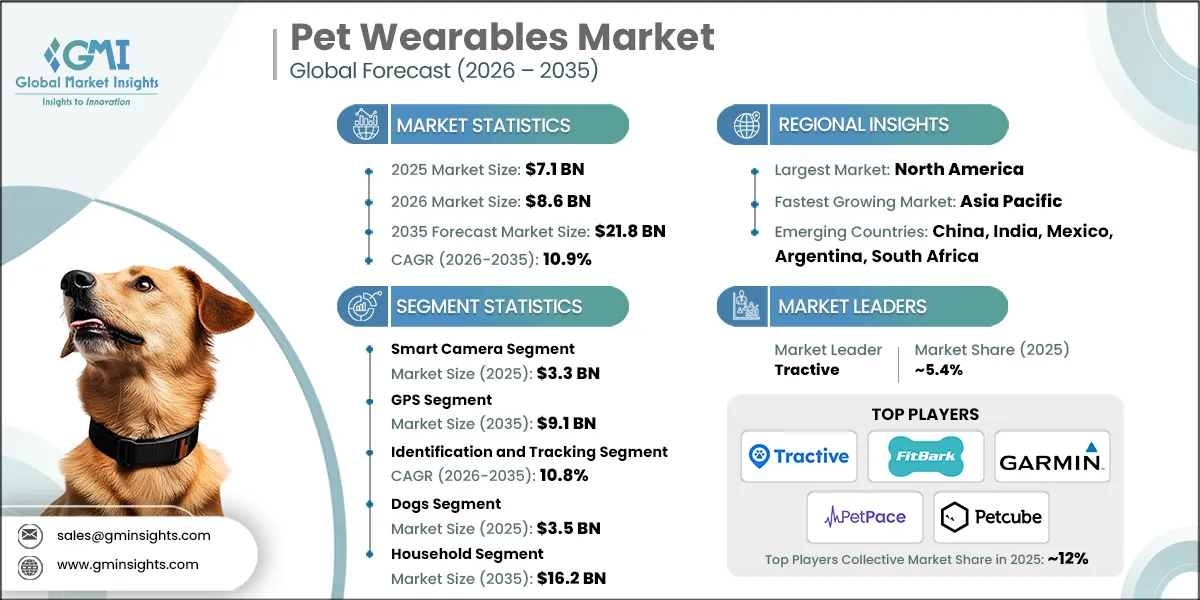
The global pet wearables market was valued at USD 7.1 billion in 2025. The market is expected to grow from USD 8.6 billion in 2026 to USD 21.8 billion in 2035, growing at a CAGR of 10.9% during the forecast period, according to the latest report published by Global Market Insights Inc.
Pet Wearables Market Key Takeaways
Market Size & Growth
- 2025 Market Size: USD 7.1 Billion
- 2026 Market Size: USD 8.6 Billion
- 2035 Forecast Market Size: USD 21.8 Billion
- CAGR (2026–2035): 10.9%
Regional Dominance
- Largest Market: North America
- Fastest Growing Region: Asia Pacific
Key Market Drivers
- Increased pet ownership and humanization of pets.
- Growing awareness of pet health and wellness.
- Technological advancements in IoT and AI-powered devices.
- Supportive digital and regulatory environment.
Challenges
- Technical limitations and performance gaps.
- Premium pricing of advanced wearables.
Opportunity
- AI-driven pet behavior and training solutions.
- Growth of connected veterinary ecosystems.
Key Players
- Leading Players: Top 5 players in this market include Tractive, FitBark, Garmin, PetPace, Petcube with a collective market share of 12%.
Get Market Insights & Growth Opportunities
The growth of the pet wearables market is primarily driven by a combination of factors, including the rapid expansion of the global pet population, rising household income, increased spending on pets, and the availability of several tech-friendly products for pets. For instance, according to Health for Animals, the global pet population exceeds one billion worldwide. Households in countries such as the U.S., Brazil, Europe, and China alone are home to around half a billion dogs and cats, while more than half the world estimated to have at least one pet at home.
The shift towards pet humanization where owners increasingly consider pets as a part of their family, has increased the average amount spent per household on pets. For example, according to the American Veterinary Medical Association, dog owners spent an average of USD 598, cat owners spent USD 529, and other pet owners spent USD 552 in 2025 on their pets. Thus, the growing volume of pets and the willingness of pet owners to spend on pet wearables are contributing to the market growth. Moreover, growing awareness among pet owners regarding health monitoring and preventive care has enhanced the acceptance of these solutions, further fostering the growth of this market.
The pet wearables market refers to the global industry focused on devices designed to monitor, track, and enhance the health, safety, and well-being of pets. These smart devices, such as GPS collars, activity trackers, health‑monitoring sensors, and RF-based locating tags, function using various technologies such as GPS, RFID, Bluetooth, and advanced sensor systems to provide real-time insights into pet location, activity, and biometric indicators. Wearables enable functions such as geofencing, remote monitoring, behavior analysis, and early health detection, reflecting a shift toward more connected, technology-enabled pet care.
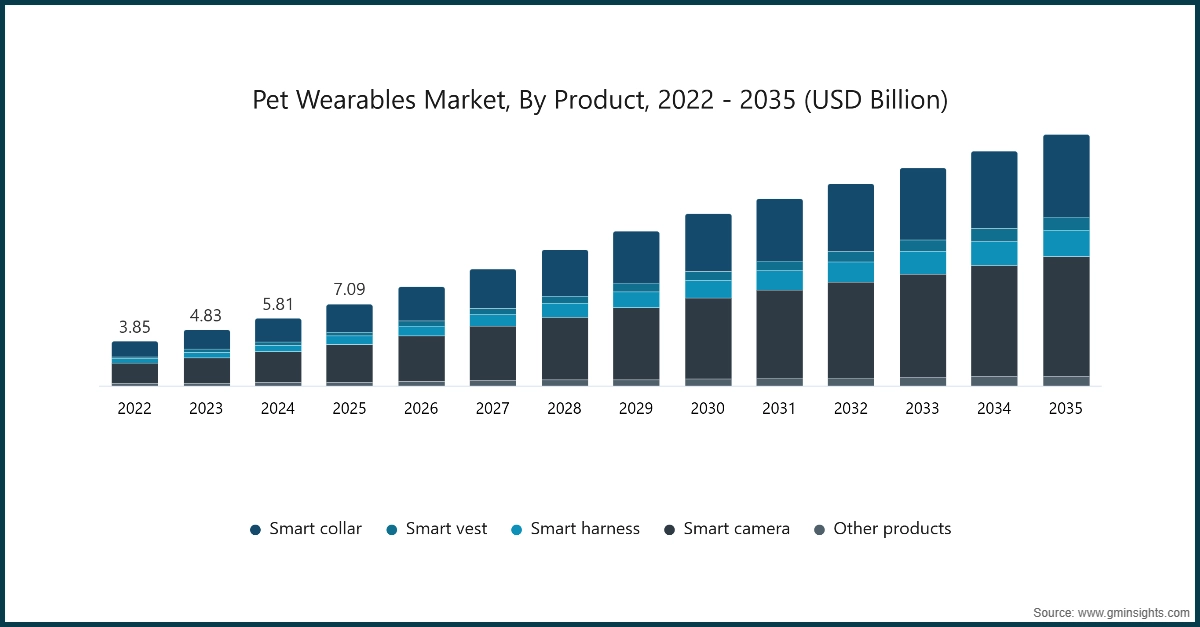
Between 2022 and 2024, the global pet wearables market witnessed considerable growth, growing from USD 3.8 billion in 2022 to USD 5.8 billion in 2024. Factors such as increasing integration of IoT technologies, improvements in sensor accuracy, and heightened focus on pet wellness, safety, and preventive care increased the adoption of pet wearable devices during this period. A rise in pet adoption during the pandemic further increased the demand for various pet care products, including pet wearables.
Market players operating in the pet wearables market include a mix of established technology brands along with emerging, specialized pet‑tech innovators. Top players such as FitBark, Tractive, Garmin, PetPace, and Loc8tor, continue to advance the market through investments in research and development, sensor innovation, and integrated health‑tracking ecosystems. These companies offer a range of devices from GPS trackers and smart dog collars to clinical-grade biometric sensors that enhance pet safety, enable data-driven health insights, and support remote veterinary interactions.
To get key market trends
Pet Wearables Market Trends
- The growing population of pets and humanization has positively influenced the pet wearables industry growth. High disposable income has further augmented the spending on animal healthcare.
- According to recent data, nearly 68% of households in the U.S. at present own a pet. Similarly, as per the American Veterinary Medical Foundation (AVMF), the most common category of total income among dog owners was in the USD 50,000 - 74,999 range for both 2023 and 2024, while the most common category of total income among cat owners was in the USD 30,000 or less range for both years. This has created a substantial demand for pet care products, including pet tech, that are set to proliferate the industry growth.
- These devices such as pet health tracking monitors, GPS trackers, smart pet collars, vests, smart cameras, etc., help the owners to better care for their pets. Thus, as the awareness among pet owners is rising, the demand for such products is also high.
- In addition, a rise in disposable income and the willingness of pet owners to spend on their pets are other crucial factors driving the adoption of various wearable pet products.
- Majority of pet owners consider their pets as family members; hence, they undertake numerous efforts to take proper care of their pets. This created tremendous opportunities for the growth of this sector, leading to a high demand for these products.
- Additionally, pet wearables have features for health monitoring and vital sign tracking. These devices can collect information and identify potential health issues with a pet. These help the owners keep an eye on their pet’s health and act when necessary.
- Also, the ability of these devices to assist pet owners in tracking their pet’s location, health, and activity in real-time through a connected mobile application makes it easier for them to manage the care routine of their pets. All these factors together aid in the market growth.
Pet Wearables Market Analysis
Learn more about the key segments shaping this market
The global pet wearables market was valued at USD 3.8 billion and USD 4.8 billion in 2022 and 2023, respectively. The market size reached USD 7.1 billion in 2025, growing from USD 5.8 billion in 2024.
Based on the product, the pet wearables market is segmented into smart collar, smart vest, smart harness, smart camera, and other products. The smart camera segment dominated the market and was valued at USD 3.3 billion in 2025.
- Smart cameras are witnessing high adoption, supported by increasing demand for remote pet monitoring and real‑time interaction capabilities that allow owners to observe and engage with pets when away from home.
- The incorporation of advanced sensors, video functions, and communication technologies such as Wi-FI and IoT functionality improves real-time data communication for behavior tracking, safety monitoring, and activity analysis.
- The segment also benefits from expanding use cases across home monitoring and pet safety, as pet owners increasingly seek smart, connected devices that ensure their pets’ well‑being even when unsupervised.
- Smart collars, on the other hand, held seconds-largest market share of 34.3% in 2025. These collars provide constant connectivity features, geofencing alerts, and smartphone app control, making them a preferred choice for pet tracking purposes both in and out of home environments.
- Furthermore, their wide applications that include location and basic activity tracking features enhance their adoption.
Based on the technology, the pet wearables market is categorized into RFID devices, GPS, sensors, and Bluetooth. The GPS segment accounted for the highest market share in 2025 and is expected to reach USD 9.1 billion by 2035.
- GPS-based devices hold a considerable market share, supported by their central role in real‑time tracking, geolocation, geofencing, and hybrid connectivity solutions. The integration of GPS together with other technologies serves to overcome gaps in coverage and improve user satisfaction, therefore driving its adoption across leading pet wearable products.
- Moreover, GPS-enabled devices have increasingly been used by pet owners as they allow remote monitoring, safety, and prevention of pet loss.
- In addition, integration of GPS into a wide range of products such as smart collars, pet tags, and other connected tracking solutions, has further strengthened its market share.
- On the other hand, sensor‑based technologies are the fastest‑growing segment, stimulated by the rapid advancements in biometric, motion, and health‑monitoring sensors.
- Modern devices increasingly integrate non‑invasive sensors to continuously monitor vital signs, activity levels, behavior patterns, and health indicators.
Based on the application, the global pet wearables market is segmented into medical diagnosis and treatment, identification and tracking, fitness monitoring, and behavior monitoring and control. The identification and tracking segment accounted for the highest market share in 2025 and is projected to grow at a CAGR of 10.8% during the analysis period.
- The identification and tracking segment holds a dominating position as it plays a crucial role in pet loss prevention and location tracking using GPS and hybrid connectivity solutions.
- For example, according to Pawsome, around 10 million pets are lost each year in the U.S. This boosts the demand for various pet wearables that enable tracking and identification.
- Moreover, tracking-enabled wearables appeal strongly to pet owners seeking enhanced safety, as these devices provide geolocation, geofencing, and live movement insights.
- The dominance of identification and tracking is further stimulated by the growing adoption of technologically advanced smart collars, many of which integrate GPS and intelligent alert features.
- On the other hand, the behavior monitoring and control segment is emerging as one of the fastest-growing application areas, supported by rising demand for continuous observation of pet’s behavioral patterns and developmental activities.
Based on the animal type, the pet wearables market is segmented into dogs, cats, and other animals. The dogs segment dominated the market and was valued at USD 3.5 billion in 2025.
- The rising number of dogs globally increases the demand for pet wearables for dogs. According to Dogster, in March 2025, the dog population was found to be 900 million.
- Moreover, the dog segment accounts for the largest share because dogs exhibit higher mobility and outdoor exposure, increasing the need for GPS tracking, activity monitoring, and safety‑oriented wearables.
- On the other hand, the cat segment is emerging as the fastest‑growing category, stimulated by increasing adoption of wearables that support activity monitoring, safety tracking, and indoor-outdoor movement analysis for feline pets.
Learn more about the key segments shaping this market
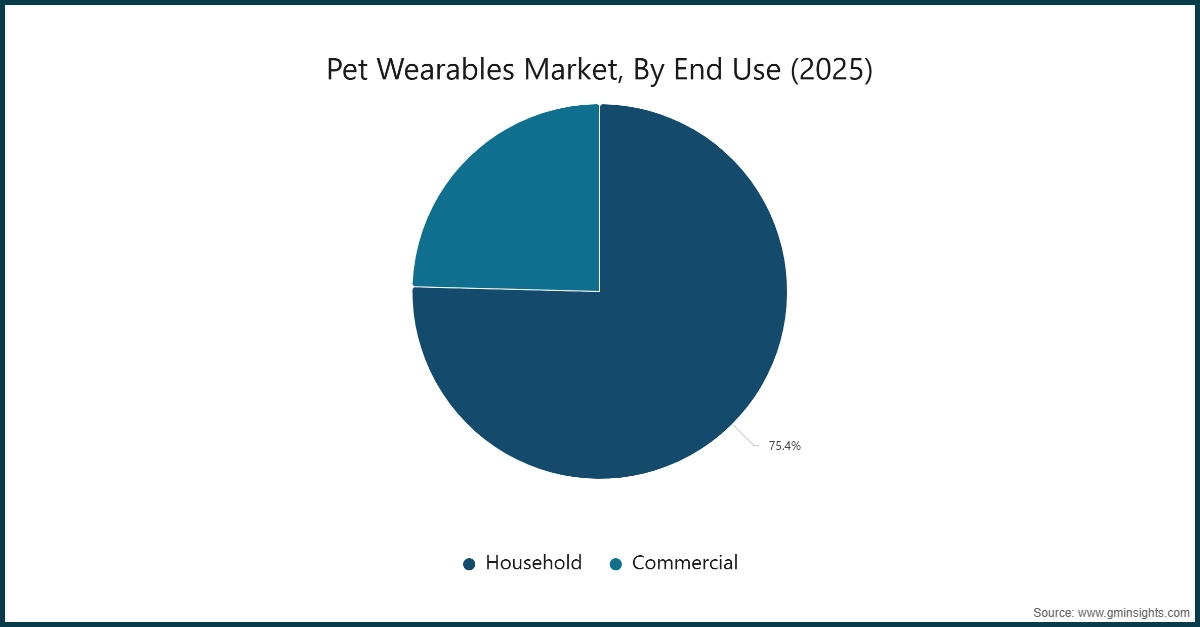
Based on the end use, the global pet wearables market is segmented into household and commercial. The household segment held a market share of 75.4% in 2025 and is estimated to reach USD 16.2 billion by 2035.
- Factors such as busy life routines and urban living of pet owners are increasing the demand for pet wearables products for home-use. Pet owners are purchasing advanced monitoring systems and pet wearables such as smart cameras, smart collars, pet tags, and harnesses, which take care of the pet’s needs when the owner is away.
- Additionally, increasing awareness among pet parents regarding preventive healthcare is stimulating the adoption of these devices.
- Features such as live location tracking, activity monitoring, and vitals monitoring increase the adoption of these solutions.
- Lastly, increasing disposable income and a shift towards digital healthcare are further augmenting the segmental growth.
- The commercial segment, on the other hand, is expected to witness growth at a CAGR of 11.4% during the forecast period. This growth can be attributed to increasing adoption of pet tech solutions in veterinary clinics, pet boarding facilities, and grooming centers to enhance operational efficiency and improve pet care services.
Looking for region specific data?
North America Pet Wearables Market
North America pet wearables industry was valued at USD 3.9 billion in 2025 and is projected to reach USD 11.7 billion by 2035, growing at a CAGR of 10.6% over the forecast years.
- The high rates of pet ownership in the region, along with the availability of advanced pet wearables products, stimulates market growth.
- Additionally, rising expenditure on pet care increases the adoption of these products in the region.
- High awareness among pet owners and accessibility to several pet wearable devices further boosts the market growth.
- Also, the presence of numerous established players in the region will positively impact the North America pet wearables market size in the upcoming years.
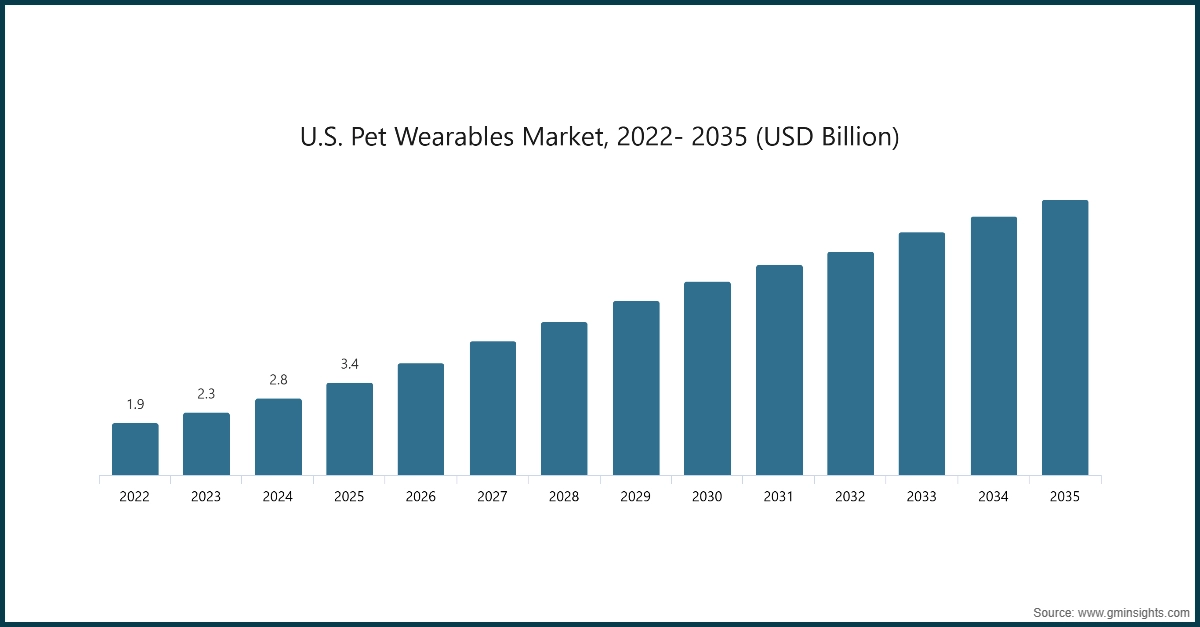
The U.S. pet wearables market was valued at USD 1.9 billion and USD 2.3 billion in 2022 and 2023, respectively. The market size reached USD 3.4 billion in 2025, growing from USD 2.8 billion in 2024.
- According to the 2021–2022 National Pet Owners Survey by the American Pet Products Association (APPA), 70% of U.S. households owned at least one type of pet. Additionally, almost 69 million of the U.S. households have at least one dog, and 45.3 million have at least one cat, about 9.9 million have birds, and 3.5 million have horses.
- Such high volume of pets in the country increases the demand for various pet wearable products.
- Further, the presence of several pet retail stores and well-established online platforms helps in market penetration.
- Also, the market players are keen on providing innovative products to cater to the high demand, which positively drives the market growth in the country.
Europe Pet Wearables Market
Europe market accounted for USD 1.5 billion in 2025 and is anticipated to show lucrative growth over the forecast period.
- The European pet wearables industry is rapidly growing due to the rise of pet ownership and the humanization of pets, with benefits from tech‑forward consumers, multi‑country distribution, and emphasis on data‑backed pet wellness.
- In addition, initiatives by various governments to improve animal healthcare are anticipated to spur market growth. For instance, according to a policy paper published in October 2022, the government of the UK is expected to invest approximately USD 16.10 billion in R&D for digital businesses including veterinary sector. With increasing digitalization and technological advancements, the pet wearables market in the UK is expected to grow.
- Additionally, the presence of several leading players such as Tractive, which continue to invest in advanced GPS technology, AI-powered analytics, and hybrid connectivity solutions, further benefits the regional market growth.
Germany dominates the Europe pet wearables market, showcasing strong growth potential.
- The high consumer preference for technology-based pet care products and surging expenditure on veterinary care are major factors driving the pet wearables market in Germany.
- Additionally, government support in favorable laws and policies implemented in the country by regulatory authorities further aids in the growth of companies operating in the market.
- High disposable income and the willingness of pet owners to spend on their pets also aid in market growth.
Asia Pacific Pet Wearables Market
The Asia Pacific pet wearables industry is anticipated to grow at the highest CAGR of 11.6% during the analysis timeframe.
- The Asia Pacific region is emerging as the fastest-growing market for pet wearables, driven by a steady rise in companion animal adoption and increasing spending on premium pet care products.
- For example, as per data published by GlobalPETS, China has the largest pet population in the Asia-Pacific region and is expected to reach 429 million in 2025.
- In addition, expanding digital infrastructure, widespread smartphone usage, and the rapid growth of online pet retail platforms are improving product accessibility across the region.
China pet wearables market is estimated to grow with a significant CAGR in the Asia Pacific market.
- The increasing pet ownership and rising disposable income in the country stimulate the market growth in the country.
- Expanding veterinary infrastructure and the rapid adoption of digital technologies are further supporting demand for smart pet monitoring and tracking solutions.
- In addition, the presence of a large number of domestic manufacturers offering competitively priced products is improving market penetration and accelerating overall growth.
Latin American Pet Wearables Market
Brazil leads the Latin American pet wearables industry, exhibiting remarkable growth during the analysis period.
- Brazil has the third-largest pet population in the world after the U.S. and Japan, with 160 million pets, of which 60 million are dogs, 30 million cats, and 32 million pet-owning households.
- Such high pet volume, coupled with strong growth in veterinary expenditure, is anticipated to foster market growth.
- Additionally, the presence of several international as well as local pet tech companies in the country further aids in the market growth.
Middle East and Africa Pet Wearables Market
South Africa pet wearables industry is expected to experience substantial growth in the Middle East and Africa market.
- The rapid expansion in the country is largely stimulated by the increasing pet ownership that results in the adoption of pet devices, including GPS-enabled collars, health wearables, and pet monitoring cameras.
- Additionally, growing awareness of pet health and safety, increasing expenditure on premium pet care products, and the emergence of organized pet retail and e-commerce platforms are further accelerating market adoption.
Pet Wearables Market Share
The global pet wearables industry is fragmented in nature due to the presence of a large number of large and small players operating in this industry. Major players such as Tractive, FitBark, Garmin, PetPace, and Petcube collectively hold approximately 12% share of the global market. These players dominate the market with extensive product portfolios and global distribution networks. The key industry players are consistently involved in creating new opportunities in the veterinary sector.
Moreover, the major market players in the pet wearables market implement several strategies to maintain a competitive edge in the market. These players are engaged in strategic acquisitions, mergers, collaborations, partnerships, expansions, and product launches, among other strategies.
Pet Wearables Market Companies
Prominent players operating in the pet wearables industry are as mentioned below:
- Buddy (Ninja Management)
- Dogtra
- Fi Smart Dog Collar
- Fitbark
- Garmin
- Halo Collar
- KYON
- Loc8tor
- Link My Pet
- Petcube
- Petpace
- PitPat
- SportDOG
- Tractive
- Wagz
Tractive strengthens its global presence through high-precision GPS tracking, virtual fencing, and multi-regional service coverage. Designed for reliability and long-range performance, Tractive’s solutions deliver continuous monitoring, activity insights, and health alerting features that support proactive pet safety. With millions of users worldwide, Tractive’s expanding product portfolio and commitment to real-time monitoring position it as a leading force in connected pet mobility and security.
Garmin International holds a strong competitive edge by delivering rugged, high-performance pet wearables integrated with advanced GPS, sensor technology, and behavioral tracking. Supported by its established global distribution and brand reputation in location technologies, Garmin enhances pet safety and outdoor management through durable smart devices.
Pet Wearables Market Report Attributes
| Key Takeaway | Details |
|---|---|
| Market Size & Growth | |
| Base Year | 2025 |
| Market Size in 2025 | USD 7.1 Billion |
| Market Size in 2026 | USD 8.6 Billion |
| Forecast Period 2026-2035 CAGR | 10.9% |
| Market Size in 2035 | USD 21.8 Billion |
| Key Market Trends | |
| Drivers | Impact |
| Increased pet ownership and humanization of pets | Rising global pet ownership and the growing trend of pet humanization increase the demand for pet wearable technologies and smart monitoring devices. |
| Growing awareness of pet health and wellness | Growing interest in preventive health insights encourages the adoption of devices that track activity, vitals, and monitor behavioral changes in real time. |
| Technological advancements in IoT and AI-powered devices | Advanced sensors, GPS, and AI analytics are transforming simple trackers into intelligent wellness platforms, thus driving their adoption rate. |
| Supportive digital and regulatory environment | Expanding digital infrastructure and regulatory encouragement for connected health tools are positively driving the market growth. |
| Pitfalls & Challenges | Impact |
| Technical limitations and performance gaps | Issues such as limited battery life, durability concerns, or inconsistent sensor readings can hinder user confidence. |
| Premium pricing of advanced wearables | High costs associated with GPS tracking devices, biometric monitoring, and AI-integrated collars restrict adoption among budget-focused pet owners. |
| Opportunities: | Impact |
| AI-driven pet behavior and training solutions | Intelligent wearables capable of interpreting behavior, detecting anomalies, and offering tailored recommendations will redefine proactive pet wellness and training experiences. |
| Growth of connected veterinary ecosystems | Wearable-generated real-time health data can be integrated into telehealth and remote‑diagnostics platforms. |
| Market Leaders (2025) | |
| Market Leader |
~5.4% market share |
| Top Players |
Collective market share is ~12% |
| Competitive Edge |
|
| Regional Insights | |
| Largest Market | North America |
| Fastest growing market | Asia Pacific |
| Emerging countries | China, India, Mexico, Argentina, South Africa |
| Future outlook |
|
What are the growth opportunities in this market?
Pet Wearables Industry News
- In July 2025, Tractive announced it had acquired Whistle from Mars Petcare, adding Whistle’s customer base and technology assets to its platform. This benefited Tractive by increasing scale and reinforcing its leadership in GPS and health‑tracking wearables.
- In May 2024, Garmin International launched the Alpha 300 series and Alpha TT 25 and T 20 collar series, the latest generation of tracking and training systems for hunters and their dogs. With this launch, Garmin strengthens its presence in the pet wearables market by providing advanced solutions for canine tracking and training.
- In March 2024, PetPace, a leading developer of AI-powered pet wearable technology, launched PetPace 2.0, a vet-grade smart dog collar that provides continuous, real-time medical insights for early detection, treatment, monitoring, and GPS tracking of a dog's health.
- In February 2024, Petcube expanded its product lineup with the launch of its new GPS Tracker. The GPS Tracker provides real-time location monitoring for pets, catering to growing consumer demand for comprehensive pet safety and tracking solutions, further solidifying Petcube's presence in the evolving pet technology space.
The pet wearables market research report includes in-depth coverage of the industry with estimates and forecast in terms of revenue in USD Million from 2022 - 2035 for the following segments:
Market, By Product
- Smart collar
- Smart vest
- Smart harness
- Smart camera
- Other products
Market, By Technology
- RFID devices
- GPS
- Sensors
- Bluetooth
Market, By Application
- Medical diagnosis and treatment
- Identification and tracking
- Fitness monitoring
- Behavior monitoring and control
Market, By Animal Type
- Dogs
- Cats
- Other animals
Market, By End Use
- Household
- Commercial
The above information is provided for the following regions and countries:
- North America
- U.S.
- Canada
- Europe
- Germany
- UK
- France
- Italy
- Spain
- Netherlands
- Asia Pacific
- China
- Japan
- India
- Australia
- South Korea
- Latin America
- Brazil
- Mexico
- Argentina
- Middle East and Africa
- South Africa
- Saudi Arabia
- UAE
Frequently Asked Question(FAQ) :
What was the market size of the pet wearables in 2025?
The market size was USD 7.1 billion in 2025, with a CAGR of 10.9% expected through 2035. The growth is driven by the rising global pet population, increasing disposable incomes, and the availability of tech-friendly pet products.
What is the projected value of the pet wearables market by 2035?
The market is poised to reach USD 21.8 billion by 2035, fueled by advancements in pet health monitoring, GPS tracking, and real-time activity tracking technologies.
What is the expected size of the pet wearables industry in 2026?
The market size is projected to reach USD 8.6 billion in 2026.
How much revenue did the smart camera segment generate in 2025?
The smart camera segment generated approximately USD 3.3 billion in 2025, led by increasing demand for remote pet monitoring and real-time interaction capabilities.
What was the valuation of the GPS segment in 2025?
The GPS segment accounted for the highest market share in 2025, with a valuation of USD 9.1 billion projected by 2035.
What is the growth outlook for the household segment from 2026 to 2035?
The household segment, which held a 75.4% market share in 2025, is estimated to grow significantly, reaching USD 16.2 billion by 2035.
Which region leads the pet wearables sector?
North America leads the market, valued at USD 3.9 billion in 2025, and is set to reach USD 11.7 billion by 2035, growing at a CAGR of 10.6%. The growth is driven by high pet ownership rates and technological adoption.
What are the upcoming trends in the pet wearables market?
Key trends include smart pet wearables such as health monitors, GPS trackers, and activity-tracking collars integrated with mobile apps, driven by rising disposable incomes and increasing pet humanization.
Who are the key players in the pet wearables industry?
Key players include Buddy (Ninja Management), Dogtra, Fi Smart Dog Collar, Fitbark, Garmin, Halo Collar, KYON, Loc8tor, Link My Pet, Petcube, Petpace, PitPat, SportDOG, Tractive, and Wagz.
Pet Wearables Market Scope
Related Reports