Summary
Table of Content

Pet Fitness Care Market
Get a free sample of this report
Form submitted successfully!
Error submitting form. Please try again.
Thank you!
Your inquiry has been received. Our team will reach out to you with the required details via email. To ensure that you don't miss their response, kindly remember to check your spam folder as well!
Request Sectional Data
Thank you!
Your inquiry has been received. Our team will reach out to you with the required details via email. To ensure that you don't miss their response, kindly remember to check your spam folder as well!
Form submitted successfully!
Error submitting form. Please try again.
Pet Fitness Care Market Size
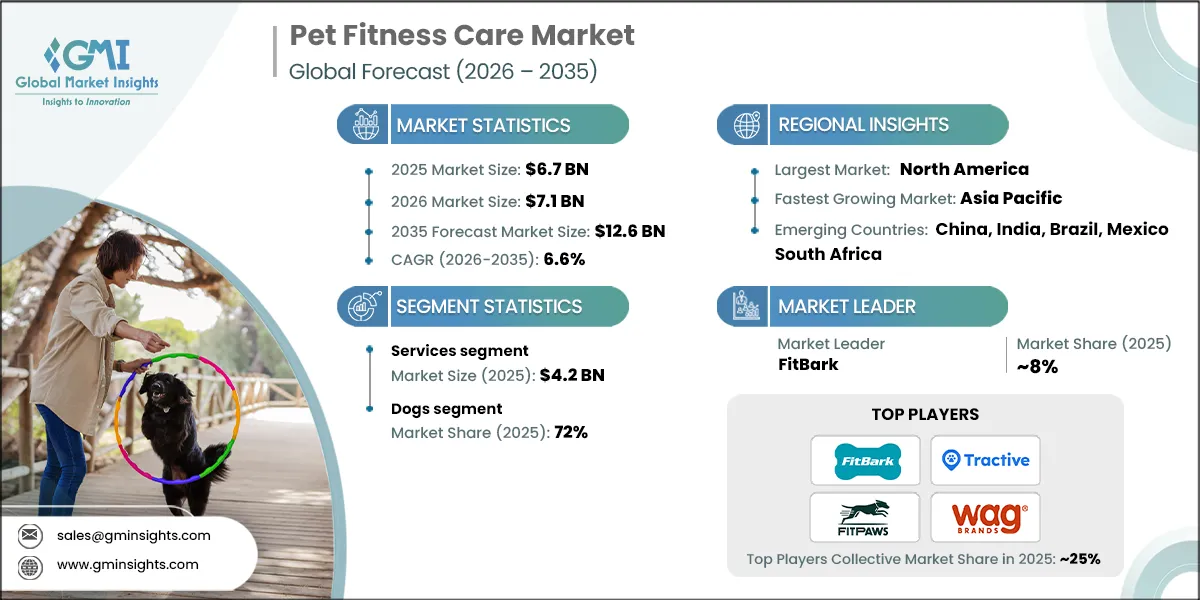
The global pet fitness care market was valued at USD 6.7 billion in 2025. The market is expected to grow from USD 7.1 billion in 2026 to USD 12.6 billion in 2035, growing at a CAGR of 6.6% during the forecast period, according to the latest report published by Global Market Insights Inc. One of the major factors driving market growth is the rising number of pets worldwide, coupled with higher disposable incomes and the willingness of pet owners to spend on their pets. Additionally, the integration of advanced technologies into pet care solutions is creating new opportunities for market expansion.
To get key market trends
Pet ownership has reached exceptional levels worldwide. For instance, the 2024 Global Pet Parent Study estimates the global pet population at around 1 billion. Households in the U.S., Brazil, Europe, and China alone are home to around half a billion dogs and cats, while more than half the world estimated to have at least one pet at home. As owners increasingly consider pets as a part of their family, the average amount spent per household on pets is also rising. In the U.S., the American Pet Products Association estimated that pet-related spending reached about USD 152 billion in 2024. Similarly, spending patterns are also seen in Europe and parts of Asia-Pacific region, where lifestyle changes and urban living are encouraging demand for premium pet care products.
Pet fitness care encompasses products such as agility equipment, pet treadmills and treadwheels, and balance training tools, alongside a growing range of specialized fitness services. Leading companies such as FitBark, Tractive, and FitPaws are introducing AI-powered and IoT-integrated products that enhance convenience and deliver real-time insights into pet wellbeing. At the same time, service providers offering agility training, aquatic therapy, and pet yoga are gaining popularity, making fitness care more engaging for pets.
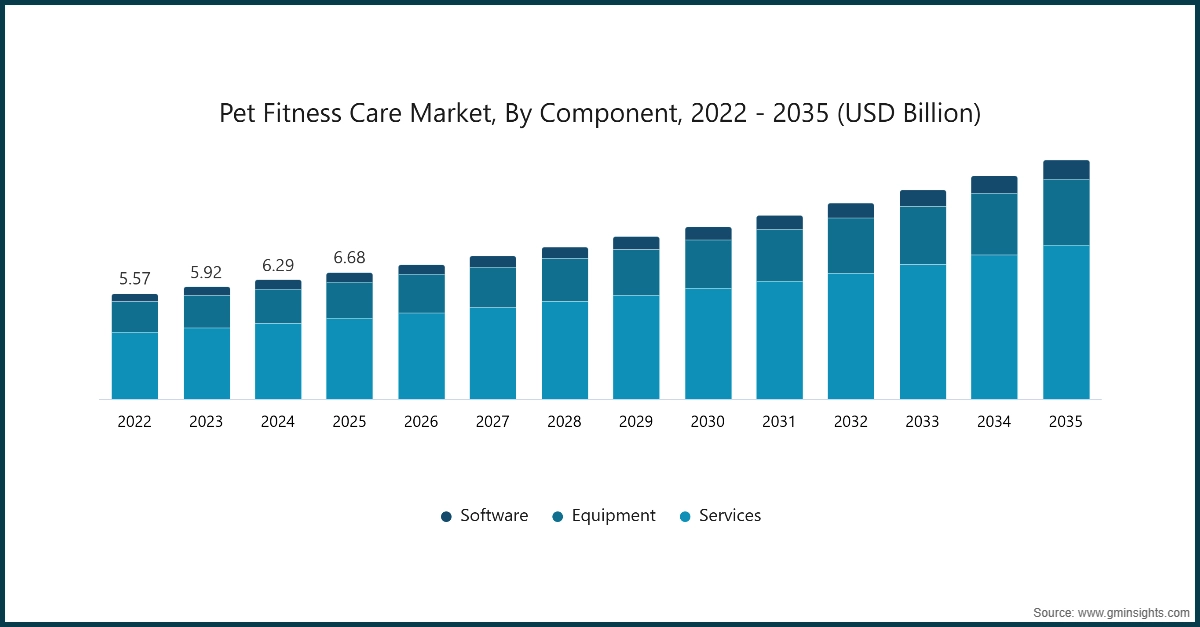
Between 2022 and 2024, the global pet fitness care market witnessed considerable growth, growing from USD 5.6 billion in 2022 to USD 6.3 billion in 2024. Investments from major consumer electronics and pet care brands accelerated product development, while improvements in affordability and functionality broadened adoption. As more pet owners look for practical and easy-to-use fitness solutions, demand for technology-driven pet care products is expected to continue rising. Moreover, the COVID-19 pandemic spurred pet adoption, thereby driving the demand for various pet care services and products, including fitness services and equipment.
Pet fitness care involves maintaining a pet’s physical well-being through specialized services and equipment. It includes physio assessments, agility and gym sessions, aquatic therapy, outdoor fitness exercises, and yoga classes to enhance mobility, strength, and mental well-being. Equipment such as treadmills, agility gear, and balance trainers aid in structured exercise routines. Advanced software also supports tracking fitness progress and health metrics.
Pet Fitness Care Market Report Attributes
| Key Takeaway | Details |
|---|---|
| Market Size & Growth | |
| Base Year | 2025 |
| Market Size in 2025 | USD 6.7 Billion |
| Market Size in 2026 | USD 7.1 Billion |
| Forecast Period 2026-2035 CAGR | 6.6% |
| Market Size in 2035 | USD 12.6 Billion |
| Key Market Trends | |
| Drivers | Impact |
| Increased pet ownership and humanization of pets | The rising adoption of pets for companionship, along with the growing trend of pet humanization, is driving demand for premium fitness, wellness, and health-tracking products, as pets are increasingly regarded as family members. |
| Rise in pet obesity and related diseases | Boosts need fitness programs, wearables, and preventive solutions to manage weight and chronic conditions in pets. |
| Increasing animal healthcare expenditure | Rising animal healthcare expenditure is accelerating the pet fitness market by increasing pet owners’ willingness to invest in preventive care, activity monitoring, and wellness solutions to maintain their pets’ long-term health. |
| Shift toward preventive and data-driven pet wellness | Expands adoption of smart devices and analytics platforms, enabling real-time health insights and personalized fitness plans. |
| Pitfalls & Challenges | Impact |
| Limited awareness and accessibility in developing nations | Limited awareness and inadequate access to pet fitness and wellness products in developing nations continue to restrain market penetration, particularly in rural areas with lower veterinary infrastructure and disposable income. |
| High cost of advanced devices and services | Limits affordability for many pet owners, reducing widespread uptake of premium fitness solutions. |
| Opportunities: | Impact |
| Expansion of at‑home fitness solutions | The expansion of at-home pet fitness solutions, including interactive toys, smart activity trackers, and app-based training programs, will drive market growth by enabling pet owners to monitor and improve their pets’ health conveniently at home. |
| Growing integration of artificial intelligence and data analytics in pet fitness | AI-powered personalization in pet fitness apps is emerging as a key opportunity, allowing tailored workout and wellness plans based on pet breed, age, and health conditions. |
| Market Leaders (2025) | |
| Market Leader |
~8% market share |
| Top Players |
Collective market share is ~25% |
| Competitive Edge |
|
| Regional Insights | |
| Largest Market | North America |
| Fastest growing market | Asia Pacific |
| Emerging countries | China, India, Brazil, Mexico, South Africa |
| Future outlook |
|
What are the growth opportunities in this market?
Pet Fitness Care Market Trends
- The pet fitness care industry is experiencing strong growth, driven by rising awareness of pet health and the increasing prevalence of obesity among companion animals. Obesity in pets is a major concern because it leads to serious health complications such as joint problems, diabetes, and reduced life expectancy.
- Obesity among pets has become a widespread problem in several countries. Data from the U.S. Food and Drug Administration shows that close to 59% of dogs and 60% of cats in the U.S. are considered overweight or obese. The situation is similar in the UK. According to Dogster’s 2024 statistics, vets identify around 1 in 14 dogs as overweight every year. Also, approximately 53% of cats fall into the overweight or obese category.
- Because of this, many owners are now paying closer attention to exercise and pet fitness routines, often following guidance from veterinarians and public awareness programs that focus on prevention rather than treatment.
- The market is witnessing growing adoption of IoT-enabled pet fitness devices, including wearable activity trackers, GPS-enabled smart collars, and app-connected interactive toys. These solutions allow real-time monitoring of pet activity, sleep patterns, calorie expenditure, and behavioral changes. Integration with mobile applications enables owners to set fitness goals, receive alerts, and share data with veterinarians, enhancing early detection of health risks and improving pet care outcomes.
- In addition, vets and public health groups continue to encourage better habits such as regular exercise and balanced feeding routines. Since pets are increasingly treated like family members, owners are more willing to spend on products that help keep them healthy.
- Furthermore, at-home pet fitness solutions are gaining traction as owners seek convenient ways to engage pets in regular physical activity without frequent outdoor or facility-based training. App-based training programs, virtual coaching, smart treadmills for pets, and automated play systems are increasingly popular, particularly among urban pet owners with limited time or space. This trend is further supported by the broader adoption of digital pet care platforms and subscription-based wellness services.
Pet Fitness Care Market Analysis
Learn more about the key segments shaping this market
The global market was valued at USD 5.6 billion and USD 5.9 billion in 2022 and 2023, respectively. The market size reached USD 6.7 billion in 2025, growing from USD 6.3 billion in 2024.
Based on the component, the pet fitness care market is segmented into services, equipment, and software. The services segment is further categorized into agility & gym sessions, outdoor fitness exercises, physio assessments, aquatic sessions, yoga classes, and other services. The equipment segment is classified into pet agility equipment, treadmills & treadwheels, balance training products, and other exercise equipment. The services segment dominated the market and was valued at USD 4.2 billion in 2025.
- The services segment holds a significant share in the pet fitness care market due to the rising demand for personalized fitness services for companion animals.
- The increasing humanization of pets and shift towards preventive care has led to growing demand for services such as agility and gym sessions, aquatic sessions, outdoor fitness exercises, and physio assessments, which aim at improving pets’ overall health.
- Pet fitness classes, personalized exercise routines, and behavior modification programs are becoming more popular, as owners seek professional guidance to keep their pets healthy and active.
- Further, the rise of senior pet populations, particularly aging dogs, has led to a demand for fitness services tailored to older pets, such as low-impact exercises and specialized physical therapy aimed at improving mobility.
- On the other hand, the equipment segment is expected to reach USD 3.5 billion by 2035, growing at a CAGR of 6.2%. This growth is being driven by the rising use of pet agility equipment, treadmills, treadwheels, and home-based fitness tools that make it easier for owners to manage pet health while adding convenience to daily routines.
Learn more about the key segments shaping this market
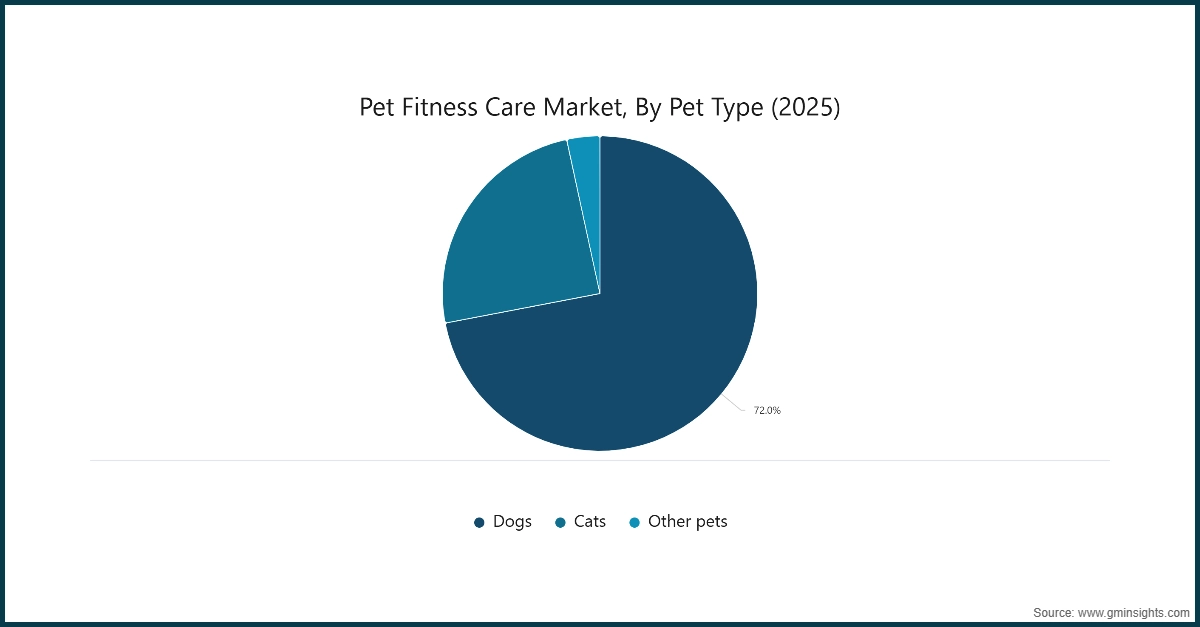
Based on the pet type, the market is categorized into dogs, cats, and other pets. The dogs segment dominated the global pet fitness care market with a market share of 72% in 2025, driven by the growing global dog population and rising health concerns.
- High population of pet dogs and their popularity as pets is a key factor driving segmental growth. For instance, as per the World Population Review, approximately 30% of households globally have a dog.
- Also, the high prevalence of chronic diseases and obesity in dogs increases the adoption of pet fitness care services and products. Research has determined that dogs in their middle-aged and older years have a prevalence of obesity between 40-45%.
- Overweight and obese dogs are highly susceptible to serious health conditions, including diabetes, joint disorders, and cardiovascular complications. Regular fitness programs are essential to manage these risks, with experts suggesting 20–30 minutes of daily vigorous exercise for dogs. However, studies show that fewer than 30% of dog owners walk their dogs regularly, highlighting a significant gap between recommended activity levels and actual practice.
- This gap is driving the growing need for fitness training, personalized activity plans, and professional pet fitness services, which help ensure effective weight management, improved mobility, and enhance overall well-being in companion dogs.
- The cat’s segment, on the other hand, is expected to reach USD 3.2 billion by 2035 due to growing awareness of feline obesity.
- Increasing demand for interactive fitness equipment and wellness programs for indoor cats further drives this growth.
Looking for region specific data?
North America Pet Fitness Care Market
North America market was valued at USD 3.6 billion in 2025 and is projected to reach USD 6.7 billion by 2035, growing at a CAGR of 6.4% over the forecast years.
- North America is leading the pet fitness care industry due to a large number of pets and strong awareness of animal health. The region has a fully developed veterinary system and a growing trend of pet humanization, leading to a higher demand for modern fitness solutions for pets.
- The use of technology-enabled solutions such as fitness devices and health apps is picking up momentum, helping pet owners to effectively track their pets' activity levels and create personalized workout plans.
- Due to increasing urbanization and the rise in obese pet population, there is an increasing demand for fitness solutions in the form of indoor fitness equipment and subscription-based wellness programs in the North American market.
- Health-related educational campaigns conducted by pet associations and pet brands further drive the adoption of pet fitness care services and products.
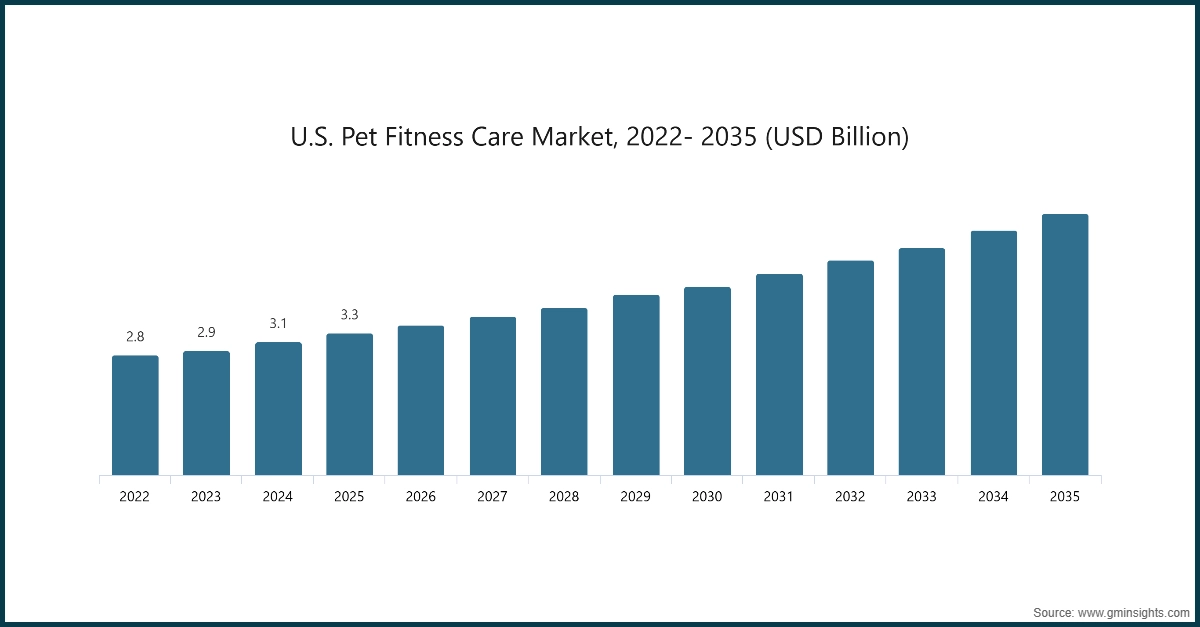
The U.S. pet fitness care market was valued at USD 2.8 billion and USD 2.9 billion in 2022 and 2023, respectively. The market size reached USD 3.3 billion in 2025, growing from USD 3.1 billion in 2024.
- Approximately 70% of U.S. households own at least one pet, as stated by the National Pet Owners Survey conducted by the American Pet Products Association (APPA) in 2021-2022.
- Similarly, 69 million U.S. households have at least one dog, and about 45.3 million U.S. households own at least one cat, in addition to around 9.9 million households having birds and 3.5 million households having horses.
- A large number of pets in the country boosts the demand for various pet fitness care services, such as gym sessions, yoga classes, physiotherapy, and agility training, along with home-based exercising equipment.
- Rising awareness programs offered by veterinary organizations and pet brands make way for wellness and preventive measures, making the U.S. at the forefront of the market.
Europe Pet Fitness Care Market
Europe market accounted for USD 1.6 billion in 2025 and is anticipated to show lucrative growth over the forecast period.
- The market for pet fitness care is growing in the Europe region with an increasing number of pet owners and a focus on animal welfare.
- Countries such as Germany, France, and the UK are leading in the adoption of structured fitness programs for pets.
- An increase in pet obesity cases in cats and older dogs has fueled the demand for premium services and in-home exercise equipment.
- The region also has a rising interest in technology-based solutions such as activity monitors with a focus on preventive health solutions.
- Further, encouraging regulations regarding animal welfare and supporting campaigns conducted by veterinary organizations help promote fitness care among pet owners, thus driving regional market growth.
Germany dominates the Europe pet fitness care market, showcasing strong growth potential.
- Germany accounts for a leading share of the pet fitness care industry in Europe, driven by its large pet-owning population, strong culture of animal welfare, and high spending on companion animal health.
- The popularity of outdoor activities and pet-friendly parks increases the demand for agility equipment and balance training products. Moreover, the increasing trend of tech-savvy people has boosted the use of smart wearables and mobile apps for monitoring pet activities and health data.
- The country also benefits from a well-established veterinary network, widespread availability of pet specialty retail stores, and strong penetration of digital pet care platforms, all of which support easy access to fitness-related products and services.
Asia Pacific Pet Fitness Care Market
The Asia Pacific market is anticipated to grow at the highest CAGR of 7.1% during the analysis timeframe.
- Asia-Pacific region is witnessing rapid growth in the global pet fitness care industry owing to the rising pet ownership, increasing disposable incomes, and growing awareness of preventive pet health.
- Urbanization and changing lifestyles in countries such as China, India, Japan, and South Korea are contributing to stronger demand for fitness and wellness products and services for companion animals.
- In addition, growing awareness of pet obesity and lifestyle-related health issues is encouraging owners to adopt exercise routines, fitness tracking devices, and digital training solutions.
- Also, the rapid expansion of e-commerce, mobile applications, and veterinary services is improving access to pet fitness products and services.
India pet fitness care market is estimated to grow with a significant CAGR in the Asia Pacific market.
- India has a large pet population with over 31 million pet dogs and 2.44 million pet cats. The increasing pet ownership and rising disposable income in the country, coupled with high expenditure on pet healthcare, will offer a lucrative market growth opportunity in the country.
- There is an increasing number of obese pet dogs and cats, which has led to the demand for systematic exercise programs in the form of outdoor exercise activities, agility training, and yoga classes.
- With the increasing urban lifestyle and lack of space, there is an increasing demand for compact exercise equipment designed for pet exercise in smaller spaces.
- The adoption of technology-enabled solutions and mobile applications among the younger generation of pet owners is further driving market growth.
Latin American Pet Fitness Care Market
Brazil leads the Latin American market, exhibiting remarkable growth during the analysis period.
- Brazil has the third-largest pet population in the world, with 160 million pets, of which 60 million are dogs, 30 million cats, and 32 million pet-owning households.
- Such high volume, coupled with strong growth in pet expenditure, is expected to boost market growth.
- The rapid expansion of veterinary services in the country will further drive market growth.
Middle East and Africa Pet Fitness Care Market
South Africa market is expected to experience substantial growth in the Middle East and Africa pet fitness care industry.
- The increasing pet ownership in the country, rising disposable income, coupled with a rapidly expanding veterinary infrastructure, will offer lucrative market growth opportunities in the country.
- Growing awareness of preventive health and lifestyle-related conditions in pets has spurred interest in fitness programs and wellness services.
- Additionally, educational initiatives and social media campaigns promoting preventive health further support this shift, positioning South Africa as an emerging market for advanced pet fitness and wellness solutions.
Pet Fitness Care Market Share
The global pet fitness care industry is highly fragmented, with established brands operating alongside a surge of emerging players and niche fitness companies. Top 4 companies, such as FitBark, Tractive, FitPaws, and Wag Brands (dogPACER), collectively hold a ~25% share of the global market, driven by their strong product portfolios and expanding consumer reach. Tractive continues to lead in connected fitness tracking solutions, offering advanced monitoring systems backed by a versatile platform and widespread global access.
These market leaders strengthen their competitive positioning through investments in smart technologies, integrated ecosystems, and performance‑focused wellness solutions that elevate the quality of pet fitness management. Their growth strategies commonly include product diversification, strategic collaborations, partnerships with training professionals, and continuous enhancement of device intelligence. The integration of IoT, AI-driven analytics, and real-time activity insights highlights the industry’s shift toward more personalized and data-enriched pet fitness experiences.
Several smaller companies and specialized fitness-focused providers such as Agility by Carlson, Gyms For Dogs, and Pet Yoga, add to the market competition. They offer targeted programs, equipment, and training formats designed for different breeds and wellness needs, driving innovation and service diversification. As demand for structured and tech-enabled pet fitness solutions continues to rise, the combined efforts of emerging players and established brands fuel ongoing market growth and advancement.
Pet Fitness Care Market Companies
Prominent players operating in the pet fitness care industry are as mentioned below:
- Agility by Carlson
- Wag Brands (dogPACER)
- Fitbark
- FitPaws
- Frolick Dogs
- GoPet
- Gyms For Dogs
- Kathy Santo Dog Training
- Pet Yoga
- Splash Canine Swim Club
- Tractive
- Woofz
- Woozelbears
FitBark distinguishes itself with an ultra‑light, waterproof tracker designed for continuous comfort and 24/7 monitoring. It provides real‑time location tracking, Safe Place alerts, and weeks‑long battery life, ensuring dependable safety. Beyond location, FitBark delivers research‑grade insights into activity, sleep, and behavior, trusted by veterinary institutions globally.
FitPaws is a leading provider of canine fitness and rehabilitation equipment, known for purpose‑built tools that enhance strength, balance, coordination, and overall mobility. Its innovative portfolio, including balance platforms, wobble boards, cavaletti sets, and the advanced FitKinect modular training system, supports dogs in recovery, conditioning, and peak performance. FitPaws’ products are trusted by trainers, rehabilitation specialists, and agility athletes worldwide for their durability, adaptability, and proven effectiveness.
Tractive holds a leading position in the pet tracking category, driven by its highly reliable real‑time location technology, multi‑network LTE connectivity, and intuitive safety features such as escape alerts and virtual boundaries. Its devices provide continuous activity and wellness monitoring, helping pet parents track movement, sleep, and overall behavior with precision.
Pet Fitness Care Industry News
- In October 2025, FitBark expanded its global device availability with the launch of FitBark GPS in both Canada and Australia, extending access to its health‑ and activity‑tracking ecosystem to new international markets. These rollouts strengthened FitBark’s footprint in smart pet wellness by providing broader coverage and improved connectivity for pet owners worldwide.
- In September 2025, FitPaws introduced FitKinect, a patent‑pending modular canine fitness and rehabilitation system designed to improve strength, coordination, and recovery outcomes for dogs. This product launch enhances FitPaws’ position as a leader in canine conditioning solutions by offering customizable training setups suitable for both home and professional environments.
- In July 2025, Tractive acquired Whistle from Mars Petcare, bringing one of the most recognized U.S. pet wearable brands under its umbrella. This acquisition significantly expanded Tractive’s customer base and strengthened its leadership in GPS‑enabled pet health and activity tracking. It also enabled deeper integration of advanced wellness metrics into Tractive’s global platform.
- In December 2025, Tractive entered a strategic collaboration with Napo Pet Insurance, integrating pet activity and wellness data with insurance services to support preventive‑care offerings and smarter health insights. This partnership enhances Tractive’s ecosystem by connecting real‑time tracking data with insurance-driven health optimization.
The pet fitness care market research report includes in-depth coverage of the industry with estimates and forecast in terms of revenue in USD Million from 2022 – 2035 for the following segments:
Market, By Component
- Services
- Agility and gym sessions
- Outdoor fitness exercises
- Physio assessments
- Aquatic sessions
- Yoga classes
- Other services
- Equipment
- Pet agility equipment
- Treadmills and treadwheels
- Balance training products
- Other exercise equipment
- Software
Market, By Pet type
- Dogs
- Cats
- Other pets
The above information is provided for the following regions and countries:
- North America
- U.S.
- Canada
- Europe
- Germany
- UK
- France
- Italy
- Spain
- Netherlands
- Asia Pacific
- China
- Japan
- India
- Australia
- South Korea
- Latin America
- Brazil
- Mexico
- Argentina
- Middle East and Africa
- South Africa
- Saudi Arabia
- UAE
Frequently Asked Question(FAQ) :
What is the pet fitness care market size in 2025?
The market size for pet fitness care was valued at USD 6.7 billion in 2025. The market's growth is driven by increasing pet ownership, rising disposable incomes, and the growing trend of pet humanization.
Who are the key players in the pet fitness care market?
Key players include FitBark, Tractive, FitPaws, Wag Brands (dogPACER), Agility by Carlson, Frolick Dogs, GoPet, Gyms For Dogs, Kathy Santo Dog Training, Pet Yoga, Splash Canine Swim Club, Woofz, and Woozelbears.
What are the upcoming trends in the pet fitness care industry?
Key trends include the integration of AI and data analytics in pet fitness apps, the expansion of at-home fitness solutions, and the adoption of connected home ecosystems for seamless pet wellness management. Additionally, the rise of predictive health insights and personalized fitness routines is shaping the industry's future.
Which region leads the pet fitness care market?
North America led the market with a valuation of USD 3.6 billion in 2025, representing a significant share. The region's dominance is driven by high pet ownership rates, advanced veterinary infrastructure, and the adoption of smart pet fitness solutions.
What is the growth outlook for the dogs segment from 2025 to 2035?
The dogs segment, which held a 72% market share in 2025, is expected to maintain its dominance through 2035. This growth is driven by the increasing global dog population and rising health concerns among dog owners.
How much revenue did the services segment generate in 2025?
The services segment dominated the global pet fitness care market, generating USD 4.2 billion in 2025. Its leadership is attributed to the rising demand for preventive care, activity monitoring, and wellness solutions.
What is the projected value of the pet fitness care market by 2035?
The market size for pet fitness care is expected to reach USD 12.6 billion by 2035, growing at a CAGR of 6.6%. This growth is fueled by the adoption of smart devices, data-driven wellness platforms, and increasing healthcare expenditure for pets.
What is the market size of the pet fitness care industry in 2026?
The market size for pet fitness care reached USD 7.1 billion in 2026, reflecting steady growth supported by advancements in pet care technologies and increasing awareness of pet wellness.
Pet Fitness Care Market Scope
Related Reports