Summary
Table of Content

Personalized Nutrition Market
Get a free sample of this report
Form submitted successfully!
Error submitting form. Please try again.
Thank you!
Your inquiry has been received. Our team will reach out to you with the required details via email. To ensure that you don't miss their response, kindly remember to check your spam folder as well!
Request Sectional Data
Thank you!
Your inquiry has been received. Our team will reach out to you with the required details via email. To ensure that you don't miss their response, kindly remember to check your spam folder as well!
Form submitted successfully!
Error submitting form. Please try again.
Personalized Nutrition Market Size
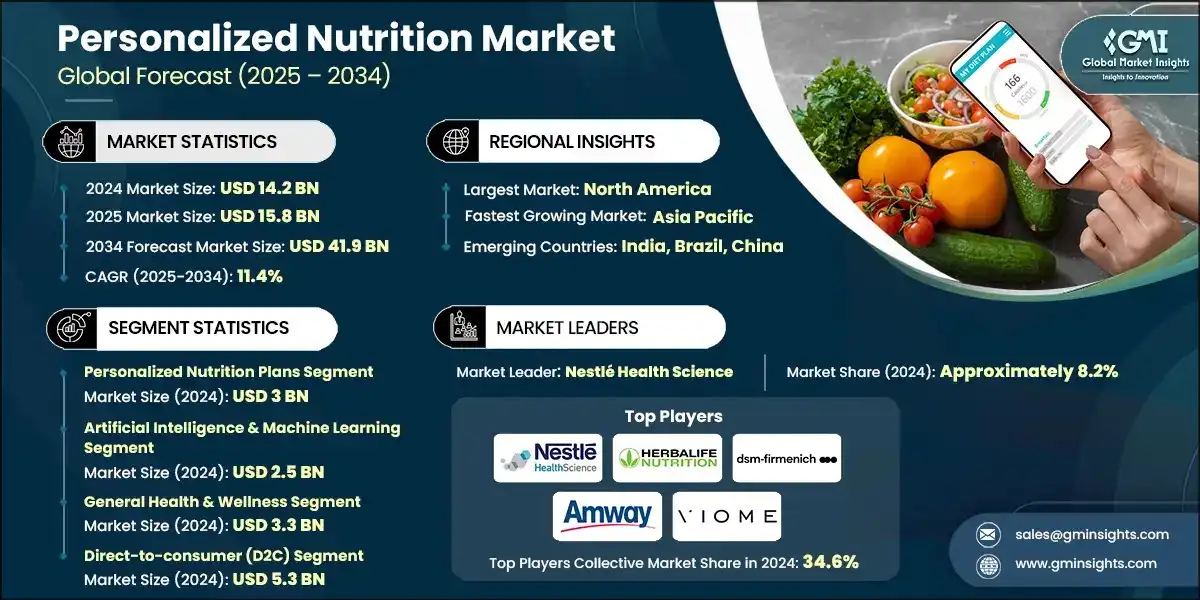
The global personalized nutrition market size was valued at USD 14.2 billion in 2024 and is expected to grow from USD 15.8 billion in 2025 to USD 41.9 billion in 2034, at a CAGR of 11.4% according to latest report published by Global Market Insights Inc.
Personalized Nutrition Market Key Takeaways
Market Size & Growth
- 2024 Market Size: USD 14.2 Billion
- 2025 Market Size: USD 15.8 Billion
- 2034 Forecast Market Size: USD 41.9 Billion
- CAGR (2025–2034): 11.4%
Key Market Drivers
- Personalized wellness demand rising.
- Advances in genomics and microbiome.
- Growth in digital health platforms.
Challenges
- Data privacy and security concerns.
- High cost of advanced testing.
- Lack of regulatory standardization.
Opportunity
- Corporate wellness program expansion.
- Integration with wearable devices.
- Aging population health focus.
Key Players
- Market Leader: Nestlé Health Science led with over 8.2% market share in 2024.
- Leading Players: Top 5 players in this market include Nestlé Health Science, Herbalife Nutrition, DSM-Firmenich, Amway, Viome, which collectively held a market share of 34.6% in 2024.
Get Market Insights & Growth Opportunities
- In the last four years, the market has grown quickly due to advancements in genomics, digital health, and consumer demand for personalized wellness. The National Institutes of Health stated that studies published in the last three years on nutrigenomics and microbiome-based diets have doubled, which infers there is growing interest in both science and business. The COVID-19 pandemic brought even faster adoption as customers sought health boosters and immune supplements for preventative health.
- In the past, personalized nutrition meant clinical dietetics and specifically tailored supplementation. The landscape changed with the availability of cheap DNA testing and health mobile applications. The U.S. Food and Drug Administration stated that there was a 30% increase in direct to consumer genetic tests, linked to nutrition and wellness. This new health data breakthrough let companies provide automated custom meal plans, adjusted meal subscriptions, personalized supplements, and AI meal plans in bulk.
- Industry wearables and other digital systems have also helped the personalized nutrition world. The Consumer Technology Association stated that there were over 512 million health wearables. Larger sections of these wearables provide nutritional info and personalized feedback. The growing interest in gut health and microbiome testing has also made personalized nutrition easier to access.
- The market is expected to keep growing as rules become clearer and science validates more opportunities. The European Food Safety Authority and the U.S. National Institutes of Health, with their recent efforts, are beginning to redefine expectations around value, efficacy, and privacy of data. Consumers are becoming increasingly health-aware and data-driven, so the focus on personalized nutrition will become a standard component of preventive health and wellness on a global scale.
To get key market trends
Personalized Nutrition Market Trends
- Rise of At-Home Testing and Digital Tools: At-home DNA and genetic testing kits, microbiome testing, and blood biomarker testing are on the rise. Companies like Viome offer personalized health insights, and real-time feedback and health monitoring are available through mobile health apps and wearables. Consumers can track their health closely, and many dishes and meal plans can be monitored for compliance, and adjustments can be made on the fly for dialed-in plans.
- Growth in AI-Driven Nutrition and Meal Planning: AI platforms create and refining personalized nutrition plans and incorporating suggested meals. Services like Noom and MyFitnessPal utilize machine learning to synthesize and analyze user data, fuel adaptive diet recommendations, and create a data-driven and ultimately personalized eating experience for a large audience.
- Expansion of Personalized Supplements and Functional Foods: Custom vitamins, probiotics and functional foods are on the rise and for good reason, targeted supplements are becoming widely available. Companies like Care/of and Persona Nutrition are providing tailored supplements after a personal assessment, industry tailored functional foods and beverages are a growing segment to support the fitness and wellness of initiative-taking consumers.
- The Need for Professional Coaching and Tele-Nutrition Services: Since the pandemic, the need for registered dietitian consultations and tele-nutrition services has grown. Telehealth services offered by companies such as Nutrigenomix and Teladoc Health streamline the process of connecting clients with certified nutritionists for personalized coaching. This fosters long-term adherence to tailored nutrition plans and helps fill the gap between digital resources and expert human support.
Personalized Nutrition Market Analysis
Learn more about the key segments shaping this market
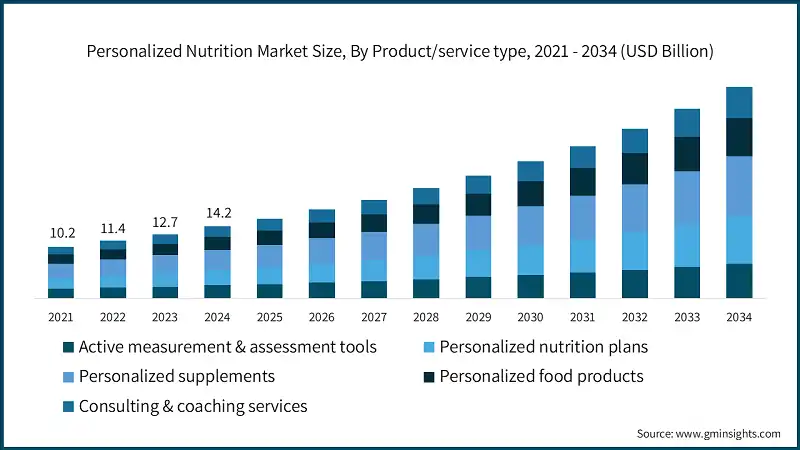
Based on product/service type, the market is segmented into Active measurement & assessment tools, personalized nutrition plans, personalized supplements, personalized food products, consulting & coaching services. The Personalized nutrition plans were valued at USD 3 billion in 2024, and it is anticipated to expand with 12% CAGR during 2025-2034.
- The growing market for personalized nutrition is driven by consumers adopting active measuring tools, mobile health apps, DNA and microbiome testing for customized wellness, and subscription-based nutrition services. AI-driven meal planners, custom supplements, and functional foods are becoming popular because of their specific health targeted and convenient inline diet benefits.
- Consulting and coaching services like tele-nutrition and registered dietitian sessions are closing the expert gap with digital solutions. The addition of wearable health trackers and real-time biomarker analysis for continuous feedback is keeping long-term adherence to personalized plans. This comprehensive approach fosters extensive growth across all product and service categories; from meal kits to sports nutrition.
Based on technology, the personalized nutrition market is segmented into Artificial intelligence & machine learning, big data analytics, genomics & nutrigenomics, microbiome sequencing, digital health platforms, mobile applications, wearable devices integration, blockchain for data security & traceability. Artificial intelligence & machine learning was valued at USD 2.5 billion in 2024, and it is anticipated to expand to 9.7% of CAGR during 2025-2034.
- The combination of artificial intelligence, big data analytics, and genomics is changing personalized nutrition with advanced tailored recommendations based on genetics, microbiome, and lifestyle. Integrated digital health platforms, mobile apps and wearable devices provide real-time data and make nutrition adaptive and user-friendly for pro-active health consumers.
- Blockchain technology offers a way to securely share and trace data to address trust and confidentiality issues in digital health ecosystems. The convergence of these technologies fuels innovation and the creation of scalable, evidence-based, customizable solutions in nutrition for collaboration between technology partners and the healthcare and nutrition sectors.
Learn more about the key segments shaping this market
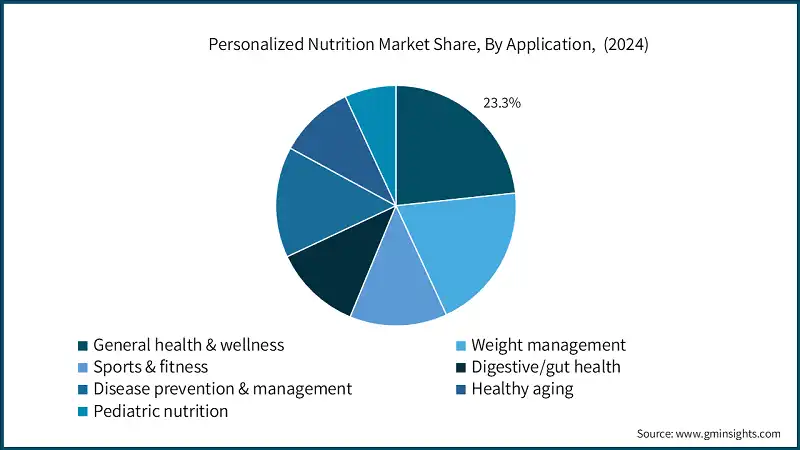
Based on applications, the personalized nutrition market is segmented into General health & wellness, weight management, sports & fitness, digestive/gut health, disease prevention & management, healthy aging, pediatric nutrition. General health & wellness was largest and valued at USD 3.3 billion in 2024, and it is anticipated to expand to 10.3% of CAGR during 2025-2034, constituting 23.3% in overall market share.
- Consumers are looking for products with flexible solutions for energy and recovery and sustainable outcomes, particularly among those with active lifestyles. In-wellness nutrition and weight management sports performance is also an area of growing interest. Digital tools and applications that adjust nutrition plans to improve outcomes are tools for a wide range of people to shift toward data-driven, initiative-taking health management.
- Interest in the personalization of nutrition to support the management of chronic diseases, digestive health, and healthy aging continues to grow. Individuals are using dietary revision, food sensitivity analysis, and microbiome testing to manage diabetes, cardiovascular disease, and food allergies. Pediatric nutrition and support for other chronic conditions are also emerging and indicative of the market’s increasing expansion to address the full spectrum of health in all life stages.
In end-user segment, Direct-to-consumer (D2C) segment was valued at USD 5.3 billion in 2024, and it is anticipated to expand to 10.7% of CAGR during 2025-2034, constituting 37.3% in overall market share.
- The personalized nutrition market is being led by Direct-to-consumer platforms and the provision of DNA tests, personalized meal plans, and tailor-made supplements. Fitness centers, sports organizations, and corporate wellness programs use personalized nutrition to improve employee productivity and wellness, and to help with sport performance and recovery.
- Healthcare professionals use linked devices and biomarker tests to manage chronic diseases and offer personalized nutrition as part of preventive care. Food and beverage companies create and sell more customized products. Pharmacies, retail stores, and healthcare centers now offer personalized supplements and nutrition. There are more research activities and scholarships to demonstrate efficacy, which will aid in the adoption and innovation of personalized nutrition.
Looking for region specific data?
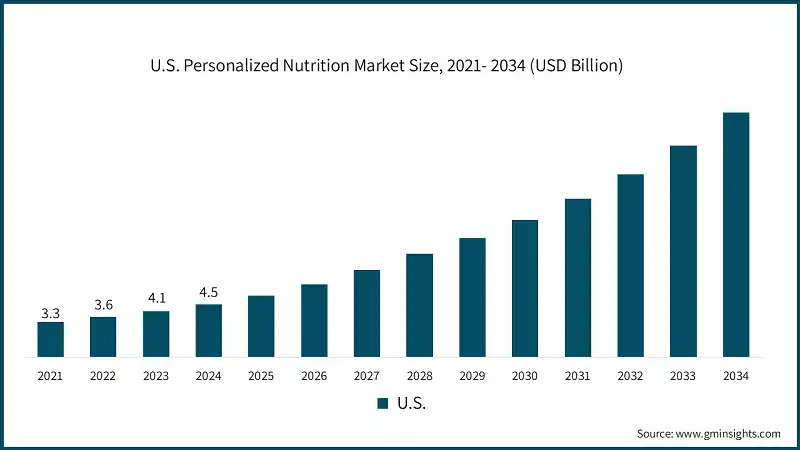
- North America leads the world personalized nutrition market, poised to grow from USD 5.4 billion in 2024 to USD 16 billion in 2034. Significant reasons for this growth include the increasing adoption of digital healthcare services and the awareness of healthcare consumers in the region. For the United States, the market is expected to grow from USD 4.5 billion in 2024 to 11.4% CAGR from 2025 to 2034.
- The United States is the leader of the region because of the expansive digital health care services, D2C brands, and advanced genomics. Canada is also increasing in size, with a focus on preventive healthcare and wellness technologies, although in 2024, its market will still be under 1 billion dollars.
- Europe’s expected market growth for 2024 through 2034 is from USD 3.8 billion to 11 billion. This growth is expected because of increased demand for preventive healthcare and clear regulatory actions surrounding healthcare. In 2024, Germany’s market of preventive healthcare is valued at USD 715.6 million with an expected 11% CAGR from 2025 to 2034.
- Germany is a leading center of new personalized nutrition market development in the world. It has strong R&D, engaged consumers, and is leading in development of nutrigenomics and microbiomes.
- In 2024, the U.K. market, valued at USD 515.3 million is supported by digital health adoption and NHS wellness initiatives.
- In the Asia Pacific region, the market is projected to grow from USD 3.1 billion in 2024 to USD 9.5 billion in 2034, due to health sector spending and innovations in mobile health. In 2024, the Chinese market is projected to grow 11.6% from USD 1.4 billion and continue to lead the region.
- China is the largest market, primarily due to the rapid adoption of DNA testing and personalized supplement platforms.
- India, projected to grow from USD 412.7 million in 2024, is growing due to urbanization, digital health startups, and awareness surrounding preventive nutrition.
- In Latin America, the market is projected to grow from USD 1 billion in 2024 to USD 2.8 billion in 2034, largely due to urban wellness and the expansion of digital health. In 2024, the Brazilian market is projected to grow 10.8% from USD 309.8 million.
- Brazil is largest in the region, due to the demand for online fitness and weight management, and online nutrition services.
- Increased investment in health technology and personalized supplement brands is helping to grow Mexico as well.
- The Middle East and Africa region is expected to grow from USD 915.6 million in 2024 to USD 2.6 billion in 2034, due to urbanization, increases in chronic diseases, and government initiatives in health. Saudi Arabia’s market was worth USD 319.8 million in 2024 and projected to grow 11.5% CAGR from 2025-2034.
- Saudi Arabia is focusing on digital health and wellness, specifically in preventive health and personalized nutrition. The UAE is also expanding, fueled by higher-income earners and government-initiated innovations in health.
Personalized Nutrition Market Share
- Nestlé Health Science, Herbalife Nutrition, DSM-Firmenich, Amway, Viome accounted for market share of 34.6% of the global market in 2024.
- Personalized nutrition combines food and health tailored just for you! This exciting field of integrated health and nutrition is being researched and developed by both well-known large nutrition companies and digital health companies. These companies not only have strong brands, but valuable nutrition research and big, varied product offerings that let them serve many different consumers.
- World nutrition leaders keep their strong market positions through innovative research/ product development, developing new products and market expansion through new companies and their transformative capacity of incorporating innovative health tech, AI and personalized nutrition.
- New and small companies focusing directly on the consumer (bypassing traditional retail) that assess the microbiome, or offer subscriptions, lead new, very innovative and specialized product offerings in personalized nutrition. This encourages leaders in personalized nutrition to remain innovative and flexible which fuels the development of sports nutrition, products for losing and controlling weight, and chronic disease products.
Personalized Nutrition Market Companies
The major players operating in personalized nutrition industry include:
- Nestlé Health Science
- Herbalife Nutrition
- DSM-Firmenich
- Amway
- Viome
- Nestlé Health Science: Nestlé Health Science leads to personalized nutrition with an 8.2% market share. It conducts scientifically supported personalized supplements, medical nutrition, and digital health technology. With recent investments in AI technology and the acquisition of Persona Nutrition, Nestlé Health Science expanded its direct-to-consumer and customized wellness offerings, increasing its market presence.
- Herbalife Nutrition: With 7.5% of the market share, Herbalife Nutrition uses its global presence to provide personalized supplements, meal plans, and wellness coaching. The company expanded digital engagement and introduced additional products for weight loss and sports nutrition, fueling its growth within the personalized nutrition sector.
- DSM-Firmenich: DSM-Firmenich has a 6.9% market share, which they earned by combining nutrition science, biotechnology, and innovative ingredients. The company focuses on nutrigenomics and custom supplements and collaborates with multiple digital health companies to gain market share in the personalized nutrition industry.
- Amway: With 6.2% of the market share, Amway's Nutrilite brand was one of the first to offer DNA-based nutrition studies and personalized vitamin packs. Amway reached large populations in Asia and North America with its direct selling and digital health investment, which in turn was the basis for its market expansion.
- Viome: Company holds 5.8% of the market share and offers innovative microbiome and RNA testing with personalized nutrition recommendations. It is regarded as a market disruptor with its AI-powered insights and subscription-based model and has entered new partnerships to grow its presence in the U.S. and Europe.
Personalized Nutrition Market Report Attributes
| Key Takeaway | Details |
|---|---|
| Market Size & Growth | |
| Base Year | 2024 |
| Market Size in 2024 | USD 14.2 Billion |
| Market Size in 2025 | USD 15.8 Billion |
| Forecast Period 2025 - 2034 CAGR | 11.4% |
| Market Size in 2034 | USD 41.9 Billion |
| Key Market Trends | |
| Drivers | Impact |
| Personalized wellness demand rising | Drives adoption of DNA and diet apps |
| Advances in genomics and microbiome | Enables precise, science-based nutrition plans |
| Growth in digital health platforms | Expands reach of personalized solutions |
| Pitfalls & Challenges | Impact |
| Data privacy and security concerns | Limits consumer trust and adoption |
| High cost of advanced testing | Restricts access for mass market |
| Lack of regulatory standardization | Creates confusion and market fragmentation |
| Opportunities: | Impact |
| Corporate wellness program expansion | Opens new B2B revenue streams |
| Integration with wearable devices | Enhances real-time feedback and engagement |
| Aging population health focus | Increases demand for preventive nutrition |
| Market Leaders (2024) | |
| Market Leaders |
Approximately 8.2% Market share |
| Top Players |
Collective market share in 2024 is 34.6% |
| Competitive Edge |
|
| Regional Insights | |
| Largest Market | North America |
| Fastest Growing Market | Asia-Pacific |
| Emerging Country | India, Brazil, China |
| Future Outlook |
|
What are the growth opportunities in this market?
Personalized Nutrition Industry News
- In April 2024, Nestlé Health Science announced the launch of a new AI personalized nutrition platform which combines genetic data, microbiome data, and lifestyle data, and makes personalized meals and supplement recommendations for customers in North America and Europe.
- In September 2023, Viome partnered with CVS Health, making personalized nutrition testing kits based on microbiome and RNA assessments available in CVS pharmacies across the United States for customers to buy, making advanced at-home health assessments more accessible to the general public.
- In June 2022, DSM-Firmenich completed the acquisition of personalized nutrition startup Mixfit, which expanded their real-time nutrient tracking in combination with AI formulated supplements for the direct-to-consumer and corporate wellness market.
The personalized nutrition market research report includes in-depth coverage of the industry with estimates & forecast in terms of revenue (USD Billion) from 2021 to 2034, for the following segments:
Market, By Product/Service Type
- Active measurement & assessment tools
- DNA/genetic testing kits
- Microbiome/gut health testing
- Blood biomarker analysis
- Wearable health trackers
- Mobile health apps
- Personalized nutrition plans
- Diet and meal planning platforms!
- Subscription-based nutrition services
- AI-driven nutrition recommendations
- Personalized supplements
- Custom vitamins & minerals
- Probiotics & prebiotics
- Functional foods & beverages
- Sports nutrition
- Personalized food products
- Customized meal kits
- Functional snacks
- Fortified foods
- Consulting & coaching services
- Registered dietitian/nutritionist consultations
- Health and wellness coaching
- Tele-nutrition services
Market, By Technology
- Artificial intelligence & machine learning
- Big data analytics
- Genomics & nutrigenomics
- Microbiome sequencing
- Digital health platforms
- Mobile applications
- Wearable devices integration
- Blockchain for data security & traceability
Market, By Application
- General health & wellness
- Weight management
- Sports & fitness
- Digestive/gut health
- Disease prevention & management
- Diabetes
- Cardiovascular health
- Food allergies/intolerances
- Other chronic conditions
- Healthy aging
- Pediatric nutrition
Market, By End Use
- Direct-to-consumer (D2C)
- Corporate wellness programs
- Healthcare providers
- Fitness & sports centers
- Research & academic institutions
- Food & beverage manufacturers
- Pharmacies & retail stores
The above information is provided for the following regions and countries:
- North America
- U.S.
- Canada
- Europe
- UK
- Germany
- France
- Italy
- Spain
- Rest of Europe
- Asia Pacific
- China
- India
- Japan
- South Korea
- Australia
- Rest of Asia Pacific
- Latin America
- Brazil
- Mexico
- Argentina
- Rest of Latin America
- MEA
- UAE
- Saudi Arabia
- South Africa
- Rest of Middle East and Africa
Frequently Asked Question(FAQ) :
What is the market size of the global personalized nutrition market in 2024?
The market size was USD 14.2 billion in 2024, driven by advances in genomics, digital health, and growing consumer demand for tailored wellness and diet solutions.
What is the projected market value of the global personalized nutrition market by 2034?
The market is expected to reach USD 41.9 billion by 2034, growing at a CAGR of 11.4%, fueled by AI-driven nutrition platforms, increasing preventive healthcare focus, and wider integration of nutrigenomics and microbiome science.
What is the estimated market size of the global market in 2025?
The market is projected to reach USD 15.8 billion in 2025, supported by strong adoption of DNA testing, mobile health applications, and AI-powered dietary recommendation systems.
Which product/service segment dominated the market in 2024?
The personalized nutrition plans segment led the market with USD 3 billion revenue in 2024, expanding rapidly due to the rising adoption of AI-based meal planning and subscription-based diet platforms.
Which technology segment held the largest market share in 2024?
The artificial intelligence and machine learning segment was valued at USD 2.5 billion in 2024, driving innovation in data-driven nutrition personalization and adaptive meal recommendations.
Which application segment generated the highest revenue in 2024?
The general health and wellness segment dominated the market, valued at USD 3.3 billion in 2024, reflecting the widespread consumer shift toward preventive health and lifestyle optimization.
Which end-user segment accounted for the largest share in 2024?
The direct-to-consumer (D2C) segment held the largest share at USD 5.3 billion in 2024, driven by the growth of personalized supplement subscriptions, online testing, and AI-guided digital health platforms.
Which region leads the global market?
North America led the global market, with the U.S. accounting for USD 4.5 billion in 2024, supported by advanced digital healthcare systems, D2C adoption, and robust consumer health awareness.
Who are the key players in the global personalized nutrition market?
Key players include Nestlé Health Science, Herbalife Nutrition, DSM-Firmenich, Amway, Viome, Persona Nutrition, Care/of, Nutrigenomix, 23andMe, Noom, MyFitnessPal, and Teladoc Health.
Personalized Nutrition Market Scope
Related Reports