Summary
Table of Content

North America Vertical Lift Module Market
Get a free sample of this report
Form submitted successfully!
Error submitting form. Please try again.
Thank you!
Your inquiry has been received. Our team will reach out to you with the required details via email. To ensure that you don't miss their response, kindly remember to check your spam folder as well!
Request Sectional Data
Thank you!
Your inquiry has been received. Our team will reach out to you with the required details via email. To ensure that you don't miss their response, kindly remember to check your spam folder as well!
Form submitted successfully!
Error submitting form. Please try again.
North America Vertical Lift Module Market Size
- The North America Vertical Lift Module (VLM) market is experiencing significant growth, driven by the increasing demand for warehouse automation. Businesses across e-commerce, manufacturing, retail, and logistics are under growing pressure to accelerate order fulfillment processes and minimize operational errors. According to the U.S. Census Bureau, e-commerce sales in the United States reached USD 1.03 trillion in 2022, reflecting a 7.7% increase from the previous year. This surge in online shopping has led to a rise in SKU counts and heightened customer expectations for faster and more accurate deliveries. To address these challenges, companies are investing in automated storage and retrieval systems that enhance efficiency while reducing reliance on manual labor. VLMs play a critical role in this transformation by offering high-density vertical storage, faster picking speeds, improved inventory visibility, and optimized floor space utilization. As supply chains grow increasingly complex and competition intensifies, the adoption of automation technologies like VLMs is becoming essential for organizations seeking operational resilience and scalability.
- Another key factor driving the adoption of VLMs is the growing labor shortage and rising labor costs across North America. The U.S. Bureau of Labor Statistics reported that the warehousing and storage sector had a job vacancy rate of 4.5% in 2023, highlighting the difficulty in filling roles. High turnover rates further exacerbate these challenges, leading to increased training costs and productivity losses. To mitigate these workforce constraints, businesses are turning to automated solutions such as VLMs. These systems streamline picking processes, reduce physical strain on workers, and enable continuous operations with minimal staffing. By improving ergonomics and eliminating repetitive manual tasks, VLMs not only address labor shortages but also enhance workplace safety and reduce long-term labor-related expenses. This makes them an attractive investment for companies navigating labor market pressures.
- The expansion of Industry 4.0 and smart factory initiatives is further accelerating the adoption of VLMs. Organizations are increasingly transitioning to digitized, interconnected, and data-driven operational models. Modern VLMs integrate seamlessly with warehouse management systems (WMS), enterprise resource planning (ERP) platforms, IoT sensors, and robotics. This integration enables real-time inventory tracking, automated picking sequences, remote diagnostics, and predictive maintenance. As manufacturers and logistics companies invest in smart automation to improve productivity, accuracy, and equipment utilization, VLMs are emerging as indispensable tools. The growing emphasis on digital transformation across North America ensures that VLM adoption will continue to rise, with the market poised for sustained growth in the coming years.
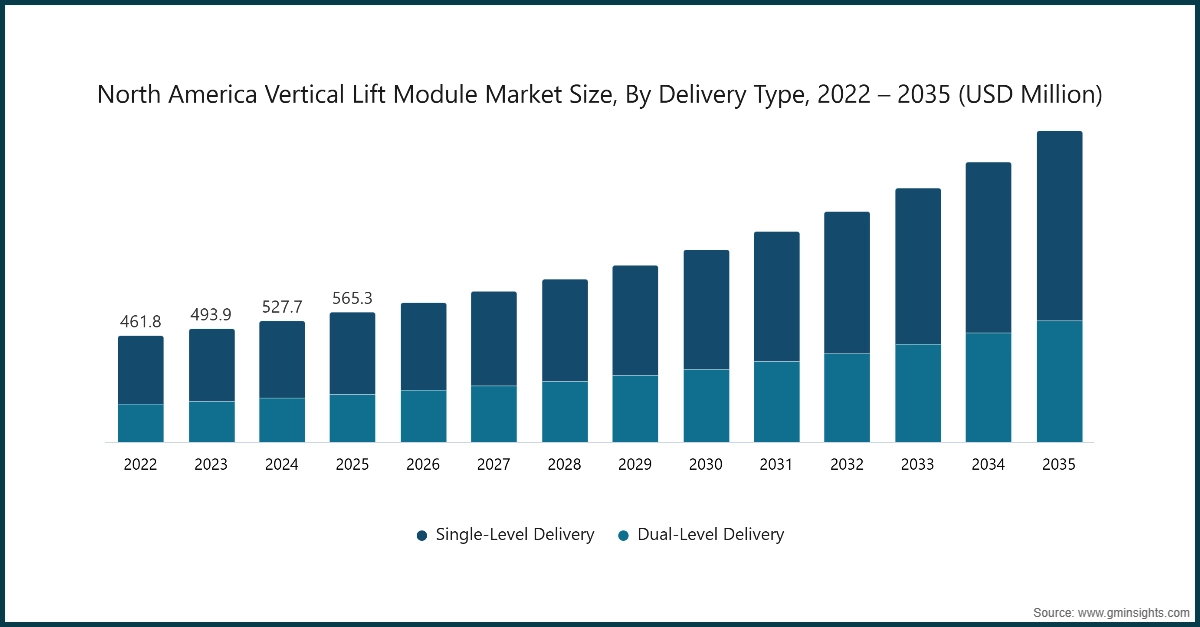
The North America vertical lift module market was estimated at USD 565.3 million in 2025. The market is expected to grow from USD 609 million in 2026 to USD 1.35 billion in 2035, at a CAGR of 9.3% according to latest report published by Global Market Insights Inc.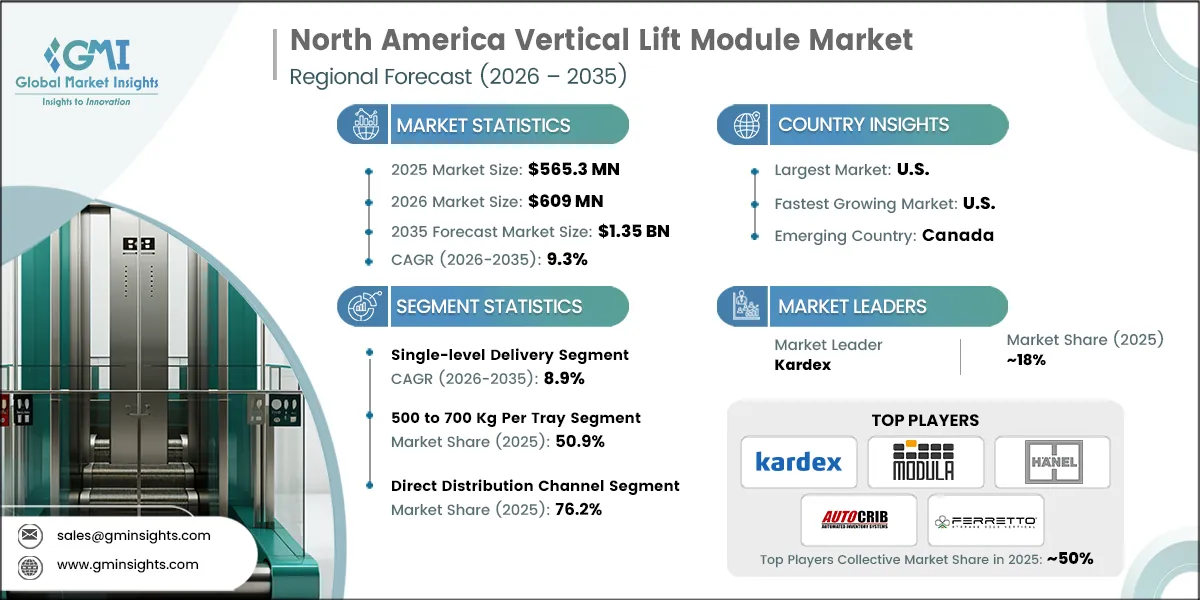
North America Vertical Lift Module Market Key Takeaways
Market Size & Growth
- 2025 Market Size: USD 565.3 Million
- 2026 Market Size: USD 609 Million
- 2035 Forecast Market Size: USD 1.35 Billion
- CAGR (2026–2035): 9.3%
Regional Dominance
- Largest Market: U.S.
- Fastest Growing Country: U.S.
Key Market Drivers
- Rising demand for warehouse automation.
- Growing labor shortages and rising labor costs.
- Expansion of industry 4.0 and smart factory initiatives.
Challenges
- High initial investment costs.
- Integration complexity with existing systems.
Opportunity
- Increasing adoption of industry 4.0 and smart warehousing.
- Growth of automated micro‑fulfillment centers (MFCs).
Key Players
- Market Leader: Kardex led with over 18% market share in 2025.
- Leading Players: Top 5 players in this market include Kardex, Hanel Buro, Ferretto SpA, Modula GROUP, AutoCrib, which collectively held a market share of 50% in 2025.
Get Market Insights & Growth Opportunities
To get key market trends
North America Vertical Lift Module Market Trends
- North American companies are increasingly integrating Vertical Lift Modules (VLMs) with robotics and Automated Mobile Robots (AMRs), marking a significant trend as they strive for fully automated, high-throughput warehouse environments. By combining VLMs with AMRs, Automated Guided Vehicles (AGVs), and robotic picking arms, businesses are establishing fluid and efficient workflows. In these setups, robots retrieve trays, transport items between workstations, and enhance goods-to-person operations with greater speed, precision, and reliability. This integration not only reduces human intervention but also significantly boosts productivity and ensures uninterrupted 24/7 operations. This trend is particularly prominent in industries such as e-commerce, automotive, aerospace, and electronics manufacturing, where operational efficiency and accuracy are critical. As robotics technology becomes more affordable and widely accessible, the demand for VLMs capable of seamless communication and coordination with these automated systems is experiencing rapid growth.
- Furthermore, the ability of these integrated systems to handle diverse inventory types and adapt to varying operational requirements is driving their adoption across multiple sectors.
- Simultaneously, the increasing adoption of IoT technologies, predictive maintenance tools, and intelligent monitoring systems is revolutionizing how VLMs are managed and operated. Modern VLMs are now equipped with advanced sensors, telemetry systems, and connected software platforms that provide real-time visibility into inventory levels, machine performance metrics, and overall system health. These features enable businesses to monitor operations continuously and make data-driven decisions to optimize workflows. Predictive maintenance capabilities allow companies to identify and address potential issues before they result in costly downtime, ensuring uninterrupted operations.
- Additionally, remote diagnostics streamline troubleshooting processes, reducing maintenance costs and improving system reliability. This transformation aligns with the broader Industry 4.0 initiatives, which prioritize automation, operational transparency, and the use of data analytics to enhance decision-making. As North American companies continue to invest in digital transformation strategies, the demand for intelligent, connected VLM solutions is accelerating significantly. These systems are also being integrated with enterprise resource planning (ERP) and warehouse management systems (WMS) to further enhance operational efficiency and inventory management.
- Another significant trend is the growing preference for modular and space-efficient VLM configurations, as businesses increasingly seek flexible and scalable storage solutions that maximize vertical space utilization. With industrial real estate costs rising, particularly in metropolitan areas and logistics-dense regions, companies are prioritizing automation systems that deliver high storage density without requiring costly facility expansions. Modular VLM designs offer the flexibility to start with a smaller system and expand incrementally as inventory needs grow, making them an ideal choice for both large enterprises and small and medium-sized enterprises (SMEs). These systems are particularly well-suited for industries with fluctuating inventory demands, as they can be easily reconfigured to accommodate changing requirements. Compact and space-optimized VLM configurations are also gaining traction in micro-fulfillment centers, urban warehouses, and facilities with limited floor space, where maximizing storage capacity is essential.
- Furthermore, these systems are being designed to handle a wide range of inventory types, including small parts, heavy items, and fragile goods, making them versatile solutions for diverse operational needs. As industries increasingly prioritize efficiency, adaptability, and cost-effectiveness, modular and space-optimized VLMs are emerging as a key driver of long-term market growth across North America.
North America Vertical Lift Module Market Analysis
Learn more about the key segments shaping this market
Based on delivery type, the market is categorized into single-level delivery and dual-level delivery. The single-level delivery accounted for revenue of around USD 359.3 million in 2025 and is anticipated to grow at a CAGR of 8.9% from 2026 to 2035.
- Companies in sectors such as e‑commerce, automotive, aerospace, logistics, pharmaceuticals, and manufacturing are under pressure to increase throughput and reduce operational costs conditions that make VLMs highly attractive because they maximize vertical storage capacity while minimizing floorspace usage. Rising labor shortages and increasing labor costs across North America are also pushing organizations to adopt automated storage and retrieval solutions that reduce dependency on manual workforce and improve picking accuracy.
- Additionally, the rapid expansion of e‑commerce fulfillment centers, which demand faster order processing with minimal errors, is significantly boosting demand for VLMs with advanced delivery mechanisms. Growing digital integration such as the use of IoT, warehouse management systems (WMS), robotics, real‑time inventory tracking, and data analytics further supports adoption because modern VLMs can seamlessly integrate with automated workflows.
Based on loading capacity of North America vertical lift module market consists of up to 500 kg per tray, 500 to 700 kg per tray and above 700 kg per tray. The 500 to 700 kg per tray emerged as leader and held 50.9% of the total market share in 2025 and is anticipated to grow at a CAGR of 9.6% from 2026 to 2035.
- This capacity range is particularly attractive for sectors such as automotive, aerospace, machinery, heavy equipment, electronics, and industrial manufacturing, where components, tools, and spare parts are often too heavy for lower‑capacity trays but do not require the costlier, more specialized infrastructure of systems rated above 700 kg.
- Additionally, growing labor shortages and rising labor costs across North America are pushing companies to automate storage and retrieval tasks, and this capacity band supports high‑throughput operations without requiring highly specialized handling systems. Modern VLMs in this range also integrate easily with warehouse management systems (WMS), robotics, and IoT‑enabled inventory tracking, making them well‑aligned with the region’s rapid adoption of Industry 4.0 technologies.
Learn more about the key segments shaping this market
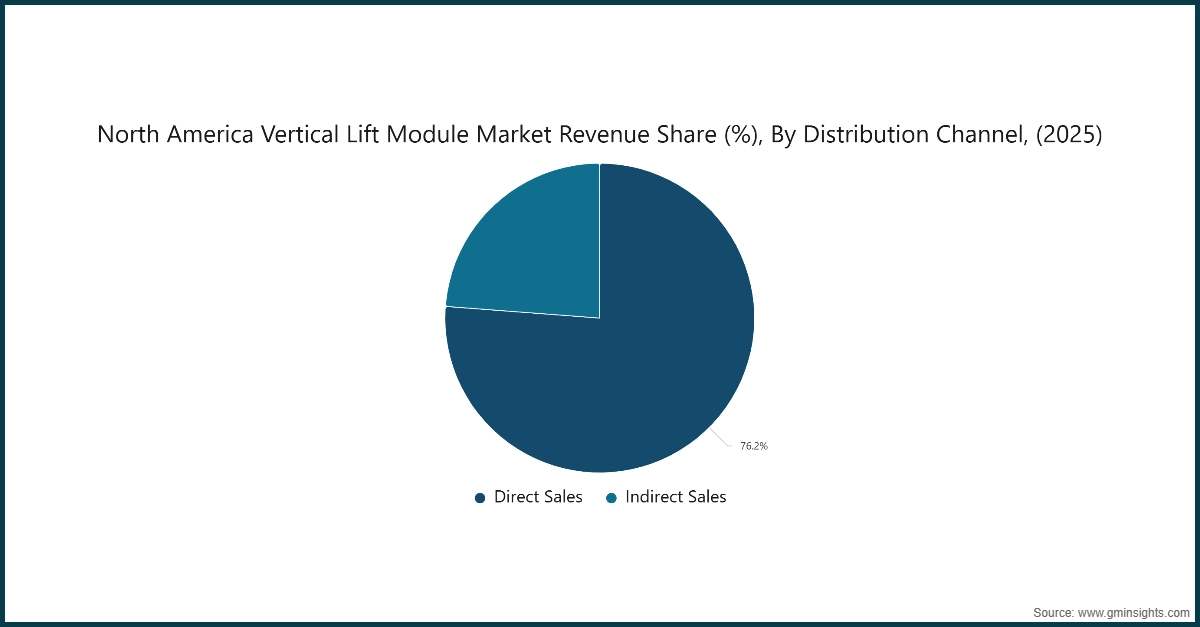
Based on distribution channel of North America vertical lift module market consists of direct and indirect. The direct distribution channel emerged as leader and held 76.2% of the total market share in 2025 and is anticipated to grow at a CAGR of 9.7% from 2026 to 2035.
- The growth is because end‑users increasingly prefer to work directly with manufacturers for high‑value, technically complex automation systems that require customization, integration, and long‑term service support. VLMs are mission‑critical storage and retrieval systems used in industries such as automotive, aerospace, e‑commerce, pharmaceuticals, and heavy manufacturing, where operational uptime, precision, and seamless integration with warehouse management systems (WMS), ERP platforms, and automated workflows are essential.
- Moreover, manufacturers in North America are expanding their direct sales networks, offering bundled solutions that include consultation, on‑site assessment, employee training, preventive maintenance, and rapid-response technical support, making the direct channel more attractive to enterprises seeking reliability and accountability.
Looking for region specific data?
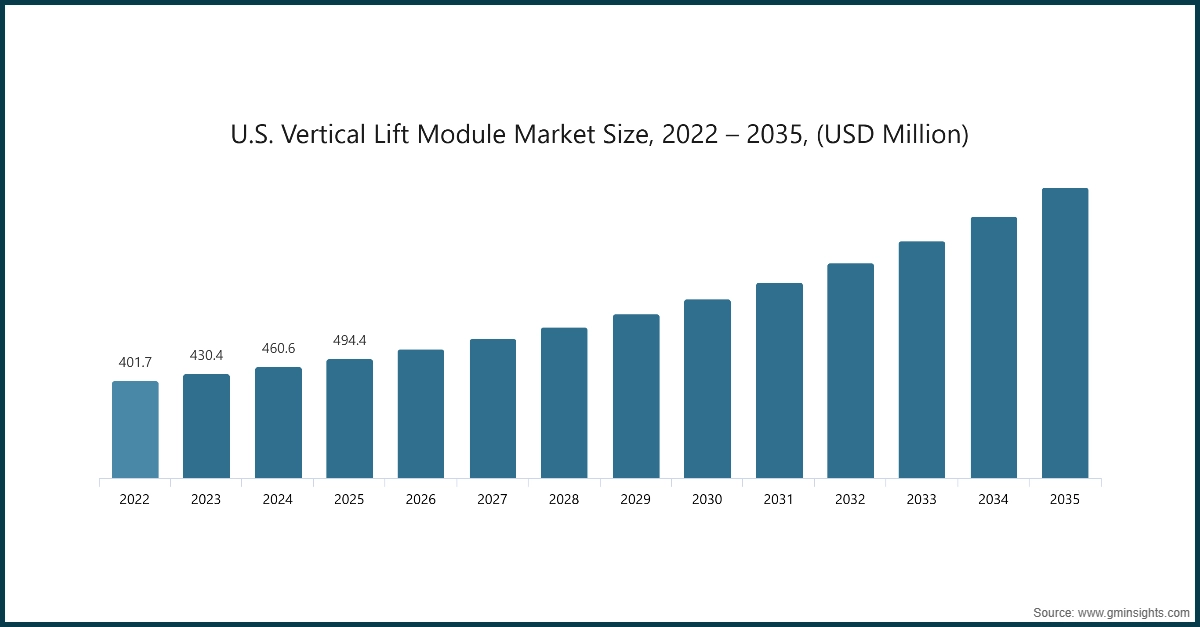
The U.S. dominates an overall North America vertical lift module valued at USD 494.4 million in 2025 and is estimated to grow at a CAGR of 9.5% from 2026 to 2035.
- The United States boasts a highly developed business environment and advanced supply chains, driving significant demand for automated storage systems, particularly Vertical Lift Modules (VLMs). These systems are increasingly adopted across various industries, including manufacturing, retail, healthcare, and logistics, as businesses seek to enhance operational efficiency, minimize lead times, and achieve precise inventory management. The U.S. market benefits from a well-established digital infrastructure, enabling seamless integration of VLMs with advanced warehouse management systems (WMS) and enterprise resource planning (ERP) solutions, which further optimize supply chain operations.
- The region's strong inclination toward VLM adoption is attributed to several factors, including the availability of extensive customization options tailored to specific industry needs, robust after-sales services ensuring long-term system reliability, and a continuous focus on technological innovation. Additionally, the U.S. market is characterized by a high level of automation adoption, supported by government initiatives and investments in smart manufacturing and Industry 4.0 technologies. These advancements contribute to the widespread implementation of VLMs in both small and large-scale enterprises.
- Furthermore, the presence of key market players and a competitive landscape fosters innovation and the development of cutting-edge VLM solutions. Companies in the region prioritize features such as modular designs, enhanced storage capacities, and integration with IoT and AI technologies to meet evolving customer demands. Collectively, these factors solidify North America's leading position in the global VLM market, making it a hub for technological advancements and a benchmark for other regions.
North America Vertical Lift Module Market Share
- In 2025, the prominent manufacturers in North America vertical lift module industry are Kardex, Hanel Buro, Ferretto SpA, Modula GROUP and AutoCrib collectively held the market share of ~50%.
- Organizations are continuously striving to enhance the strength and efficiency of their products to meet the growing demand for automated storage systems. These systems are increasingly valued for their speed, precision, and ability to streamline operations. Key differentiators in this competitive landscape include the ability to offer highly customized solutions, rapid installation processes, and minimal downtimes. Companies are also focusing on delivering value-added services such as remote diagnostics, predictive maintenance, and seamless integration support to gain a competitive edge. The intense competition in the market is fostering a culture of constant innovation, driving advancements in technology, and promoting pricing efficiency to meet customer expectations effectively.
- Furthermore, the market is witnessing a surge in collaborations between automation companies and industry-specific integrators to develop tailored Vertical Lift Module (VLM) solutions. These partnerships aim to address the unique needs of industries such as automotive, pharmaceuticals, and logistics, which heavily rely on high-density, space-efficient technologies to optimize their operations. Companies that provide highly customizable and easily configurable solutions are consistently outperforming those offering standard products. This success is attributed to their ability to deliver competitive pricing, quick response times, and reliable after-sales services, which are critical factors influencing buyer decisions. As industries increasingly adopt smart warehouse technologies and focus on lean operations to improve efficiency, the competition within the market is expected to become even more intense, driving further innovation and advancements in the sector.
North America Vertical Lift Module Market Companies
Major players operating in the North America vertical lift module industry include:
- AutoCrib
- Conveyor Handling Company
- ELF Automation
- Ferretto SpA
- Hänel Büro
- ICAM S.p.A.
- Kardex
- LISTA
- Mecalux, S.A.
- Modula GROUP
- Rabatex Group
- SSI SCHÄFER
- Vidir Solutions, Inc.
- Vidmar
- Weland Solutions
Leading the charge in the Vertical Lift Module (VLM) market are powerhouses like Kardex, Hanel Buro, Ferretto SpA, Modula GROUP, and AutoCrib. Renowned for their robust storage solutions, these companies offer features such as modular designs, ergonomic connections, and advanced inventory control programming. Their ability to ensure rapid picking, optimize space, and seamlessly integrate with warehouse management systems (WMS) has made them the preferred choice across industries, including automotive, pharmaceuticals, and e-commerce. Through significant investments in R&D, these firms enhance wear resistance, operational efficiency, and connectivity, aligning their offerings with the evolving demands of smart warehouses. With a formidable international presence and advanced technological frameworks, these players are pivotal in driving innovation and standardization in automated vertical storage.
Other notable contenders shaping the competitive landscape include SSI SCHAFER, ICAM S.p.A., LISTA, Vidmar, and Weland Solutions. These companies offer a diverse range of VLM equipment tailored to various storage capacities and load requirements, emphasizing scalability, low maintenance, and safety. Their products are widely utilized in settings like manufacturing plants, distribution centers, and retail warehouses, where space optimization is crucial. Many of these businesses prioritize energy efficiency, customizable system configurations, and alignment with Industry 4.0 technologies. Their agility in addressing the rising demand for highly automated and dense storage positions them as key players in the market's competitive dynamics. This diverse competitive landscape fosters continuous innovation and growth in the global VLM sector.
North America Vertical Lift Module Market Report Attributes
| Key Takeaway | Details |
|---|---|
| Market Size & Growth | |
| Base Year | 2025 |
| Market Size in 2025 | USD 565.3 Million |
| Market Size in 2026 | USD 609 Million |
| Forecast Period 2026-2035 CAGR | 9.3% |
| Market Size in 2035 | USD 1.35 Billion |
| Key Market Trends | |
| Drivers | Impact |
| Rising demand for warehouse automation | This accelerates adoption of VLMs as companies seek faster, more accurate, and space efficient inventory handling. It directly boosts market growth by making automated storage essential for modern fulfillment operations. |
| Growing labor shortages and rising labor costs | Businesses adopt VLMs to reduce dependency on manual labor and improve operational continuity. This trend drives strong investment in automation to control labor expenses and enhance productivity. |
| Expansion of industry 4.0 and smart factory initiatives | VLMs benefit from increasing integration with IoT, WMS, and real time data systems. This expands their role in digitally connected, automated warehouse ecosystems, accelerating long term market demand. |
| Pitfalls & Challenges | Impact |
| High initial investment costs | Upfront expenses deter SMEs and delay automation decisions for many facilities. This slows overall market penetration despite long term operational benefits. |
| Integration complexity with existing systems | Compatibility issues with older WMS/ERP platforms increase implementation time and cost. Such integration hurdles discourage adoption among companies with outdated infrastructure. |
| Opportunities: | Impact |
| Increasing adoption of industry 4.0 and smart warehousing | VLMs gain strong opportunities as businesses modernize with connected, data driven automation. Demand rises for systems that support predictive maintenance, real time tracking, and intelligent workflows. |
| Growth of automated micro‑fulfillment centers (MFCs) | VLMs are ideal for compact, high speed urban fulfillment hubs, creating a major new application area. Rising demand for rapid last mile delivery expands VLM deployment across retail and grocery sectors. |
| Market Leaders (2025) | |
| Market Leader |
Market share of ~18% |
| Top Players |
Collective market share of ~50% |
| Competitive Edge |
|
| Regional Insights | |
| Largest Market | U.S. |
| Fastest growing market | U.S. |
| Emerging countries | Canada |
| Future outlook |
|
What are the growth opportunities in this market?
North America Vertical Lift Module Industry News
- In March 2025, SPARETECH unveiled an advanced automated spare-parts management platform, leveraging a database of over 10 million standardized SKUs. This innovation empowers manufacturers to enhance inventory transparency, streamline procurement workflows, and minimize downtime with real-time insights on parts availability.
- In February 2025, Infosys, in collaboration with Kardex, embarked on a comprehensive global SAP S/4HANA transformation initiative. Spanning operations in over 30 countries, the program aims to unify enterprise processes, modernize IT infrastructures, and propel Kardex towards a fully digital, future-ready supply chain.
- In January 2025, AutoStore inaugurated a state-of-the-art modular robot manufacturing plant in Rayong Province, Thailand. This facility is poised to double its output to 15,000 robots in just 18 months, thanks to its efficient assembly lines and a seamlessly integrated local supply chain.
- In January 2025, Bertel O. Steen supercharged its warehouse operations by adopting AutoStore’s automated storage and retrieval system. This upgrade not only quadrupled their storage capacity but also enhanced fulfillment accuracy, achieving an impressive system uptime of 99.7%.
The North America vertical lift module market research report includes in-depth coverage of the industry, with estimates & forecast in terms of revenue (USD Million) and volume (Thousand Units) from 2022 to 2035, for the following segments:
Market, By Storage Type
- Temperature controlled/refrigerated
- Non-refrigerated
Market, By Technology Type
- Vertical carousel modules
- Vertical lift modules
- Vertical buffer modules
Market, By Height Capacity
- Standard Height VLM (< 15m)
- Medium Height VLM (15m - 30m)
- High Height VLM (30m+)
- Extra-High VLM (40m+)
Market, By Delivery Type
- Single-level delivery
- Dual-level delivery
Market, By Loading Capacity
- Up to 500 kg per tray
- 500 to 700 kg per tray
- Above 700 kg per tray
Market, By End Use
- Automotive
- Food & beverages
- Retail, warehouse & logistics
- Metals & machinery
- Chemical
- Others (healthcare, aviation etc.)
Market, By Distribution Channel
- Direct sales
- Indirect sales
The above information is provided for the following regions and countries:
- North America
- U.S.
- Canada
Frequently Asked Question(FAQ) :
What is the market size of the North America vertical lift module market in 2025?
The market was valued at USD 565.3 million in 2025. Growth in the vertical lift module market is driven by rising warehouse automation demand, increasing SKU complexity, and strong adoption of automated storage and retrieval systems across e-commerce and manufacturing industries.
What is the projected North America vertical lift module market size in 2026?
The North America vertical lift module industry is expected to reach USD 609 million in 2026. Increasing investments in smart warehousing, Industry 4.0 technologies, and goods-to-person automation solutions are accelerating market expansion.
What is the forecast value of the North America vertical lift module market by 2035?
The market is projected to reach USD 1.35 billion by 2035, growing at a CAGR of 9.3% from 2026 to 2035. Industry growth is supported by labor shortages, rising labor costs, and the need for space-optimized, high-density automated storage systems.
How much revenue did the single-level delivery segment generate in North America vertical lift module industry in 2025?
The single-level delivery segment generated around USD 359.3 million in 2025 and is expected to grow at a CAGR of 8.9% through 2035. The segment dominates the vertical lift module industry due to its efficiency in high-throughput fulfillment centers and seamless integration with WMS and ERP systems.
Which loading capacity segment leads the North America vertical lift module market?
The 500 to 700 kg per tray segment held 50.9% of the total market share in 2025 and is projected to grow at a CAGR of 9.6% between 2026 and 2035. This capacity range supports heavy industrial components and aligns well with automation needs in automotive, aerospace, and machinery industries.
Which distribution channel dominates the North America vertical lift module industry?
The direct sales channel accounted for 76.2% of the total market share in 2025 and is expected to grow at a CAGR of 9.7% through 2035. Enterprises prefer direct engagement with manufacturers for customized solutions, system integration, and long-term technical support in mission-critical automation deployments.
What is the size of the U.S. vertical lift module market?
The U.S. vertical lift module market was valued at USD 494.4 million in 2025 and is projected to grow at a CAGR of 9.5% from 2026 to 2035. Growth in the U.S. vertical lift module industry is driven by advanced supply chain infrastructure, strong adoption of Industry 4.0 technologies, and rising demand for automated warehouse optimization.
Who are the key players in the North America vertical lift module industry?
Key players in the market include Kardex, Hänel Büro, Ferretto SpA, Modula GROUP, AutoCrib, SSI SCHÄFER, ICAM S.p.A., LISTA, Vidmar, and Weland Solutions. These companies compete through modular system designs, ERP/WMS integration capabilities, smart inventory technologies, and strong after-sales support within the warehouse automation industry.
What are the major trends shaping the North America vertical lift module market?
Key trends in the vertical lift module market include integration with robotics and automated mobile robots (AMRs), adoption of IoT-enabled predictive maintenance, and increasing preference for modular and space-efficient storage systems. The industry is moving toward fully connected, data-driven smart warehouse ecosystems to improve productivity, accuracy, and operational scalability.
North America Vertical Lift Module Market Scope
Related Reports