Summary
Table of Content

North America Mini Split Air Conditioning System Market
Get a free sample of this report
Form submitted successfully!
Error submitting form. Please try again.
Thank you!
Your inquiry has been received. Our team will reach out to you with the required details via email. To ensure that you don't miss their response, kindly remember to check your spam folder as well!
Request Sectional Data
Thank you!
Your inquiry has been received. Our team will reach out to you with the required details via email. To ensure that you don't miss their response, kindly remember to check your spam folder as well!
Form submitted successfully!
Error submitting form. Please try again.
North America Mini Split Air Conditioning System Market Size
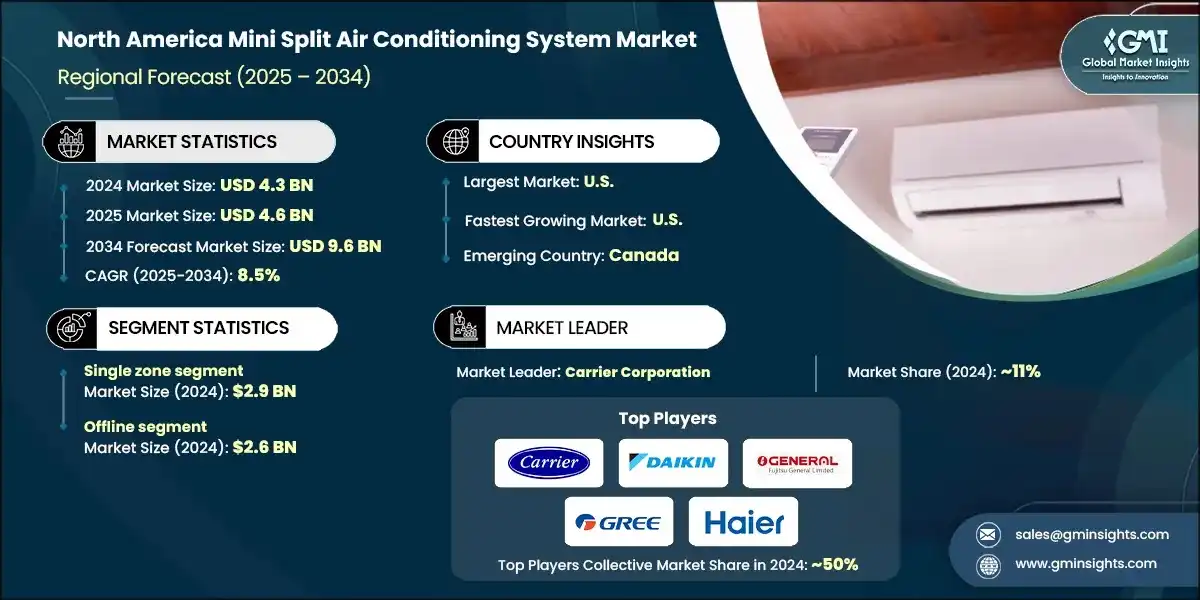
The North America mini split air conditioning system market was estimated at USD 4.3 billion in 2024. The market is expected to grow from USD 4.6 billion in 2025 to USD 9.6 billion in 2034, at a CAGR of 8.5% according to latest report published by Global Market Insights Inc.
North America Mini Split Air Conditioning System Market Key Takeaways
Market Size & Growth
- 2024 Market Size: USD 4.3 Billion
- 2025 Market Size: USD 4.6 Billion
- 2034 Forecast Market Size: USD 9.6 Billion
- CAGR (2025–2034): 8.5%
Key Market Drivers
- Technological Advancements.
- Shifting Consumer Demographics.
- Global Supply Chain Disruption.
Challenges
- Cybersecurity Threats.
- Talent Acquisition & Retention.
Opportunity
- Hyper-Personalization via Generative AI.
- The Circular Economy Transition.
Key Players
- Market Leader: Carrier Corporation led with over 11% market share in 2024.
- Leading Players: Top 5 players in this market include Carrier Corporation, Daikin Industries, Fujitsu General Ltd., GREE Electric Appliances, Haier Group Corporation, which collectively held a market share of 50% in 2024.
Get Market Insights & Growth Opportunities
- The North American mini split air conditioning system market is experiencing considerable growth, mainly because of three key trends that are changing the residential and commercial HVAC landscape. First, more people are adopting inverter technology for energy efficiency. This shift is pushing more consumers and businesses to lower their operational costs while also meeting strict regulations. This leads to significant energy savings for users. The U.S. Department of Energy points out that ductless mini split systems eliminate duct losses, which can account for over 30% of a home's space-conditioning energy use. This makes them especially appealing for retrofitting. The need for repeatable accuracy and precision of metal fabrication processes is important to all industries, but vital where safety, performance, and reliability are necessary.
- For instance, the U.S. and Canada are major contributors to this growth, with the market value projected to nearly double from 2024 to 2034. A key factor propelling this trend is the increasing consumer awareness of long-term operational cost savings associated with inverter technology, further encouraged by government rebates and the Environmental Protection Agency's ENERGY STAR program incentives. Furthermore, the rise in home renovation projects and the adoption of multi-zone systems for small commercial spaces, such as restaurants and boutique hotels, underscore the versatility of mini splits in addressing specific heating and cooling needs where installing traditional ductwork is impractical or too expensive.
- The ongoing infrastructure and construction boom in North America is another significant driver of market growth. As North America becomes more urbanized, with the United Nations predicting that the global urban population will reach 68% by 2050, homeowners and property developers are increasingly choosing mini split systems.
- These systems offer flexible installation options and a small spatial footprint. They require only a small three-inch wall penetration and can connect outdoor and indoor units up to 50 feet apart, offering design freedom that traditional ducted systems can't provide.
- Rising energy prices have led both consumers and businesses to look for air conditioning systems that use less power. Efficient technologies, like inverter ACs, help lower electricity bills. This makes them a popular choice for budget-conscious users in both residential and commercial sectors. Higher energy consumption also leads to increased carbon emissions, motivating consumers to choose energy-efficient cooling solutions. This change supports sustainability goals and aligns regulations promoting eco-friendly air conditioners that lessen environmental impacts.
To get key market trends
North America Mini Split Air Conditioning System Market Trends
- The market for mini split air conditioning system in North America is rapidly growing mainly due to developments in automation, technology, and principles of Industry 4.0. Manufacturers are using more integrated technology to ensure improved precision, faster production cycle times, and a reduction in human error. Finally, industry consolidation is altering competitive dynamics. With over 120 M&A deals in 2023 alone, scale advantages are becoming more pronounced, especially in distribution and service delivery. For companies like Atomi USA, these disruptions present both risks and strategic opportunities
- Furthermore, these mini splits are now capable of performing complex bending and cutting with very little manual input. Demand for new construction is fueled by various factors. Building energy codes and green building standards increasingly require high-efficiency HVAC systems. Mini split systems offer better SEER2 and HSPF2 performance compared to minimum code requirements
- In North America, the mini split air conditioning system market is governed by a range of federal, state, and industry-specific regulations designed to ensure energy efficiency, product safety, and environmental compliance. Oversight is provided by key regulatory bodies including the U.S. Department of Energy (DOE), the Environmental Protection Agency (EPA), and various standard-setting organizations.
- Environmental Protection Agency (EPA): The EPA regulates refrigerants through the Significant New Alternatives Policy (SNAP) program and the Clean Air Act. Manufacturers must comply with phased reductions and bans on high-global-warming-potential (GWP) refrigerants like R-410A, driving a shift toward environmentally friendly alternatives.
- Energy Star Certification: Jointly managed by DOE and EPA, the Energy Star label identifies mini split systems that exceed baseline efficiency and environmental performance standards. The program promotes consumer adoption of energy-efficient HVAC solutions.
- Industry Standards and Testing: Compliance with ASHRAE standards and Air-Conditioning, Heating, and Refrigeration Institute (AHRI) certifications is widespread. These ensure safety, reliability, and consistent performance across products in the market.
- The market is further fueled by the fast-growing renewable energy sector. The widespread adoption of inverter technology and growing demand for smart system integration are pushing manufacturers and service providers to upgrade capabilities across the value chain. At the same time, shifting market forces—including labor shortages projected to exceed 200,000 skilled workers, changing consumer expectations, and the impact of seasonal demand cycles—are putting pressure on traditional operating models.
North America Mini Split Air Conditioning System Market Analysis

Learn more about the key segments shaping this market
Based on product, the market is categorized into single-zone and multi-zone. The single zone accounted for revenue of around USD 2.9 billion in 2024 and is anticipated to grow at a CAGR of 8.6% from 2025 to 2034.
- Single-zone mini split systems are the most popular in the market. Their demand is driven by the increase in residential construction, the growth of urban housing, and the rising trend of home renovations. These systems are preferred because they are easy to install, cost less upfront, and are energy-efficient for cooling or heating individual rooms. As urban areas grow and homes in North America become smaller, single-zone systems are becoming a preferred choice for apartments, home offices, and additional rooms.
- On the other hand, multi-zone mini split systems are becoming more popular in larger homes, small commercial buildings, and light industrial spaces. These systems allow users to cool or heat multiple rooms independently using just one outdoor unit. This makes them a good option for buildings where installing ductwork is either not possible or too expensive. In the United States and Canada, multi-zone systems are especially popular in high-end residential developments and boutique hotels, where people value customized comfort and stylish designs. However, these systems are more expensive to install and more complex than single-zone systems, which limits their use in many residential settings.
- The demand for both types of systems is expected to grow, but single-zone systems will likely remain the market leader. This is because they are more affordable, easier to install, and fit well with the increasing number of single-family and multi-family homes in urban and suburban areas. As climate change becomes a bigger concern and energy efficiency becomes more important to homeowners, mini split systems, especially single-zone ones, are seen as a practical and environmentally friendly alternative to traditional HVAC systems.
- Overall, mini split systems are changing the way people manage temperature control in North America. Their ductless design, high energy efficiency ratings (SEER), and ability to control temperatures in specific zones make them a valuable option in a region that prioritizes sustainability, energy savings, and flexible comfort solutions. As builders, property developers, and consumers continue to look for smart and adaptable air conditioning options for both new and existing buildings, the market for mini split systems is expected to grow even further.
Learn more about the key segments shaping this market
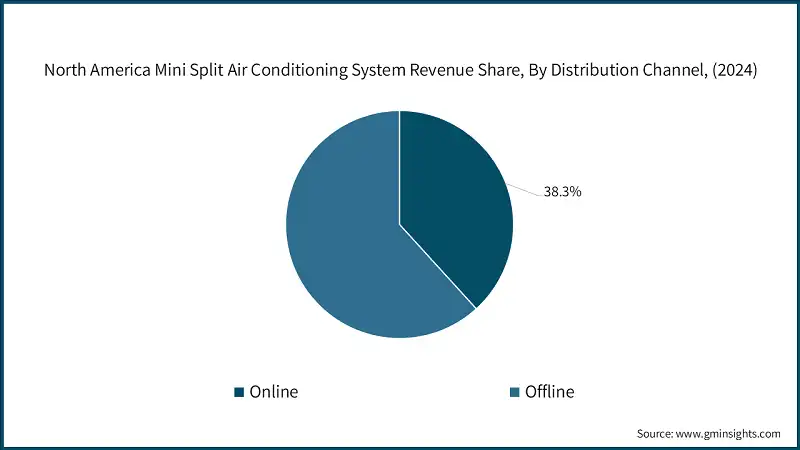
Based on distribution channel of North America mini split air conditioning system market consists of online and offline. The offline channel emerged as leader and USD 2.6 billion of the total sales in 2024 and is anticipated to grow at a CAGR of 8.3% from 2025 to 2034.
- Online sales in the U.S. are growing the fastest due to strong e-commerce platforms and the convenience they offer. Websites like Amazon, eBay, and Home Depot's online store make it easy for customers to buy budget and mid-range mini splits. Many DIY buyers and cost-conscious customers prefer buying HVAC systems online and often use third-party installation services. Competitive prices and wide availability make online channels a key part of market growth.
- Manufacturer-owned websites are becoming a popular way for brands to sell directly to customers. Companies like Mitsubishi, Daikin, and LG use these websites to promote premium models, offer financing, and bundle installation services. While these websites sell fewer units than e-commerce platforms, they help brands connect directly with customers by providing product details, warranties, and service packages. E-commerce platforms like Amazon, Walmart, and Home Depot are major channels for mini splits in the U.S. They mainly target budget-conscious buyers who want affordable and quickly available products. Features like customer reviews, product comparisons, and discounts help build trust. This channel is growing fast, especially among younger shoppers who prefer online shopping over visiting stores.
- Offline channels are still the most popular in North America, thanks to dealers, contractors, and specialty HVAC stores. Many buyers rely on professionals for advice and installation. Contractor-led sales dominate residential installations, while specialty stores attract both residential and commercial buyers looking for expert guidance and customized solutions.
- Additionally, the rise of e-commerce and digital procurement platforms has made it easier for customers to compare products, access technical specifications, and place orders with minimal friction, further boosting the appeal of indirect sales.
Looking for region specific data?
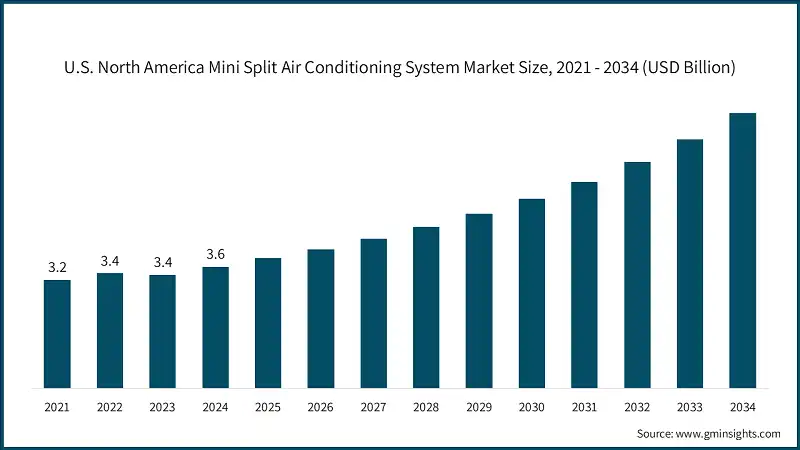
The U.S. dominates an overall North America mini split air conditioning system market with USD 3.6 billion in 2024 and is estimated to grow at a CAGR of 8.7% from 2025 to 2034.
- Over the past decade, the U.S. market for mini split air conditioning systems has surged, largely fueled by a growing use of ductless and energy-efficient cooling solutions. While traditional central air conditioning systems still dominate the U.S. landscape due to the widespread ducted infrastructure in both residential and commercial settings mini split systems are carving out a niche. They're particularly favored in older homes, small apartments, and retrofit scenarios where ductwork installation proves either costly or impractical.
- Driving this shift is a heightened focus on energy efficiency and sustainability. This push is bolstered by regulations like the U.S. Department of Energy's energy efficiency standards and a move towards low-GWP refrigerants, as mandated by the American Innovation and Manufacturing (AIM) Act. Furthermore, as consumers become more aware of zoned cooling— allowing for individual room temperature control, the adoption of mini splits gains further traction.
- The U.S. market is a battleground for global giants such as Carrier, Daikin, Mitsubishi Electric, LG, and Fujitsu. They're up against Chinese contenders like GREE, Midea, and Haier, who often compete on price. Key differentiators in this competitive landscape include robust domestic distribution, strategic partnerships with HVAC contractors, and the incorporation of advanced
North America Mini Split Air Conditioning System Market Share
- In 2024, the prominent manufacturers in North America mini split air conditioning system industry are Carrier Corporation, Daikin Industries, Fujitsu General Ltd., GREE Electric Appliances, and Haier Group Corporation held the market share of ~50%. These companies continuously invest in research and development to introduce CNC-controlled and servo-electric machines that deliver high precision, energy efficiency, and automation capabilities. They also focus on integrating IoT and smart manufacturing features, enabling predictive maintenance and real-time monitoring to meet Industry 4.0 requirements.
- In North America, single-zone mini-splits hold a steady share of the market because they are a cost-effective solution for individual rooms, garages, or extensions where central ductwork is unavailable. Their compact design, lower upfront cost, and ease of installation make them popular among budget-conscious consumers. However, their growth is slower compared to multi-zone units, as households increasingly prioritize whole-home solutions that maximize efficiency and comfort across multiple rooms.
North America Mini Split Air Conditioning System Market Companies
Major players operating in the North America mini split air conditioning system industry include:
- Carrier Corporation
- Daikin Industries
- Fujitsu General Ltd.
- GREE Electric Appliances
- Haier Group Corporation
- Hitachi
- Johnson Controls Plc
- LG Electronics
- Midea Group Co. Ltd.
- Mitsubishi Electric Corporation
- Panasonic Corporation
- Samsung Electronics Co. Ltd.
- Senville
- Toshiba Corporation
- Trane Technologies
Midea grabbed attention in the mini split air conditioning market by showcasing its products at IFA 2024 in Berlin. The company introduced the AI-powered Solstice split AC and the portable
Mitsubishi Electric launched a new line of mini split air conditioning systems that are compatible with smart home platforms such as Amazon Alexa and Google Home. The new systems, called Mitsubishi Electric HyperCore, can be controlled using voice commands or through a smartphone app. They can also be programmed to turn on and off automatically based on the user's schedule.
North America Mini Split Air Conditioning System Market Report Attributes
| Key Takeaway | Details |
|---|---|
| Market Size & Growth | |
| Base Year | 2024 |
| Market Size in 2024 | USD 4.3 Billion |
| Market Size in 2025 | USD 4.6 Billion |
| Forecast Period 2025 - 2034 CAGR | 8.5% |
| Market Size in 2034 | USD 9.6 Billion |
| Key Market Trends | |
| Drivers | Impact |
| Technological Advancements | This driver increases operational efficiency, reduces long-term labor costs through automation, and enables faster product development, ultimately enhancing the companys competitive advantage. |
| Shifting Consumer Demographics | This trend necessitates the creation of personalized products, requires targeted digital marketing strategies, and opens lucrative new market segments, especially in rapidly growing developing economies. |
| Global Supply Chain Disruption | This forces companies to diversify sourcing and increase inventory buffers, leading to volatile input costs, but also accelerates the adoption of digital tracking technologies for greater visibility. |
| Pitfalls & Challenges | Impact |
| Cybersecurity Threats | This risk demands continuous, substantial investment in security infrastructure, threatens significant financial loss and reputational harm from breaches, and necessitates strict compliance with global data privacy regulations. |
| Talent Acquisition & Retention | This challenge limits innovation and growth by keeping key roles unfilled, increases costs associated with competitive compensation and recruitment, and requires fostering a strong company culture with flexible work models. |
| Opportunities: | Impact |
| Hyper-Personalization via Generative AI | This opportunity allows companies to create unique customer experiences and targeted content at scale, significantly boosting engagement, increasing conversion rates, and fostering deep brand loyalty. |
| The Circular Economy Transition | This shift enables businesses to reduce waste and raw material costs by adopting Product-as-a-Service models, enhancing resource efficiency, and attracting the growing segment of environmentally conscious consumers and investors. |
| Market Leaders (2024) | |
| Market Leaders |
Market share of ~11% |
| Top Players |
Collective market share in 2024 is Collective market share of ~50% |
| Competitive Edge |
|
| Regional Insights | |
| Largest Market | U.S. |
| Fastest Growing Market | U.S. |
| Emerging Country | Canada |
| Future Outlook |
|
What are the growth opportunities in this market?
North America Mini Split Air Conditioning System Industry News
- In July 2024, Johnson Controls International plc, a global leader in smart and sustainable building solutions, announced an agreement to sell its Residential and Light Commercial (R&LC) HVAC business to the Bosch Group in an all-cash deal. This sale includes the North America Ducted business and a global Residential joint venture with Hitachi, Ltd., where Johnson Controls owns 60% and Hitachi owns 40%.
- In January 2024, Carrier Corporation acquired Viessmann Climate Solutions to expand its footprint in mini split air conditioning. Carrier now extends its operations in Europe residential and light commercial segment and will incorporate Viessmann's energy-efficient and renewable HVAC technology, and this acquisition helped Carrier strengthen its global climate sustainable solutions position in the marketplace.
- In February 2025, Lennox a leader in climate control solutions, partnered with Samsung, a global leader in HVAC technology. Together, they are offering new ductless heating and cooling solutions. Their joint venture, Samsung Lennox HVAC North America, has introduced its first products: the Lennox Powered by Samsung mini-split systems and the Varix™ variable refrigerant flow (VRF) lineup. These products are available to Lennox customers through Lennox's sales channels.
- In January 2025, Panasonic Corporation announced that its Heating & Ventilation A/C Company (HVAC Company) will launch the OASYS Residential Central Air Conditioning System in the US. This new system, the first of its kind in the US, features a Mini Split AC, an ERV (Energy Recovery Ventilator), and transfer fans powered by DC motor-driven ventilation. It uses over 50% less energy for heating and cooling compared to traditional systems. The OASYS is designed to create a comfortable and healthy home by circulating more air, keeping temperatures steady, purifying the air, and running quietly.
- In March 2024, Mitsubishi Electric Trane, a leading company in mini-split and VRF heat pump and air conditioning systems, introduced its new Premier Wall-mounted Indoor Units. These new units are upgrades of the older models and offer better energy efficiency and a more user-friendly experience.
- In 2023, Daikin developed a new inverter technology that reduces energy consumption by as much as 30%. Daikin's recent technology called Daikin Ururu Sarara Z has developed efficient refrigerant, along with a quiet, long-lasting compressor design.
The North America mini split air conditioning system market research report includes in-depth coverage of the industry, with estimates & forecast in terms of revenue (USD Billion) and volume (Thousand Units) from 2021 to 2034, for the following segments:
Market, By Product Type
- Single-zone mini splits
- Multi-zone mini splits
Market, By Installation
- Wall mounted
- Free standing
- Others (floor ceiling)
Market, By Technology
- Inverter mini splits
- Non-inverter mini splits
Market, By Price Range
- Low
- Medium
- High
Market, By Capacity
- Less than 1 ton
- 1 to 1.5 ton
- 1.5 to 2 ton
- More than 2 ton
Market, By End User
- Residential
- Commercial
Market, By Distribution Channel
- Online
- Offline
The above information is provided for the following countries:
- North America
- U.S.
- Canada
Frequently Asked Question(FAQ) :
What is the market size of the North America mini split air conditioning system in 2024?
The market size was USD 4.3 billion in 2024, with a CAGR of 8.5% expected through 2034 driven by adoption of inverter technology, energy efficiency demands, and infrastructure development.
What is the projected value of the North America mini split air conditioning system market by 2034?
The North America mini split air conditioning system market is expected to reach USD 9.6 billion by 2034, propelled by smart system integration, renewable energy adoption, and green building standards.
What is the current North America mini split air conditioning system market size in 2025? The market
size is projected to reach USD 4.6 billion in 2025.
How much revenue did the single-zone segment generate in 2024?
Single-zone mini splits generated USD 2.9 billion in 2024, expected to grow at a CAGR of 8.6% through 2034.
What was the valuation of the offline distribution channel segment in 2024?
The offline channel held USD 2.6 billion sales in 2024, driven by dealer networks and contractor-led installations.
What is the growth outlook for the offline distribution channel from 2025 to 2034?
The offline channel is projected to grow at a 8.3% CAGR till 2034, due to professional installation services, expert guidance, and specialty HVAC store networks.
Which country leads the North America mini split air conditioning system market?
The U.S. held USD 3.6 billion in 2024, with a CAGR of 8.7% expected through 2034. Energy efficiency regulations and ductless cooling adoption fuel the country's dominance.
What are the upcoming trends in the North America mini split air conditioning system market?
Key trends include adoption of automation and Industry 4.0 principles, integration of smart home platforms, AI-powered climate control, and transition to low-GWP refrigerants for environmental compliance.
Who are the key players in the North America mini split air conditioning system market?
Key players include Carrier Corporation, Daikin Industries, Fujitsu General Ltd., GREE Electric Appliances, Haier Group Corporation, Hitachi, Johnson Controls Plc, LG Electronics, Midea Group Co. Ltd., Mitsubishi Electric Corporation, Panasonic Corporation, Samsung Electronics Co. Ltd., Senville, Toshiba Corporation, and Trane Technologies.
North America Mini Split Air Conditioning System Market Scope
Related Reports