Summary
Table of Content

North America AI-Driven Retinal Screening Device Market
Get a free sample of this report
Form submitted successfully!
Error submitting form. Please try again.
Thank you!
Your inquiry has been received. Our team will reach out to you with the required details via email. To ensure that you don't miss their response, kindly remember to check your spam folder as well!
Request Sectional Data
Thank you!
Your inquiry has been received. Our team will reach out to you with the required details via email. To ensure that you don't miss their response, kindly remember to check your spam folder as well!
Form submitted successfully!
Error submitting form. Please try again.
North America AI-Driven Retinal Screening Device Market Size
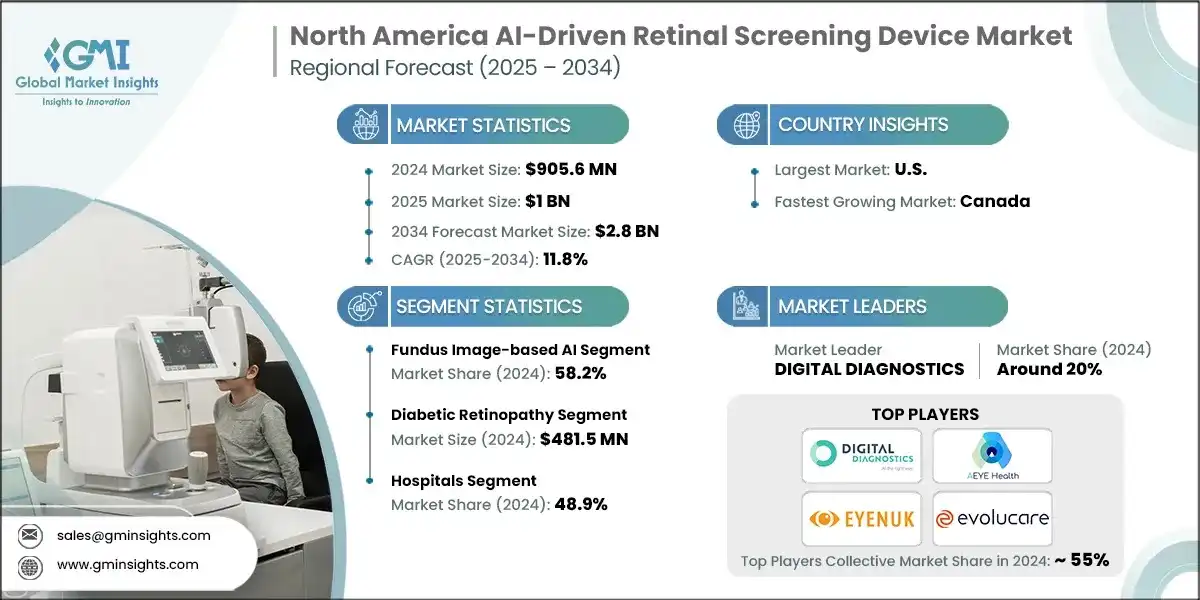
The North America AI-driven retinal screening device market was estimated at USD 905.6 million in 2024. The market is expected to grow from USD 1 billion in 2025 to USD 2.8 billion in 2034, at a CAGR of 11.8% during the forecast period, according to the latest report published by Global Market Insights Inc.
North America AI-Driven Retinal Screening Device Market Key Takeaways
Market Size & Growth
- 2024 Market Size: USD 905.6 Million
- 2025 Market Size: USD 1 Billion
- 2034 Forecast Market Size: USD 2.8 Billion
- CAGR (2025–2034): 11.8%
Regional Dominance
- Largest Market: U.S.
- Fastest Growing Region: Canada
Key Market Drivers
- Rising prevalence of retinal diseases.
- Favorable government initiatives and funding for AI in healthcare.
- Rising geriatric population.
- Integration with telemedicine platforms for remote screening and diagnosis.
Challenges
- Data privacy and security concerns.
- Stringent regulatory guidelines.
Opportunity
- Multi-disease detection platform development.
- Advancements in AI and deep learning algorithms.
Key Players
- Market Leader: DIGITAL DIAGNOSTICS led with over 20% market share in 2024.
- Leading Players: Top 5 players in this market include DIGITAL DIAGNOSTICS, AEYE Health, EYENUK, evolucare, which collectively held a market share of 55% in 2024.
Get Market Insights & Growth Opportunities
The North American AI-driven retinal screening device market is driven by rising prevalence of retinal diseases, technological advancements, integration with telemedicine platforms for remote screening and diagnosis, and surging focus on integration of AI-based tools, among other factors.
Rise in patients suffering from diabetes, growing geriatric population, supportive public health campaigns, and funding are among the key factors propelling the industry demand. AEYE Health, DIGITAL DIAGNOSTICS, EYENUK, and evolucare are among the leading players operating in the market. These players mainly focus on product innovation, ease of integration, scalability, and affordability to improve their industry positioning.
The market reached USD 775.7 million in 2023 from USD 508 million in 2021. The rise in prevalence of diabetes has led to a surge in diabetic retinopathy cases, a leading cause of preventable blindness. For instance, according to the data reported by the Centers for Disease Control and Prevention (CDC), 1 in 10 Americans is suffering from diabetes, and most of them have type 2 diabetes. AI-driven retinal screening devices offer a scalable solution for early detection, especially in primary care and community health settings. These tools help identify retinal damage before symptoms appear, reducing the burden on ophthalmologists and improving patient outcomes. As diabetes becomes more widespread, the demand for accessible and automated screening solutions for different retinal diseases continues to grow.
Additionally, the increased acceptance of telemedicine witnessed in North America has led to the growing utilization of AI-based retinal screening devices. These options help facilitate remote eye exams for patients who reside in rural areas or areas with limited resources, delivering timely access to clinical visits without scheduling in-office visits with specialists. Cloud-based AI solutions process patient retinal images in a secure environment and provide timely diagnostics, mitigating delays while promoting preventive health care.
Further, in the U.S. and Canada, AI adoption in healthcare and, specifically, in the field of eye care, is being substantially expedited by government-funded programs and funding mechanisms. These solutions are becoming financially available with grants at the federal and state levels, as reimbursement codes allow for the assessment of AI diagnostics performed autonomously. Health campaigns focused on the diabetic eye disease population create a demand for scalable solutions to screening. Thus, such collaboration spurs innovation, increases access, and positions AI-based retinal screening as a viable aspect of modern healthcare delivery.
An AI-driven retinal screening device is a medical diagnostic tool that uses artificial intelligence algorithms to analyze retinal images for signs of eye diseases. It enables fast, accurate, and often autonomous detection of conditions such as diabetic retinopathy, glaucoma, and age-related macular degeneration, improving access to early eye care.
To get key market trends
North America AI-Driven Retinal Screening Device Market Trends
Integration with telemedicine platforms, favorable reimbursement support, multi-disease screening capabilities, expansion into non-specialist settings, and growing FDA approvals for autonomous AI screening are among the key trends shaping the market growth in an upward trajectory.
- The increase in adoption of telehealth has led to a growing focus on portable retinal imaging devices and cloud-based AI analytics. This trend allows for improved access to eye care in rural and underserved areas, which corresponds properly with preventive health models.
- In addition, the introduction of CPT codes for autonomous AI screening has prompted clinics to adopt these technologies that are compatible with reimbursement guidelines. Availability of proper reimbursement along with clinical validation is a key parameter, as clinicians are working on implementing and integrating such tools to improve their normal workflows.
- AI screening tools are being integrated into private practices, primary care offices, pharmacies, and retail clinics, among other settings. The decentralization of eye care enables earlier detection of eye conditions while reducing the pressure on ophthalmologists.
- Further, next-generation AI platforms have a keen focus on upgrading and developing tools to detect multiple conditions such as diabetic retinopathy, glaucoma, and AMD with a single screening. This adds value for the provider and patient, thereby fostering development and adoption.
North America AI-Driven Retinal Screening Device Market Analysis
Learn more about the key segments shaping this market
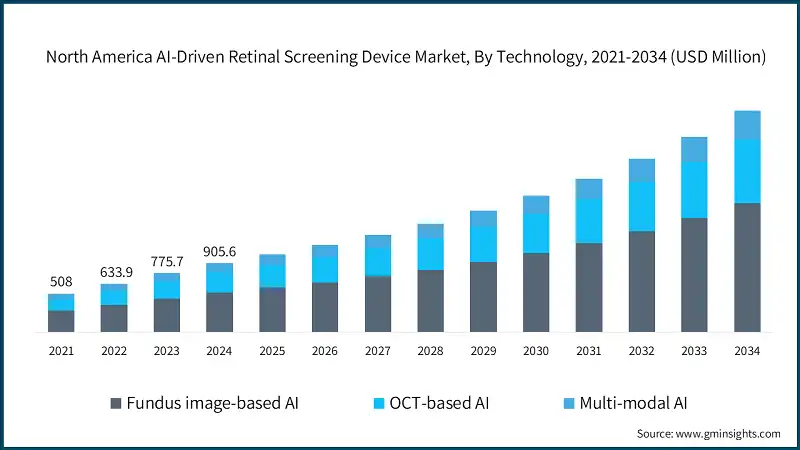
In 2021, the market was valued at USD 508 million and grew to USD 633.9 million in 2022, reaching USD 775.7 million by 2023. Growing geriatric population, technological advancements in AI and supportive funding to combat preventable blindness are among the key variables contributing to industry growth.
Based on technology, the North America AI-driven retinal screening device market is segmented into fundus image-based AI, OCT-based AI, and multi-modal AI. The fundus image-based AI segment accounted for a leading share of 58.2% in 2024. Growing focus on early detection of different ophthalmic disorders is anticipated to fuel the industry growth. The segment is expected to exceed USD 1.6 billion by 2034, growing at a CAGR of 12.1% during the forecast period.
- Fundus image-based AI systems utilize 2D retinal images captured through fundus cameras to identify surface-level features such as hemorrhages and optic disc abnormalities. These AI models are specifically trained to diagnose conditions such as diabetic retinopathy, glaucoma, and hypertensive retinopathy.
- Fundus imaging-based applications are widely adopted due to their cost-effectiveness and portability, making them suitable for use in primary care settings and rural areas. These systems enable rapid screening and are often employed in large-scale health programs.
- The OCT-based AI segment was valued at USD 260.2 million in 2024. Optical Coherence Tomography (OCT)-based image analysis provides cross-sectional imaging of the retina, offering detailed views of deeper retinal layers. This high-resolution imaging is particularly effective in diagnosing conditions such as macular degeneration (e.g., diabetic macular edema) and glaucoma.
- Additionally, AI algorithms trained on OCT images can detect subtle structural changes that may not be visible through fundus imaging. While OCT imaging is more expensive and primarily used in specialized clinics, it enhances diagnostic accuracy and streamlines workflows when utilized by eye care practitioners trained in multi-modal imaging systems.
Based on application, the North America AI-driven retinal screening device market is segmented into diabetic retinopathy, age-related macular degeneration, glaucoma, cataract, and other applications. The diabetic retinopathy segment accounted for a leading share and was valued at USD 481.5 million in 2024.
- Diabetic retinopathy remains the leading cause of vision loss among diabetic patients in North America. AI-driven retinal screening devices have proven highly effective in identifying early indicators such as microaneurysms, hemorrhages, and exudates from fundus images.
- These devices enable quick, non-invasive diagnoses, often eliminating the need for direct ophthalmologist involvement. Their deployment in primary care settings and diabetic clinics has significantly enhanced screening accessibility, particularly in underserved areas. Hence, diabetic retinopathy continues to dominate the market due to its high prevalence and the potential for early intervention.
- The age-related macular degeneration (AMD) segment was valued at USD 208.6 million in 2024. AMD, which affects the central retina, is a leading cause of vision impairment among older adults. AI systems trained on OCT and fundus images can detect early structural changes in the macula, aiding in the differentiation between dry and wet AMD.
- Additionally, these tools facilitate timely interventions, that are critical for preserving vision. With the aging population in North America, AI-based AMD screening is becoming increasingly important in geriatric care and routine eye examinations.
- The glaucoma segment was valued at USD 131 million in 2024. Glaucoma, a progressive optic nerve disease often associated with elevated intraocular pressure, is another significant application area for AI-driven screening devices. AI models analyze optic disc cupping and nerve fiber layer thickness using fundus and OCT images to detect early signs of the disease.
- Since glaucoma progresses silently, AI tools play a crucial role in routine screening and monitoring. Their integration into ophthalmology clinics and mobile screening units helps identify at-risk individuals before irreversible damage occurs, positioning glaucoma as a key growth area for AI diagnostics in the region.
Learn more about the key segments shaping this market
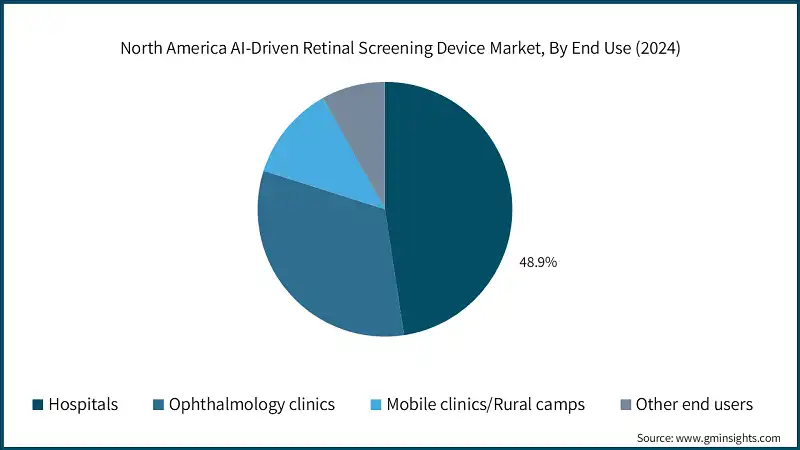
Based on end use, the North America AI-driven retinal screening device market is segmented into hospitals, ophthalmology clinics, mobile clinics/rural camps, and other end users. The hospitals segment accounted for the leading market share of 48.9% in 2024 as it records high patient footfall and are capable of investing in advanced resources.
- Regional hospitals are utilizing AI-powered retinal screening devices to improve early detection of diabetic retinopathy and other serious eye disorders. These systems incorporate seamlessly into electronic health records, creating an efficient workflow and reducing the burden on specialists.
- Hospitals are using AI tools to support large-scale screening programs, improve patient outcomes, and advance preventive care. Providing autonomous diagnostic testing at the point of care is an important variable that aligns with value-based care models and has made hospitals important enablers of this technology.
- Moreover, growing partnerships between hospitals and AI technology providers can assist in extending telehealth services to underserved communities.
- The ophthalmology clinics segment was valued at USD 294.7 million in 2024. Ophthalmology clinics are among the early adopters of AI-based retinal screening devices to improve diagnostic accuracy and reduce overall turnaround time. They benefit from AI’s ability to identify a variety of conditions (for example, diabetic retinopathy, glaucoma, and AMD) in a single screening, enhancing care.
- Clinics can also leverage imaging systems and cloud-based platforms that seamlessly connect with AI tools to streamline workflows and better facilitate patient consultations remotely.
- In addition, AI tools can help address increasing patient volumes by automating initial screenings and allowing specialists to focus on more complex cases. Clinics are opting for such solutions primarily to enhance their teleophthalmology services and expand accessibility to advanced eye care.
Looking for region specific data?
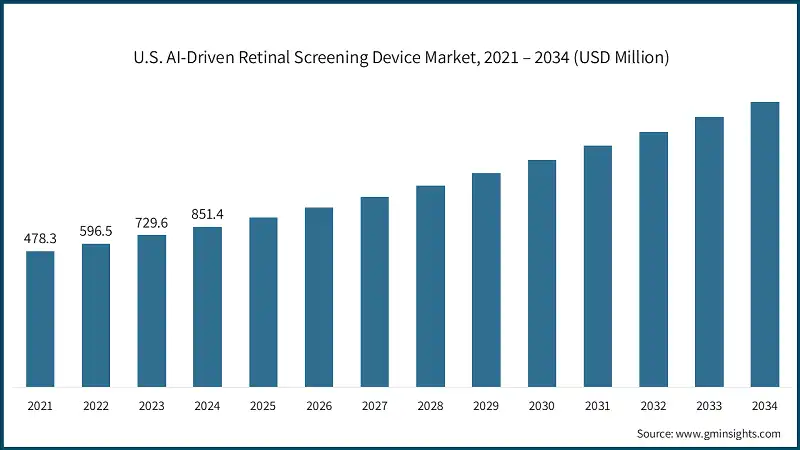
The U.S. AI-driven retinal screening device market was valued at USD 478.3 million and USD 596.5 million in 2021 and 2022, respectively. In 2024 the market size was valued at USD 851.4 million from USD 729.6 million in 2023. The increasing trend of adopting advanced devices and tools with AI integration for faster disease diagnosis is projected to fuel the market growth.
- The U.S. is the largest and most advanced market for AI-driven retinal screening devices in the region. AI tools are widely deployed in hospitals, primary care clinics, and retail health settings, offering fast, accurate, and cost-effective diagnostics. For instance, as per the recently published article, after deploying the system by DIGITAL DIAGNOSTICS, St. Louis-based health system SSM Health achieved a 15%-20% increase in their diabetic retinopathy screening. Such improvements in accurate diagnosis may push the adoption rate throughout the country.
- Additionally, the market is expanding rapidly, fueled by a surge in diabetic retinopathy and age-related eye conditions. For example, as per the data reported in a 2021 report, around 1.84 million people in the country were suffering from vision-threatening diabetic retinopathy (VTDR). The prevalence of VTDR is considerably higher among Black and Hispanic populations.
- In addition, strong healthcare infrastructure and favorable reimbursement policies make adoption easier for clinics and primary care providers. Further, cloud-based platforms and portable imaging devices are also gaining traction, supporting early detection and preventive care initiatives that align with national health priorities.
Canada accounted for a notable share of the North America AI-driven retinal screening device market and was valued at USD 54.2 million in 2024.
- The Canadian market for AI-driven screening devices for retinal health is driven by innovation and a growing focus on faster disease diagnosis through advanced tools. The country benefits from a well-established healthcare infrastructure, high awareness of preventive eye care, and a strong presence of AI startups and medical device companies.
- In addition, integrating AI-based screening exams and digital tools with electronic health records and telehealth systems allows for seamless workflows and remote evaluation with diagnosis at the point of care. AI-based screening are being used autonomously in pharmacy and community health clinic settings, helping improve access from detection to treatment of eye diseases in at-risk and underserved populations.
- Further, public-private partnerships and investments in AI infrastructure are accelerating commercialization. Local healthcare providers are increasingly recognizing the value of AI in reducing diagnostic bottlenecks and enhancing preventive care, thereby improving the product demand in the country.
North America AI-Driven Retinal Screening Device Market Share
The competitive dynamics of the North American AI-driven retinal screening device market are a combination of global and local players that have a critical focus on innovation, regulatory approvals, and strategic developments. The market is led by companies such as Digital Diagnostics, AEYE Health, Eyenuk, and other competitors driving advancements in autonomous retinal disease detection through the use of AI.
Digital Diagnostics, which was the first to receive FDA clearance with a fully autonomous device, LumineticsCore, is witnessing widespread adoption as part of primary care workflows in the U.S. healthcare system. AEYE Health is focused on developing rapid screening devices that are portable and offer reimbursement to simplify adoption in health settings. Similarly, Eyenuk has rapidly gained adoption of its EyeArt platform through collaborations with health systems and payers to assist in stage-of-care decisions.
Small companies and emerging start-ups are entering the market by building partnerships with telemedicine platform providers. Competitive differentiation often focuses on accuracy, ease of integration, regulatory approval, and reimbursement backing. The next growth phase is expected to be primarily driven by technology partnerships with device manufacturers and cloud-based solutions while demand for low-cost, point-of-care screening continues to accelerate in the region.
North America AI-Driven Retinal Screening Device Market Companies
A few of the prominent players operating in the North America AI-driven retinal screening device industry include:
- AEYE Health
- DIGITAL DIAGNOSTICS
- evolucare
- EYENUK
- Forus Health
- iCare
- NOTAL VISION
- OPTOMED
- remidio
- Topcon Healthcare
- Visionix
- DIGITAL DIAGNOSTICS
Digital Diagnostics holds approximately 20% of the market share in 2024 within the North America AI-driven retinal screening device market. The company specializes in autonomous AI systems designed to function without clinician oversight. Their strategy prioritizes regulatory advancements, highlighted by the launch of the first FDA-cleared AI solution for diabetic retinopathy. Additionally, they focus on seamless integration with electronic health records (EHRs) and scalable implementation in primary care settings to alleviate specialist shortages and enhance early detection capabilities.
The company centers on digital health transformation through AI integration in critical care software, unified patient data systems, and strategic alliances to expand their regional presence and enhance hospital interoperability.
AEYE Health focuses on enhancing accessibility and portability in the North American market by providing handheld, autonomous AI screening devices. Their approach prioritizes rapid diagnostics, positioning them as a significant player for retail clinics, pharmacies, and rural health centers. By emphasizing affordability, user-friendliness, and integration into non-specialist settings, AEYE Health aims to democratize eye care across the region.
North America AI-Driven Retinal Screening Device Market Report Attributes
| Key Takeaway | Details |
|---|---|
| Market Size & Growth | |
| Base Year | 2024 |
| Market Size in 2024 | USD 905.6 Million |
| Market Size in 2025 | USD 1 Billion |
| Forecast Period 2025 – 2034 CAGR | 11.8% |
| Market Size in 2034 | USD 2.8 Billion |
| Key Market Trends | |
| Drivers | Impact |
| Rising prevalence of retinal diseases | Increasing cases of diabetic retinopathy and AMD have created urgent demand for early detection tools, making AI-driven screening a priority in hospitals and primary care settings. |
| Favorable government initiatives and funding for AI in healthcare | Federal programs and grants are accelerating AI adoption, while reimbursement codes for autonomous screening make these solutions financially viable for clinics and health systems. |
| Rising geriatric population | An aging population with higher risk of vision-threatening conditions is driving consistent demand for AI-based screening, especially in preventive care programs and routine check-ups. |
| Integration with telemedicine platforms for remote screening and diagnosis | Telehealth integration enables remote retinal exams, improving access for rural and underserved communities and supporting large-scale screening initiatives across North America. |
| Pitfalls & Challenges | Impact |
| Data privacy and security concerns | Strict compliance requirements under HIPAA and other regulations slow cloud-based AI adoption, as providers prioritize secure data handling and patient confidentiality. |
| Stringent regulatory guidelines | Lengthy approval processes for autonomous AI systems delay market entry, requiring extensive clinical validation and adherence to evolving standards. |
| Opportunities: | Impact |
| Multi-disease detection platform development | Platforms capable of screening for multiple conditions will enhance value for providers, reduce patient visits, and accelerate adoption in integrated care settings. |
| Advancements in AI and deep learning algorithms | Improved algorithms will boost diagnostic accuracy, enable predictive analytics, and support real-time decision-making, making AI indispensable in ophthalmology workflows. |
| Market Leaders (2024) | |
| Market Leaders |
20% Market Share |
| Top Players |
Collective market share in 2024 is 55% |
| Competitive Edge |
|
| Regional Insights | |
| Largest Market | U.S. |
| Fastest growing Market | Canada |
| Future outlook |
|
What are the growth opportunities in this market?
North America AI-Driven Retinal Screening Device Industry News:
- In July 2025, AEYE Health, an AI-powered retinal diagnostics company, announced that it signed a strategic partnership with Ford Medical, a healthcare distributor supporting non-acute care providers. The collaboration is expected to implement AEYE's fully autonomous diabetic eye exam screening solutions to pharmacies and non-acute centers nationwide, making early detection of diabetic retinopathy easier, faster and more widely accessible for patients.
- In July 2025, Topcon Healthcare announced the acquisition of Intelligent Retinal Imaging Systems (IRIS). The company aims to enhance AI-driven clinical decision-making for diabetic retinopathy within its Healthcare from the Eye initiative. Topcon has plans to integrate IRIS technologies into its systems to improve retinal disease diagnostics.
- In February 2025, Altris AI announced the launch of an advanced glaucoma optic disc analysis module with an aim to aid in the early detection of the disease. The key parameters captured by the module include disc area, cup area, cup volume, among other metrics. This product launch is expected to improve the company's focus towards providing high-quality glaucoma care in the region.
The North America AI-driven retinal screening device market research report includes an in-depth coverage of the industry with estimates and forecasts in terms of revenue in (USD Million) from 2021 - 2034 for the following segments:
Market, By Technology
- Fundus image-based AI
- OCT-based AI
- Multi-modal AI
Market, By Application
- Diabetic retinopathy
- Age-related macular degeneration
- Glaucoma
- Cataract
- Other applications
Market, By End Use
- Hospitals
- Ophthalmology clinics
- Mobile clinics/Rural camps
- Other end users
The above information is provided for the following countries:
- U.S.
- Canada
Frequently Asked Question(FAQ) :
What is the market size of the North America AI-driven retinal screening device in 2024?
The market size was estimated at USD 905.6 million in 2024, with a CAGR of 11.8% expected through 2034, driven by advancements in AI technology, increasing FDA approvals, and integration with telemedicine platforms.
What is the projected value of the North America AI-driven retinal screening device market by 2034?
The market is expected to reach USD 2.8 billion by 2034, fueled by multi-disease screening capabilities, favorable reimbursement policies, and expansion into non-specialist settings.
What is the projected size of the North America AI-driven retinal screening device market in 2025?
The market is expected to reach USD 1 billion in 2025.
What was the market share of the fundus image-based AI segment in 2024?
The fundus image-based AI segment accounted for 58.2% of the market share in 2024, driven by its focus on early detection of ophthalmic disorders. The segment is projected to exceed USD 1.6 billion by 2034, growing at a CAGR of 12.1% during the forecast period.
What was the valuation of the diabetic retinopathy application segment in 2024?
The diabetic retinopathy segment was valued at USD 481.5 million in 2024, leading the market among application segments.
Which end-use segment led the North America AI-driven retinal screening device market in 2024?
The hospitals segment held the leading market share of 48.9% in 2024, attributed to high patient footfall and the ability to invest in advanced resources.
What was the valuation of the U.S. AI-driven retinal screening device market in 2024?
The U.S. market was valued at USD 851.4 million in 2024, up from USD 729.6 million in 2023, driven by the adoption of AI-integrated devices for faster disease diagnosis.
What are the upcoming trends in the North America AI-driven retinal screening device market?
Key trends include the integration of AI with telemedicine platforms, the introduction of CPT codes for autonomous AI screening, growing FDA approvals, and the adoption of portable retinal imaging devices with cloud-based AI analytics to improve access in underserved areas.
Who are the key players in the North America AI-driven retinal screening device market?
Key players include AEYE Health, DIGITAL DIAGNOSTICS, evolucare, EYENUK, Forus Health, iCare, NOTAL VISION, OPTOMED, remidio, and Topcon Healthcare.
North America AI-Driven Retinal Screening Device Market Scope
Related Reports