Summary
Table of Content

Non-woven Abrasives Market
Get a free sample of this report
Form submitted successfully!
Error submitting form. Please try again.
Thank you!
Your inquiry has been received. Our team will reach out to you with the required details via email. To ensure that you don't miss their response, kindly remember to check your spam folder as well!
Request Sectional Data
Thank you!
Your inquiry has been received. Our team will reach out to you with the required details via email. To ensure that you don't miss their response, kindly remember to check your spam folder as well!
Form submitted successfully!
Error submitting form. Please try again.
Non-woven Abrasives Market Size
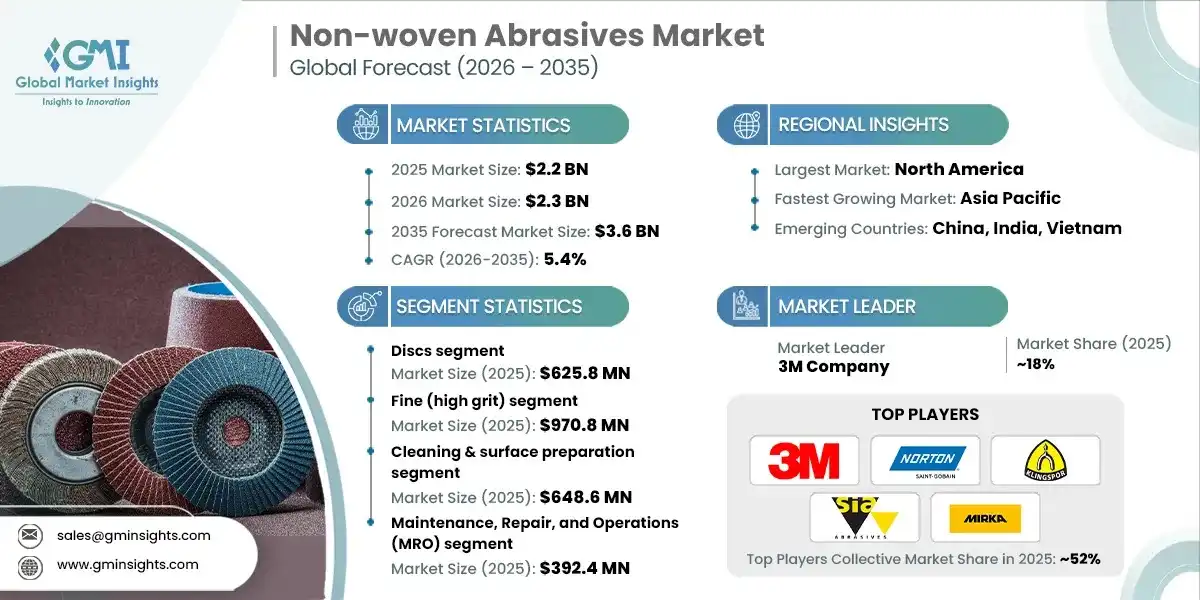
The global non-woven abrasives market was valued at USD 2.2 billion in 2025. The market is estimated to grow from USD 2.3 billion in 2026 to USD 3.6 billion in 2035, at a CAGR of 5.4%.
Non-woven Abrasives Market Key Takeaways
Market Size & Growth
- 2025 Market Size: USD 2.2 Billion
- 2026 Market Size: USD 2.3 Billion
- 2035 Forecast Market Size: USD 3.6 Billion
- CAGR (2026–2035): 5.4%
Key Market Drivers
- Industrial automation and precision manufacturing expansion.
- Aerospace and automotive lightweighting initiatives.
- Maintenance, repair, and operations (MRO) market growth.
Challenges
- Raw material price volatility and supply chain constraints.
- Competition from alternative finishing technologies.
Opportunity
- Expansion in Asia Pacific manufacturing hubs.
- Development of specialized finishing systems for advanced materials.
- Premium consumer and DIY market penetration.
Key Players
- Market Leader: 3M Company led with over 18% market share in 2025.
- Leading Players: Top 5 players in this market include 3M Company, Saint-Gobain Abrasives / Norton, Klingspor Abrasives, Sia Abrasives Industries AG, Mirka Ltd., which collectively held a market share of 52% in 2025.
Get Market Insights & Growth Opportunities
- Non-woven abrasives refer to engineered three-dimensional abrasive products manufactured through the integration of synthetic fibers, bonding resins, and abrasive minerals into open-web structures that provide consistent finishing performance across diverse industrial and consumer applications. These abrasives are characterized by their unique construction utilizing nylon, polyester, or synthetic fiber matrices impregnated with aluminum oxide, silicon carbide, or ceramic abrasive grains bonded through resin systems that ensure uniform mineral distribution and controlled cutting action. Non-woven abrasive products include hand pads, belts, discs, sheets and rolls, wheels, brushes, and specialty configurations offering grit grades ranging from coarse (40-80 grit equivalent) to ultra-fine (600+ grit equivalent) for applications requiring controlled material removal, surface conditioning, and finishing operations. They are produced through precision manufacturing processes involving fiber web formation, resin saturation, mineral coating, curing, and converting operations that deliver consistent density, conformability, and load resistance properties essential for professional metalworking, woodworking, automotive refinishing, and maintenance applications.
- Non-woven abrasives have witnessed significant technological advancements in recent years, driven by innovations in fiber engineering, abrasive mineral technology, and bonding system chemistry. Enhanced synthetic fiber technologies incorporating microfiber structures and engineered fiber blends have improved product conformability and surface contact characteristics, enabling superior finishing results on complex geometries and contoured surfaces. Modern manufacturing methods utilizing precision-engineered ceramic and seeded gel abrasive minerals have extended product life by 40-60% compared to conventional aluminum oxide formulations while maintaining consistent cut rates throughout the product lifecycle. Innovations in resin chemistry including moisture-resistant formulations, heat-dissipating bonding systems, and environmentally compliant water-based adhesives have expanded the operating temperature range to 200-250°C and enabled wet-use applications in metalworking and marine environments. The development of structured abrasive patterns and three-dimensional surface geometries has enhanced debris clearance and reduced loading in high-material-removal applications including paint stripping, weld cleaning, and heavy deburring operations.
- Innovations in product design and sustainable manufacturing practices have expanded market opportunities while addressing performance and environmental challenges. Advanced multi-layer construction technologies combining different abrasive grades and fiber densities within single products have enabled progressive finishing capabilities that eliminate the need for multiple-grit sequences in automotive refinishing and wood finishing applications. The introduction of quick-change attachment systems, including hook-and-loop backing, threaded hubs, and snap-on mounting configurations, has reduced changeover time by 50-70% in production environments and improved operator productivity in MRO operations. Growing adoption of recycled fiber content and bio-based resin systems has improved sustainability profiles, with several manufacturers achieving products containing 30-40% post-industrial recycled content while maintaining performance specifications. Recognition of non-woven abrasives' superior dust control characteristics, reduced noise generation compared to coated abrasives, and consistent finish quality has driven adoption in aerospace surface preparation, medical device manufacturing, and electronics assembly where process control and contamination management are critical specification parameters.
To get key market trends
Non-woven Abrasives Market Trends
- Growing demand for discs is anticipated to be driven by expanding applications in metalworking, automotive refinishing, and precision grinding operations. Non-woven abrasive discs deliver superior conformability to contoured surfaces, consistent finishing performance across extended product life, and versatile mounting options compatible with angle grinders, die grinders, and robotic finishing systems. The discs segment is estimated to experience significant growth, with manufacturers requiring high-performance finishing products meeting stringent quality standards for stainless steel fabrication, aluminum surface preparation, and composite material processing. Advanced structured abrasive technologies incorporating ceramic minerals and engineered fiber matrices are expected to enable new applications in aerospace component finishing and medical device manufacturing where surface integrity and contamination control are critical specification parameters.
- Expansion of automotive production is forecasted to create substantial growth opportunities for non-woven abrasives. The automotive sub-segment within the end use category is anticipated to demonstrate strong growth, driven by global automotive manufacturing expansion and increasing quality requirements. Non-woven abrasives serve critical functions in paint preparation, clearcoat blending, plastic trim finishing, and metal surface conditioning, with body shops and OEM facilities typically utilizing multiple non-woven products to achieve premium finish quality and production efficiency. The proven performance of non-woven abrasives in automated sanding systems, combined with reduced dust generation and consistent surface preparation results, is expected to support continued market penetration. Manufacturers are anticipated to develop specialized non-woven formulations with enhanced cut rates and extended durability to meet evolving requirements for electric vehicle battery enclosure finishing and lightweight material processing.
- Finishing and polishing application innovation is estimated to increase demand for fine-grade non-woven abrasives in precision manufacturing, jewelry production, and high-end surface treatment operations. These applications represent a significant market segment, with non-woven abrasives used in stainless steel polishing, chrome finishing, and decorative metal surface enhancement. Fine-grade non-woven abrasives offer controlled material removal and superior surface quality that enable mirror-like finishes and consistent aesthetic results, with performance advantages compared to traditional buffing compounds in applications where scratch-free surfaces are critical. Growing regulatory acceptance of non-woven abrasives in food processing equipment finishing and medical instrument manufacturing is anticipated to drive specification rates in new facility installations, with several major equipment manufacturers establishing approved finishing procedures that include ultra-fine non-woven products for sanitary surface preparation.
- Asia Pacific market expansion is forecasted to be a significant growth driver, with the region estimated to demonstrate robust growth throughout the forecast period. The market is expected to benefit from rapid industrialization, expanding manufacturing infrastructure, and increasing quality standards driving precision finishing adoption in China, India, Vietnam, and Indonesia. Non-woven abrasives' positioning as professional-grade, consistent-performance products aligns with Asian manufacturers' requirements for quality improvement and production efficiency enhancement. Local production capacity development in China and India is anticipated to reduce import dependency and improve cost competitiveness, with several regional manufacturers investing in non-woven abrasive production facilities integrated with existing coated abrasive operations. The growing electronics manufacturing and precision machining industries in Asia Pacific is estimated to create demand for specialized non-woven products in circuit board finishing, semiconductor component handling, and precision optical component manufacturing.
Non-woven Abrasives Market Analysis
Learn more about the key segments shaping this market
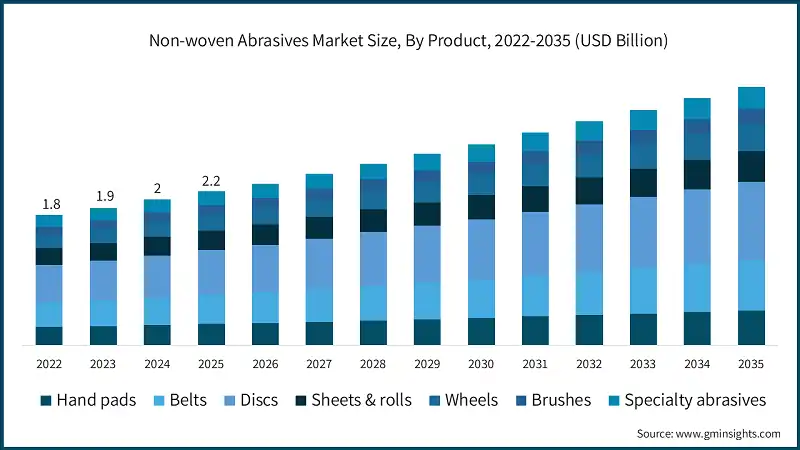
The non-woven abrasives industry by product is segmented into hand pads, belts, discs, sheets & rolls, wheels, brushes, and specialty abrasives. Discs hold the largest market value of USD 625.8 million in 2025.
- Discs are anticipated to show consistency in demand due to their versatility in metalworking applications, superior conformability to contoured surfaces, and compatibility with multiple power tool platforms. This is attributed to their position as the most widely specified non-woven abrasive product category, accounting for approximately 29% of total market value, making them the most economically viable option for automotive refinishing, metal fabrication, and surface conditioning applications. Furthermore, availability in multiple diameter configurations, grit grades, and mounting options provides flexibility for diverse finishing requirements, combined with established performance data in stainless steel finishing, aluminum surface preparation, and composite material processing, have sustained applications across manufacturing facilities and maintenance operations.
- Growing segments include belts as industries are leaning towards automated finishing systems and high-volume production environments. Belts, valued at USD 410.3 million in 2025, find applications in deburring operations, edge rounding, and continuous surface conditioning due to their consistent material removal rates and extended operational life in belt grinding systems. This segment is estimated to demonstrate steady growth, driven by industrial automation expansion and demand for repeatable finishing processes in metalworking facilities. Belts are anticipated to continue being essential in robotic finishing cells, CNC-integrated grinding operations, and automated surface preparation lines for their uniform abrasive distribution and predictable wear characteristics.
- The discs segment, valued at USD 625.8 million in 2025, is estimated to experience steady growth driven by specialized requirements across aerospace, automotive, and precision manufacturing sectors. Discs are engineered with application-specific fiber densities, abrasive mineral selections, and backing materials to meet precise surface finish and material removal requirements. This segment serves high-value applications including turbine blade finishing, automotive clearcoat preparation, and medical device component polishing where surface integrity and contamination control are critical specification parameters. Discs command diverse pricing based on diameter, grade, and attachment systems, with quick-change disc configurations offering productivity improvements compared to standard threaded hub designs.
The non-woven abrasives market by abrasive grade is segmented into coarse (low grit), medium (medium grit), and fine (high grit). Fine (high grit) holds the largest market value of USD 970.8 million in 2025.
- Fine (high grit) non-woven abrasives are anticipated to show consistency in demand due to their critical role in finishing operations, surface polishing, and aesthetic enhancement applications across precision manufacturing sectors. This is attributed to their position as the most widely specified abrasive grade category, accounting for approximately 45% of total market value, making them the preferred choice for final finishing stages in automotive refinishing, stainless steel polishing, and decorative surface treatment. Furthermore, grit equivalents ranging from 180 to 600+ provide controlled material removal with minimal surface scratching, combined with established performance data in clearcoat blending, chrome finishing, and mirror-polish applications, have sustained adoption across quality-focused manufacturing facilities and professional finishing operations.
- Growing segments include medium (medium grit) grades as industries are leaning towards versatile surface conditioning products for intermediate finishing and blending operations. Medium grit non-woven abrasives, valued at USD 787 million in 2025, find applications in deburring, surface preparation, and paint removal due to their balanced cutting action and ability to prepare surfaces for subsequent finishing steps. This segment is estimated to demonstrate steady growth, driven by metalworking expansion and demand for multi-purpose abrasive products in fabrication facilities. Medium grades are anticipated to continue being essential in weld cleaning, rust removal, and surface conditioning operations for their aggressive material removal capabilities while maintaining surface finish control.
- The fine (high grit) segment, valued at USD 970.8 million in 2025, is estimated to experience steady growth driven by specialized requirements across aerospace component finishing, medical device manufacturing, and premium consumer products. Fine grade non-woven abrasives are engineered with ultra-fine mineral particles, dense fiber matrices, and precision-controlled abrasive distribution to meet stringent surface finish specifications and cosmetic appearance requirements. This segment serves high-value applications including turbine blade polishing, surgical instrument finishing, and luxury automotive trim preparation where surface roughness measurements and scratch-free finishes are critical specification parameters. Fine grades command premium pricing due to specialized manufacturing processes and superior finishing capabilities, with performance advantages in applications requiring Ra values below 0.4 micrometers.
- Emerging applications within the coarse (low grit) segment represent heavy-duty material removal operations valued at USD 401.4 million in 2025. This category includes aggressive deburring, paint stripping, heavy rust removal, and weld scale cleaning where rapid material removal is prioritized over surface finish quality. Coarse grade non-woven abrasives are gaining attention in maintenance, repair, and operations (MRO) applications for their ability to remove thick coatings, corrosion layers, and surface contaminants without damaging base materials. Coarse products are experiencing increased interest in marine maintenance, industrial equipment refurbishment, and construction applications for their durability in demanding environments and ability to prepare heavily oxidized or contaminated surfaces with material removal rates significantly higher compared to fine and medium grades.
Learn more about the key segments shaping this market
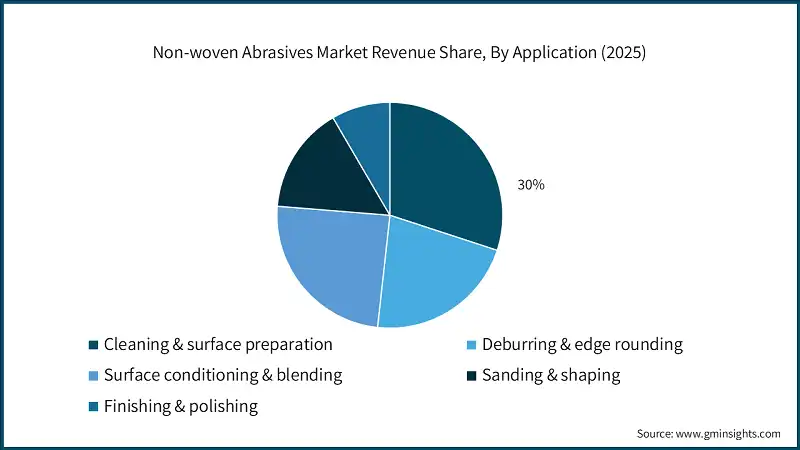
The non-woven abrasives market by application is segmented into cleaning & surface preparation, deburring & edge rounding, surface conditioning & blending, sanding & shaping, and finishing & polishing. Cleaning & surface preparation holds the largest market value of USD 648.6 million in 2025.
- Cleaning & surface preparation are anticipated to show consistency in demand due to their fundamental role in pre-treatment operations, paint adhesion enhancement, and contamination removal across manufacturing and maintenance sectors. This is attributed to their position as the most widely utilized application category, accounting for approximately 30% of total market value, making them essential for welding preparation, coating application readiness, and general surface cleaning operations. Furthermore, non-woven abrasives' ability to remove rust, scale, oxidation, and surface contaminants without aggressive substrate removal, combined with established performance data in marine maintenance, structural steel preparation, and equipment refurbishment, have sustained adoption across industrial facilities and field service operations.
- Growing segments include deburring & edge rounding as industries are leaning towards automated finishing systems and precision edge treatment in metalworking operations. Deburring & edge rounding applications, valued at USD 469.0 million in 2025, find extensive use in machined component finishing, stamped part processing, and laser-cut edge treatment due to their ability to remove sharp edges and burrs while maintaining dimensional tolerances. This segment is estimated to demonstrate steady growth, driven by precision manufacturing expansion and demand for consistent edge quality in automotive components, aerospace parts, and medical device fabrication. Deburring applications are anticipated to continue being essential in CNC machining centers, robotic deburring cells, and automated part finishing systems for their repeatable edge treatment and ability to access complex geometries.
- The cleaning & surface preparation segment, valued at USD 648.6 million in 2025, is estimated to experience steady growth driven by specialized requirements across maintenance, repair, and operations (MRO) sectors, marine applications, and industrial equipment servicing. Non-woven abrasives for cleaning applications are engineered with open-web structures, chemical-resistant fibers, and optimized mineral distributions to effectively remove surface contaminants while preserving base material integrity. This segment serves high-value applications including stainless steel passivation preparation, aluminum surface cleaning prior to anodizing, and composite material surface preparation where contamination-free surfaces are critical specification parameters. Cleaning-grade products command diverse pricing based on durability requirements and chemical compatibility, with specialized marine-grade formulations offering superior performance in saltwater environments.
- Emerging applications within the finishing & polishing segment represent precision surface enhancement operations valued at USD 180.5 million in 2025. This category includes mirror polishing, decorative finishing, chrome enhancement, and high-gloss surface development where aesthetic appearance and scratch-free results are paramount. Finishing & polishing applications are gaining attention in architectural metalwork, luxury automotive detailing, and consumer electronics manufacturing for their ability to achieve superior surface reflectivity and uniform appearance. Fine-grade non-woven products are experiencing increased interest in jewelry finishing, decorative hardware production, and premium appliance manufacturing for their controlled polishing action and ability to develop consistent surface luster with finishing quality significantly superior compared to conventional buffing compounds in applications requiring defect-free surfaces.
The non-woven abrasives market by end use is segmented into household, maintenance, repair, and operations (MRO), marine, metalworking, automotive, aerospace, woodworking, construction, electronics, and others. Maintenance, Repair, and Operations (MRO) holds the largest market value of USD 392.4 million in 2025.
- Maintenance, Repair, and Operations (MRO) are anticipated to show consistency in demand due to their critical role in facility maintenance, equipment servicing, and general-purpose cleaning across diverse industrial sectors. This is attributed to their position as the most widely utilized end use category, accounting for approximately 18% of total market value, making them essential for routine maintenance tasks, equipment refurbishment, and surface restoration operations. Furthermore, non-woven abrasives' versatility in handling multiple surface types, materials, and finishing requirements without specialized training, combined with established performance data in manufacturing facility maintenance, commercial building upkeep, and industrial equipment servicing, have sustained adoption across maintenance departments and facility management operations.
- Growing segments include aerospace as industries are leaning towards precision finishing systems and stringent surface quality requirements in aircraft component manufacturing and maintenance. Aerospace applications, valued at USD 306.8 million in 2025, find extensive use in turbine blade finishing, structural component surface preparation, and composite material processing due to their ability to achieve controlled surface finishes without inducing stress concentrations or surface damage. This segment is estimated to demonstrate steady growth, driven by commercial aircraft production expansion and demand for certified finishing processes meeting aerospace quality standards. Aerospace applications are anticipated to continue being essential in engine component refurbishment, airframe maintenance, and advanced composite fabrication for their contamination-free operation and ability to meet strict surface integrity specifications.
- The MRO segment is estimated to experience steady growth driven by specialized requirements across manufacturing facilities, industrial plants, and commercial maintenance operations. Non-woven abrasives for MRO applications are engineered with durable fiber constructions, versatile grit grades, and multi-purpose functionality to address diverse maintenance challenges ranging from rust removal to equipment cleaning. This segment serves high-value applications including machinery maintenance, conveyor system cleaning, and production equipment refurbishment where operational uptime and cost-effective maintenance solutions are critical specification parameters. MRO-grade products command competitive pricing due to volume purchasing patterns and standardized product specifications, with bulk packaging options offering cost savings for large maintenance operations.
The non-woven abrasives market by distribution channel is segmented into direct sales, online retailers, hardware stores, industrial supply stores, and others. Direct sales hold the largest market value of USD 1.5 billion in 2025.
- Direct sales are anticipated to show consistency in demand due to their critical role in serving large-volume industrial customers, OEM manufacturing facilities, and contract-based supply arrangements. This is attributed to their position as the dominant distribution channel, accounting for approximately 53% of total market value, making them the preferred procurement method for automotive manufacturers, aerospace facilities, and large metalworking operations requiring consistent product specifications and technical support. Furthermore, direct sales relationships enable customized product development, volume-based pricing structures, and integrated inventory management systems, combined with established performance in serving Fortune 500 manufacturers and multi-site industrial operations, have sustained adoption across quality-focused production environments requiring certified abrasive products and application engineering support.
- Growing segments include online retailers as industries are leaning towards digital procurement platforms and e-commerce channels for industrial supplies and professional-grade abrasive products. Online retailers, valued at USD 398.9 million in 2025, find extensive adoption among small-to-medium manufacturers, independent contractors, and maintenance professionals due to their convenient ordering processes, competitive pricing transparency, and rapid delivery capabilities. This segment is estimated to demonstrate steady growth, driven by digital transformation in industrial procurement and demand for direct-to-customer fulfillment models. Online channels are anticipated to continue being essential for specialty product sourcing, product comparison shopping, and emergency replacement orders for their accessibility and expanded product selection compared to traditional brick-and-mortar outlets.
- The direct sales segment, valued at USD 1.5 billion in 2025, is estimated to experience steady growth driven by specialized requirements across aerospace manufacturing, automotive production, and large-scale metalworking operations. Direct sales channels are structured with dedicated account management, technical field support, and customized logistics solutions to meet precise procurement specifications and quality assurance requirements. This segment serves high-value customers including tier-one automotive suppliers, commercial aircraft manufacturers, and integrated steel producers where product traceability, performance consistency, and just-in-time delivery are critical specification parameters. Direct sales command preferential pricing through volume commitments and long-term supply agreements, with value-added services including on-site training, application optimization, and inventory consignment programs.
- Emerging channels within the online retailers segment represent digital marketplace expansion and B2B e-commerce platforms valued at USD 398.9 million in 2025. This category includes manufacturer-direct websites, industrial supply aggregators, and specialized abrasive product marketplaces where product specifications, technical data sheets, and customer reviews facilitate informed purchasing decisions. Online retail channels are gaining attention in geographic markets with limited physical distribution infrastructure, remote industrial facilities, and time-sensitive replacement part requirements for their accessibility and transparent pricing models. Digital channels are experiencing increased interest among younger procurement professionals and digitally native manufacturing operations for their streamlined ordering processes and ability to compare multiple product options with delivery timeframes significantly reduced compared to traditional distribution methods requiring phone orders and manual quotation processes.
Looking for region specific data?
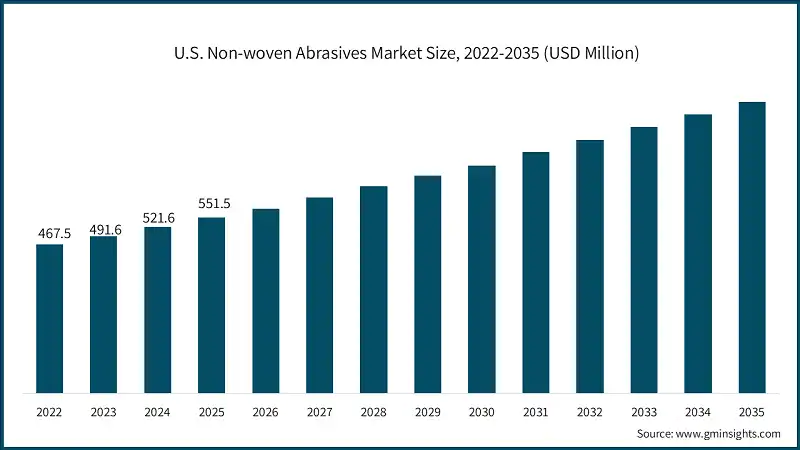
The U.S. non-woven abrasives market accounted for USD 551.5 million in 2025.
- The strong support for non-woven abrasives in North America comes primarily from the United States, wherein consistent demand is driven by well-established automotive manufacturing, advanced aerospace production capabilities, and extensive metalworking and fabrication industries. Constant emphasis on precision finishing products for automated manufacturing systems, surface preparation operations, and maintenance applications, along with robust adoption of professional-grade abrasive products in industrial facilities and specialty finishing sectors, consistently elevates the country's market position. The presence of major abrasive manufacturers including 3M, Saint-Gobain, and PFERD with domestic production facilities, combined with established distribution networks through industrial supply channels and growing demand from electric vehicle manufacturing requiring specialized finishing solutions for aluminum and composite materials, ensures sustained demand for high-quality non-woven abrasives meeting performance specifications and safety standards.
The market in Germany is estimated to experience significant and promising growth from 2025 to 2035.
- Non-woven abrasives growth in Europe is an integral component of the market due to strong manufacturing infrastructure and well-established sectors of automotive production, aerospace engineering, and precision metalworking. In Germany, industrial manufacturers and fabrication facilities are utilizing high-quality non-woven abrasives that meet stringent European safety standards and environmental regulations, which can improve surface finish quality and operational efficiency while meeting stricter requirements for worker safety and dust emission control, driving the advancement of specialty-grade non-woven products into automotive component finishing, aerospace surface preparation, and precision machinery manufacturing across industrial production and maintenance sectors.
The non-woven abrasives market in China is estimated to experience significant and promising growth from 2026 to 2035.
- Asia Pacific is the fastest-growing region in the market and includes China, India, Japan, and South Korea. China remains the most essential growth driver of the Asia-Pacific non-woven abrasives industry, which is increasingly driven by the expansion of domestic manufacturing capacity, rapid industrialization, massive infrastructure development, and growing adoption of automated finishing systems. The country is increasing both import volumes from established international producers and domestic production capacity development through local manufacturing facilities, thus becoming a significant consumer in the global arena. The regional momentum is further fueled by strong demand from automotive manufacturing, electronics production, metalworking operations, and construction applications, with rising quality standards and increasing emphasis on surface finish consistency accelerating market expansion.
Saudi Arabia market is estimated to experience significant and promising growth from 2026 to 2035.
- The non-woven abrasives market keeps steadily growing in the Middle East and Africa catered by rising investments in industrial infrastructure, construction sector development, and expanding manufacturing capabilities. The development of petrochemical facilities, marine maintenance operations, and strategic positioning as regional industrial hubs are the drivers for such high-quality non-woven abrasives requirements in countries like Saudi Arabia and the UAE in the Middle East. In Africa, countries such as South Africa are experiencing increased adoption in metalworking facilities, automotive component manufacturing, and industrial maintenance applications all requiring durable, versatile finishing products for demanding operational environments and diverse material processing requirements.
Brazil is estimated to experience significant and promising growth from 2026 to 2035.
- Brazil is contributing to the market in Latin America owing to its increasing emphasis on industrial modernization, manufacturing sector expansion, and infrastructure development initiatives. With the growth in Brazil's automotive production sector, gaining momentum for quality finishing products, and thus demand for non-woven abrasive discs, belts, and hand pads is steady. Industries are maintaining the trend with increasing regional adoption of non-woven abrasives for applications in metal fabrication, automotive refinishing, woodworking operations, and maintenance, repair, and operations (MRO) activities across diverse industrial sectors.
Non-woven Abrasives Market Share
Non-woven abrasives industry are moderately consolidated with players like 3M, Saint-Gobain, Mirka Ltd, PFERD, and Sia Abrasives hold approximately 52% market share collectively in 2025.
- Non-woven abrasives manufacturers are constantly involved in research and development to improve fiber engineering, develop enhanced abrasive mineral technologies, and enhance product durability. Innovations in ceramic abrasive formulations, multi-layer construction techniques, structured surface geometries, and advanced resin bonding systems help companies meet evolving customer needs and remain relevant in high-growth sectors such as aerospace finishing, automotive refinishing, precision metalworking, and automated manufacturing systems. Advanced quality control capabilities using abrasive distribution analysis, fiber density measurement, performance consistency testing, and durability validation systems, along with ISO 9001, ISO 14001, and industry-specific certifications, enable producers to consistently deliver products that exceed stringent performance specifications and meet industry standards including aerospace material specifications, automotive OEM requirements, and various safety and environmental regulations across multiple jurisdictions.
- By establishing collaborations with equipment manufacturers, industrial distributors, end use manufacturing facilities, and industry associations, companies are increasing the strength of their market presence. These collaborations facilitate co-development of customized non-woven abrasive solutions for specific applications such as turbine blade finishing, automotive clearcoat preparation, stainless steel polishing, or composite material processing, and sharing best practices which lead to improved finishing methodologies and performance specifications. Strategic partnerships with end use enable manufacturers to anticipate market trends and develop next-generation products aligned with industry requirements, including quick-change attachment systems, enhanced mineral formulations, and specialized product configurations that enhance application performance and operational efficiency.
Non-woven Abrasives Market Companies
Major players operating in the non-woven abrasives industry are
- 3M Company
- Saint-Gobain Abrasives / Norton
- Klingspor Abrasives
- Sia Abrasives Industries AG
- Mirka Ltd.
- Carborundum Universal Limited (CUMI)
- PFERD Inc. / PFERD GmbH & Co. KG
- Osborn International / Osborn LLC
- DEWALT (Stanley Black & Decker)
- Hermes Abrasives (Hermes Schleifmittel GmbH)
- Weiler Abrasives
- RHODIUS Abrasives
- Nihon Kenshi Co., Ltd.
- Walter Surface Technologies
- ARC Abrasives, Inc.
3M operates a highly diversified portfolio beyond abrasives, supplying advanced materials, adhesives, tapes, films, filtration systems, medical products, home improvement items, and industrial safety solutions. Its non-abrasive offerings play a major role in automotive, electronics, healthcare, construction, and consumer markets. 3M’s core strengths lie in polymer science, surface engineering, and precision manufacturing, enabling high-performance products such as protective coatings, insulation materials, packaging solutions, and personal safety equipment. The company continues to invest in sustainability, digital manufacturing, and smart materials to strengthen its position as a global innovation leader in non-abrasive specialty solutions across industrial and consumer segments.
Saint-Gobain offers a wide range of high-value materials and solutions including construction products, insulation, performance plastics, ceramics, refractories, and engineered materials. Its non-abrasive portfolio serves building & construction, mobility, energy, and industrial filtration markets. The group focuses heavily on lightweighting, thermal efficiency, noise reduction, and high-performance composites meeting global sustainability standards. Norton benefits from Saint-Gobain’s broader material-science expertise, enabling innovations in coatings, adhesives, engineered foams, and sealing systems. With strong R&D capabilities and global manufacturing, Saint-Gobain remains a major supplier of advanced non-abrasive materials driving efficiency, safety, and sustainability across multiple end use industries.
Klingspor is primarily known for coated and bonded abrasives, but the company also supports non-abrasive segments through complementary surface treatment, finishing accessories, tools, and equipment. Its non-abrasive offerings include polishing tools, cleaning wheels, non-woven surface finishing pads, and protective solutions for metalworking and woodworking lines. Klingspor emphasizes process optimization by providing integrated surface-processing systems that help industries achieve consistent finishing quality beyond traditional abrasive use. With strong distribution across manufacturing, fabrication, and construction markets, Klingspor’s non-abrasive solutions support productivity, safety, and high-precision finishing workflows, especially in metal fabrication, woodworking, and industrial maintenance sectors.
Sia Abrasives complements its abrasive systems with non-abrasive surface-treatment products such as polishing pads, cleaning materials, finishing accessories, and engineered surface-conditioning solutions. The company positions itself as a full-process partner, offering support across the entire surface-finishing value chain—from preparation to polishing. Its non-abrasive products cater to automotive refinishing, aerospace, woodworking, composites, and general industry. Backed by the Swiss Burckhardt Group, Sia focuses on high-precision materials, ergonomic tools, and sustainability initiatives that enhance user efficiency. In non-abrasive domains, Sia delivers integrated surface-finishing systems that improve workflow quality, reduce processing time, and ensure consistent finishing performance.
Non-woven Abrasives Market Report Attributes
| Key Takeaway | Details |
|---|---|
| Market Size & Growth | |
| Base Year | 2025 |
| Market Size in 2025 | USD 2.2 Billion |
| Market Size in 2026 | USD 2.3 Billion |
| Forecast Period 2026-2035 CAGR | 5.4% |
| Market Size in 2035 | USD 3.6 Billion |
| Key Market Trends | |
| Drivers | Impact |
| Industrial automation and precision manufacturing expansion | Non-woven abrasives offer consistent finishing performance with controlled material removal rates and superior surface quality, driving adoption in automated grinding systems, robotic finishing cells, and CNC machining operations where process repeatability and dimensional accuracy are critical requirements. |
| Aerospace and automotive lightweighting initiatives | Growing use of aluminum alloys, titanium, composites, and advanced high-strength steels in aerospace and automotive manufacturing requires specialized surface preparation and finishing solutions, with non-woven abrasives providing 30-40% faster processing times and reduced heat generation compared to conventional grinding methods. |
| Maintenance, repair, and operations (MRO) market growth | Expanding industrial infrastructure and aging equipment base drive demand for versatile finishing products in maintenance applications, with non-woven abrasives offering multi-purpose capabilities for cleaning, deburring, and surface conditioning across metalworking, marine, and facility maintenance operations. |
| Pitfalls & Challenges | Impact |
| Raw material price volatility and supply chain constraints | Non-woven abrasives production depends on synthetic fibers, specialty resins, and abrasive minerals subject to petroleum-based feedstock pricing fluctuations and supply disruptions, creating cost pressures of 15-25% during periods of raw material scarcity and limiting margin stability for manufacturers. |
| Competition from alternative finishing technologies | Emerging finishing methods including laser surface treatment, chemical etching, and advanced coated abrasive systems with engineered patterns compete for market share in precision applications, particularly in electronics and medical device manufacturing where process automation and contamination control are prioritized. |
| Opportunities: | Impact |
| Expansion in Asia Pacific manufacturing hubs | Rapid industrialization in China, India, Southeast Asia, and Vietnam creates opportunities for non-woven abrasives in automotive production, electronics manufacturing, and metalworking operations |
| Development of specialized finishing systems for advanced materials | Innovation in non-woven abrasives engineered for carbon fiber composites, ceramic matrix composites, and additive manufacturing post-processing expands addressable markets in aerospace, defense, and medical implant production where conventional abrasives cause delamination or surface damage. |
| Premium consumer and DIY market penetration | Growing consumer awareness of professional-grade finishing products and expanding DIY renovation activities create opportunities for branded non-woven abrasive products in hardware retail, online channels, and home improvement segments with premium positioning and application-specific product lines. |
| Market Leaders (2025) | |
| Market Leaders |
~18% |
| Top Players |
|
| Competitive Edge |
|
| Regional Insights | |
| Largest Market | North America |
| Fastest Growing Market | Asia Pacific |
| Emerging Country | China, India, Vietnam |
| Future Outlook |
|
What are the growth opportunities in this market?
Non-woven Abrasives Industry News
- In November 2024, Mirka announced a EUR 25 million (approx. USD 29 million) investment to build the world’s first circular grain manufacturing plant in Jeppo, Finland. Supported by USD 7 million in RRF funding from Business Finland, the facility will convert industrial and post-use abrasive waste into new circular ceramic grains. The project is expected to cut Mirka’s CO2 emissions by 5,000 tons annually, with the first circular abrasive products set for launch in 2026.
- In November 2024, Berry Global Group and Glatfelter have finalized the merger of Berry’s Health, Hygiene and Specialties Global Nonwovens and Films business with Glatfelter Corporation, creating Magnera, now the world’s largest nonwovens company. Magnera begins trading on the NYSE under the ticker MAGN. The combined entity will operate 46 global manufacturing sites and supply hygiene, protective apparel, wipes, construction, and food-and-beverage material solutions.
The non-woven abrasives market research report includes an in-depth coverage of the industry with estimates and forecast in terms of revenue in USD Billion and volume in terms of Tons from 2022–2035 for the following segments:
Market, By Product
- Hand pads
- Belts
- Discs
- Sheets & rolls
- Wheels
- Brushes
- Specialty abrasives
Market, By Abrasive Grade
- Coarse (low grit)
- Medium (medium grit)
- Fine (high grit)
Market, By Application
- Cleaning & surface preparation
- Deburring & edge rounding
- Surface conditioning & blending
- Sanding & shaping
- Finishing & polishing
Market, By End Use
- Household
- Maintenance, repair, and operations (MRO)
- Marine
- Metalworking
- Automotive
- Aerospace
- Woodworking
- Construction
- Electronics
- Others
Market, By Distribution Channel
- Direct sales
- Online retailers
- Hardware stores
- Industrial supply stores
- Others
The above information is provided for the following regions and countries:
- North America
- U.S.
- Canada
- Europe
- Germany
- UK
- France
- Spain
- Italy
- Rest of Europe
- Asia Pacific
- China
- India
- Japan
- Australia
- South Korea
- Rest of Asia Pacific
- Latin America
- Brazil
- Mexico
- Argentina
- Rest of Latin America
- Middle East and Africa
- Saudi Arabia
- South Africa
- UAE
- Rest of Middle East & Africa
Frequently Asked Question(FAQ) :
What is the market size of the non-woven abrasives industry in 2025?
The non-woven abrasives market was valued at USD 2.2 billion in 2025, with a CAGR of 5.4% projected through 2035 driven by automation and precision manufacturing expansion.
What is the current non-woven abrasives market size in 2026?
The market size is projected to reach USD 2.3 billion in 2026.
What is the projected value of the non-woven abrasives market by 2035?
The non-woven abrasives industry is expected to reach USD 3.6 billion by 2035, at a CAGR of 5.4% supported by demand for advanced finishing systems and high-precision surface conditioning. The growth is driven by industrial automation, aerospace lightweighting, and rising MRO requirements.
How much revenue did the discs product segment generate in 2025?
The discs segment generated USD 625.8 million in 2025, leading the market among product categories. Its dominance comes from high adoption in metalworking, automotive refinishing, and precision finishing operations.
What was the valuation of the fine (high grit) abrasive grade segment in 2025?
The fine abrasive grade segment held USD 970.8 million in 2025, making it the largest grade category. Its growth is supported by strong demand for polishing, aesthetic finishing, and high-precision applications.
What is the growth outlook for the online retail distribution channel from 2025 to 2035?
Online retailers accounted for USD 398.9 million in 2025, reflecting steady adoption across industrial buyers. Growth is fueled by digital procurement, rapid delivery needs, and increasing usage of e-commerce platforms in the abrasives industry.
Which region leads the non-woven abrasives market?
The U.S. accounted for USD 551.5 million in 2025, positioning North America as the largest regional market. Growth is supported by strong automotive, aerospace, and metal fabrication infrastructure, along with adoption of high-performance finishing materials.
What are the upcoming trends in the non-woven abrasives industry?
Key trends include advancements in ceramic abrasive minerals, sustainable manufacturing practices, and rising adoption of structured abrasive technologies. Industry momentum is also driven by automation, EV component finishing, and increasing precision requirements across advanced materials processing.
Who are the key players in the non-woven abrasives market?
Key companies include 3M Company, Saint-Gobain Abrasives/Norton, Klingspor, Sia Abrasives Industries AG, Mirka Ltd., CUMI, PFERD, Osborn, DEWALT, Hermes Abrasives, Weiler Abrasives, RHODIUS Abrasives, Nihon Kenshi, Walter Surface Technologies, and ARC Abrasives, Inc.
Non-woven Abrasives Market Scope
Related Reports