Summary
Table of Content

Network Probe Market
Get a free sample of this report
Form submitted successfully!
Error submitting form. Please try again.
Thank you!
Your inquiry has been received. Our team will reach out to you with the required details via email. To ensure that you don't miss their response, kindly remember to check your spam folder as well!
Request Sectional Data
Thank you!
Your inquiry has been received. Our team will reach out to you with the required details via email. To ensure that you don't miss their response, kindly remember to check your spam folder as well!
Form submitted successfully!
Error submitting form. Please try again.
Network Probe Market Size
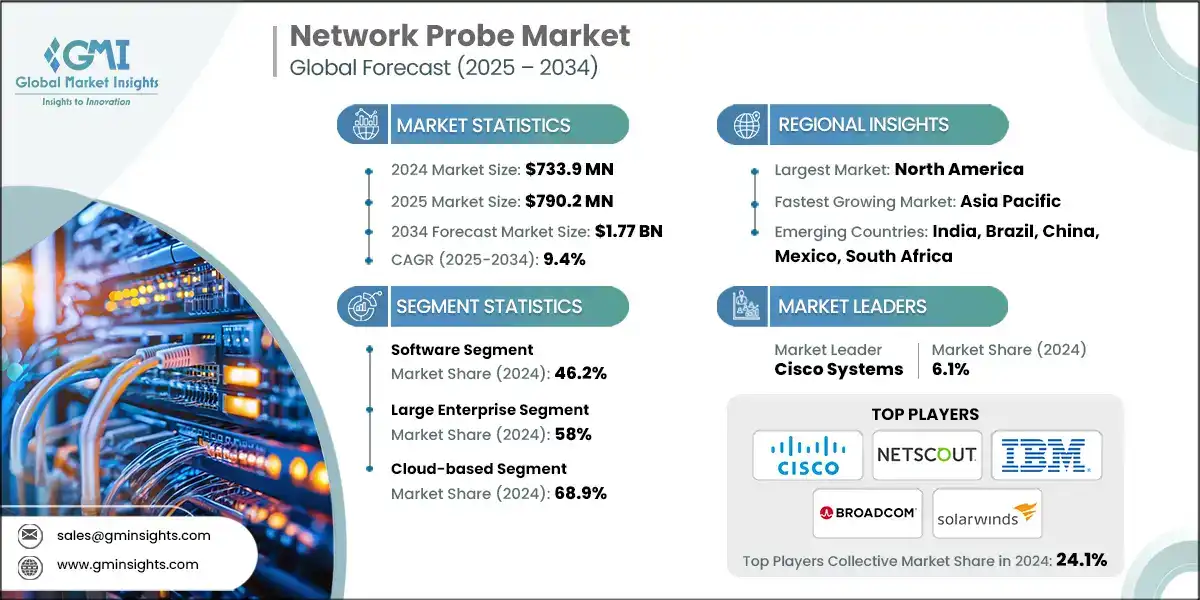
The global network probe market size was estimated at USD 733.9 million in 2024. The market is expected to grow from USD 790.2 million in 2025 to USD 1.77 billion in 2034, at a CAGR of 9.4%, according to latest report published by Global Market Insights Inc.
To get key market trends
- The development of digital services, Internet of Things (IoT) devices, cloud computing and fifth generation (5G) networking is generating unprecedented network traffic. Organizations require more probes to quantify performance, debug bandwidth constraints, uncover non-standard data output, and dependable interconnection in elaborate, distributed IT and telecommunications infrastructures.
- As cyber threats and ransomware attacks continue to rise, enterprises and service providers realize they need sufficient network monitoring. Probes will provide real-time visibility in their network environment, threat detection, and anomalous events, allowing organizations to protect data assets, achieve compliance, limit any downtime, and other key areas, making cybersecurity impetus a central factor to network probes deployment.
- The move from traditional hardware-based architecture to cloud-native, software-defined networks has created demand for adaptable and scalable probes. This means the solution can be utilized for remote monitoring, integrated with analytics platforms, and deploy for proactive network management, allowing enterprises to support hybrid and multi-cloud environments with less operational cost.
- In April 2024, SolarWinds and DNSFilter teamed up to provide more capabilities to Managed Service Providers’ (MSPs) cybersecurity. By embedding DNSFilter’s cloud-based security solution into the SolarWinds N-Central platform, the partnership aims to allow MSPs to provide their clients with threat protection services and content filtering as well as increased network monitoring and security.
- Organizations in North America are increasingly using cloud-native and software-defined network probes to monitor hybrid and multi-cloud environments. These solutions are scalable, remotely managed, and support real-time analytics for proactive threat detection, security, and operational efficiencies, consistent with the region’s digital transformation and IT modernization efforts.
Network Probe Market Report Attributes
| Key Takeaway | Details |
|---|---|
| Market Size & Growth | |
| Base Year | 2024 |
| Market Size in 2024 | USD 733.9 Million |
| Market Size in 2025 | USD 790.2 Million |
| Forecast Period 2025 - 2034 CAGR | 9.4% |
| Market Size in 2034 | USD 1.77 Billion |
| Key Market Trends | |
| Drivers | Impact |
| Increasing Network Traffic | The surge in digital services, IoT devices, and cloud applications creates massive volumes of network traffic. Network probes help organizations monitor performance, optimize bandwidth, detect anomalies, and ensure seamless, reliable connectivity across complex and distributed infrastructures. |
| Cybersecurity Concerns | Rising cyber threats, ransomware attacks, and data breaches necessitate real-time network monitoring. Probes provide visibility into network activity, detect anomalies, enforce security policies, and ensure regulatory compliance, protecting sensitive data and minimizing downtime for enterprises and service providers. |
| Cloud & Software-Defined Networks | The transition from hardware-based networks to cloud-native and software-defined environments demands flexible, scalable probes. These solutions enable remote monitoring, proactive issue detection, and integration with analytics platforms, improving operational efficiency, cost-effectiveness, and management of hybrid or multi-cloud infrastructures. |
| Growth of 5G & Edge Computing | 5G networks and edge computing introduce high-bandwidth, low-latency traffic, and increased IoT connectivity. Network probes ensure real-time monitoring, predictive maintenance, and performance optimization, supporting latency-sensitive applications like autonomous vehicles, smart cities, and advanced industrial systems. |
| Industry-Specific Adoption | BFSI, healthcare, retail, and government sectors demand secure, uninterrupted networks for sensitive data and mission-critical operations. Network probes facilitate real-time monitoring, regulatory compliance, anomaly detection, and efficient traffic management, driving widespread adoption in industry-specific applications. |
| Pitfalls & Challenges | Impact |
| Data Privacy & Regulatory Concerns | Collecting and analysing network traffic raises data privacy issues. Compliance with GDPR, HIPAA, and other regulations complicates deployment, as organizations must ensure probes do not violate legal standards, slowing adoption in sensitive industries. |
| Limited Skilled Workforce | Effective deployment and management of advanced network probes require skilled IT and network engineers. The shortage of trained professionals can hinder efficient implementation, maintenance, and analysis, particularly for smaller enterprises lacking in-house expertise. |
| Opportunities: | Impact |
| Growing Cloud Adoption | The rapid shift toward cloud-native infrastructure and hybrid IT environments creates demand for cloud-compatible network probes. Enterprises can leverage these probes for scalable, real-time monitoring, predictive analytics, and seamless integration across multi-cloud and on-premises environments. |
| Expansion in 5G and IoT Networks | 5G rollout and exponential IoT device growth create complex, high-volume network traffic. Network probes can provide low-latency monitoring, anomaly detection, and performance optimization, enabling telecom operators and enterprises to deliver reliable, high-quality connectivity for emerging applications. |
| Industry-Specific Solutions | Sectors such as BFSI, healthcare, retail, and government require specialized network monitoring for compliance, cybersecurity, and performance. Tailored probes for these industries provide targeted analytics, enhancing adoption and enabling providers to capture niche, high-value market segments. |
| Integration with AI & Analytics | Incorporating AI and machine learning into network probes enhances predictive maintenance, anomaly detection, and automated network optimization. This opportunity allows vendors to offer intelligent, value-added solutions, increasing demand across enterprises seeking proactive network management. |
| Market Leaders (2024) | |
| Market Leaders |
Holds 6.1% market share |
| Top Players |
Collective market share in 2024 is 24.1% |
| Competitive Edge |
|
| Regional Insights | |
| Largest Market | North America |
| Fastest growing market | Asia Pacific |
| Emerging countries | India, Brazil, China, Mexico, South Africa |
| Future outlook |
|
What are the growth opportunities in this market?
Network Probe Market Trends
- Businesses have increasingly moved toward cloud-based native and SaaS-based network probes and backed away from on-premises hardware. Cloud probes allow remote management, faster deployments, and integration with analytics platforms to support management of network optimization and security proactively in less-static, decentralized, and distributed infrastructures.
- Network probes are incorporating AI and machine learning to facilitate predictive analytics, anomaly detection, and automated problem resolution. The intelligent probes can analyze large volumes of traffic data and provide reliable connectivity to help streamline bandwidth, forecast outages before they happen, and maintain security. All these improvements enable enterprises to rely on greater connectivity and better enterprise decision making.
- Probes are becoming more common in mission-critical industries like BFSI and healthcare, where networks that provide secure and uninterrupted experiences are a must. Probes enable organizations to monitor and troubleshoot high transaction volumes, track sensitive patient information, and gain visibility across all digital operations.
- The expansion of 5G networks, along with the widespread growth of edge computing in telecom and enterprises, is quickly increasing demand for network probes with advanced capabilities. The network probe must be able to support higher bandwidth, low-latency traffic, IoT applications, and in autonomous systems and the Internet of Things.
- In April 2024, Broadcom and Google Cloud announced a strategic partnership to boost innovation and enhance cloud services integration. As part of this collaboration, Broadcom will be able to provide its suites on the Google Cloud Platform, including enhanced capabilities of network probes with cloud scalability.
Network Probe Market Analysis
Learn more about the key segments shaping this market
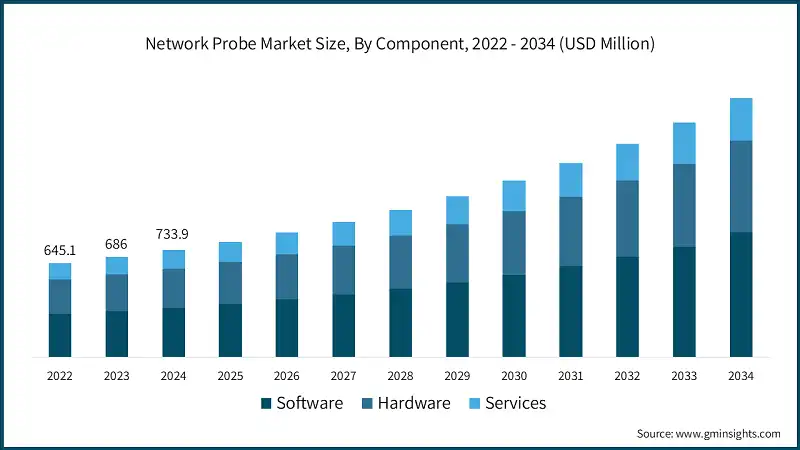
Based on component, the network probe market is segmented as hardware, software and services. The software segment dominated the market accounting for around 46.2% in 2024 and is expected to grow at a CAGR of over 9.9% through 2034.
- Business organizations are increasingly seeking cloud-native software probes instead of hardware probes due to scalability, remote access and cost efficiency. Cloud probes are capable of operating in a hybrid and multi-cloud environment, deliver real-time monitoring and predictive analytics, and communicate with AI platforms to make the network more visible and enable operations to be agile.
- Moreover, software probes are starting to integrate more AI and machine learning functionality so that predictive maintenance, anomaly detection, and traffic optimization are not adding to an engineer's workload. This capability provides efficiency and reduces the need for manual intervention, allowing enterprises to proactively manage complex networks, all while enhancing security, performance, and decision-making flexibility.
- In high-bandwidth, low-latency environments for example, telecom operators, data centers, etc., hardware probes will remain essential. Hardware probes offer deep packet analysis, real time monitoring, and strong security for even enterprise networks, where software-probes alone cannot provide necessary performance or reliability.
- The rise of edge computing is pushing on-prem hardware probes to monitor distributed networks in real-time. Hardware probes complement software probes in hybrid monitoring frameworks where some applications are latency sensitive and connectivity to/from IoT devices and telematics performance of critical infrastructure is essential.
- In June 2025, Cornelis Networks launched its CN5000 networking chips, which use proprietary OmniPath technology to connect up to 500,000 AI chips as efficiently as possible. This new option eliminates bottlenecks for inter-chip data transfers associated with AI datacenters, making it possible to scale improved performance.
Learn more about the key segments shaping this market
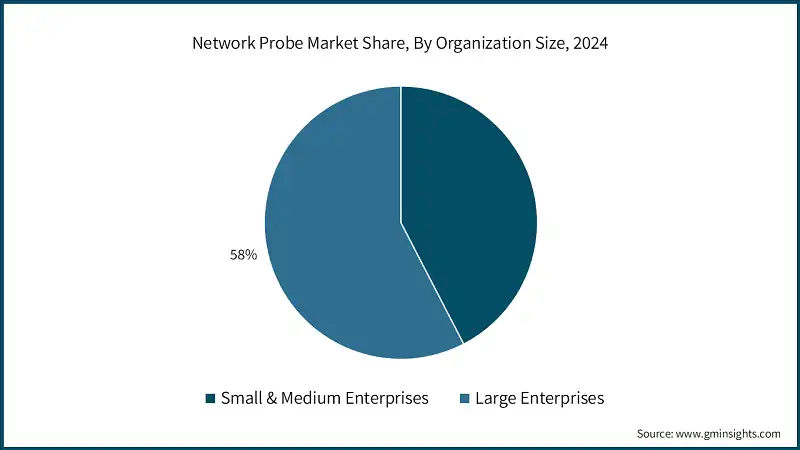
Based on organization size, the network probe market is bifurcated into large enterprise and SMEs. The large enterprise segment dominates the market with 58% share in 2024, and the segment is expected to grow at a CAGR of over 9.5% from 2025 to 2034.
- The traditional network adoption and indicators are shifting gears with cloud-native network probes. Enterprises at scale have fully realized the experience and benefits that cloud-native network probes provide, i.e., scale, flexibility, real-time analytics, and the ability to manage hybrid stacks. Cloud-native tools offer complete centralized visibility and management capabilities for an organization with workloads distributed over global offices and/or heterogeneous multi-cloud environments.
- Artificial Intelligence (AI) has completely shifted the paradigm for network monitoring by bringing the possibility of predictive analytics and automated anomaly detection to an enterprise. The trend of AI-driven probes for large enterprises continues as AI could be trained to proactively search for anomalies, enabling measurement to predict impending downtime as an event happens, or to implement protections in scalable and virtually integrated enterprise networks to eliminate or mitigate unexpected downtime altogether.
- SMEs are also on board and quickly adopting affordable network probe solutions that give organizations basic monitoring capabilities without the complicated enterprise-grade tools to use, nor the costs associated with those tools. Many affordable probes provide coverage of traffic flow analysis, basic anomaly detection, and dashboards that visualization screens are easy to use to maintain a healthy and secure network without the financial burden.
- Both large companies and SMEs are moving toward unified network monitoring platforms that depend on probes as well as other IT management agents. The unified approach reduces costs, enhances efficiency and provides an overall view of the network allowing faster decisions and resource allocation.
- For instance, Site24x7 is a tool developed by Zoho Corporation that delivers network monitoring capabilities traditionally limited to enterprise level service to SMBs, all in a simple package. Site24x7 runs real-time checks from over 90 locations worldwide and measures 60+ performance metrics, giving a definitive view of a network's health.
Based on deployment model, the network probe market is bifurcated into cloud based and on-premises. The cloud-based segment held a share of 68.9% in 2024, and it dominates the market as they are easier and faster to deploy compared to physical appliances.
- Small and medium-sized businesses (SMBs) are increasingly using cloud-based network probes because they cost less and will grow with your needs. They too include real-time monitoring and analytics capabilities without needing to make a significant initial investment on the hardware side.
- Cloud-based network probes have experienced many advancements recently, incorporating artificial intelligence (AI) and machine learning (ML), which enhances anomaly detection and increases advanced analytics types, like predictive analytics for an overall improved proactive network management experience and faster identification of potential issues.
- The development of cloud-based network probes emerged through the onslaught of remote working and expanded distributed and complex networks, where IT teams can monitor network performance and services from nearly anywhere. Overall, it provides a much quicker and improved experience, enabling businesses to maintain service delivery and network performance metrics and not impacting the user's experience.
- On-premises network probes typically connect nicely with the existing IT landscape and sometimes legacy systems. This allows organizations to take advantage of existing systems for easy integration and compatibility.
- Organizations in regulated industries often choose on-premises network probes as a component in meeting data privacy and protection regulations. This may give organizations additional controls with respect to how and where the data is processed and stored.
- At re:Invent 2024, a new tool called Network Flow Monitor, was introduced by Amazon Web Services (AWS). The tool, which also integrates with Amazon CloudWatch, provides near real-time visibility into network traffic between compute resources such as Amazon EC2 or Amazon EKS, including insights on packet loss, latency and traffic patterns; the Network Flow Monitor allows monitoring visibility across multiple AWS managed services.
Based on end use, the network probe market is segmented into IT & Telecom, BFSI, government, healthcare, retail, manufacturing, and others. IT & Telecom, BFSI are the largest segments and jointly hold a share of 55.6% in 2024.
- The IT & Telecom industry generates and handles large amounts of real-time data because of cloud services, the rollout of 5G, video streaming, and the adoption of IoT devices. Network probes are vital to this industry for performance monitoring, traffic distribution, and management of latency and security.
- Telecom operators must also rely on network probes to monitor their networks to ensure Quality of Service (QoS), comply with regulatory obligations, and ensure connectivity to millions on a constant basis. The expansion towards edge computing and the growth of hyperscale data centers has only increased this need for probes.
- The BFSI industry processes high-value, high-volume transactions on a daily basis, where downtime of even a few seconds can lead to losses that are both reputational and monetary. The BFSI industry is also one of the most heavily regulated sectors, which requires compliance, security, and visibility into every single transaction on their network to be audit ready.
- Network probes enable BFSI firms to detect anomalies, prevent fraud, guarantee the protection of funds and firm data, and ensure adequate uptime of service for online banking, mobile apps, and trading. BFSI has reported growth in digital banking, fintech, among other industries, meaning the reliance on network probes continues to increase.
- Healthcare providers build their digital infrastructure specifically for the needs of EHRs, telemedicine, connected medical devices, AI-based diagnostics, or anything else. In these environments, proving the consistency and integrity of data privacy (HIPAA - Health Insurance Portability, & GDPR General Data Protection Regulation) and fast and secure communications are critical with these real-time patient care or health systems typically managed by network probes.
- Imagine Communications will introduce the Imagine Monitoring Solution (IMS) at IBC 2025 scheduled for September 12-15, in Amsterdam. It is specifically designed for video networks with full visibility on the video delivery chain from content ingest to playout. Video-aware monitoring capabilities, dashboards, predictive analytics and customizable alert escalation are to be expected lessons from the IMS.
Looking for region specific data?
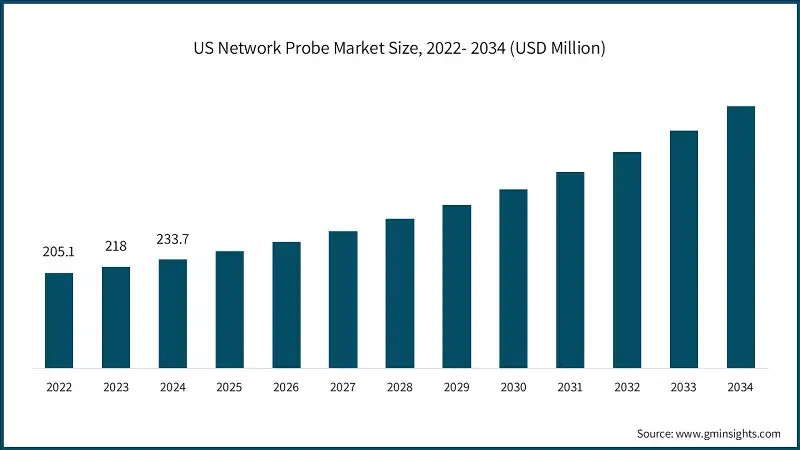
North America dominated the network probe market with around 40.3% share and generated USD 295.8 million in 2024.
- North America is leading the way in 5G deployment, IoT proliferation, and the use of AI-based services, which support data-rich environments where real-time monitoring is necessary. Network probes help provide low latency, high bandwidth, performance, and ability to detect threats, all of which are critical for technologies to perform reliably.
- Hyperscale growth is being led by North America, with AWS, Microsoft, Google and Meta investing in mega data centers. These massive facilities support the increasing demand for cloud services, AI and big data processing for which North America is well-positioned as the global leader in digital infrastructure capacity and next generation computing services.
- At the same time there is an explosive growth of smaller edge facilities. These much smaller footprints are methodically built out to support 5G telecommunications networks, IoT based ecosystems, AR/VR based applications, and autonomous vehicles. Edge centers improve latency and ensure faster service delivery encouraging advancements in smart cities, healthcare, and real time digital applications.
- Sustainability is a major defining trend of North America's data center market. Data center operators are investing significantly in renewable energy senior, utilizing liquid cooling and immersion cooling technologies, carbon-neutrality initiatives amongst other sustainability practices. With both strong regulatory oversight and ESG expectations, data center operators are re-engineering both the interiors and exteriors of their facilities to reduce emissions, increase efficiency, and as well, deliver on corporate climate obligations.
- In January 2025, Cisco Systems unveiled its new AI-enabled network probe which increases real-time traffic analysis and threat automation. The solution utilizes machine learning algorithms to identify performance bottlenecks and security vulnerabilities faster than ever. It enables organizations to improve network performance, facilitate troubleshooting, and enhance security within fast-paced, complex networks, allowing for maximum operational efficiency.
The network probe market in US is expected to experience significant and promising growth from 2025 to 2034.
- The US is rapidly deploying AI-ready data center infrastructure. Rising demand for generative AI and machine learning to drive business decisions pushes new adoption of GPU- and TPU-powered clusters and high-density racks. Operators are repositioning their facilities with the cooling and power solutions needed to efficiently scale the critical processing loads required by resource-hungry AI workloads.
- US metros such as Ashburn, Dallas, Silicon Valley and Chicago necessitate global interconnection. These hubs house dense ecosystems of cloud providers, carriers and enterprises, that are globally important in their strategic role as business demand for fast, reliable, and highly connected facilities increases as digital transformation strategies pivot toward connecting ecosystems.
- US companies, particularly in regulated industries such as banking, financial services, and insurance (BFSI), healthcare, and government services where compliance is important, want an infrastructure that is secure and compliant. They are driven by compliance mandates in their respective industries such as HIPAA, FedRAMP, and PCI DSS. Data center providers need to provide secure cybersecurity, data sovereignty, and compliance capabilities that are needed by their customer base in ultra-regulated industries.
- In the US data center market, there is tremendous consolidation going on. Private equity firms and infrastructure funds are acquiring collocation and cloud providers helping to grow the markets and push industry players to consolidate and create larger, more competitive players. This will help the service offerings to expand, leading to more economies of scale and competition across the country.
- In December 2024, Rohde & Schwarz introduced a network monitoring probe as part of an expansion to their product range, targeted at mobile network operators and private enterprises. The probe was created to improve security and performance monitoring within mission-critical, on-premises network infrastructures.
The network probe market in Europe is expected to experience significant and promising growth because of a combination of technological, regulatory, and industry-driven factors.
- 5G expansion and IoT deployment in Europe ensued at full speed, with telecom operators and enterprises investing in their next-generation networks, with network probes available at the forefront to support service assurance and latency management for the very large volume of data produced by connected devices, cloud services, and digital platforms.
- There is now a strong regulatory authority pushing organizations to optimize cybersecurity and compliance capabilities and how probes could provide the essential tools for real-time monitoring, anomaly detection, and data visibility that enterprises must leverage in regulated sectors like BFSI, government, and healthcare when meeting regulatory and security requirements.
- Europe seems to have strong objectives around sustainability and moving forward, which is very apparent to organizations increasingly adopting hybrid and multi-cloud models, smart manufacturing, and Industry 4.0. Too, network probes will support these organizations to optimize performance, support downtime prevention through security and manage the security of their ongoing digital operations which all points to the value of probes in being able to be relied on at every step of the journey.
- In February 2024, a report cited unplanned security issues as the leading reason that organizations transitioned cloud-based workloads back to on-premises infrastructure. This transition is notable for network monitoring, as on-premises solutions provide control over data security and compliance. This trend points to an increasing preference toward on-premises network probes in order to reduce the risk of cloud-based deployments.
The network probe market in Germany is expected to experience strong growth from 2025 to 2034.
- As Germany's drive toward 5G technology and edge computing continues to evolve, so too does the complexity of network deployment. To facilitate effective network monitoring and ensure proper performance and reliability of these networks, network probes are necessary.
- With strong adherence to data protection regulations such as GDPR, German organizations will also be attentive to cyber security concerns. Network probes play a key role in identifying the breach, responding to security threats, indicating compliance with legal standards, and protecting sensitive data.
- A recent development to the landscape of network probes in Germany, Deutsche Telekom’s AI-enhanced network monitoring is expanding. In addition to the AI phone, Magenta AI and the AI honeypots, Deutsche Telekom is attempting to be an AI-driven company and looking to more effectively improve network performance and security as requirements for modern networks become more complex. They claim AI will allow them to more proactively identify issues and optimize network resources so they can continue to provide reliable services to customers.
- As Industry 4.0 continues to cement itself within Germany as an initiative also relevant is the proliferation of IoT devices being integrated into manufacturing the amount of data to be collected is astounding. Therefore, utilizing network probes against performance and security will facilitate predictive maintenance, improved uptime, and a meaningful connection to underlying networks.
The network probe market in Asia Pacific held a market share of 21.4% in 2024 and is expected to experience robust growth from 2025 to 2034 owing to rapid digital transformation and IoT expansion.
- Digital transformation is taking hold in the Asia Pacific region, with sectors increasingly integrating more Internet of Things (IoT) devices. Consequently, the use of connected devices means more data is automatically generated, creating a need for network monitoring tools.
- As cyber threats develop, therefore organizations' efforts to prioritize cybersecurity; in the Asia Pacific region, network probes are a core component of security detection and breach mitigation, while also helping comply with evolving regulations related to data protection.
- Governments in the Asia Pacific region are investing in digital, network infrastructure to advance their economies and for technological advancement purposes. Given that there is now an extensive array of smart city programs, along with the implication of the rollout of 5G networks, network monitoring will be an essential aspect of achieving the above-mentioned objectives.
- The opening of Google's first Safety Engineering Centre (GSEC) center in Hyderabad, India, in June 2025. This center marks the fourth GSEC location globally following GSECs in Munich, Dublin, and Malaga. The Hyderabad GSEC will leverage artificial intelligence (AI) to help improve online safety as cyber threat sophistication increases including AI-driven fraud and cybercrime.
The network probe market in China is expected to experience fast growth from 2025 to 2034.
- China is speeding the adoption of 5G-Advanced networks and starting 6G research, as well as establishing developing AI/data centers in rural areas. These technological advances require sophisticated network monitoring tools to maintain performance and reliability.
- The expedited deployment of 5G networks and fiber optics requires devices capable of advanced network monitoring to confirm the system works reliably and properly. Huawei is working to improve the performance of networks in homes and businesses with its Fiber to the Room (FTTR) technology supporting applications using excessive data.
- China is also strengthening law regarding cybersecurity, personal information protection, and data security. The introduction of new laws and regulations also emphasizes the need for reliable network monitoring solutions that may help manage compliance and protection from cyber threats.
- In July 2025, China stated that it would set up a state-controlled cloud network to repurpose surplus computing capacity of over 7,000 data centers that are legitimately licensed. It is a government initiative to put a stop to the inefficiencies that three years of building has caused and to make the best use of the computing power that has been invested in the country.
The Latin American network probe market is projected to grow at a CAGR of 7.7% from 2025 to 2034. This growth is driven by the need to optimize urban traffic flow, reduce congestion, and enhance public safety through smart infrastructure.
- Countries such as Brazil, Mexico and Argentina are investing a lot of money into both 5G and fiber optic networks to improve the level of connectivity being provided. As this continues to expand, there will be an increase in advanced network probes and management tools to provide performance and reliability.
- With the increase in cyber threat complexity, many Latin American organizations are adding AI-powered cybersecurity tools to their arsenal. These AI solutions provide real-time detections of threats and automate threat response. This is enabling the Latin American region to enhance its ability to address any cyberattacks, enabling organizations to be more reactive, proactive, and informed.
- As a result of the increased economic significance of Latin America, increased sophistication of cyber threats has arisen that we are seeing. Increasingly cybercriminals are targeting sectors of the economy to attack, such as banking, energy and mining. Therefore, many governments and organizations are going through processes that strengthen cybersecurity methods.
- In June 2025, Google entered into an agreement with the Chilean government for the deployment of a 14,800-kilometer submarine data cable that will connect Chile to Australia and Asia. The project aims to improve the level of digital connectivity by providing faster connections that facilitate scientific and industrial needs, such as astronomical data transfers and mining operations. Google's deployment of subsea cable shows what a competitive sector digital infrastructure in Latin America is becoming.
The MEA network probe market is projected to grow at a CAGR of 5.6% from 2025 to 2034. Organizations across MEA are investing in digital infrastructure, leading to increased network traffic and the need for advanced monitoring solutions.
- Cybersecurity strategies across the Middle East and Africa (MEA) are increasingly deploying AI and machine learning as part of their overall strategy by enhancing threat detection, automating detection response times and improving the overall efficiency of security operations. Organizations are introduced to AI-driven; solutions focused on detecting sophisticated cyber threats.
- Countries in the MEA region are investing heavily in the expansion of 5G and fiber optic networks throughout the region. The rapid expansion of broadband networks will not only facilitate faster internet and data consuming services but also requiring advanced security network management and monitoring solutions.
- Governments are also implementing policies and programs across the MEA region to improve cyber-security substantially, including national cybersecurity strategies, compliance frameworks and supporting public-private partnerships for a cooperative cybersecurity environment.
- In June 2025, several organizations in the MEA region became victims of attacks some were ransomware and data-leakage attacks which makes it even more important to be especially careful about resilient cybersecurity systems and other sophisticated network oversight systems to keep sensitive information safe and take care of organizational survival.
Network Probe Market Share
- The top 7 companies in the network probe industry are Cisco Systems, NETSCOUT Systems, IBM, Broadcom, SolarWinds Worldwide, Dynatrace, and Juniper Networks contributing around 28.4% of the market in 2024.
- NETSCOUT was a major factor in the network probe market in 2024 with its InfiniStreamNG platform. Its solutions are employed as a common choice for real-time network traffic analysis and monitoring network performance among large enterprises and service providers.
- IBM's Netcool Probes contributed to its strong market share in the network probe market. The company's solutions provide core functionality to its broader IT Management and automation portfolio for large enterprises where network infrastructure is complex.
- Juniper plays in the network probe category with its Apstra Probes that were part of its Intent-Based Networking solution. The company's emphasis on AI-native data center networking and SDN solutions strengthened its competitiveness in the enterprise networking space.
- SolarWinds Network Performance Monitor (NPM) had a strong reputation for its traditional SNMP-based network monitoring capabilities. Yet, SolarWinds did not have a leading position in the cloud-native segment. However, it maintained a strong position in on-premises network monitoring for medium to large organizations.
Network Probe Market Companies
Major players operating in the network probe industry are:
- Broadcom
- NETSCOUT Systems
- Cisco Systems
- SolarWinds Worldwide
- IBM
- Juniper Networks
- ManageEngine (Zoho Corporation)
- Paessler
- Riverbed Technology
- Dynatrace
- Cisco's FindIT Network Probe addresses small to medium-sized businesses focused on monitoring and troubleshooting network performance. The FindIT Network Probe allows network administrators to conduct real-time diagnostics, monitor the health of devices, and visualize the network topology. The FindIT Network Probe works cohesively with the FindIT Network Manager to provide network administrators with a single method of managing the network.
- NETSCOUT's InfiniStreamNG is an extremely well-featured network probe with the ability to capture and analyze packet level data in real-time. InfiniStreamNG can be deployed in a variety of models including hardware, software, and virtual. The probe provides deep visibility into network traffic and aids in performance optimization and troubleshooting.
- IBM offers Netcool Probes which are designed to assist in collecting and normalizing data from a variety of network devices and applications. The Probes can support many protocols including SNMP and syslog while integrating to IBM's Netcool/OMNIbus for centralized event management. The probes provide proactive monitoring and resolution of issues in the networks that they monitor.
- The Symantec Probe Network, part of Broadcom, is dedicated to email security and provides live detection and analysis of spam. The probe takes information on spam distribution and allows Symantec Security Response to know the scope of emerging threats. It is essential for the continued protection of email systems.
- SolarWinds' NPM is an entire NIC agent networking monitoring solution that offers deep packet inspections, SNMP monitoring, and customizable dashboard technology. It can provide live information on how the network is performing, and this can be very helpful to IT teams who must quickly address issues. Medium and large companies with complicated infrastructures will benefit most.
Network Probe Industry News
- In August 2025, Broadcom launched the Jericho4 Ethernet fabric router, Jericho is designed to connect one million plus processors in a data center, meaning that jericho's performance and chip logic carry the growing weight and urgency of artificial intelligence. Developing a solution for the demands of AI infrastructure - scalability, performance, high-speed transport, secure transport, lossless transport is ideal for Broadcom's portfolio, who brought the router to market. At that time Broadcom continued to round-out its AI data center networking collection of products with the Jericho4 Ethernet fabric router.
- At Cisco Live 2024, Cisco touted its advances in AI for networking, security, and observability across the corporation's entire portfolio of products for customers in "getting better visibility, insight and connection into how to protect their digital infrastructure".
- In March 2024, the IBM team released version 3.9.0 of IBM's Netcool Operations Insight Event Integrations CASE, number of security fixes, improvements to the utility, a broad range of updates to security overall all designed to improve the utility for performance, and reliability of managing network events and incidents.
- In August 2024, Juniper announced a strategy to hasten AI-native Network Platform adoption to achieve up to 9x faster time to value. With this in mind, Juniper is investing in integrating AI capabilities into the network infrastructure to drive performance and scalability.
- In October 2024, Juniper introduced a secure AI-native edge solution, consolidating security and networking configuration under a shared cloud and AI umbrella to provide security and management for edge environment protections.
The network probe market research report includes in-depth coverage of the industry with estimates & forecasts in terms of revenue ($Bn) from 2021 to 2034, for the following segments:
Market, By Component
- Hardware
- Packet Brokers
- Network Switches
- Specialized Processing Units (FPGA / ASIC-based)
- Software
- Services
- Professional Services
- Managed Services
Market, By Organization Size
- Large enterprise
- SME
Market, By Deployment mode
- Cloud Based
- On-premises
Market, By End Use
- IT & Telecom
- BFSI
- Government
- Healthcare
- Retail
- Manufacturing
- Others
The above information is provided for the following regions and countries:
- North America
- US
- Canada
- Europe
- Germany
- UK
- France
- Italy
- Spain
- Russia
- Nordics
- Asia Pacific
- China
- India
- Japan
- Australia
- South Korea
- Southeast Asia
- Latin America
- Brazil
- Mexico
- Argentina
- MEA
- South Africa
- Saudi Arabia
- UAE
Frequently Asked Question(FAQ) :
What are the upcoming trends in the network probe market?
Trends include cloud-native and SaaS probes, AI-driven predictive analytics, growing use in BFSI and healthcare, and rising demand from 5G and edge computing.
Who are the key players in the network probe industry?
Key players include Broadcom, NETSCOUT Systems, Cisco Systems, SolarWinds Worldwide, IBM, Juniper Networks, ManageEngine, Paessler, Riverbed Technology, and Dynatrace.
Which region leads the network probe sector?
North America leads the market with a 40.3% share, generating USD 295.8 million in 2024, led by widespread adoption of advanced network technologies.
What was the valuation of the large enterprise segment in 2024?
The large enterprise segment dominated the market with a 58% share in 2024 and is set to expand at a CAGR of over 9.5% up to 2034.
What is the market size of the network probe in 2024?
The market size was USD 733.9 million in 2024, with a CAGR of 9.4% expected through 2034. The market growth is driven by increasing digital services, IoT devices, cloud computing, and 5G networking.
How much revenue did the software segment generate in 2024?
The software segment generated approximately 46.2% of the market share in 2024 and is expected to witness over 9.9% CAGR through 2034.
What is the expected size of the network probe market in 2025?
The market size is projected to reach USD 790.2 million in 2025.
What is the projected value of the network probe market by 2034?
The market is poised to reach USD 1.77 billion by 2034, fueled by advancements in AI, machine learning, and the expansion of 5G and edge computing.
Network Probe Market Scope
Related Reports