Summary
Table of Content

Mobile Gaming Market
Get a free sample of this report
Form submitted successfully!
Error submitting form. Please try again.
Thank you!
Your inquiry has been received. Our team will reach out to you with the required details via email. To ensure that you don't miss their response, kindly remember to check your spam folder as well!
Request Sectional Data
Thank you!
Your inquiry has been received. Our team will reach out to you with the required details via email. To ensure that you don't miss their response, kindly remember to check your spam folder as well!
Form submitted successfully!
Error submitting form. Please try again.
Mobile Gaming Market Size
- The surge of android usage and the increasing accessibility of lower-cost internet subscriptions are drastically altering the way people play games. With androids becoming available to more and more parts of the world, now many more gamers have access to mobile gaming. Emerging countries have been at the forefront of this development as low-income gamers can now afford low-priced devices and have access to cheap internet connections, boosting the opportunities for game creators and distributors.
- As mobile gaming continues to develop due to technological improvements, the flexibility of mobile device gaming has made mobile platforms extremely attractive to a large number of gamers - in fact, they are growing to be more popular than the traditional consoles and computers that gamers used to love. Because of these shifts, the game creators are also focused on developing new ideas for games to appeal to a larger variety of gamers.
- The use of the cloud, augmented reality, and virtual reality to facilitate the gamer experience will change how quickly games can reach players. For example, augmented reality combines digital components with the physical world, providing gamers with a completely new and spectacular interactive experience.
- In contrast, Virtual Reality is an entirely immersive experience that places players in a simulated world where they can engage with the game on a whole new level. Not only do these technologies enhance the quality of gaming, they have also attracted new types of gamers such as casual players and non-gamers.
- Cloud Gaming provides gamers with the power to play games directly from any device, no expensive gaming console or computer required! With Cloud Gaming, premium games now have wider access to more people than ever before. The combination of these technologies with mobile devices has created new opportunities for game developers and is likely to greatly impact the gaming industry's future.
The mobile gaming market was estimated at USD 161.4 billion in 2025. The market is expected to grow from USD 169 billion in 2026 to USD 349.9 billion in 2035, at a CAGR of 8.4% according to latest report published by Global Market Insights Inc.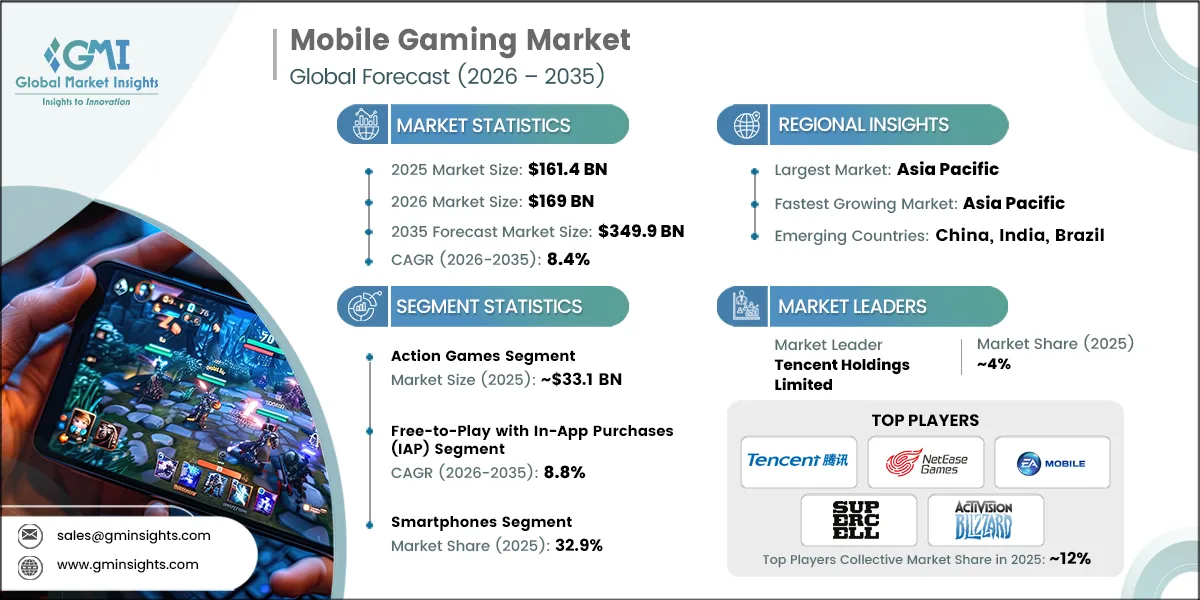
Mobile Gaming Market Key Takeaways
Market Size & Growth
- 2025 Market Size: USD 161.4 Billion
- 2025 Market Size: USD 169 Billion
- 2034 Forecast Market Size: USD 349.9 Billion
- CAGR (2025–2034): 8.4%
Regional Dominance
- Largest Market: Asia Pacific
- Fastest Growing Region: Asia Pacific
Key Market Drivers
- Smartphone penetration & affordable internet.
- Freemium & in-app purchases model.
- Advancements in AR/VR & cloud gaming.
Challenges
- High competition & market saturation.
- Regulatory & privacy concerns.
Opportunity
- E-sports & competitive mobile gaming.
- Expansion in emerging markets.
Key Players
- Market Leader: Tencent Holdings Limited led with over 4% market share in 2025.
- Leading Players: Top 5 players in this market include Tencent Holdings Limited, NetEase, Inc., Electronic Arts (EA Mobile), Supercell Oy, Activision Blizzard, which collectively held a market share of 12% in 2025.
Get Market Insights & Growth Opportunities
To get key market trends
Mobile Gaming Market Trends
- Hyper-casual games, defined by their simple mechanics and short play sessions, have emerged as a dominant force in the mobile gaming industry. These games are designed to be easy to learn, making them accessible to a wide audience, including casual gamers who may not engage with more complex games. Their addictive nature and low learning curve have contributed to their widespread popularity. Hyper-casual games primarily monetize through advertisements, which allows developers to generate revenue without relying heavily on in-app purchases. This monetization model, combined with the relatively low development costs, has made hyper-casual games a lucrative and rapidly growing segment in the market. As the demand for quick and engaging entertainment continues to rise, hyper-casual games are expected to maintain their strong position in the mobile gaming landscape.
- Cloud gaming is transforming the mobile gaming industry by reducing the reliance on high-end hardware. Players can now stream high-quality games directly to their mobile devices, eliminating the need for expensive gaming consoles or PCs. The ongoing global rollout of 5G networks has been a significant enabler of cloud gaming, addressing latency issues and ensuring a seamless gaming experience. With faster internet speeds and reduced lag, players can enjoy console-like gaming experiences on their smartphones.
- Augmented Reality (AR) and Virtual Reality (VR) are revolutionizing mobile gaming by offering immersive and interactive experiences. AR games, in particular, have gained significant traction, with titles like Pokémon GO showcasing the potential of this technology. AR-based games overlay digital elements onto the real world, creating a unique and engaging gaming experience. As mobile devices become more powerful and affordable, the adoption of AR and VR in gaming is expected to rise.
- Blockchain technology is introducing new possibilities in the mobile gaming market through play-to-earn models and NFT-based assets. These innovations allow players to own and trade in-game items, creating a decentralized gaming economy. NFTs (non-fungible tokens) enable players to have true ownership of digital assets, which can be bought, sold, or traded on blockchain platforms. This trend is reshaping the way games are monetized, as developers can generate revenue through the sale of NFTs and transaction fees.
- Mobile games are increasingly incorporating social and multiplayer features to enhance player engagement and retention. Features such as in-game chat, guilds, and live streaming are turning gaming into a community-driven experience. These social elements encourage players to interact with each other, fostering a sense of belonging and competition. Multiplayer modes allow players to team up or compete against friends and other players worldwide, adding a layer of excitement to the gaming experience. By integrating social features, mobile games are becoming more than just entertainment they are evolving into platforms for social interaction, similar to social media. This trend is driving higher player retention and increasing the time spent on games. Developers are also leveraging these features to create events and tournaments, further boosting engagement and monetization opportunities.
- Artificial Intelligence (AI) is playing a pivotal role in personalizing the mobile gaming experience. AI algorithms analyze player behavior to recommend content, adjust difficulty levels, and optimize in-app purchases. This level of personalization enhances the user experience by tailoring the game to individual preferences and play styles.
Mobile Gaming Market Analysis
Learn more about the key segments shaping this market
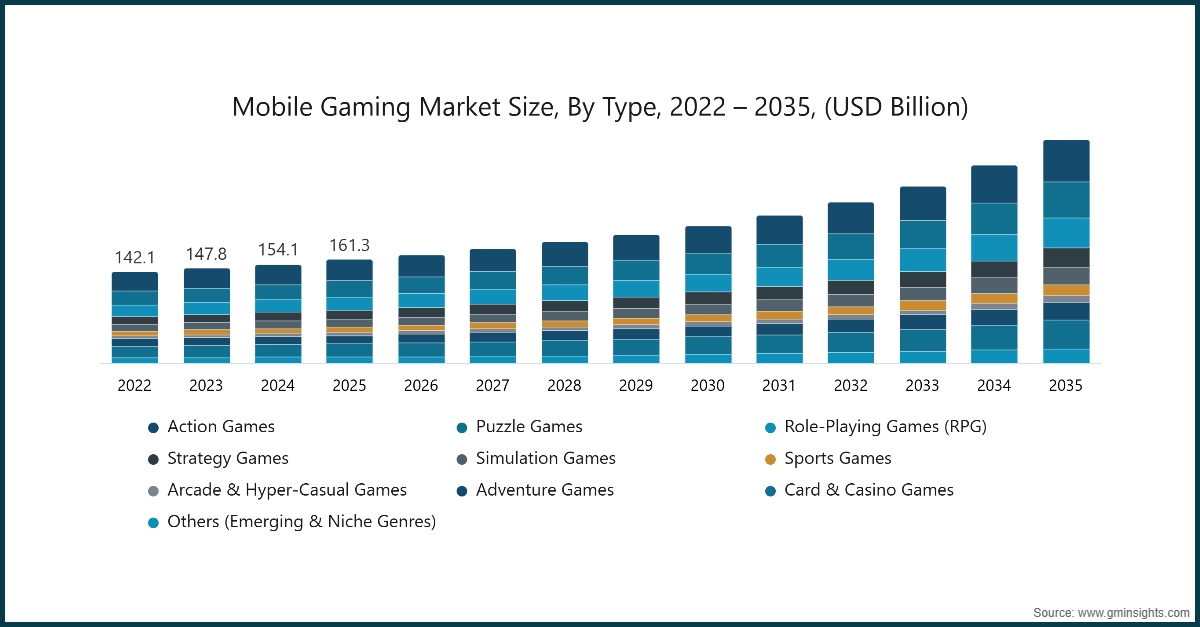
Based on product type, the market is categorized into action games, puzzle games, role-playing games (RPG), strategy games, simulation games, sports games, arcade & hyper-casual games, adventure games, card & casino games and others (emerging & niche genres). The action games segment accounted for revenue of around USD 33.1 billion in 2025 and is anticipated to grow at a CAGR of 7.7% from 2026 to 2035.
- Action games have established themselves as a dominant force in the mobile gaming market, appealing to a wide demographic with their fast-paced and adrenaline-driven gameplay. These games are designed to provide an immersive experience, often featuring high-quality graphics, competitive gameplay mechanics, and frequent updates that keep players engaged over time. The genre's ability to deliver thrilling and dynamic experiences has made it a favorite among both casual and hardcore gamers.
- One of the key factors contributing to the popularity of action games is their integration with multiplayer modes. These modes allow players to compete or collaborate with others in real-time, adding a social dimension to the gaming experience. Additionally, the rise of esports has further elevated the status of action games.
- Many titles in this genre are now featured in professional gaming tournaments, attracting large audiences and fostering a sense of community among players. This combination of competitive and social elements ensures that action games remain a preferred choice for a diverse range of gamers.
Learn more about the key segments shaping this market
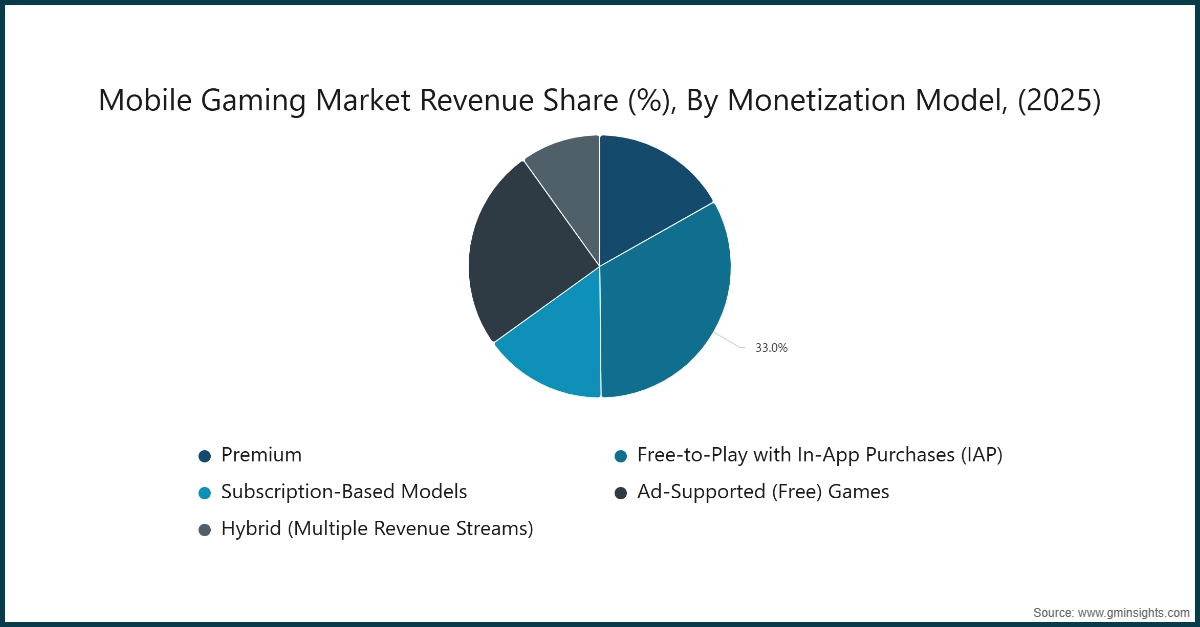
Based on monetization model, of mobile gaming market consists of premium, free-to-play with in-app purchases (IAP), subscription-based models, ad-supported (free) games and hybrid (multiple revenue streams). The IAP based segment emerged as leader and held 33% of the total market share in 2025 and is anticipated to grow at a CAGR of 8.8% from 2026 to 2035.
- The free-to-play model, supported by in-app purchases (IAP), has become the cornerstone of monetization in the mobile gaming industry. By removing the barrier of upfront costs, developers can attract a massive user base, making their games accessible to a broader audience.
- Once players are engaged, developers offer optional purchases for items such as cosmetic upgrades, power-ups, and premium features. This approach not only enhances the gaming experience but also generates recurring revenue streams for developers.
- Players are often more willing to spend incrementally on in-app purchases rather than paying a one-time fee for a game. This psychological advantage has made the free-to-play model highly effective in driving revenue.
- Moreover, the model allows developers to continuously update and improve their games, keeping players invested over the long term. The success of this strategy is evident in the mobile gaming market, where free-to-play titles consistently dominate the top-grossing charts. This model has also paved the way for innovative monetization strategies, such as battle passes and subscription services, further diversifying revenue opportunities for developers.
Based on device type, the market consists of smartphones, tablets, wearable devices and others (feature phones & emerging devices). The smartphones segment emerged as leader and held 32.9% of the total market share in 2025.
- Smartphones have emerged as the primary platform for mobile gaming, thanks to their widespread adoption and continuous technological advancements. Modern smartphones are equipped with high-resolution displays, powerful processors, and advanced graphics capabilities, transforming them into portable gaming consoles. These technological improvements have significantly enhanced the quality of mobile games, making them more immersive and visually appealing.
- In addition to hardware advancements, the availability of affordable internet access has played a crucial role in the growth of mobile gaming. Faster and more reliable internet connections enable seamless gameplay, particularly for online multiplayer games. Furthermore, app store ecosystems, such as the Apple App Store and Google Play Store, provide a centralized platform for developers to distribute their games and for players to discover new titles. These ecosystems also facilitate social connectivity, allowing players to share their achievements and compete with friends, further enriching the gaming experience.
- Smartphones have also democratized gaming by making it accessible to people across different age groups, income levels, and geographic regions. Unlike traditional gaming platforms, which often require significant investments in hardware, smartphones are more affordable and widely available.
Looking for region specific data?
North America Mobile Gaming Market
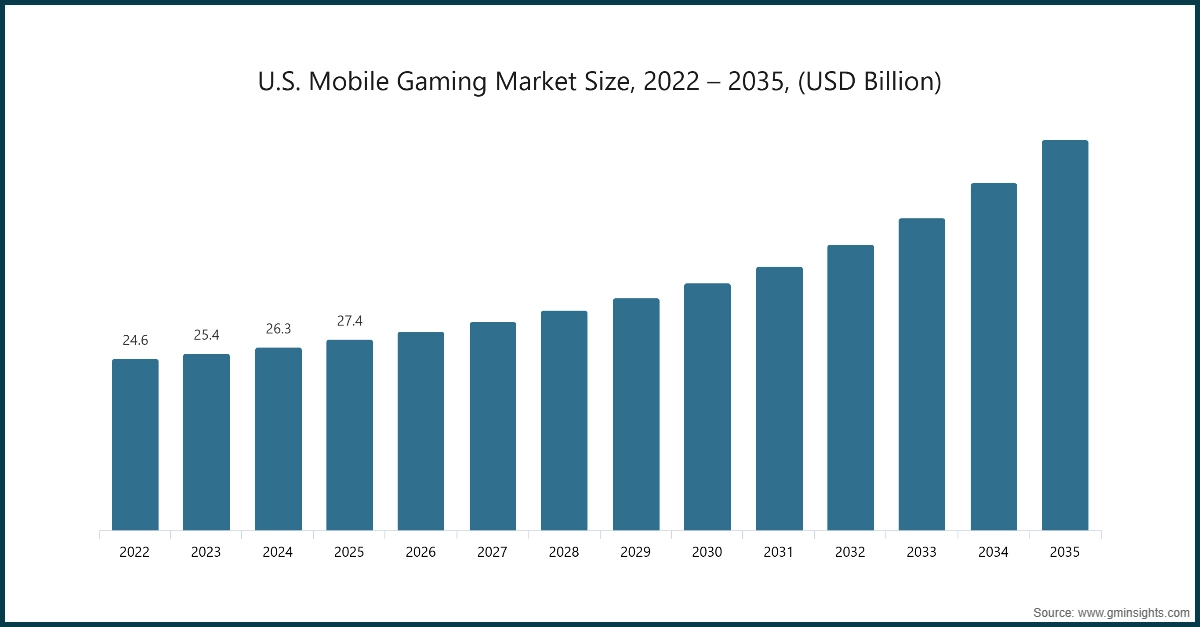
The U.S. dominates an overall North America market and valued at USD 27.4 billion in 2025 and is estimated to grow at a CAGR of 7.8% from 2026 to 2035.
- The United States remains a powerhouse in the mobile gaming market, driven by high smartphone penetration, advanced technology infrastructure, and strong consumer spending. The region benefits from a mature gaming ecosystem, with leading developers and publishers headquartered in the country, ensuring a steady stream of innovative titles and monetization strategies.
- Additionally, the U.S. market is characterized by strong adoption of premium in-app purchases and subscription models. The presence of tech giants and robust advertising networks further amplifies revenue generation, making the U.S. one of the most lucrative regions for mobile gaming globally.
Europe Mobile Gaming Market
In the European market, UK is expected to experience significant and promising growth from 2026 to 2035.
- Europe holds a significant share in the mobile gaming industry due to its diverse gaming culture and high disposable income among consumers. Countries like Germany, the UK, and France lead in mobile game downloads and spending, supported by widespread 4G/5G connectivity and advanced payment systems.
- The EU market also benefits from strong regulatory frameworks that ensure fair competition and consumer protection, fostering trust in digital transactions. Additionally, localization strategies and culturally tailored content have helped developers penetrate multiple European markets effectively.
Asia Pacific Mobile Gaming Market
In the Asia Pacific market, the China held 37% market share in 2025 and is anticipated to grow at a CAGR of 9.7% from 2026 to 2035.
- Asia-Pacific is the largest and fastest-growing region in the mobile gaming industry, accounting for the majority of global downloads and revenue. Countries like China, India, Japan, and South Korea dominate due to massive smartphone adoption, affordable internet, and a strong gaming culture.
- The APAC market thrives on free-to-play models and competitive gaming, with esports and streaming platforms fueling engagement. Local developers and global giants alike invest heavily in this region, making APAC the epicenter of innovation and growth in mobile gaming.
Middle East and Africa Mobile Gaming Market
In the Middle East and Africa market, Saudi Arabia held 24.2% market share in 2025 promising growth from 2026 to 2035.
- The Middle East and Africa (MEA) region is emerging as a promising market for mobile gaming, driven by rapid smartphone penetration and improving internet infrastructure. Countries like Saudi Arabia, UAE, and South Africa are witnessing a surge in gaming activity, supported by young, tech-savvy populations.
- Although MEA currently contributes a smaller share compared to other regions, its growth potential is immense. Increasing investment in digital ecosystems and localized content, coupled with rising interest in esports, positions MEA as a future hotspot for mobile gaming expansion.
Mobile Gaming Market Share
In 2025, the prominent manufacturers in market are collectively held the market share of ~12%.
Activision Blizzard, Inc. is recognized as one of the leading companies in the mobile gaming industry. The company leverages its strong portfolio of intellectual property, which includes globally popular franchises such as Call of Duty and Candy Crush. Activision Blizzard’s ability to adapt its franchises for mobile platforms has been a key factor in its success. The company focuses on creating immersive gaming experiences and has established strategic partnerships with developers and publishers worldwide. These efforts have enabled. Activision Blizzard to expand its reach and maintain a significant presence in the mobile gaming sector. Its commitment to innovation and quality ensures its continued leadership in the industry.
Electronic Arts, through its EA Mobile division, has established itself as one of the top global publishers in the mobile gaming market. The company’s success is driven by its flagship franchises, including FIFA Mobile and The Sims Mobile, which have garnered a loyal player base across various regions. EA Mobile’s ability to deliver engaging gameplay experiences and implement effective monetization strategies has been instrumental in its growth.
SupercellOy, a subsidiary of Tencent, is renowned for its blockbuster titles such as Clash of Clans and Brawl Stars. The company’s unique small-team development model allows it to focus on creating high-quality games that resonate with players worldwide. Supercell’s ability to consistently deliver hit games has made it one of the most profitable mobile-centric studios globally.
Mobile Gaming Market Companies
Major players operating in the market include:
- Activision Blizzard
- Bandai Namco Entertainment
- Century Games
- Dream Games
- Electronic Arts (EA Mobile)
- Garena (Sea Limited)
- Hungry Studio
- Krafton Inc.
- NetEase, Inc.
- Netmarble Corporation
- Playrix
- Roblox Corporation
- Scopely, Inc.
- Supercell Oy
- Tencent Holdings Limited
- Voodoo
Tencent Holdings Limited is widely regarded as the global leader in the mobile gaming market. The company’s success is driven by its highly popular titles, including Honor of Kings, PUBG: Mobile, and Call of Duty: Mobile. Tencent’s dominance is further strengthened by its extensive ecosystem, which includes global licensing agreements and seamless integration with China’s leading social platforms.
NetEase, Inc. is a major player in the mobile gaming industry and consistently ranks among the top global companies in this space. The company’s success is built on its portfolio of hit titles, which have gained immense popularity among gamers in China and internationally. NetEase has also made significant investments in live operations and esports, which have helped it maintain a competitive edge in the rapidly evolving mobile gaming market. By focusing on delivering high-quality gaming experiences and fostering player engagement, NetEase has solidified its position as a dominant force in the industry.
Mobile Gaming Market Report Attributes
| Key Takeaway | Details |
|---|---|
| Market Size & Growth | |
| Base Year | 2025 |
| Market Size in 2025 | USD 161.4 Billion |
| Market Size in 2026 | USD 169 Billion |
| Forecast Period 2025-2034 CAGR | 8.4% |
| Market Size in 2034 | USD 349.9 Billion |
| Key Market Trends | |
| Drivers | Impact |
| Smartphone penetration & affordable internet | Increasing smartphone adoption and cheaper data plans are making mobile gaming accessible to a wider audience globally. |
| Freemium & in-app purchases model | The success of free-to-play games with monetization through ads and microtransactions drives revenue without upfront cost barriers. |
| Advancements in AR/VR & cloud gaming | Emerging technologies like augmented reality and cloud gaming enhance user experience and attract new demographics. |
| Pitfalls & Challenges | Impact |
| High competition & market saturation | Thousands of games launch every month, making user acquisition and retention increasingly difficult. |
| Regulatory & privacy concerns | Data protection laws and restrictions on loot boxes or in-game purchases pose compliance challenges for developers. |
| Opportunities: | Impact |
| E-sports & competitive mobile gaming | Growing interest in mobile-based esports tournaments opens new revenue streams and brand sponsorship opportunities. |
| Expansion in emerging markets | Regions like Southeast Asia, Africa, and Latin America offer untapped potential due to rising smartphone adoption and improving connectivity. |
| Market Leaders (2025) | |
| Market Leader |
~4% market share |
| Top Players |
The collective market share in 2025 is ~12% |
| Competitive Edge |
|
| Regional Insights | |
| Largest Market | Asia Pacific |
| Fastest growing market | Asia Pacific |
| Emerging countries | China, India, Brazil |
| Future outlook |
|
What are the growth opportunities in this market?
Mobile Gaming Industry News
- In 2025, Bandai Namco revealed Jump+ Jumble Rush, a tower-defense mobile game featuring characters from Chainsaw Man, Spy × Family, and Dandadan, scheduled for Fall 2025 release in Japan.
- In 2025, Garena launched delta force mobile early 2025 across SEA, MENA, and Latin America, achieving over 10 million downloads by Q1 2025. Free Fire saw double-digit growth with a Naruto collaboration.
- In April 2024, Krafton, Inc. launched Dark and Darker Mobile and inZOI, planned for 2024 release, as part of its “scale‑up the creative” strategy.
The mobile gaming market research report includes in-depth coverage of the industry, with estimates & forecast in terms of revenue (USD Billion) from 2022 to 2035, for the following segments:
Market, By Type
- Action games
- Puzzle games
- Role-playing games (RPG)
- Strategy games
- Simulation games
- Sports games
- Arcade & hyper-casual games
- Adventure games
- Card & casino games
- Others (emerging & niche genres)
Market, By Monetization Model
- Premium
- Free-to-play with in-app purchases (IAP)
- Subscription-based models
- Ad-supported (free) games
- Hybrid (multiple revenue streams)
Market, By Device Type
- Smartphones
- Tablets
- Wearable devices
- Others (feature phones & emerging devices)
Market, By Platform
- iOS
- Android
- Progressive web apps (PWAs)
- Others (HarmonyOS & emerging platforms)
Market, By Connectivity
- Online multiplayer games
- Offline games
- Hybrid connectivity games
Market, By Age Group
- Kids
- Teenagers
- Young adults
- Adults
- Seniors
Market, By Distribution channel
- App store (iOS)
- Google play store
- Third-party app stores
- Direct APK/sideloading
- Social media platforms
- Others (carrier pre-installs, OEM partnerships, web portals)
The above information is provided for the following regions and countries:
- North America
- U.S.
- Canada
- Europe
- Germany
- UK
- France
- Italy
- Spain
- Asia Pacific
- China
- Japan
- India
- South Korea
- Australia
- Latin America
- Brazil
- Mexico
- Argentina
- MEA
- Saudi Arabia
- UAE
- South Africa
Frequently Asked Question(FAQ) :
What was the market size of the mobile gaming in 2025?
The market was valued at USD 161.4 billion in 2025, growing at a CAGR of 8.4% till 2035. The market is driven by the increasing accessibility of affordable internet and the proliferation of Android devices.
What is the projected value of the mobile gaming market by 2035?
The market is expected to reach USD 349.9 billion by 2035, fueled by advancements in cloud gaming, AR/VR, and blockchain technology.
What is the expected size of the mobile gaming industry in 2026?
The market size is projected to reach USD 169 billion in 2026.
How much revenue did the action games segment generate in 2025?
The action games segment generated approximately USD 33.1 billion in 2025 and is anticipated to grow at a CAGR of 7.7% till 2035.
What was the market share of the in-app purchase (IAP) segment in 2025?
The in-app purchase (IAP) segment held 33% of the total market share in 2025 and is set to expand at a CAGR of 8.8% up to 2035.
What was the valuation of the smartphones segment in 2025?
The smartphones segment accounted for 32.9% of the total market share in 2025, led by technological advancements and widespread adoption.
What is the growth outlook for the U.S. mobile gaming sector?
The U.S. market, valued at USD 27.4 billion in 2025, is projected to grow at a CAGR of 7.8% through 2035.
What are the upcoming trends in the mobile gaming market?
Key trends include the rise of hyper-casual games, cloud gaming enabled by 5G, AR/VR integration, blockchain-based play-to-earn models, social and multiplayer features, and AI-driven personalization.
Who are the key players in the mobile gaming industry?
Major players include Activision Blizzard, Bandai Namco Entertainment, Century Games, Dream Games, Electronic Arts (EA Mobile), Garena (Sea Limited), Hungry Studio, Krafton Inc., NetEase, Inc., and Netmarble Corporation.
Mobile Gaming Market Scope
Related Reports