Summary
Table of Content

Mobile Accessories Market
Get a free sample of this report
Form submitted successfully!
Error submitting form. Please try again.
Thank you!
Your inquiry has been received. Our team will reach out to you with the required details via email. To ensure that you don't miss their response, kindly remember to check your spam folder as well!
Request Sectional Data
Thank you!
Your inquiry has been received. Our team will reach out to you with the required details via email. To ensure that you don't miss their response, kindly remember to check your spam folder as well!
Form submitted successfully!
Error submitting form. Please try again.
Mobile Accessories Market Size
- An increase in smartphone use around the world is causing an increase in demand for mobile accessories. The growth in smartphone ownership means more people will need mobile accessories, such as protective cases, to help protect their new devices from accidental damage and wear and tear. As consumers use their phones more often, there will be an increase in demand for both screen protectors and chargers as well. Consumers are increasingly purchasing wireless earphones or headphones because they are consuming more media than ever on their phones. Because consumers frequently upgrade their phones, they will frequently be replacing accessories that go with their new devices. Consumers will also have a need for better-performing power banks because of the growth in purchasing high-end smartphones. Mobile gamers and video streamers will also increase their demand for specialized accessories. Consumers will be able to find affordable smartphones in greater quantities in emerging markets, which means that the demand for mobile accessories will increase as well. Retailers will continue to expand their mobile accessory inventory to have a variety of accessories for all the device brands and specifications that they sell. Mobile accessory demand will continue to be relatively stable because of the strong sales cycles for smartphones.
- The rapid advancements of technology in Mobile devices have led to increased growth within the mobile accessories market. Manufacturers are constantly introducing new features to their smartphones that will require compatible accessories. Fast charging technology has led to an increased need for new chargers & cables. New camera features lead to a higher demand for tripods, lenses, & stabilization accessories. Improvements to the way of making audio wirelessly through Bluetooth has also increased the number of audio devices purchased. The availability of foldable and premium phones creates a higher need for specialized protective cases & covers. With the removal of headphone jacks as an option on most phones, more inducements are now available to make people buy wireless earphones and adapters. Advancements in battery power have generated a need for higher capacity portable power banks as well. Many consumers will continue looking for accessories to improve their devices and overall user experience. With all the upgrades of devices taking place, the life cycles of many accessories sold around the world have greatly shortened. Retailers will continue to increase the number of products offered to be in line with current and future design specs on smartphones.
- The mobile accessory markets have one of the largest shares in protective cases due to the growing number of smartphones. As smartphones have become more expensive, consumers are also going to pay for a solution to protect their phones from impact. Durable materials that can absorb shock like silicone, polycarbonate and thermoplastic polyurethane are being used to manufacture cases. While design is slim and light, they do not detract from the phone's aesthetics or safety when it comes to using a case. Personalization with various prints and clear finishes. As consumers continue to upgrade their smartphones often, they will continue to buy new cases across all demographics. The global availability of protective cases through both retail stores and online retailers helps keep demand for these products steady.
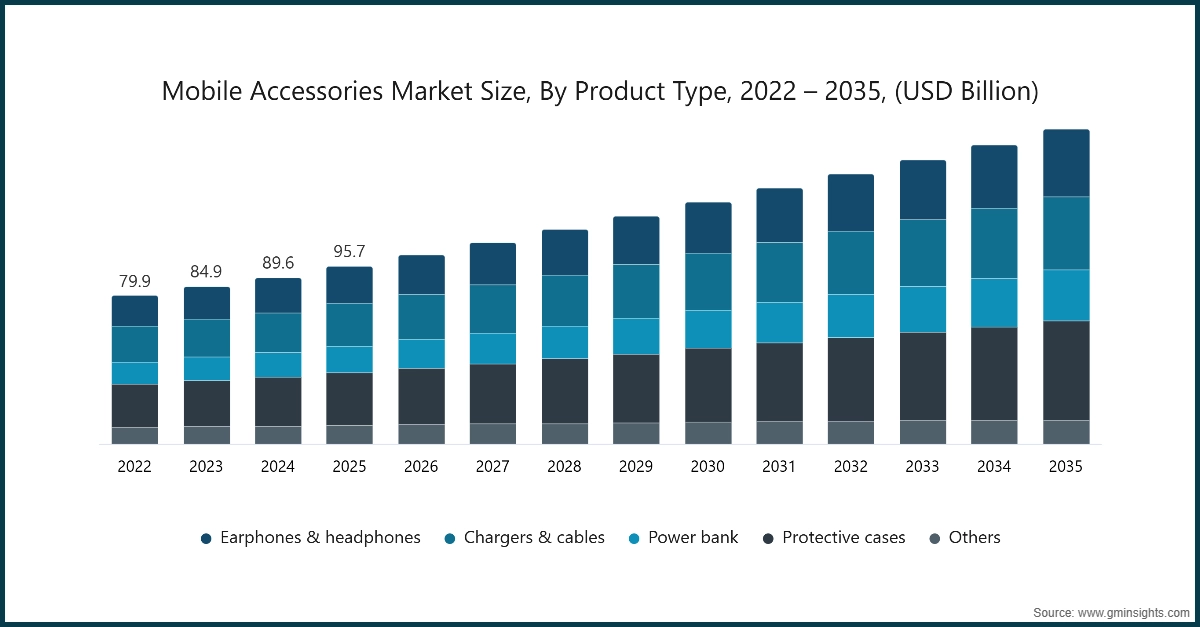
The mobile accessories market was estimated at USD 95.7 billion in 2025. The market is expected to grow from USD 101.8 billion in 2026 to USD 169.8 billion in 2035, at a CAGR of 5.8%, according to latest report published by Global Market Insights Inc.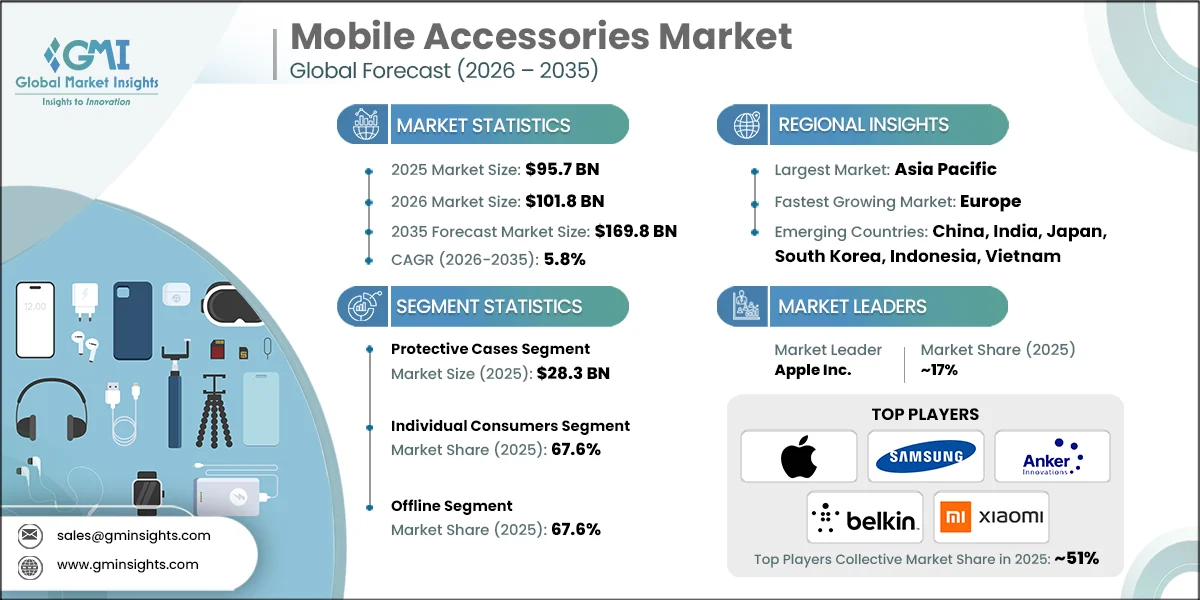
Mobile Accessories Market Key Takeaways
Market Size & Growth
- 2025 Market Size: USD 95.7 Billion
- 2026 Market Size: USD 101.8 Billion
- 2035 Forecast Market Size: USD 169.8 Billion
- CAGR (2026–2035): 5.8%
Regional Dominance
- Largest Market: Asia Pacific
- Fastest Growing Region: Europe
Key Market Drivers
- Surging global smartphone penetration.
- Growing consumer preference for personalization.
- Rapid technological innovation in mobile devices.
Challenges
- Intense competition and price sensitivity.
- Rapid product obsolescence.
Opportunity
- Growth in premium and luxury accessory segments.
- Integration of smart features and AI capabilities.
Key Players
- Market Leader: Apple Inc. led with over 17% market share in 2025.
- Leading Players: Top 5 players in this market include Apple Inc., Samsung, Anker Innovations, Belkin, Xiaomi, which collectively held a market share of 51% in 2025.
Get Market Insights & Growth Opportunities
To get key market trends
Mobile Accessories Market Trends
- Fast-charging accessories are an important factor for consumers looking to purchase a device with rapid power delivery capability. With users of smartphones and other mobile devices wanting batteries that can be recharged quickly, the introduction of larger batteries and higher charging standards has significantly increased the need to purchase accessories that are compatible with the devices. Growth in sales of fast-charging mobile accessories such as high-wattage chargers, portable power banks, and charger cables that are compatible with devices will continue to increase.
- Bluetooth- and wireless-enabled mobile accessories have become the mainstay of accessory purchases. Consumers are purchasing Bluetooth-enabled devices because of their convenience in removing the need for a cable to connect to the accessory. Some consumers no longer need to contend with tangled cords when using true wireless earbuds, Bluetooth speakers, and Bluetooth headsets. This, combined with consumers' ease of connecting to and disconnecting from multiple devices when commuting or working out, has increased worldwide demand for compatible and user-friendly mobile accessories worldwide.
- Mobile accessories that protect and personalize a consumer's device will continue to drive consumer purchases, as consumers are looking for stylish ways to protect their devices. Protective accessories for mobile devices include phone cases, tempered glass screen protectors, and decorative skins that help protect various mobile devices from damage and scratches caused by accidental drops or falls. There are numerous designs available from various manufacturers to allow consumers to protect their devices while reflecting their personal style and keeping up with the latest trends in style and fashion.
- As smartphone gaming continues to rise in popularity among gamers of all ages, mobile gaming accessories are becoming more widely adopted. Along with improving the experience of extended gameplay, mobile gaming accessories have been designed to maximise players' control over their devices and minimise the amount of heat generated by them; therefore, many gamers are now looking for items like gaming triggers, cooling fans and ergonomic grips to use when playing on their mobile devices. In addition, the increasing popularity of mobile esports and streaming will also contribute to the continued growth of this industry segment as gamers move online for competitive play.
- Consumers are relying more heavily on online e-commerce platforms to discover and purchase mobile gaming accessories. When making their decisions to purchase mobile gaming accessories, consumers turn to e-commerce sites that offer multiple comparison options on mobile gaming accessories, including product descriptions, reviews from other consumers and competitive pricing for each option. The growth of e-commerce has been aided by social media recommendations from peers and blogs reviewing new mobile gaming accessories. With the expansion of digital retail networks, sales growth is expected to accelerate exponentially in the global and local brands.
Mobile Accessories Market Analysis
Learn more about the key segments shaping this market
- Protective cases dominate the mobile accessories market by product type due to essential device protection needs. Rising smartphone prices encourage consumers to safeguard devices against accidental damage. Impact-resistant materials enhance durability and reduce repair expenses. Wide compatibility across brands and models supports high sales volumes.
- Fashion-oriented designs attract style-conscious buyers seeking personalized accessories. Frequent smartphone replacements generate repeat purchases within short upgrade cycles. Strong retail and online distribution networks ensure consistent product availability, reinforcing segment leadership globally.
Based on end-user, the market consists of individual consumers (B2C), and commercial (B2B). The individual consumers segment emerged as leader and held 67.6% of the total market share in 2025 and is anticipated to grow at a CAGR of 5.3% from 2026 to 2035.
- Individual consumers lead the mobile accessories market due to widespread smartphone ownership globally. Daily device usage increases demand for protective and performance-enhancing accessories. Personal preference drives purchases of cases, chargers, earphones, and screen protectors. Frequent device upgrades generate repeat buying across different accessory categories.
- Growing disposable income supports spending on branded and premium products. E-commerce platforms enable easy comparison and convenient purchasing for individuals. Strong influence of social media further accelerates consumer-driven demand in the market.
Learn more about the key segments shaping this market
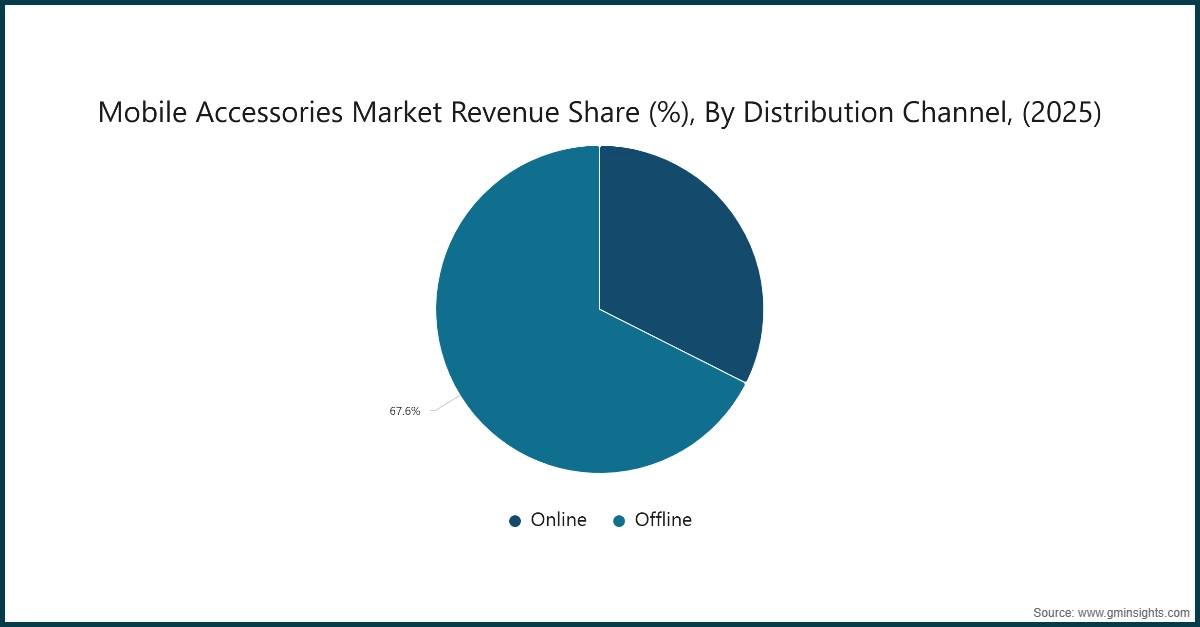
Based on distribution channel, the mobile accessories market consists of online and offline. The offline emerged as leader and held 67.6% of the total market share in 2025 and is anticipated to grow at a CAGR of 5.3% from 2026 to 2035.
- Offline distribution channels emerged as leaders in the market due to strong retail presence. Consumers prefer physical stores for immediate product availability and compatibility checks. In-store assistance improves confidence when selecting device-specific accessories. Retail outlets offer hands-on evaluation of quality, design, and fit before purchase.
- Impulse buying increases during smartphone purchases at electronics stores. Established dealer networks ensure wide accessibility across urban and rural areas. Consistent foot traffic and promotional displays strengthen offline channel dominance.
Asia Pacific Mobile Accessories Market
Looking for region specific data?
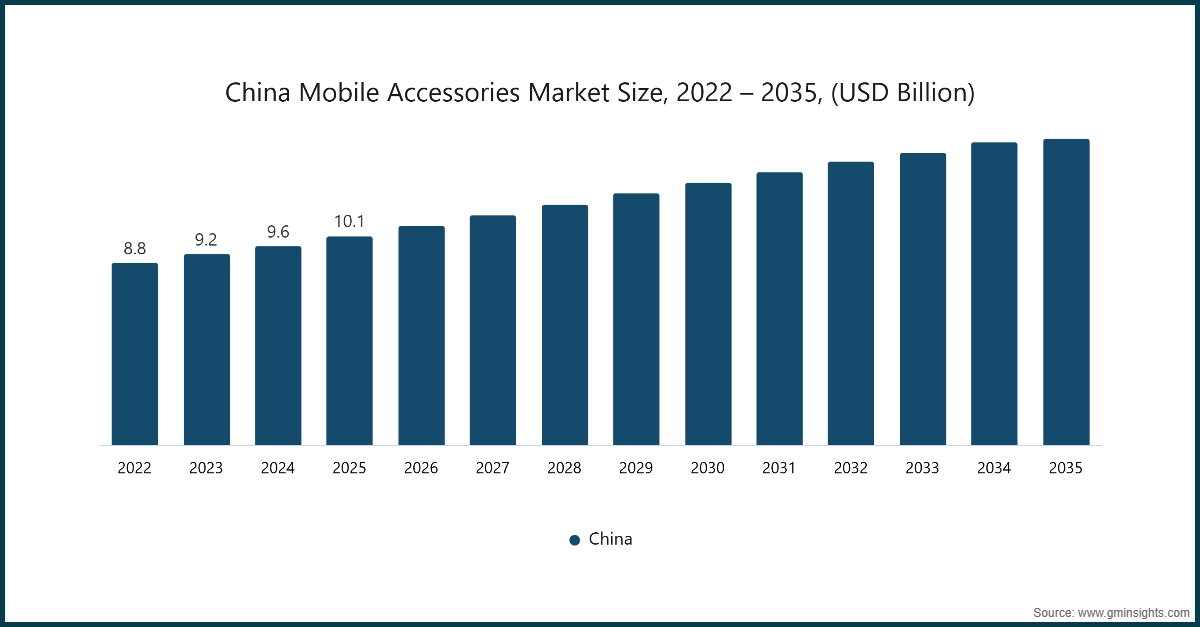
China dominates an overall Asia Pacific mobile accessories market and valued at USD 10.1 billion in 2025 and is estimated to grow at a CAGR of 6.0% from 2026 to 2035.
- The China market benefits from large-scale smartphone manufacturing and consumption. Strong domestic brands drive innovation in wireless audio and charging technologies. High digital adoption supports demand for advanced smart accessories. E-commerce dominance accelerates product launches and nationwide reach.
- Consumers show strong interest in multifunctional and fast-charging devices. Rapid 5G expansion increases sales of compatible mobile accessories. Competitive pricing strategies intensify market competition among local vendors. Continuous product innovation sustains strong replacement demand across urban regions.
North America Mobile Accessories Market
In the North America mobile accessories industry, the U.S. held 73.6% market share in 2025 and is anticipated to grow at a CAGR of 4.3% from 2026 to 2035.
- The North America market is supported by high smartphone replacement rates. Strong demand for premium devices increases sales of branded protective cases and chargers. Consumers prioritize wireless earbuds and fast-charging accessories for convenience. Growth of remote work culture boosts demand for mobile productivity accessories.
- Retail chains and online marketplaces ensure wide product availability. Preference for certified and safety-compliant products shapes purchasing decisions. High spending capacity supports adoption of advanced smart accessories. Continuous product innovation sustains competitive market dynamics.
Europe Mobile Accessories Market
In the Europe mobile accessories industry, Germany is expected to experience significant and promising growth from 2026 to 2035.
- The European market benefits from strong regulatory focus on product standardization. USB-C adoption policies influence demand for compatible charging accessories. Consumers prefer durable and eco-friendly accessory materials. Growing cycling and commuting culture supports demand for mobile mounts and holders.|
- Established electronics retailers maintain steady distribution networks. Brand reputation plays a significant role in purchasing behavior. Demand for high-quality audio accessories remains consistent across urban markets. Sustainability initiatives encourage development of recyclable accessory packaging.
Middle East and Africa Mobile Accessories Market
In the Middle East and Africa mobile accessories industry, UAE held a significant market share in 2025 promising growth from 2026 to 2035.
- The Middle East and Africa market is growing due to expanding smartphone user base. Rising youth population increases demand for fashionable phone cases and audio devices. Import-driven supply supports availability of affordable accessory options. Growth of organized retail improves access in urban centers.
- High mobile internet usage drives demand for power banks and charging cables. Price sensitivity influences purchasing decisions across developing markets. Premium accessory adoption rises in affluent Gulf countries. Expanding telecom infrastructure supports steady market growth.
Mobile Accessories Market Share
- In 2025, the prominent manufacturers in mobile accessories industry are Apple Inc., Samsung, Anker Innovations, Belkin International, and Xiaomi collectively held the market share of ~51%.
- Apple Inc. leads the global mobile accessories industry through its ecosystem-driven strategy. The company offers wireless earbuds, chargers, cases, MagSafe accessories, and wearables designed specifically for its devices. Apple emphasizes seamless integration, premium design, and proprietary technologies. Strong brand loyalty, direct retail presence, and high-margin accessory sales significantly contribute to its leadership position in the premium segment worldwide.
- Samsung holds a major share in the mobile accessories industry, supported by its global smartphone ecosystem. The company provides wireless earbuds, chargers, power banks, cases, and smart wearables tailored to Galaxy devices. Samsung focuses on cross-device compatibility, premium design, and innovation in wireless audio and charging technologies. Its extensive global distribution network strengthens its competitive position.
Mobile Accessories Market Companies
Major players operating in the mobile accessories industry include:
- Anker Innovations
- Apple Inc.
- Belkin
- Bose Corporation
- Huawei
- Incipio Group
- Mophie
- Panasonic
- Plantronics
- Samsung
- Skullcandy, Inc.
- Sony Corporation
- Spigen Inc.
- UGREEN Group Limited
- Xiaomi
Anker Innovations is a leading independent mobile accessory brand known for charging solutions, power banks, cables, and audio devices. The company emphasizes fast-charging technology, durability, and value-for-money pricing. Anker benefits from strong e-commerce penetration and positive consumer reviews. Its diversified sub-brands in audio and smart home categories support continued global growth.
Belkin is a recognized provider of premium mobile accessories, including charging devices, screen protectors, docking stations, and connectivity solutions. The company focuses on high-quality materials, certified compatibility, and retail partnerships. Belkin benefits from strong relationships with major electronics retailers and device manufacturers. Its emphasis on design and reliability supports steady demand across mid- to premium-price segments.
Xiaomi participates in the mobile accessories market through a wide portfolio of affordable earphones, power banks, chargers, and wearables. The company focuses on competitive pricing, online distribution channels, and ecosystem integration. Xiaomi’s strong presence in Asia and emerging markets contributes significantly to its accessory sales. Its value-driven positioning supports volume growth in price-sensitive regions.
Mobile Accessories Market Report Attributes
| Key Takeaway | Details |
|---|---|
| Market Size & Growth | |
| Base Year | 2025 |
| Market Size in 2025 | USD 95.7 Billion |
| Market Size in 2026 | USD 101.8 Billion |
| Forecast Period 2026-2035 CAGR | 5.8% |
| Market Size in 2035 | USD 169.8 Billion |
| Key Market Trends | |
| Drivers | Impact |
| Surging global smartphone penetration | As more consumers own smartphones worldwide, demand for accessories like chargers, cases, and headphones increases proportionally. |
| Growing consumer preference for personalization | Trend toward customized and stylish accessories boosts sales of premium covers, skins, and wearable add-ons. |
| Rapid technological innovation in mobile devices | New features drive adoption of compatible accessories, expanding product demand. |
| Pitfalls & Challenges | Impact |
| Intense competition and price sensitivity | A crowded market with multiple low-cost brands pressures margins, forcing frequent price cuts that can reduce profitability. |
| Rapid product obsolescence | Fast smartphone upgrade cycles and evolving standards can make accessories outdated quickly, leading to inventory risk. |
| Opportunities: | Impact |
| Growth in premium and luxury accessory segments | High-end materials, designer collaborations, and brand-exclusive accessories appeal to affluent consumers and generate higher margins. |
| Integration of smart features and AI capabilities | Accessories with advanced sensors, health tracking, or voice interaction can create differentiated value propositions for users. |
| Market Leaders (2025) | |
| Market Leader |
Market share of ~17% |
| Top Players |
Collective market share of ~51% |
| Competitive Edge |
|
| Regional Insights | |
| Largest Market | Asia Pacific |
| Fastest growing market | Europe |
| Emerging countries | China, India, Japan, South Korea, Indonesia, Vietnam |
| Future outlook |
|
What are the growth opportunities in this market?
Mobile Accessories Machine Industry News
- In January 2026, Belkin announced the UltraCharge Modular Charging Dock at CES 2026, a Qi2-certified wireless charging stand that supports smartphones, wireless earbuds, and smartwatches all in one unit. The dock uses Qi2.2 magnetic charging technology with up to 25W output and offers compatibility with Apple, Samsung, and Google smartwatch charging pucks.
- In October 2025, Belkin unveiled a new lineup of mobile accessories for the iPhone 17 and iPhone Air, including premium screen protection, chic phone cases, and Qi2 25W wireless chargers. This collection is designed to power, protect, and personalize Apple mobile devices with enhanced charging performance and stylish protective solutions.
- In January 2025, Anker Innovations showcased several charging solutions at CES 2025, including a 25,000 mAh power bank with built-in and retractable cables and a 140 W charger with a digital display. These products underscore Anker’s efforts to lead in portable power and fast charging technologies.
- In 2025, Samsung expanded its smart accessory range with upgraded Galaxy SmartTag 2 Bluetooth trackers featuring enhanced battery life, improved UWB support, and advanced Find-My-Device integration, broadening its presence in mobile accessory ecosystems.
The mobile accessories machine market research report includes in-depth coverage of the industry with estimates & forecasts in terms of revenue (USD Billion) and volume (Thousand Units) from 2022 to 2035, for the following segments:
Market, By Product Type
- Earphones & headphones
- Chargers & cables
- Power bank
- Protective cases
- Others
Market, By Compatibility
- Universal/Multi-Platform Accessories
- iOS-Specific Accessories
- Android-Specific Accessories
Market, By Price Range
- Low (Less than $50)
- Mid Range ($50 to $100)
- Premium (More than $100)
Market, By End-User
- Individual Consumers (B2C)
- Commercial (B2B)
Market, By Distribution Channel
- Online
- E-commerce
- Brand Websites
- Offline
- Brand-owned Stores
- Electronics Retailers
- Hypermarkets & Supermarkets
- Others
The above information is provided for the following regions and countries:
- North America
- U.S.
- Canada
- Europe
- Germany
- UK
- France
- Italy
- Spain
- Asia Pacific
- China
- Japan
- India
- South Korea
- Australia
- Latin America
- Brazil
- Mexico
- Argentina
- MEA
- Saudi Arabia
- UAE
- South Africa
Frequently Asked Question(FAQ) :
What is the market size of the mobile accessories market in 2025?
The market size was USD 95.7 billion in 2025, with a CAGR of 5.8% expected through 2035, driven by increasing smartphone adoption and demand for complementary accessories.
What is the projected value of the mobile accessories market by 2035?
The mobile accessories market is expected to reach USD 169.8 billion by 2035, supported by advancements in 5G networks, smart device ecosystems, and e-commerce growth.
What is the current mobile accessories market size in 2026?
The market size is projected to reach USD 101.8 billion in 2026.
How much revenue did the protective cases segment generate in 2025?
The protective cases segment generated USD 28.3 billion in 2025, dominating the market due to essential device protection needs.
What was the valuation of the individual consumers segment in 2025?
The individual consumers segment held 67.6% market share and generated significant revenue in 2025, driven by widespread smartphone ownership and frequent device upgrades.
What is the growth outlook for the offline distribution channel from 2026 to 2035?
The offline distribution channel is projected to grow at a CAGR of 5.3% till 2035, supported by strong retail presence and consumer preference for in-store purchases.
Which region leads the mobile accessories market?
Asia Pacific leads the market, with China valued at USD 10.1 billion in 2025, driven by large-scale smartphone manufacturing and consumption.
What are the upcoming trends in the mobile accessories market?
Key trends include the adoption of wireless audio devices, fast-charging technologies, sustainable materials, and AI-integrated accessories for enhanced functionality.
Mobile Accessories Market Scope
Related Reports