Summary
Table of Content

Microfluidics Market
Get a free sample of this report
Form submitted successfully!
Error submitting form. Please try again.
Thank you!
Your inquiry has been received. Our team will reach out to you with the required details via email. To ensure that you don't miss their response, kindly remember to check your spam folder as well!
Request Sectional Data
Thank you!
Your inquiry has been received. Our team will reach out to you with the required details via email. To ensure that you don't miss their response, kindly remember to check your spam folder as well!
Form submitted successfully!
Error submitting form. Please try again.
Microfluidics Market Size
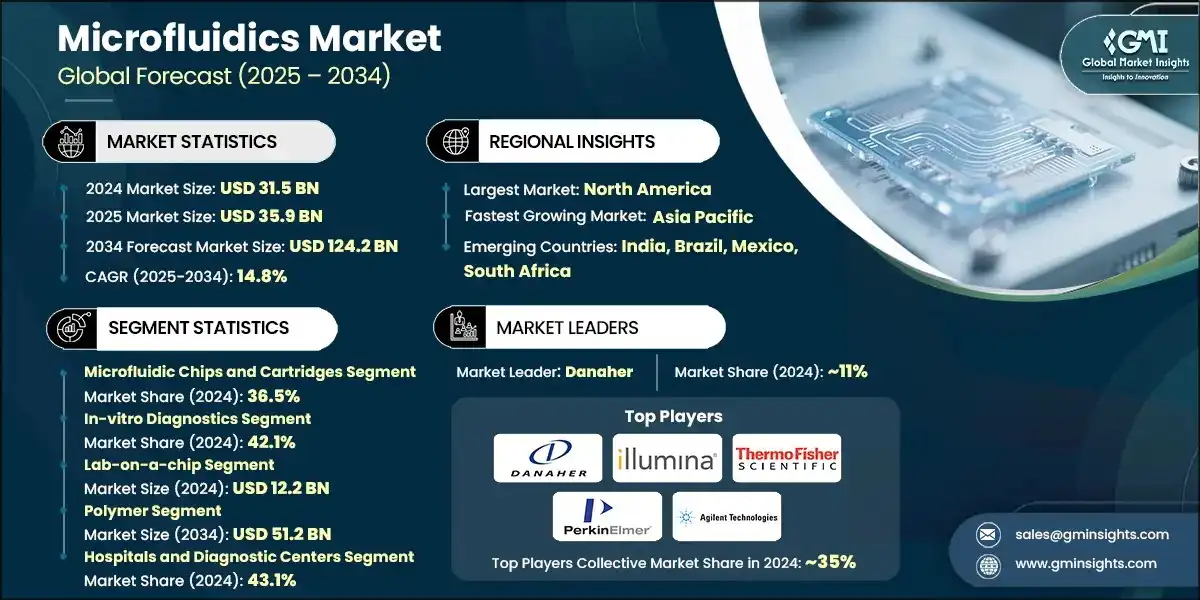
The global microfluidics market was estimated at USD 31.5 billion in 2024. The market is expected to grow from USD 35.9 billion in 2025 to USD 124.2 billion in 2034, at a CAGR of 14.8%, according to the latest report published by Global Market Insights Inc.
Microfluidics Market Key Takeaways
Market Size & Growth
- 2024 Market Size: USD 31.5 Billion
- 2025 Market Size: USD 35.9 Billion
- 2034 Forecast Market Size: USD 124.2 Billion
- CAGR (2025–2034): 14.8%
Key Market Drivers
- Rising demand for point-of-care diagnostics.
- Expansion of personalized medicine and genomics.
- Integration with AI and digital health platforms.
- Advancements in microfabrication and materials.
Challenges
- High development and manufacturing costs.
- Regulatory and standardization hurdles.
Opportunity
- Growth in organ-on-chip and 3D cell culture platforms.
- Adoption in low-resource and decentralized settings.
Key Players
- Market Leader: Danaher led with over 11% market share in 2024.
- Leading Players: Top 5 players in this market include Danaher, Illumina, Thermo Fisher Scientific, PerkinElmer, Agilent Technologies, which collectively held a market share of 35% in 2024.
Get Market Insights & Growth Opportunities
The rising demand for point-of-care diagnostics, precision medicine, and rapid sample analysis is significantly driving the growth of the microfluidics market. Additionally, the high prevalence of chronic diseases such as diabetes, cardiovascular conditions, and cancer is further increasing the need for advanced diagnostic tools that offer high precision, efficiency, and enhanced patient compliance.
Additionally, microfluidic devices are increasingly being integrated into healthcare workflows due to their ability to deliver faster results with high accuracy using minimal sample volumes. In addition, innovations in digital microfluidics, 3D cell culture systems, and miniaturized lab-on-chip platforms are expanding the scope of applications across clinical diagnostics, drug development, and life sciences research. The market is also benefiting from rising investments in research and development, along with the growth of healthcare infrastructure.
Microfluidics is defined as the science and technology of systems that process or manipulate small amounts of fluids typically in the microliter to picolitre range using channels with dimensions ranging from tens to hundreds of micrometers. This field has found widespread applications in diagnostics, drug delivery, and chemical analysis due to its efficiency, miniaturization, and low reagent consumption. Major players in the industry include Danaher, Illumina, Thermo Fisher Scientific, PerkinElmer, and Agilent Technologies. These companies have maintained market dominance through strategies such as product expansion and the establishment of global distribution networks.
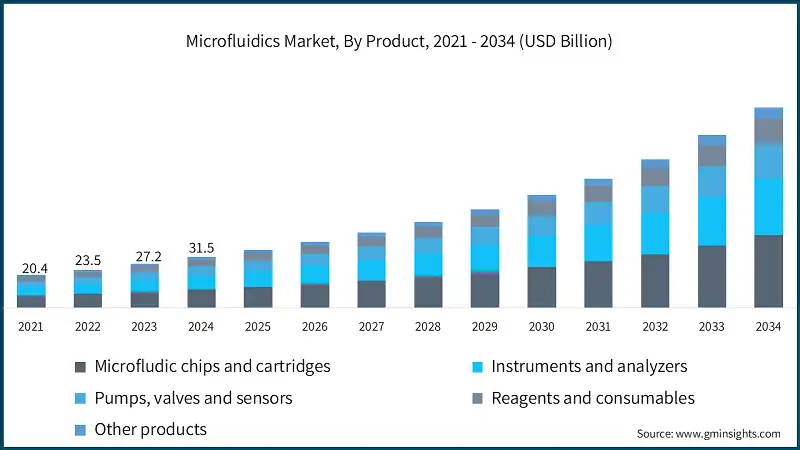
The microfluidics market grew from USD 20.4 billion in 2021 to USD 27.2 billion in 2023. This growth was escalated by the increasing demand for efficient diagnostic tools, integration of microfluidics with wearable biosensors, and the development of microfluidics-based 3D cell culture systems. Moreover, the growing adoption of digital microfluidics which uses electric fields to manipulate droplets on open surfaces is simplifying device design and enabling faster prototyping. This advancement is particularly beneficial for point-of-care diagnostics in low-resource settings.
The high demand for microfluidic chips, micropumps, and sensors is stimulating innovation in component design and fabrication. Materials such as polymethyl methacrylate and PDMS are gaining traction due to their optical clarity, chemical resistance, and compatibility with microfabrication techniques. Companies such as bioMerieux, Illumina, and Thermo Fisher Scientific are actively expanding their microfluidics portfolios through acquisitions and product launches.
However, challenges such as technical complexity, high development costs, and limited awareness in emerging regions persist. These barriers are being addressed through modular platform designs, simplified fabrication processes, and educational initiatives. Hospitals and diagnostic centers remain the largest end users, driven by the need for rapid and accurate testing. Academic and research institutions are also key contributors to innovation and adoption.
To get key market trends
Microfluidics Market Trends
- The market is shifting toward miniaturized, automated systems that enable rapid, low-volume biochemical analysis, driven by demand for faster diagnostics, reduced reagent use, and integration into portable platforms for clinical and research applications.
- AI-powered microfluidic platforms are gaining traction, enabling real-time data processing, intelligent fluid control, and adaptive diagnostics. These systems are improving throughput and precision in genomics, proteomics, and personalized medicine.
- Droplet and digital microfluidics are transforming single-cell analysis and multiplexed assays, allowing researchers to isolate, manipulate, and study individual cells with high accuracy, which is critical for cancer research, immunology, and drug screening.
- Material innovation is reshaping device design, with a shift from traditional silicon and glass to polymers and paper-based substrates. These materials offer better biocompatibility, lower cost, and easier fabrication, especially for disposable and point-of-care devices.
- Organ-on-chip technologies are expanding rapidly, providing physiologically relevant models for drug testing and disease modelling. These platforms are being adopted in oncology, neurology, and toxicology to reduce reliance on animal testing and improve predictive accuracy.
- 3D printing is revolutionizing microfluidic prototyping, enabling rapid design iterations, custom geometries, and on-demand manufacturing. This is accelerating innovation and reducing development costs for startups and academic labs.
- Wearable microfluidic devices are emerging for real-time health monitoring, particularly in sweat analysis and non-invasive biomarker detection. These devices are being integrated into fitness, chronic disease management, and remote patient monitoring solutions.
- Microfluidics is expanding into non-medical domains, including food safety, environmental monitoring, and electronics cooling. This diversification is broadening the market’s industrial relevance and attracting cross-sector investment.
- Paper-based microfluidics is gaining popularity in resource-limited settings, offering low-cost, easy-to-use diagnostic tools for infectious diseases, water quality testing, and agricultural applications.
- Hybrid and smart materials are being developed to overcome PDMS limitations, improving chemical resistance, mechanical stability, and integration with electronics, which is essential for next-generation microfluidic systems.
Microfluidics Market Analysis
Learn more about the key segments shaping this market
Based on product, the market is categorized into microfluidic chips and cartridges, instruments and analysers, pumps, valves and sensors, reagents and consumables and other products. The microfluidic chips and cartridges segment accounted for 36.5% of the market in 2024 which is stimulated due to important role of enabling lab-on-a-chip applications, point-of-care diagnostics, and screening. The segment is expected to exceed USD 44.9 billion by 2034, growing at a CAGR of 14.7% during the forecast period.
- The growth of the segment is further stimulated by the increasing demand of the rapid, portable, and cost-effective diagnostic solutions. The increasing utilisation of microfluidic chips in decentralized healthcare settings, particularly in low-resource environments where traditional diagnostic infrastructure is limited.
- Moreover, the integration of microfluidic cartridges with biosensors and smartphone-based readers has enabled real-time disease detection and monitoring, especially for conditions that include tuberculosis, and cancer.
- Moreover, the chips are being tailored for multiplexed assays, allowing simultaneous detection of multiple biomarkers, which enhances diagnostic efficiency and clinical decision-making.
- Moreover, technological advancements in chip fabrication, such as 3D printing, soft lithography, and injection molding, have further improved the scalability and affordability of microfluidic chips.
- On the other hand, instruments and analysers are another vital segment, projected to grow at a CAGR of 15.2%. These systems are essential for interpreting results from microfluidic assays and are widely used in applications such as cell sorting, DNA sequencing, and drug screening.
- Likewise, reagents and consumables are escalated by the recurring need for assay-specific reagents, buffers, dyes, and detection agents. These products are essential for the functionality of microfluidic systems and represent a significant portion of operational costs in diagnostic and research labs.
Based on application, the microfluidics market is segmented into pharmaceuticals, medical devices, in-vitro diagnostics and other applications. The in-vitro diagnostics segment dominated the market in 2024 with a market share of 42.1% due to the growing demand for rapid, accurate, and cost-effective diagnostic solutions across infectious diseases, oncology, and chronic conditions.
- The in-vitro diagnostics segment is the dominant category as it has an ability to deliver high, multiplexed testing with enhanced sensitivity and specificity. The microfluidic-based diagnostics are being adopted in clinical laboratories for applications such as liquid biopsy, infectious disease screening, and genetic testing.
- Moreover, the rise of personalized medicine and companion diagnostics has further stimulated the adoption of microfluidic IVD platforms, particularly in oncology and reproductive health.
- Additionally, the pandemic significantly boosted the demand for microfluidic-based rapid antigen and PCR testing, setting a precedent for future infectious disease management.
- The segment is also supported by advancements in biosensor integration, miniaturization, and digital connectivity. The use of smartphone-compatible microfluidic devices and AI-powered diagnostic algorithms is enhancing accessibility and clinical decision-making.
- Further, the pharmaceutical segment is stimulated by the increasing use of microfluidics in drug discovery, preclinical testing, and formulation development. Microfluidic systems enable precise control over reaction conditions, allowing for high-throughput screening of drug candidates and real-time monitoring of cellular responses.
Based on technology, the microfluidics market is segmented into lab-on-a-chip, organs-on-chips, continuous flow microfluidics and other technologies. The lab-on-a-chip segment dominated the market in 2024 with USD 12.2 billion market size, stimulated by the ability to miniaturize and integrate complex laboratory functions onto a single chip.
- The segment is growing further by the increasing shift toward decentralized diagnostics and the need for real-time, on-site testing. The lab-on-a-chip devices are used actively for various chronic respiratory, kidney, and metabolic diseases, that addresses the growing global burden of non-communicable diseases. The integration of lab-on-chips with mobile along with digital technologies is also enhancing remote diagnostics in emerging regions.
- Additionally, advances in 3D printing and soft lithography have made the lab-on-a-chip devices accessible and customizable. The Nature mentions, the 3D-printed lab-on-a-chip systems can be fabricated by using low-cost materials along with operating with the smartphones, that eliminates the need for bulky lab equipment.
- Moreover, the organs-on-chips segment is gaining traction due to its ability to replicate human organ-level physiology for drug testing. These systems offer dynamic microenvironments that mimic tissue-tissue interfaces, mechanical cues, and fluid flow.
- In addition, the continuous flow microfluidics segment is expanding steadily, driven by its utility in applications requiring precise, uninterrupted fluid handling such as nanoparticle synthesis, chemical gradient generation, and cell encapsulation.
Based on material, the microfluidics market is segmented into silicon, glass, polymer and other materials. The polymer segment is anticipated to reach USD 51.2 billion by 2034, growing with a significant growing CAGR of 14.9% during the analysis period, the segment dominates due to its cost-effectiveness, ease of fabrication, and compatibility with mass production techniques.
- The polymer is supported by the biocompatibility and optical transparency of polymers, which make them suitable for cell-based assays, fluorescence detection, and biosensing.
- Also, they offer flexibility that allows for the integration of valves, pumps, and sensors, enabling the development of fully functional lab-on-a-chip systems. Additionally, the ability to rapidly prototype polymer-based devices accelerates innovation and reduces time-to-market for diagnostic and analytical tools.
- Additionally, the silicon segment requiring high thermal conductivity and mechanical stability is commonly used in microelectromechanical systems (MEMS) and high-precision analytical platforms.
- The glass segment is valued for its chemical resistance, optical clarity, and inertness, making it suitable for applications involving aggressive solvents or high-resolution imaging.
Learn more about the key segments shaping this market
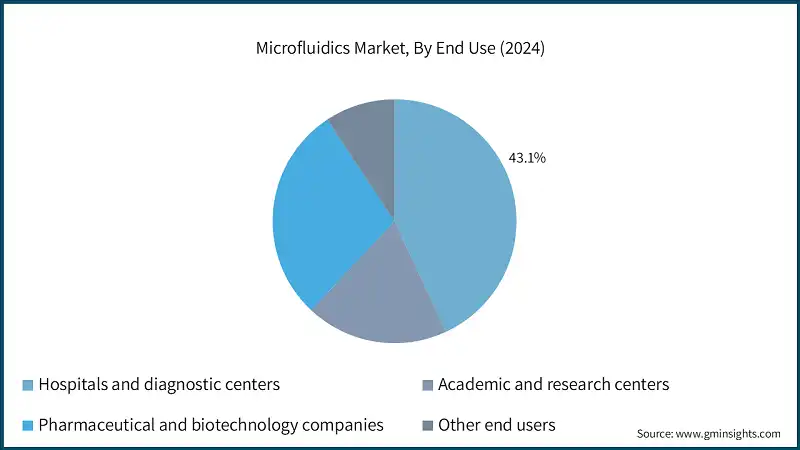
Based on end use, the microfluidics market is segmented into hospitals and diagnostic centers, academic and research centers, pharmaceutical and biotechnology companies and other end users. The hospitals and diagnostic centers segment dominated the market in 2024 with a market share of 43.1%, the segment domination is driven due to the increasing adoption of microfluidic-based point-of-care testing and rapid diagnostics.
- These facilities rely on microfluidic platforms for their ability to deliver quick, accurate results with minimal sample volumes, which is crucial for time-sensitive clinical decision-making. The integration of microfluidics into routine diagnostic workflows has improved patient throughput, reduced operational costs, and enhanced the overall efficiency of diagnostic services.
- The adoption of microfluidic platforms in hospitals is also driven by their ability to streamline laboratory workflows and reduce operational costs. By minimizing reagent usage and automating sample handling, microfluidic devices help laboratories process a higher volume of tests with improved efficiency. Diagnostic centers benefit from the compact design and portability of these systems, which allow for decentralized testing and faster turnaround times, especially in outpatient and rural healthcare settings.
- On the other hand, academic and research centers represent a key segment where microfluidics is extensively used for experimental studies, technology development, and proof-of-concept validation.
- Whereas, pharmaceutical and biotechnology companies utilize microfluidic technologies to streamline drug discovery, formulation, and preclinical testing for high screening, precise control of reaction conditions, and miniaturized assays.
Looking for region specific data?
North America Microfluidics Market
The North America market dominated the global market with a market share of 43.5% in 2024. The market is stimulated due to advanced healthcare infrastructure and strong research and development investments across the U.S. and Canada.
- The region experiences growing demand for diagnostic tools in various end users including hospitals and academic research centers which stimulates the market. The use of microfluidic chips is growing rapidly, reflecting increased adoption in life sciences.
- The region also benefits from many active participation of leading companies such as Illumina, Roche, PerkinElmer, and Danaher, which offer continuity to launch innovative lab-on-chip and organ-on-chips platforms for diagnostics and drug development.
- Moreover, government initiatives in countries are supporting molecular testing, personalized medicine, and AI-integrated diagnostics, further escalating market growth and accessibility.
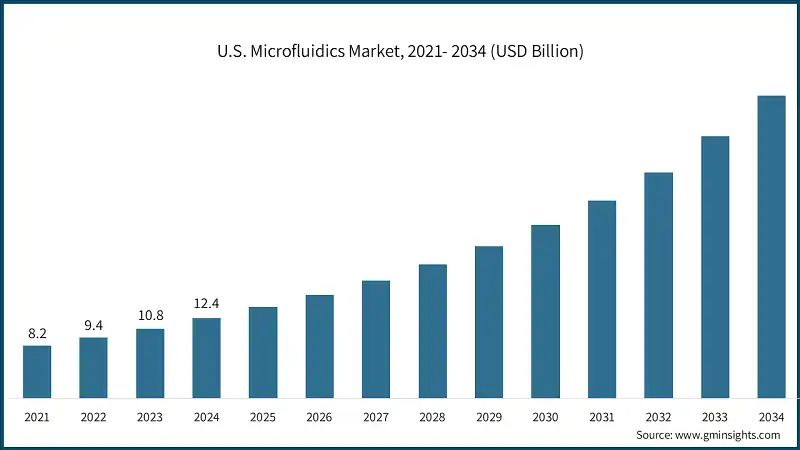
The U.S. microfluidics market was valued at USD 8.2 billion and USD 9.4 billion in 2021 and 2022, respectively. The market size reached USD 12.4 billion in 2024, growing from USD 10.8 billion in 2023.
- The U.S. market experiencing growth due to rising demand for point-of-care diagnostics and personalized medicine.
- The prevalence of chronic conditions such as diabetes and cardiovascular disease is accelerating the need for rapid, low-volume diagnostic platforms. According to CDC, over 38.4 million people in U.S. are living with diabetes, further advancing demand for microfluidic-based testing.
- Rising healthcare spending and the push for decentralized diagnostics are expanding the use of microfluidics in oncology, infectious disease screening, and therapeutic monitoring.
Europe Microfluidics Market
Europe market accounted for USD 8.3 billion in 2024 and is anticipated to show lucrative growth over the forecast period.
- European countries such as France, Italy, and Spain are expanding access to microfluidic-based diagnostics, particularly in infectious disease detection and chronic disease monitoring, supporting the shift toward personalized medicine.
- The region is experiencing increased adoption of microfluidics in pharmaceutical research and development, with companies leveraging high-throughput screening and drug delivery platforms to accelerate clinical workflows and reduce costs.
Germany microfluidics market is anticipated to witness considerable growth over the analysis period.
- Germany’s aging population and rising chronic disease burden are increasing demand for rapid, low-volume testing platforms, for efficient clinical diagnostics. According to AARP International, by 2050 24 million and more people will be aged above 65 ages.
- Local manufacturers and research institutions are investing in microfluidic flow cells and organ-on-chip systems for genomics and proteomics, enhancing precision and throughput in biomedical research.
- Strategic partnerships between German firms and international diagnostic companies are expanding the microfluidics product pipeline, with innovations in respiratory pathogen panels and multiplexed assays gaining traction.
Asia Pacific Microfluidics Market
The Asia Pacific market is anticipated to grow at the highest CAGR of 15.3% during the analysis timeframe.
- The region includes key markets such as China, India, Japan, South Korea, and Australia, where rising chronic disease cases and growing investments in healthcare infrastructure are stimulating demand for microfluidic-based solutions in diagnostics and drug delivery.
- Moreover, increasing adoption of microfluidics in academic research and clinical labs is supported by high disposable income levels and government-backed initiatives to modernize healthcare systems, especially in urban centers.
China microfluidics market is predicted to grow significantly over the forecast period.
- The lifestyle challenges and high urbanization in the country is increasing the demand for advanced diagnostics and therapeutic monitoring, which stimulates the microfluidics demand as they play an important role in enabling rapid, low-volume testing.
- Additionally, China is expanding clinical trial landscape in microfluidic-based diagnostics, especially in oncology, infectious diseases, and metabolic disorders, which requires precision and accessibility.
- Moreover, integration of advanced technologies such as AI-powered imaging, and laser-assisted diagnostics is transforming care delivery, offering personalized, minimally invasive solutions across hospitals and specialty clinics.
Latin America Microfluidics Market
Brazil is experiencing significant growth in the Latin America market due to the use of advanced diagnostic technologies along with the mainstream healthcare and research.
- The country has a growing emphasis on healthcare needs, particularly for aging populations and people with chronic diseases, are stimulating the demand for microfluidic diagnostic solutions. Hospitals and clinics are increasingly adopting miniaturized platforms to manage high patient volumes and improve diagnostic turnaround times.
- According to NIH, data from a large cancer registry in Sao Paulo, Brazil, only 8.8% of 20,850 lung cancer patients were registered in the system, highlighting gaps in early detection and diagnosis areas where microfluidics can offer scalable, rapid testing solutions.
Middle East and Africa Microfluidics Market
Saudi Arabia market is poised to witness substantial growth in Middle East and Africa market during the forecast period.
- The increasing complexity of diseases and the push for early, accurate diagnosis are stimulating demand for microfluidic platforms that support personalized treatment approaches and real-time monitoring.
- Vision 2030 incentives, combined with the expansion of digital health infrastructure and local manufacturing capabilities, are boosting adoption across public and private healthcare systems. These efforts are modernizing healthcare delivery and enhancing access to advanced diagnostic technologies nationwide.
Microfluidics Market Share
Leading companies such as Danaher, Illumina, Thermo Fisher Scientific, PerkinElmer, and Agilent Technologies collectively hold a dominant share of approximately 35% in the global market. These companies maintain leadership through diversified product portfolios, strategic investments in diagnostics and life sciences, regulatory expertise, and continued innovation in lab-on-chip platforms, digital microfluidics, and integrated analytical systems.
Danaher offers automated microfluidic diagnostic platforms that dominate the point-of-care molecular testing segment across global markets. Illumina strengthens its position through innovations in digital microfluidics for sequencing and sample preparation, driving adoption in personalized medicine and genomics. Thermo Fisher Scientific embeds microfluidic technologies into PCR and analytical systems, supporting high-throughput diagnostics and expanding its reach in clinical and research labs.
PerkinElmer competes with microfluidic electrophoresis and drug discovery platforms, focusing on toxicology, environmental testing, and life sciences applications. Agilent Technologies contributes with AI-integrated microfluidic chips and analytical systems, enhancing precision diagnostics and expanding its footprint in academic and pharmaceutical sectors.
Emerging and niche players such as Dolomite Microfluidics, Sphere Fluidics, uFluidix, Fluigent, Micronit, Biosurfit, and Boston Pharmaceutical (Nanomix) are gaining traction through specialized platforms, droplet microfluidics, and portable diagnostic solutions. These companies support market growth by offering modular systems, enabling decentralized testing, and innovating in organ-on-chip, single-cell analysis, and low-cost fabrication. Their contributions are vital in expanding access, improving scalability, and driving the evolution of microfluidics into a more personalized, automated, and accessible domain.
Microfluidics Market Companies
Few prominent players operating in the microfluidics industry includes:
- Agilent Technologies
- Bartels Mikrotechnik
- Becton Dickinson
- bioMerieux
- Bio-Rad Laboratories
- Boston Pharmaceutical (Nanomix)
- Danaher
- Dolomite Microfluidics
- Emulate
- F. Hoffmann-La Roche
- Fluigent
- Illumina
- PerkinElmer
- Qiagen
- Sphere Fluidics
- Standard BioTools
- Thermo Fisher Scientific
- uFluidix
- Xona Microfluidics
- Danaher
Danaher leads the microfluidics market with a share of approximately 11%, driven by its automated diagnostic platforms that dominate point-of-care molecular testing globally. The company’s strength lies in its integration of microfluidic chips with thermal and optical systems, supported by strategic expansion and regulatory expertise.
Illumina holds a strong position through its innovations in digital microfluidics for sequencing and sample preparation. Its focus on personalized medicine, miniaturized workflows, and genomic precision reinforces its leadership in the life sciences segment of microfluidics.
Thermo Fisher Scientific maintains its edge by embedding microfluidic technologies into PCR and analytical systems. With a broad reach across clinical and research labs, the company supports high-throughput diagnostics and continues to invest in scalable, AI-integrated platforms.
Microfluidics Market Report Attributes
| Key Takeaway | Details |
|---|---|
| Market Size & Growth | |
| Base Year | 2024 |
| Market Size in 2024 | USD 31.5 Billion |
| Market Size in 2025 | USD 35.9 Billion |
| Forecast Period 2025 - 2034 CAGR | 14.8% |
| Market Size in 2034 | USD 124.2 Billion |
| Key Market Trends | |
| Drivers | Impact |
| Rising demand for point-of-care diagnostics | Increasing need for rapid, portable, and accurate testing solutions is driving adoption of microfluidic-based devices in clinical settings. |
| Expansion of personalized medicine and genomics | Microfluidics enables precise sample handling and analysis, supporting tailored therapies and genomic testing workflows. |
| Integration with AI and digital health platforms | AI-powered microfluidic systems are enhancing diagnostic accuracy, automating workflows, and enabling real-time data analysis. |
| Advancements in microfabrication and materials | Innovations in PDMS, glass, and polymer-based microfluidic chips are improving device performance, scalability, and biocompatibility. |
| Pitfalls & Challenges | Impact |
| High development and manufacturing costs | Complex fabrication processes and material limitations can hinder scalability and affordability of microfluidic solutions. |
| Regulatory and standardization hurdles | Lack of harmonized standards and lengthy approval timelines may delay commercialization and global adoption. |
| Opportunities: | Impact |
| Growth in organ-on-chip and 3D cell culture platforms | These technologies offer realistic biological models for drug testing and disease research, expanding microfluidics applications. |
| Adoption in low-resource and decentralized settings | Portable, low-cost microfluidic devices are ideal for remote diagnostics, enabling healthcare access in underserved regions. |
| Market Leaders (2024) | |
| Market Leaders |
~11% |
| Top Players |
Collective market share in 2024 is ~35% |
| Competitive Edge |
|
| Regional Insights | |
| Largest Market | North America |
| Fastest Growing Market | Asia Pacific |
| Emerging Country | India, Brazil, Mexico, South Africa |
| Future Outlook |
|
What are the growth opportunities in this market?
Microfluidics Industry News
- In December 2024, Dapu Biotechnology and Leveragen announced a strategic partnership to integrate droplet microfluidics with genetic models for antibody discovery. It advanced DPBIO’s Cytospark platform.
- In November 2024, Parallel Fluidics secured a seed round to expand its on-demand microfluidic manufacturing platform and launch its MV-2 product. It accelerated the company’s commercialization efforts.
- In July 2024, Bio-Rad Laboratories launched Celselect Slides 2.0, a microfluidics-based tool for capturing rare and circulating tumor cells in cancer research. It enhanced Bio-Rad’s portfolio in oncology diagnostics.
- In May 2024, Takara Bio USA introduced the Lenti-X Transduction Sponge, a dissolvable microfluidic enhancer for lentivirus-mediated gene delivery. It expanded its microfluidics applications.
The microfluidics market research report includes in-depth coverage of the industry with estimates and forecast in terms of revenue in USD Million from 2021 - 2034 for the following segments:
Market, By Product
- Microfluidic chips and cartridges
- Instruments and analysers
- Pumps, valves and sensors
- Reagents and consumables
- Other products
Market, By Application
- Pharmaceuticals
- Medical devices
- In-vitro diagnostics
- Other applications
Market, By Technology
- Lab-on-a-chip
- Organs-on-chips
- Continuous flow microfluidics
- Other technologies
Market, By Material
- Silicon
- Glass
- Polymer
- Other materials
Market, By End Use
- Hospitals and diagnostic centers
- Academic and research centers
- Pharmaceutical and biotechnology companies
- Other end use
The above information is provided for the following regions and countries:
- North America
- U.S.
- Canada
- Europe
- Germany
- UK
- France
- Italy
- Spain
- Netherlands
- Asia Pacific
- China
- Japan
- India
- Australia
- South Korea
- Latin America
- Brazil
- Mexico
- Argentina
- Middle East and Africa
- South Africa
- Saudi Arabia
- UAE
Frequently Asked Question(FAQ) :
What was the market size of the global microfluidics in 2024?
The market size was USD 31.5 billion in 2024, with a CAGR of 14.8% projected through 2034, driven by advancements in miniaturized systems, AI-powered platforms, and material innovations.
What is the projected value of the global microfluidics market by 2034?
The market is expected to reach USD 124.2 billion by 2034, fueled by increasing demand for point-of-care diagnostics, personalized medicine, and cost-effective diagnostic solutions.
What is the projected size of the microfluidics market in 2025?
The market is expected to reach USD 35.9 billion in 2025.
How much revenue did the microfluidic chips and cartridges segment generate in 2024?
The microfluidic chips and cartridges segment accounting for 36.5% of the market share, driven by their role in lab-on-a-chip applications and point-of-care diagnostics.
What was the valuation of the in-vitro diagnostics segment in 2024?
The in-vitro diagnostics segment held a 42.1% market share in 2024, driven by the demand for rapid, accurate, and cost-effective diagnostic solutions for infectious diseases, oncology, and chronic conditions.
Which region led the global microfluidics market in 2024?
North America dominated the market with a 43.5% share in 2024, supported by advanced healthcare infrastructure and significant R&D investments in the U.S. and Canada.
What are the upcoming trends in the microfluidics industry?
Key trends include the adoption of AI-powered microfluidic platforms, advancements in droplet and digital microfluidics for single-cell analysis, and the shift toward polymer-based materials for cost-effective and disposable devices.
Who are the key players in the microfluidics market?
Prominent players include Agilent Technologies, Bartels Mikrotechnik, Becton Dickinson, bioMerieux, Bio-Rad Laboratories, Boston Pharmaceutical (Nanomix), Danaher, Dolomite Microfluidics, Emulate, F. Hoffmann-La Roche, Fluigent, and Illumina.
Microfluidics Market Scope
Related Reports