Summary
Table of Content

Marine Sealants Market
Get a free sample of this report
Form submitted successfully!
Error submitting form. Please try again.
Thank you!
Your inquiry has been received. Our team will reach out to you with the required details via email. To ensure that you don't miss their response, kindly remember to check your spam folder as well!
Request Sectional Data
Thank you!
Your inquiry has been received. Our team will reach out to you with the required details via email. To ensure that you don't miss their response, kindly remember to check your spam folder as well!
Form submitted successfully!
Error submitting form. Please try again.
Marine Sealants Market Size
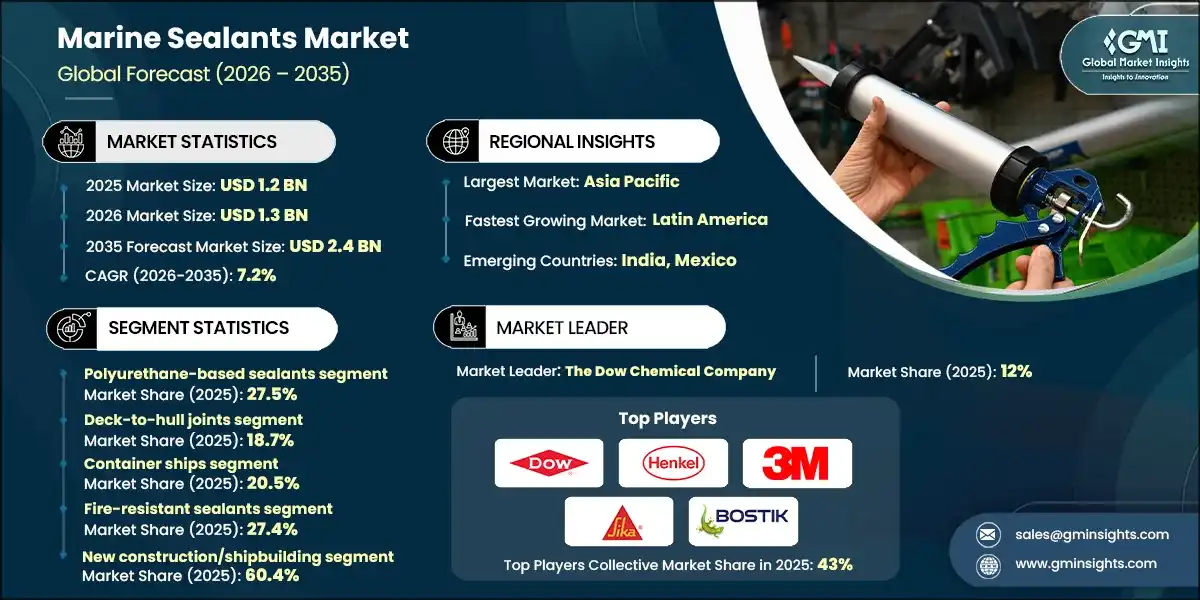
The global marine sealants market was valued at USD 1.2 billion in 2025. The market is expected to grow from USD 1.3 billion in 2026 to USD 2.4 billion in 2035, at a CAGR of 7.2% according to latest report published by Global Market Insights Inc.
Marine Sealants Market Key Takeaways
Market Size & Growth
- 2025 Market Size: USD 1.2 Billion
- 2026 Market Size: USD 1.3 Billion
- 2035 Forecast Market Size: USD 2.4 Billion
- CAGR (2026–2035): 7.2%
Regional Dominance
- Largest Market: Asia Pacific
- Fastest Growing Region: Latin America
Key Market Drivers
- Rapid offshore wind energy expansion.
- Stringent IMO fire safety regulations.
- Global fleet expansion & modernization.
Challenges
- High cost of advanced smart sealants.
- Skilled application requirements.
Opportunity
- Self-healing & smart sealant technologies.
- Offshore wind foundation sealing specialization.
Key Players
- Market Leader: The Dow Chemical Company led with over 12% market share in 2025.
- Leading Players: Top 5 players in this market include The Dow Chemical Company, Henkel AG & Co. KGaA, 3M Company, Sika AG, Bostik (Arkema Group), which collectively held a market share of 43.4% in 2025..
Get Market Insights & Growth Opportunities
- Marine sealants transitioned over years from being a specific product category into an essential enabler of modern-day maritime operations. Their role has expanded beyond simple sealing functionality into support structures support for advanced vessel integrity, corrosion resistance, and life cycle performance. Sustainability is coming to redefine industrial priorities. Marine sealants are set in this new paradigm as one of the key components toward diminishing the environmental footprint in shipbuilding, maintaining, and retrofitting activities. This change indicates the shift of an entire industry toward materials that combine durability with eco-friendly formulations.
- The market is buoyed increasingly by technological advancements and frameworks of sustainability. Hybrid polymer formulations, low volatile organic content systems, and similar formulations attract attention as they become the norm for shipbuilding and operation in compliance with strict environmental regulation. Not only do they provide better performance in extreme marine conditions, but they also boast compliance with world decarbonization goals.
- The regional strengths and the priorities of any of the marine regions define the growth patterns of the marine sealants market. Asia Pacific is a significant driving force in shipbuilding activities, coupled with the ever-growing commercial fleets that consequently create a highly demanding end-use market for high-performance sealing solutions. The stringent regulations and sustainability requirements in Europe favor the adoption of environment-friendly products, while North America boosts market momentum through its recreational boating segment and technological innovations.
To get key market trends
Marine Sealants Market Trends
- Marine sealants are redefining the performance metrics along with sustainability. Historically, they were functional adhesives for maintaining the hull and being leak-free but are smartly marketed now as solutions of the future featuring durability, flexibility, and compliance with the environment. The developments being made drive the move away from conventional, high-emission, petrochemical-based products to low-emission alternative materials-a change that is compliant with global regulatory frameworks and supports de-carbonization goals.
- Technological advancement is instrumental in shaping the market that innovates hybrid polymer systems, moisture curing chemistries and solvent-free formulations. The foregoing not only improves adhesion under extreme marine conditions but also reduces lifecycle environmental impacts. Integrated production models enable manufacturers to optimize raw material utilization and minimize waste; therefore, making marine sealants commercially attractive and strategically aligned with circular economy principles.
- The incorporation of smart functionalities into sealant systems is yet another paradigm shift. Self-healing technologies and sensor enabled sealants are gathering momentum owing to the predictive maintenance capabilities they offer at extending service life. In conjunction with the digital performance management platforms of vessels, these create new value propositions for operators that seek efficiency and reliability in extremely harsh offshore environments.
- The use of marine sealants not merely as commodities, but as strategic enablers of performance, safety and environmental stewardship in a maritime operation of the next generation, has enlarged their scope to include structural integrity, fire and emission standard compliance, plus compatibility with renewable infrastructure such as foundations for offshore wind.
Marine Sealants Market Analysis
Learn more about the key segments shaping this market
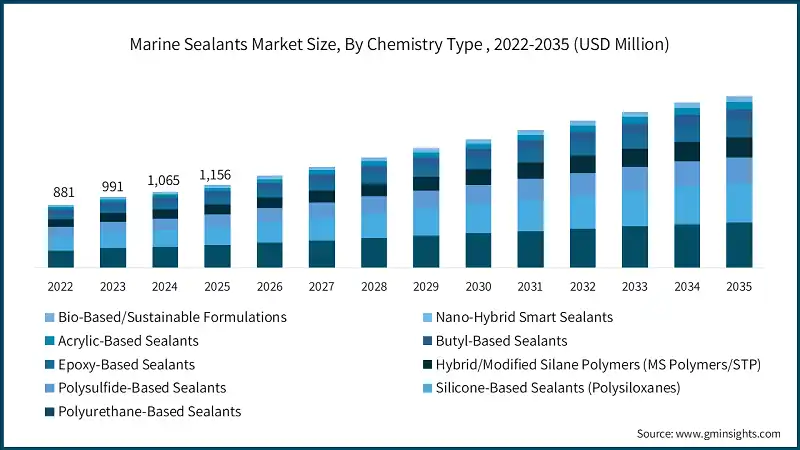
Based on chemistry type, the market is segmented into polyurethane-based sealants, silicone-based sealants (polysiloxanes), polysulfide-based sealants, hybrid/modified silane polymers (MS Polymers/STP), epoxy-based sealants, butyl-based sealants, acrylic-based sealants, nano-hybrid smart sealants, bio-based/sustainable formulations. Polyurethane-based sealants dominated the market with an approximate market share of 27.5% in 2025 and is expected to grow with a CAGR of 6.8% by 2035.
- Polyurethane sealants are used in marine applications because they have superior dynamic load adhesion and flexibility thus, one could not do without them for the hull joints and deck structure. Silicone sealants (polysiloxanes) provide excellent UV and saltwater resistance and, therefore, are preferred for exterior sealing in extremely marine environments. Polysulfide sealants are still very much required for their fuel and chemical resistance in operating conditions considered harsh.
- Hybrid and modified silane polymers (MS Polymers/STPs) combine elasticity with superior bonding: a compromise mixture between the strength of polyurethane and durability of silicone. Epoxy offers structural strength for heavy-duty bonding. On the other hand, butyl-and acrylic-based sealants are valid only in niche situations, where they are demanded to work economically in a more moderate way. The next-generation products will be nano-hybrid smart sealants, integrating self-healing and sensor-enabled capabilities for predictive maintenance in the trending areas of digital vessel management.
Learn more about the key segments shaping this market
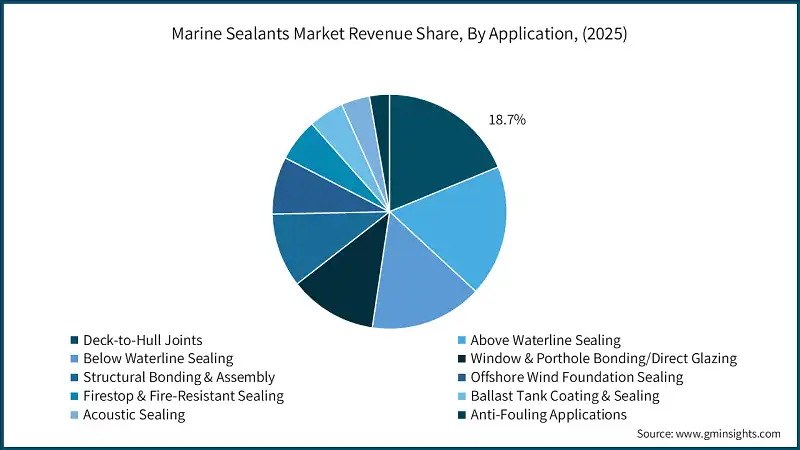
Based on application, the marine sealants market is segmented into deck-to-hull joints, above waterline sealing, below waterline sealing, window & porthole bonding/direct glazing, structural bonding & assembly, offshore wind foundation sealing, firestop & fire-resistant sealing, ballast tank coating & sealing, acoustic sealing, anti-fouling applications. Deck-to-hull joints held the largest market share of 18.7% in 2025 and is expected to grow at a CAGR of 6.9% during 2026-2035.
- Deck-to-hull joints remain the structural integrities are of the highest requirements, and high flexibility sealants can suffer dynamic stress under the ever-changing marine environment. Sealing above the waterline requires emphasis on UV stability and weather resistance, whereas the sealing below the waterline needs gone product development with superior adhesion and water impermeability to maintain long-term resistance to submerged conditions.
- Specialty use applications set apart the differentiation. Window and porthole bonding/direct glazing require precision bonding and clarity retention, whereas structural bonding and assembly deploys high-strength sealants on load-bearing components. With the emergence of renewable energy infrastructure, sealing offshore wind foundations creates the need for sealants that can gainfully withstand very high levels of hydrostatic pressure and resist corrosion.
Based on vessel/structure type, the marine sealants market is segmented into container ships, bulk carriers, oil & chemical tankers, offshore wind turbines & structures, passenger vessels, liquefied gas carriers, naval & defense vessels, offshore oil & gas structures, general cargo & multi-purpose ships, small craft & recreational vessels, fishing vessels. Container ships segment dominated the market with an approximate market share of 20.5% in 2025 and is expected to grow with the CAGR of 6.6% by 2035.
- The container and bulk carriers have very high demands for strong structural joint sealing, and these sealants are also used in the cargo hold where integrity should be maintained under enormous and dynamic loads. Chemically resisted formulations would be the order of the day for oil and chemical tankers as these have high safety and compliance concerns as they operate in very aggressive environments; liquefied gas carriers would have high needs for very advanced sealing systems to go with extreme temperature variations and pressure conditions.
- The specialized segments drive the innovations. Fastest growing sector of offshore wind turbine and structures, wherein sealants should be very durable against hydrostatic pressure, exposure to saltwater, and cyclical loading
Based on performance characteristics, the marine sealants market is segmented into fire-resistant sealants, anti-corrosion sealants, UV-resistant sealants, anti-fouling sealants, high-movement capability sealants, self-healing sealants. Fire-resistant sealants segment dominated the segment with an approximate market share of 27.4% in 2025 and is expected to grow with the CAGR of 6.6% by 2035.
- Fireproof sealants are on the rise owing to the stringent safety rules of the IMO regarding vessels (passenger, naval and offshore structures where fire protection is critical). Anti-corrosion sealants are still effective for ballast tanks, hull joints as well as structures offshore, guarding such very aggressive saline environments and chemicals for a long period of time. UV-resistant sealants are highly used in above-waterline applications-their structural integrity and aesthetics under prolonged sunlight and harsh weather conditions are safeguarded.
- Anti-fouling sealants are an increasingly growing niche with bio-compatible technologies that work to stop the growth of marine organisms and improve vessel efficiency in compliance with sustainability requirements. High-movement capability sealants are of utmost importance as they provide elasticity and fatigue resistance under continuous mechanical stress for dynamic joints such as deck-to-hull connections.
Based on end use, the marine sealants market is segmented into new construction/shipbuilding, repair & maintenance, retrofit & modernization, and offshore installation & construction. New construction/shipbuilding dominated the category with an approximate market share of 60.4% in 2025 and is expected to grow with the CAGR of 6.9% by 2035.
- New construction and shipbuilding are the primary bases that serve demand, wherein sealants ensure structural integrity, watertight joints, and adherence to evolving safety and environmental standards. Repair and maintenance applications increasingly focus on versatility and quick curing techniques that allow for efficiency in keeping aging fleets maintained, while minimizing the time that those fleets are unavailable for commercial operations.
- Retrofit and modernization are emerging as a strategic area for growth-not surprisingly, fueled by sustainability mandates and regulatory upgrades. The sealants in this area need to be compatible with advanced coatings and hybrid materials so that they can help meet goals for energy efficiency and emission reductions. Offshore installation and construction represent a high-value niche in which sealants are engineered to withstand extreme durability against hydrostatic pressure, saltwater exposure, and dynamic loading conditions.
- The offshore wind foundation and oil and gas platforms as well as the subsea structures fall under such applications, casting marine sealants as enablers of reliability and resilience in the next generation of maritime infrastructure.
Looking for region specific data?
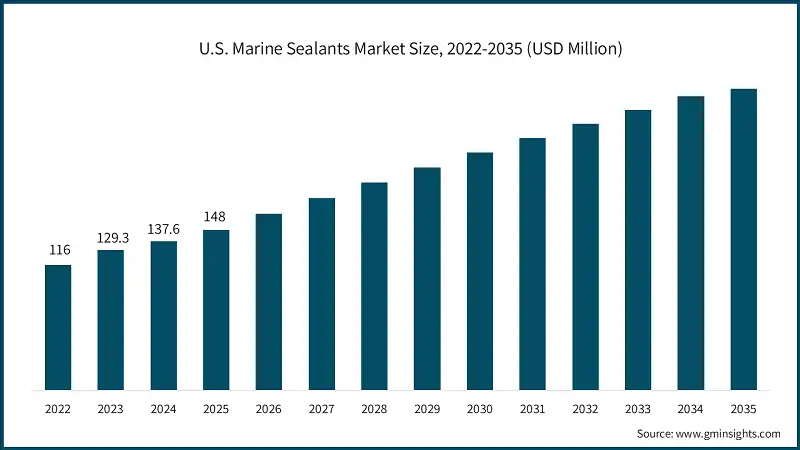
The North America marine sealants market is growing rapidly on the global level with a market share of 15.4% in 2025.
- Current shipbuilding activities in the region, booming recreational boating industries, and increasing investments in offshore infrastructures have emerged North America as a prime strategic growth hub for marine sealants. This region is already known for advanced manufacturing capabilities, legislative frameworks addressing safety, and sustainability, giving rise to opportunities for developing high-performance sealant technologies.
U.S. dominates the North America market, showcasing strong growth potential.
- The U.S. policies that encourage fleet modernization and procurement of cleaner materials have created an impetus in U.S. leadership, positioning the United States as a market influencer.
Europe marine sealants market leads the industry with revenue of USD 302.2 million in 2025 and is anticipated to show lucrative growth over the forecast period.
- The marine sealants global market is marching towards the approaching goals of sustainability and performance by reshaping materials strategies across maritime operations. Regulations on emissions and lifecycle efficiency are fast-tracking the shift to next-generation sealants that are engineered not just to be durable, compliant, and environmentally responsible.
Germany dominates the European marine sealants market, showcasing strong growth potential.
- These products are now perceived not just as simple adhesives, but as strategic enablers of vessel integrity and offshore infrastructure reliability.
The Asia Pacific market is anticipated to grow at a CAGR of 7.8% during the analysis timeframe.
- Asia Pacific is rapidly becoming the most dynamic growth hotspot for marine sealants, accustomed to its strong shipbuilding ecosystem, fast development of offshore wind, and mounting investments in maritime infrastructure.
China marine sealants market is estimated to grow with a significant CAGR in the Asia Pacific region.
- Emphasis on high-performance formulations for structural bonding, underwater sealing, and offshore applications is accelerating acceptance by both commercial and renewable energy sectors.
Latin America marine sealants accounted for 7.7% market share in 2025 and is anticipated to show highest growth over the forecast period.
- Strengthened by its future shipbuilding activity, the port infrastructure modernization, and many investments in offshore energy projects, Latin America could be a good bet for marine sealants growth. This development will help create space for advanced sealing solutions in performance and environmental requirements owing to the favorable regulatory setup and sustainability-driven initiatives at the forefront.
Brazil leads the Latin American marine sealants market, exhibiting remarkable growth during the analysis period.
- Brazil becomes the principal growth engine in the region because it can combine a strong industrial foundation with the strength of its maritime infrastructures to accelerate the adoption of innovative sealant technologies.
Middle East & Africa Marine Sealants accounted for 4.5% market share in 2025 and is anticipated to show lucrative growth over the forecast period.
- The marine sealants industry within Middle East and Africa is bound to grow as the rate of development in maritime infrastructures and offshore energy projects accelerates all over the region. Economic diversifications and many policies propelling sustainability provide very good ground for advanced sealing solutions that meet global performance standards and compliance. This market is becoming rather increasingly affected by modernization schemes for ports and fleets and by heavy investments in offshore wind and oil platforms.
Saudi Arabia marine sealants industry to experience substantial growth in the Middle East and Africa market in 2025.
- Saudi Arabia is shaping up as one of the major growth drivers in this regional horizon, taking advantage of the country's agenda for industrial transformation to incorporate newer advanced materials into marine applications.
Marine Sealants Market Share
The top 5 companies in Marine Sealants industry include The Dow Chemical Company, Henkel AG & Co. KGaA, 3M Company, Sika AG, Bostik (Arkema Group). These are prominent companies operating in their respective regions covering approximately 43% of the market share in 2025. These companies hold strong positions due to their extensive experience in market. Their diverse product portfolios, backed by robust production capabilities and distribution networks, enable them to meet the rising demand across various regions.
- The Dow Chemical Company is a globally present materials science company, headquartered in Midwestern United States, and offers a diverse portfolio of specialty chemicals, advanced materials, and performance products to meet important needs in many industries such as packaging, infrastructure, and other consumer-oriented businesses.
- Henkel AG & Co. KGaA is a large, multi-business, multinational company with three main areas of business: adhesives technologies, beauty care, and laundry & home care. Most of the industrial and consumer solutions are developed through the use of a variety of adhesive systems and branded products.
- 3M Company is a company that specializes in many fields, from communications to manufacturing. It caters for around 140 diverse markets on a global scale, such as industrial, healthcare, consumer, as well as safety solutions. Some of its product lines include adhesives, abrasives, filtration systems, and personal protection equipment.
- Sika AG manufactures chemical products for construction as well as industrial applications, which include sealing and bonding, waterproofing, and reinforcement. These products range from admixtures for concrete over roofing systems to structural strengthening.
- Bostik (Arkema Group) functions in the capacity of global adhesive solution provider to the Arkema Group meant for the industrial, construction, and consumer markets. Its product offerings include sealants, bonding systems, and specialty adhesives designed to serve flexible and rigid applications.
Marine Sealants Market Companies
Major players operating in the marine sealants industry include:
- Sika AG
- 3M Company
- Henkel AG & Co. KGaA
- The Dow Chemical Company
- PPG Industries, Inc.
- The Sherwin-Williams Company
- Trelleborg AB
- Berger Maritiem
- Chugoku Marine Paints, Ltd.
- Jotun A/S
- Hempel A/S
- Feynlab
- Sea-Shield
- ITW Performance Polymers
- Bostik (Arkema Group)
- Wacker Chemie AG
- Momentive Performance Materials
- Evonik Industries AG
Marine Sealants Market Report Attributes
| Key Takeaway | Details |
|---|---|
| Market Size & Growth | |
| Base Year | 2025 |
| Market Size in 2025 | USD 1.2 Billion |
| Market Size in 2026 | USD 1.3 Billion |
| Forecast Period 2026 - 2035 CAGR | 7.2% |
| Market Size in 2035 | USD 2.4 Billion |
| Key Market Trends | |
| Drivers | Impact |
| Rapid offshore wind energy expansion | The demand for high-performing sealants for turbine foundations and subsea structures is growing rapidly, |
| Stringent IMO fire safety regulations | Generate opportunities for compliance-led innovation and premium products |
| Global fleet expansion & modernization | Sustain the long-term volume growth for sealants due to new build retrofits |
| Pitfalls & Challenges | Impact |
| High cost of advanced smart sealants | Value-constrained segments that hammer on value positioning and justification of adoption based on ROI |
| Skilled application requirements | Raising labor costs, emphasizing the need for training programs and easy-to-use application technologies |
| Opportunities: | Impact |
| Self-healing & smart sealant technologies | Enables differentiation by predictive maintenance and long service life, relevant to the domain of digital vessel management |
| Offshore wind foundation sealing specialization | Creates a high-margin niche leveraging renewable energy investments, allowing sealant providers to secure strategic contracts in forthcoming green spheres |
| Market Leaders (2025) | |
| Market Leaders |
12% market share |
| Top Players |
|
| Competitive Edge |
|
| Regional Insights | |
| Largest Market | Asia Pacific |
| Fastest growing market | Latin America |
| Emerging countries | India, Mexico |
| Future outlook |
|
What are the growth opportunities in this market?
Marine Sealants Industry News
- In October 2024, IPS Adhesives (IPSA), a manufacturer of structural and surfacing products, acquired a wide range of adhesives based on acrylate and methyl methacrylate (MMA) technology from L & L Products. According to IPS Adhesives, the acquisition complements its specialist MMA-based products and provides a platform that enhances its ability to deliver innovative solutions that offer lightweighting and the bonding of dissimilar materials.
- In October 2022, Holcim completed the acquisition of the Polymers Sealants North America (PSNA) division of Illinois Tool Works. PSNA is a leader in coating, adhesive and sealant solutions with 2022 estimated net sales of USD 100 million.
These marine sealants market research report includes in-depth coverage of the industry, with estimates & forecasts in terms of revenue (USD Million) and volume (Kilo Tons) from 2025 to 2035, for the following segments:
Market, By Chemistry Type
- Polyurethane-based sealants
- Silicone-based sealants (polysiloxanes)
- Polysulfide-based sealants
- Hybrid/modified silane polymers (MS polymers/STP)
- Epoxy-based sealants
- Butyl-based sealants
- Acrylic-based sealants
- Nano-hybrid smart sealants
- Bio-based/sustainable formulations
Market, By Application
- Deck-to-hull joints
- Above waterline sealing
- Below waterline sealing
- Window & porthole bonding/direct glazing
- Structural bonding & assembly
- Offshore wind foundation sealing
- Monopile grout seals
- Pre-piled jacket sealing
- Post-piled jacket sealing
- Skirt seals (non-grouted monopiles)
- Flange seals (VW, VT types)
- Airtight platform seals (CS-111/114, CS-80/70)
- Nacelle & turbine component sealing
- Firestop & fire-resistant sealing
- Ballast tank coating & sealing
- Acoustic sealing
- Anti-fouling applications
- Biocidal anti-fouling
- Biocide-free anti-fouling
Market, By Vessel/Structure Type
- Container ships
- Bulk carriers
- Capesize (≥100,000 dwt)
- Panamax (65,000-99,999 dwt)
- Handymax (40,000-64,999 dwt)
- Handysize (10,000-39,999 dwt)
- Oil & chemical tankers
- ULCC & VLCC (Ultra/Very Large Crude Carriers)
- Suezmax Tankers
- Aframax/LR2 Tankers
- Panamax/LR1 Tankers
- MR & Handy Tankers
- Chemical Tankers (Specialized Sealing Requirements)
- Offshore wind turbines & structures
- Passenger vessels
- Liquefied gas carriers
- Naval & defense vessels
- Offshore oil & gas structures
- General cargo & multi-purpose ships
- Small craft & recreational vessels
- Fishing vessels
Market, By Performance Characteristics
- Fire-resistant sealants
- Anti-corrosion sealants
- Uv-resistant sealants
- Anti-fouling sealants
- High-movement capability sealants
- Self-healing sealants
Market, By End Use
- New construction/shipbuilding
- Repair & maintenance
- Retrofit & modernization
- Offshore installation & construction
The above information is provided for the following regions and countries:
North America
- U.S.
- Canada
Europe
- Germany
- UK
- France
- Spain
- Italy
- Rest of Europe
Asia Pacific
- China
- India
- Japan
- Australia
- South Korea
- Rest of Asia Pacific
Latin America
- Brazil
- Mexico
- Argentina
- Rest of Latin America
Middle East and Africa
- Saudi Arabia
- South Africa
- UAE
- Rest of Middle East and Africa
Frequently Asked Question(FAQ) :
What is the marine sealants market size in 2025?
The marine sealants industry is valued at USD 1.2 billion in 2025. Growth is supported by rapid offshore wind energy expansion, rising shipbuilding activity, and increased emphasis on durability and corrosion resistance in marine structures.
What is the market size of the marine sealants industry in 2026?
The market size for marine sealants reached USD 1.3 billion in 2026, reflecting steady expansion driven by sustainability-focused formulations, hybrid polymer technologies, and compliance with stringent IMO safety norms.
What is the projected value of the marine sealants market by 2035?
The market size for marine sealants is expected to reach USD 2.4 billion by 2035, growing at a CAGR of 7.2%. This growth is fueled by offshore wind infrastructure development, smart/self-healing sealant technologies, and global fleet modernization.
How much revenue did the polyurethane-based sealants segment generate in 2025?
Polyurethane-based sealants accounted for 27.5% of the market in 2025, making them the leading chemistry type. High flexibility and strong dynamic load adhesion in hull joints and deck structures drive their continued dominance.
What was the valuation of the deck-to-hull joints application segment in 2025?
The deck-to-hull joints segment captured 18.7% share in 2025, establishing it as the largest application category. Demand is driven by the need for high-flexibility, high-strength sealants that withstand dynamic marine stresses.
What is the growth outlook for the container ships segment from 2025 to 2035?
The container ships segment held 20.5% share in 2025 and is projected to grow at a CAGR of 6.6% through 2035. Increasing global container traffic and demand for advanced sealing in cargo holds and structural joints support strong growth.
Which region shows strong growth in the global marine sealants market in 2025?
The North America market is growing rapidly, accounting for 15.4% share in 2025. This growth is driven by active shipbuilding activity, expansion of recreational boating, and rising investments in offshore infrastructure across the region.
What are the upcoming trends in the marine sealants industry?
Key trends include adoption of hybrid polymer and solvent-free systems, integration of self-healing and sensor-enabled smart sealants, sustainability-driven low-VOC formulations, and specialized sealing solutions for offshore wind foundations.
Who are the key players in the marine sealants market?
Key players include The Dow Chemical Company, Henkel AG & Co. KGaA, 3M Company, Sika AG, and Bostik (Arkema Group). These companies lead in advanced silicone, polyurethane, and hybrid polymer technologies, supported by strong global manufacturing and distribution networks.
Marine Sealants Market Scope
Related Reports