Summary
Table of Content

Marine Protein Hydrolysate Market
Get a free sample of this report
Form submitted successfully!
Error submitting form. Please try again.
Thank you!
Your inquiry has been received. Our team will reach out to you with the required details via email. To ensure that you don't miss their response, kindly remember to check your spam folder as well!
Request Sectional Data
Thank you!
Your inquiry has been received. Our team will reach out to you with the required details via email. To ensure that you don't miss their response, kindly remember to check your spam folder as well!
Form submitted successfully!
Error submitting form. Please try again.
Marine Protein Hydrolysate Market Size
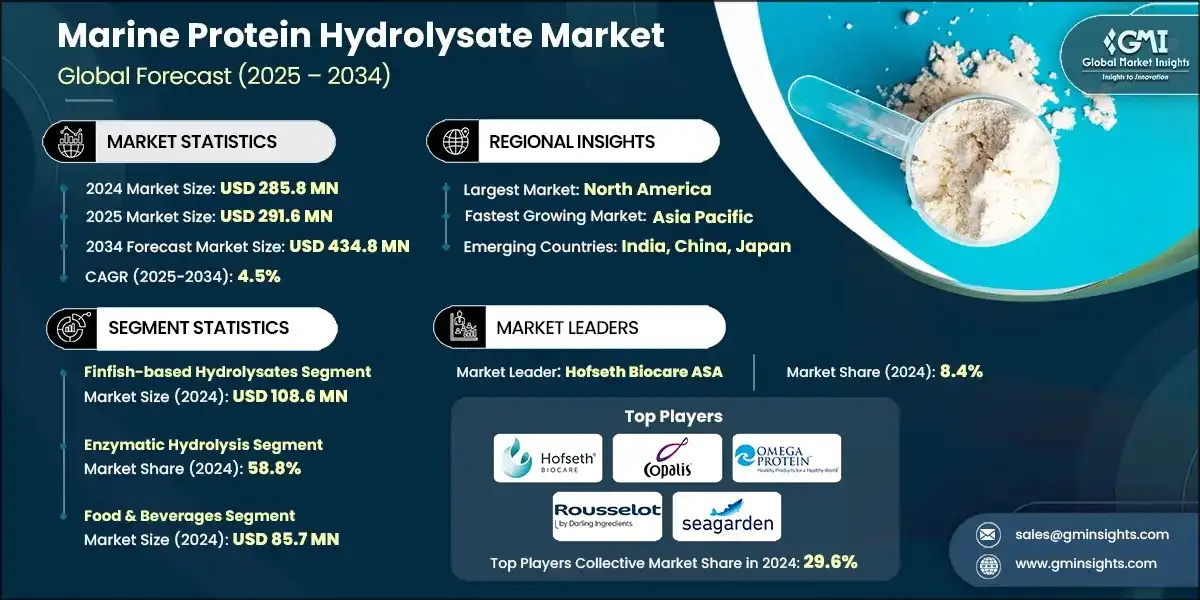
The global marine protein hydrolysate market was valued at USD 285.8 million in 2024. The market is expected to grow from USD 291.6 million in 2025 to USD 434.8 million in 2034, at a CAGR of 4.5% according to the latest report published by Global Market Insights Inc.
Marine Protein Hydrolysate Market Key Takeaways
Market Size & Growth
- 2024 Market Size: USD 285.8 Million
- 2025 Market Size: USD 291.6 Million
- 2034 Forecast Market Size: USD 434.8 Million
- CAGR (2025–2034): 4.5%
Key Market Drivers
- Rising demand in animal feed and aquaculture.
- Advancements in extraction and processing.
- Increasing health awareness.
Challenges
- Unpleasant taste or odor.
- Competition from alternative proteins.
Opportunity
- Cosmetics and personal care applications.
- Develop nutraceutical and dietary supplement products.
- Innovate in premium pet food.
Key Players
- Market Leader: Hofseth Biocare ASA led with over 8.4% market share in 2024.
- Leading Players: Top 5 players in this market include Hofseth Biocare ASA, Copalis, Omega Protein Corporation, Darling Ingredients Inc. (Rousselot), Seagarden AS, which collectively held a market share of 29.6% in 2024.
Get Market Insights & Growth Opportunities
- Marine protein hydrolysate (MPH) products are those formed from enzymatic hydrolysis of marine proteins from fish or other seafood by-products. These hydrolysates contain large number of bioactive peptides, amino acids, and other compounds which make them more valuable for use in food, nutraceutical, and animal feed industries.
- This growth is due to increasing consumer awareness about health, nutrition, and sustainability. Advances in processing technologies such as enzymatic hydrolysis, purification techniques have contributed to the enhancement of the quality and functionality of protein hydrolysates. The increasing use of fishery by-products and thus reduce wastage of food adds further new opportunities for the market expansion, with an endorsement of further promotion of sustainable and eco-friendly practices.
- Marine protein hydrolysates are used for many purposes in diverse areas such as pharmaceuticals, dietary supplements, animal feed, and aquaculture. They also facilitate opportunities for the market when considered for personalized nutrition or manufactured products targeting the aging population by providing high protein quality and bioactive properties of MPH.
To get key market trends
Marine Protein Hydrolysate Market Trends
- The marine protein hydrolysate is mostly used these days in functional foods, protein bars and health drinks because of its easy digestibility along with a rich amino acid profile resulting in higher growth of the market. Consumers seek natural, clean-label proteins that are beneficial for immunity, muscle recovery, and feature wellness at large while inventing trends on product formulation innovations and extended applications beyond conventional animal feeds.
- The demand for marine protein hydrolysate has also increased for aquaculture and livestock feed, whereby it enhances growth performance, digestibility, and overall health in the animal. The producers have concentrated on the sustainable protein alternatives that will reduce dependency on conventional feed ingredients. The trend is meant to reflect a wider shift toward efficiency and sustainability in the practice of animal farming.
- Production of marine protein hydrolysate utilizes fish processing by-products and waste to minimize environmental impact. Resource-efficient production methods are adopted by corporations to be in line with the sustainability efforts, and they also fulfil the consumer demand for eco-friendly ingredients. Such a trend, therefore, contributes to the enhancement of corporate social responsibility and thus results in growth of the market.
- Innovation in the methods of enzymatic hydrolysis, purification, and flavour-masking is boosting the quality and well-solubility and sensory traits of marine protein hydrolysate. These high-value formulations are being built toward nutraceuticals, cosmetics, and specialized dietary products hence the manufacturers are broadening offerings while entering new market segments.
Marine Protein Hydrolysate Market Analysis
Learn more about the key segments shaping this market
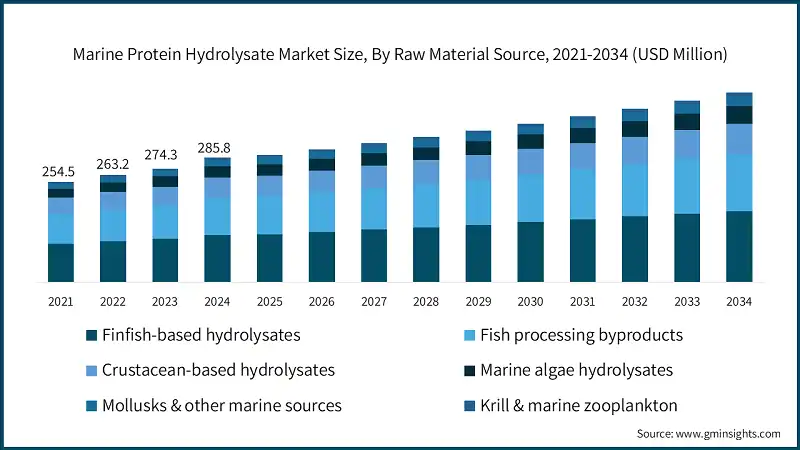
Based on raw material source, the market is segmented into finfish-based hydrolysates, fish processing byproducts, crustacean-based hydrolysates, marine algae hydrolysates, mollusks & other marine sources, krill & marine zooplankton. The finfish-based hydrolysates hold the largest market value of USD 108.6 million in 2024.
- Finfish-derived hydrolysates hold the highest market value in marine protein hydrolysates market because of highest protein content, amino acid and well-established decided supply chains. These are widely used as a material source in functional foods, nutraceuticals, aquaculture, and animal feeds. Fish processing waste also becomes famous because of sustainable and circular economy requirements, rapidly converting waste to the value of protein hydrolysates with a minimized environmental footprint.
- Crustacean hydrolysates are an emerging growth segment owing to bioactive compounds and increased use in nutraceuticals and specialized feeds. Marine algae hydrolysates are getting more prominence because of the rapidly increasing demand for plant and vegan protein alternatives and their utility for sustainability. Mollusks and other marine sources cater to niche applications that fulfill specific peptide properties while krill and marine zooplankton are appreciated for high-end applications of omega-3 supplementation though limited in terms of quantity.
Learn more about the key segments shaping this market
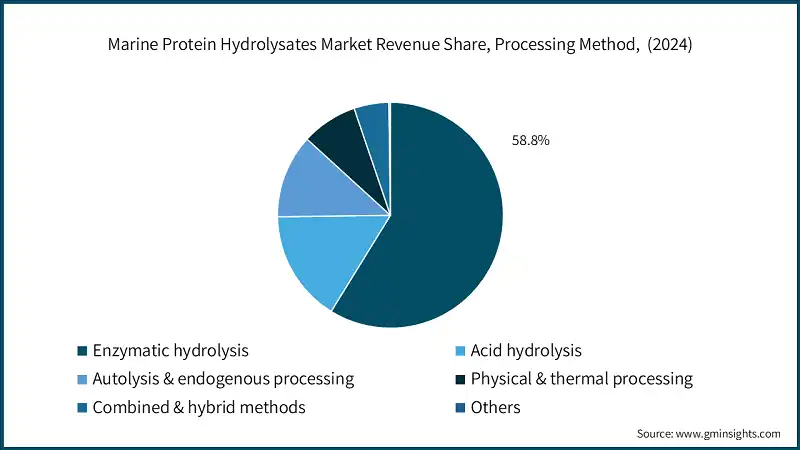
The marine protein hydrolysate market by processing method is segmented into enzymatic hydrolysis, acid hydrolysis, autolysis & endogenous processing, physical & thermal processing, combined & hybrid methods and others. The enzymatic hydrolysis holds the highest market share of 58.8% in 2024.
- Enzymatic hydrolysis accounts highest market shares due to its ability to convert proteins into bioactive peptides while retaining its nutritional quality. Acid hydrolysis is used where cost efficiency is prioritized as this process results in lowering the quality of some amino acids.
- Autolysis, which uses the natural enzymes in the raw material, has the simplest processing route, while the older and more traditional methods of extraction may incorporate heat or mechanical means through physical or thermal methods. Combined or hybrid methods emerge due to combinations of the different techniques which can lead to further efficiency, better peptide profiles, or specific functional properties. A few other methods, which are uncommon but are still in use and mostly for special applications within even narrower niches.
Based on end use industry, the market is segmented into food & beverages, aquaculture feed, pet food industry, sports nutrition & supplements, clinical nutrition & medical foods, pharmaceuticals & therapeutics, cosmetics & personal care, nutraceuticals & dietary supplements and livestock feed applications. The food & beverages hold the highest market value of USD 85.7 million in 2024.
- The food and beverage sector dominates the market because of its high protein content and functional benefits in products like protein bars, health drinks, and fortified foods. Followed by aquaculture due to factors such as good growth, digestibility, and health in farmed fish. Pet food industry is catered by consumer interest in nutritious and rising increasing sustainable options.
- Due to the digestibility and bioactive properties of marine protein hydrolysates, adoption is rising in areas such as sports nutrition and supplements, clinical nutrition, and medical foods. Other industries into which bioactive peptides are utilized in diverse application such health and skin benefits include pharmaceuticals, cosmetics, and personal care. While nutraceuticals, dietary supplements, and livestock feed also helps in the growth of marine protein hydrolysates market by creating additional demand for high-quality, bioactive protein in specialized health and in animal nutrition.
Looking for region specific data?
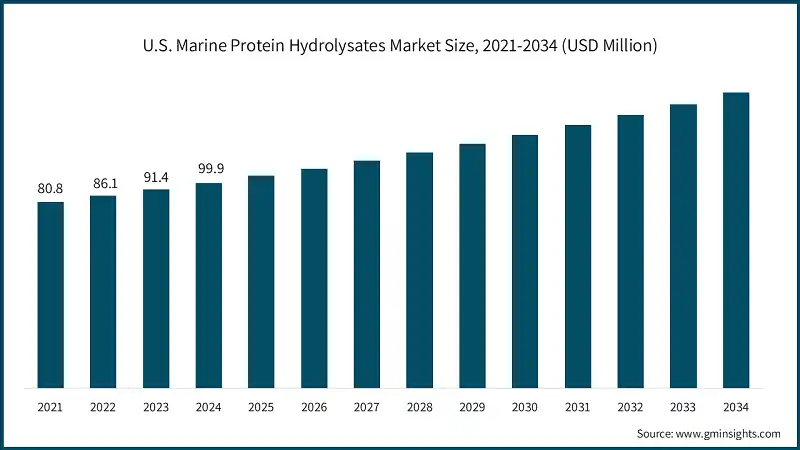
The U.S. marine protein hydrolysate market accounted for USD 99.9 million in 2024.
- The demand for marine protein hydrolysates in North America, is growing because of rising consumer preference for clean label and high-protein functional foods. The market in U.S. is growing due to higher demand in sports nutrition and dietary supplements while Canada has developed an emphasis on sustainable seafood and by-product utilization. Product safety and quality are supported by strong regulatory frameworks and advanced processing technologies. Awareness of health and wellness increases demand in pet food and aquaculture feed. These all are driving the growth of the market in the region.
The marine protein hydrolysate market in the Germany is expected to experience significant and promising growth from 2025 to 2034.
- European countries, especially Germany are growing as there are rising demands for sustainable, traceable, and eco-friendly protein sources. Germany as a country served as a hub for nutraceutical functional food and cosmetics application of marine protein hydrolysates. Regulatory support and environmental initiatives encourage circular economy practices like the valorization of fish by-products. The knowledge among other European countries about the health benefits of marine-based nutrition is also growing. This combination of consumer trends and policy support strengthens the steady growth of the market.
The marine protein hydrolysate market in China is expected to experience significant and promising growth from 2025 to 2034.
- Asia-Pacific region along with China and India is growing due to urbanization, rising disposable incomes and changing dietary patterns-increasingly protein-rich and functional foods. China's huge aquaculture and seafood processing industries contribute to its industrial needs for marine protein hydrolysates while framing the growing market of India. Moreover, rising demands also manifest in health supplements and animal feed. Awareness in the public about health and wellness coupled with high-quality nutrition leads to market growth.
UAE marine protein hydrolysate market is expected to experience significant and promising growth from 2025 to 2034.
- Aquaculture and livestock production are expanding in the Middle East and Africa, encouraging growth, particularly with the support of the United Arab Emirates and South Africa. In the United Arab Emirates growth of the market is due to focus on premium products for pet food and human nutrition, while South Africa utilizes fisheries and by-products in functional ingredients. Another driving forces for the growth of market are urbanization, growing health awareness, and initiatives for sourcing sustainable proteins. Government support towards food security and ingredient traceability further supports the industry. Together, these factors steadily promote the acceptance of marine protein hydrolysates in the region.
Brazil is expected to experience significant and promising growth from 2025 to 2034.
- In Latin America particularly Brazil and Mexico, market growth is attributed by the vast marine resources present in the country and a rising domestic demand for cheap, high-protein food and feed. Brazil's focus is on the use of fish by-products for sustainable protein production while Mexico deals with an economy that focuses on creating export-oriented supply chains for feed and functional ingredients. Increased income among the middle class coupled with urbanization also provide higher demand to this market. All these trends are, thus, fostering an extended region of growth in the market overall.
Marine Protein Hydrolysate Market Share
- Marine protein hydrolysate industry is moderately consolidated with players like Hofseth Biocare ASA, Copalis, Omega Protein Corporation, Darling Ingredients Inc. (Rousselot), Seagarden AS holding 29.6% market share in 2024 and Hofseth Biocare ASA being the market leader holding the market share of 8.4% in 2024.
- Continuous investments in advanced technologies like extraction, hydrolysis and purification helps companies to provide competitive edged in the marine protein hydrolysate market.
- With a strong focus on producing high-quality and bioactive protein hydrolysates for application in food, feed, nutraceuticals, and pharmaceuticals, the innovations introduced in enzymatic processing, ultrafiltration and peptide fractionation enable producers to increase yield, maintain consistency, and customize functional properties to match different end use requirements.
- Sustainability is the core driver for the development of competitive strategies and thus helps the competitors to maintain their position. The producers optimize their processes to minimize energy consumption, water usage and waste, while fisheries or byproducts are their sources of raw materials.
- Compliance with regulations, quality certifications, and traceable frameworks distinguish another factor for providing competitive advantage. Following the food safety standards, certification of Marine stewardship, and international quality guidelines caters trust to the users in the global markets.
Marine Protein Hydrolysate Market Companies
Major players operating in the marine protein hydrolysate industry are:
- Hofseth Biocare ASA
- Copalis
- Omega Protein Corporation
- Croda International Plc
- Gelita AG
- Rousselot
- Symrise AG
- Darling Ingredients Inc.
- Titan Biotech Ltd.
- Seagarden AS
- Nuritas Limited
- Matis (Prokaria)
- Sopropeche
- Janatha Fish Meal & Oil Products
Hofseth Biocare ASA is a Norwegian based company engaged in the conversion of salmon by-products into high-quality protein ingredients and bioactive peptides. The company caters services for human and pet nutrition with health benefit plus sustainability. The company invests in enzymatic processing for the consistent quality and bioavailability of its products. It ventures more into innovating and tracing what goes into its operations. With this, the company serves its both local and international markets with its marine products.
Copalis is a French company that processes fish by-products into protein hydrolysates and other marine ingredients. This line serves the animal feed, nutraceutical, and functional food sectors. The company uses sustainable practices for marine resource utilization. The company has acquired decades of experience in extracting bioactive compounds from seafood waste. Copalis' products are marketed throughout Europe and in other international markets.
Omega Protein Corporation manufactures proteins-rich ingredients, as well as oils, derived from the wild-caught menhaden fish. It adopts a vertically integrated model harvesting to processing. Its product is food, supplements, and animal nutrition. Key focus areas are sustainability and efficient marine resource.
Darling Ingredients Inc. (Rousselot) manufactures marine collagen peptides and many other specialty proteins from fish and animal by-products. Health, beauty, and nutrition industries at a global level are targeted by the company. It emphasizes sustainability and traceability product innovation. The research is focused mainly on functional peptides designed for applications in food and nutraceuticals. Combining traditional knowledge and processing practices, Darling Ingredients made modern approaches to ensure the very best quality in products.
Seagarden AS is a Norway-based company that can extract high-quality marine proteins from fish and shellfish by-products. The company's main activity is to supply ingredients to the food, health, feed, and cosmetic industries. Sustainability and responsible sourcing are part of the company. Seagarden relies on cold-water marine resources for its premium products.
Marine Protein Hydrolysate Market Report Attributes
| Key Takeaway | Details |
|---|---|
| Market Size & Growth | |
| Base Year | 2024 |
| Market Size in 2024 | USD 285.8 Million |
| Market Size in 2025 | USD 291.6 Million |
| Forecast Period 2025 - 2034 CAGR | 4.5% |
| Market Size in 2034 | USD 434.8 Million |
| Key Market Trends | |
| Drivers | Impact |
| Rising demand in animal feed and aquaculture | Marine Protein Hydrolysate improves digestibility and growth in livestock, aquaculture, and pets. Its inclusion in feeds enhances health and performance, boosting demand from these industries. |
| Advancements in extraction and processing | New enzymatic hydrolysis and purification techniques improve the quality, solubility, and bioavailability of Marine Protein Hydrolysate. |
| Increasing health awareness | People are becoming more conscious about nutrition and protein intake. Marine Protein Hydrolysate is rich in peptides and amino acids, supporting functional foods, dietary supplements, and sports nutrition. This awareness drives steady demand globally. |
| Pitfalls & Challenges | Impact |
| Unpleasant taste or odor | Marine Protein Hydrolysate can have a fishy taste or smell. Masking these characteristics in food and beverages can be challenging. |
| Competition from alternative proteins | Plant-based proteins, whey, and lab-grown protein sources are growing rapidly. Marine Protein Hydrolysate must compete on price, taste, and nutritional benefits to stay relevant. |
| Opportunities: | Impact |
| Cosmetics and personal care applications | Bioactive peptides from Marine Protein Hydrolysate can be used in skincare and haircare products for anti-aging and repair benefits. |
| Develop nutraceutical and dietary supplement products | Marine Protein Hydrolysate can be used to create capsules, powders, and drinks targeting immunity, muscle recovery, and overall health. Rising global demand for supplements makes this a strong growth area. |
| Innovate in premium pet food | Marine Protein Hydrolysate can improve palatability and nutrition in pet food. With pet owners seeking sustainable and high-protein options, this sector offers significant growth potential. |
| Market Leaders (2024) | |
| Market Leaders |
8.4% market share |
| Top Players |
Collective market share of 29.6 % in 2024 |
| Competitive Edge |
|
| Regional Insights | |
| Largest Market | North America |
| Fastest Growing Market | Asia Pacific |
| Emerging Country | India, China, Japan |
| Future Outlook |
|
What are the growth opportunities in this market?
Marine Protein Hydrolysate Industry News
- In February 2025, Symrise AG announced a strategic partnership with Norwegian firm HBC to expand its portfolio in human health and premium pet nutrition using clinically proven marine ingredients. HBC makes use of salmon by-products to produce bioactive peptides, collagen, oils, and bone powders for metabolic, immune, bone, and joint health. This partnership would augment opportunities for market access with a global reach, open new avenues for product development, and boost sustainability efforts.
- In January 2025, Aquaproducts launched a new product PEPTITOM which is an eco-friendly shrimp hydrolysate powder catering to aquaculture, livestock, and poultry nutrition. The utilization of underutilized shrimp by-products for the manufacture of PEPTITOM allows it to offer highly digestible proteins, bioactive peptides, and peptide-bound calcium for the support of growth, immunity, and reproductive health across the species. The product was manufactured at Marine Biotech Vietnam (MBV) utilizing controlled batch hydrolysis-based intermediate, and HACCP-compliant processes, thus ensuring the combination of quality, cost-efficient and sustainable processing.
The marine protein hydrolysate market research report includes an in-depth coverage of the industry with estimates and forecast in terms of revenue in USD Million and volume in terms of kilo tons from 2021-2034 for the following segments:
Market, By Raw Material Source
- Finfish-based hydrolysates
- Fish processing byproducts
- Crustacean-based hydrolysates
- Marine algae hydrolysates
- Mollusks & other marine sources
- Krill & marine zooplankton
Market, By Processing Method
- Enzymatic hydrolysis
- Acid hydrolysis
- Autolysis & endogenous processing
- Physical & thermal processing
- Combined & hybrid methods
Market, By End Use Industry
- Food & beverages
- Functional foods
- Protein beverages & sports drinks
- Bakery & confectionery
- Dairy & dairy alternative
- Others
- Aquaculture feed
- Fish feed applications
- Shrimp & crustacean feed
- Others
- Pet food industry
- Premium pet nutrition
- Digestibility & palatability enhancement
- Therapeutic pet food
- Others
- Sports nutrition & supplements
- Protein powder
- Recovery & performance
- Clean label & natural product
- Others
- Clinical nutrition & medical foods
- Dysphagia-friendly applications
- Wound healing & recovery nutrition
- Geriatric nutrition applications
- Others
- Pharmaceuticals & Therapeutics
- Drug delivery systems
- Bioactive peptide therapeutics
- Wound care & tissue engineering
- Others
- Cosmetics & personal care
- Anti-aging & skincare
- Hair care product
- Marine collagen
- Others
- Nutraceuticals & dietary supplements
- Capsule & tablet formulations
- Liquid supplement
- Targeted health benefit
- Others
- Livestock feed applications
- Poultry feed
- Swine nutrition
- Ruminant feed
- Others
The above information is provided for the following regions and countries:
- North America
- U.S.
- Canada
- Europe
- Germany
- UK
- France
- Spain
- Italy
- Rest of Europe
- Asia Pacific
- China
- India
- Japan
- Australia
- South Korea
- Rest of Asia Pacific
- Latin America
- Brazil
- Mexico
- Argentina
- Rest of Latin America
- Middle East and Africa
- Saudi Arabia
- South Africa
- UAE
- Rest of Middle East & Africa
Frequently Asked Question(FAQ) :
What is the market size of the marine protein hydrolysate in 2024?
The market size was USD 285.8 million in 2024, with a CAGR of 4.5% expected through 2034 driven by increasing consumer awareness about health, nutrition, and sustainability.
What is the projected value of the marine protein hydrolysate market by 2034?
The marine protein hydrolysate market is expected to reach USD 434.8 million by 2034, propelled by advancements in processing technologies, rising demand in animal feed and aquaculture, and increasing health awareness.
What is the current marine protein hydrolysate market size in 2025?
The market size is projected to reach USD 291.6 million in 2025.
How much revenue did the finfish-based hydrolysates segment generate in 2024?
Finfish-based hydrolysates generated USD 108.6 million in 2024, leading the raw material source segment due to highest protein content and well-established supply chains.
What was the valuation of enzymatic hydrolysis segment in 2024?
Enzymatic hydrolysis held 58.8% market share in 2024, dominating due to its ability to convert proteins into bioactive peptides while retaining nutritional quality.
Which region leads the marine protein hydrolysate market?
The U.S. marine protein hydrolysate market accounted for USD 99.9 million in 2024, supported by rising consumer preference for clean label and high-protein functional foods, along with strong regulatory frameworks.
What are the upcoming trends in the marine protein hydrolysate market?
Key trends include increasing use in functional foods and health drinks, growing demand in aquaculture and livestock feed, sustainable production using fish by-products, and innovations in enzymatic hydrolysis, purification, and flavor-masking techniques.
Who are the key players in the marine protein hydrolysate market?
Key players include Hofseth Biocare ASA, Copalis, Omega Protein Corporation, Croda International Plc, Gelita AG, Rousselot, Symrise AG, Darling Ingredients Inc., Titan Biotech Ltd., Seagarden AS, Nuritas Limited, Matis (Prokaria), Sopropeche, and Janatha Fish Meal & Oil Products.
Marine Protein Hydrolysate Market Scope
Related Reports