Summary
Table of Content

Luxury Electric Vehicle Market
Get a free sample of this report
Form submitted successfully!
Error submitting form. Please try again.
Thank you!
Your inquiry has been received. Our team will reach out to you with the required details via email. To ensure that you don't miss their response, kindly remember to check your spam folder as well!
Request Sectional Data
Thank you!
Your inquiry has been received. Our team will reach out to you with the required details via email. To ensure that you don't miss their response, kindly remember to check your spam folder as well!
Form submitted successfully!
Error submitting form. Please try again.
Luxury Electric Vehicle Market Size
The high rate of electrification and ultra- luxurious positioning is quickening the demand of fine-end electric vehicles. The value of sustainability is growing among the higher-end consumers with no reduction in performance, comfort, and brand image. Companies are retaliating by making long-range batteries, sophisticated thermal management, high-performance drives that rival or surpass internal combustion engines, characterizing luxury EVs as aspirational but environmentally friendly mobility solutions to wealthy consumers around the world.
Luxury Electric Vehicle Market Key Takeaways
Market Size & Growth
- 2025 Market Size: USD 191.2 Billion
- 2026 Market Size: USD 214.7 Billion
- 2035 Forecast Market Size: USD 562.4 Billion
- CAGR (2026–2035): 11.3%
Regional Dominance
- Largest Market: North America
- Fastest Growing Region: Asia Pacific
Key Market Drivers
- Growing demand for premium sustainable mobility.
- Technological advancements in battery and ADAS.
- Expansion of fast-charging infrastructure.
- Brand electrification strategies.
- Increasing government incentives and emission regulations.
Challenges
- High upfront vehicle cost.
- Battery raw material supply constraints.
- Charging infrastructure disparity.
- Technology obsolescence risks.
Opportunity
- Expansion in Asia Pacific luxury segment.
- Integration of solid-state batteries.
- Autonomous and connected mobility ecosystems.
- Subscription and digital sales models.
Key Players
- Market Leader: Volkswagen led with over 13% market share in 2025.
- Leading Players: Top 5 players in this market include BMW, Mercedes-Benz, NIO, Tesla, Volkswagen, which collectively held a market share of 45% in 2025.
Get Market Insights & Growth Opportunities
As per Statista, EV is likely to experience tremendous growth due to the high rate of adoption as estimated sales of 16.63 million electric passenger cars are projected to be made in 2025. The growing number of consumers showing confidence in electric mobility, growing awareness of the importance of sustainability, and government-provided incentives are all positive indicators that affluent buyers will switch conventional premium automobiles to high-performance luxury electric vehicles. Automakers can ride this wave by providing state-of-the-art battery technology, long-range capability, as well as digitally connected experience that appeals to environmentally aware, high-income customers, to be associated with status and innovation.
The use of digital transformation in cars is becoming one of the driving forces behind the adoption of luxury EVs. These systems play a crucial role in improving the user experience and brand differentiation, as advanced driver assistance systems, AI-driven infotainment, customized over-the-air updates, and vehicle architectures that are based on software-defined systems add value to users. Luxury EV customers attach importance to the absence of interruptions in connections and autonomous capability and are more likely to demand integration with technology as it is one of the essential elements of the luxury car, as well as mastery, so the luxury price power and customer loyalty to the product are high in developed segments.
Efforts by corporates to be sustainable and stricter regulations on emissions are forcing luxury manufacturers to hasten the pace of electrification. The carbon neutrality goals in Europe, China, and North America are redefining the product line to an all-electric one. The innovation being used is compliance driven based and is driving investment in the next generation battery technology, lightweight materials, and specific electric vehicle platform, enhancing the long-term development opportunities of the luxury electric vehicles segment in the world.
The fastest-growing market is in Asia Pacific as the affluent middle and high-net-worth population in China and the Southeast Asian region is rapidly expanding. Powerful government subsidies, electrification mandates, and domestic domination in battery production and sales generate good economics towards EV production and sales of high-quality ones. The trends on urbanization and the increasing interest in technologically sophisticated vehicles are additional factors that boost the luxury EV uptake in the region.
The market share in North America is high due to the high consumer purchasing power, the high adoption of high-performance electric vehicles and the well-developed charging infrastructure. Large-scale deployments are aided by both federal and state-level incentives, as well as by increasing demand of premium SUVs and performance sedans. Existing luxury names and developed software ecosystems cement market leadership and maintain high-value sales volumes.
The global luxury electric vehicle market was estimated at USD 191.2 billion in 2025. The market is expected to grow from USD 214.7 billion in 2026 to USD 562.4 billion in 2035, at a CAGR of 11.3% according to latest report published by Global Market Insights Inc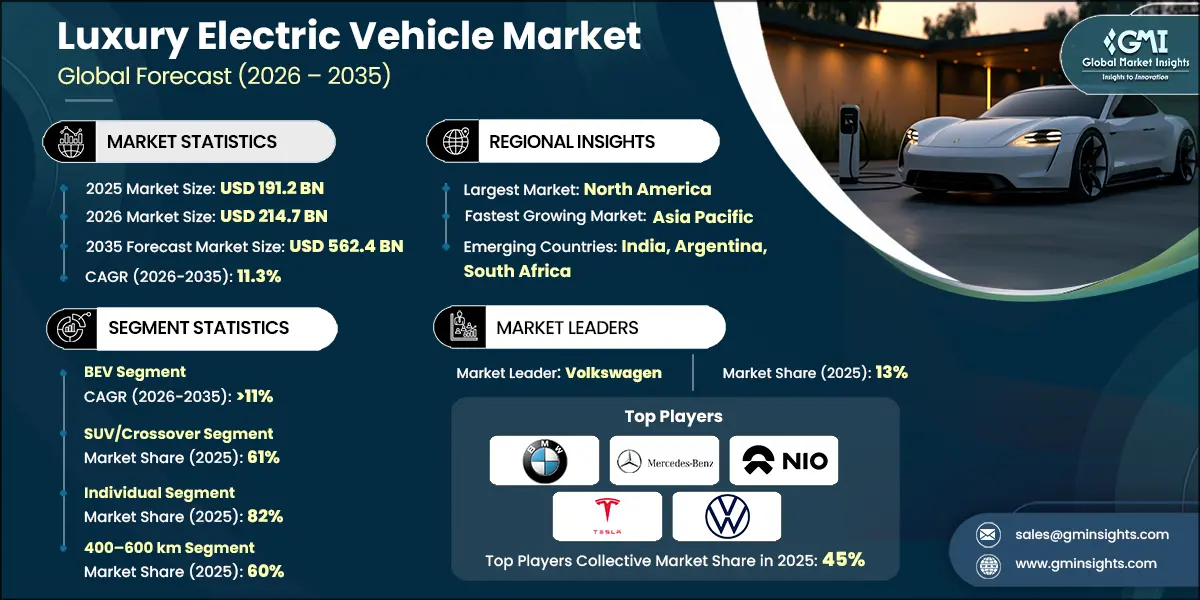
To get key market trends
Luxury Electric Vehicle Market Trends
The increase in high-net-worth population concentration globally is greatly increasing the demand of high-quality electric mobility products. Wealthy shoppers are now willing to drive cars that are associated with sustainability, innovation and exclusivity. Luxury EVs will offer high-performance acceleration, high design, and zero-election credential that is in line with the changing lifestyle trends. This age cohort change especially in the financial centres of the cities is widening the targetable market of high-end electric vehicle manufacturers around the globe.
The endless research of battery chemistry and energy density is allowing longer range and quicker charges, making EV ownership of luxury models more practical. Applied enhancements in thermal stability, lightweight pack integration and battery management systems contribute to high performance standards. Such technological innovations help alleviate range anxiety and bolster consumer trust, hastening the process of substituting the old luxury internal combustion vehicles with high-end electric ones.
The luxury EVs are also being turned into smart mobility platforms through the introduction of soft-defined vehicle architecture. Autonomous driving, over-the-air updates, AI-driven personalization, and predictive maintenance make ownership a higher experience. Premium clients appreciate digital ecosystems which are combined with smart homes and electronic devices. Such a combination of the movement and new sophisticated software enhances brand distinction and promotes buy-back in the luxury electric segment.
Tax incentives, carbon credit schemes, and high emission standards are driving the uptake of luxury EVs faster due to government policies founded on their electrification. The pressure exerted by regulators on car manufacturers to cut fleet emissions is compelling premium brands to pursue ambitious plans to electrify their brands. These facilitating systems reduce effective prices of purchases by consumers and provide friendly investment climate in the development of high-performance electric vehicles.
Luxury car makers are pouring a lot of money in purpose-built electric platforms instead of reconfiguring combustion-based platforms. Specially designed EVs enhance weight distribution, interior space, safety and handling. This redesign of the structure increases the overall efficiency and comfort of the vehicles, which is a better premium experience. Scalability of the platform also decreases the cost of production in the long term, which will sustain the development of various luxury EV models.
Luxury Electric Vehicle Market Analysis
Learn more about the key segments shaping this market
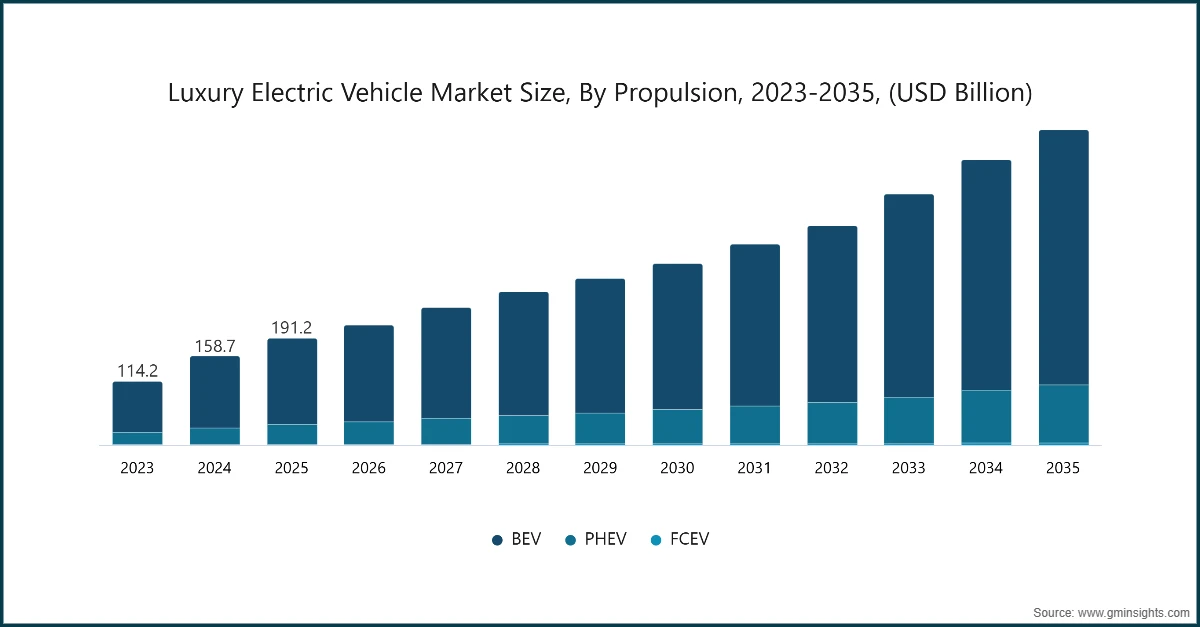
Based on propulsion, the luxury electric vehicles market is divided into BEV, PHEV, and FCEV. The BEV segment dominated the luxury electric vehicle market accounting for around 80% in 2025 and is expected to grow at a CAGR of over 11% from 2026 to 2035.
- The value proposition of BEVs in the market is becoming stronger as the new technology of high-capacity lithium-ion batteries is rapidly evolving. Increased energy density, better thermal control, and increased driving ranges over 500km per charge satisfy high-end consumer demands. Such innovations diminish range anxiety and provide better acceleration and silent operation that make battery electric cars more appealing to high-income consumers who want to have high mobility options.
- The zero tailpipe emissions and the reduced cost of operation over time are also making luxury consumers favor fully electric over hybrid type of drivetrain. BEVs to get rid of engine noise and vibration, increase cabin comfort and refinement which are the major differentiators of premium cars. With the increased awareness among high-income populations on the importance of environmental sustainability, fully electric luxury models are poised as a status symbol that will integrate sustainability with technological prowess and the feature of performance excellence.
- Special EV platforms specifically created to support BEVs allow better use of interior spaces, reduced centers of gravity, and even driving characteristics. In the high-end automobiles, this would be in terms of spacious cabins, high levels of infotainment integration, and better ride comfort. The flexibility of the platform also enables battery builders to add big battery packs to the car without damaging beauty, which strengthens the argument of battery-electric designs in luxury car market segments.
- An increase in ultra-fast charging stations plays a major role in the development of BEV in luxury markets. DC chargers with high power that can provide high range in several minutes increase the comfort of long-distance travel. Premium automakers are collaborating with charging providers to provide exclusive networks and access priority and smooth digital payment integration that enhances ownership and boost consumer confidence in fully electric luxury mobility.
- Strict emissions standards and the requirement to become carbon neutral are compelling luxury brands to focus on pure battery electric cars instead of transitional technologies. The governments of Europe, China, and North America have been promoting zero-emission vehicles by means of subsidies and regulatory credits. These policy frameworks help to speed up investment in BEV portfolio to make sure luxury car manufacturers develop all-electric lineup to comply with the requirements of regulations and meet the changing market demand.
Learn more about the key segments shaping this market
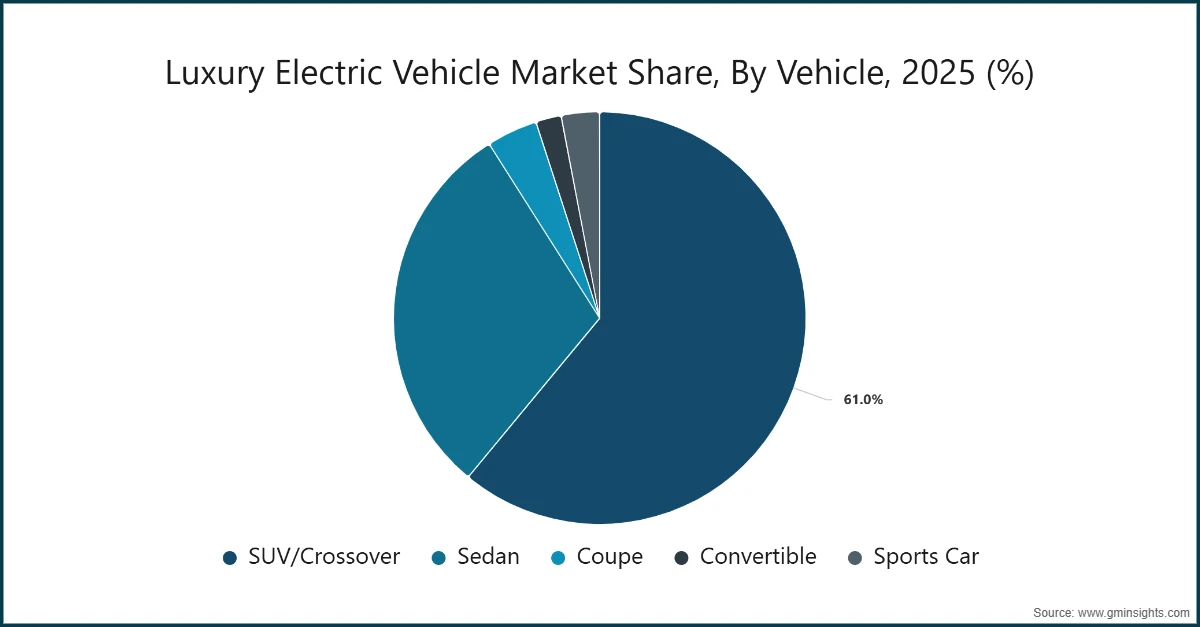
Based on vehicle, the luxury electric vehicles market is segmented into SUV/crossover, sedan, coupe, convertible, and sports car. The SUV/crossover dominate the market with 61% share in 2025, and the segment is expected to grow at a CAGR of over 11% from 2026 to 2035.
- The increase in popularity of SUVs and crossovers in the world is contributing immensely to the expansion of luxury electric vehicles. The consumers are moving towards higher seating, better visibility on the road and wide interiors without compromising on performance. With the ability to provide potent torque and comfortable acceleration, luxury electric SUVs become appealing to the rich families and businesspeople who are willing to have a practical drive with all the features of luxury and comfort as well as advanced mobility.
- The need to purchase high-end family cars is increasing the use of electric SUVs and crossovers. Luxury customers demand more room in the cabin, versatile seating layouts, and sophisticated safety features that are inherent in the SUV platform. Battery electric design has been efficient in interior packaging, which offers flat floors and more cargo space, which strengthens the feasibility and popularity of luxury electric SUV in urban and suburban markets.
- The high-performance luxury electric SUVs are the ones with enhanced battery energy density and platform scalability that allow developing the models with longer range. The new EV platforms enable the manufacturers to add bigger battery packs without affecting the ride quality or design. This has made it do long-distance travel and high towing capability, which is important to high income customers of the premium SUV in North America, Europe, and emerging high-income markets.
- The integration in technology is successful especially in SUV and crossover models in the luxury segment. Big cabin designs enable the use of panoramic screens, hi-tech infotainment, high-quality sound design, and seat entertainments. The roomy vehicle format boosts the digital user experience, making the luxury electric SUVs as mobile technology centers that are customized to the connected lifestyles and executive mobility demands.
- The growth of urban infrastructure and the charging networks can facilitate the rise of electric SUVs in urban centers. The urban consumer with high income prefers multi-purpose cars combined with status, comfort and sustainability. Luxury electric crossovers offer zero-emission mobility but with commanding presence and brand prestige, which are in line with emerging city regulations that facilitate the adoption of low-emission transportation solutions in the major economic centers of the world.
Based on ownership, the market is segmented individual, corporate & fleet and subscription/leasing. The individual segment dominated the market, accounting for share of 82% in 2025.
- The growing disposable income and high net-worth individuals’ populations are contributing largely to the adoption of luxury electric vehicles. Wealthy consumers are demanding the best mobility, which indicates a sense of individual accomplishment and sustainability. Luxury EVs are high-performance vehicles with exclusivity and zero-emission statements, so they appeal to a specific group of people who might consider themselves innovative and sustainable as their choice of lifestyle and long-term investment.
- The increasing environmental awareness of the individual consumer is boosting the demand of full electric luxury automobiles. Buyers with high income are taking pro-active efforts to cut down on the personal carbon footprint without reducing comfort or performance. The government subsidies and low-emission zones in cities continue to push the idea of electric models being privately owned, which makes luxury EVs a responsible but prestigious option to the traditional high-end cars based on internal combustion engines.
- The luxury segment is highly motivated by technological sophistication, which drives individual buyers. High-order driver assistance systems, artificial intelligence enabled infotainment, customized digital interface, and over-the-air updates improve the ownership experience. People are attracted to cars that act as linked smart appliances, which blend effortlessly with individual ecosystems, which further enhances the popularity of high-end battery electric models.
- Electric drivetrains are altering the performance quotient in the ownership of individual luxury vehicles. The immediate torque output, acceleration, silent operation and movement of the car make driving fun. Electric sedans and SUVs The high-performance models provide sports-car-like responsiveness with everyday usability that is desirable to individual consumers interested in excitement and refinement in their own transport.
- Growth of the home charging systems is also facilitating personal use of luxury electric cars. Solar integration, smart energy management, and installation of personal fast chargers should be made to increase convenience and cost savings. To homeowners, charging at night makes them less reliant on the infrastructure provided by the government, and therefore, the electric luxury cars make more sense and become more appealing to their daily personal car usage.
Based on driving range, the market is divided into below 400 km, 400–600 km, and above 600 km. 400–600 km driving range dominate with 60% market share in 2025.
- The emergence of new high-density batteries technology has allowed the luxury electric vehicles to have a range of up to 400-600 km, which has greatly improved the appeal of such vehicles. Long range will minimize range anxiety among the premium customers as they can travel long distances without a constant need to charge the battery. This feature conforms to the demands of affluent customers concerning convenience, performance, and reliability, and luxury EVs are convenient enough to use daily and on weekends.
- The range of 400-600 km ensures that luxury electric cars can compete directly with high-performance internal combustion cars in flexibility of journeys. Wealthy consumers who want unbroken long-distance travel can be interested in the extended-range EVs since they can use them to travel without interruptions in the urban, suburban, and highway networks. This enhanced usability increases the adoption amongst people with high net worth who value more efficiency without losing luxury or performance.
- Long-range EVs have an advantage in terms of improved battery management systems, regenerative braking, and fuel-efficient designs of the drive train. Such technologies increase efficiency without reducing performance so that the vehicles will provide them with the same acceleration and comfort along the road. In the case of premium customers, this can be translated to the assurance of reliable and foreseeable driving experience and the trust that their EVs can get them to the city and the pre-planned holiday destinations without any issues with functionality.
- 400-600km would also allow luxury car manufacturers to introduce advanced features without affecting fuel efficiency. Higher battery capacity will accommodate the more power-intensive features like high-end infotainment, dynamic suspension, self-driving technology, and climate comfort, and will be long-range capable. Such a combination of comfort, performance, and technology adds to the attractiveness of luxury EV to a high-income customer who desires convenience and exclusivity.
- The existence of the extended-range EVs stimulates the use of EVs in areas where there are few fast-charging stations. The emerging markets or other loosely linked regions with luxury consumers feel confident that EVs with a 400-600 km can travel great distances without the urgency to rely on charging stations. This will enhance market penetration opportunity of the high-end electric brands, especially in the nations having emerging affluent citizens still with emerging charging systems.
Looking for region specific data?
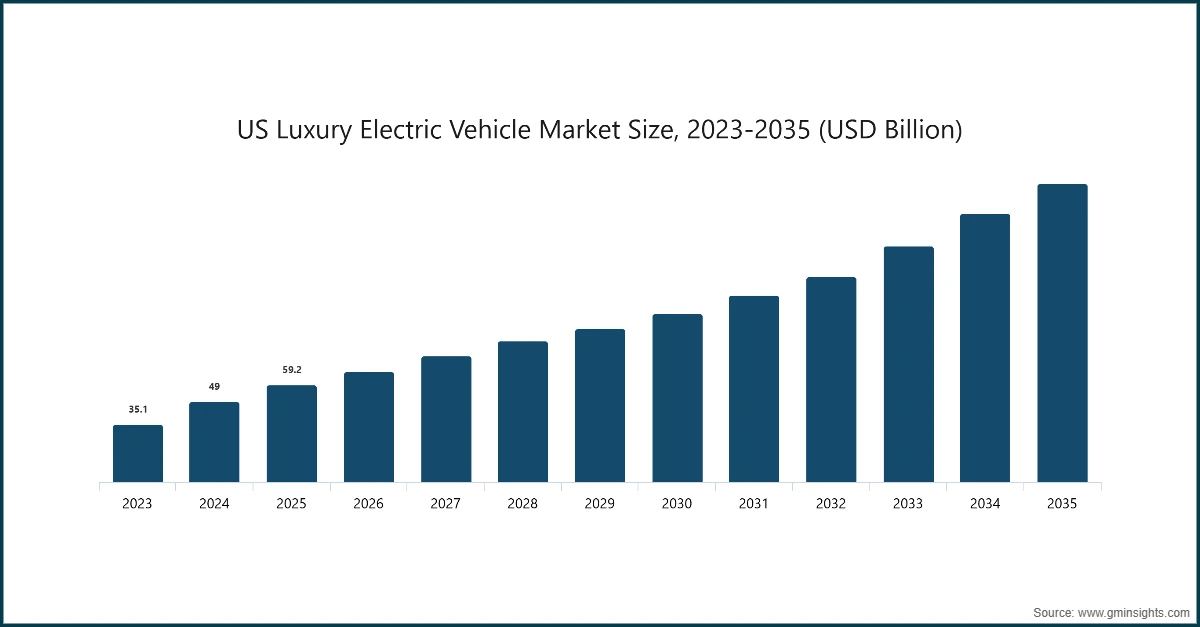
US dominated the luxury electric vehicle market in North America with around 88% share and generated USD 59.2 billion in revenue in 2025.
- The luxury adoption of electric vehicles is being facilitated by the existence of a strong purchasing power and high disposable incomes within the US. The rich customers are focusing on high quality performance, cutting-edge technology, and sustainable mobility, and thus luxury EVs are an aspirational purchase. The culture of early adoptions, along with the availability of the high-quality financing options and leasing, enables individuals and executives to invest in premium electric mobility solutions without sacrificing the lifestyle or convenience.
- A well-developed charging system in urban and suburban areas of the US with favorable development prospects of luxury EVs. Large fast-charging networks, home-installed charging, and car manufacturer-subsidized supercharger networks eliminate range anxiety among high-income customers. The ease of access to compatible charging increases the functional use of such vehicles on a daily basis and in terms of travelling long distances, owning the luxury electric automobiles will be feasible, enticing and corresponding to the high-quality lifestyle standards.
- US consumers are motivated to use luxury electric cars due to favorable incentives by the federal and state governments in the form of tax credits, rebates, and access to HOV lanes. These policy initiatives bring effective purchase prices of high-end EVs to be cost-effective to individuals with high income levels. Affordability through incentives, in addition to the increasing environmental awareness, will further boost the adoption and enhance penetration in the market by luxury electric automakers in the US.
- The trend in electric vehicles is accompanied by growing demand of luxury SUVs and crossovers in the US. Consumers will choose vehicles of a large size, high-performance and advanced technology that can be used over long distances. Electrified SUV models have instant torque, all-wheel-driving and high-end comfort, which is especially attractive to American consumers because they put a high premium on versatility, safety, and prestige in their daily and recreational driving experience.
- US luxury EVs are adopted due to consumer preference to vehicles that are technologically advanced. Such functions as AI-assisted driving, over-the-air updates, digital cockpits, and personalized infotainment attract high-income tech-savvy people. The compatibility of the mobile gadgets, intelligent home systems, and high-level connectivity solutions raise the level of convenience and ownership satisfaction and make luxury electric cars not only a means of transportation but also a smart living companion in the U.S. market.
Germany luxury electric vehicle market reached over USD 9 billion in 2025. Germany’s leadership in battery production and supply chain security supports luxury EV growth.
- Luxury EV is being embraced by the well-established automotive engineering base of Germany, as well as the legacy of luxury automobiles. Quality consumers have confidence in local brands such as BMW, Mercedes-Benz, and Audi in terms of performance, safety, and craftsmanship. The iconic brands being electrified, together with the sophisticated battery and drive train technology, strengthens the consumers’ confidence and makes Germany a center of luxury electric vehicles of high and technologically advanced quality.
- Germany has government incentives and regulatory support that promotes the growth of luxury electric vehicles. Prices of high-end EVs become more affordable due to subsidies on EV purchases, lowering taxes, and programs of environmental bonuses. Severe emissions of CO 2 compel the automakers to increase the number of electric models, as they guarantee the required compliance and preservation of brand image. These incentives will encourage higher-income earners to move out of the conventional combustion luxury cars to high-quality battery-based electric ones.
- High density and expanding charger network facilitate long range and urban luxury EV ownership in Germany. Home and workplace installations together with nationwide fast-charging networks would decrease range anxiety among premium buyers. The abundance of convenient charging options will make electric cars more useful and trustworthy, and luxury EV will also be more attractive as a day commuting vehicle, business travel, and adventurous holiday nationwide.
- German luxury EV uptake is influenced by technological innovation and embrace of superior digital ecosystems. Such elements as autonomous driving help, AI-enhanced energy management, online updates, and connected infotainment attract high-income consumers that are technologically aware. German buyers of luxury EV cars expect their vehicles to be a smart, connected system with a combination of performance, safety, and comfort, and this is why the country became one of the leaders in luxury electric mobility.
The luxury electric vehicle market in China is projected to grow at a strong CAGR of 14% from 2026 to 2035. Domestic EV brand emergence and strategic partnerships drive luxury electric vehicle growth in China.
- The increase in wealth and the fast urbanization in China is contributing to the luxury vehicle usage of electric vehicles. The increasing high-net-worth populations in large cities are focused on high-performance, comfortable, and sustainable mobility solutions. Such an overlap between status-based consumption and environmental awareness is making high-end battery electric vehicles more appealing to Chinese buyers who are interested in acquiring technologically advanced and high-end vehicles that serve the purpose of personal and business transportation.
- The luxury EV market in China is growing with the strong government support. Favorable registration policies, tax incentives, and subsidies of electric vehicles lower the prices of these vehicles and make them more affordable to high-income consumers. At the same time, the high emission standards and low-emission urban areas will promote the use of zero-emission luxury vehicles, which will lead domestic and foreign manufacturers to broaden the range of premium electric vehicles in the largest EV market in the world.
- The fast-growing charging network in China encourages the use of luxury EVs and their usability on long-distance. Wide charging networks in cities, highway superchargers, and home charge initiatives eliminates range anxiety among higher-end buyers. Smart charging, app-based and vehicle-to-grid integration adds to these features, making luxury electric cars convenient, reliable, and desirable, and making luxury electric vehicles a viable, reliable, and appealing choice to high-income Chinese buyers.
- In the luxury EV market in China, technological innovation is one of the primary forces. The use of high-performance electric drives, AI-enhanced autopilot, software updates that are provided over-the-air, and the use of a digital cockpit are also attractive to tech-savvy wealthy buyers. The luxury customers appreciate cars that can be used as smart and interconnected environments, integrating the high-performance with a personalized user experience, which supports the success of the high-end battery electric cars within the competitive landscape of China EV.
The luxury electric vehicle market in Brazil reached significant scale in 2025. Sustainability and environmental consciousness are motivating luxury EV adoption in Brazil.
- Increasing disposable income as well as the development of high-income city dwellers in Brazil is fueling the usage of luxury electric vehicles. The wealthy are now more interested in buying high-end EVs that offer performance, fashion, and sustainability. With the rising environmental consciousness and the need to keep up with the desire to socially rise in the status, luxury-electric cars have become the symbol of prestige and innovation, which attracts consumers seeking eco-friendly innovation in their mobility needs in Brazilian metropolitan areas.
- The luxury EV market in Brazil is getting encouraged by government incentives and policy efforts. The reduction in taxation, incentives of importing electric vehicles, and environmental regulations that promote zero-emission mobility make premium EVs more economically viable. Such steps, along with increasing fuel prices, lead to the shift of high-income consumers to battery-only types of vehicles instead of the traditional combustion luxury vehicle, which opens the opportunities to manufacturers of luxury vehicles.
- Placing further power stations in major Brazilian cities is hastening the use of luxury EVs. A combination of urban and highway charging networks with home installations available in the individual home enhances convenience and usability by the high-income consumers. The availability of fast chargers with reliable access lowers range anxiety so that the distance can be covered and so that people can travel every day. This infrastructure will be necessary to help instill the confidence in high-value luxury battery electric vehicles in Brazil.
The luxury electric vehicle market in UAE is projected to grow at a CAGR 11% from 2026 to 2035. Rising wealth and high disposable incomes in the UAE are driving luxury electric vehicle adoption.
- With government programs and incentives, the UAE luxury EV market is speeding up. The high-end EVs are becoming more financially viable with the support of the zero-emission vehicles, the reduction of registration fees, and the allocation of free license plates. Combined with the national strategy of sustainable mobility and net-zero carbon targets, these steps will motivate the wealthy to replace the conventional combustion-powered luxury vehicles with high-end battery electric models.
- The growth of the charging systems in major cities and highways facilitates the adoption of luxury EVs in the UAE. High-income consumers can be relieved of range anxiety because of fast-charging networks, smart-home chargers, and specially dedicated EV parking facilities. Charging infrastructure should be universally available and dependable, allowing traveling over long distances and commuting to work, which makes owning high-end electric vehicles easily accessible, convenient and on par with the technological progressive and luxury-minded lifestyle in the region.
- The electric vehicles segment of the UAE is increasing due to the rising need of luxury SUVs and crossovers. Customers prefer high-capacity cars with high performance to use in urban commuting, leisure and within the region. Electrified models offer comfort and versatility delivering instant torque, refined acceleration and high-quality interiors. This trend makes the luxury electric SUVs and crossovers aspirational vehicle mobility solutions among the high-net-worth residents in the UAE.
Luxury Electric Vehicle Market Share
- The top 7 companies in the luxury electric vehicle market are Volkswagen, BMW, Tesla, Mercedes-Benz, NIO, Li Auto, and Rivian, contributing around 50% of the market in 2025.
- Competitiveness in the luxury EV market is ensured in Volkswagen by the investments in electric platforms, which are scalable, solid-state and long-range batteries, and advanced driver-assistance systems. The group aims at increasing its high-quality EVs portfolio under the Audi, Porsche, and VW brands along with improving software integration and charging infrastructure relationships that provide high-performance, connected, and sustainable cars that will attract high-income consumers around the world.
- BMW is competitive with its focus on performance-oriented electric cars, including i4, iX, and i7, which combine lavish functionality, sophisticated infotainments, and semi-autonomous driving. BMW is a blend of brand heritage and electrification with sustainability, lightweight material and battery efficiency. Global launches, high-end marketing, and online interactions provide the company with the ability to stay on the top of the tech-sensitive and luxury high-income EVs.
- Tesla is ahead due to constant battery technology innovation, autonomous driving software, and over-the-air updates. The competitive advantage is supported by a network of Superchargers, powerful designs of vehicles, and a well-developed brand perception in the luxury EV segment. By providing smooth software experiences, the constant refresh of products and expansion of high-end EV models to the wealthiest and most environmentally mindful customers all over the world, Tesla strengthens its loyalty.
- Mercedes-Benz competes by development of its sub-brand portfolio EQ, which is oriented to luxury, comfort, and high-technical connectivity. The company incorporates the finest interiors, hyper screen displays, and autonomous-ready features with sustainability as their ultimate goal in the form of electric platforms and carbon-neutral production. The partnerships with other companies, the service provision on the Internet, and high-performance EVs help it to maintain its role in the market, addressing the needs of wealthy consumers who want to demonstrate their status and acquire the latest technological experience.
- NIO continues to be competitive in the luxury EV segment with such innovations as battery swapping technology, AI-controlled cockpits, and connected mobility services. The company focuses on intelligent, user-friendly cars that are luxurious, performance-driven, and digital. The growth of brand experiences, high-quality customer services, and fast EV launches in China and abroad help NIO to attract tech-savvy and high-income customers who want futuristic and environmentally friendly solutions to transportation.
- Li Auto remains competitive with regard to long range electric SUVs, which have spacious interiors, advanced driver assistance systems, and are based on platforms that are energy efficient. Li Auto is aimed mainly at the high-end consumer segment that predominantly consists of Chinese wealthy people by offering sensible EV offerings, putting an emphasis on the long range, comfort, and performance. By effectively increasing its sales channels, after sales services, and technology, it will continue to compete in high-end segment of electric SUVs.
- Rivian is competing in the high-end electric vehicle market with high-end adventure-focused electric trucks and electric SUVs, with specific focus on off-road use, all-wheel-drive performance, and luxury interior technology. The company develops brand loyalty in the area of experiential marketing, lifestyle-oriented features, and built-in charging solutions. The sustainability, rugged design, and technologically advanced vehicles that Rivian specializes in are attractive to high income earners who like to enjoy unique mobility experiences, which are performance-based and environmentally conscious.
Luxury Electric Vehicle Market Companies
Major players operating in the luxury electric vehicle industry include:
- Volkswagen
- BMW
- Tesla
- Mercedes-Benz
- NIO
- Li Auto
- Rivian
- Lucid
- Jaguar
- Lotus
- The luxury electric vehicle is a highly competitive market due to the intensely competitive entry by existing automakers, as well as new entrants making massive investments in luxury, technology, and sustainability. Firms such as the Volkswagen Group, BMW, Tesla, and Mercedes-Benz use cutting-edge battery technologies, extended range, and digital interconnection to make their products unique. In the meantime, startup companies like NIO, Li Auto and Rivian are working on such innovative concepts as battery swapping, long-range electric vehicles, and adventure-like style, targeting tech-conscious and upscale customers who are looking to feel exclusive, fast, and environmentally friendly in their mobility.
- To stay a market leader, the automakers focus on software integration, autonomous driving features, as well as premium interior experience. Collaborations with charging networks, technology providers, and sustainability programs make the company more competitive, and regular product changes and over-the-air improvements make customers more loyal to the company. Some of these strategies are global expansion, local production, and SUV and crossover electrification. The movement of the market also demands that the brands are innovative at all times, walking the line between luxury, performance, and environmental concerns to appeal to the high-income consumers in Europe and North America, as well as in China and the emerging luxury EV markets.
Luxury Electric Vehicle Market Report Attributes
| Key Takeaway | Details |
|---|---|
| Market Size & Growth | |
| Base Year | 2025 |
| Market Size in 2025 | USD 191.2 Billion |
| Market Size in 2026 | USD 214.7 Billion |
| Forecast Period 2026-2035 CAGR | 11.3% |
| Market Size in 2035 | USD 562.4 Billion |
| Key Market Trends | |
| Drivers | Impact |
| Growing demand for premium sustainable mobility | Rising high-net-worth population and environmental awareness are accelerating demand for high-performance luxury EVs with zero-emission credentials. |
| Technological advancements in battery and ADAS | Integration of solid-state battery development, AI-enabled driver assistance, autonomous features, and over-the-air updates enhances brand differentiation and customer experience. |
| Expansion of fast-charging infrastructure | Ultra-fast DC charging networks and home charging ecosystems improve convenience, reducing range anxiety among premium buyers. |
| Brand electrification strategies | Legacy luxury automakers are accelerating full-electric portfolios to meet carbon neutrality goals and regulatory mandates. |
| Increasing government incentives and emission regulations | Stringent CO₂ norms in Europe, China, and North America push OEMs toward electrified luxury fleets. |
| Pitfalls & Challenges | Impact |
| High upfront vehicle cost | Luxury EV pricing limits penetration in price-sensitive markets despite long-term savings benefits. |
| Battery raw material supply constraints | Dependence on lithium, cobalt, and nickel creates volatility in production costs. |
| Charging infrastructure disparity | Emerging markets face slower infrastructure deployment, restricting adoption. |
| Technology obsolescence risks | Rapid innovation cycles increase R&D pressure and shorten product lifespans. |
| Opportunities: | Impact |
| Expansion in Asia Pacific luxury segment | Growing affluent population in China, India, and Southeast Asia fuels premium EV demand. |
| Integration of solid-state batteries | Improved range, safety, and energy density create competitive advantage in ultra-luxury EVs. |
| Autonomous and connected mobility ecosystems | AI-driven cockpit experiences and Level 3/4 automation enhance premium positioning. |
| Subscription and digital sales models | Direct-to-consumer platforms and luxury EV leasing models increase accessibility and recurring revenue streams. |
| Market Leaders (2025) | |
| Market Leader |
13% market share |
| Top Players |
Collective Market Share in 2025 is 45% |
| Competitive Edge |
|
| Regional Insights | |
| Largest Market | North America |
| Fastest growing market | Asia Pacific |
| Emerging countries | India, Argentina, South Africa |
| Future outlook |
|
What are the growth opportunities in this market?
Luxury Electric Vehicle Industry News
- In February 2026, Ferrari announces its fully electric supercar Ferrari Luce. Ferrari will bring Luce to the market in May 2026. The vehicle has a quad-motor design with above 1000 horsepower and a WLTP-provisioned range of approximately 330 miles.
- In February 2026, BMW will introduce three new electric vehicles in India. German carmaker aims to expand its already leading presence in the luxury segment of the three-largest automobile market in the world. BMW has also placed 12 high-capacity fast chargers along major highways with a distance between them of approximately 300 kilometers (186 miles) and 52 fast chargers at dealer locations to support the adoption of EVs.
- In October 2025, AMP has introduced the first charging on-demand service of premium EVs in India, meant to target salaried professionals who have the desire to access luxury EVs without buying them. The service proposes vehicles subscriptions of such manufacturers as BMW, Mercedes, BYD, Audi, and Volvo.
- In June 2025, the US EV company Dacora announced its first fully electric car. It has a range of more than 400 miles, 800+ horsepower, and 45-inches of rear legroom that is all-electric. Much has been focused on the inside, including carved wood panels, semi-transparent non-touchscreen displays and mechanical controls that are tactile.
The luxury electric vehicle market research report includes in-depth coverage of the industry with estimates & forecasts in terms of revenue ($ Mn/Bn) and shipment (Units) from 2022 to 2035, for the following segments:
Market, By Propulsion
- BEV
- PHEV
- FCEV
Market, By Vehicle
- SUV/Crossover
- Sedan
- Coupe
- Convertible
- Sports Car
Market, By Ownership
- Individual
- Corporate & fleet
- Subscription/Leasing
Market, By Driving Range
- Below 400 km
- 400–600 km
- Above 600 km
Market, By Price
- USD 80,000 – USD 149,999
- USD 150,000 – USD 299,999
- USD 300,000 – USD 499,999
- Above 500,000
The above information is provided for the following regions and countries:
- North America
- US
- Canada
- Europe
- UK
- Germany
- France
- Italy
- Spain
- Russia
- Denmark
- Finland
- Norway
- Sweden
- Asia Pacific
- China
- India
- Japan
- South Korea
- ANZ
- Singapore
- Thailand
- Indonesia
- Vietnam
- Latin America
- Brazil
- Mexico
- Argentina
- MEA
- UAE
- South Africa
- Saudi Arabia
Frequently Asked Question(FAQ) :
What is the market size of the luxury electric vehicle market in 2025?
The market size was USD 191.2 billion in 2025, with a CAGR of 11.3% expected through 2035, driven by advancements in battery technology, increasing high-net-worth individuals, and demand for sustainable mobility solutions.
What is the projected value of the luxury electric vehicle market by 2035?
The market is expected to reach USD 562.4 billion by 2035, fueled by technological innovations, rising adoption of electric vehicles, and integration of smart mobility features.
What is the projected size of the luxury electric vehicle industry in 2026?
The luxury electric vehicle market is expected to reach USD 214.7 billion in 2026.
How much revenue did the BEV segment generate?
The BEV segment dominated the market, accounting for approximately 80% of the share in 2025, and is projected to grow at a CAGR of over 11% from 2026 to 2035.
What was the market share of the SUV/crossover segment?
The SUV/crossover segment held a 61% market share in 2025 and is expected to grow at a CAGR of over 11% from 2026 to 2035.
Which region leads the luxury electric vehicle market?
The United States dominated the North American market with an 88% share, generating USD 59.2 billion in revenue in 2025.
What are the upcoming trends in the luxury electric vehicle market?
Key trends include advancements in battery chemistry for longer range and faster charging, adoption of software-defined vehicle architecture, integration of AI-driven personalization, and increasing demand for sustainable and high-performance electric vehicles.
Who are the key players in the luxury electric vehicle market?
Key players include Volkswagen, BMW, Tesla, Mercedes-Benz, NIO, Li Auto, Rivian, Lucid, and Jaguar.
Luxury Electric Vehicle Market Scope
Related Reports