Summary
Table of Content

Kitchen Small Electronic Appliances Market
Get a free sample of this report
Form submitted successfully!
Error submitting form. Please try again.
Thank you!
Your inquiry has been received. Our team will reach out to you with the required details via email. To ensure that you don't miss their response, kindly remember to check your spam folder as well!
Request Sectional Data
Thank you!
Your inquiry has been received. Our team will reach out to you with the required details via email. To ensure that you don't miss their response, kindly remember to check your spam folder as well!
Form submitted successfully!
Error submitting form. Please try again.
Kitchen Small Electronic Appliances Market Size
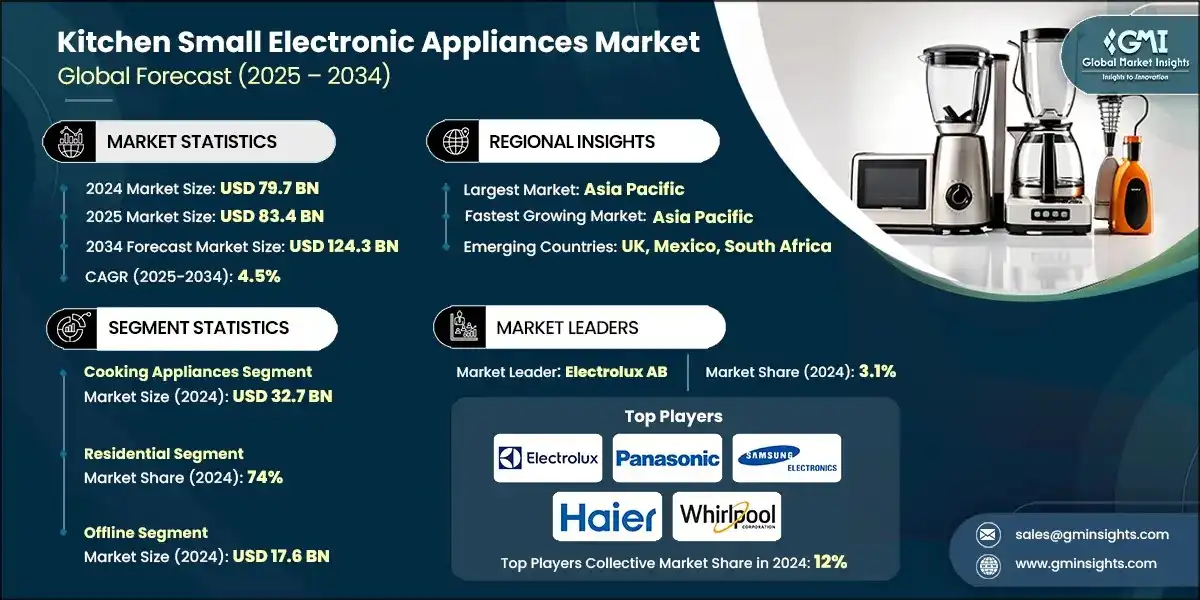
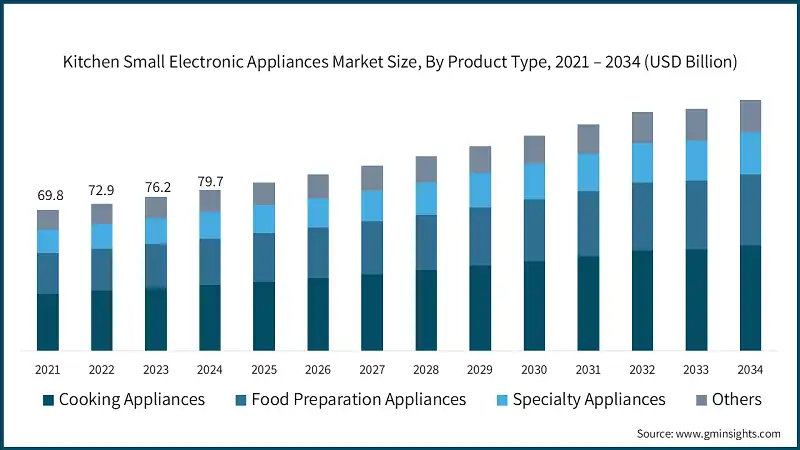
The global kitchen small electronic appliances market was estimated at USD 79.7 billion in 2024. The market is expected to grow from USD 83.4 billion in 2025 to USD 124.3 billion in 2034, at a CAGR of 4.5%, according to latest report published by Global Market Insights Inc.
Kitchen Small Electronic Appliances Market Key Takeaways
Market Size & Growth
- 2024 Market Size: USD 79.7 Billion
- 2025 Market Size: USD 83.4 Billion
- 2034 Forecast Market Size: USD 124.3 Billion
- CAGR (2025–2034): 4.5%
Key Market Drivers
- Smart & connected technology.
- Health & wellness trends.
- Rising disposable incomes.
- Changing lifestyles & urbanization.
Challenges
- High competition.
- Regulatory complexity.
Opportunity
- Smart kitchen ecosystem integration.
- Energy-efficient & eco-designed appliances.
Key Players
- Market Leader: Electrolux AB led with over 3.1% market share in 2024.
- Leading Players: Top 5 players in this market include Electrolux AB, Panasonic, Samsung Electronics, Haier, Whirlpool, which collectively held a market share of 12% in 2024.
Get Market Insights & Growth Opportunities
The incorporation of smart technologies into small cooking devices is changing how consumers look at these products. Wi-Fi-enabled coffee pots, air fryers and ovens are all excellent examples of devices allowing for remote control of product features like temperature or cooking time and also offer unique ways to customize cooking preferences through a mobile application or voice control. In addition to convenience, commercial users use this ability to predict maintenance needs and implement new software as required that will enhance their overall product experience and lengthen their lifespan; as a result, more consumers view the products as must-have when buying products for their Smart Homes.
In addition to providing convenience, in doing so, manufacturers are utilizing both Internet Connectivity and Artificial Intelligence to produce household appliances that learn about their owners' normal usage and preferences, and then can also assist in optimizing their owners' cooking practices; smart ovens can suggest recipes based on your current stock in your refrigerator, whereas smart blenders may let the users know how much Nutrition they are consuming, etc. These advanced technologies will not only provide added convenience but will also contribute toward the overall digitization of homes, and ultimately, they represent a major opportunity for future growth in the appliance market.
Prioritizing health-based lifestyles is causing a dramatic shift in how consumers are creating demand for kitchen appliances. Healthy kitchen appliances such as air fryers, steamers and juicers have increased in popularity, due to their ability to facilitate low-fat cooking and retain nutrients. Smoothie making blenders and other fitness-enthusiasts appliances continue to foster this trend by assisting in the speedy preparation of nutritious meals and snacks. The health-consciousness trend is especially strong among younger-age groups and among urban areas, where the need for speed meets the need for health benefits.
Furthermore, manufacturers are continuing to develop additional products that offer features like calorie tracking, portion control and integration with health apps. These additions present another benefit to consumers who are searching for an all-encompassing solution to managing their diet and wellness goals. As global awareness of healthy eating grows, manufacturers see a tremendous opportunity in creating kitchen appliances that simplify cooking healthy foods.
To get key market trends
Kitchen Small Electronic Appliances Market Trends
Rapidly changing technology, evolving consumer behaviors and increased consideration of healthy and sustainable living are accelerating growth in the kitchen small electronic appliance industry. As consumers desire kitchen appliances that provide convenience and multiple functions as well as smart connectivity, the design of kitchen appliances and the solutions offered by manufacturers to meet these demands is also advancing dramatically. The rapidly changing landscape of these products will continue to provide both new opportunities and competitive challenges across many international markets.
- Smart connectivity is changing the way that consumers use kitchen small electronic appliances. Kitchen appliances are becoming available with built-in Wi-Fi connectivity, Bluetooth technology and voice assistant capabilities, which allow consumers to monitor their kitchen appliances from anywhere in the home via mobile devices. As a result, consumers can set cooking schedules, make necessary adjustments and receive reminders for cooking tasks, all of which will make their lives easier and more productive. Manufacturers of kitchen appliances are also incorporating artificial intelligence features into their products to learn user preferences and to complete tasks such as recommending recipes and optimally timing cooking processes.
- A global shift to healthier lifestyles and improved nutrition is driving innovation in small kitchen appliances. The growing number of consumers looking for cooking appliances that promote low-fat and nutrient-dense meals, such as air fryers, steamers, and juicers, has led to the popularity of products with features such as calorie tracking, portion control, and integration with fitness apps. The strong demand for healthy, quick meal preparation by millennials and other urban professionals is a driving force behind this trend.
- Increasing environmental concerns coupled with regulatory requirements may be motivating manufacturers to pursue better environmental conditions through the implementation of energy-efficient motors and the use of sustainable raw materials, while at the same time ensuring compliance with international sustainability standards such as ENERGY STAR. Consumers, as a result of their growing awareness of the impact of appliances on the world's ecology, will increasingly purchase products that are designed to conserve energy and that are made from recyclable materials and that have been manufactured using lower carbon emissions.
- Urbanization and limited homes have created a growing demand for compact multi-functional kitchen gadgets that are designed to accommodate today's consumer's preference to purchase a product that serves multiple purposes/uses, and is therefore an economical choice. This versatility is suited to small-family homes, college students and young professionals who are residing in urban apartments, many of which have very limited kitchen areas. In addition, multi-functional kitchen appliances are in line with the current trend towards minimalism as consumers look to limit the number of products in their kitchens to just a few choice, multi-functional items.
Kitchen Small Electronic Appliances Market Analysis
Learn more about the key segments shaping this market
Based on product type, the market is divided into cooking appliances, food preparation appliances, specialty appliances and others. In 2024, cooking appliances held the major market share, generating a revenue of USD 32.7 billion.
- Cooking appliances make up the largest segment of small kitchen electronics, including air fryers, electric ovens, induction cooktops, and multi-cookers. These appliances have become extremely popular because they have streamlined the process of preparing a meal while allowing for precise, even cooking. Customers have increasingly gravitated towards compact, energy efficient cooking products that align with their busy schedules and urban living space limitations, as time and space constraints typically drive consumer purchasing decisions in urban centers.
- Manufacturers have begun incorporating technologies such as app-based control, programmable modes, and AI recipe suggestions, making the cooking process more convenient and customized for consumers. Consumers' growing concern for their health has increased the demand for cooking appliances that help them cook healthier foods using less oil or only water e.g., steam ovens, air fryers, and as this trend towards healthy living continues, cookware will continue to be viewed by consumers not only as a tool but also as a way to promote a healthy lifestyle.
- The cooking appliance market is growing as consumers continue to demand convenience, health, and sustainability. Manufacturers of cooking appliances have a unique opportunity to capitalize on this trend by developing cooking appliances that are energy efficient and environmentally friendly, while also incorporating smart features that make cooking more user-friendly.
Learn more about the key segments shaping this market
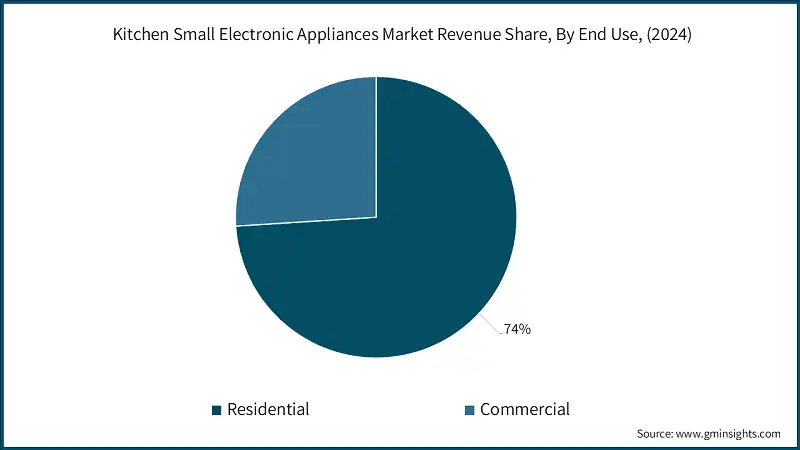
Based on end use, the kitchen small electronic appliances market is segmented into residential and commercial. The residential segment held the largest share, accounting for 74% of the global market in 2024.
- With increased urbanization, higher incomes among the middle class, and changes in lifestyle, the residential market has the largest market share of small kitchen electronic appliances. These households have started to invest more in appliances that help with convenience, speed, and multiple uses, creating a need for appliances such as air fryers, blenders, electric cooktops, and other similar appliances that are essential for daily food preparation. This trend is even bigger in larger metropolitan areas because of time constraints on people's ability to prepare meals, and due to living in smaller homes with a limited amount of space to cook in.
- The modern kitchen's focus on functionality and design is having an influence on the purchases of residential consumers. as such, residential consumers become interested in smart and connected kitchen appliances, they are seeking solutions that work seamlessly with their home automation systems. health-conscious consumers are also driving demand for kitchen appliances that promote healthy cooking, such as steamers and juicers.
- Innovation in the areas of energy efficiency, sustainable product design and multifunctional capability provides the greatest opportunity for growth in the residential segment. Compact space-saving designs and features that enhance convenience and personalization are appealing to urban households. Emerging markets will benefit from rising disposable incomes and increasing digital penetration as they begin to adopt these technologies.
Based on distribution channel, the kitchen small electronic appliances market is segmented into online and offline. In 2024, offline held a major market share generating a revenue of USD 17.6 billion.
- The fast-paced growth of e-commerce has made online distribution a dominant force in kitchen small electronic appliances. This rapid growth has been fueled by changing consumer shopping patterns, an increase in e-commerce platforms, and an overall increase in the number of people who are using digital marketplaces for their shopping needs. Digital marketplaces offer a tremendous level of convenience for consumers; they also offer consumers a much greater range of product selection, price comparisons and the ability to return items with little to no hassle.
- Online resources have become increasingly popular among customers, allowing consumers to research individual products, compare pricing, and find special offers. Additionally, reviews or ratings and content produced by influencers all greatly affect the way consumers ultimately decide what to buy. The top e-commerce platforms have started to support the increasing demand for personalization by utilizing ai in their shopping experiences. Companies are also beginning to offer virtual product demonstrations or utilize augmented reality solutions to assist customers when shopping. seasonal sales & promotion events, such as black friday and holiday sales, along with regional festivals, also result in the increase of online sales. Therefore, online appliance manufacturers will need to develop both digital marketing and an omnichannel strategy.
Looking for region specific data?
North America Kitchen Small Electronic Appliances Market
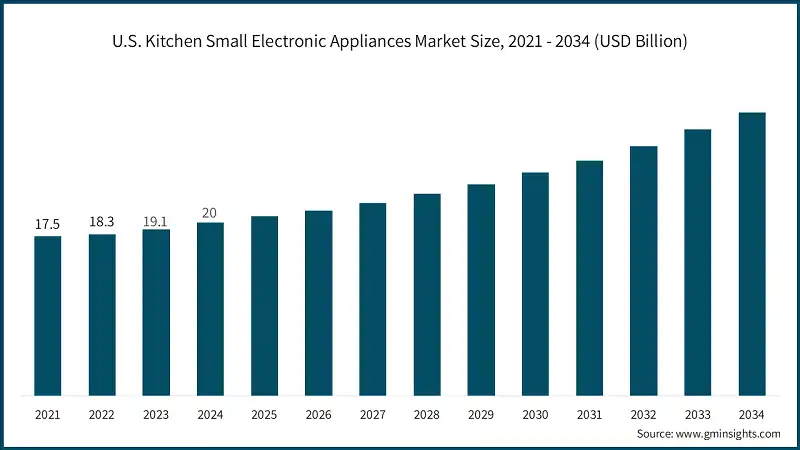
In 2024, the U.S dominated the North America market, accounting for around 84% and generating around USD 20 billion revenue in the same year.
- The market for small kitchen electronics in the U.S. is extremely developed and will continue to be fueled by new technologies, which are shaping the direction of consumer preference away from single eco products towards those that include smart technology, such as smart appliances, multi-functional equipment, and smart appliances with connected to other devices. The increase in disposable income, the availability of home ecosystems for the full integration of smart technology, and the increase in demand for healthy cooking options has resulted in increased demand for small kitchen appliances such as gladys appliances, home+cook.
- Consumer requirements and buying ability in North America differ greatly between the U.S., and Canada due to cultural and economic differences. The U.S. leads the way with technology adoption and premium products. In contrast, Canada is more concerned about the use of environmentally friendly and energy-efficient appliances. This is because online sales opportunities are also increasingly important throughout all three countries, as many consumers are now using digital technologies to make their purchases in order to save money and have more convenience when shopping.
Europe Kitchen Small Electronic Appliances Market
Europe market, Germany leads the market with 23% share in 2024 and is expected to grow at 4.9% during the forecast period.
- The European market for small kitchen appliances is well established but has continued to grow due to consumers' preference for devices that are energy-efficient and environmentally friendly. The EU Eco-Design Directive and other strict energy labeling requirements have encouraged manufacturers to introduce new sustainable and performance-enhancing technologies. There is an increasing number of people adopting healthier living practices throughout the continent, resulting in increased demand for appliances such as air fryers, steam ovens and juicers.
- The European market rises with opportunities for companies and brands to enter the emerging Smart Home Market and build Multi-Functional Appliances for the Limited Living Spaces typical of a modern urban environment. The European countries leading in the Adoption of Internet-connected appliance technology are Germany, France, and the UK, while Southern and Eastern Europe have the most potential for growth by way of providing affordable mid-range products.
Asia Pacific Kitchen Small Electronic Appliances Market
China leads with market share of around 32.7% in 2024 and is anticipated to grow with a CAGR of around 5.5% from 2025 to 2034.
- The Asia Pacific (APAC) Region continues to dominate the global kitchen small appliances market since it is home to the largest proportion of the world's population, Urbanization continues to grow dramatically and increasing amounts of disposable income are being generated within the APAC Region. The growth of APAC is fueled primarily by the enormous population growth of China, India, and Japan; along with this, the population's desire for modern lifestyles and products that save time and provide multiple functions. An additional factor driving Sales Growth within the APAC Region is the rapid growth in e-commerce as a result of the Digital Penetration of the region.
- Manufacturers of smart appliances have an unparalleled opportunity to create a huge market in Asia Pacific by manufacturing more affordable smart products for the growing number of mid-level households in APAC. Companies must offer innovative technology with a price point that is attractive to price-sensitive but digitally centric consumers in APAC. Both Energy Efficient and Sustainable solutions are becoming increasingly popular throughout the region; however, Japan and South Korea are currently leading in these types of solution.
Middle East and Africa Kitchen Small Electronic Appliances Market
Middle East and Africa kitchen small electronic appliances markets are growing at a CAGR of 3.8% during the forecast period.
- The MEA Region is a growing in market. This growth is due to urbanization, increasing disposable income, and modern retail/e-commerce penetration. Customers in the Middle East tend to prefer higher end/smart kitchen appliances that are aesthetically pleasing in their kitchens and other rooms. Customers in Africa tend to look for affordable and durable products; therefore, demand will be higher for basic multifunctional appliances that serve the needs of the growing middle class. Health-related trends are becoming more popular in urban areas, and these trends will drive purchases of products like air fryers/blenders.
- The creation of Localized Product Strategies and the expansion of digital distribution channels will create tremendous opportunities for growth in the Middle East and Africa that stems from the rapid rise of smartphone and digital payment systems which are promoting the expansion of e-commerce and other direct to consumer opportunities. Additionally, due to infrastructure challenges, the use of compact and energy efficient appliances is becoming more important in areas with smaller living spaces. As a result of the changing demographics, including digital transformation and continued development of a large consumer market in the MEA, this region offers strong potential for long-term growth.
Kitchen Small Electronic Appliances Market Share
Electrolux AB is leading with 3.1% market share. Electrolux AB, Panasonic, Samsung Electronics, Haier and Whirlpool collectively hold around 12%, indicating moderately fragmented market concentration. These prominent players are proactively involved in strategic endeavors, such as mergers & acquisitions, facility expansions & collaborations, to expand their product portfolios, extend their reach to a broad customer base, and strengthen their market position.
Breville's focus is on premium quality small kitchen appliances, along with its commitment to innovation through its high-end products such as espresso machines, blenders, and multicookers. Breville products have streamlined designs with sophisticated technology that make the user experience simple, thus lending the company a significant market share within certain segments where superior performance and appearance are of the utmost importance; this has attracted many customers who want professional-grade results when cooking in their own kitchens.
Philips takes a different health-centered approach to its products, focusing on health-orientated appliance solutions, such as air fryers, blenders, and pasta makers, that support the creation of healthy meals. Many Philips appliances also feature integrated digital platforms, allowing users to find recipes and personalize their cooking using their computers or other technology through mobile connectivity. Customers interested in creating healthy food options, achieving convenience, and using technology to connect with the world around them will be especially drawn to Philips.
Kitchen Small Electronic Appliances Market Companies
Major players operating in the kitchen small electronic appliances industry are:
- Bajaj Electricals
- Breville
- Daewoo
- Electrolux
- Haier Group
- Havells India
- Koninklijke Philips N.V.
- LG
- Morphy Richards
- Panasonic Group
- Robert Bosch
- Samsung Electronics
- V-Guard Industries
- Voltas
- Whirlpool
Electrolux is well-known for its emphasis on sustainable design and innovation. By providing eco-friendly and digitally progressive solutions, Electrolux meets the needs of those consumers who are looking for energy-efficient and network-capable kitchen products. In addition to providing many of the most expensive brands, Electrolux also serves as a trusted source of products in both "Traditional" kitchens and the "Smart" Kitchen market, which continues to gain momentum as it grows.
Panasonic’s approach to small kitchen appliances is both versatile and technological. Panasonic's collection of kitchen appliances consists of many items that come equipped with multiple cooking modes, including multifunctional cookers, toaster ovens, and bread makers that have many of the features of modern smart devices. Panasonic has developed a brand strategy that focuses on combining the reliability of the traditional kitchen with the added value of smart, modern features for busy, tech-savvy consumers who desire ease of use and the latest cooking solutions.
Kitchen Small Electronic Appliances Market Report Attributes
| Key Takeaway | Details |
|---|---|
| Market Size & Growth | |
| Base Year | 2024 |
| Market Size in 2024 | USD 79.7 Billion |
| Market Size in 2025 | USD 83.4 Billion |
| Forecast Period 2025 - 2034 CAGR | 4.5% |
| Market Size in 2034 | USD 124.3 Billion |
| Key Market Trends | |
| Drivers | Impact |
| Smart & connected technology | Provides greater demand for appliances with IoT functionality, smartphone application capabilities and integrated voice controls, which has created a higher sense of engagement with consumers through the development of premium quality products. |
| Health & wellness trends | Increases the sales of healthy cooking appliances (air fryers, steamers and juicers), based on the increase in consumer preference for low-fat cooking and preparing nutrient-rich foods. |
| Rising disposable incomes | Promotes the use of high-end multifunctional cooking products and has expanded the availability of a premium brand and market for smart kitchen ecosystems. |
| Changing lifestyles & urbanization | Increases the demand for compact and time-saving kitchen appliances designed for smaller kitchens and urban lifestyles on-the-go. |
| Pitfalls & Challenges | Impact |
| High competition | Mid-tier category commoditization and ongoing price competition are creating downward pressure on margin levels. |
| Regulatory complexity | Many manufacturers are now focusing on meeting safety, energy efficiency, and environmental compliance standards; therefore, increasing product development costs and restricting speed of product introduction. |
| Opportunities: | Impact |
| Smart kitchen ecosystem integration | Consumers want to experience seamless cooking experiences through linked appliance and home automation platforms. |
| Energy-efficient & eco-designed appliances | The increased demand among consumers for sustainable products will enable brands to differentiate themselves. |
| Market Leaders (2024) | |
| Market Leaders |
3.1% market share |
| Top Players |
The collective market share in 2024 is 12% |
| Competitive Edge |
|
| Regional Insights | |
| Largest Market | Asia Pacific |
| Fastest Growing Market | Asia Pacific |
| Emerging Country | UK, Mexico, South Africa |
| Future Outlook |
|
What are the growth opportunities in this market?
Kitchen Small Electronic Appliances Industry News
- In September 2025, During the International Fair for Electronics (IFA), Electrolux revealed their newest product, the Controlled Stone Baked Pizza Oven. This front-control oven has been designed for consumers who want an advanced appliance that gives them the high temperatures needed to create authentic Neapolitan-style pizzas within minutes and reflects Electrolux's continually growing consumer base of individuals who desire restaurant level cooking results in their own kitchens by incorporating leading edge design principles with cutting-edge engineering.
- In September 2025, Haier’s expanded the product range by releasing the Compact Coffee Machine Series 5 and an 11-Litre Dual Basket Air Fryer at IFA. The major features of these two products is that the fryer has independent temperature controls, allowing you to prepare multiple meals at different temperatures at once and the coffee machine offers an emphasis on ease of use and contemporary design
- In March 2025, Panasonic announced their latest product the new HomeCHEF Connect Four-ways-in-One Multi-Oven. A unique combination of the following microwave cooking, AirFry Cooking, Convection Oven Cooking, and Broiling all combined into one compact unit. The HomeCHEF Connect Multi-Oven has integrated smart connectivity with the use of the Kitchen+ app and offers intuitive controls to enable users a simplified approach to creating numerous meals effortlessly while enjoying a very smooth cooking experience every step of the way. The introduction of this very versatile cooking appliance speaks directly to Panasonic's ongoing focus on creating multi-functional products while also continuing their tradition of creating cutting-edge digital products to serve today's ever-changing consumer.
- In February 2025, Whirlpool Corporation exhibited multiple innovative technologies for small kitchen appliances across many of its well-known brands at KBIS. The JennAir brand revealed premium, sleek induction cooktops and upscale wine columns. In addition, KitchenAid revealed new updated color options, as well as several technological upgrades, designed to enhance the utility and beauty of its kitchen appliances. The Gallery of Care Collection from Whirlpool provided interactive innovation and improved design above what has previously been offered, illustrating Whirlpool's commitment to combining good design with cutting-edge technology for modern kitchens.
- In February 2025, Philips launched their Airfryer 3000 Series Single Basket. Designed to provide healthier cooking using the latest in RapidAir Plus technology, this new design has a clear viewing area so users can see the food cooking without opening the device, and 16 different cooking functions with easy-to-understand controls via an LCD touchscreen interface. Philips continues to support wellness as the best way to improve overall health by providing innovative and easy to use kitchen appliances.
The kitchen small electronic appliances market research report includes in-depth coverage of the industry with estimates & forecasts in terms of revenue (USD Billion) and volume (Thousand Units) from 2021 to 2034, for the following segments:
Market, By Product Type
- Cooking appliances
- Coffee makers
- Drip coffee makers
- Espresso machines
- Single-serve coffee makers
- Others (french press etc.)
- Toasters
- Two-slice toasters
- Four-slice toasters
- Toaster ovens
- Microwaves
- Solo microwaves
- Grill microwaves
- Others
- Hot plates
- Single hot plate
- Double hot plate
- Multi hot plate
- Cookers
- Others (electric kettles etc.)
- Coffee makers
- Food preparation appliances
- Fryers
- Air fryers
- Deep fryers
- Others
- Grinders
- Mixers
- Juicers
- Food processors
- Others (food dehydrators etc.)
- Fryers
- Specialty appliances
- Popcorn machines
- Ice cream makers
- Waffle makers
- Soda maker
- Others (hot dog machines etc.)
- Others (heating appliances etc.)
Market, By End Use
- Residential
- Commercial
- HoReCa
- Institutional
- Healthcare
- Others (Entertainment Centers, Tours & Travels, Sport Complex, etc.
Market, By Function
- Conventional
- Smart
- Wi-fi
- Bluetooth
- Others (Zigbee technology, etc.)
Market, By Distribution Channel
- Online
- E-commerce
- Company websites
- Offline
- Specialty stores
- Individual stores
- Others
The above information is provided for the following regions and countries:
- North America
- U.S.
- Canada
- Europe
- Germany
- UK
- France
- Italy
- Spain
- Asia Pacific
- China
- India
- Japan
- Australia
- South Korea
- Latin America
- Brazil
- Mexico
- Argentina
- Middle East and Africa
- South Africa
- Saudi Arabia
- UAE
Frequently Asked Question(FAQ) :
What is the market size of the global kitchen small electronic appliances industry in 2024?
The market size was USD 79.7 billion in 2024, with a CAGR of 4.5% expected through 2034, driven by smart & connected technologies and rising demand for multifunctional appliances.
What is the current kitchen small electronic appliances market size in 2025?
The market size is projected to reach USD 83.4 billion in 2025, supported by strong consumer adoption of healthy cooking appliances and digital kitchen ecosystems.
What is the projected value of the global kitchen small electronic appliances market by 2034?
The kitchen small electronic appliances industry is expected to reach USD 124.3 billion by 2034, driven by AI-enabled kitchen solutions, smart home integration, and increasing health-conscious consumer behavior.
How much revenue did the cooking appliances segment generate in 2024?
Cooking appliances generated USD 32.7 billion in 2024, fueled by rising demand for air fryers, induction cooktops, multi-cookers, and other energy-efficient appliances that enable fast and healthy meal preparation.
What was the valuation of the offline distribution channel in 2024?
The offline channel generated USD 17.6 billion in 2024. Growth is supported by strong brand presence in specialty stores and continued consumer preference for in-store product evaluation.
Which region leads the kitchen small electronic appliances market?
The U.S. led the North America market in 2024, accounting for 84% share and generating approximately USD 20 billion in revenue. Its dominance is driven by strong consumer adoption of smart appliances, higher disposable incomes, and rapid integration of connected home ecosystems across households.
What are the upcoming trends in the kitchen small electronic appliances industry?
Key trends include AI-enabled cooking suggestions, IoT-based smart connectivity, multi-functional compact appliances for small urban spaces, and growing demand for energy-efficient and eco-designed products.
Who are the key players in the global kitchen small electronic appliances market?
Key players include Electrolux AB, Panasonic, Samsung Electronics, Haier, Whirlpool, Breville, Philips, Havells, LG, Morphy Richards, Robert Bosch, V-Guard Industries, Voltas, Bajaj Electricals, and Daewoo.
Kitchen Small Electronic Appliances Market Scope
Related Reports