Summary
Table of Content

Inhalation Anesthesia Market
Get a free sample of this report
Form submitted successfully!
Error submitting form. Please try again.
Thank you!
Your inquiry has been received. Our team will reach out to you with the required details via email. To ensure that you don't miss their response, kindly remember to check your spam folder as well!
Request Sectional Data
Thank you!
Your inquiry has been received. Our team will reach out to you with the required details via email. To ensure that you don't miss their response, kindly remember to check your spam folder as well!
Form submitted successfully!
Error submitting form. Please try again.
Inhalation Anesthesia Market Size
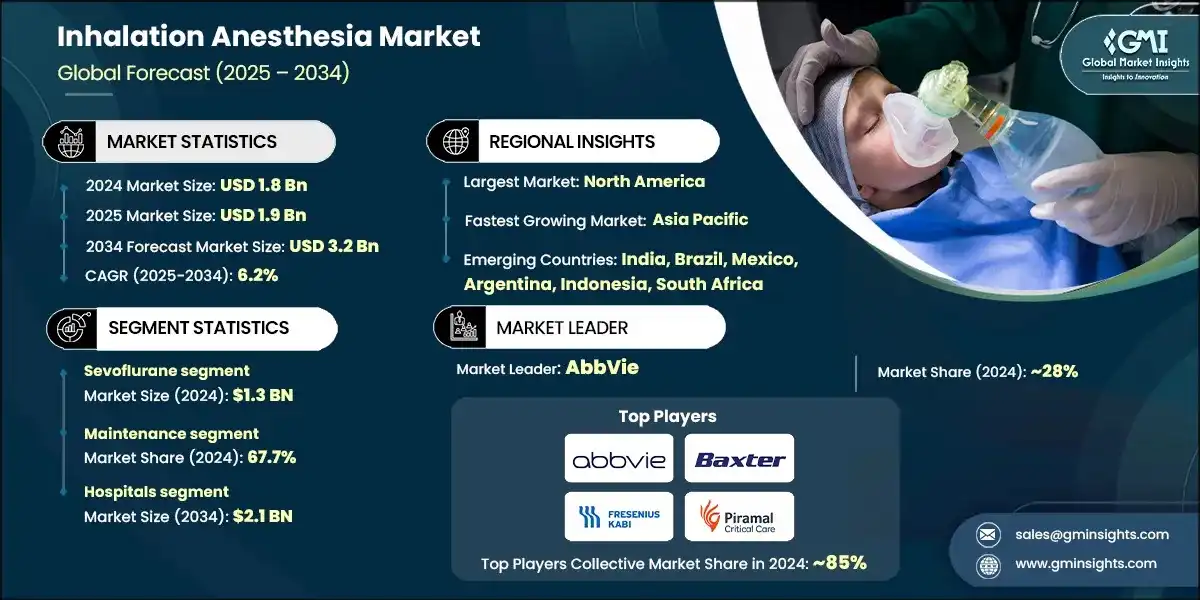
The global inhalation anesthesia market was valued at USD 1.8 billion in 2024. The market is anticipated to grow from USD 1.9 billion in 2025 to USD 3.2 billion in 2034, growing at a CAGR of 6.2% during the forecast period, according to the latest report published by Global Market Insights Inc. The market is experiencing significant growth driven by the growing aging population and rising chronic disease prevalence. These conditions often necessitate surgical intervention, both elective and emergency, prompting the need for effective anesthesia solutions to foster market growth.
Inhalation Anesthesia Market Key Takeaways
Market Size & Growth
- 2024 Market Size: USD 1.8 Billion
- 2025 Market Size: USD 1.9 Billion
- 2034 Forecast Market Size: USD 3.2 Billion
- CAGR (2025–2034): 6.2%
Key Market Drivers
- Rising surgical volume.
- Technological advancement in anesthesia delivery systems.
- Growing prevalence of chronic diseases.
- Global rise in ambulatory surgical centers (ASCs).
Challenges
- High setup costs.
- Postoperative side effects.
Opportunity
- Anesthesia recycling systems.
- Expansion in emerging markets.
Key Players
- Market Leader: AbbVie led with over 28% market share in 2024.
- Leading Players: Top 5 players in this market include Piramal Critical Care, Fresenius Kabi, Baxter, AbbVie, which collectively held a market share of 85% in 2024.
Get Market Insights & Growth Opportunities
Inhalation anesthesia refers to the administration of an anesthetic agent through inhalation, allowing rapid induction and recovery during surgical procedures. Its wide acceptance is primarily reflected in its compliance, non-invasiveness and efficiency in maintaining anesthesia depth. The key players in the industry include AbbVie, Baxter, Fresenius Kabi, and Piramal Critical Care, focusing on innovation, eco-friendly agents, and expanding presence in emerging markets.
Technological advancements in anesthesia delivery systems are significantly enhancing the accuracy, safety, and efficiency of inhalational anesthetics. Advanced anesthesia machines integrated with vaporizers, monitor exhaled CO2, and automate agent delivery, reducing human error and minimizing waste of expensive drugs. Innovations like closed-loop systems, low-flow techniques, and AI-driven real-time monitoring are improving patient outcomes and drug usage. These improvements enable faster induction and recovery, making inhalational anesthesia increasingly popular across diverse healthcare settings, boosting market growth.
Furthermore, the expanding ambulatory surgical centers (ASCs) are significantly influencing market demand. As ASCs prioritize efficiency, shorter recovery times, and cost-effectiveness, inhalable anesthetic agents with rapid onset and recovery like sevoflurane and desflurane are highly desirable. These agents enable rapid patient turnover and reduced hospital stays, aligning with ASC goals. As outpatient procedures are gradually rising, the demand for fast-acting, controllable inhalational anesthetics continues to grow, driving market expansion and innovation in delivery systems.
Inhalational anesthesia refers to the administration of anesthetic agents via the lungs, through a face mask, endotracheal tube, or laryngeal mask airway. These anesthetic agents, delivered as gases or vapors, enter the bloodstream through pulmonary absorption and act on the central nervous system (CNS) to induce unconsciousness, amnesia, and muscle relaxation. Their non-invasive nature, rapid onset, and controllability make them vital in surgical interventions, significantly influencing market demand and innovation.
To get key market trends
Inhalational Anesthesia Market Trends
- The inhalational anesthesia market is currently shaped by rising surgical volumes, particularly in aging populations and patients with chronic diseases.
- According to recent statistics reported by the World Health Organization (WHO), over 230 million surgical procedures were performed annually, worldwide, with a significant portion necessitating general anesthesia drugs via inhalation or injection. Additionally, the Centers for Disease Control and Prevention (CDC) informed that, in 2022 the U.S. alone recorded over 155.4 million emergency hospital visits, with 43.5 million injury-related visits, demonstrating substantial demand for medical interventions. The complexity and diversity of emergency surgeries have increased the availability and development of potential anesthetic options.
- The market growth is further influenced by the growing technological advancements, such as closed-loop delivery systems and AI-integrated monitoring are improving precision, safety, and efficiency in anesthesia administration. These innovations are driving demand in both hospital and ambulatory surgical settings, where rapid induction and recovery are critical.
- Moreover, the preference for minimally invasive procedures and shorter hospital stays is boosting the adoption of agents like sevoflurane and desflurane.
- Also, developing eco-friendly anesthetic agents and portable delivery systems tailored for low-resource settings could unlock significant growth potential.
Inhalational Anesthesia Market Analysis
Learn more about the key segments shaping this market
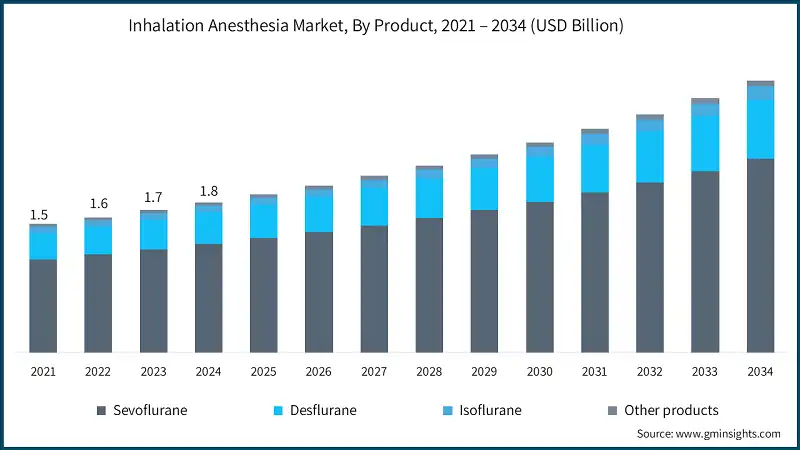
Based on product, the global inhalation anesthesia market is segmented into sevoflurane, desflurane, isoflurane, and other products. The sevoflurane segment held a dominant position in the market, valuing USD 1.3 billion in 2024, and is expected to dominate throughout the forecast period.
- Sevoflurane acceptance is attributed to its favorable clinical properties, including a low blood-gas partition coefficient that enables rapid induction and recovery, ideal for pediatric and outpatient surgeries.
- Its mild airway irritation makes it suitable for mask induction, particularly in pediatrics.
- With a strong safety profile, ease of use, and compatibility with low-flow techniques, it has strengthened Sevoflurane preference in routine practice.
- With growing global surgical volumes and advancements in anesthesia delivery systems further supporting its widespread adoption and continued market dominance.
- On the other hand, the isoflurane segment is poised to grow significantly in the coming years, due to its cost-effectiveness, widespread availability, and established use in developing regions. Its stability and familiarity among anesthesiologists further support its increasing adoption.
Learn more about the key segments shaping this market
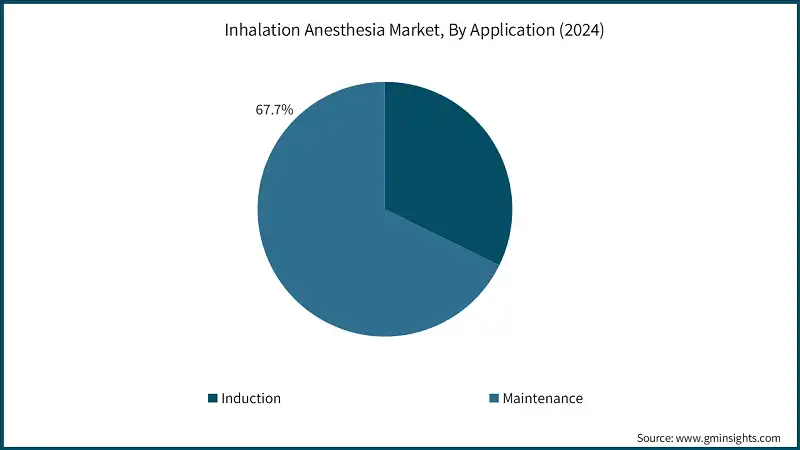
Based on application, the inhalation anesthesia market is categorized into induction and maintenance. The maintenance segment accounted for the highest market share of 67.7% in 2024. The maintenance segment dominance is driven by its critical role in sustaining anesthesia during lengthy and complex surgical procedures.
- The prominence of the maintenance segment is largely driven by the rising number of complex surgeries in specialties such as orthopedics, cardiology, oncology, and neurology.
- Volatile anesthetics like sevoflurane, desflurane, and isoflurane are preferred for their rapid adjustability, low toxicity, and suitability for prolonged procedures.
- Additionally, the growing demand for outpatient surgeries underscores the need for rapid and efficient maintenance, making this segment a key contributor to market growth.
- On the other hand, the induction segment is poised for significant growth in the coming years due to increasing demand for rapid-onset anesthesia, particularly in outpatient and emergency procedures, where rapid patient sedation and recovery are vital.
Based on end use, the global inhalation anesthesia market is categorized into hospitals, ambulatory surgical centers, and other end users. The hospitals segment is expected to witness high growth to reach USD 2.1 billion by 2034 due to the increasing number of complex and high-volume surgeries performed in hospital settings.
- Hospitals are equipped with advanced anesthesia delivery systems and staffed by experienced anesthesiologists, ensuring safe and efficient administration of inhalational agents.
- Additionally, the rising prevalence of chronic diseases and trauma cases is driving surgical demand, further boosting anesthetic consumption.
- In addition, favorable reimbursement policies and government support for hospital infrastructure further support the growth. As a result, hospitals remain the primary end users, contributing significantly to market expansion during the forecast period.
- On the other hand, the ASCs segment is poised for significant growth due to rising demand for outpatient procedures, cost-effectiveness, shorter recovery times, and increasing adoption of advanced anesthesia technologies.
Looking for region specific data?
North America Inhalation Anesthesia Market
North America accounted for 51.7% market share in the inhalation anesthesia market in 2024 and is anticipated to witness high growth during the forecast timeframe.
- North America leadership is driven by advanced healthcare infrastructure, high surgical volumes, and widespread adoption of modern anesthesia technologies.
- The region benefits from strong clinical research, skilled anesthesiologists, and a growing preference for outpatient procedures, which require fast-acting and efficient anesthetic agents.
- The U.S. leads the market with consistent year-on-year growth, supported by innovation, sustainability initiatives, and strategic partnerships among pharmaceutical and device companies.
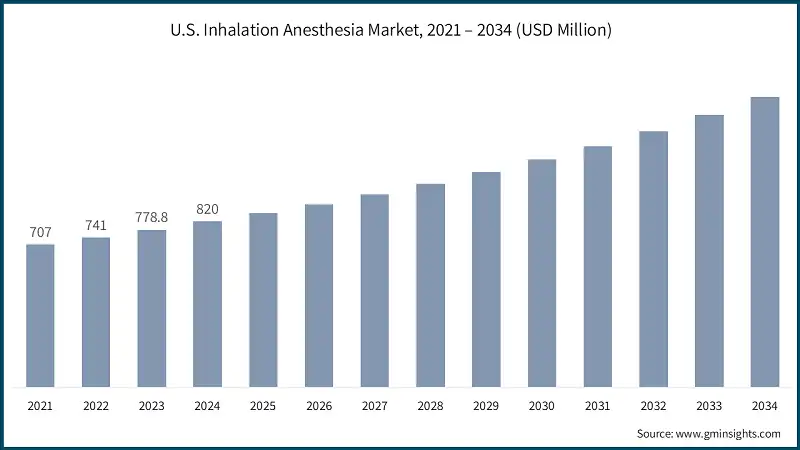
The U.S. market was valued at USD 707 million and USD 741 million in 2021 and 2022, respectively. The market size reached USD 820 million in 2024, growing from USD 778.8 million in 2023.
- U.S. dominance is attributed to several factors, such as the increasing surgical procedures, technological advancements in anesthesia delivery systems, and a growing preference for outpatient surgeries.
- The consistent growth reflects strong demand for efficient and safe anesthetic agents, supported by robust healthcare infrastructure and innovation in the country.
- In addition, continued investment in clinical research and sustainable anesthesia practices, expanding the market penetration, reinforces U.S. leadership in the North American market.
Europe Inhalation Anesthesia Market
The European market held a revenue of USD 399.4 million in 2024 and is anticipated to exhibit lucrative growth over the forecast period.
- The European market growth is driven by high surgical volumes, aging populations, and increasing adoption of advanced anesthesia technologies across key countries like Germany, France, and the UK.
- The region benefits from well-established healthcare infrastructure, skilled medical professionals, and strong regulatory frameworks that support innovation and safety.
- Additionally, the shift toward outpatient procedures and environmentally sustainable anesthesia practices is boosting demand for efficient inhalational agents.
- Furthermore, strategic collaborations and product advancements are expected to further accelerate market expansion.
Germany dominates the European Inhalation Anesthesia Market, showcasing strong growth potential.
- Germany’s strong growth potential is reflected in its advanced healthcare infrastructure, high surgical volumes, and early adoption of innovative anesthesia technologies.
- The country benefits from a well-established network of hospitals and surgical centers, supported by skilled anesthesiologists and robust regulatory frameworks.
- Germany’s focus on patient safety, environmental sustainability, and precision medicine is driving demand for high-quality inhalational agents and modern delivery systems.
- Additionally, collaborations between global pharmaceutical companies and German healthcare providers are accelerating the adoption of next-generation anesthesia solutions, reinforcing the country’s leadership position in the European market.
Asia Pacific Inhalation Anesthesia Market
The Asia Pacific inhalation anesthesia is anticipated to witness significant growth over the analysis timeframe.
- The Asia Pacific's potential growth is driven by rising surgical procedures, expanding healthcare infrastructure, and increasing adoption of advanced anesthesia technologies.
- Countries like China, India, and Southeast Asia are witnessing a surge in chronic diseases and trauma cases, leading to higher surgical volumes.
- Additionally, government initiatives to modernize healthcare systems and improve access to quality surgical care are further fueling demand.
- Also, the growing popularity of outpatient surgeries and the presence of both global and regional manufacturers are enhancing product availability and affordability, positioning the Asia Pacific as a key growth engine in the global market.
China is anticipated to grow significantly within the Asia Pacific inhalation anesthesia market.
- China's robust growth is driven by its rapidly expanding healthcare infrastructure, rising surgical volumes, and increasing adoption of advanced medical technologies.
- Government initiatives to modernize hospitals and improve surgical care access are driving demand for efficient anesthesia solutions.
- Additionally, the growing elderly population and prevalence of chronic diseases are contributing to higher surgical intervention rates.
- China's strong domestic manufacturing capabilities and strategic partnerships with global pharmaceutical and device companies are enhancing product availability and affordability. These factors position China as a key driver of regional market expansion in the coming years.
Latin America Inhalation Anesthesia Market
Brazil is projected to witness significant growth in the Latin America market in the coming years.
- Brazil is projected to witness substantial growth driven by expanding healthcare infrastructure, rising surgical volumes, and increasing adoption of advanced medical technologies.
- Government investments in public health and private sector expansion are driving demand for efficient anesthesia solutions.
- Additionally, the growing prevalence of chronic diseases and a shift toward outpatient procedures are boosting the need for fast-acting inhalational agents.
- Brazil’s strategic partnerships with global pharmaceutical and device companies are enhancing product availability and affordability. These factors position Brazil as a key growth engine for the Latin American inhalational anesthesia market in the coming years.
Middle East And Africa Inhalation Anesthesia Market
Saudi Arabia is poised to witness substantial growth in the Middle East and Africa market during the forecast period.
- Saudi Arabia is poised for substantial growth due to its expanding healthcare infrastructure, rising surgical volumes, and government-led modernization under Vision 2030.
- Investments in hospital upgrades and medical workforce training are increasing access to advanced anesthesia technologies.
- The country’s focus on improving surgical outcomes and adopting global best practices is driving demand for efficient inhalational agents.
- For example, the King Faisal Specialist Hospital has integrated modern anesthesia delivery systems, reflecting the broader national trend toward high-quality surgical care. These developments position Saudi Arabia as a regional leader in anesthesia innovation and adoption.
Inhalation Anesthesia Market Share
The market is moderately consolidated, with a few global players dominating due to strong portfolios and manufacturing capabilities. The top four leading players, including Baxter, AbbVie, Fresenius Kabi, and Piramal Critical Care, collectively account for nearly 85% of the market share. These companies are leading in supplying key agents like sevoflurane, desflurane, and isoflurane. For example, Baxter stands out with its sustainability-focused CONTRAfluran system, while Piramal emphasizes global reach and U.S.-based production. Fresenius Kabi and AbbVie leverage hospital networks and research and development strength.
Competition is intensifying with emerging and regional players entering the market, particularly in the Asia-Pacific and Latin America. Key differentiators include product purity, sustainability initiatives, regulatory compliance, and strategic hospital partnerships. As outpatient surgeries and environmental concerns rise, innovation and cost-efficiency will shape future market dynamics.
Inhalation Anesthesia Market Companies
A few of the prominent players operating in the inhalation anesthesia industry include:
- AbbVie
- Aetos Pharma
- Baxter
- Fresenius Kabi
- Halocarbon
- Linde
- Lunan Pharmaceutical
- Piramal Critical Care
- Raman & Weil
- Troikaa Pharmaceuticals
- AbbVie
AbbVie leverages its legacy Allergan portfolio to offer high-purity sevoflurane, known for its rapid onset and recovery. Its strong research and development capabilities and global distribution network ensure consistent supply and innovation in inhalational anesthetic solutions.
Baxter is the only global supplier of all three modern inhaled anesthetics, sevoflurane, desflurane, and isoflurane, packaged in recyclable aluminum bottles. Its CONTRAfluran gas capture system highlights its commitment to sustainability and environmental responsibility.
Fresenius Kabi offers cost-effective, high-quality inhalational anesthetics with a focus on accessibility in both developed and emerging markets. Its integrated supply chain and hospital-focused portfolio support efficient delivery and patient safety in critical care settings.
Piramal is the world’s third-largest manufacturer of inhaled anesthetics, offering sevoflurane, desflurane, and isoflurane. With U.S. based manufacturing and presence in 100+ countries, it emphasizes quality, global reach, and strong hospital partnerships.
Inhalation Anesthesia Market Report Attributes
| Key Takeaway | Details |
|---|---|
| Market Size & Growth | |
| Base Year | 2024 |
| Market Size in 2024 | USD 1.8 Billion |
| Market Size in 2025 | USD 1.9 Billion |
| Forecast Period 2025 - 2034 CAGR | 6.2% |
| Market Size in 2034 | USD 3.2 Billion |
| Key Market Trends | |
| Drivers | Impact |
| Rising surgical volume | Increasing surgical procedures worldwide, driven due to aging populations, trauma cases, and chronic diseases, are significantly boosting demand for inhalational anesthetics. |
| Technological advancement in anesthesia delivery systems | Innovations like smart vaporizers, closed-loop systems, and AI-assisted monitoring are enhancing precision, safety, and efficiency in anesthesia administration, stimulating market growth. |
| Growing prevalence of chronic diseases | Chronic conditions such as cancer, cardiovascular diseases, and orthopedic conditions often require surgery, driving consistent demand for effective anesthesia solutions. |
| Global rise in ambulatory surgical centers (ASCs) | The expansion of ASCs is increasing outpatient surgeries, creating demand for fast-acting, cost-effective inhalational anesthetics suitable for short procedures. |
| Pitfalls & Challenges | Impact |
| High setup costs | Initial investment in anesthesia machines, vaporizers, and monitoring systems can be prohibitive for smaller hospitals and clinics, limiting market penetration. |
| Postoperative side effects | Side effects like nausea, vomiting, and cognitive dysfunction post-surgery may deter clinicians from using inhalational agents in certain patient populations. |
| Opportunities: | Impact |
| Anesthesia recycling systems | Emerging technologies to capture and reuse anesthetic gases can reduce environmental impact and operational costs, offering sustainable growth opportunities. |
| Expansion in emerging markets | Increasing healthcare infrastructure and surgical access in Asia-Pacific, Latin America, and MEA present untapped potential for inhalational anesthesia adoption. |
| Market Leaders (2024) | |
| Market Leaders |
~28% |
| Top Players |
Collective market share in 2024 is ~85% |
| Competitive Edge |
|
| Regional Insights | |
| Largest Market | North America |
| Fastest Growing Market | Asia Pacific |
| Emerging Country | India, Brazil, Mexico, Argentina, Indonesia, South Africa |
| Future Outlook |
|
What are the growth opportunities in this market?
Inhalation Anesthesia Industry News
- In April 2025, Piramal Pharma expanded its commercial production of Sevoflurane in Telangana, India, by adding its manufacturing capacity at its Digwal facility. This complements its existing site in Bethlehem, U.S. This strategic expansion is aimed at strengthening Piramal’s supply capability and boosting Sevoflurane production in the Indian market.
- In September 2021, Sedana Medical AB received approval from Germany’s BfArM for the Sedaconda (isoflurane) to be administered via the AnaConDa device for sedation in intensive care. This approval marked a significant advancement in intensive care sedation, expanding treatment options for critically ill patients. It also strengthens Sedana’s position in the European market and reflects growing demand for innovative, device-integrated anesthetic solutions—contributing to the overall growth of the inhalational anesthesia market.
- In April 2020, Blue-Zone received the approval by Health Canada of a Drug Identification Number (DIN) for the desflurane drug. The DIN permits Blue-Zone to produce and commercialize the launch of its branded generic drug. The approval marked a milestone, strengthening the domestic supply of anesthesia gases in hospitals.
The inhalation anesthesia market research report includes in-depth coverage of the industry with estimates and forecast in terms of revenue in USD Million from 2021 - 2034 for the following segments:
Market, By Product
- Sevoflurane
- Desflurane
- Isoflurane
- Other products
Market, By Application
- Induction
- Maintenance
Market, By End Use
- Hospitals
- Ambulatory surgical centers
- Other end use
The above information is provided for the following regions and countries:
- North America
- U.S.
- Canada
- Europe
- Germany
- UK
- France
- Spain
- Italy
- Netherlands
- Asia Pacific
- China
- Japan
- India
- Australia
- South Korea
- Latin America
- Brazil
- Mexico
- Argentina
- Middle East and Africa
- Saudi Arabia
- South Africa
- UAE
Frequently Asked Question(FAQ) :
What is the market size of the inhalation anesthesia in 2024?
The market size was USD 1.8 billion in 2024, with a CAGR of 6.2% expected through 2034 driven by rising surgical volumes, aging populations, and growing prevalence of chronic diseases.
What is the projected value of the inhalation anesthesia market by 2034?
The market is expected to reach USD 3.2 billion by 2034, driven by technological advancements in anesthesia delivery systems, eco-friendly agents, and expansion of ambulatory surgical centers.
What is the projected size of the inhalation anesthesia industry in 2025?
The inhalation anesthesia market is expected to reach USD 1.9 billion in 2025.
How much revenue did the sevoflurane segment generate?
The sevoflurane segment generated USD 1.3 billion in 2024, dominating the market due to its favorable clinical properties and rapid induction and recovery profile.
What was the valuation of the maintenance application segment?
The maintenance application segment accounted for 67.7% market share in 2024, making it the leading application in sustaining anesthesia during lengthy and complex surgical procedures.
Which region leads the inhalation anesthesia market?
North America led with 51.7% share in 2024, supported by advanced healthcare infrastructure, high surgical volumes, and widespread adoption of modern anesthesia technologies.
What are the upcoming trends in the inhalation anesthesia industry?
Key trends include adoption of AI-assisted monitoring, closed-loop delivery systems, anesthesia recycling technologies, and development of eco-friendly anesthetic agents.
Who are the key players in the inhalation anesthesia market?
Key players include AbbVie, Baxter, Fresenius Kabi, Piramal Critical Care, Aetos Pharma, Halocarbon, Linde, Lunan Pharmaceutical, Raman & Weil, and Troikaa Pharmaceuticals.
Inhalation Anesthesia Market Scope
Related Reports