Summary
Table of Content

Industrial Communication Market
Get a free sample of this report
Form submitted successfully!
Error submitting form. Please try again.
Thank you!
Your inquiry has been received. Our team will reach out to you with the required details via email. To ensure that you don't miss their response, kindly remember to check your spam folder as well!
Request Sectional Data
Thank you!
Your inquiry has been received. Our team will reach out to you with the required details via email. To ensure that you don't miss their response, kindly remember to check your spam folder as well!
Form submitted successfully!
Error submitting form. Please try again.
Industrial Communication Market Size
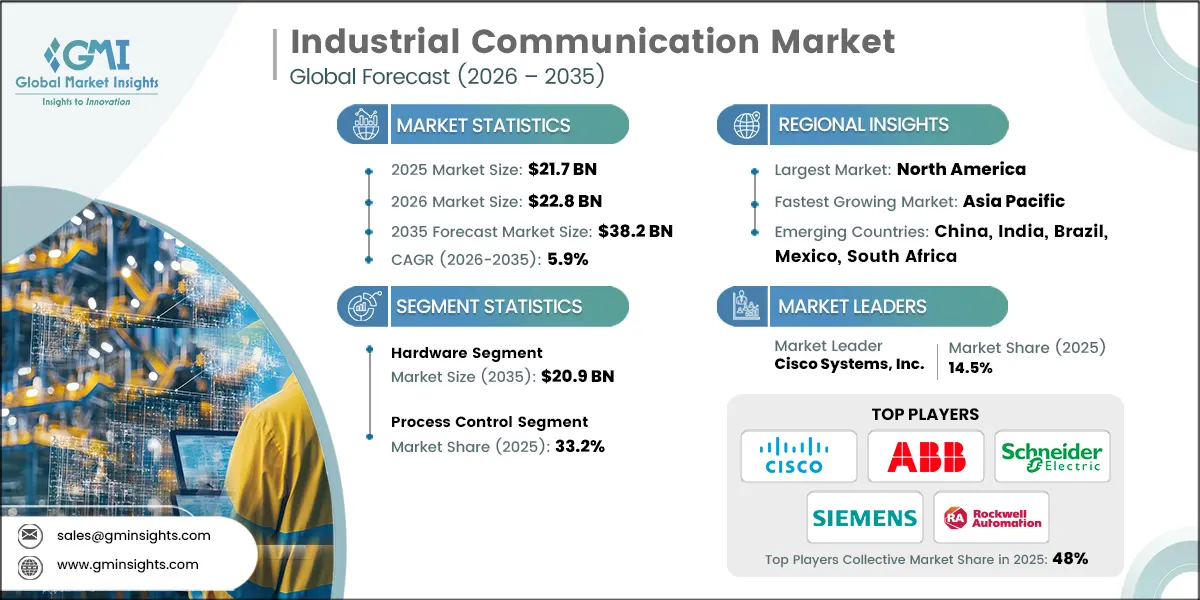
The global industrial communication market was valued at USD 21.7 billion in 2025. The market is expected to grow from USD 22.8 billion in 2026 to USD 38.2 billion in 2035, at a CAGR of 5.9% during the forecast period according to the latest report published by Global Market Insights Inc.
Industrial Communication Market Key Takeaways
Market Size & Growth
- 2025 Market Size: USD 21.7 Billion
- 2026 Market Size: USD 22.8 Billion
- 2035 Forecast Market Size: USD 38.2 Billion
- CAGR (2026–2035): 5.9%
Regional Dominance
- Largest Market: North America
- Fastest Growing Region: Asia Pacific
Key Market Drivers
- Expansion of industrial internet of things (IIoT) ecosystems.
- Growth in connected and autonomous industrial equipment.
- Integration of advanced technologies (robotics, AI, digital twins).
- Demand for seamless IT–OT convergence across industrial facilities.
- Growing emphasis on industrial cybersecurity and network resilience.
Challenges
- High initial deployment and integration costs.
- Interoperability challenges across multiple communication protocols.
Opportunity
- Emergence of private industrial 5G and time-sensitive networking (TSN).
- Expansion of industrial communication in small and mid-sized manufacturing facilities.
Key Players
- Market Leader: Cisco Systems, Inc. led with over 14.5% market share in 2025.
- Leading Players: Top 5 players in this market include Cisco Systems, Inc., Siemens AG, Rockwell Automation, Inc., Schneider Electric SE, ABB Ltd., which collectively held a market share of 48% in 2025.
Get Market Insights & Growth Opportunities
The increasing adoption of advanced technologies like robotics, artificial intelligence, and digital twins is a major growth factor for the industrial communication market, as these technologies need high-speed, reliable, and interoperable communication networks to work effectively. For example, robotics and artificial intelligence need continuous real-time communication between sensors, controllers, and platforms to enable autonomous decision-making, control, and optimization. Another example is digital twins, which need seamless communication between various equipment in a production facility to virtually reflect physical operations. These trends were also highlighted in a recent announcement made by SPIE France in January 2026, where it declared the large-scale deployment of its AI Hub across French subsidiaries to accelerate digital transformation and operational efficiency. These announcements highlight how advanced digital technologies are driving a need for reliable industrial communication infrastructures that can support data-intensive, intelligent, and connected industrial environments.
The rising interconnectivity of industrial infrastructures has raised the importance of cybersecurity and network availability as a strategic priority for manufacturers. With the growing presence of connected devices, edge systems, and cloud connectivity in production environments, the vulnerability to cyber threats, data theft, and network downtime has increased substantially. This has prompted industries to invest in communication networks that possess inherent security capabilities such as encryption, authentication, network separation, and redundancy, thereby ensuring uninterrupted and secure operation. The challenge of securing critical infrastructure and ensuring high availability and deterministic performance is set to make secure industrial communication architecture a basic enabler of industrial operations.
To get key market trends
Industrial Communication Market Trends
- Industrial Ethernet technology has been replacing traditional fieldbus solutions owing to their higher bandwidth capabilities. Manufacturers are adopting industrial Ethernet technology as a basis for their architecture to cater to data-intensive applications with real-time control capabilities.
- Wireless communication systems, including industrial Wi-Fi and private 5G networks, are also gaining popularity in industrial environments for the implementation of flexible production systems. Wireless communication systems provide the required communication in complex industrial environments with reduced costs of cables and time required for deployment.
- Manufacturing industries are focusing on achieving low latency communication solutions that support high-end automation solutions with deterministic communication capabilities. Time sensitive networking technology has been increasingly adopted as a means of achieving deterministic communication solutions.
- Edge computing is being integrated with industrial communication systems to enable data processing closer to machines and sensors. This is reducing latency and enabling real-time analytics and decision-making.
- The boundary between IT and OT environments is increasingly blurring, and this is creating a need for unified communication platforms. This is making it possible to monitor and manage industrial operations centrally.
Industrial Communication Market Analysis
Learn more about the key segments shaping this market
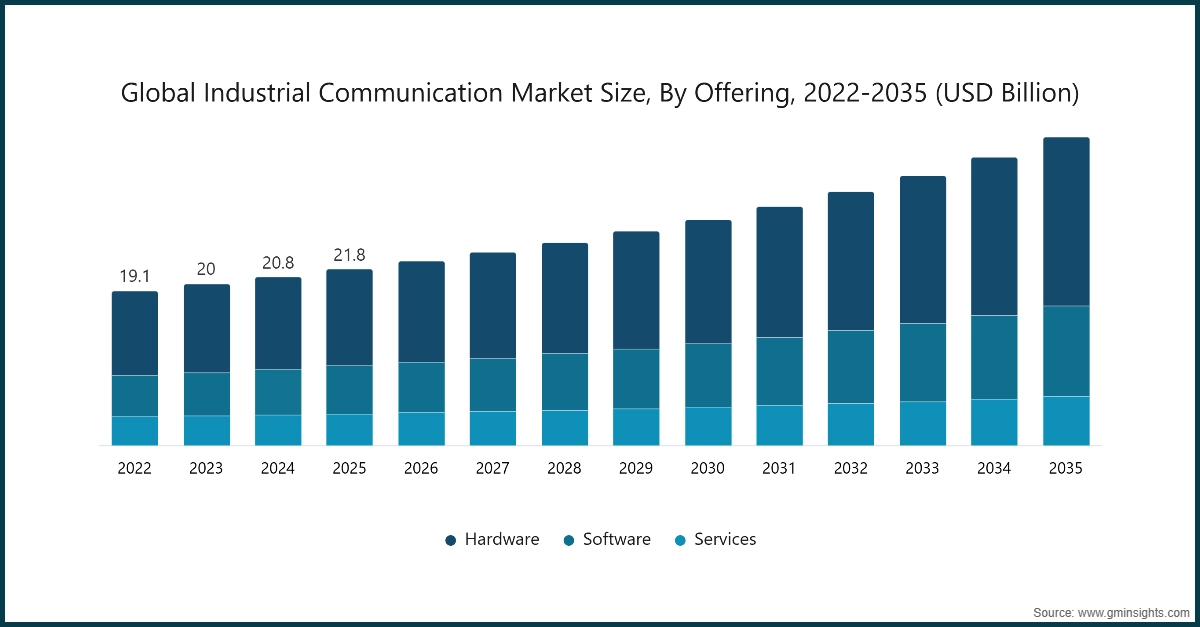
On the basis of offering, the market is segmented into hardware, software and services.
- The hardware segment is anticipated to reach USD 20.9 billion by 2035. Increasing adoption of ruggedized communication hardware designed to operate reliably in harsh industrial environments with high temperature, vibration, and electromagnetic interference.
- Rising integration of edge devices and embedded connectivity modules to support real-time data processing and low-latency communication.
- The software segment was valued at USD 5.9 billion in 2025 and is anticipated to grow at a CAGR of 6.7% over the forecast years. Rising deployment of centralized and software-defined industrial communication platforms for network configuration, diagnostics, and performance monitoring.
- Advanced analytics, AI, and digital twin technologies are being increasingly incorporated as part of the software layers to improve the optimization of the network, predict failures, and improve visibility in the distributed industrial environment.
Learn more about the key segments shaping this market
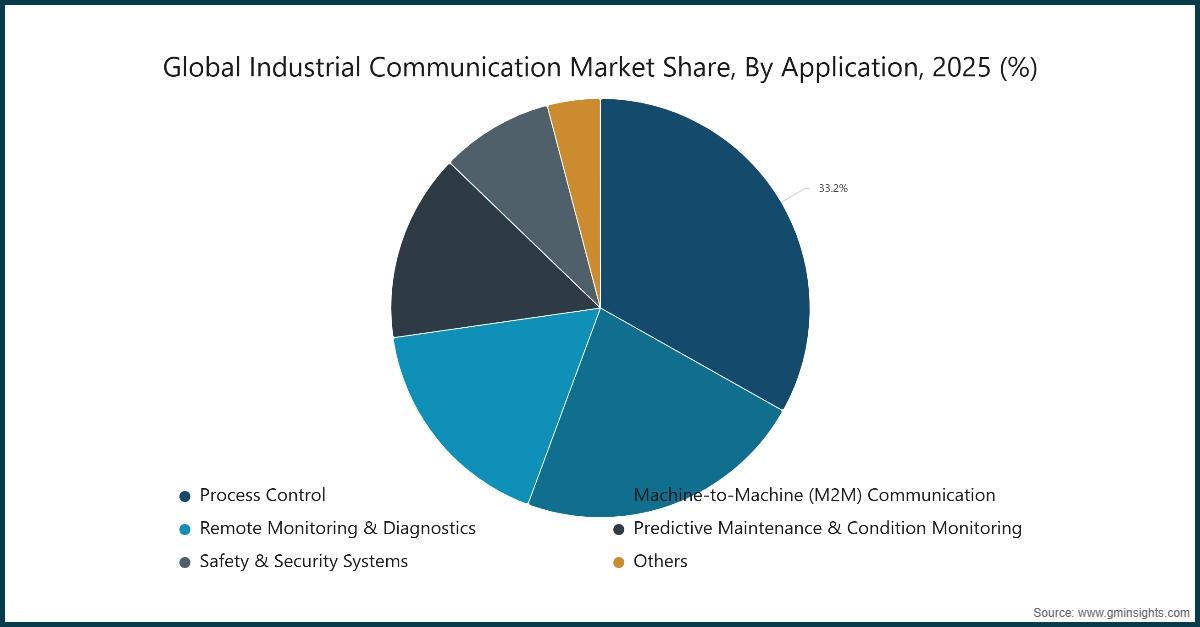
On the basis of application, the industrial communication market is divided into process control, machine-to-machine (M2M) communication, remote monitoring & diagnostics, predictive maintenance & condition monitoring and safety & security systems, and others.
- The process control segment held a market share of 33.2% in 2025. Fast-tracking the development and deployment of high-speed, deterministic communication networks to support the automation of processes and control in real-time. The industrial communication systems are being closely integrated with the distributed control systems and programmable logic controllers to improve the synchronization, precision, and scalability of the complex industrial environment.
- The predictive maintenance & condition monitoring segment is anticipated to grow at a CAGR of 7.7% during the forecast period 2026 - 2035. Growing use of sensor-dense communication architectures to enable continuous monitoring of equipment health and operating conditions.
- Industrial communication networks are increasingly supporting edge and cloud-based predictive maintenance platforms that leverage machine learning to reduce unplanned downtime and extend asset life cycles.
On the basis of communication protocol, the industrial communication market is divided into fieldbus protocols, industrial ethernet protocols, and wireless industrial protocols.
- The industrial ethernet protocols segment held a market share of 47.4% in 2025. The strong adoption of standardized Ethernet-based protocols is driven by the need for greater bandwidth, as well as interoperability and convergence of the network. The rising adoption of time sensitive networking protocols is facilitating deterministic and time-synchronized communication for advanced automation, robotics, and motion control applications.
- The wireless industrial protocols segment is anticipated to grow at a CAGR of 7.1% during the forecast period 2026 - 2035. Increased deployment of industrial wireless communication technologies like private 5G, Wi-Fi 6, and low-power wide-area networks for the management of mobile assets. The increased emphasis on the reliability, security, and low-latency attributes of these technologies will help increase the adoption of wireless protocols in critical safety processes.
Looking for region specific data?
North America Industrial Communication Market
The North America market held a share of 31.2% in 2025.
- North America exhibits a strong trend in the deployment of industrial communication infrastructure, which can be attributed to the large-scale digital transformation in the country’s manufacturing and energy sectors, a strong adoption rate of industrial Ethernet and IIoT technologies, and the increasing focus on automation to enhance operational efficiency and resiliency.
- The focus on secure network architectures and private industrial wireless systems further reinforces the region’s position as a major adopter of advanced industrial connectivity solutions.
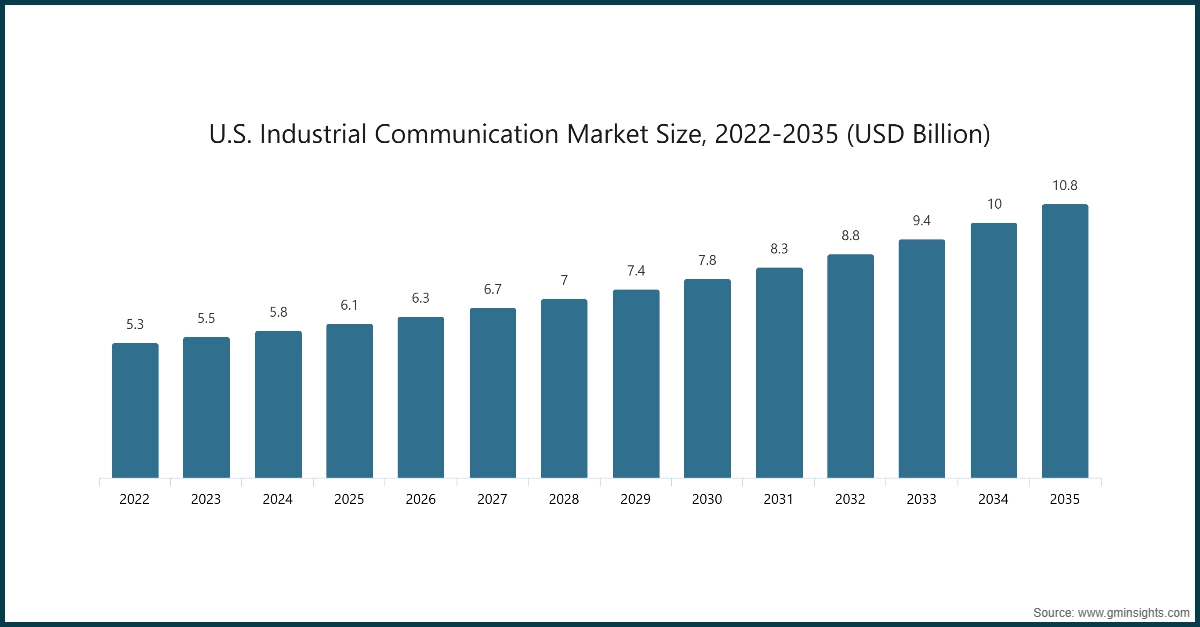
The U.S. industrial communication market was valued at USD 5.3 billion and USD 5.5 billion in 2022 and 2023, respectively. The market size reached USD 6.1 billion in 2025, growing from USD 5.8 billion in 2024.
- The evolution of the industrial communication industry in the U.S. is characterized by consolidation and portfolio development to improve the coverage of protocols and interoperability of the systems. The acquisition of Molex Industrial Communications Business by HMS Networks, completed in January 2026, is an example of the strategy to expand the business of industrial connectivity in the sectors of factory automation and embedded systems. This demonstrates the need to improve the coverage of the market through the provision of integrated communication solutions that are essential in the development of multi-protocol environments, as well as the deployment of connected industrial equipment in the diverse sectors of the market.
Europe Industrial Communication Market
- Europe market accounted for USD 5 billion in 2025 and is anticipated to show lucrative growth over the forecast period.
- Europe's industrial communication infrastructure has been supported by robust regulatory environments and strategic investment policies for digital infrastructure development and the adoption of Industry 4.0. The European Union has established various programs for the development of digital infrastructure, including the Digital Europe initiative, which has placed great emphasis on connected manufacturing, data exchange in real-time, and standardized communication protocols for industrial automation.
Germany dominates the Europe industrial communication market, showcasing strong growth potential.
- The industrial communication landscape in Germany is marked by strong cooperation between technology developers in the promotion of interoperation and ease of integration in Industry 4.0 solutions. Infineon Technologies announced in March 2025 that it had partnered with RT-Labs in embedding six significant industrial communication protocols into the firmware of the XMC7000 microcontroller portfolio.
- This partnership reflects Germany’s focus on standardization and enabling software-based industrial communication, which helps simplify integration complexities and achieve scalable automation.
Asia Pacific Industrial Communication Market
- The Asia Pacific market is anticipated to grow at the highest CAGR of 6.8% during the analysis timeframe.
- Asia’s industrial communication industry has a growth outlook fueled by fast-paced industrialization, broad adoption of automation technologies, and government strategies aimed at modernizing manufacturing infrastructure. National strategies in Asia are driving the integration of connected devices, real-time monitoring, and smart networks to achieve competitive industry development.
China industrial communication market is estimated to grow with a significant CAGR of 7.6% during the forecast period from 2026-2035.
- China’s Ministry of Industry and Information Technology has articulated an ambitious plan to deepen integration of the industrial internet with artificial intelligence, mandating upgrades of industrial networks at tens of thousands of enterprises by 2028 to strengthen manufacturing competitiveness and support smart factory deployments.
Latin American Industrial Communication Market
- In Brazil, basic digital infrastructure like broad bandwidth and fiber networks in industrial areas makes it easier to adopt connected systems and industrial IoT solutions.
- While the adoption rate may differ from one business size to another, the majority of large businesses use high-speed connectivity as a platform for automation, security, and data exchange operations.
Middle East and Africa Industrial Communication Market
- South Africa’s industrial communication infrastructure continues to improve as connectivity solutions become more integrated in manufacturing, utilities, and mining industries.
- The country’s digital transformation strategies focus on automation and remote monitoring operations, as well as the overall national strategies for enhancing industrial efficiency and competitiveness.
Industrial Communication Market Share
The competitive landscape of the industrial communication industry is characterized by continuous technological innovation and strategic collaboration among leading automation and networking solution providers. Major players such as Cisco Systems, Siemens, Rockwell Automation, Schneider Electric, ABB, and Omron Corporation collectively account for an estimated 48% share of the global market, reflecting a moderately consolidated structure. These companies are actively investing in R&D to improve the reliability of the network, real-time communication, security features, and interoperability among various industrial Ethernet, wireless, and multi-protocol technologies. Strategic partnerships, acquisitions, and collaborations are common among these companies, with the aim of broadening the protocol support, software portfolio, and convergence between IT and OT in various industrial environments.
Simultaneously, emerging companies are adding to the dynamics in the market by providing innovative communication modules, software-defined networking solutions, and application-focused connectivity platforms targeting robotics, IIoT, and smart factory segments. This promotes healthy competition, resulting in rapid technological advancements, shorter technology lifecycle, and continuous improvements in the scalability, security, and integration ease of the solutions, thereby driving the growth of the market in various industrial segments.
Industrial Communication Market Companies
Prominent players operating in the industrial communication industry are as mentioned below:
- Cisco Systems
- Siemens
- Rockwell Automation
- Schneider Electric
- ABB
- Omron
- Huawei
Cisco Systems is an important participant in the industrial communication industry, and the company uses its strengths in networking, cybersecurity, and industrial Ethernet solutions. The company is focused on developing secure, scalable, and high-performance industrial networks that support IT-OT convergence, real-time data transfer, and IIoT applications. The solutions offered by Cisco Systems are widely used in the manufacturing, energy, and infrastructure industries, where reliability, network visibility, and cybersecurity are critical for continuous operations.
Siemens AG is a prominent player in the industrial communication domain, especially considering its deep integration of communication technologies into automation, control, and digitalization solutions. Siemens focuses on interoperable industrial Ethernet, fieldbus, and software-based communication architectures, which are important for smart factories and Industry 4.0 concepts. Siemens’s deep ecosystem approach ensures seamless connectivity in industrial scenarios, which further cements its position in industry.
Rockwell Automation is a prominent contributor to the industrial communication market, particularly in discrete and processed automation applications. The company is committed to providing real-time, deterministic communication for controllers, devices, and software platforms, enabling the concept of connected manufacturing. The company’s focus on integrated control and information architecture is beneficial for enhanced operational visibility, system flexibility, and productivity, making it an ideal choice for manufacturers seeking to advance towards digitally connected operations.
Industrial Communication Market Report Attributes
| Key Takeaway | Details |
|---|---|
| Market Size & Growth | |
| Base Year | 2025 |
| Market Size in 2025 | USD 21.7 Billion |
| Market Size in 2026 | USD 22.8 Billion |
| Forecast Period 2026-2035 CAGR | 5.9% |
| Market Size in 2035 | USD 38.2 Billion |
| Key Market Trends | |
| Drivers | Impact |
| Expansion of industrial internet of things (IIoT) ecosystems | Drives sustained demand for scalable, high-bandwidth, and low-latency communication networks to support large-scale device connectivity and real-time industrial data exchange. |
| Growth in connected and autonomous industrial equipment | Increases the requirement for deterministic and reliable communication to enable machine autonomy, coordinated operations, and real-time control. |
| Integration of advanced technologies (robotics, AI, digital twins) | Accelerates adoption of advanced industrial communication architectures capable of supporting data-intensive, intelligence-driven, and simulation-based applications. |
| Demand for seamless IT–OT convergence across industrial facilities | Fuels deployment of unified communication platforms that enable end-to-end visibility, centralized system management, and data-driven decision-making across industrial environments. |
| Growing emphasis on industrial cybersecurity and network resilience | Strengthens demand for secure and resilient communication infrastructures to protect critical assets, minimize downtime, and ensure operational continuity. |
| Pitfalls & Challenges | Impact |
| High initial deployment and integration costs | Restricts adoption by increasing capital and integration complexity, particularly for cost-sensitive industries and small-scale manufacturing operations. |
| Interoperability challenges across multiple communication protocols | Creates system complexity and longer deployment timelines by limiting seamless data exchange across multi-vendor and multi-protocol industrial environments. |
| Opportunities: | Impact |
| Emergence of private industrial 5G and time-sensitive networking (TSN) | Enables ultra-reliable, low-latency connectivity, opening new use cases for advanced automation, mobile equipment, and real-time industrial control. |
| Expansion of industrial communication in small and mid-sized manufacturing facilities | Unlocks incremental growth opportunities as small and mid-sized manufacturers increasingly adopt flexible and cost-effective communication solutions to improve operational efficiency. |
| Market Leaders (2025) | |
| Market Leader |
Market share for Cisco Systems is 14.5% in 2025 |
| Top Players |
Collective market share for is 48% in 2025 |
| Competitive Edge |
|
| Regional Insights | |
| Largest Market | North America |
| Fastest growing market | Asia Pacific |
| Emerging countries | China, India, Brazil, Mexico, South Africa |
| Future outlook |
|
What are the growth opportunities in this market?
Industrial Communication Industry News
- In November 2025, Hilscher launched the comX 90, its next-generation embedded communication module designed to succeed the comX 51. Built on the netX 90 network controller, it provides a single hardware platform for all major Real-Time Ethernet protocols and native IIoT connectivity.
- In December 2025, Pepperl+Fuchs launched a pioneering Ethernet-APL control cabinet solution, integrating its FieldConnex Ethernet-APL field switches with the LB Remote I/O system. This engineered solution is designed for greenfield projects and hazardous areas, enabling high-speed, digital communication from the field to higher-level systems.
The industrial communication market research report includes in-depth coverage of the industry with estimates and forecast in terms of revenue in USD Million from 2022 – 2035 for the following segments:
Market, By Offering
- Hardware
- Industrial switches
- Gateways & protocol converters
- Routers & wireless access points
- Controllers & connectors
- Communication interfaces & converters
- Power supply devices
- Other components
- Software
- Protocol stacks & firmware
- Network management & monitoring tools
- Industrial IoT integration software
- Configuration & diagnostic software
- Services
- System integration & consulting
- Network deployment & commissioning
- Maintenance & support services
Market, By Communication Protocol
- Fieldbus Protocols
- PROFIBUS
- MODBUS RTU
- CAN
- DeviceNet
- CANopen
- Other fieldbus
- Industrial Ethernet Protocols
- PROFINET
- EtherNet/IP
- EtherCAT
- MODBUS-TCP
- POWERLINK
- SERCOS III
- CC-Link IE
- Time-sensitive networking (TSN)
- Other industrial ethernet
- Wireless Industrial Protocols
- Industrial WLAN (Wi-Fi 6/6E)
- 5G / Private LTE
- Bluetooth Industrial
- ISA100.11a
- WirelessHART
- Zigbee
- Other Wireless
Market, By Application
- Process control
- Machine-to-machine (M2M) communication
- Remote monitoring & diagnostics
- Predictive maintenance & condition monitoring
- Safety & security systems
- Others
Market, By End-use Industry
- Manufacturing sectors
- Automotive
- Aerospace & defense
- Food & beverage
- Pharmaceutical & medical devices
- Electronics & semiconductor
- Metals & mining
- Machinery & equipment
- Textile & apparel
- Pulp, paper & packaging
- Others
- Process & utilities sectors
- Oil & gas
- Energy & power generation
- Water & wastewater management
- Renewable energy
- Others
- Others
The above information is provided for the following regions and countries:
- North America
- U.S.
- Canada
- Europe
- Germany
- UK
- France
- Spain
- Italy
- Netherlands
- Asia Pacific
- China
- India
- Japan
- Australia
- South Korea
- Latin America
- Brazil
- Mexico
- Argentina
- Middle East and Africa
- South Africa
- Saudi Arabia
- UAE
Frequently Asked Question(FAQ) :
What is the industrial communication market size in 2025?
The market size for industrial communication is valued at USD 21.7 billion in 2025. The expansion of IIoT ecosystems and the integration of advanced technologies like robotics and AI are driving market growth.
What is the market size of the industrial communication industry in 2026?
The market size for industrial communication reached USD 22.8 billion in 2026, reflecting steady growth driven by increasing demand for scalable and reliable communication networks.
What is the projected value of the industrial communication market by 2035?
The market size for industrial communication is expected to reach USD 38.2 billion by 2035, growing at a CAGR of 5.9%. This growth is fueled by the adoption of private industrial 5G, time-sensitive networking, and seamless IT–OT convergence.
How much revenue will the hardware segment generate by 2035?
The hardware segment is anticipated to reach USD 20.9 billion by 2035. This growth is supported by the increasing adoption of ruggedized communication hardware designed for harsh industrial environments.
What was the market share of the process control segment in 2025?
The process control segment held a market share of 33.2% in 2025. Its growth is driven by the deployment of high-speed, deterministic communication networks to support real-time process automation and control.
What was the market share of the industrial Ethernet protocols segment in 2025?
The industrial Ethernet protocols segment accounted for 47.4% of the market in 2025. The adoption of standardized Ethernet-based protocols is driven by the need for greater bandwidth, interoperability, and network convergence.
Which region led the industrial communication market in 2025?
North America held a 31.2% share of the market in 2025. The region's leadership is attributed to advancements in industrial automation, cybersecurity, and the adoption of IIoT technologies.
What are the upcoming trends in the industrial communication industry?
Key trends include the adoption of private industrial 5G, time-sensitive networking, seamless IT–OT integration, and advanced cybersecurity solutions. The integration of digital twins, AI, and robotics is also driving innovation in industrial communication systems.
Who are the key players in the industrial communication market?
Key players include Cisco Systems, Siemens AG, Rockwell Automation, Schneider Electric, ABB, Omron, and Huawei. These companies are focusing on advanced industrial communication solutions, including Ethernet-based protocols, wireless technologies, and secure connectivity platforms.
Industrial Communication Market Scope
Related Reports