Summary
Table of Content

India Condom Market
Get a free sample of this report
Form submitted successfully!
Error submitting form. Please try again.
Thank you!
Your inquiry has been received. Our team will reach out to you with the required details via email. To ensure that you don't miss their response, kindly remember to check your spam folder as well!
Request Sectional Data
Thank you!
Your inquiry has been received. Our team will reach out to you with the required details via email. To ensure that you don't miss their response, kindly remember to check your spam folder as well!
Form submitted successfully!
Error submitting form. Please try again.
India Condom Market Size
Rising awareness of sexual health and family planning, affordability and accessibility, focus on gender equity in contraception, and changing attitudes toward sexual well-being are among the key attributes anticipated to fuel the market growth.
A condom is a barrier device used during sexual intercourse to reduce the risk of sexually transmitted infections (STIs) and prevent unintended pregnancies. It is typically made from materials such as latex or polyurethane. Condoms are available for both male and female users.
India Condom Market Key Takeaways
Market Size & Growth
- 2025 Market Size: USD 367 Million
- 2026 Market Size: USD 415.5 Million
- 2035 Forecast Market Size: USD 1.3 Billion
- CAGR (2026–2035): 13.9%
Key Market Drivers
- Increase in awareness levels and emphasis on safe sex practices.
- Significant rise in online condom purchases.
- Rising awareness about sexually transmitted infections (STIs).
- Increased product availability and affordability.
Challenges
- Social stigma and side effects associated with the materials used in condoms.
Opportunity
- Rapid expansion of e‑commerce and quick‑commerce platforms.
Key Players
- Market Leader: Mankind led with over 17% market share in 2025.
- Leading Players: Top 5 players in this market include HLL Lifecare Limited, Mankind, okamoto, PLAYGARD, reckitt, which collectively held a market share of 44% in 2025.
Get Market Insights & Growth Opportunities
The key players in the India condom market include HLL Lifecare Limited, Mankind, okamoto, PLAYGARD, and reckitt. These players compete through aggressive product innovation, expanding omni‑channel distribution, including strong penetration in e‑commerce, and differentiated offerings such as textured, flavored, ultra‑thin, vegan, and biodegradable condoms to meet evolving consumer preferences and strengthen market positioning.
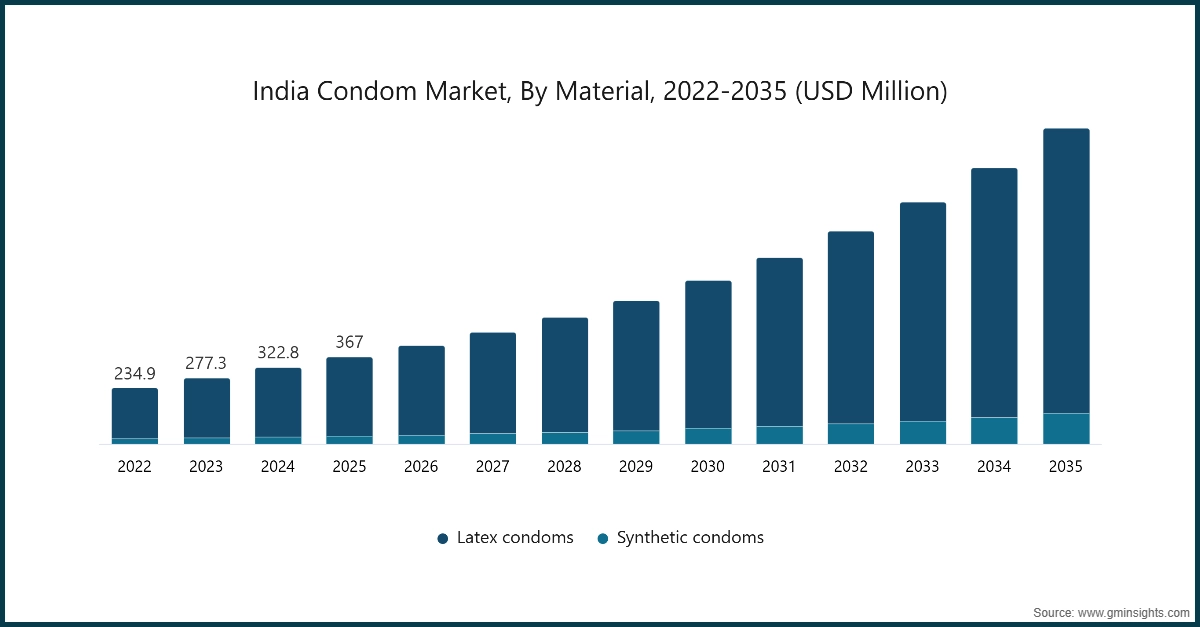
The market has increased from USD 234.8 million in 2022 to USD 322.8 million in 2024, with a historic growth rate of 17%. The market has shown steady expansion in recent years, supported by the rising awareness of sexual health and family planning, affordability and accessibility, focus on gender equity in contraception.
Government and non-government organizations have been actively promoting the use of condoms through campaigns aimed at improving awareness of sexual health, preventing sexually transmitted infections (STIs), and advocating family planning. Government-led free distribution programs and subsidized condoms for economically weaker sections have significantly increased accessibility. In addition, initiatives such as the National AIDS Control Programme (NACP) and targeted social marketing campaigns have helped normalize condom use in the country, especially in rural and semi-urban areas.
Further, younger generations are becoming more open about discussions on sexual health and contraception due to increasing urbanization, education, and exposure to global lifestyles. Moreover, inclusion of sex education in school curricula and youth-targeted awareness campaigns emphasizes safe sex practices, encouraging the use of condoms among adolescents and young adults.
The India condom market was valued at USD 367 million in 2025. The market is expected to reach from USD 415.5 million in 2026 to USD 1.3 billion in 2035, growing at a CAGR of 13.9% during the forecast period, according to the latest report published by Global Market Insights Inc.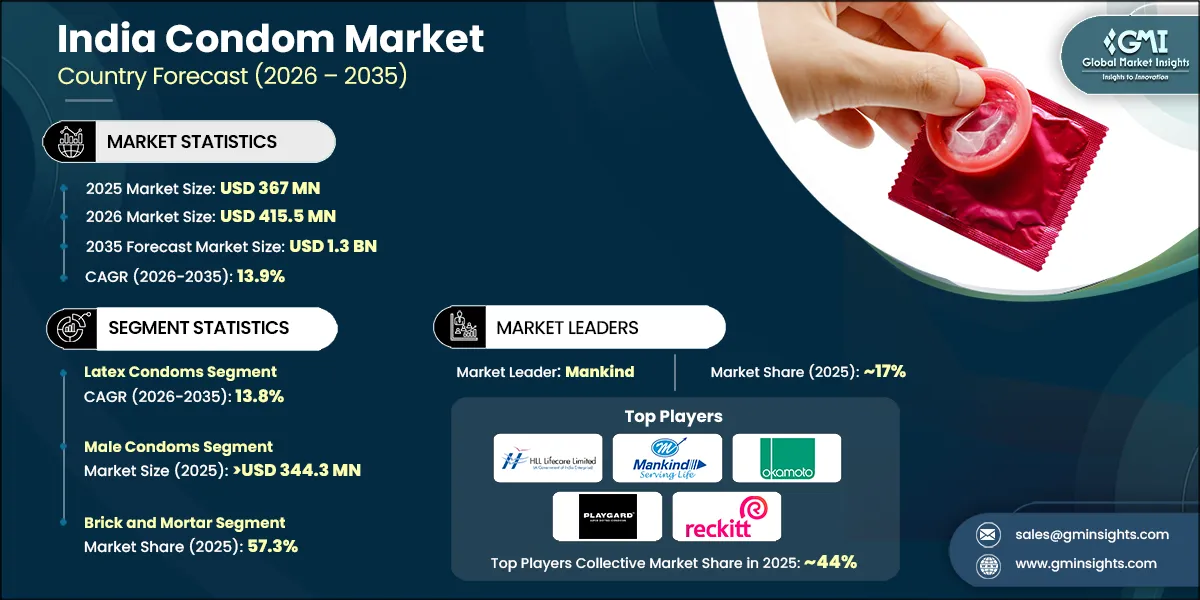
To get key market trends
India Condom Market Trends
As digital adoption continues to grow in India, online channels are expected to play an even larger role in driving condom market growth. Mobile commerce allows customers to buy condoms on-the-go, contributing to spontaneous purchases.
- Online platforms offer a broader variety of condoms, from basic options to premium, flavored, textured, and specialty products. This wide variety allows consumers to explore and select products that suit their preferences, which physical retail stores often cannot match due to limited shelf space.
- Additionally, online marketplaces enable customers to read and share product reviews anonymously, thus building trust and influencing purchase decisions.
- Moreover, the proliferation of smartphones and digital payment methods has made online shopping more accessible and user-friendly in India. Furthermore, the availability of discreet packaging further reinforces trust and loyalty among customers.
India Condom Market Analysis
Learn more about the key segments shaping this market
Based on material, the market is segmented as latex condoms and synthetic condoms. The latex condoms segment is expected to drive business growth and expand at a CAGR of 13.8%, reaching over USD 1.2 billion by 2035.
- Latex is a highly elastic and durable material, offering superior protection against unintended pregnancies and sexually transmitted infections (STIs), including HIV/AIDS.
- Latex condoms are available in various types, including ultra-thin, ribbed, dotted, flavored, and colored variants, catering to diverse consumer preferences. Manufacturers frequently innovate with textures and designs to enhance sexual experience, driving consumer interest and boosting sales.
- Moreover, unlike synthetic materials like polyurethane, latex is a biodegradable, natural material derived from rubber trees, aligning with the growing consumer preference for eco-friendly products.
- The synthetic condoms segment was valued at USD 32.3 million in 2025 and is expected to reach USD 127.6 million by 2035. The segment is gaining traction due to growing awareness of latex sensitivity and the increasing preference for premium, ultra-thin alternatives made from materials such as polyurethane and polyisoprene that enhance comfort and sensation. Moreover, rising urbanization, evolving consumer attitudes toward sexual wellness, and the expanding presence of discreet online retail channels are expected to drive steady growth of synthetic condoms across metropolitan and tier-1 cities over the forecast period.
Based on category, the India condom market is segmented as male condom and female condom. The male condom segment accounted for a dominant revenue share and was valued at over USD 344.3 million in 2025.
- Male condoms are highly effective as a barrier method for contraception and in preventing STIs, including HIV/AIDS, when used correctly and consistently. Educational programs and awareness campaigns aimed at reducing STIs and unwanted pregnancies emphasize male condom use.
- Additionally, male condoms are one of the most affordable contraceptive options, making them accessible to a broad audience, especially in low-income and developing regions. Their widespread availability in pharmacies, supermarkets, vending machines, and online platforms ensures ease of access for consumers.
- Furthermore, the role of male condoms in public health campaigns focused on promoting safe sex and family planning significantly contributes to their demand.
- The female condom segment was valued at USD 22.7 million in 2025 and is expected to reach USD 96.8 million by 2035. Growth of this segment is supported by increasing awareness of women-controlled contraceptive methods and ongoing public health initiatives promoting dual protection against unintended pregnancies and sexually transmitted infections. Additionally, gradual expansion of availability through government programs, NGOs, and urban retail channels is expected to improve accessibility and encourage adoption, particularly among younger and health-conscious female populations.
Learn more about the key segments shaping this market
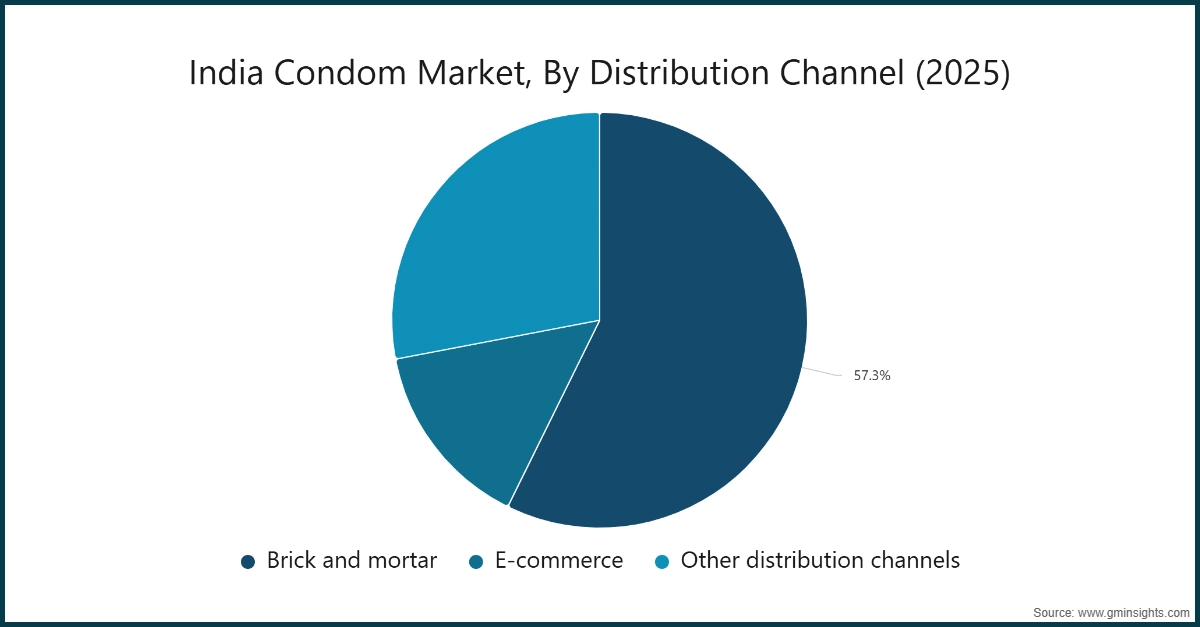
Based on distribution channel, the India condom market is classified into brick and mortar, e-commerce, and other distribution channels. The brick and mortar segment dominated the market with a revenue share of 57.3% in 2025.
- Brick and mortar outlets are one of the most accessible points for condom purchases, offering convenience and immediacy. Pharmacies and drugstores are considered trustworthy sources for purchasing healthcare products, including condoms.
- Similarly, the expansion of modern trade practices in the country, such as supermarkets and hypermarkets, has made condom shopping more accessible and less stigmatized.
- Additionally, brick and mortar stores typically stock a variety of condom brands and types, including flavored, ribbed, dotted, and ultra-thin variants. The availability of diverse options caters to different consumer preferences, boosting sales within the retail segment.
- The e-commerce segment was valued at USD 54 million in 2025 and is expected to reach USD 217.8 million by 2035. Growth of e-commerce in India is driven by increasing consumer preference for discreet purchasing, wider product assortment, and attractive pricing offered by online platforms. Additionally, the rise of quick-commerce services, subscription models, and targeted digital marketing by sexual wellness brands is expected to further accelerate online condom sales over the forecast period.
- The other distribution channels segment was valued at USD 102.7 million in 2025 and is poised to witness growth over the coming years. This segment includes government supply programs, NGOs, vending machines, and institutional distribution, all of which play a crucial role in expanding condom accessibility across rural and underserved regions in India. Ongoing public health campaigns, social marketing initiatives, and increasing installation of condom vending machines in educational institutions and public spaces are expected to support steady segment growth.
India Condom Market Share
The India condom industry is moderately fragmented, featuring a mix of large multinational brands and strong domestic manufacturers that collectively drive competition through product innovation, aggressive marketing, and deep retail penetration. Market dynamics are shaped by factors such as product variety (textures, flavors, ultra‑thin, latex‑free), affordability, government distribution programs, and expanding access through pharmacies, supermarkets, and rapidly growing e‑commerce and quick‑commerce channels. Rising sexual‑health awareness, digital‑first consumer behavior, and government initiatives like the National AIDS Control Program (NACP) further influence purchasing preferences and broader market uptake.
Leading players, including HLL Lifecare, Mankind Pharma, Okamoto, PLAYGARD, and Reckitt, collectively hold around 44% of the market share. Their dominance is supported by established manufacturing capabilities, broad distribution footprints across urban and rural India, and strong brand equity cultivated through sustained advertising and public‑health partnerships. These companies benefit from extensive retail presence, government‑supported supply channels, and product portfolios designed to appeal to diverse consumer needs, from low‑cost public‑health condoms to premium, flavored, and ultra‑thin offerings.
Other emerging and niche participants, such as CORAL, CUPID, Godrej Consumer Products, Redcliffe Hygiene, SIRONA, SKYN, and TTK Healthcare, are strengthening their competitive positioning through differentiated product innovation, youth‑targeted branding, and strong emphasis on online sales channels. Many of these brands focus on specialty features and leverage influencer marketing, digital campaigns, and discreet home‑delivery models to attract younger, urban consumers. Their presence enhances market diversity, intensifies competitive pressure, and contributes to the sector’s rapid evolution toward more personalized and lifestyle‑driven sexual‑wellness offerings.
India Condom Market Companies
A few of the prominent players operating in the India condom industry include:
CORAL
- CUPID
- godrej Consumer Products
- HLL Lifecare Limited
- Mankind
- okamoto
- PLAYGARD
- reckitt
- Redcliffe Hygiene
- SIRONA
- SKYN
- ttk HEALTHCARE
India Condom Market Report Attributes
| Key Takeaway | Details |
|---|---|
| Market Size & Growth | |
| Base Year | 2025 |
| Market Size in 2025 | USD 367 Million |
| Market Size in 2026 | USD 415.5 Million |
| Forecast Period 2026-2035 CAGR | 13.9% |
| Market Size in 2035 | USD 1.3 Billion |
| Key Market Trends | |
| Drivers | Impact |
| Increase in awareness levels and emphasis on safe sex practices | Boosts condom adoption as consumers proactively seek reliable protection and responsible sexual behavior. |
| Significant rise in online condom purchases | Enhances accessibility and privacy, accelerating demand through convenient digital buying channels. |
| Rising awareness about sexually transmitted infections (STIs) | Encourages preventive behaviors, driving higher utilization of condoms for protection. |
| Increased product availability and affordability | Expands reach across diverse income groups, supporting market penetration in both urban and rural areas. |
| Pitfalls & Challenges | Impact |
| Social stigma and side effects associated with the materials used in condoms | Restricts open purchasing behavior and limits adoption among sensitive or allergic user segments. |
| Opportunities: | Impact |
| Rapid expansion of e‑commerce and quick‑commerce platforms | Enables discreet, fast, and widespread access, driving higher purchase frequency and category growth. |
| Market Leaders (2025) | |
| Market Leader |
Market share ~17% |
| Top Players |
Collective market share ~44% |
| Competitive Edge |
|
| Regional Insights | |
| Future outlook |
|
What are the growth opportunities in this market?
India Condom Industry News:
- In September 2024, Durex announced the launch of its Close Fit Invisible Condoms. This is India's first-ever close-fit thin condom that may allow couples to experience enhanced closeness without compromising on protection. Such an innovative product launch will enable the company to further consolidate its industry position in the country.
- In February 2024, Bleu, a sexual wellness product company, launched a digital campaign, Come Clean, through its 100 percent natural condoms. The campaign focuses on environmental sustainability as the company's condoms are free from any harmful chemicals such as parabens, nitrosamines, glycerine, and benzocaine. Such initiatives may attract users looking for sustainable product offerings, thereby contributing to improved product demand.
The India condom market research report includes an in-depth coverage of the industry with estimates and forecasts in terms of revenue in USD Million from 2022 – 2035 for the following segments:
Market, By Material
- Latex condoms
- Synthetic condoms
- Polyurethane
- Polyisoprene
- Nitrile
Market, By Category
- Male condom
- Female condom
Market, By Distribution Channel
- Brick and mortar
- Pharmacies
- Convenience stores
- Supermarkets and hypermarkets
- E-commerce
- Other distribution channels
Frequently Asked Question(FAQ) :
What is the market size of the India condom in 2025?
The market size was USD 367 million in 2025, with a CAGR of 13.9% expected through 2035 driven by rising awareness of sexual health, affordability, and accessibility.
What is the projected value of the India condom market by 2035?
The India condom market is expected to reach USD 1.3 billion by 2035, propelled by changing attitudes toward sexual well-being and increasing focus on gender equity in contraception.
What is the current India condom market size in 2026?
The market size is projected to reach USD 415.5 million in 2026.
How much revenue did the latex condom segment generate in 2035?
The latex condoms segment is expected to drive business growth and expand at a CAGR of 13.8%, reaching over USD 1.2 billion by 2035.
What was the valuation of the synthetic condom segment in 2025?
The synthetic condoms segment was valued at USD 32.3 million in 2025 and is expected to reach USD 127.6 million by 2035., driven by growing awareness of latex sensitivity and demand for premium alternatives.
What is the growth outlook for the e-commerce distribution channel from 2026 to 2035?
The e-commerce segment is projected to grow at a significant pace, reaching USD 217.8 million by 2035, fueled by discreet purchasing preferences and digital marketing initiatives.
Which distribution channel leads the India condom market?
The brick-and-mortar segment led the market with a 57.3% revenue share in 2025, supported by the accessibility of pharmacies and modern trade practices.
What are the upcoming trends in the India condom market?
Key trends include eco-friendly product innovation, increasing adoption of female condoms, and the rise of quick.
What are the leading condom brands in India
The widely recognized condom brands include CORAL, CUPID, Godrej Consumer Products, HLL Lifecare Limited, Mankind, Okamoto, PLAYGARD, Reckitt, Redcliffe Hygiene, SIRONA, SKYN, TTK Healthcare.
India Condom Market Scope
Related Reports