Summary
Table of Content

In-Vehicle Neuroadaptive Haptic Feedback Component Market
Get a free sample of this report
Form submitted successfully!
Error submitting form. Please try again.
Thank you!
Your inquiry has been received. Our team will reach out to you with the required details via email. To ensure that you don't miss their response, kindly remember to check your spam folder as well!
Request Sectional Data
Thank you!
Your inquiry has been received. Our team will reach out to you with the required details via email. To ensure that you don't miss their response, kindly remember to check your spam folder as well!
Form submitted successfully!
Error submitting form. Please try again.
In-Vehicle Neuroadaptive Haptic Feedback Component Market Size
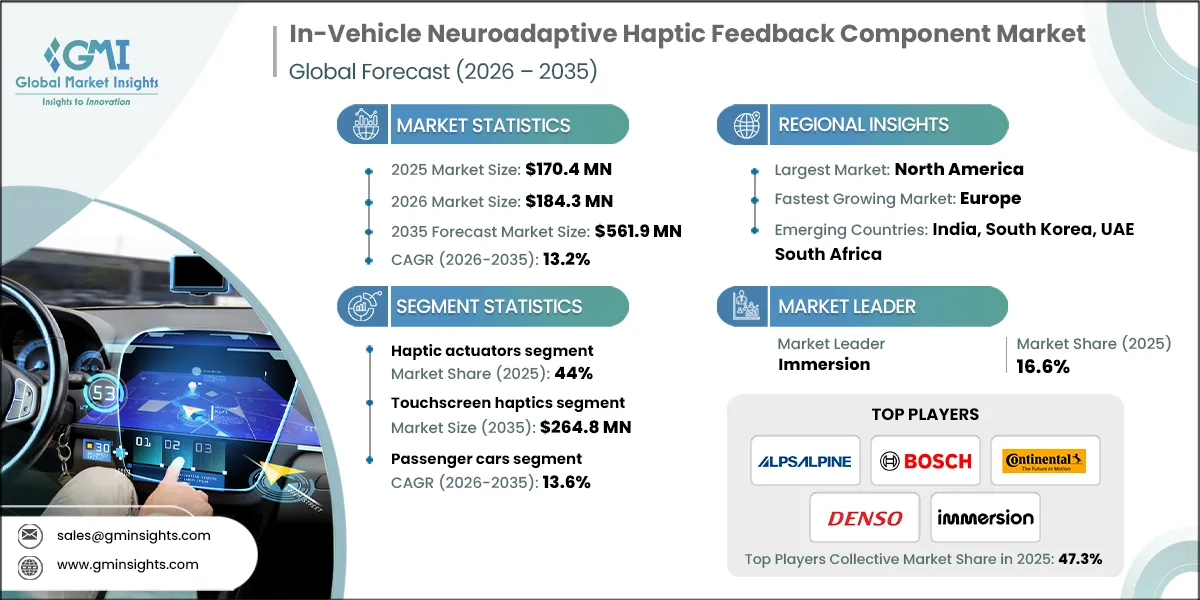
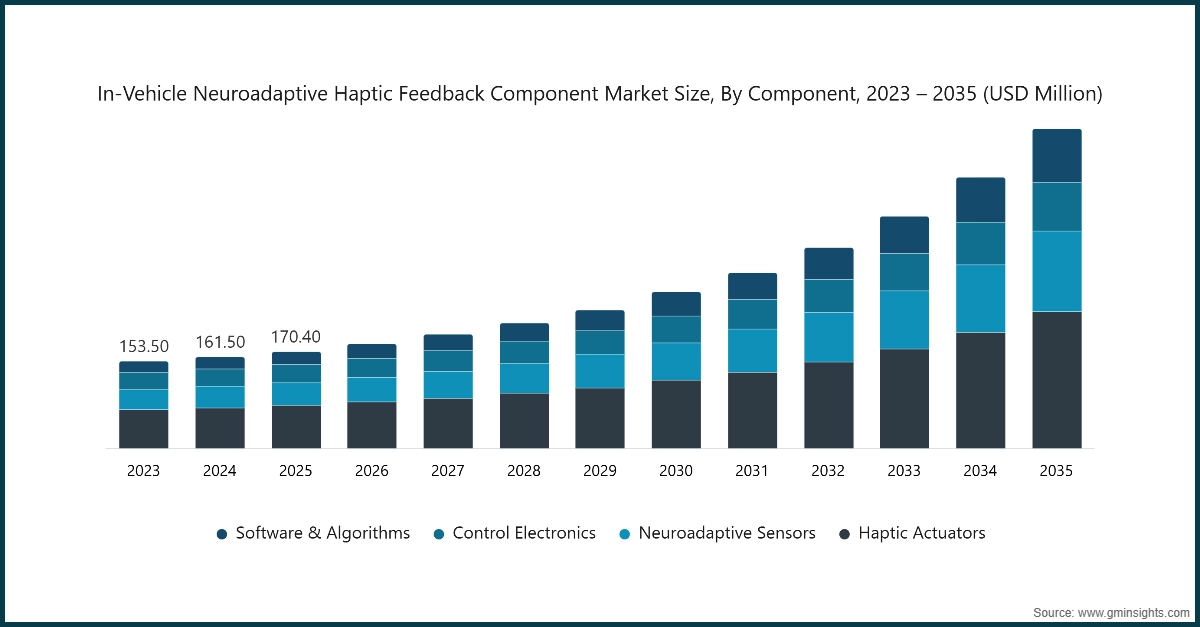
The global in-vehicle neuroadaptive haptic feedback component market was valued at USD 170.4 million in 2025. The market is expected to grow from USD 184.3 million in 2026 to USD 561.9 million in 2035 at a CAGR of 13.2%, according to latest report published by Global Market Insights Inc.
In-Vehicle Neuroadaptive Haptic Feedback Component Market Key Takeaways
Market Size & Growth
- 2025 Market Size: USD 170.4 Million
- 2026 Market Size: USD 184.3 Million
- 2035 Forecast Market Size: USD 561.9 Million
- CAGR (2026–2035): 13.2%
Regional Dominance
- Largest Market: North America
- Fastest Growing Region: Europe
Key Market Drivers
- Increasing Focus on Driver State Awareness and Cognitive Safety.
- Growth of Autonomous and Semi-Autonomous Driving Features.
- OEM Push for Differentiated In-Cabin User Experience.
- Demand for Real-Time Adaptive Human–Machine Interaction.
Challenges
- High System Complexity of Neuro-Adaptive Feedback Integration.
- Challenges in Calibrating Haptics to Individual Cognitive Variability.
Opportunity
- Integration with Driver Monitoring and Cognitive Load Detection Systems.
- Development of Software-Defined and Upgradable Haptic Algorithms.
- Adoption in Premium EV and Software-First Vehicle Platforms.
- Use of Neuroadaptive Haptics for Driver Wellness and Fatigue Management.
Key Players
- Market Leader: Immersion led with over 16.6% market share in 2025.
- Leading Players: Top 5 players in this market include Alps Alpine, Bosch, Continental, Denso, Immersion, which collectively held a market share of 47.3% in 2025.
Get Market Insights & Growth Opportunities
The driver’s attention to the road is a must, as well as the complete avoidance of any distractions and the instant activation of the driver’s control in situations like sleep. These systems improve safety and adapt support to the driver’s actual mental condition.
World Health Organization's statistics show that road traffic accidents take 1.19 million lives every year around the globe. The Safe System approach, accepted by several countries including the U.S. has already been implemented, which is a comprehensive method to road safety that protects all the users, confesses to the mistakes of humans and takes into consideration human weakness.
In one of the last years, NHTSA attributed over 3,200 deaths to distracted driving. Distracted driving, like making a phone call, eating, putting on makeup, and other things that divert the driver's attention from the road, the chances of an accident occurring.
With the help of in-vehicle neuroadaptive haptic feedback sensors, drivers can be instantly activated with just a small vibration. Neuroadaptive haptics use biometric and contextual data in real-time to modify tactile feedback, thus enhancing the user's awareness of the situation. This transformation goes hand in hand with the growing use of advanced driver-assistance systems (ADAS) and digital cockpits that eliminate conventional physical controls, making needs for tactile feedback even more necessary in order to avoid visual distraction and reinforce safety cues.
The system is likely to experience significant expansion primarily in the luxury car market. In November 2025, Boréas Technologies, a leader in the development of third-generation piezo-based haptics for cars, consumers, and mobile applications, announced that the Chinese electric vehicle maker NIO has used Boréas' strong automotive haptic module to TUI Bar, which is the touch area in the completely new ES8. This moves the leading haptic experience from NIO ET9 to the NIO all-scenario technology flagship SUV, thus, giving very prompt and realistic feedback to a wider circle of customers of the premium electric vehicles.
To get key market trends
In-Vehicle Neuroadaptive Haptic Feedback Component Market Trends
The market for in-vehicle neuroadaptive haptic feedback components is growing as vehicles adopt smarter human-machine interfaces. With vehicles becoming more software-focused, manufacturers are working to improve how drivers interact with systems without making it harder to focus.
Advanced driver assistance systems (ADAS) expected to boost the demand for neuroadaptive haptic feedback components. According to the AAA Foundation, ADAS could prevent about 40% of passenger vehicle crashes, 37% of injuries from these crashes, and 29% of deaths in such accidents. This is expected to benefit neuroadaptive haptic feedback sensors. As more vehicles adopt ADAS, these sensors will help improve customer experience and engagement.
At first, neuroadaptive haptic components were mostly used in luxury cars, but now they are starting to show up in mid-range models. Better designs and improved efficiency are making this technology more affordable. Car makers are using haptic systems to make their vehicles stand out without adding complicated visual features.
These neuroadaptive haptics use touch-based cues to respond to driver behavior and conditions, making interactions smoother. This trend highlights the need for controls that are easy to use, reduce distractions, and still handle the complexity of modern vehicle systems.
Changes in car interior design are also increasing the demand for neuroadaptive haptic feedback. Minimalist dashboards and touch-based controls are replacing physical buttons, which means vehicles need other ways to provide feedback.
Haptic components let car designers keep interiors simple and clean while still being functional. Neuroadaptive features make sure the feedback stays useful and relevant, even as cabin designs change. This helps balance modern design with practical driver interaction.
In-Vehicle Neuroadaptive Haptic Feedback Component Market Analysis
Learn more about the key segments shaping this market
- Actuators are essential for providing tactile feedback to drivers in neuroadaptive haptic systems used in vehicles. They convert digital signals into physical vibrations or forces, making haptic feedback possible. Even with advancements in sensors, control electronics, or algorithms, actuators remain a mandatory component, ensuring their demand stays higher than other parts.
- Their dominance is also due to their use in multiple areas of a vehicle. Haptic actuators are found in steering wheels, seats, pedals, center consoles, infotainment displays, and touch controls.
- Automotive OEMs have already tested and approved actuators for reliability, durability, and safety, allowing them to be adopted more quickly and on a larger scale. In comparison, neuroadaptive sensors and algorithms are still being developed and are added gradually.
- For instance, Cirrus Logic introduced its new closed-loop haptic drivers, the CS40L51, CS40L52, and CS40L53, in December 2025. These drivers use advanced closed-loop technology to improve actuator response, provide a wider range of haptic effects, and maintain consistent performance in different conditions. This technology delivers high-quality haptic feedback for applications such as interactive displays, steering wheels, smart surfaces, center consoles, and smart seats.
Learn more about the key segments shaping this market
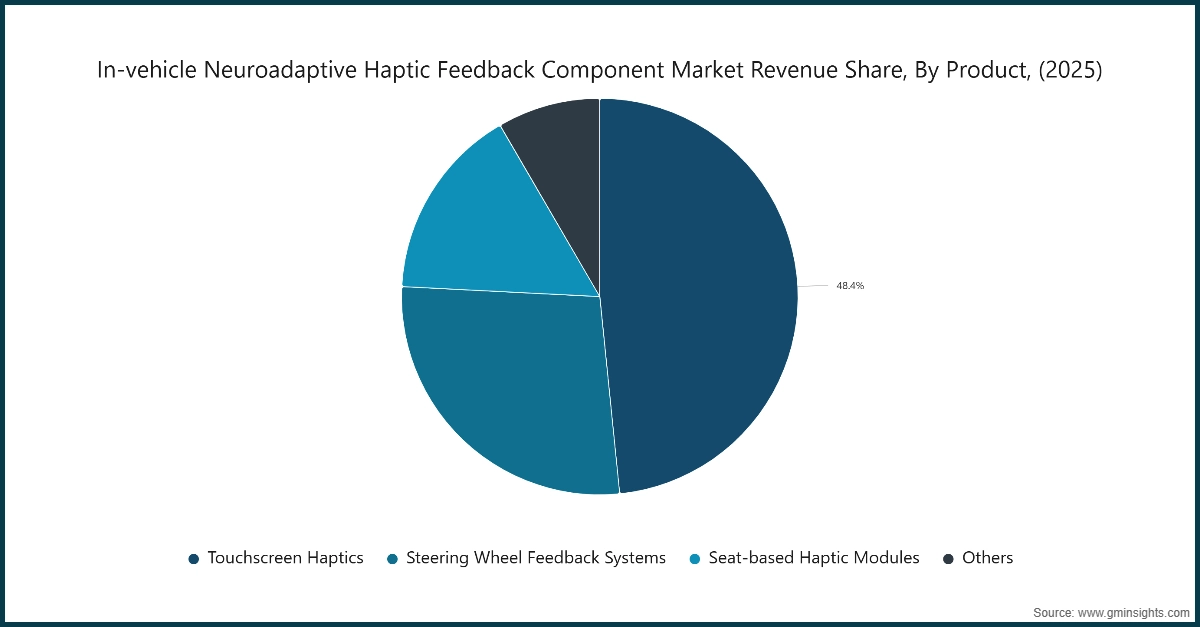
Based on product, the in-vehicle neuroadaptive haptic feedback component market is divided into touchscreen haptics, steering wheel feedback systems, seat-based haptic modules and others. The touchscreen haptics segment accounts for 48.4% in 2025 and is expected to reach USD 264.8 million by 2035.
- Touchscreens are now the main way people interact with modern vehicles, which has made touchscreen haptics a key part of in-vehicle neuroadaptive haptic feedback systems. Features like infotainment, navigation, climate control, and vehicle settings are often combined into large touch displays.
- Neuroadaptive haptics improve touchscreens by providing tactile feedback, replacing physical buttons. This technology helps reduce distractions and enhance safety, making it highly useful for drivers.
- By adjusting feedback intensity and patterns based on the driver’s mental state or driving conditions, neuroadaptive haptics have become a key feature in modern vehicle interiors.
- Between 2026 and 2035, the steering wheel feedback systems will grow at the fastest CAGR of around 14% because they play a key role in safety and driver interaction. Since drivers always have physical contact with the steering wheel, it is an ideal platform for delivering alerts like lane departure warnings, collision alerts, or driver condition notifications.
- Recently, AUDIOWELL introduced a haptic solid-state button solution for steering wheels, which received strong industry recognition for its performance and functionality. This shows the growing confidence in steering wheel-based haptic technologies.
Based on vehicle, the in-vehicle neuroadaptive haptic feedback component market is divided into passenger cars and commercial vehicles. The passenger cars segment is expected to grow at the fastest CAGR of 13.6% between 2026 and 2035.
- The global sales of passenger cars with integrated ADAS features are increasing year on year. By 2035, the passenger car ADAS market is expected to grow from USD 36.7 billion in 2026 to USD 160.3 billion in 2035, at a CAGR of 17.8%. As the adoption of ADAS depends on the government and regulatory bodies within the region, it is expected that Europe will see the fastest growth in the projected period between 2026 and 2035.
- Passenger cars, mainly mid-range and luxury, will add more sensors. As the ADAS has so many features in itself, neuroadaptive haptic feedback components will experience exponential growth in these segments mainly.
- In April 2025, Boréas Technologies announced that NIO, the global company for smart electric vehicles in the premium segment, has integrated Boréas’ powerful automotive haptic module into TUI Bar, the touch area in NIO ET9. This makes the NIO ET9 the world’s first tech-luxury EV to offer highly responsive, tactile feedback in an automotive infotainment system.
Looking for region specific data?
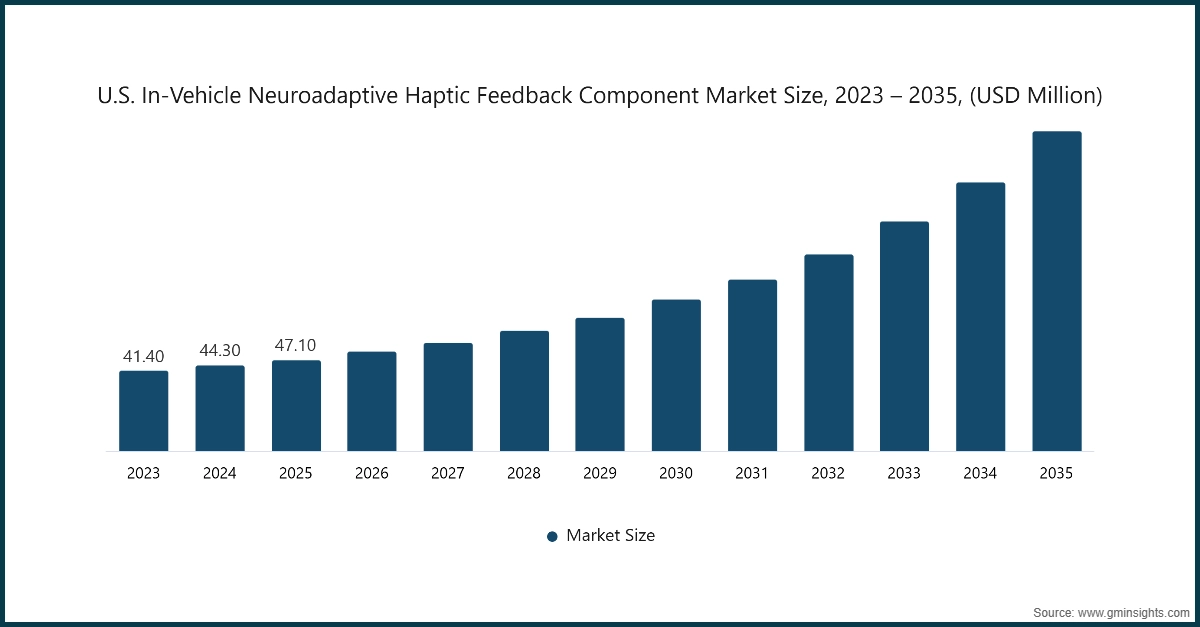
The US in-vehicle neuroadaptive haptic feedback component market reached USD 47.1 million in 2025, growing from USD 44.3 million in 2024.
- The U.S. has been constantly demonstrating its opinion regarding the safety of both drivers and pedestrians. MITRE Corporation states that the number of vehicles equipped with advanced driver assistance systems (ADAS) on U.S. roads has now exceeded 98 million which amounts to approximately 80% of the total number of vehicles on roads.
- The rates of such penetration indicate that the U.S. is the leading market for advanced sensors such as neuroadaptive haptic feedback globally. As the U.S. continues to be a major player in the ADAS market, it will directly cause the in-vehicle neuroadaptive haptic feedback component market to grow at a faster rate.
- Neuroadaptive haptic feedback technology fulfills this demand through the transformation of ADAS signals into tactile notifications that are adjusted according to the driver's cognitive and emotional states thus increasing the use of haptic actuators, sensors, and control software in the U.S. vehicle market.
North America is projected to grow at a CAGR of 13.7% between 2026 and 2035 and is estimated to reach USD 191.6 million by 2035.
- The region will be benefiting because of the availability and adoption dynamics of the automotive electronics and software ecosystem. As vehicles become more automated, OEMs in the U.S. and Canada are focusing on non-visual, intuitive communication to keep drivers engaged.
- Neuroadaptive haptics provide tactile alerts that adapt to driving conditions and driver behavior, making them a key part of advanced safety systems. Early testing and deployment in this region often set standards for global adoption.
- In 2025, total luxury car sales in the U.S. rose 1.5 percent in 2025 to a record 2.1 million. Such an increased year-over-year growth is indicating how U.S. consumers are prioritizing luxury cars, as these cars come with more features. This will create potential opportunities for players in the in-vehicle neuroadaptive haptic feedback component market.
The Europe region holds around 29% of the in-vehicle neuroadaptive haptic feedback component market in 2025 and is expected to grow at the fastest CAGR of 14.8% between 2026 and 2035.
- Europe is the second-largest region that has heavily deployed and has been constantly commercializing ADAS-level upgrades. Recently, new EU safety regulations have mandated the use of ADAS. As soon as ADAS becomes common in the EU, this will enable the providers to generate revenue with the in-vehicle neuroadaptive haptic feedback components.
- Additionally, some of the barriers would be the cost constraints with such advanced components. The European Union estimated that advanced driver assistance systems (ADAS) will cost nearly USD 36 Billion to purchase and install over 15 years (2026-2041).
- Despite this, there are many supporting factors that will give players opportunities to expand with the EV luxury vehicle segment. As EVs are going to reach 90% by 2035 as per the policy introduced by Europe, this will create growth opportunities for vendors.
Germany's in-vehicle neuroadaptive haptic feedback component market is growing quickly in Europe, with a CAGR of 16.7% between 2026 and 2035.
- Vehicle production in Germany is increasing the demand for such advanced sensors in the automotive market. According to OICA statistics, domestic passenger car production went up by 2% in the first three quarters of 2025 compared to the same time in 2024. At the same time, the German Association of the Automotive Industry (VDA) stated a total of 4.15 million vehicles were manufactured in Germany in 2024.
- Rising vehicle production in the country will attract players in the neuroadaptive haptic feedback component market for partnerships with the OEMs like Volkswagen, BMW, and Mercedes-Benz. In January 2026, Volkswagen significantly increased its sales of all-electric vehicles in 2025, especially in Germany, rising to 93,800 vehicles in the company’s home market of Germany (+60.7 percent).
The Asia Pacific region is expected to grow from USD 46.7 million in 2026 to USD 130.4 million by 2035 with a CAGR of around 12%.
- Countries like China, Japan, South Korea, and India have high vehicle manufacturing volumes, along with growing demand for advanced human-machine interfaces. These factors are driving the adoption of haptic feedback technology in Asia Pacific.
- Electric and connected vehicles in the region are increasingly using digital cockpits with haptic feedback to improve usability and enhance the driving experience.
- Consumers in Asia Pacific, who prefer intuitive and immersive interface features, are encouraging OEMs to invest in responsive haptic technologies.
- Recently, Geely Auto introduced the Galaxy E8, an electric SUV with an advanced infotainment touchscreen featuring haptic feedback. This technology allows drivers to interact with navigation, climate, and entertainment controls without losing focus.
China is estimated to grow with a CAGR of 12.6% in the projected period between 2026 and 2035, in the Asia Pacific in-vehicle neuroadaptive haptic feedback component market.
- Notably, China is making a huge leap forward in the vehicle manufacturing process, and at the same time, it is digitalizing the cockpits, and it is applying the most modern entertainment and ADAS features. These changes are the main reason for the market growth of haptic feedback technologies in the Asia-Pacific automotive sector.
- Major OEMs in China are using haptic systems in touchscreen monitors, rotary controls, and clever interfaces. The automotive innovation ecosystem in the country is so strong that it is quickly adopting tactile feedback technologies.
- The established electronics supply chain in China, presence of local Tier-1 suppliers, and government support for smart mobility are major factors that are contributing to the growth of haptic components. The partnerships between the local suppliers and car manufacturers are leading to the mass production of haptic actuators and controllers, which are specially designed for the smart cockpits.
Latin America in-vehicle neuroadaptive haptic feedback component market is estimated to reach USD 13.7 million in 2025 and is anticipated to show lucrative growth over the forecast period.
- Haptic interfaces, such as rotary controllers and touchscreen feedback, are being integrated by OEMs to improve user experience and reduce driver distraction. This trend is noticeable in the mid-tier and aftermarket segments in Brazil and Mexico. It is also creating opportunities for neuroadaptive haptic components as part of broader upgrades to vehicle human-machine interfaces.
- Meanwhile, in major Latin American countries, drivers and buyers are becoming more open to advanced automotive technologies that focus on safety and usability. As vehicles increasingly feature digital controls and ADAS systems, haptic feedback is valued for providing tactile cues.
Brazil is estimated to grow with a CAGR of 9.8% between 2026 and 2035, in the Latin America in-vehicle neuroadaptive haptic feedback component market.
- The adoption of features such as connected car technologies and advanced driver-assistance systems (ADAS) is increasing at a rapid pace since the drivers are now prioritizing safety, convenience, and connectivity.
- The demand for easy-to-use human-machine interfaces (HMIs) is making the OEMs think of different ways to look into the tactile feedback mechanisms. The driving experience is further enhanced by these mechanisms, as they provide non-visual confirmations for digital controls which are making haptic solutions more vital in future vehicle interiors.
- In October 2025, the Renault Kwid EV was unveiled in Brazil with 11 ADAS features. Such an introduction is the indication that automakers are fulfilling the country’s demand for advanced driver assistance technologies.
- On top of that, as fast as the cars are turning more software-oriented and packed with features, the necessity of tactile and adaptive haptic technologies will also be on the rise, thus getting Brazil ready to embrace advanced in-vehicle feedback components very soon.
The Middle East and Africa accounted for USD 9.2 million in 2025 and is anticipated to show lucrative growth over the forecast period.
- In the Middle East, carmakers are adding advanced digital cockpits and connected features to their vehicles, opening the door for haptic feedback technology. For example, Mercedes-Benz introduced its MBUX Hyperscreen in the region. This AI-powered digital cockpit highlights the growing interest from both consumers and manufacturers in modern in-vehicle systems that could use touch-based feedback.
- Advanced Driver Assistance Systems (ADAS) are becoming more popular in key Middle Eastern markets, increasing the need for feedback systems beyond just visual alerts. In 2024, Chery Automobile partnered with AW Rostamani to include advanced ADAS in several models in the UAE. This reflects the rising demand for safety and convenience features, where haptic feedback can help drivers respond better and stay more aware.
UAE to experience substantial growth in the Middle East and Africa in-vehicle neuroadaptive haptic feedback component market in 2025.
- The UAE’s car market is focused on premium and luxury vehicles, which are often the first to get new technologies. Companies like Qualcomm and Harman are working together to bring AI and smart cockpit features to these cars. These advancements are helping introduce adaptive haptic feedback systems, which match the region’s demand for high-tech and premium car interiors.
- People in the UAE are very open to self-driving technology. Many are interested in cars with advanced features and digital buying options. To meet these needs, cars are adding systems like ADAS and driver monitoring. These systems work better when combined with touch-based feedback, like haptics, which can improve alerts and make driving safer and easier.
In-Vehicle Neuroadaptive Haptic Feedback Component Market Share
The top 7 companies in the in-vehicle neuroadaptive haptic feedback component industry are Alps Alpine, Bosch, Continental, Denso, Immersion, Valeo and ZF contributing 56.8% of the market in 2025.
Alps Alpine develops electromagnetic haptic actuators and tactile interface components for automotive human-machine interfaces. These provide realistic touch feedback for steering controls, touch panels, and rotary devices.
Bosch integrates adaptive haptic feedback elements within automotive infotainment and control systems, delivering tactile responses in touchscreens and control surfaces that improve driver interaction and situational awareness.
Continental supplies automotive haptic systems including embedded tactile actuators for touch displays and control interfaces, providing tactile feedback to support driver interaction with safety and infotainment functions.
Denso produces vehicle electronics that incorporate haptic feedback mechanisms for controls such as steering wheels and infotainment interfaces.
Immersion focuses on haptic technology software and algorithms used to generate high-fidelity tactile effects, licensing its haptic feedback solutions for integration in automotive interfaces to create responsive touch sensations.
Valeo develops vehicle interior electronic systems that may include haptic feedback functions for controls and displays, adding tactile response to enhance interaction with infotainment and driver assistance features.
ZF provides automotive components and systems incorporating tactile feedback technology for vehicle controls such as steering and human-machine interfaces, supporting intuitive driver engagement in advanced cabins.In-Vehicle Neuroadaptive Haptic Feedback Component Market Companies
Major players operating in the in-vehicle neuroadaptive haptic feedback component industry are:
- Alps Alpine
- Bosch
- Cirrus Logic
- Continental
- Denso
- Hyundai Mobis
- Immersion
- TDK
- Ultraleap
- Valeo
- ZF
- Alps Alpine uses its expertise in precision haptic actuators and tactile technology to create small and reliable components. These are commonly used by car manufacturers to make touch response systems more intuitive.
- Bosch combines its knowledge of automotive systems with haptic feedback, electronics, and sensors. This helps improve how infotainment, safety, and driver assistance systems work together.
- Continental integrates haptic feedback into digital cockpits and vehicle control systems. Its strong background in automotive electronics and partnerships with manufacturers make this possible.
- Denso focuses on making small, energy-efficient car components. It combines tactile feedback with control interfaces that can be used in many types of vehicles.
- Immersion is known for its haptic software and algorithms. These allow for customizable tactile effects that work alongside hardware in vehicle interfaces.
- Valeo adds haptic feedback to ergonomic HMI solutions. It uses its experience in smart cockpit controls and multi-modal designs to improve how users interact with vehicles.
- ZF uses its advanced actuator and sensor technology to include tactile feedback in steering and control systems. This adds value to its wide range of automotive components.
In-Vehicle Neuroadaptive Haptic Feedback Component Market Report Attributes
| Key Takeaway | Details |
|---|---|
| Market Size & Growth | |
| Base Year | 2025 |
| Market Size in 2025 | USD 170.4 Million |
| Market Size in 2026 | USD 184.3 Million |
| Forecast Period 2026-2035 CAGR | 13.2% |
| Market Size in 2035 | USD 561.9 Million |
| Key Market Trends | |
| Drivers | Impact |
| Increasing Focus on Driver State Awareness and Cognitive Safety | Drives adoption of neuroadaptive haptic components as OEMs prioritize real-time cognitive alerts to prevent overload, distraction, and delayed driver responses. |
| Growth of Autonomous and Semi-Autonomous Driving Features | Expands need for intuitive haptic feedback to communicate system intent, handover readiness, and situational awareness without increasing visual or auditory dependence. |
| OEM Push for Differentiated In-Cabin User Experience | Encourages integration of advanced haptic components as OEMs seek premium, intelligent, and emotionally responsive cabin interactions to strengthen brand differentiation. |
| Demand for Real-Time Adaptive Human–Machine Interaction | Accelerates deployment of neuroadaptive haptics capable of dynamically adjusting feedback intensity and patterns based on driver state and driving context. |
| Pitfalls & Challenges | Impact |
| High System Complexity of Neuro-Adaptive Feedback Integration | Increases development time and validation costs, limiting scalability as multiple sensors, AI models, and haptic actuators must operate seamlessly in real time. |
| Challenges in Calibrating Haptics to Individual Cognitive Variability | Restricts widespread adoption as differing neurological and physiological responses complicate standardized tuning of haptic feedback effectiveness across diverse driver populations. |
| Opportunities: | Impact |
| Integration with Driver Monitoring and Cognitive Load Detection Systems | Enables closed-loop adaptive feedback systems, enhancing safety outcomes while increasing demand for tightly coupled sensor, processor, and haptic component ecosystems. |
| Development of Software-Defined and Upgradable Haptic Algorithms | Creates recurring value through OTA updates, allowing OEMs to refine feedback logic post-deployment and extend component relevance across vehicle lifecycles. |
| Adoption in Premium EV and Software-First Vehicle Platforms | Positions neuroadaptive haptics as a core experiential feature in EVs where silent cabins and digital interfaces amplify the value of tactile communication. |
| Use of Neuroadaptive Haptics for Driver Wellness and Fatigue Management | Opens new use cases beyond safety, leveraging haptic cues to mitigate fatigue, stress, and cognitive decline during extended or monotonous driving scenarios. |
| Market Leaders (2025) | |
| Market Leader |
16.6% market share |
| Top Players |
Collective market share in 2025 is 47.3% |
| Competitive Edge |
|
| Regional Insights | |
| Largest Market | North America |
| Fastest growing market | Europe |
| Emerging countries | India, South Korea, UAE, South Africa |
| Future outlook |
|
What are the growth opportunities in this market?
In-Vehicle Neuroadaptive Haptic Feedback Component Industry News
- In December 2025, Cirrus Logic launched its new closed-loop haptic drivers: CS40L51, CS40L52, and CS40L53. These drivers provide a better and more immersive tactile experience for in-cabin interfaces.
- In November 2025, Boréas Technologies, a leader in piezo-based haptics, announced that NIO, a premium smart electric vehicle company, has added Boréas' haptic module to the TUI Bar in its new ES8 model.
- In September 2025, Interhaptics and Foster Electric announced a partnership. They aim to combine Interhaptics' haptic platform with Foster's acoustic and vibration technologies to create better products for consumer electronics, gaming, and automotive markets.
- In October 2024, Rivian announced that its upcoming R2 and R3X prototypes will feature a new steering wheel designed to improve driver control and feedback.
The in-vehicle neuroadaptive haptic feedback component market research report includes in-depth coverage of the industry with estimates & forecasts in terms of revenue ($ Mn/Bn) from 2022 to 2035, for the following segments:
Market, By Component
- Haptic actuators
- Electromagnetic actuators
- Piezoelectric actuators
- Ultrasonic phased arrays
- Neuroadaptive sensors
- EEG (Electroencephalography) sensors
- ECG (Electrocardiography) sensors
- Eye-tracking sensors
- Pressure & grip sensors
- Control electronics
- Software & algorithms
Market, By Product
- Touchscreen haptics
- Steering wheel feedback systems
- Seat-based haptic modules
- Others
Market, By Vehicle
- Passenger cars
- Hatchback
- SUV
- Sedan
- Commercial vehicles
- LCV
- MCV
- HCV
Market, By Vehicle Class
- Economy/entry-level
- Mid-range
- Luxury/premium
Market, By Autonomy Level
- Semi-autonomous vehicles
- Fully autonomous vehicles
Market, By Application
- Driver assistance systems (ADAS)
- Infotainment systems
- Safety & warning systems
- Comfort & personalization systems
- Navigation systems
Market, By Sales Channel
- OEM
- Aftermarket
The above information is provided for the following regions and countries:
- North America
- US
- Canada
- Europe
- Germany
- UK
- France
- Italy
- Spain
- Russia
- Czech Republic
- Belgium
- Netherlands
- Asia Pacific
- China
- India
- Japan
- South Korea
- Australia
- Singapore
- Malaysia
- Indonesia
- Vietnam
- Thailand
- Latin America
- Brazil
- Mexico
- Argentina
- Colombia
- MEA
- South Africa
- Saudi Arabia
- UAE
Frequently Asked Question(FAQ) :
What was the market size of the in-vehicle neuroadaptive haptic feedback component in 2025?
The market size was valued at USD 170.4 million in 2025, with a CAGR of 13.2% expected through 2035. The market growth is driven by advancements in human-machine interfaces, ADAS adoption, and evolving vehicle interior designs.
What is the projected value of the in-vehicle neuroadaptive haptic feedback component market by 2035?
The market is poised to reach USD 561.9 million by 2035, fueled by increasing adoption of ADAS, touch-based controls, and neuroadaptive technologies in vehicles.
What is the expected size of the in-vehicle neuroadaptive haptic feedback component industry in 2026?
The market size is projected to reach USD 184.3 million in 2026.
How much revenue did the haptic actuators segment generate in 2025?
The haptic actuators segment generated approximately USD 75 million in 2025, dominating the market with a 44% share.
What was the valuation of the touchscreen haptics segment in 2025?
The touchscreen haptics segment accounted for 48.4% of the market in 2025 and is expected to reach USD 264.8 million by 2035.
What is the growth outlook for the passenger cars segment from 2026 to 2035?
The passenger cars segment is set to observe around 13.6% CAGR between 2026 and 2035.
Which region leads the in-vehicle neuroadaptive haptic feedback component sector?
The U.S. leads the market, with a valuation of USD 47.1 million in 2025. Over 98 million vehicles in the U.S. are equipped with ADAS, representing approximately 80% of the total vehicles on the road.
What are the upcoming trends in the in-vehicle neuroadaptive haptic feedback component market?
Key trends include touch-based cues for smoother interactions, minimalist dashboards, replacing physical buttons with touch controls, and more affordable neuroadaptive haptics in mid-range vehicles.
Who are the key players in the in-vehicle neuroadaptive haptic feedback component industry?
Key players include Alps Alpine, Bosch, Cirrus Logic, Continental, Denso, Hyundai Mobis, Immersion, TDK, Ultraleap, Valeo, and ZF.
In-Vehicle Neuroadaptive Haptic Feedback Component Market Scope
Related Reports