Summary
Table of Content

In-Car Wellness Monitoring System Market
Get a free sample of this report
Form submitted successfully!
Error submitting form. Please try again.
Thank you!
Your inquiry has been received. Our team will reach out to you with the required details via email. To ensure that you don't miss their response, kindly remember to check your spam folder as well!
Request Sectional Data
Thank you!
Your inquiry has been received. Our team will reach out to you with the required details via email. To ensure that you don't miss their response, kindly remember to check your spam folder as well!
Form submitted successfully!
Error submitting form. Please try again.
In-Car Wellness Monitoring System Market Size
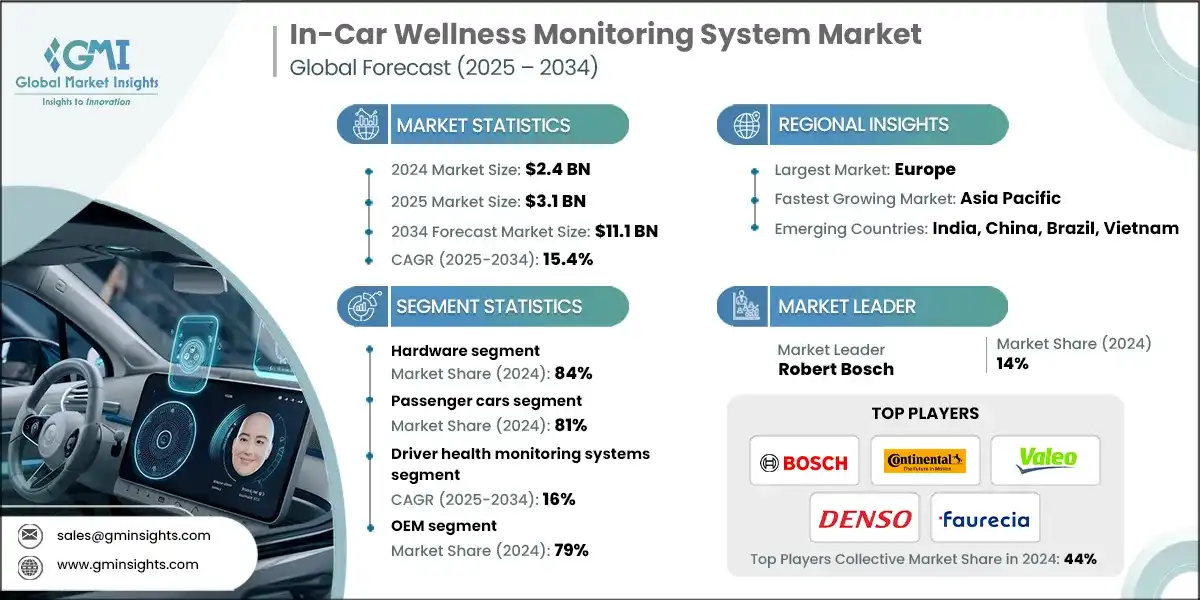
The global in-car wellness monitoring system market size was estimated at USD 2.4 billion in 2024. The market is expected to grow from USD 3.1 billion in 2025 to USD 11.1 billion in 2034, at a CAGR of 15.4% according to latest report published by Global Market Insights Inc.
In-Car Wellness Monitoring System Market Key Takeaways
Market Size & Growth
- 2024 Market Size: USD 2.4 Billion
- 2025 Market Size: USD 3.1 Billion
- 2034 Forecast Market Size: USD 11.1 Billion
- CAGR (2025–2034): 15.4%
Regional Dominance
- Largest Market: Europe
- Fastest Growing Region: Asia Pacific
Key Market Drivers
- Rising focus on driver safety and health.
- Integration of AI, IoT, and advanced sensors.
- Government safety regulations and mandates.
- Increasing adoption in luxury and premium vehicles.
- Technological convergence with wearables and mobile devices.
Challenges
- High system cost and integration complexity.
- Data privacy and security concerns.
Opportunity
- Expansion into commercial and fleet vehicles.
- Growth in autonomous and semi-autonomous vehicles.
- Integration with wearable devices and mobile health platforms.
- Development of AI-driven predictive health analytics.
Key Players
- Market Leader: Robert Bosch led with over 14% market share in 2024.
- Leading Players: Top 5 players in this market include Robert Bosch, Continental, Valeo, Denso, Faurecia, which collectively held a market share of 44% in 2024.
Get Market Insights & Growth Opportunities
The in-car wellness monitoring system market is growing rapidly as vehicles integrate sensors, cameras, and AI to monitor health metrics like vital signs and fatigue. Rising consumer focus on in-vehicle safety and the adoption of advanced technologies in connected and luxury vehicles drive this growth.
Regulatory frameworks in key automotive markets are fundamentally bolstering market growth. By 2026, the European Union mandates all new vehicles to incorporate Driver Drowsiness and Attention Warning systems, thanks to its General Safety Regulation. This regulatory backdrop not only instills market confidence but also propels Original Equipment Manufacturers (OEMs) to systematically integrate these features across their vehicle platforms.
AI-driven monitoring systems have evolved, offering advanced wellness features that go beyond mere safety. With cutting-edge computer vision algorithms, detection accuracy for monitoring driver states now surpasses 95%. Furthermore, by fusing multiple sensors, these systems can gauge physiological metrics, assess environmental conditions, and analyze behaviors. Such advancements pave the way for holistic wellness ecosystems, keeping tabs on occupant health, stress, and comfort.
Regional market dynamics reveal distinct regulatory timelines and OEM strategies. Europe, bolstered by GSR mandates and a robust OEM presence, spearheads market adoption. In contrast, the Asia Pacific region, fueled by a surge in electric vehicles and the embrace of connected cars, showcases the most rapid growth. Meanwhile, North America experiences steady growth, buoyed by forthcoming federal legislation and the integration of premium vehicles.
Europe dominates the in-car wellness monitoring system market, driven by strict EU regulations, luxury vehicle adoption, and a focus on driver well-being. For instance, in April 2025, Automakers like BMW, Mercedes-Benz, and Volvo integrate advanced systems to monitor fatigue, stress, and heart rate, with BMW launching an AI-driven wellness suite. The
Asia-Pacific region leads the growth of the market, driven by rising connected vehicle production, disposable incomes, and electrification in countries like China, Japan, and South Korea. Governments and automakers, such as Hyundai's 2025 collaboration with LG Electronics, are advancing wellness features like air quality and fatigue detection in vehicles.
To get key market trends
In-Car Wellness Monitoring System Market Trends
In early 2025, the in-car wellness monitoring system industry surged as companies and Tier-1 suppliers prioritized both vehicle safety and the well-being of drivers and passengers. Heightened focus on preventing fatigue-related accidents, coupled with efforts to enhance cabin comfort, spurred rapid advancements in wellness monitoring features, especially in connected, electric, and premium vehicles.
AI-driven biometric systems, infrared cameras, and multi-sensor setups are now tracking heart rates, stress levels, postures, and alertness in real time. These advanced technologies are being integrated into smart cockpit architectures, enabling proactive driver support, adaptive climate control, and tailored comfort preferences.
As car systems increasingly integrate with wearable technology and mobile health platforms, the ecosystem is expanding, facilitating continuous health monitoring and cloud-driven health analytics. With the rise of more automated vehicles, in-car wellness is set to play a pivotal role, ensuring the safety and emotional stability of occupants, especially in scenarios where the vehicle may lose control.
Technological advancements in AI, IoT connectivity, and sensor fusion are transforming vehicles into health-centric environments, seamlessly blending safety, comfort, and wellness to align with emerging global standards.
The European Union's General Safety Regulation mandates Driver Drowsiness and Attention Warning systems for all new vehicle type approvals starting July 2024, with full implementation across new registrations by July 2026, driving significant market growth.
Euro NCAP is pushing for the adoption of driver monitoring systems by linking them to its coveted five-star safety ratings. Starting in 2026, Euro NCAP will broaden its criteria to encompass seatbelt detection and monitoring for driver impairment. This shift mandates features that go beyond just detecting drowsiness. As a result, OEMs are being steered towards developing holistic wellness monitoring platforms, moving away from mere compliance solutions.
In the US, the Bipartisan Infrastructure Law is pushing for advanced technologies to prevent impaired driving. The NHTSA's recent notice signals a federal push for mandatory wellness monitoring in vehicles. Their phased approach, starting from simple driver alerts and evolving to full vehicle intervention systems, lays out a clear development path for OEMs.
China's regional DMS mandates for commercial vehicles and the transport of hazardous goods highlight a growing trend in global regulatory oversight. The GB/T 41797-2022 standard sets forth precise monitoring criteria, including eye closure, head posture, and mobile phone usage, establishing technical benchmarks that shape worldwide product innovation.
In-Car Wellness Monitoring System Market Analysis
Learn more about the key segments shaping this market
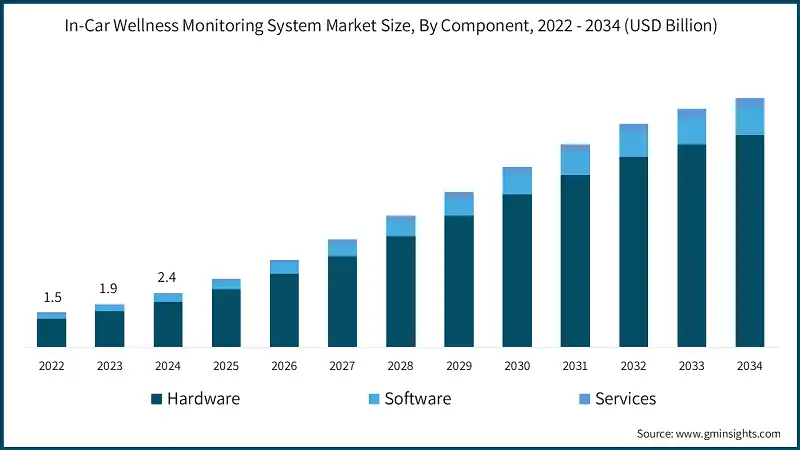
Based on component, in-car wellness monitoring system market is segmented into hardware, software and services. The hardware segment dominates the market with 84% share in 2024, and the segment is expected to grow at a CAGR of over 15.6% from 2025 to 2034.
- Advanced camera systems, featuring high-resolution sensors, infrared for low-light, and cabin monitoring optics, dominate as key hardware components. Suppliers like Smart Eye and Seeing Machines have deployed these automotive-grade solutions in over 3.7 million vehicles globally.
- Radar sensors enable contactless monitoring of heart rate, respiratory patterns, and subtle movements without wearables. Bosch offers radar solutions for in-cabin monitoring, enhanced by AI-driven signal processing.
- Edge computing platforms enable real-time wellness analytics with local data processing, ensuring privacy. Advanced processors from Qualcomm, Texas Instruments, and NVIDIA support efficient AI inference and multimodal sensor fusion without cloud reliance.
- The software segment is growing at a 15.1% CAGR, driven by advancements in AI algorithms and cloud analytics. These solutions transform raw sensor data into actionable wellness insights and automated responses.
- AI algorithms integrate visual, physiological, and behavioral data for wellness assessment, addressing real-time processing, limited computational resources, and safety standards. Machine learning models require extensive datasets and validation across diverse populations and driving conditions.
- Cloud analytics platforms enable wellness tracking, population health insights, and algorithm enhancement through federated learning, while ensuring data privacy with advanced encryption and compliance management.
- The services segment, growing at a 12.5% CAGR, offers significant opportunities through managed wellness services, emergency response coordination, and health coaching, driving recurring revenue and enhanced customer engagement.
- Emergency response services integrate wellness monitoring with automatic crash notifications and medical emergency detection, alerting emergency teams with location and health data. These services depend on partnerships with emergency responders and medical professionals.
- Wellness coaches harness long-term health data to tailor advice on stress relief, fatigue avoidance, and enhancing overall well-being. By syncing with wearable tech, health apps, and medical records, these coaches offer a holistic approach to wellness.
Learn more about the key segments shaping this market
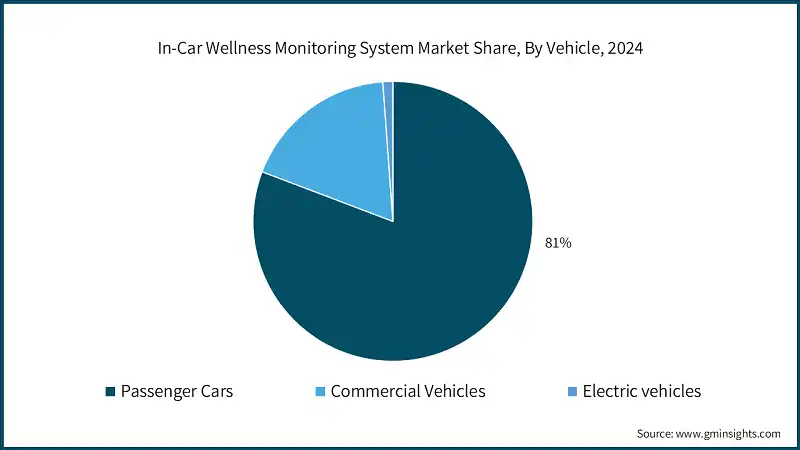
Based on vehicle, in-car wellness monitoring system market is divided into passenger cars, commercial vehicles, and electric vehicles. Passenger cars segment dominated the market, accounting for around 81% share in 2024 and is expected to grow at a CAGR of 15.5% from 2025 to 2034.
- Premium and luxury vehicles, led by brands like Mercedes-Benz, BMW, and Audi, are pioneering wellness monitoring systems, including stress detection and vital sign tracking, in their flagship models as early adoption platforms.
- Regulatory mandates and cost efficiencies are accelerating mass market adoption. OEMs are developing scalable wellness monitoring platforms to ensure compliance and enable future upgrades.
- Commercial vehicles segment holds an 18.1% of the in-car wellness monitoring system market share and is expected to grow with 15.3% CAGR from 2025 to 2034, driven by fleet safety and regulatory compliance. Adoption emphasizes safety, fatigue management, and efficiency over comfort.
- Fleet operators achieve measurable ROI from wellness monitoring through lower accident rates, insurance savings, and better driver retention. Seeing Machines reported a 90% reduction in fatigue-related driving incidents, validating system investment.
- Long-haul trucking applications prioritize wellness monitoring with 24/7 human intervention and real-time alerts. Integration with fleet management systems ensures comprehensive driver tracking and coaching.
- Electric vehicles, with a 2.4% market share, offer unique integration opportunities through advanced electrical architecture and technology-driven features like wellness monitoring.
- Battery management systems enable wellness monitoring without extra power usage, while advanced thermal systems in EVs optimize cabin comfort and battery efficiency.
- As EVs gear up for autonomous driving, there's a growing need for advanced occupant monitoring systems. Beyond just keeping an eye on the driver, these systems now focus on passenger wellness, ensuring children are present, and identifying emergencies, all in vehicles where human oversight is dwindling.
Based on system, the market is segmented into driver health monitoring systems, passenger wellness monitoring systems, in-cabin environment and comfort monitoring systems, integrated vehicle wellness systems and others. The driver health monitoring systems segment is projected to dominate the in-car wellness monitoring system market with a CAGR of 16% from 2025 to 2034.
- In 2024, driver health monitoring systems command a dominant 39.2% market share, underscoring their pivotal role in ensuring safety, meeting regulatory standards, and gaining traction among OEMs. These systems are adept at detecting fatigue, monitoring attention levels, and recognizing acute health events.
- Advanced driver monitoring integrates physiological sensing, enabling health assessments through heart rate, stress, and vital sign tracking. These systems detect emergencies like heart attacks or strokes, triggering automatic responses.
- Passenger wellness monitoring, holding a 12.9% market share, is poised for robust growth as interior sensing capabilities evolve beyond just driver-centric applications. These advanced systems now oversee the safety, comfort, and overall wellness of every vehicle occupant.
- By harnessing individual biometric data, passenger comfort optimization fine-tunes seating, climate control, and entertainment systems to enhance wellness. Such tailored adjustments can mitigate motion sickness, boost alertness, and elevate the overall travel experience.
- Environmental monitoring systems, with a 20.9% market share, optimize air quality, temperature, humidity, and lighting for occupant wellness while integrating with vehicle climate control and lighting systems.
- Advanced air quality monitoring systems not only detect pollutants, allergens, and infectious agents but also automatically adjust filtration and ventilation systems. These sophisticated systems can identify COVID-19 and other airborne pathogens, ensuring health protection for vehicle occupants.
Based on sales channel, the in-car wellness monitoring system market is divided into OEM and aftermarket. The OEM segment dominated the market accounting around 79% share in 2024 and is expected to grow at a CAGR of 15.5% from 2025 to 2034.
- The OEM segment led the market in 2024 and is expected to retain its dominance. This is due to their ability to seamlessly integrate advanced wellness and safety technologies while meeting global safety standards.
- OEMs are integrating multi-sensor wellness systems, such as heart rate sensors and fatigue detection cameras, into next-generation vehicles. These systems enhance comfort and safety, particularly in luxury and premium models, by coordinating with features like adaptive cruise control and infotainment.
- Regulatory mandates in Europe, North America, and Asia are driving OEMs to integrate fatigue and attention monitoring systems, enhancing safety compliance. These systems also offer data-driven insights for predictive health and driver alertness.
- The Aftermarket segment is growing steadily in developing regions, driven by cost-effective wellness kits offering basic health tracking and fatigue alerts. However, limited system integration and analytics hinder their accuracy and scalability compared to OEM-installed systems.
- For instance, in June 2024, Mercedes-Benz introduced its Energizing Comfort Control system, featuring biometric monitoring and stress-relief functions, in models like the E-Class and EQE. This highlights the growing focus on driver well-being in connected mobility.
Looking for region specific data?
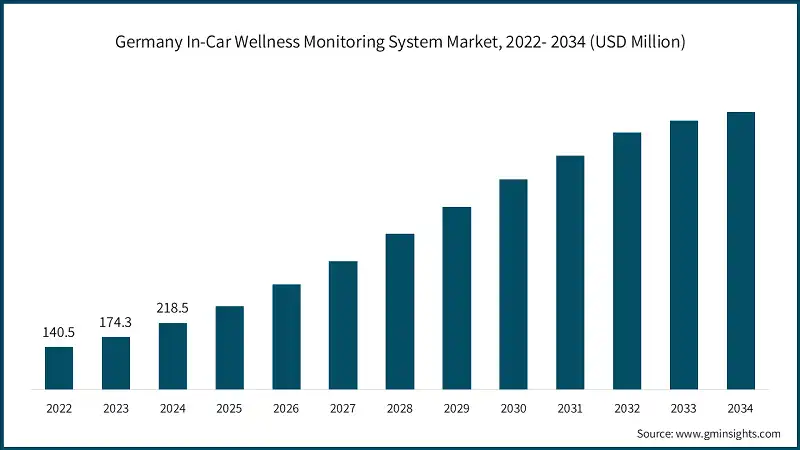
Germany dominates the Europe in-car wellness monitoring system market, showcasing strong growth potential, with a CAGR of 14.3% from 2025 to 2034.
- Germany leads Europe's market due to its strong automotive manufacturing and focus on driver safety. Key manufacturers like BMW and Audi are adopting AI-driven wellness monitors to enhance driver well-being.
- Biometric sensors, driver monitoring systems, and emotion recognition technologies are increasingly integrated into vehicles, driven by the rise of electrification, connectivity, and semi-autonomous features. These advancements address the demand for personalized and health-focused mobility experiences.
- Germany's strong R&D and supplier base, led by Bosch, Continental, and Faurecia, focuses on advanced sensors and data analytics to detect fatigue or medical distress through vital sign and posture monitoring.
- Government initiatives and EU safety regulations are driving in-car wellness adoption, with Germany leading due to the inclusion of Driver Drowsiness and Attention Warning (DDAW) systems in the EU General Safety Regulation (GSR).
- In April 2024, Mercedes-Benz launched the second-generation MBUX Wellness Suite in the EQS model, featuring biometric monitoring, adaptive lighting, and climate control to enhance focus and reduce stress.
Europe dominated in-car wellness monitoring system market with a market share of 35% in 2024 and is expected to grow at 16% CAGR from 2025 to 2034.
- European carmakers like BMW, Mercedes-Benz, Volvo, and Audi are integrating AI-based wellness and fatigue monitoring systems into premium and electric models, addressing safety standards and rising demand for health-focused vehicle technologies.
- Strict EU safety standards, such as those for Driver Drowsiness and Attention Warning (DDAW) systems, are driving OEMs to adopt wellness monitoring technologies, including fatigue warnings, posture monitoring, and vital signs tracking as standard features in vehicles.
- In Europe, automotive OEMs, sensor manufacturers, and health tech firms are collaborating to integrate biosensors, AI-driven emotion recognition, and connected health systems for real-time in-cabin wellness monitoring.
- Europe's focus on R&D and digital health innovation drives advancements in in-car wellness systems, with Germany, France, and Sweden leading in sensor technology, emotion detection, and ergonomic cockpits.
- EU member states' regulatory harmonization fosters uniform market standards and allows OEMs to achieve economies of scale. Moreover, the Euro NCAP's inclusion of wellness monitoring in its safety ratings offers added incentives for adoption, surpassing mere regulatory compliance.
The China in-car wellness monitoring systems market leads in Asia Pacific region.
- China's market is expanding, driven by electric vehicles, driver safety focus, and health-conscious consumers, with OEMs like BYD and NIO adding AI-based wellness features.
- Government initiatives like the ICV Development Strategy and Healthy China 2030 are driving carmakers to adopt in-cabin sensing and biometric systems, promoting safer and health-conscious mobility.
- Chinese automakers, tech firms, and research centers are leveraging AI, computer vision, and IoT to create intelligent interiors that detect stress, drowsiness, and posture in real-time, enabling personalized comfort and safety actions.
- China's 14th Five-Year Plan drives market growth by promoting smart vehicle innovations, with firms like Horizon Robotics and Huawei investing in domestic sensor fusion and edge AI to reduce import reliance.
- Chinese OEMs like BYD, Geely, and NIO are partnering with domestic AI suppliers to integrate facial recognition and biometric systems, creating local alternatives to Western technologies.
- For instance, in May 2024, Geely Auto partnered with Huawei Intelligent Automotive Solutions to launch an AI-based In-Car Wellness Platform that monitors real-time health metrics and provides personalized driving recommendations.
Asia Pacific region is the fastest growing in-car wellness monitoring system market with a market share of 32% and China leading the market with revenue of USD 205.2 million in 2024.
- In 2024, the Asia Pacific market will lead due to rapid vehicle digitalization, rising demand for health and safety features, and AI-driven driver monitoring systems. The growth of connected and electric cars in countries like China, Japan, South Korea, and India further drives this adoption.
- Market growth in the region is driven by increased R&D spending, OEM-health tech collaborations, and localized sensor production. Regional OEMs focus on integrating biometric and emotion-recognition sensors to improve vehicle safety and comfort in urban traffic.
- China, supported by its government, leads Asia Pacific's shift toward intelligent vehicle designs. Automakers like BYD, NIO, and Geely are integrating in-cabin systems for heart rate monitoring and fatigue detection, aligning with safety and wellness demands.
- For instance, in April 2024, Geely Auto rolled out its AI-driven Driver Care System in select EVs, featuring facial recognition, stress detection, and smart posture correction, underscoring the significance of occupant comfort and advanced mobility in China.
- Asia Pacific is leading the way in adopting in-car wellness monitoring systems, driven by strong policy backing, technological progress, and key industry partnerships, positioning the region at the forefront of health-centric mobility advancements.
- In August 2024, Denso Corporation increased production of advanced biometric sensors in Japan to support domestic OEMs in launching next-generation in-cabin wellness features. This aligns with stricter driver focus and fatigue monitoring laws in Japan, South Korea, and India.
The in-car wellness monitoring system market in US is expected to experience significant and promising growth from 2025 to 2034.
- The US market is growing as automakers integrate AI-enabled systems to monitor fatigue, stress, and vital signs, enhancing safety and driving experiences.
- The US, led by NHTSA and DOT, is advancing in-car wellness by integrating driver monitoring and wellness systems into vehicle safety and automation, positioning itself as a leader in health-focused mobility innovation.
- US-based automotive and tech companies are developing AI-powered wellness systems with emotion detection, thermal imaging, and biometric sensors to enhance driver alertness by adjusting vehicle settings in real-time.
- Initiatives like the CHIPS and Science Act (2022) and federal road safety programs are driving US innovation in smart mobility technologies by fostering collaboration among automakers, sensor developers, and AI companies.
- The US dominates the market for intelligent cockpit and occupant monitoring technologies, driven by strong R&D, data privacy frameworks, and EV adoption. Companies like Ford, Tesla, and Rivian are integrating wellness features through AI and sensor collaborations.
- For instance, in May 2024, General Motors partnered with Affectiva and Gentherm to launch a Driver Wellness and Comfort Suite for its electric SUVs, showcasing U.S. leadership in in-car wellness innovation.
The North America in-car wellness monitoring system market is anticipated to grow at a CAGR of 15.3% during the analysis timeframe.
- North America, holding a 20.1% market share, is witnessing steady growth, bolstered by upcoming federal legislation and a surge in premium vehicle adoption. The market's expansion finds a regulatory backbone in the Bipartisan Infrastructure Law, which mandates technology for impaired driving prevention.
- In North America, the growing adoption of connected vehicles, EVs, and autonomous technologies is driving demand for advanced automotive cybersecurity semiconductors. Automakers in the US and Canada, are deploying high-performance chips to protect communication networks, OTA systems, and cloud platforms from cyber threats.
- The region focuses on vehicle intelligence and occupant well-being, driving advancements in biometric sensing and in-cabin experiences. Major OEMs like General Motors, Ford, Tesla, and Stellantis are investing in real-time monitoring technologies to enhance driver alertness and wellness feedback.
- Automakers are partnering with sensor manufacturers, wearable tech firms, and AI startups to integrate vehicle wellness systems with mobile and cloud health platforms, enabling real-time monitoring and predictive analytics.
- The US market is prioritizing premium and luxury vehicles while gradually expanding to the mass market. Tesla, Ford, and General Motors are integrating facial recognition and biometric monitoring into electric and autonomous vehicles.
- While aligning closely with US market trends, Canada carves out its own regulatory path. In Canada, the spotlight is on adopting technologies for commercial vehicles and prioritizing fleet safety.
Brazil leads the Latin American in-car wellness monitoring system market, exhibiting remarkable growth of 12.7% during the forecast period of 2025 to 2034.
- Brazil's market is growing rapidly, driven by rising demand for connected vehicles and features like fatigue detection and stress monitoring to enhance driver safety and comfort.
- Government initiatives in Brazil are driving the adoption of smart mobility and advanced driver assistance technologies, prompting automakers to integrate wellness and biometric monitoring systems to enhance vehicle safety and reduce road accidents.
- Brazilian automotive manufacturers and Tier-1 suppliers are collaborating with global tech firms to develop in-car wellness solutions, including driver monitoring, seat ergonomics, and thermal comfort systems, tailored for Latin America.
- The Brazilian market is growing due to the adoption of electric and connected vehicles. Automakers are integrating biometric and wellness technologies into smart cabins, making wellness systems standard in premium and mid-range vehicles.
Saudi Arabia to experience substantial growth in the Middle East and Africa in-car wellness monitoring system market in 2024.
- Saudi Arabia's vehicle ecosystem is evolving under Vision 2030, driving demand for in-car wellness monitoring systems (IWMS) that enhance safety by tracking driver health metrics like fatigue and stress.
- Despite challenges like ramping up EV penetration, local manufacturing, and infrastructure, the Saudi automotive market is making strides, bolstered by substantial government investments in smart mobility and vehicle safety systems.
- In Saudi Arabia, automakers, Tier-1 suppliers, and health-tech vendors are integrating wellness features like driver sleep detection and heart-rate sensors into vehicles. These efforts align with the Kingdom's smart mobility and connected car initiatives while addressing occupant wellness and regulatory mandates.
- The Saudi market is driven by advancements in vehicle electronics, health sensor adoption, government initiatives, and cross-industry collaborations, positioning wellness modules as key differentiators in the market.
In-Car Wellness Monitoring System Market Share
The top 7 companies in the in-car wellness monitoring system industry are Robert Bosch, Continental, Valeo, Denso, Faurecia, Smart Eye, Seeing Machines, and Tata Elxsi contributed around 52% of the market in 2024.
- Robert Bosch leads the market with a 14.20% share, leveraging its automotive expertise and OEM partnerships. Its portfolio includes sensors, AI-driven signal processing, and platforms designed for in-cabin monitoring.
- Continental focuses on integrating intelligent sensors with cloud-based analytics, leveraging its expertise in tire pressure monitoring, battery sensors, and vehicle connectivity to enable comprehensive vehicle and occupant health monitoring.
- Valeo focuses on advanced driver assistance systems and interior sensing technologies, integrating wellness monitoring into ADAS platforms through partnerships with Mobileye and Volkswagen Group.
- Denso develops reliable, cost-effective automotive-grade sensors and platforms, enabling wellness monitoring system integration across diverse vehicle platforms.
- Faurecia leads with seat-embedded biometric sensors, posture and breathing monitoring, and wellness feedback functions, integrating comfort features with health monitoring for premium OEMs.
- Smart Eye specializes in AI-driven driver monitoring systems, achieving 361 design wins across 23 OEMs and deployment in over 2 million vehicles globally, highlighting its successful commercialization.
- Seeing Machines specializes in commercial vehicle applications and fleet monitoring. Its Guardian system, deployed in over 60,000 vehicles, has reduced fatigue-related driving incidents by more than 90%.
- Tata Elxsi focuses on AI-driven driver health analytics and modular software platforms, enabling OEMs and Tier1 suppliers to deploy real-time in-car wellness monitoring efficiently.
In-Car Wellness Monitoring System Market Companies
Major players operating in the in-car wellness monitoring system industry are:
- Aptiv
- Continental
- Denso
- Faurecia
- Gentex
- Robert Bosch
- Seeing Machines
- Smart Eye
- Tata Elxsi
- Valeo
- Aptiv, Continental, and Denso lead the in-car wellness monitoring market by developing AI-driven occupant sensing, driver health analytics, and integrated sensor platforms to monitor fatigue, stress, heart rate, and posture, enabling OEMs to enhance vehicle safety and occupant well-being.
- Faurecia, Gentex, and Robert Bosch focus on hardware-software integration for in-cabin wellness, offering seat-embedded biometric sensors, air-quality and thermal comfort management, and real-time posture/breathing monitoring for premium and fleet vehicles.
- Seeing Machines, Smart Eye, Tata Elxsi, and Valeo advance occupant wellness through driver-monitoring and AI-based predictive systems, providing cloud-connected platforms, real-time alerts, and modular software stacks for fatigue detection, distraction management, and holistic wellness monitoring in connected and autonomous vehicles.
In-Car Wellness Monitoring System Market Report Attributes
| Key Takeaway | Details |
|---|---|
| Market Size & Growth | |
| Base Year | 2024 |
| Market Size in 2024 | USD 2.4 Billion |
| Market Size in 2025 | USD 3.1 Billion |
| Forecast Period 2025 - 2034 CAGR | 15.4% |
| Market Size in 2034 | USD 11.1 Billion |
| Key Market Trends | |
| Drivers | Impact |
| Rising focus on driver safety and health | Driver fatigue, linked to 20% of severe accidents, prompts OEMs to adopt wellness monitoring systems. |
| Integration of AI, IoT, and advanced sensors | AI analytics and IoT sensors enable real-time health monitoring and safety measures. |
| Government safety regulations and mandates | Regulatory focus on safety drives OEM adoption of in-car wellness and monitoring systems. |
| Increasing adoption in luxury and premium vehicles | Premium automakers are incorporating wellness features like stress detection and biometric monitoring to enhance user experience. |
| Technological convergence with wearables and mobile devices | Wearables and smartphones enable seamless health tracking and remote wellness management beyond vehicles. |
| Pitfalls & Challenges | Impact |
| High system cost and integration complexity | High costs and design complexity hinder the adoption of advanced systems in mid-range and economy vehicles. |
| Data privacy and security concerns | The collection of biometric and behavioral data poses privacy risks, requiring strict compliance with regulations like GDPR. |
| Opportunities: | Impact |
| Expansion into commercial and fleet vehicles | Wellness monitoring systems in commercial vehicles enhance safety and reduce costs. |
| Growth in autonomous and semi-autonomous vehicles | As automation advances, in-cabin wellness systems ensure occupant safety and comfort. |
| Integration with wearable devices and mobile health platforms | Integrating in-car wellness systems with wearables enables real-time health tracking. |
| Development of AI-driven predictive health analytics | AI analytics detect early signs of health issues, enabling timely interventions. |
| Market Leaders (2024) | |
| Market Leaders |
14% Market Share |
| Top Players |
Collective market share in 2024 is Collective Market Share is 44% |
| Competitive Edge |
|
| Regional Insights | |
| Largest Market | Europe |
| Fastest growing market | Asia Pacific |
| Emerging countries | India, China, Brazil, Vietnam |
| Future outlook |
|
What are the growth opportunities in this market?
In-Car Wellness Monitoring System Industry News
- In September 2025, Seeing Machines introduced alcohol impairment detection for its Driver Monitoring System, capable of identifying BAC levels from 0.05 with peak accuracy at 0.10 and above. The technology aligns with European NCAP standards and EU mandates for 2026, with a phased implementation plan submitted to NHTSA.
- In September 2025, Bosch showcased its software-driven mobility solutions at IAA Mobility 2025, featuring AI-powered cameras, extended-range radar sensors, and edge computing for real-time wellness analytics. The "Comfort Stop" feature, reducing braking jolts by 70-90%, highlighted the wellness benefits of integrated sensing systems.
- In November 2024, Continental, in collaboration with trinamiX GmbH, launched the "Invisible Biometrics Sensing Display," a system behind an OLED screen that tracks vital signs, monitors body position, and enables 3D mapping for airbag and seat belt safety.
- In July 2025, Valeo Unveils Next-Generation Vehicle Technology At IAA Mobility 2025, Valeo unveiled its next-generation vehicle technologies, spotlighting advanced occupant sensing and comfort features aimed at holistic wellness monitoring. This showcase underscores Valeo's commitment to advancing cabin monitoring and seamlessly integrating it with broader vehicle systems, all to elevate the occupant experience.
The in-car wellness monitoring system market research report includes in-depth coverage of the industry with estimates & forecasts in terms of revenue (USD Mn) and Volume from 2021 to 2034, for the following segments:
Market, By Component
- Hardware
- Sensors
- Cameras
- Steering wheel and seat sensors
- Control units and processors
- Software
- AI-based health analytics
- Driver monitoring algorithms
- Data integration and alert systems
- Services
- Cloud connectivity and data management
- Emergency assistance and telehealth integration
Market, By Vehicle
- Passenger cars
- Hatchbacks
- Sedans
- SUV
- Commercial vehicles
- Light commercial vehicles (LCV)
- Medium commercial vehicles (MCV)
- Heavy commercial vehicles (HCV)
- Electric vehicles (EV)
Market, By System
- Driver health monitoring systems
- Passenger wellness monitoring systems
- In-cabin environment and comfort monitoring systems
- Integrated vehicle wellness systems
- Others
Market, By Sales Channel
- OEM
- Aftermarket
The above information is provided for the following regions and countries:
- North America
- US
- Canada
- Europe
- Germany
- UK
- France
- Italy
- Spain
- Russia
- Nordics
- Portugal
- Croatia
- Asia Pacific
- China
- India
- Japan
- Australia
- South Korea
- Singapore
- Thailand
- Indonesia
- Vietnam
- Latin America
- Brazil
- Mexico
- Argentina
- MEA
- South Africa
- Saudi Arabia
- UAE
- Turkey
Frequently Asked Question(FAQ) :
What is the market size of the in-car wellness monitoring system in 2024?
The market size was USD 2.4 billion in 2024, with a CAGR of 15.4% expected through 2034. The growth is driven by the integration of sensors, cameras, and AI in vehicles to monitor health metrics like vital signs and fatigue.
What is the projected value of the in-car wellness monitoring system market by 2034?
The market is poised to reach USD 11.1 billion by 2034, fueled by advancements in AI, IoT connectivity, and sensor fusion, along with increasing adoption in connected and luxury vehicles.
What is the expected size of the in-car wellness monitoring system industry in 2025?
The market size is projected to reach USD 3.1 billion in 2025.
How much revenue did the hardware segment generate in 2024?
The hardware segment generated approximately 84% of the market revenue in 2024 and is expected to witness over 15.6% CAGR from 2025 to 2034.
What was the market share of the passenger cars segment in 2024?
The passenger cars segment accounted for around 81% of the market share in 2024 and is set to expand at a CAGR of 15.5% till 2034.
What is the growth outlook for the OEM segment from 2025 to 2034?
The OEM segment, which held a 79% market share in 2024, is anticipated to observe around 15.5% CAGR up to 2034.
Which region leads the in-car wellness monitoring system sector?
Germany leads the European market with a CAGR of 14.3% from 2025 to 2034, led by its strong automotive manufacturing base and focus on driver safety.
What are the upcoming trends in the in-car wellness monitoring system market?
AI-driven biometrics, wearable integration, cloud-based health analytics, proactive driver support, adaptive climate control, and compliance with global safety standards (EU GSR, China GB/T 41797-2022).
Who are the key players in the in-car wellness monitoring system industry?
Key players include Aptiv, Continental, Denso, Faurecia, Gentex, Robert Bosch, Seeing Machines, Smart Eye, Tata Elxsi, and Valeo.
In-Car Wellness Monitoring System Market Scope
Related Reports