Summary
Table of Content

Household Cleaning Tools & Supplies Market
Get a free sample of this report
Form submitted successfully!
Error submitting form. Please try again.
Thank you!
Your inquiry has been received. Our team will reach out to you with the required details via email. To ensure that you don't miss their response, kindly remember to check your spam folder as well!
Request Sectional Data
Thank you!
Your inquiry has been received. Our team will reach out to you with the required details via email. To ensure that you don't miss their response, kindly remember to check your spam folder as well!
Form submitted successfully!
Error submitting form. Please try again.
Household Cleaning Tools & Supplies Market Size
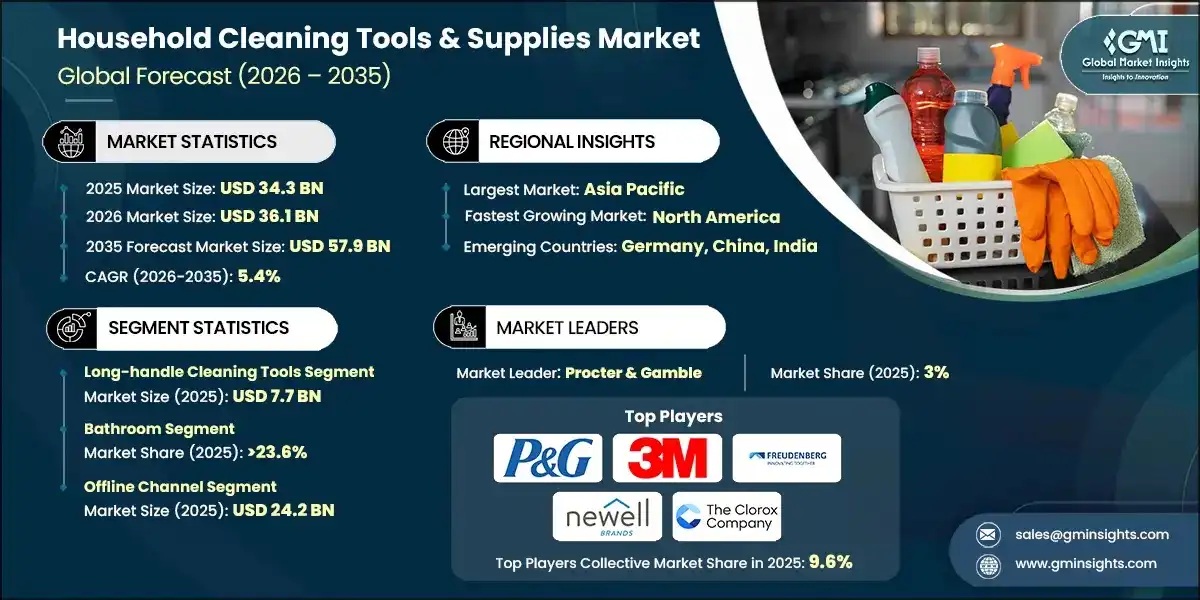
The household cleaning tools & supplies market was estimated at USD 34.3 billion in 2025. The market is expected to grow from USD 36.1 billion in 2026 to USD 57.9 billion in 2035, at a CAGR of 5.4%, according to latest report published by Global Market Insights Inc.
Household Cleaning Tools & Supplies Market Key Takeaways
Market Size & Growth
- 2025 Market Size: USD 34.3 Billion
- 2026 Market Size: USD 36.1 Billion
- 2035 Forecast Market Size: USD 57.9 Billion
- CAGR (2026–2035): 5.4%
Regional Dominance
- Largest Market: Asia Pacific
- Fastest Growing Region: North America
Key Market Drivers
- Increasing awareness of hygiene and cleanliness.
- Technological advancements in cleaning equipment.
- E-commerce expansion and subscription models.
Challenges
- Rising adoption of professional cleaning services.
- Lack of consumer retention and product differentiation.
Opportunity
- Rising demand for sustainability.
- Integration of smart and automated cleaning solutions.
Key Players
- Market Leader: Procter & Gamble led with over 3% market share in 2025.
- Leading Players: Top 5 players in this market include Procter & Gamble, 3M Company, Freudenberg Group, Newell Brands, The Clorox Company, which collectively held a market share of 9.6% in 2025.
Get Market Insights & Growth Opportunities
It is projected that urbanization will represent approximately 57% of the world's population by 2024 and urbanization’s growth has resulted in more people wanting cleaning products to use in urban areas. Additionally, regulations on cleanliness in the workplaces such as offices and hotels have been major contributors to the market's growth. Furthermore, the World Health Organization (WHO's) focus on clean facility standards has supported market growth as well. An example of this is Unilever's introduction of a plant-based cleaning spray under the brand name Seventh Generation, launched in 2023, in alignment with the global shift to sustainable products.
Additionally, the ongoing strong housing market has increased demand for cleaning products and tools globally for use in the home. According to the U.S. Census Bureau, the homeownership rate is up to 65.7% in Q3 2024 and over 86.6 million homes are occupied by their owners. There has been a growth in homeownership which has allowed lending opportunities for companies such as Clorox. In 2023, GlaxoSmithKline (GSK) Clorox disinfecting wipes have grown 20% from last year's sales.
Consumer housecleaning behaviors have adapted due to COVID-19, with consumers now more aware of the cleanliness of their homes. The Centers for Disease Control and Prevention (CDC) continues to provide the same guidelines that recommend cleaning and disinfecting frequently touched surfaces, and, according to the American Cleaning Institute (ACI), 85% of American households have listed cleaning as one of their highest priorities. For instance, Procter & Gamble created a new line of cleaners in 2020 called Microban 24, which offers 24-hour protection against bacteria.
Increasing global demand for cleaner and greener cleaning products are also boosting the market of household cleaning machines worldwide. The International Federation of Robotics (IFR) has reported a 19% growth in the global sales volume of robotic cleaners during the year 2023. Innovating companies in this sector include iRobot, Ecovacs, and Xiaomi, which lead the way in creating new technology in this field. An example of this is iRobot’s recent introduction to the market of their Roomba Combo j7+, a robotic vacuum cleaner that also mops.
Also, due to the increased awareness of the importance of protecting the environment, the demand for sustainable cleaning products has rapidly expanded since 2021. According to the Environmental Working Group (EWG), eco-friendly cleaning supplies have been growing at 15 per cent per year. In response to this need for environmentally friendly products, Method, part of SC Johnson, has recently introduced a line of biodegradable cleaning supplies and solutions aimed at consumers who are concerned with the environment.
To get key market trends
Household Cleaning Tools & Supplies Market Trends
The household cleaning tools & supplies is evolving, driven by consumer demand for smart, energy-efficient, and aesthetically pleasing appliances.
- Environmental sustainability is shaping the household cleaning tools and supplies market– companies such as Unilever, Procter & Gamble and Reckitt are using recycled materials and less plastic in the products they make. According to a study by the American Cleaning Institute, almost three out of every four manufacturers within this market are now using greener packaging. An example of this is Kimberly-Clark's commitment to reduce its plastic footprint by half by 2030.
- Further, e-commerce is reshaping the purchasing landscape, accounting for a large percentage of all retail sales around the world in 2023 and household essentials were a big part of that. Procter & Gamble and Reckitt Benckiser have both focused increasingly on developing direct-to-consumer sales channels. For example, Reckitt has reported a significant increase in the sale of its Lysol and Harpic cleaning products through online channels during the past year.
- New materials are continuing to change how we clean our homes, globally, according to the American Cleaning Institute, microfiber products have become increasingly important within the cleaning tools industry. Freudenberg home and cleaning solutions has introduced microfiber mops and microfiber wipes that clean better than traditional mop and wipes and require less water and cleaning products to maintain.
- Consumers across the world who consider themselves to be environmentally conscious are increasingly demanding cleaning materials that reduce exposure to harmful chemicals and allergens. The American Cleaning Institute suggests that over 60% of consumers now consider health and safety to be a factor in their purchase of cleaning products. Companies have responded to consumers' focus on health and safety for example Kimberly-Clark's windows and surfaces cleaning wipes, which are advertised to be free of harsh chemicals and helpful to the sensitives.
- Government regulations and industry efforts are pushing adoption of sustainable practices in the household cleaning market. The U.S. Environmental Protection Agency (EPA) has developed guidelines that encourage organizations to use eco-friendly materials. For example, Freudenberg has partnered with industry associations to advocate for sustainability as a direction for cleaning product innovation.
Household Cleaning Tools & Supplies Market Analysis
Learn more about the key segments shaping this market
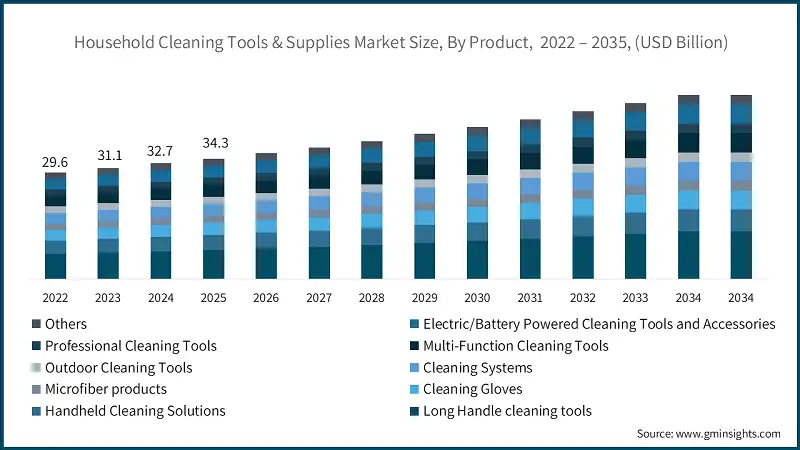
Based on product, the market is segmented long-handle cleaning tools, handheld cleaning solutions, cleaning gloves, microfiber products, cleaning systems, outdoor cleaning tools, multi-function cleaning tools, professional cleaning tools, electric/battery-powered cleaning tools and accessories, and others. In 2025, the long-handle cleaning tools segment generated a revenue of USD 7.7 billion and is expected to grow at a CAGR of around 5.5% during the forecast period.
- Long-handle cleaning tools account for the largest product segment and are usually designed to be user-friendly and ergonomic to lessen the physical impact of cleaning. The American Cleaning Institute (ACI) noted that the need for ergonomic cleaning tools has grown dramatically over time. Long-handle cleaning tools, such as brooms, mops, dusters, and/or long-handle scrubbers, are essential in cleaning those difficult to reach and access areas.
- The growing home sizes and new multi-story homes has greatly contributed to this trend. The average size of new single-family homes in the U.S. exceeds 2,500 square feet, and multi-story housing developments globally have significantly increased, these larger homes and buildings require efficient cleaning products to effectively clean larger indoor and outdoor spaces, and patios and driveways.
- Consumers are increasingly opting for durable and multi-purpose cleaning tools. Adjustable features and detachable, high-quality handles are gaining popularity as they enable comprehensive household cleaning. Governments worldwide are promoting eco-friendly practices, driving demand for lightweight and sustainable cleaning tools. For example, Freudenberg Home and Cleaning Solutions introduced microfiber-based long-handle tools with antibacterial protection, aligning global sustainability goals.
- Leading global manufacturers are responding to this trend by using advanced technologies and designs to adapt to these changing needs. For example, both Vileda and Kärcher have developed products specifically intended for the changing needs of consumers. Kärcher offers telescopic cleaning products that feature spray technology, and Vileda has developed ergonomic mop systems as an example of user-friendly, effective cleaning solutions.
- Growth in the market is bolstered by companies such as Carlisle Companies Inc., Carolina Mop Company, and O'Dell Corp. who focus on producing eco-friendly and multi-use cleaning tools. For instance, Carlisle Companies, Inc. was one of the first manufacturers of long-handled scrubbers, which are designed to tackle tough cleaning tasks in commercial applications. In addition, the trend towards developing long-handle household cleaning tools will remain a strong focus for manufacturers, as they continue to innovate and launch new products.
Learn more about the key segments shaping this market
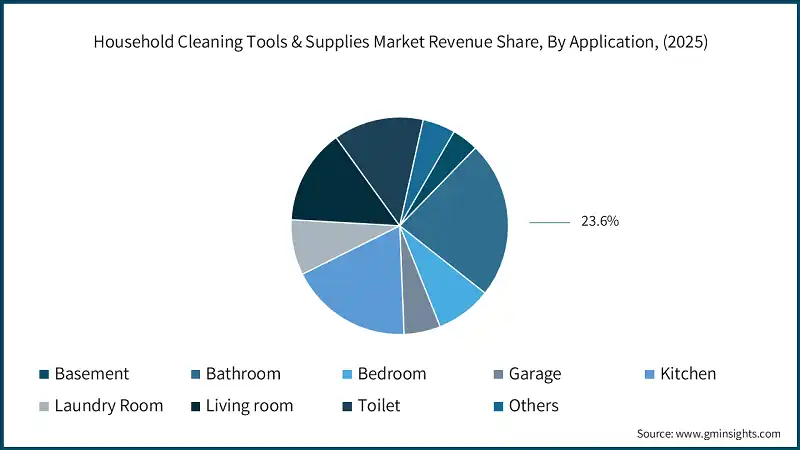
Based on applications, the household cleaning tools & supplies market is bifurcated into basement, bathroom, bedroom, garage, kitchen, laundry room, living room, toilet, and others. In 2025, the bathroom segment accounted for over 23.6% share and is expected to grow at a CAGR of 5.8% till 2035.
- The greatest percentage of household cleaning products is attributed to households' need for cleaning products for their bathrooms, as bathrooms have higher amounts of moisture than other areas of the house and offer a perfect environment for the growth of mildew, mold, and germs. According to a survey conducted by the American Cleaning Institute (ACI), approximately 70% of all households who respond to the ACI's annual surveys report cleaning their bathrooms regularly.
- Health-related government agencies like the CDC have advised consumers on the necessity of cleaning their bathrooms on a regular basis so as not to risk the transmission of diseases. Due to the growing popularity of these recommendations, many consumers are now looking for the latest products in bathroom cleaning tools like antimicrobial scrubbers and microfibre-based cleaning products. A lot of manufacturers like Freudenberg Home Products have responded to these consumer requests for more specialized bathroom cleaning tools with built-in antibacterial features.
- Consumers all over the world continue to seek out new and innovative bathroom cleaning tools that are easy to use, long-lasting, and will provide the most success in terms of cleaning their bathrooms. There has also been a growing interest in products that are ergonomically designed and can be used for multiple purposes. For instance, Vileda produces cleaners with extendible handles that can be used interchangeably for cleaning tiles, tubs, and shower doors. A recent report from the World Bank states that in 2023, 57% of the world's population lives in urban areas, resulting in a continued need for innovative cleaning products.
- Global producers are developing solutions to challenges associated with cleaning bathrooms by creating innovative products. Some examples include Unilever’s Domestos who have created disposable cleaning pads, Kärcher whose steam cleaning devices allow for deep cleaning of hard surfaces, and Reckitt-Lysol who have produced disinfecting wipes for both convenience and cleanliness.
- The bathroom cleaning tools category has also been growing as companies like Freudenberg Group and Scotch-Brite continue to emphasize eco-friendly green products and high-performing products in this segment of the market. As an example of this, Kärcher's commercial and residential cleaning scrub brushes are highly effective/efficient and durable. Given Freudenberg Group and Scotch-Brite’s continued efforts in manufacturing and developing new products based upon consumer demand.
Based on the distribution channel, the household cleaning tools & supplies market is segmented as online and offline. The offline channel segment is expected to hold a major share with revenue of USD 24.2 billion in 2025.
- Offline retail channels command the largest share of the market for household cleaning products worldwide because shoppers want to inspect a product's quality physically and gain access to products on the spot. Approximately 70% of all household cleaning products are purchased through offline channels according to the World Bank. Shopping at physical stores enables buyers to gain knowledge about products and receive support from retail associates to obtain product demos and to take advantage of in-store promotion opportunities.
- Offline shopping is also very important to assist with urgent cleaning needs since users can obtain the product without any delivery waiting time. This is true especially at peak times like Christmas holidays and for workers who support businesses such as janitors and hospitality workers. Brands like Unilever, Reckitt and Henkel have realized the importance of providing their products through offline retail distribution and they have significantly enhanced their ability to fulfil their customers' needs.
- Government bodies and associations representing the cleaning industry such as the American Cleaning Institute (ACI) also provide support through education regarding the safe use of cleaning products and the proper skills to clean according to menu instructions, and through in-store product demonstration opportunities provided by retailers such as 3M and Kimberly-Clark that manufacture cleaning products.
- Companies such as Carlisle Companies Inc., Carolina Mop Company, and Karcher North America, Inc., are developing strategies for building stronger offline distribution networks by partnering with larger retail chains to offer store-specific exclusive product lines. CRAFTSMAN's solution to meet retail customers needs is to offer durable cleaning tools, while ODell Corp.'s focus is in providing quality janitorial supplies to professional customers who desire them.
Looking for region specific data?
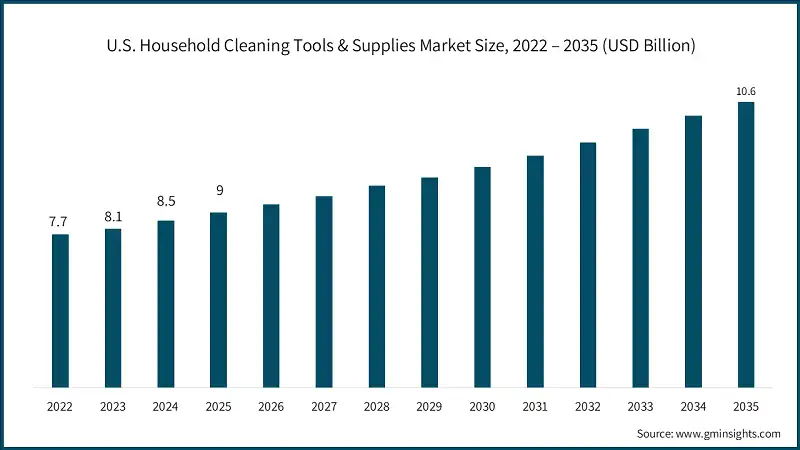
U.S. household cleaning tools & supplies market accounted for around 73.7% share in 2025.
- This dominance is due in part to interest in new cleaning products and the presence of the major players, Freudenberg Home and Cleaning Solutions, Karcher North America, Inc., Kimberly-Clark, Newell Brands Inc. (Quickie), O’Dell Corp., and Procter & Gamble (Swiffer).
- To the U.S. Census Bureau, the increasing number of households, and disposable incomes, have driven more demand for cleaning tools and supplies. Additionally, market developments are encouraged by continued product innovation and sustainability initiatives from many of the larger companies in the region.
Europe household cleaning tools & supplies market is expected to grow at 5.3% CAGR during the forecast period.
- Europe’s growth is driven by strong sustainability regulations and hygiene awareness. The EU’s Circular Economy Action Plan and bans on single-use plastics encourage eco-friendly cleaning tools. Rising demand for microfiber and reusable products aligns with European Green Deal targets. For example, Germany and France have introduced incentives for sustainable household goods, boosting market adoption.
Asia Pacific household cleaning tools & supplies market is expected to grow at 6.2% CAGR during the forecast period.
- The Asia Pacific region is growing due to rapid urbanization and rising disposable incomes in China, India, and Southeast Asia fuel demand for modern cleaning tools. Government programs like Swachh Bharat Mission (India) and China’s hygiene campaigns post-COVID have increased household cleaning awareness. E-commerce growth and smart cleaning appliances adoption further accelerate market expansion.
Middle East and Africa household cleaning tools & supplies market is expected to grow at 4.3% CAGR during the forecast period.
- While the MEA regions growth stems from improving living standards and hygiene regulations. GCC countries promote cleanliness through initiatives like Saudi Vision 2030, which emphasizes modern household infrastructure. Increased tourism and hospitality investments in UAE and Qatar also drive demand for advanced cleaning tools. South Africa’s urban housing projects add to household cleaning needs.
Household Cleaning Tools & Supplies Market Share
The top companies in the household cleaning tools & supplies industry include Procter & Gamble, 3M Company, Freudenberg Group, Newell Brands, and The Clorox Company and collectively hold a share of 9.6% in the market. These prominent players are proactively involved in strategic endeavors, such as mergers & acquisitions, facility expansions & collaborations, to expand their product portfolios, extend their reach to a broad customer base, and strengthen their market position.
Procter & Gamble combines advanced material science with ergonomic design to deliver high-performance cleaning tools for modern households. Its solutions emphasize durability, ease of use, and sustainability, featuring microfiber technologies and water-saving innovations. With a focus on convenience and hygiene, P&G integrates smart dispensing systems and eco-friendly packaging, catering to consumers seeking efficiency and environmental responsibility.
3M leverages its expertise in surface science to create cleaning tools that deliver superior stain removal with minimal effort. Its Scotch-Brite range incorporates innovative abrasives and reusable designs, reducing reliance on harsh chemicals. By prioritizing sustainability and multi-surface versatility, 3M addresses growing consumer demand for eco-conscious solutions without compromising cleaning performance.
Freudenberg’s O-Cedar brand blends German engineering precision with user-centric design to simplify household cleaning. Its mop systems feature dual-tank technology for hygienic water separation and machine-washable pads for long-term use. Focused on eco-friendly performance and ergonomic handling, O-Cedar products resonate with consumers seeking practical, sustainable solutions for everyday cleaning tasks.
Household Cleaning Tools & Supplies Market Companies
Major players operating in the household cleaning tools & supplies include:
- 3M
- Bissell
- Casabella
- Clorox
- Dyson
- Electrolux
- Freudenberg
- Karcher
- Libman
- Makita
- Newell
- Norwex
- Procter and Gamble
- Techtronic Industries
- Unger
Newell Brands delivers innovative cleaning tools under trusted names like Rubbermaid, emphasizing durability and smart functionality. Its products incorporate modular designs, advanced microfiber technology, and easy storage solutions for space-conscious homes. By combining performance with contemporary aesthetics, Newell caters to consumers who value both practicality and style in household care.
The Clorox Company integrates its cleaning expertise with advanced material technologies to offer tools that complement its chemical solutions. Its designs focus on maximizing hygiene and reducing cross-contamination, featuring antimicrobial components and reusable systems. With a strong commitment to sustainability and health, Clorox provides consumers with reliable, high-performance tools for a cleaner, safer home environment.
Household Cleaning Tools & Supplies Market Report Attributes
| Key Takeaway | Details |
|---|---|
| Market Size & Growth | |
| Base Year | 2025 |
| Market Size in 2025 | USD 34.3 Billion |
| Market Size in 2026 | USD 36.1 Billion |
| Forecast Period 2026-2035 CAGR | 5.4% |
| Market Size in 2035 | USD 57.9 Billion |
| Key Market Trends | |
| Drivers | Impact |
| Increasing awareness of hygiene and cleanliness | Heightened health consciousness post-pandemic continues to drive strong demand for cleaning tools, especially multi-surface and antimicrobial products. This trend supports consistent growth in both household and commercial segments. |
| Technological advancements in cleaning equipment | Innovations such as ergonomic mop systems, advanced microfiber technology, and self-cleaning features enhance convenience and efficiency, pushing consumers toward premium solutions. |
| E-commerce expansion and subscription models | Online platforms and auto-replenishment programs improve accessibility and customer retention, enabling brands to reach wider audiences and strengthen recurring revenue streams. |
| Pitfalls & Challenges | Impact |
| Rising adoption of professional cleaning services | Increased outsourcing of cleaning tasks in urban areas reduces household tool usage, limiting growth potential for traditional cleaning products. |
| Lack of consumer retention and product differentiation | Lack of consumer retention and product differentiation |
| Opportunities: | Impact |
| Rising demand for sustainability | Drives innovation in eco-friendly materials and energy-efficient designs, positioning brands to meet regulatory standards and appeal to environmentally conscious consumers. |
| Integration of smart and automated cleaning solutions | IoT-enabled tools and robotic systems tap into the smart-home trend, offering convenience and driving growth in the premium segment. |
| Market Leaders (2025) | |
| Market Leaders |
3% market share |
| Top Players |
|
| Competitive Edge |
|
| Regional Insights | |
| Largest market | Asia Pacific |
| Fastest growing market | North America |
| Emerging countries | Germany, China, India |
| Future outlook |
|
What are the growth opportunities in this market?
Household Cleaning Tools & Supplies Industry News
- In October 2025, O’Dell Corporation launched its Heavy-Duty Outdoor Broom, engineered for demanding environments such as warehouses, loading docks, and industrial spaces. Built with stiff bristles and a durable block, the broom tackles heavy debris with ease while ensuring long-lasting performance. Its ergonomic design enhances user comfort during extended use.
- In October 2025, 3M introduced the Scotch-Brite Easy Eraser Pad to the North American market, targeting commercial and household cleaning sectors seeking eco-friendly alternatives. The pad effectively removes tough stains, scuff marks, and soap residue using only water, eliminating the need for harsh chemicals
- In June 2025, Freudenberg Home and Cleaning Solutions thought its subsidiary- O-Cedar, launched its innovative H2prO Flat Mop System, designed to make post-party cleanup easier and more hygienic. The system features a dual-tank design that keeps clean and dirty water separate, ensuring fresh water for every mop.
- In May 2025, P&G launched an upgraded Swiffer PowerMop XL with improved absorbent pads and eco-friendly packaging. The product targets convenience and sustainability trends in North America and Europe, responding to rising consumer preference for quick-clean solutions. This expansion reinforces Swiffer’s leadership in the mop segment.
- In April 2025, Kärcher acquired an Italian company specializing in steam cleaning systems to expand its household and professional cleaning portfolio. This acquisition strengthens Kärcher’s position in sustainable cleaning technologies across Europe.
The household cleaning tools & supplies market research report includes in-depth coverage of the industry, with estimates & forecast in terms of revenue (USD Billion) and volume (Thousand Units) from 2022 to 2035, for the following segments:
Market, By Product
- Long handle cleaning tools
- Mops
- Brooms
- Brushes
- Dustpans
- Spin Mops
- Sweeper floor mop
- Dusters
- Handheld cleaning solutions
- Sponges
- Scour pads
- Cleaning brushes
- Squeegees
- Toilet brushes and plungers
- Cleaning cloths/towels
- Others
- Cleaning gloves
- Disposable cleaning gloves
- Reusable cleaning gloves
- Others
- Microfiber products
- Towels/cloth
- Microfiber mops
- Spin mops
- Mops
- Dusters
- Others
- Cleaning systems
- Mop/bucket systems
- Cleaning carts and caddies
- Professional cleaning systems
- Lint rollers
- Cleaning storage and organization
- Others
- Outdoor cleaning tools
- Window cleaning tools
- Gutter cleaning tools
- Others
- Multi-function cleaning tools
- 2 in 1 multi-function cleaning tools
- 3 in 1 multi-function cleaning tools
- Multi-function cleaning tool kits
- Other
- Professional cleaning tools
- Professional cleaning tools
- Professional cleaning systems
- Professional cleaning accessories
- Other
- Electric/battery powered cleaning tools and accessories
- Electronic/battery power cleaning tools
- Short handle
- Long handle
- Electric/battery power cleaning tool kits & accessories
- Others
- Electronic/battery power cleaning tools
- Others
Market, By Application
- Basement
- Bathroom
- Bedroom
- Garage
- Kitchen
- Laundry room
- Living room
- Toilet
- Others
Market, By End Use
- DIY/homeowners
- Cleaning professionals
Market, By Distribution channel
- Online
- E-commerce websites
- Company owned websites
- Offline
- Home centers
- Hypermarkets/supermarkets
- Big box retailers
- Club channel
- Others
The above information is provided for the following region and countries:
- North America
- U.S.
- Canada
- Europe
- Germany
- France
- UK
- Italy
- Spain
- Asia Pacific
- China
- Japan
- India
- Australia
- South Korea
- Latin America
- Brazil
- Mexico
- Argentina
- MEA
- Saudi Arabia
- UAE
- South Africa
Frequently Asked Question(FAQ) :
What is the market size of the household cleaning tools & supplies in 2025?
The market size was USD 34.3 billion in 2025, with a CAGR of 5.4% expected through 2035 driven by rising hygiene awareness, technological innovations, and increasing demand for eco-friendly products.
What is the projected value of the household cleaning tools & supplies market by 2035?
The household cleaning tools & supplies market is expected to reach USD 57.9 billion by 2035, propelled by sustainability trends, smart cleaning solutions, and e-commerce expansion.
What is the current household cleaning tools & supplies market size in 2026?
The market size is projected to reach USD 36.1 billion in 2026.
How much revenue did the long-handle cleaning tools segment generate in 2025?
Long-handle cleaning tools generated USD 7.7 billion in 2025, leading the product category with expected growth at 5.5% CAGR during the forecast period.
What was the market share of the bathroom application segment in 2025?
The bathroom segment held over 23.6% market share in 2025 and is expected to grow at a CAGR of 5.8% till 2035.
What is the growth outlook for the Asia Pacific household cleaning tools & supplies market from 2025 to 2035?
Asia Pacific market is projected to grow at a 6.2% CAGR till 2035, driven by rapid urbanization, rising disposable incomes, and government hygiene initiatives in China, India, and Southeast Asia.
Which region leads the household cleaning tools & supplies market?
The U.S. household cleaning tools & supplies market held about 73.7% share in 2025, supported by strong consumer interest in innovative cleaning products and the presence of major market players.
What are the upcoming trends in the household cleaning tools & supplies market?
Key trends include integration of IoT and smart sensors, rising demand for sustainable and eco-friendly materials, growth of e-commerce and subscription models, and adoption of robotic cleaning systems with automated features.
Who are the key players in the household cleaning tools & supplies market?
Key players include Procter & Gamble, 3M Company, Freudenberg Group, Newell Brands, The Clorox Company, Bissell, Casabella, Dyson, Electrolux, Karcher, Libman, Makita, Norwex, Techtronic Industries, and Unger.
Household Cleaning Tools & Supplies Market Scope
Related Reports