Summary
Table of Content

Hair Straightener Market
Get a free sample of this report
Form submitted successfully!
Error submitting form. Please try again.
Thank you!
Your inquiry has been received. Our team will reach out to you with the required details via email. To ensure that you don't miss their response, kindly remember to check your spam folder as well!
Request Sectional Data
Thank you!
Your inquiry has been received. Our team will reach out to you with the required details via email. To ensure that you don't miss their response, kindly remember to check your spam folder as well!
Form submitted successfully!
Error submitting form. Please try again.
Hair Straightener Market Size
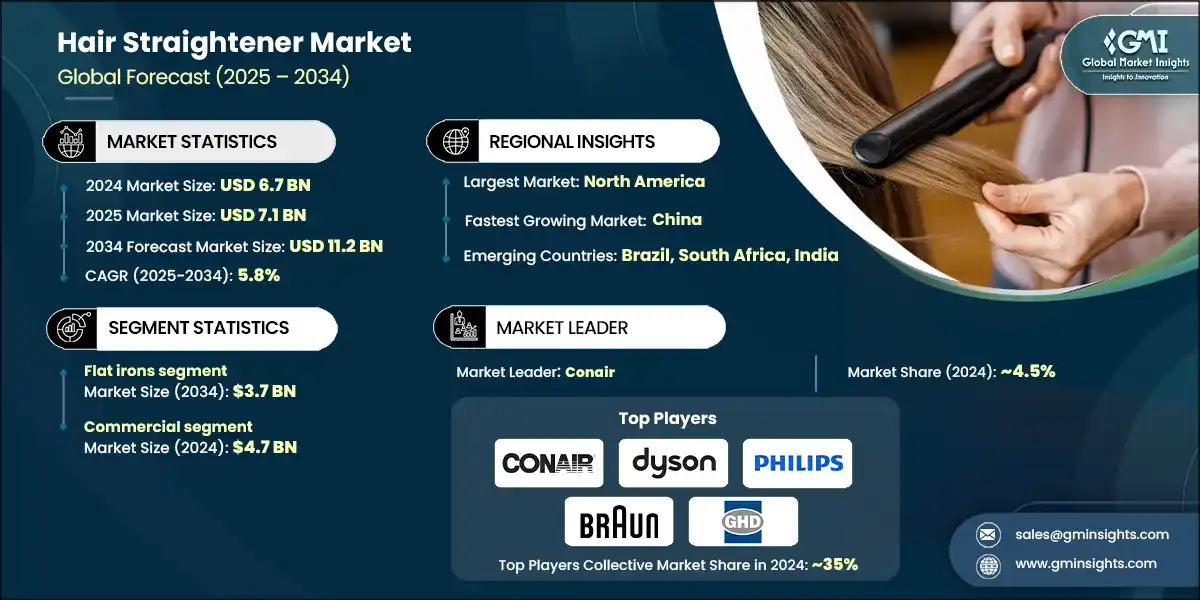
The global hair straightener market was estimated at USD 6.7 billion in 2024. The market is expected to grow from USD 7.1 billion in 2025 to USD 11.2 billion in 2034 at a CAGR of 5.8%, according to latest report published by Global Market Insights Inc.
Hair Straightener Market Key Takeaways
Market Size & Growth
- 2024 Market Size: USD 6.7 Billion
- 2025 Market Size: USD 7.1 Billion
- 2034 Forecast Market Size: USD 11.2 Billion
- CAGR (2025–2034): 5.8%
Regional Dominance
- Largest Market: North America
- Fastest Growing Region: China
Key Market Drivers
- Growing Consumer Focus on Personal Grooming and Styling.
- Sustainability and Energy Efficiency Regulations.
- Enhanced Safety Standards and Consumer Protection.
Challenges
- Rising Energy and Cost Pressures.
- Safety Risks and Compliance Complexity.
Opportunity
- Integration of Smart and Connected Features.
- Expansion into Sustainable and Eco-Friendly Product Lines.
Key Players
- Market Leader: Conair led with over 4.5% market share in 2024.
- Leading Players: Top 5 players in this market include Conair, Dyson, Philips, Braun GmbH, GHD, which collectively held a market share of 35% in 2024.
Get Market Insights & Growth Opportunities
Due to recent developments in consumer awareness regarding grooming, the increased prevalence of hair straighteners will likely be a result of this trend. The U.S. Bureau of Labor Statistics states that personal grooming industry employment will increase 8.1 percent over the next ten years (2020 - 2030) which is almost 5 times higher than the average for all occupations; thus, there is a significant increase in the demand for beauty and barbering services. Additional demographic trends toward enhanced self-care and improved appearance primarily exists with millennials and Generation Z, as both groups view grooming as part of their overall identity. The effect has been that the rise of beauty "influencers" and beauty tutorial videos have encouraged the normalization of using heat to style hair on a regular basis. As an indication of the above, currently, 70 percent of women within the U.S. regularly use heat tools for styling hair.
The latest innovations in hardware used for hair styling are changing consumers' expectations. For example, companies like Dyson and L'Oreal are now producing smart hair straighteners that can use an artificial intelligence heat sensor and provide users with a cordless design. Advanced technologies allow companies to address two key consumer pain points: potential heat damage and the effectiveness of their products. In addition, companies are producing tools using new types of materials, such as ceramic and tourmaline, to help distribute heat evenly across the hair and reduce frizz and enhance shine afterward. In addition to that, the new smart sensors allow users to set temperature settings based on their type of hair.
Economic factors really drive a lot of demand in this area. People with more disposable income, particularly in those emerging markets, can afford to go for higher-end grooming tools. Urbanization makes it even stronger by getting folks used to worldwide beauty trends and squeezing their schedules tighter, so quick styling options become pretty much essential. Take the U.S. Census Bureau numbers for example. They point to a consistent rise in older people and city dwellers. Both groups tend to spend more on personal care items. You see this playing out in how folks are moving toward devices that do multiple jobs. Like ones that straighten hair while adding some conditioning. That appeals to buyers looking for good value along with solid results. As more economic power gets around, the whole hair straightener scene stands to gain from people chasing aspirational purchases. This hits hard in places like Asia-Pacific and Latin America. There grooming ties right into getting ahead at work or fitting in socially.
To get key market trends
Hair Straightener Market Trends
A big shift is happening in the market toward tools that are smart and sustainable. People want devices now that mix high-tech stuff with green features. Things like controlling temperature through phone apps, auto shut off to stay safe, and designs that save energy all fit the bill. On top of that, folks prefer materials such as ceramic and tourmaline because they cut down on hair damage. Ionic and infrared tech help make styling healthier too. Brands are pushing sustainability hard with recyclable packaging and products built to last. This draws in buyers who care about the environment. In a way, it all comes together where beauty meets tech and green living to guide what people pick next.
- One key trend in the hair straightener market involves smart features and AI tech taking hold. Devices these days have predictive sensors for heat, links to apps, and adjustments to temperature on the fly. All this aims to give the best styling while keeping hair safe from too much damage. Take premium ones like Dyson Corrale or GHD Platinum. They use smart heat control that matches hair thickness and how fast you style. Results stay even without getting too hot. Tech fans love the personal touch and ease it brings. App devices let you tweak settings, watch your usage, and get tips on upkeep. That boosts the whole experience for users. With safety and efficiency mattering more, companies putting money into smart tech get ahead of rivals. These changes not only boost how well the tools work but also match the push for pro-level results right at home. Smart straighteners drive growth in the high-end area pretty much.
- Environmental awareness plays a big role in what people buy for hair straighteners. The market fights back with green innovations to match. Brands add recyclable materials, heating systems that use less power, and parts that hold up over time. This cuts down on harm to the planet. Some even offer trade-ins or fixes to make products last longer. Buyers lean toward items that perform well but stay sustainable. Straighteners from recycled plastics or with low-energy options stand out. Millennials and Gen Z lead this charge since they value eco-friendly living in everything they do. Rules from regulators and what shoppers expect push these practices more. Makers who go green build stronger loyalty and set themselves apart in a crowded field. Sustainability has moved past just a small group. It feels like a standard need in beauty tech now.
- Heatless options and tools that do multiple jobs are rising too, thanks to more focus on hair health. People worry about damage from heat, so they seek gentler ways to style. New ideas include devices that straighten and curl in one go, handle wet-to-dry use, or even use air to straighten without touching heat directly. Tools like the Dyson Airstrait and T3 SinglePass StyleMax show this change well. They give flexibility and save time for those wanting various looks from a single gadget. This fits with the boom in at-home grooming where folks chase salon vibes without hurting their hair. Brands cut back on high heat needs and add features that adapt. They tackle a main issue in the market, damage to hair. At the same time, it pulls in busy people and those who prioritize health.
Hair Straightener Market Analysis
Learn more about the key segments shaping this market
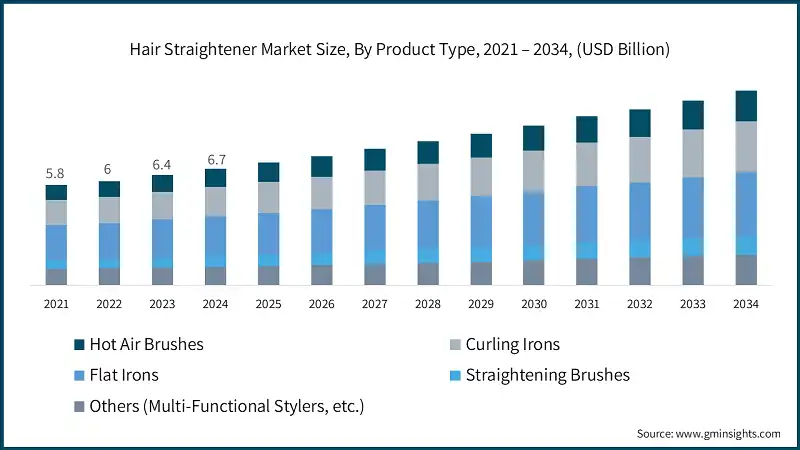
Based on the product type, the market is segmented into hot air brushes, curling irons, flat irons, straightening brushes, others (multi-functional stylers, etc.). The flat irons segment leads the market and was valued at USD 2.3 billion in 2024 and is projected to reach USD 3.7 billion by 2034.
- Flat irons are the most popular tools on the market because they provide an exact straightening/styling experience for many kinds of hair. Because hot air brushes or curling irons do not create any type of uniform heating, as flat irons do through ceramic, titanium, or tourmaline plate technology, they produce smooth finished looks with fewer problems (e.g., frizz). Consumers seeking a single multifunctional appliance can create both perfectly straight styles and soft waves with this one product; therefore, flat irons are ideal for Europeans looking for professional style results at home and provide a direct link to the growing popularity of these products.
- Flat irons are popularized by several different social media networks, greeting cards, etc., but most notably Instagram and TikTok. Through the promotion of straight hair through these channels as well as education via influencers on how to achieve sleek looks, flat irons are quickly becoming ingrained in everyday beauty habits among people. Eurostat data shows that more than 65% of European consumers have stated that social media impacts the purchasing of beauty items, and flat irons are often shown as a styling tool forming part of the social media content. Therefore, for consumers looking for aesthetic value and convenience, flat irons represent an ideal solution.
Learn more about the key segments shaping this market
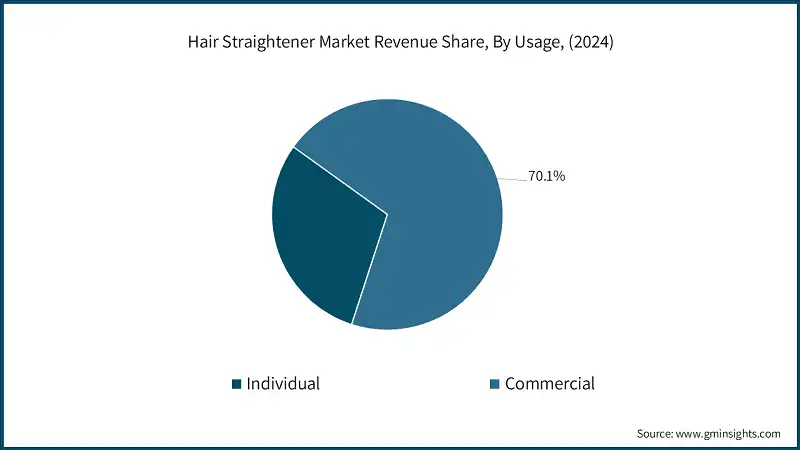
The hair straightener market by usage is segmented into individual and commercial. The commercial segment was the leading segment in this market in 2024 with a revenue of USD 4.7 billion and has a market share of around 70.1%.
- The commercial segment (salons, beauty parlors, professional stylists) dominates the market because of the high levels of use and demand for premium-quality styling tools. Because of the requirement for hair straighteners to consistently perform at a high level and provide durability and advanced features to accommodate different types of hair, even the busiest salon environments require styling tools that perform above and beyond the average consumer's needs. Unlike individual consumers, many salons utilize multiple hair styling tools at the same time which leads to larger volume purchases and, therefore, increased revenue contribution. The consistent demand for hair styling tools used in commercial environments is a key driver of commercial market share.
- Because the fashion and beauty industries are thriving globally, there is a great deal of commercial business generated within the commercial market. For example, there is a need for high-quality hair styles to be created and worn at events such as fashion shows, weddings, and photo shoots. The growing use of professional hair treatment and hair styling has helped solidify this trend. High-end salons make purchases of premium hair straighteners that include technology such as ionic conditioning and temperature control to meet the high expectations of their customers, further growing commercial usage. Manufacturers also typically target the commercial market with premium hair styling products and exclusive relationships, resulting in products that have been designed to withstand the rigors of heavy use and have superior performance. These premium products usually have much higher price points than are typically paid by a consumer and, as a result, greatly influence the revenue generated by the commercial market vs. the revenue generated by the individual consumer market.
Looking for region specific data?
North America Hair Straightener Market
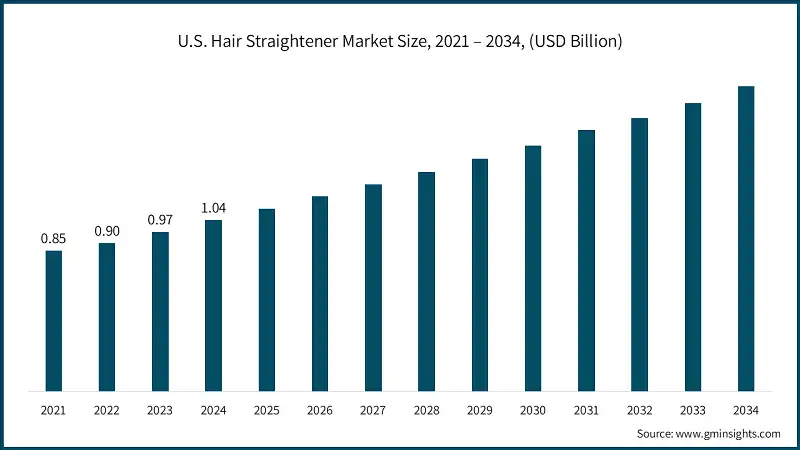
The U.S. market was valued at around USD 1.04 billion in 2024 and is anticipated to register a CAGR of 6.6% between 2025 and 2034.
- In North America, the U.S. pretty much takes the lead in demand for hair straighteners. This happens mainly because of strong consumer spending on personal care items and services. The U.S. Bureau of Labor Statistics reports that spending in this area went up by 9.7 percent in 2023. That marked one of the biggest jumps among major categories. People seem eager to put money into grooming and styling tools like hair straighteners. Lifestyle changes and social media play a big role in pushing this along. The market here has a huge number of buyers with plenty of extra cash. This lets them go for high-end products and helps drive sales of newer styling tech.
- The professional salon business in the U.S. adds a lot to the demand for these straighteners. Data from the U.S. Census Bureau points out that personal care services, which include salons, brought in more than 60 billion dollars in revenue back in 2022. This shows just how big the world of pro grooming really is. Salons count on top-quality tools that perform well. They create ongoing needs from businesses, right alongside what people buy for home use.
- The overall strength of the U.S. economy supports its top spot in this market. The Bureau of Economic Analysis notes steady growth in personal consumption expenditures. Monthly bumps averaged 0.5 to 0.6 percent in the middle of 2025. This contributes to solid confidence among buyers and their ability to keep spending. With more disposable income around, folks can afford fancier options like smart or cordless hair straighteners. Even when inflation hits hard, the economy holds up well. Beauty and grooming stay as key areas where people do not cut back much.
Asia Pacific Hair Straightener Market
The Asia Pacific market was valued at around USD 1.2 billion in 2024 and is anticipated to register a CAGR of 8.2% between 2025 and 2034.
- As a result of the rapid economic expansion and shifting demographics across Asia Pacific, the need for personal care equipment like hair straighteners has skyrocketed. The Government of India as well as the Department of State of the United States data indicate that India is one of the largest markets in the Asia Pacific; therefore it is expected to continue being one of the fastest growing major economies in the world, with India projected average GDP growth of nearly 7% in 2023 and an expected continued annual GDP growth rate between 6%-7% in subsequent years. This increasing disposable income and increased urbanization therefore creates a large growing middle-class consumer group interested in grooming products. China also represents the second largest economy in the world, with GDP growth of 5% in 2024, and a projected GDP growth of 4.5% in 2025, due to rising household income and changing consumption behavior. Therefore, the overall economic fundamentals indicate that consumers are becoming more focused on personal care and are increasingly choosing to purchase more expensive styling tools and beauty products.
- Asian-Pacific countries have factors that contribute to growth through cultural and structural reasons. According to a report published by Japan’s Ministry of Economy, Trade and Industry, the Japanese cosmetics and personal care industry was USD 35 billion in 2015 and was ranked No. 3 globally (behind USA and France) due to the demand in high quality and advanced technology. The beauty routines have an extraordinary impact on the purchase decision-making process in Asia-Pacific because of their integration into people's lives from an early age and the recent social media influence of younger age groups, as well as the growth of eCommerce. The growth of digital penetration is accelerating the availability of beauty/grooming products to this market.
- Chinese government initiatives like the "Healthy China 2030" plan to encourage citizens to lead healthier lifestyles but will indirectly increase the consumption of grooming products in this region. It is also important to note that rapid urbanization, as well as the emphasis on physical appearance within many Asian cultures, are factors that have put this region in a position to be the fastest-growing region of the world for hair straighteners, overtaking the more established markets in North America and Western Europe.
Europe Hair Straightener Market
The Europe market shows diverse dynamics across countries, shaped by economic development, and sustainability trends. The Germany hair straightener industry was valued at around USD 290 million in 2024 and is anticipated to register a CAGR of 4.4% between 2025 and 2034.
- The fact that Germany is Europe’s largest economy fosters a large size market for consumer spending on premium products for grooming. In 2022, Household Final Consumption Expenditure is recorded at an increase of 10.7%. Private consumption will continue to remain strong despite inflation. This means consumers will have more disposable income due to their economic position and therefore will spend money on high-tech hair-styling appliances including flat irons and multifunctional straighteners. As well, Germany's urban population and culturally trendy nature drive up demand for grooming appliances that are of high quality and keep Germany at the forefront on a regional basis.
- In addition to being Europe's largest economy, Germany is a leader in innovation and sustainability in consumer goods and wants to produce high-tech products that are energy efficient. By complying proactively with the Electrical and Electronic Equipment Act (ElektroG) and EU Ecodesign regulations, the manufacturers will produce appliances that use less energy and are recyclable and enhance the eco-friendly image of German brands to environmentally conscious consumers across Europe. In addition to this, the manufacturers will be able to incorporate advanced engineering into the production of hair styling appliances, including smart technology devices such as temperature sensors and auto shut-off features, which both enhance safety and reduce energy consumption.
Hair Straightener Market Share
- The top 5 companies in the hair straightener industry, such as Conair, Dyson, Philips, Braun GmbH, and GHD, hold a market share of 35%.
- Conair differentiates itself from competing brands by employing both worldwide distribution capabilities as well as a continuous product innovation strategy. The wide variety of products that Conair sells includes hair stylers (hair straighteners, curling wands, and multi-functional hair stylers) which are designed to meet the needs of both consumers and stylists. In addition to being affordable, Conair promotes its products as 'premiumization,' by providing consumers with the latest/current technology, such as ceramic and ionic conditioning materials, while providing consumers with a price point within their reach. As a result of the strong working relationships that Conair has established with its retail customers and online retailing partners, it has become a significant player in the European marketplace. Additionally, through continuous updates of its product offerings, Conair now offers a wide variety of cordless and travel-friendly options that enable it to compete effectively with several niche luxury brands while providing value to consumers.
- The strategy of Dyson is centered on establishing itself as the premier player in both technology and premium branding. Dyson has a long history of excellence in engineering and has invested substantially in the development and application of state-of-the-art technologies (including smart heat controls and airflow optimization) in all their products, with the goal of minimizing damage caused to hair, while providing the highest possible performance. Dyson is also very active in digital marketing, creating engaging consumer experiences by offering products that can be demonstrated using virtual reality and partnering with social media influencers for greater consumer engagement. Moreover, Dyson utilizes environmentally sustainable business practices that align with the European Union's commitment to promoting energy efficiency, which has allowed Dyson to establish itself as an innovative and leading-edge company. Dyson's continued emphasis on research and development and its established brand equity have allowed Dyson to distinguish itself from competitors in the hair styling tool category, appealing to both tech-savvy consumers and environmentally conscious consumers.
- Philips is committed to providing quality products that meet the consumer’s need for personal grooming while being environmentally friendly through both health and consumer electronics. Philips offers hair straighteners as part of its Health & Sustainability strategy in the health & wellness space and, therefore, can provide consumers with the best products available for personal grooming. Philips will continue to elevate its premiumization strategy by adding digital technology that allows for the personalization of consumers' hair styling experiences directly through application integration with their current product offerings. As a company dedicated to innovation and compliance, supported by its extensive multichannel distribution network, Philips will be well positioned to compete in the marketplace and attract and retain customers looking for safe, sustainable, and technological advancements in personal grooming products.
Hair Straightener Market Companies
Major players operating in the hair straightener industry are:
- BaByliss
- Braun GmbH
- CHI
- Conair
- Drybar Products LLC
- Dyson
- GHD
- Hot Tools Professional
- HSI Professional
- Moehair USA Inc.
- Panasonic
- Philips
- Remington
- Revlon
- RUSK PRO
Braun has a history in the engineering of quality products that are of good craftsmanship and durable. Braun is a German company with a strong background in precision engineering and design excellence. Braun is now using Advanced Technology and AI to develop products that enhance the user's experience while also creating a safer experience for the user. Braun's strategy for entering new markets is through partnerships with professional salons and premium retailers, and its focus on branding as well as adherence to EU Safety Regulations. Additionally, Braun promotes the introduction of new products by leveraging their current portfolio of internationally recognized brands across different categories in the grooming and wellness industry, thus creating a strong product ecosystem. Through the combination of product innovation, regulatory compliance, and branding integrity, Braun has successfully sustained resilience against new competitors and the risk of counterfeit products.
GHD has maintained its leadership position by utilizing an emphasis on premium product placement and utilizing influential marketing techniques. They were the first brands to develop and bring to market 'ceramic plate technology'. GHD has continued to lead the way in innovation, most recently with its introduction of 'dual-zone heating technology' and the implementation of 'AI tools' on its website that provide customers with a customized profile based on what was received in an online form. The multi-channel distribution model of GHD combines luxury retailers, professional salons, and promotes a strong eCommerce presence. Additionally, GHD partners with over 10,000 influencers; this partnership, along with their 'AI' consumer engagement initiatives such as personalized styling quizzes, provides additional measures to build brand loyalty, as well as expanding their digital reach. By combining technology/innovation with an aspirational brand image, GHD can continue to compete effectively and remain the premier styling brand in Europe today.
Hair Straightener Market Report Attributes
| Key Takeaway | Details |
|---|---|
| Market Size & Growth | |
| Base Year | 2024 |
| Market Size in 2024 | USD 6.7 Billion |
| Market Size in 2025 | USD 7.1 Billion |
| Forecast Period 2025 - 2034 CAGR | 5.8% |
| Market Size in 2034 | USD 11.2 Billion |
| Key Market Trends | |
| Drivers | Impact |
| Growing Consumer Focus on Personal Grooming and Styling | This trend is fueling worldwide demand for advanced hair care appliances, creating opportunities for premium and multifunctional product innovations. |
| Sustainability and Energy Efficiency Regulations | These regulations are setting benchmarks that influence global manufacturing standards, accelerating the adoption of eco-friendly and energy-efficient hair styling tools. |
| Enhanced Safety Standards and Consumer Protection | Stricter safety norms are driving global compliance, pushing brands to prioritize user safety features and quality assurance across all markets. |
| Pitfalls & Challenges | Impact |
| Rising Energy and Cost Pressures | Higher electricity prices and inflation are reducing consumer spending on non-essential grooming appliances, slowing premium product adoption globally. |
| Safety Risks and Compliance Complexity | Stringent safety regulations and costly compliance requirements are increasing production expenses and limiting market entry for smaller manufacturers. |
| Opportunities: | Impact |
| Integration of Smart and Connected Features | Incorporating IoT-enabled technology, such as Bluetooth connectivity, temperature control via mobile apps, and usage analytics, can transform hair straighteners into smart devices. This aligns with the growing trend of connected home ecosystems and personalized beauty solutions. |
| Expansion into Sustainable and Eco-Friendly Product Lines | Developing hair straighteners with recyclable materials, energy-efficient heating elements, and low-carbon manufacturing processes aligns with EU sustainability regulations and global consumer demand for eco-conscious products. |
| Market Leaders (2024) | |
| Market Leaders |
Market share of ~4.5% |
| Top Players |
Collective market share in 2024 is ~35% |
| Competitive Edge |
|
| Regional Insights | |
| Largest Market | North America |
| Fastest growing market | China |
| Emerging countries | Brazil, South Africa, India |
| Future outlook |
|
What are the growth opportunities in this market?
Hair Straightener Industry News
- In April 2025, GHD introduced the Chronos Max straightener with 42mm wide plates offering 3× faster styling across European markets. This launch helps GHD target professional users and consumers with long/thick hair requiring faster styling solutions.
- In January 2025, Remington introduced the AIRvive collection featuring Ionic Air Technology across five SKUs including the Slim Straightener in Europe. This launch enables Remington to compete in the anti-frizz technology segment and expand its mid-premium product portfolio.
- In January 2025, Remington launched the S8598 model with patented intelligent heat sensor detecting hair moisture 8× per second in Europe. This innovation positions Remington as a technology leader in hair protection and personalized styling solutions.
- In February 2024, Dyson launched the Airstrait straightener in UK, France, and Germany markets. This expansion helps Dyson strengthen its premium positioning and capture market share in Europe's high-value hair-styling segment.
The hair straightener market research report includes in-depth coverage of the industry, with estimates & forecasts in terms of revenue (USD Billion) and volume (Million Units) from 2021 to 2034, for the following segments:
Market, By Product Type
- Hot air brushes
- Curling irons
- Flat irons
- Narrow plates flat irons (<1 inch)
- Standard plates flat irons (1-1.5 inch)
- Wide plates flat irons (>1.5 inch)
- Straightening brushes
- Others (multi-functional stylers, etc.)
Market, By Power Source
- Cordless
- Standard (<3000mAh)
- Extended (3000-5000mAh)
- Professional (>5000mAh)
- Corded
Market, By Technology
- Ceramic
- Titanium
- Tourmaline
- Ionic
- Steam
- Infrared
Market, By Price Range
- Economy (<USD 30)
- Mid-range (USD 30 - USD 80)
- Premium (USD 80- USD 200)
- Ultra-premium (> USD 200)
Market, By Consumer Group
- Men
- Women
Market, By Usage
- Individual
- Commercial
- Beauty centers
- Salons
- Other (dermatological center, etc.)
Market, By Distribution Channel
- Online
- E-commerce marketplace
- Company websites
- Offline
- Hypermarkets & supermarkets
- Specialty stores
- Others (beauty shops, retail stores, etc.)
The above information is provided for the following regions and countries:
- North America
- U.S.
- Canada
- Europe
- Germany
- U.K.
- France
- Italy
- Spain
- Netherlands
- Asia Pacific
- China
- Japan
- India
- South Korea
- Australia
- Latin America
- Brazil
- Mexico
- Argentina
- MEA
- UAE
- Saudi Arabia
- South Africa
Frequently Asked Question(FAQ) :
What is the market size of the hair straightener industry in 2024?
The market size was USD 6.7 billion in 2024, with a CAGR of 5.8% expected through 2034 driven by rising beauty consciousness and premium grooming product adoption.
What is the current hair straightener market size in 2025?
The market size is projected to reach USD 7.1 billion in 2025.
What is the projected value of the hair straightener market by 2034?
The hair straightener industry is expected to reach USD 11.2 billion by 2034, supported by smart styling technologies, premium product demand, and growing DIY home-grooming trends.
How much revenue did the flat irons segment generate in 2024?
Flat irons generated USD 2.3 billion in 2024, leading the market with strong demand for ceramic, titanium, and tourmaline plate technologies.
What was the valuation of the commercial usage segment in 2024?
The commercial usage segment held about 70.1% share and generated USD 4.7 billion in 2024.
What is the growth outlook for the hair straightener market from 2025 to 2034?
The market is projected to expand at a CAGR of 5.8% through 2034, driven by rising personal grooming expenditure, premiumization, and influencer-led styling trends.
Which region leads the hair straightener market?
The U.S. market was valued at around USD 1.04 billion in 2024 and remains the largest contributor to regional revenue. Strong consumer spending, salon industry demand, and rapid adoption of smart and premium styling tools drive this dominance.
What are the upcoming trends in the hair straightener industry?
Key trends include the rise of AI-enabled styling tools, cordless and energy-efficient straighteners, sustainable materials, and multifunctional devices that help reduce heat damage while improving styling efficiency.
Who are the key players in the hair straightener market?
Major players include Conair, Dyson, Philips, Braun GmbH, GHD, Remington, BaByliss, Panasonic, CHI, Revlon, and Hot Tools Professional
Hair Straightener Market Scope
Related Reports