Summary
Table of Content

Golf Equipment Market
Get a free sample of this report
Form submitted successfully!
Error submitting form. Please try again.
Thank you!
Your inquiry has been received. Our team will reach out to you with the required details via email. To ensure that you don't miss their response, kindly remember to check your spam folder as well!
Request Sectional Data
Thank you!
Your inquiry has been received. Our team will reach out to you with the required details via email. To ensure that you don't miss their response, kindly remember to check your spam folder as well!
Form submitted successfully!
Error submitting form. Please try again.
Golf Equipment Market Size
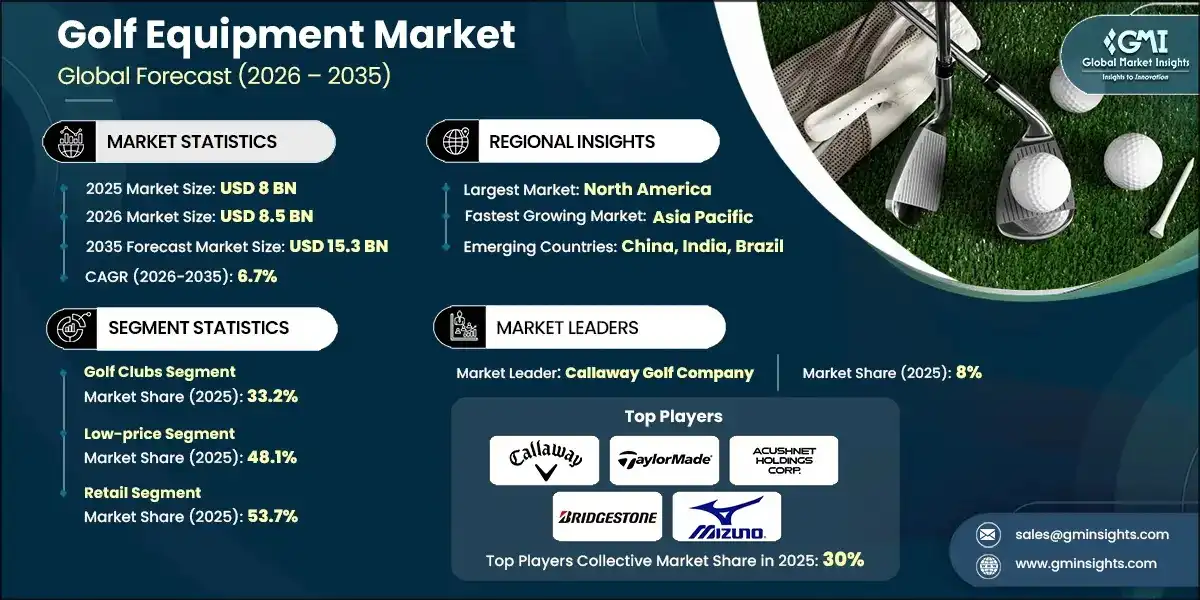
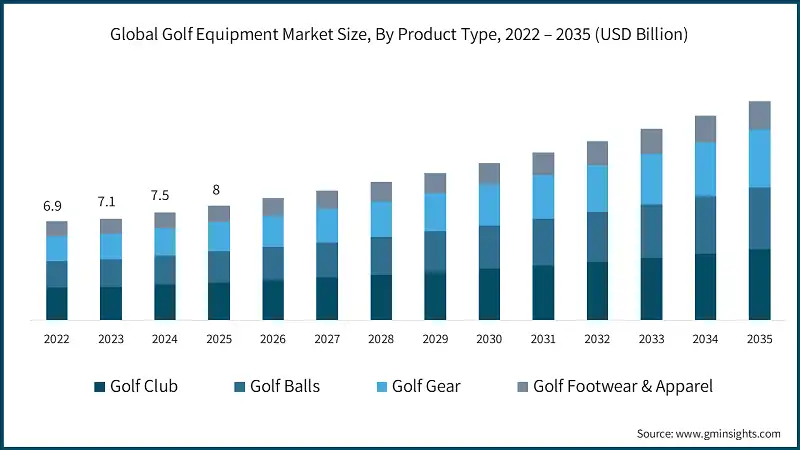
The global golf equipment market was estimated at USD 8 billion in 2025. The market is expected to grow from USD 8.5 billion in 2026 to USD 15.3 billion in 2035, at a CAGR of 6.7%, according to latest report published by Global Market Insights Inc.
Golf Equipment Market Key Takeaways
Market Size & Growth
- 2025 Market Size: USD 8 Billion
- 2026 Market Size: USD 8.5 Billion
- 2035 Forecast Market Size: USD 15.3 Billion
- CAGR (2026–2035): 6.7%
Regional Dominance
- Largest Market: North America
- Fastest Growing Region: Asia Pacific
Key Market Drivers
- Rising Participation Among Youth & Women.
- AI and Smart Technology Integration.
- Premiumization & Customization.
Challenges
- High Initial Cost of Entry.
- Seasonality and Weather Dependence.
Opportunity
- E-commerce & Direct-to-Consumer (DTC) Growth.
- Sustainability in Manufacturing.
Key Players
- Market Leader: Callaway Golf Company led with over 8% market share in 2025.
- Leading Players: Top 5 players in this market include Callaway Golf Company, TaylorMade Golf Company, Acushnet Holdings Corporation (Titleist, Bridgestone Corporation, Mizuno Corporation, which collectively held a market share of 30% in 2025.
Get Market Insights & Growth Opportunities
Innovations in technology primarily fuel the demand for advanced golf equipment. The need to enhance player performance because of a surge in strategic mergers and acquisitions among industry leaders is also a major factor by which this demand expands. Market consolidation among the major players in the business leads to many innovations to the market, expanded product portfolios, and more robust market presence. High, performance alternatives are gradually replacing conventional ways of practicing and playing, such as basic steel, shaft clubs or standard non-layered balls.
Currently, smart clubs and AI designed equipment are offering a more data, driven approach to the game as they digitally and physically track swing metrics and impact data, thus, a new player can be self, taught in a very short time. The use of this advanced technology is consistent with the sports sector's trend towards personalized performance; thus, it is a major contributor to market expansion.
The rising demand for recreational sports and premium leisure activities in North America, coupled with the increasing disposable income and golf tourism budgets in Europe and some parts of the Asia, Pacific region, are the main factors behind the commercial viability of this equipment. Both consumers and professionals are more willing to opt for efficient and technologically enhanced solutions to improve their game.
One of the most significant factors determining the market for high performance sports equipment is the use of multi, material drivers and AI, modeled irons, which have gained considerable popularity due to their proven benefits, e.g., increased ball speed and minimized risk of mishits. It is, however, a market that heavily depends on the awareness of the long, term benefits of custom fitting and precision engineering, which, in turn, leads to wider acceptance of these powerful tools. Additionally, the athletes' comfort and ease of use will be further enhanced by the continuous advancements in aerodynamics and vibration-damping materials.
These combined factors are at the heart of the market's positive financial performance, alongside the rise in participation rates, the industry, wide focus on digital integration, and the demand for high, efficient performance. The gradual expansion of the market and its transformation of basic sports tools into highly durable, professional, grade machinery, is largely dependent on advancements in material science. The industry is undergoing significant change in favor of titanium, carbon composites and high resilience resins that not only extend the products durability but also improve energy transfer in a wider range of swing speeds and environmental conditions.
Manufacturers are keen to enhance the user experience by implementing features like IoT, enabled sensors that offer real, time swing analysis and adjustable weighting systems for improved maneuverability on the course. The largest factor driving the golf equipment market is the growing interest of younger demographics and of course entertainment venues, which are increasing at a very rapid pace, and at the same time, the professional and the amateur desire for data-backed improvement.
Smart clubs unlike conventional equipment forcibly track or analyze swing patterns that are just under the micro, level in a mechanical and digital way, thus effectively removing performance obstacles while generating a detailed output and greatly reducing the time spent on manual coaching. Such effectiveness has attracted both casual players who seek more fun, and professional tour athletes who require consistency and precision. The adoption of this technology directly affects market composition: the golf clubs and apparel segments are consistently recording the largest revenue; thus, they have been accounting for most of the total equipment market revenue in recent years.
The main part of this segment is those products which are directly related to the machines' solid performance, long lifespan, and considerable customization; as a result, they are an ideal match for the versatile and quickly adaptable lifestyle of the modern professional. Besides that, technology is becoming increasingly influential and there are features like digital launch monitors that provide a more personalized and accurate playing experience.
These interdependent trends not only indicate the market's vibrancy but also its capability to fulfill the performance requirements of a diverse clientele. Moreover, the market players in the golf industry are focusing on the advancement of clubs and balls that use sophisticated technology, for instance, the development of 360 carbon chassis, revolutionary dimple patterns, and the improved multi, piece cores that enable longer and more controlled ball flight. All these are clear indications in the market of further growth as technology progresses and the corresponding demand continues.
All demonstrated in the market signs of growing further as technology develops and the respective demand continues.
To get key market trends
Golf Equipment Market Trends
The golf equipment industry is witnessing dynamic trends, largely driven by a flood of new product launches and technological advancements made by industry leaders. In particular, the market is being revolutionized by companies unveiling next, generation equipment endowed with features such as AI, optimized club faces, 360, degree carbon chassis, and smart, sensor integration.
These breakthrough technologies are targeted towards users who are constantly evolving and looking for efficient and easily accessible solutions to improve their game. The industry's reaction to these trends is a firm pledge of their sustained innovation effort which in turn equips the users with advanced tools that not only boost their performance but also lessen the "mis, hit" penalty and, in general, contribute to a more fun and hassle, free playing experience.
- Technology advancement and product innovation: The shift, which primarily focuses on more advanced and efficient clubs, also sees the introduction of IoT, enabled sensors and AI, driven ball, flight monitoring for enhanced precision. To make clubs more forgiving and help users achieve greater distances, manufacturers are engaging in the development of high, MOI (Moment of Inertia) designs and lightweight carbon composites.
- Expansion of off, course and hybrid participation: The surge in demand has mainly been led by the rise of simulators and entertainment venues. The Golf Club segment is the largest subsector, making up almost 45% of the total market. The need for specialized gear is still stable, because of the growth of both traditional green, grass play and urban indoor simulators.
- Sustainable sports management: Eco, friendly manufacturing is becoming a significant measure, as companies are using recycled plastics for apparel and are looking into biodegradable materials for tees and balls. This is in line with the global implementation of ESG goals and consumer demand for "green" sporting goods. Diversification of Demographics: The increased participation of women and Gen Z has led to a wider range of equipment aesthetics and sizes. As a result, there is a dramatic increase in lifestyle, oriented golf apparel and footwear. This situation is creating a continuous demand for versatile gear that can be used both on and off the course.
- Focus on customization and fitting: Professional management of player performance is becoming more proactive. This means that club loft, lie angle, and shaft flex are regularly customized to the individual. The endless requirement for precision is resulting in a continuous demand for professional grade fitting services and launch monitors throughout the year.
Golf Equipment Market Analysis
Learn more about the key segments shaping this market
Based on the product type, the market is divided into golf clubs, golf balls, golf gear, and golf footwear & apparel. The golf clubs segment held the largest share, accounting for 33.2% of the global golf equipment market in 2025.
- The need for high-performance materials like titanium and carbon fibre, alongside AI-driven clubhead designs, is encouraging segment growth.
- Golf clubs hold a significant portion of the market value and exhibit strong growth, indicating a continued professional and amateur preference for precision-engineered drivers and irons.
- The golf balls and golf gear segments show healthy growth rates of 7.3% and 7.1% respectively, suggesting consistent demand from a rising player base and an increasing interest in specialized accessories like GPS rangefinders and golf bags.
- Lightweight and high-tech, modern golf gear is ideal for enhancing the on-course experience. Enthusiasts and club members appreciate the convenience of tech-integrated gear for specialized performance tracking.
Learn more about the key segments shaping this market
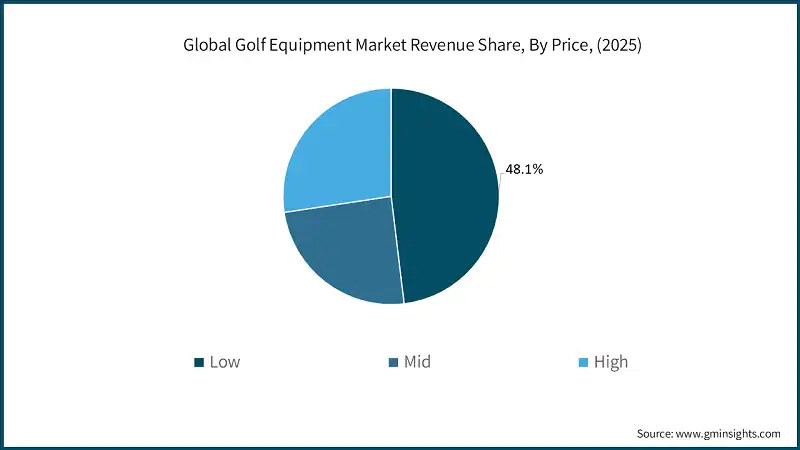
Based on the price range, the golf equipment market is segmented into low, mid, and high. In 2025, the low-price segment held a major market share of 48.1%, generating a revenue of USD 3.9 billion.
- The low-price segment represents the largest portion of the market, driven by the influx of new golfers and the demand for affordable starter sets in emerging markets.
- The mid-price segment, while currently smaller, is the fastest-growing area with a CAGR of 7.5%, reflecting a shift where improving players upgrade to better performing, mid-tier equipment.
- This trend is consistent with a market that is increasingly prioritizing player development and performance improvement, gradually increasing the mid-tier sector's contribution to the total market value
Based on the distribution channel, the golf equipment market is segmented into retail, online, and specialty stores. In 2025, retail held the major market share of 53.7%, reflecting the industry’s reliance on brick-and-mortar sports outlets and pro shops.
- Retail represents the largest portion of the market, though specialty stores show the highest projected growth rate of 7.7% through 2035.
- This dominance is driven by the critical role of custom fitting and the "feel" factor. For high-value equipment like drivers and irons, end-users often prefer physical stores for localized technical advice, professional fitting sessions, and the ability to test clubs in simulators.
- Online sales typically involve transactions through e-commerce platforms and brand websites. This channel is primarily utilized for repeat purchases of consumables like golf balls and apparel, or by tech-savvy consumers using digital fitting tools.
Looking for region specific data?
North America Golf Equipment Market
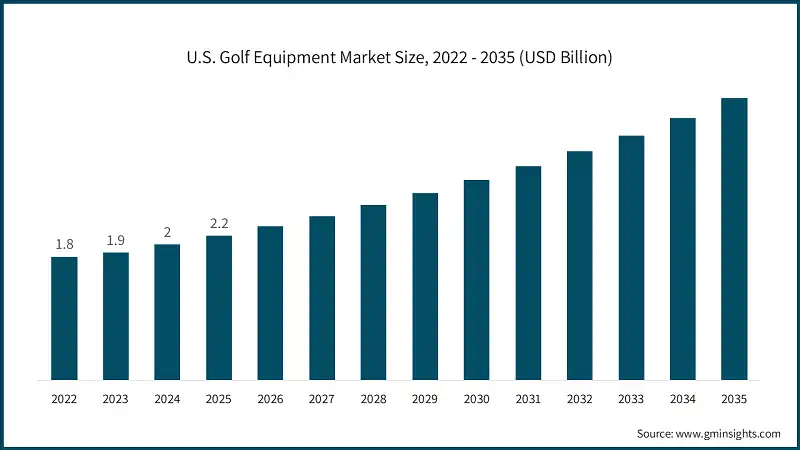
In 2025, North America is the largest market for golf equipment. It has an estimated market value of USD 2.2 billion in 2025 with a projected growth rate of 6.9% through 2035.
- The U.S. leads the region, showing a strong growth rate and representing much of the regional value. This growth comes from a mature market with high participation rates and a surge in off-course golf entertainment.
- Premium equipment is an essential tool for players looking to gain a competitive edge in both tournament play and social rounds.
- The North American market meets this need by offering various high-performance solutions that support both traditional club memberships and the growing "active lifestyle" segment
Europe Golf Equipment Market
Europe is the third-largest market, estimated at USD 1.9 billion in 2025 with a projected growth rate of 6.4%. Germany leads the region with a sub-regional growth rate of 7.0% and a market value of USD 0.5 billion in 2025, followed closely by the UK.
- The European market benefits from a tradition of high-quality craftsmanship and a focus on premium aesthetics, encouraging the adoption of forged irons and high-end apparel.
- These efforts make Europe a competitive landscape for luxury golf brands and sustainable manufacturing practices.
- The larger European market benefits from a growing interest in golf tourism and the development of new, world-class resort courses in southern Europe.
Asia Pacific Golf Equipment Market
Asia Pacific is the second largest and fastest-growing regional market. It has an estimated market value of USD 2.2 billion in 2025 with a projected growth rate of 7.3% from 2026 to 2035.
- China has a high sub-regional growth rate of 7.8%, holding the largest share in the region valued at USD 0.7 billion in 2025, while India follows with a growth rate of 7.4%.
- The rapid growth in Asia Pacific results from rising middle-class disposable income, significant investments in golf infrastructure, and the sport's inclusion in major regional multi-sport events.
- Rising awareness about the health benefits of outdoor sports and the status associated with golf significantly influence growth, promoting innovation in lightweight and "easy-to-swing" club technology.
Latin America Golf Equipment Market
Latin America represents a smaller segment of the global market, expected to reach USD 0.7 billion by 2025, growing at a rate of 5.2% from 2026 to 2035.
- Brazil is the main driver in the region, projecting a growth rate of 5.6% with a market value of USD 0.3 billion in 2025.
- Overall growth is modest due to the niche nature of the sport in several countries, but increasing tourism in Mexico is boosting demand for premium rental and retail gear.
- Market players are focusing on expanding distribution networks to take advantage of the growing high-net-worth individual (HNWI) population in urban centers.
- Brazil is the main driver in the region projecting a growth rate of 3.5% with the largest market value of USD 1.58 billion in 2025.
Golf Equipment Market Share
Callaway Golf Company is leading the market with approximately 8% market share. Top players including Callaway Golf Company, TaylorMade Golf Company, Acushnet Holdings Corporation (Titleist), Bridgestone Corporation, and Mizuno Corporation collectively hold around 30%, indicating a moderately consolidated yet competitive landscape. These prominent players are proactively involved in strategic endeavors, such as mergers & acquisitions, facility expansions, and collaborations, to expand their product portfolios, extend their reach to a broad customer base, and strengthen their market position.
Acushnet Holdings Corp. strengthened its financial position and market dominance by pricing an offering of USD 500 million in senior notes to optimize its capital structure and fuel future innovation. This strategic move follows a year of robust performance, where the company's net sales reached USD 2.08 billion in the first nine months of 2025, significantly driven by its high-margin Titleist golf ball and T-Series iron segments. The company’s increased focus on precision engineering and custom fitting services has solidified its footprint in both professional tour circles and the high-end consumer retail market.
TaylorMade Golf continued its aggressive expansion by unveiling the Qi35 series, a comprehensive line of drivers, woods, and hybrids designed for 10K MOI (Moment of Inertia) stability. This expansion aimed to improve playability for the average golfer while maintaining high production capacity for tour-grade equipment. This follows their recent integration of advanced carbon-composite matrix crowns, which bolstered their position in the high-performance metal woods sector and set new standards for ball speed and forgiveness across the industry.
Golf Equipment Market Companies
Major players operating in the golf equipment industry are:
- Acushnet Holdings Corp.
- Adidas Golf
- Bridgestone Golf
- Callaway Golf
- Cobra Golf
- Garmin
- Honma Golf
- L.A.B. Golf
- MGI Golf
- Mizuno Corporation
- Miura Golf
- Motocaddy
- Parsons Xtreme Golf
- PING
- Scotty Cameron
- Srixon/Cleveland Golf
- TaylorMade Golf
- Tour Edge
- Wilson Sporting Goods
Callaway Golf expanded its range of high-performance clubs with the 2025 launch of the Elyte family, featuring the patented Ai 10X Face technology. Engineered for optimal ball speed and precise spin control, the Elyte media is designed to reduce the distance loss on off-center hits significantly. Unlike standard titanium faces, this AI-modeled solution offers higher energy transfer while maintaining a soft, forged feel. Unveiled at major 2025 industry events, its multifunctional design allows for simultaneous improvements in aerodynamics and stability, providing a significant advantage for both professional athletes and high-handicap amateurs.
Golf Equipment Market Report Attributes
| Key Takeaway | Details |
|---|---|
| Market Size & Growth | |
| Base Year | 2025 |
| Market Size in 2025 | USD 8 Billion |
| Market Size in 2026 | USD 8.5 Billion |
| Forecast Period 2026-2035 CAGR | 6.7% |
| Market Size in 2035 | USD 15.3 Billion |
| Key Market Trends | |
| Drivers | Impact |
| Rising Participation Among Youth & Women | Growing influence of off-course venues and female-focused initiatives is expanding the consumer base, driving demand for beginner-friendly and aesthetically diverse gear. |
| AI and Smart Technology Integration | Inclusion of AI-designed club faces and IoT-enabled swing sensors provide real-time data, encouraging users to upgrade to premium, tech-heavy equipment for performance gains. |
| Premiumization & Customization | A shift toward bespoke club fitting and high-end materials (carbon fiber, titanium) aligns with consumer willingness to invest in specialized gear that matches their unique swing profile. |
| Pitfalls & Challenges | Impact |
| High Initial Cost of Entry | The substantial price of premium sets and custom fittings, combined with ongoing club membership fees, remains a significant barrier for entry-level players in emerging markets. |
| Seasonality and Weather Dependence | Reliance on favorable climates for outdoor play leads to sales volatility; however, the rise of indoor simulators is beginning to mitigate this traditional market restraint. |
| Opportunities: | Impact |
| E-commerce & Direct-to-Consumer (DTC) Growth | Expanding digital storefronts and personalized online fitting tools allow manufacturers to bypass traditional retail, capturing higher margins and reaching a global audience 24/7. |
| Sustainability in Manufacturing | Developing balls and apparel from recycled plastics and biodegradable materials appeals to eco-conscious Gen Z and Millennial golfers, opening a new "green" market niche. |
| Market Leaders (2025) | |
| Market Leaders |
8% market share |
| Top Players |
|
| Competitive Edge |
|
| Regional Insights | |
| Largest market | North America |
| Fastest growing market | Asia Pacific |
| Emerging countries | China, India, Brazil |
| Future outlook |
|
What are the growth opportunities in this market?
Golf Equipment Market News
- In November 2025, Callaway introduced two new high-efficiency solutions: the Quantum driver platform (featuring a redesigned movable weight system to simplify shot shaping) and a high-production OPTM series designed for maximum forgiveness. These units utilize a new carbon chassis, significantly reducing club head weight to allow for faster swing speeds.
- In July 2025, Srixon launched the all-new AD333 ball, a multi-layer design that meets high-performance standards for distance and greenside control. The system automatically maintains stable flight even in windy conditions, maximizing carry distance and user convenience.
- In 2025, Topgolf Callaway Brands completed the sale of its Jack Wolfskin business to ANTA Sports for USD 290 million. This focuses their strategy on "Modern Golf," which provides a multi-million-dollar efficiency boost by concentrating resources on core golf equipment and tech-enabled entertainment venues like Topgolf.
- In September 2025, Cobra Golf introduced the redesigned King 3D Printed Tour irons. While serving the aspirational player sector, the unit features an advanced internal lattice structure and Stage V engine-inspired weighting, addressing the player's need for high-throughput feedback with reduced vibration and harshness.
- In 2024, MANN+HUMMEL (Specialized Golf Division) and other tech partners continued to emphasize powerful Smart Sensors and IoT monitoring. These incorporate digital swing analysis, which uses embedded sensors to adjust performance recommendations based on real-time swing data, ensuring optimal club selection without the need for manual coaching intervention.
The golf equipment market research report includes in-depth coverage of the industry with estimates & forecasts in terms of revenue (USD Billion) and volume (Thousand Units) from 2022 to 2035, for the following segments:
By Product Type
- Golf club
- Golf balls
- Golf gear
- Golf footwear & apparel
By Price
- Low
- Mid
- High
By Distribution Channel
- Retail
- Online
- Specialty stores
- Others
The above information is provided for the following regions and countries:
- North America
- U.S.
- Canada
- Europe
- Germany
- UK
- France
- Italy
- Spain
- Asia Pacific
- China
- India
- Japan
- Australia
- South Korea
- Latin America
- Brazil
- Mexico
- Argentina
- Middle East and Africa
- South Africa
- Saudi Arabia
- UAE
Frequently Asked Question(FAQ) :
What was the market size of the golf equipment market in 2025?
The market size was USD 8 billion in 2025, with a CAGR of 6.7% projected through 2035, driven by technological advancements and increasing participation in golf activities.
What is the projected value of the golf equipment market by 2035?
The market is expected to reach USD 15.3 billion by 2035, fueled by innovations in golf equipment and the growing popularity of off-course and hybrid participation.
What is the projected size of the golf equipment market in 2026?
The market is expected to reach USD 8.5 billion in 2026.
What was the market share of the golf clubs segment in 2025?
The golf clubs segment held the largest share, accounting for 33.2% of the global golf equipment market in 2025.
What was the revenue generated by the low-price segment in 2025?
The low-price segment held a major market share of 48.1%, generating USD 3.9 billion in revenue in 2025.
Which distribution channel dominated the golf equipment market in 2025?
Retail was the leading distribution channel, holding a 53.7% market share in 2025, reflecting the industry's reliance on brick-and-mortar sports outlets and pro shops.
Which region led the golf equipment market in 2025?
North America was the largest market for golf equipment in 2025, with an estimated market value of USD 2.2 billion and a projected growth rate of 6.9% through 2035.
What are the upcoming trends in the golf equipment industry?
Key trends include the adoption of AI-enabled technologies, IoT-integrated sensors, high-MOI designs, lightweight carbon composites, and the rise of simulators and entertainment venues driving off-course participation.
Who are the key players in the golf equipment market?
Key players include Acushnet Holdings Corp., Adidas Golf, Bridgestone Golf, Callaway Golf, Cobra Golf, Garmin, Honma Golf, L.A.B. Golf, MGI Golf, Mizuno Corporation, Miura Golf, Motocaddy, and Parsons Xtreme Golf.
Golf Equipment Market Scope
Related Reports