Summary
Table of Content

Gaming Merchandise Market
Get a free sample of this report
Form submitted successfully!
Error submitting form. Please try again.
Thank you!
Your inquiry has been received. Our team will reach out to you with the required details via email. To ensure that you don't miss their response, kindly remember to check your spam folder as well!
Request Sectional Data
Thank you!
Your inquiry has been received. Our team will reach out to you with the required details via email. To ensure that you don't miss their response, kindly remember to check your spam folder as well!
Form submitted successfully!
Error submitting form. Please try again.
Gaming Merchandise Market Size
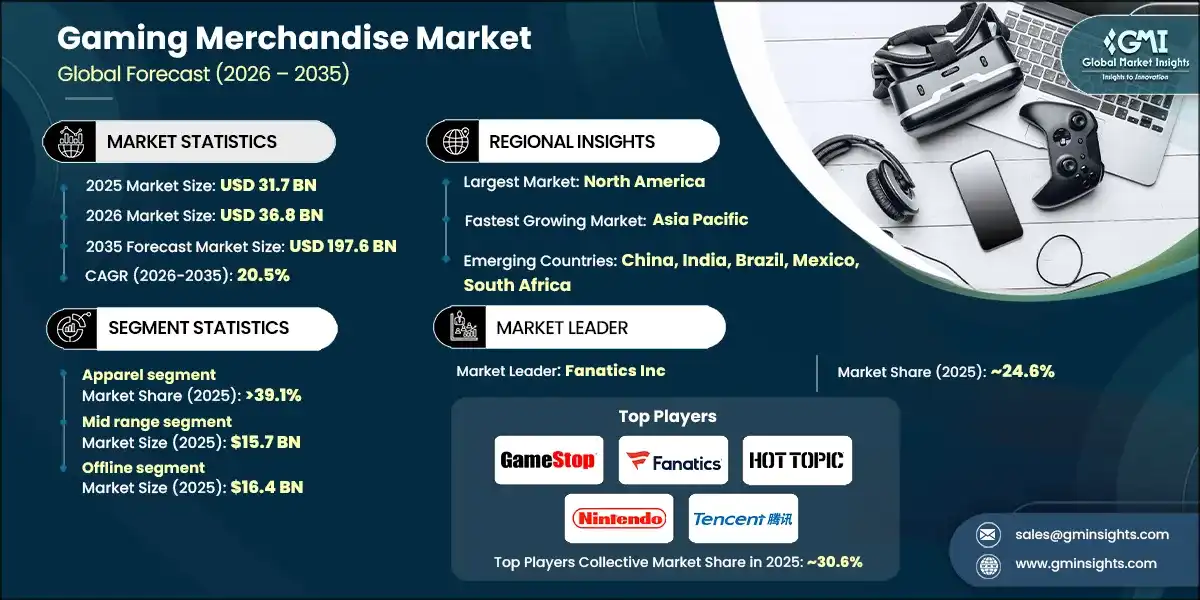
The global gaming merchandise market size was estimated at USD 31.7 billion in 2025. The market is expected to grow from USD 36.8 billion in 2026 to USD 197.6 billion by 2035, at a CAGR of 20.5% during the forecast period according to latest report published by Global Market Insights Inc.
To get key market trends
Due to the global expansion of the gaming community and an increase in the popularity of esports and engagement with gaming franchises across platforms; an increase in the demand for apparel, collectibles; accessories & lifestyle products exists due to consumers' willingness to show loyalty to iconic characters and video game titles as well as their willingness to make purchases reflecting their identity, loyalty, and lifestyle preferences.
- The continuous rise in the number of gamers across console, PC, and mobile platforms is directly driving demand for gaming merchandise. As gaming becomes mainstream across all age groups and regions, fan engagement extends beyond gameplay into merchandise purchases that reflect identity, loyalty, and lifestyle preferences. For instance, in February 2023, Microsoft partnered with NVIDIA to develop Xbox PC games to NVIDIA GeForce
- Due to the continuous increase in the number of video game players using mobile devices (including PCs, consoles, and mobile devices), the increase in video game players will stimulate video game merchandise demand. Video games are no longer limited to one group of people, but it has become mainstream and acceptable by all the people within all parts of the world and all age groups. This has created a fan engagement that was historically only seen in "traditional" sports and is now being witnessed in video games as gamers are starting to purchase merchandise that expresses their identity and loyalty.
- For instance, in September 2024, NCSOFT PURPLE expanded its PC game distribution is similar to a traditional sports league building its own broadcast network, giving the publisher greater control over content delivery, fan engagement, and the overall player ecosystem.
- Furthermore, partnerships between game developers and companies in fashion, streetwear, and lifestyle brands are making gaming merchandise available for purchase to consumers outside of the traditional gaming audience. This expands the range of potential consumers and creates new markets for these businesses through the introduction of premium/trend-driven gaming merchandise. Therefore, all types of consumers will be able to enjoy the benefits of gaming merchandise, and all consumers will have an increased average purchase amount per consumer for these products. For instance, in April 2025, Xsolla partnered with ALTAVA Group to develop luxury fashion IP into the gaming world.
- Between 2022 and 2024, the gaming merchandise market experienced significant growth, rising from USD 19.6 billion in 2022 to USD 27.4 billion in 2024. A major trend during this period, creating emotional connections with the gamers has been one of the biggest trends and has driven a constant stream of repeat purchases for merchandise. The most recognizable characters and storylines, as well as the entire universe within the game, have created a high demand for collectibles, clothing, and limited editions. This happens mostly at the time of game launches, expansions, and anniversaries.
- For instance, in December 2025, Redington Limited partnered with COUGAR Gaming under Red. Gaming strengthens its presence in India’s gaming ecosystem by expanding access to COUGAR’s full portfolio of high-performance PC components, gaming chairs, peripherals, and power supplies, supporting the country’s rapidly growing gaming hardware demand.
- Merchandising is greatly aided by gaming streamers, content producers, and social media. By utilizing influencer marketing, a large amount of exposure is created for gaming products due to their implementation of live stream events and sponsorships of the influencer, increasing visibility, stimulating impulse buys, and aiding gamers in building a closer connection with gaming brands. For instance, in December 2024, YouTube star, partnered with digital agency Studio71 in order to monetize his creator content portfolio and build out additional branded campaign opportunities and branded content through strategic media collaboration.
Gaming Merchandise Market Report Attributes
| Key Takeaway | Details |
|---|---|
| Market Size & Growth | |
| Base Year | 2025 |
| Market Size in 2025 | USD 31.7 Billion |
| Market Size in 2026 | USD 36.8 Billion |
| Forecast Period 2026 - 2035 CAGR | 20.5% |
| Market Size in 2035 | USD 197.6 Billion |
| Key Market Trends | |
| Drivers | Impact |
| Rapid growth of global gaming communities across PC, console, and mobile platforms. | Rising popularity of esports and competitive gaming drives around 35% of market demand. The rapid growth of professional gaming leagues, tournaments, and team-based competitions is fueling demand for official apparel, accessories, and collectibles. Fans increasingly purchase merchandise to show team loyalty and community identity, strengthening merchandise sales across online and offline channels. |
| Expansion of esports leagues and live gaming events | Strong fan engagement with gaming franchises contributes about 30% to market growth. Popular game titles, characters, and storylines create emotional connections with players, driving demand for licensed merchandise such as clothing, figurines, posters, and lifestyle products. Continuous game updates, sequels, and cross-media adaptations sustain long-term merchandise demand. |
| Strong fan engagement with game franchises is increasing demand for licensed and limited-edition products. | Expansion of gaming influencers and content creators fuels roughly 20% of market growth. Streamers, YouTubers, and esports personalities play a major role in promoting branded merchandise. Creator-led merchandise drops, limited editions, and direct-to-fan sales models are increasing visibility, authenticity, and purchase intent among younger gaming audiences. |
| Rising influence of streamers and gaming influencers is accelerating merchandise visibility and direct-to-consumer sales. | Growth of e-commerce and direct-to-consumer platforms drives about 15% market expansion. Online marketplaces, brand-owned stores, and global shipping options make gaming merchandise more accessible worldwide. Digital platforms enable faster launches, personalized offerings, and global reach, supporting higher sales volumes and improved customer engagement. |
| Growth of e-commerce and online marketplaces is improving global accessibility to gaming merchandise. | Increasing convergence of gaming with fashion and lifestyle contributes approximately 10% of market growth. Collaborations between game publishers, apparel brands, and pop-culture designers are positioning gaming merchandise as everyday lifestyle products. This trend is expanding the customer base beyond core gamers into mainstream fashion and youth culture segments. |
| Pitfalls & Challenges | Impact |
| High licensing and royalty costs. | Gaming merchandise often requires expensive licensing agreements with game developers, publishers, or intellectual property owners. Elevated royalty fees increase production costs, reduce profit margins for manufacturers and retailers, and may result in higher retail prices, which can limit consumer purchases and overall market demand. |
| Limited retail presence in emerging markets restricts offline merchandise sales. | In regions with underdeveloped retail infrastructure, physical stores offering gaming merchandise are scarce. This limits consumer access, reduces brand visibility, and constrains impulse purchases. Reliance on online sales alone may not fully compensate for the lack of localized offline channels, slowing overall market growth in these territories. |
| Opportunities: | Impact |
| Integration of gaming merchandise with fashion and lifestyle brands. | Integration of gaming merchandise with fashion and lifestyle brands presents growth opportunities. Collaborations between gaming franchises and popular fashion labels enable co-branded apparel, accessories, and collectibles. This fusion attracts both gamers and fashion enthusiasts, expands audience reach, enhances brand value, and drives higher sales, creating new revenue streams within the gaming merchandise market. |
| Rising demand for sustainable and eco-friendly gaming apparel presents differentiation opportunities. | Gaming merchandises are gaining traction in automotive, aerospace, and defense sectors for applications such as autonomous driving, in-cabin monitoring, robotics, and surveillance. Growing adoption in these high-tech industries presents opportunities to develop specialized solutions, improve operational efficiency, and address complex imaging challenges, fueling market growth globally. |
| Market Leaders (2025) | |
| Market Leaders |
~24.6% market share. |
| Top Players |
|
| Competitive Edge |
|
| Regional Insights | |
| Largest Market | North America |
| Fastest growing market | Asia Pacific |
| Emerging countries | China, India, Brazil, Mexico, South Africa |
| Future outlook |
|
What are the growth opportunities in this market?
Gaming Merchandise Market Trends
- A key trend shaping the gaming merchandise industry is the growing demand for branded, limited-edition, and interactive products. Merchandise such as apparel, collectibles, accessories, and lifestyle items enhance fan engagement, loyalty, and community participation, creating strong revenue opportunities across gaming, esports, and entertainment ecosystems globally.
- For instance, in 2025, Xsolla partnered with ALTAVA Group to introduce luxury fashion merchandise inspired by popular gaming IPs, enabling fans to engage with games beyond screens while blending gaming culture with lifestyle and fashion trends.
- The expansion of esports, streaming platforms, and digital content is accelerating merchandise adoption. Gamers increasingly seek products tied to favorite titles, influencers, and franchises, driving demand for collectibles, apparel, peripherals, and lifestyle items that strengthen brand connection and fan identity.
- As fan engagement becomes more immersive, gaming merchandise is incorporating interactive elements such as AR/VR-enabled collectibles, limited-edition drops, and personalized items. These innovations enhance the gaming experience, deepen loyalty, and create differentiated offerings that appeal to both casual and competitive gamers.
- Integration with e-commerce, social media, and influencer marketing is a growing focus for merchandise providers. Online platforms enable global reach, real-time promotions, pre-orders, and collaborative campaigns, allowing brands to scale effectively, track consumer trends, and improve accessibility of gaming merchandise worldwide.
- Ongoing collaborations between gaming developers, fashion brands, and merchandising companies are driving innovation and market expansion. Strategic partnerships optimize product design, co-branding opportunities, and distribution, ensuring a steady flow of high-demand merchandise across gaming communities, retail outlets, and digital marketplaces.
- With increasing emphasis on fan experience, lifestyle integration, and brand loyalty, the Gaming Merchandise market is poised for robust growth. Expansion across esports, streaming, and gaming communities, coupled with innovative product offerings, is reshaping consumer engagement and fueling a diverse, high-value global merchandise ecosystem.
Gaming Merchandise Market Analysis
Learn more about the key segments shaping this market
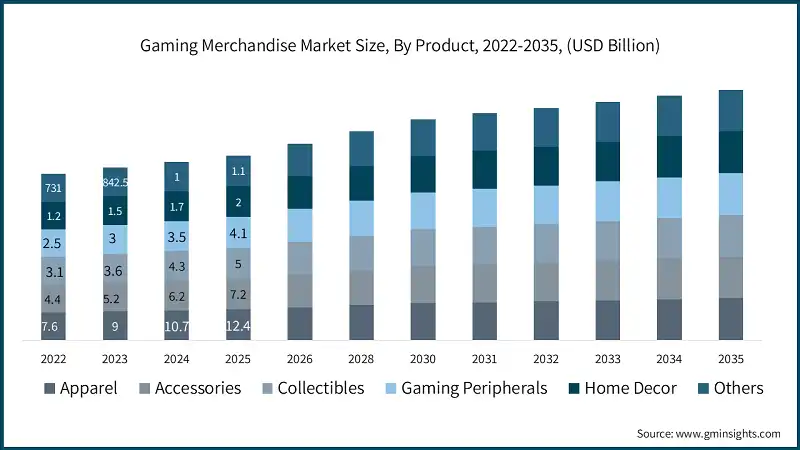
The gaming merchandise market was valued at USD 19.6 billion and USD 23.2 billion in 2022 and 2023, respectively. The market size reached USD 31.7 billion in 2025, growing from USD 27.4 billion in 2024.
Based on products, the market is segmented into apparel, accessories, collectibles, gaming peripherals, home decor, and others. The apparel segment is estimated to register a significant growth rate of over 39.1% of the market in 2025.
- The apparel segment holds the largest share in the gaming merchandise market, driven by growing consumer demand for branded clothing, esports team jerseys, and lifestyle apparel linked to popular gaming franchises. Rising gaming culture, influencer promotions, and collaborations between gaming companies and fashion brands have fueled widespread adoption. Merchandise offering comfort, style, and brand association appeals to gamers and fans alike, while online retail platforms and global esports events provide easy access, further boosting sales and reinforcing apparel as the dominant segment in the market.
- Manufacturers should focus on designing trendy, high-quality gaming apparel that resonates with fans, leveraging collaborations with popular franchises and influencers. Expanding online and offline distribution, offering limited-edition collections, and integrating esports branding can drive engagement, boost sales, and strengthen brand loyalty, ensuring dominance in the growing market.
- The collectibles segment in the gaming merchandise market is anticipated to witness significant growth, projected to expand at a CAGR of 20.6% during the forecast period, driven by increasing consumer interest in limited-edition figurines, action figures, and memorabilia linked to popular gaming franchises. Rising fan engagement, influencer promotions, and social media trends are fueling demand for exclusive items. Collaborations between game developers and merchandise manufacturers create unique, high-value collectibles that appeal to both casual gamers and dedicated fans.
- Manufacturers should focus on developing industrial-grade gaming merchandise with high-precision depth sensing, real-time 3D imaging, and AI-driven analysis. Enhancing performance for robotics, automated inspection, and machine vision will meet rising demand in automotive, aerospace, electronics, and manufacturing sectors, driving adoption and supporting faster, more accurate industrial operations.
Based on price range, the gaming merchandise market is segmented into high-end, mid range, and low cost. The mid range segment dominated the market in 2025 with a revenue of USD 15.7 billion.
- The mid-range segment holds the largest share of the market, driven by its balance of affordability and quality, appealing to a broad consumer base. Gamers and fans prefer products that offer good value without compromising design or functionality. Rising popularity of esports, collaborations with gaming franchises, and widespread availability through online and offline retail channels further support adoption. Mid-range merchandise, including apparel, accessories, and collectibles, meets mainstream demand, reinforcing its dominance in the gaming merchandise market.
- Manufacturers should focus on the mid-range segment, offering products that balance affordability and quality. Popular among gamers and fans, these items—including apparel, accessories, and collectibles—benefit from esports growth, franchise collaborations, and wide retail availability, meeting mainstream demand and reinforcing the segment’s leading position in the market.
- The high end segment in the gaming merchandise market is anticipated to witness significant growth, projected to expand at a CAGR of 18.7% and reach USD 34.2 billion by 2035. This growth is driven by rising consumer willingness to spend on premium, limited-edition, and officially licensed products linked to popular gaming franchises. Increasing influence of esports, celebrity gamers, and exclusive collaborations with luxury and lifestyle brands is boosting demand. High-quality materials, superior design, brand prestige, and collectible value further attract affluent gamers and dedicated fans.
- Manufacturers should focus on developing premium, limited-edition, and officially licensed gaming merchandise that emphasizes superior quality, design, and exclusivity. Strengthening collaborations with esports teams, influencers, and luxury or lifestyle brands, while leveraging storytelling and scarcity-driven launches, can enhance brand appeal and capture high-spending, loyal consumer segments.
Learn more about the key segments shaping this market
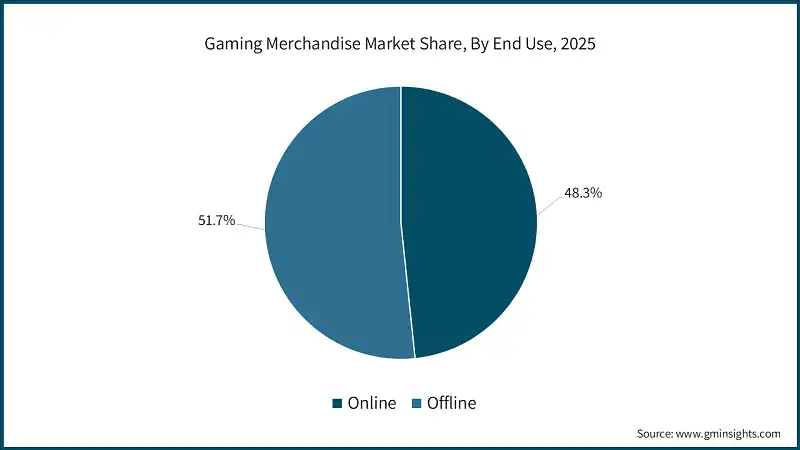
Based on the distribution channel, the gaming merchandise market is segmented into online, and offline. The offline segment dominated the market in 2025 with a revenue of USD 16.4 billion.
- The offline segment holds the largest share of the market, driven by the widespread presence of retail stores, gaming specialty shops, and mall outlets that allow consumers to experience products firsthand. Physical stores provide direct interaction with merchandise, fostering brand loyalty, impulse purchases, and customer engagement. Additionally, in-store promotions, exclusive releases, and events enhance visibility and appeal. While e-commerce grows, the tactile experience, immediate availability, and personalized service offered by offline channels continue to dominate sales, maintaining the segment’s leading market position.
- Manufacturers should focus on the offline segment of the market, leveraging retail stores and specialty outlets for direct consumer engagement. In-store experiences, promotions, exclusive releases, and events drive brand loyalty, impulse purchases, and visibility. Despite e-commerce growth, physical stores remain key for sales and customer connection.
- The online segment in the gaming merchandise market is anticipated to witness significant growth, projected to expand at a CAGR of 22.3% and reach USD 110.7 billion by 2035. Growth is driven by the convenience and accessibility of e-commerce platforms, expanding internet penetration, and increasing smartphone usage. Gamers and fans can easily browse, compare, and purchase products globally, including limited-edition and region-specific merchandise.
- Social media marketing, influencer promotions, and targeted digital campaigns further boost awareness and demand. Subscription services, gaming portals, and online auctions provide exclusive access to collectibles, apparel, and accessories, enhancing consumer engagement. The scalability, fast delivery, and personalized recommendations offered by online channels are accelerating adoption, positioning e-commerce as a major growth driver in the market.
- Manufacturers should focus on the online segment, leveraging e-commerce platforms, social media promotions, and influencer marketing to reach global consumers. Offering limited-edition merchandise, personalized recommendations, and fast delivery enhances engagement and sales. Subscription services, gaming portals, and online auctions further drive adoption, making digital channels a key growth avenue in the market.
Looking for region specific data?
The North America gaming merchandise market dominated with a market share of 35.5% in 2025.
- In North America, the market is experiencing robust growth, driven by the popularity of esports, strong fan engagement, and collaborations between gaming franchises and fashion or lifestyle brands. High internet penetration, widespread e-commerce adoption, and active social media communities further boost sales. Consumers increasingly seek branded apparel, collectibles, and accessories linked to favorite games. Additionally, influencer promotions, gaming events, and conventions enhance visibility and brand loyalty, supporting sustained demand and making North America a key regional market for gaming merchandise.
- Manufacturers should focus on popularity, fan engagement, and collaborations with fashion brands. High internet penetration, e-commerce, and social media boost sales of branded apparel, collectibles, and accessories. Influencer promotions and gaming events further enhance visibility and loyalty, making the region a key market.
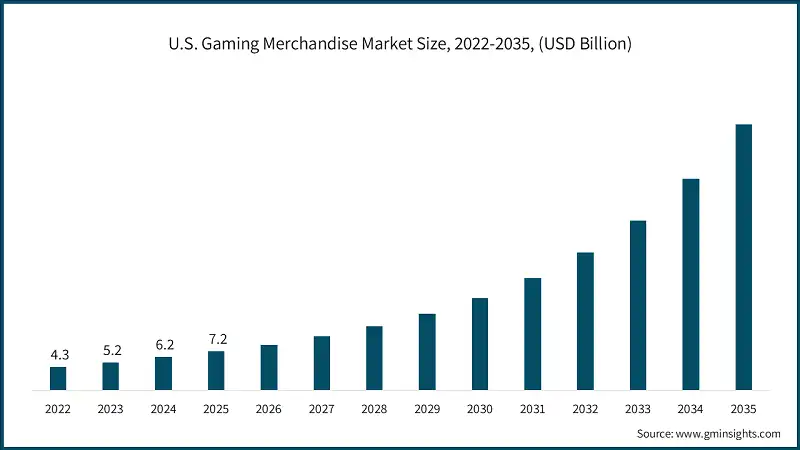
The U.S. gaming merchandise market was valued at USD 4.3 billion in 2022 and USD 5.2 billion in 2023, reaching USD 7.2 billion in 2025, up from USD 6.2 billion in 2024.
- The U.S. continues to dominate the market, fueled by strong consumer demand, the popularity of esports, and collaborations between gaming franchises and fashion or lifestyle brands. High internet penetration, e-commerce adoption, and social media influence, along with influencer promotions and gaming events, further drive growth and market expansion.
- Manufacturers should focus on producing mid-range and collectible gaming merchandise, including apparel, accessories, and exclusive items, leveraging online and offline retail channels. Collaborations with gaming franchises, esports teams, and influencers can boost visibility, enhance consumer engagement, and strengthen the U.S. market leadership in the global gaming merchandise industry.
The Europe gaming merchandise market accounted for USD 7.6 billion in 2025 and is anticipated to witness strong growth over the forecast period.
- Europe holds a significant share of the market, driven by strong consumer interest in branded gaming apparel, collectibles, and accessories. The region’s vibrant esports scene, collaborations between gaming and fashion brands, and well-established retail and e-commerce infrastructure further boost sales. Social media influence and gaming events also contribute to market growth.
- Manufacturers should focus on producing mid-range and premium gaming merchandise, including apparel, collectibles, and lifestyle accessories, tailored to European consumers. Collaborations with gaming franchises, esports teams, and influencers can enhance brand visibility, drive engagement, and strengthen market presence across both online and offline retail channels in Europe.
Germany dominates the Europe gaming merchandise market, showcasing strong growth potential.
- Germany holds a substantial share of the market, driven by strong consumer interest in branded gaming apparel, collectibles, and lifestyle accessories. The country’s vibrant gaming community, esports events, and collaborations between gaming franchises and local retailers further boost sales, making Germany a key contributor to Europe’s gaming merchandise market growth.
- Manufacturers should focus on developing mid-range and premium gaming merchandise for Germany, including apparel, collectibles, and accessories. Leveraging collaborations with local gaming franchises, influencers, and esports teams can enhance brand visibility, engage consumers, and strengthen market presence across both online and offline retail channels in the country.
The Asia-Pacific gaming merchandise market is anticipated to grow at the highest CAGR of 21.9% during the analysis period.
- The Asia-Pacific market is witnessing rapid growth, driven by rising gamer populations, expanding esports ecosystems, and increasing demand for branded apparel, collectibles, and lifestyle accessories. Collaborations between gaming franchises, influencers, and local retailers, along with growing online and offline retail penetration, are accelerating market expansion across the region.
- Manufacturers should focus on developing mid-range and premium gaming merchandise for the Asia-Pacific market. Leveraging partnerships with popular game franchises, esports teams, and digital influencers can boost visibility, enhance consumer engagement, and drive adoption of apparel, collectibles, and accessories across both online and offline sales channels.
The China gaming merchandise market is estimated to grow at a significant CAGR of 22.1% from 2026 to 2035.
- China leads the gaming merchandise market, driven by rapid growth in gaming culture, esports popularity, and rising consumer demand for branded apparel, collectibles, and accessories. Collaborations with gaming franchises, influencer promotions, and expanding online and offline retail channels are accelerating adoption, making China a key contributor to the Asia-Pacific market.
- Manufacturers should focus on developing mid-range and premium gaming merchandise for the Chinese market. Leveraging esports collaborations, influencer partnerships, and omnichannel retail strategies can enhance visibility, boost consumer engagement, and drive adoption of apparel, collectibles, and lifestyle accessories, supporting market growth and strengthening brand presence.
The Latin America gaming merchandise market, valued at USD 3.3 billion in 2025, is driven by growing esports popularity, rising gaming culture, and increasing collaborations between gaming franchises and lifestyle brands. Expanding internet access, social media influence, and retail availability are boosting demand for apparel, collectibles, and accessories across the region.
The Middle East and Africa gaming merchandise market, projected to reach USD 11.1 billion by 2035, is driven by rising gaming culture, growing esports engagement, and collaborations between gaming franchises and fashion or lifestyle brands. Expanding online retail, social media influence, and regional events are fuelling demand for apparel, collectibles, and accessories.
In Saudi Arabia, the gaming merchandise market is set to experience substantial growth in 2025.
- Saudi Arabia is emerging as a key growth hub for the market, driven by rising esports engagement, increasing popularity of gaming franchises, and growing demand for branded apparel, collectibles, and gaming accessories. Expanding retail presence, online platforms, and influencer-led promotions are further accelerating market adoption in the region.
- Manufacturers should focus on developing high-quality, affordable, and trendy gaming merchandise for Saudi Arabia. Leveraging collaborations with gaming franchises, influencers, and local retailers, while expanding e-commerce and offline distribution, will strengthen market presence, boost consumer engagement, and drive growth in this rapidly expanding market.
Gaming Merchandise Market Share
The competitive landscape of the gaming merchandise industry is witnessing significant growth, fuelled by rising demand for branded apparel, collectibles, and gaming accessories linked to popular franchises, esports, and influencer-led promotions. Major players, including GameStop Corp., Fanatics, Inc., Hot Topic, Inc., Nintendo, and Tencent Holdings collectively hold a 30.6% share of the market, driving innovation through collaborations with gaming studios, fashion brands, and e-commerce platforms. These partnerships enhance product variety, exclusivity, and engagement with gaming communities.
Emerging startups and niche providers are introducing limited-edition, customizable, and high-quality merchandise designed for collectors, esports fans, and casual gamers. Leveraging social media, influencer marketing, online marketplaces, and retail expansions, these innovations improve accessibility, fan engagement, and brand loyalty. Collaborations with content creators, esports organizations, and fashion brands are accelerating adoption, enabling widespread distribution of gaming merchandise globally.
Gaming Merchandise Market Companies
Some of the prominent market participants operating in the gaming merchandise industry include:
- Activision Blizzard
- Amazon
- Bandai Namco
- Bioworld Merchandising
- Capcom Store
- Electronic Arts (EA)
- Etsy Sellers
- Fanatics, Inc.
- Fangamer
- Funko, Inc.
- Gamerabilia
- GameStop Corp.
- Insert Coin Clothing
- Hasbro, Inc.
- Hot Topic, Inc.
- J!NX, LLC
- LEGO Group
- Logitech G
- Loot Crate, LLC
- Microsoft Gaming
- NetEase
- Nintendo
- Numskull Designs
- Razer
- Sony Interactive Entertainment
- Square Enix Store
- SteelSeries
- Take-Two Interactive
- Tencent Holdings
- Ubisoft
- Fanatics, Inc.
Fanatics, Inc. is a leading player in the gaming merchandise market, holding an estimated market share of ~24.6%. The company is known for its extensive range of branded apparel, collectibles, and gaming accessories. Collaborations with gaming franchises, esports teams, and influencers help deliver exclusive, high-quality merchandise. Strong online and offline retail presence, along with scalable production and distribution capabilities, reinforces its competitive position and supports widespread adoption among gamers and fans globally.
GameStop Corp. holds a significant share of ~2.3% in the gaming merchandise market. The company is recognized for offering a wide array of gaming collectibles, apparel, and accessories tied to popular gaming franchises. Its strong e-commerce platform, retail network, and collaborations with gaming developers and influencers enable timely releases of exclusive merchandise, driving fan engagement and loyalty worldwide.
Hot Topic, Inc. plays a crucial role in the gaming merchandise market, providing diverse gaming-themed apparel, collectibles, and lifestyle products. The company emphasizes exclusive collaborations with game developers and influencers to deliver limited-edition merchandise. Its strong retail footprint, coupled with online channels, enhances accessibility, consumer engagement, and brand loyalty, supporting adoption across casual gamers and dedicated fans alike.
Gaming Merchandise Industry News
- In November 2025, Activision Blizzard partnered with Fanattik to introduce a new collection of officially licensed gaming merchandise, featuring collectibles and accessories from popular franchises such as World of Warcraft, Overwatch, and Diablo, aimed at expanding offerings for fans worldwide.
- In October 2025, Funko expanded its gaming merchandise licensing, introducing new collectible figures and products based on popular video game franchises, aiming to engage fans and broaden its presence in the gaming collectibles market.
The gaming merchandise market research report includes in-depth coverage of the industry, with estimates & forecast in terms of revenue (USD billion) from 2022 to 2035, for the following segments:
Market, By Products
- Apparel
- Accessories
- Collectibles
- Gaming Peripherals
- Home Decor
- Others
Market, By Price Range
- High-end
- Mid-range
- Low-cost
Market, By Distribution Channel
- Online
- Offline
The above information is provided for the following regions and countries:
- North America
- U.S.
- Canada
- Europe
- Germany
- UK
- France
- Italy
- Spain
- Russia
- Rest of Europe
- Asia-Pacific
- China
- Japan
- India
- South Korea
- ANZ
- Rest of Asia-Pacific
- Latin America
- Brazil
- Mexico
- Rest of Latin America
- MEA
- Saudi Arabia
- UAE
- South Africa
- Rest of MEA
Frequently Asked Question(FAQ) :
Which region led the gaming merchandise sector in 2025?
North America led the market with a 35.5% share in 2025. The region's growth is attributed to the popularity of esports, strong fan engagement, collaborations between gaming franchises and lifestyle brands, and high internet penetration.
What are the upcoming trends in the gaming merchandise market?
Key trends include rising demand for branded and limited-edition products, AR/VR-enabled collectibles, personalized merchandise, gaming–fashion collaborations, and the expanding role of e-commerce and influencer marketing.
Who are the key players in the gaming merchandise industry?
Prominent players include Activision Blizzard, Amazon, Bandai Namco, Bioworld Merchandising, Capcom Store, Electronic Arts (EA), Etsy Sellers, Fanatics, Inc., Fangamer, Funko, Inc., and Gamerabilia.
What was the revenue of the offline segment in 2025?
The offline segment generated USD 16.4 billion in 2025. The market is propelled by the widespread presence of retail stores, gaming specialty shops, and mall outlets.
What was the valuation of the mid-range segment in 2025?
The mid-range segment generated USD 15.7 billion in 2025, dominating the market due to its balance of affordability and quality, which appeals to a broad consumer base.
What was the market size of the gaming merchandise in 2025?
The market size was USD 31.7 billion in 2025, with a CAGR of 20.5% expected through 2035. The growth is driven by the global expansion of the gaming community, increasing popularity of esports, and rising consumer demand for branded merchandise.
How much revenue did the apparel segment generate in 2025?
The apparel segment accounted for over 39.1% of the market in 2025, led by consumer demand for branded clothing, esports team jerseys, and lifestyle apparel linked to popular gaming franchises.
What is the expected size of the gaming merchandise industry in 2026?
The market size is projected to reach USD 36.8 billion in 2026.
What is the projected value of the gaming merchandise market by 2035?
The market is poised to reach USD 197.6 billion by 2035, fueled by innovations in interactive products, collaborations between gaming and fashion brands, and the integration of e-commerce and social media platforms.
Gaming Merchandise Market Scope
Related Reports