Summary
Table of Content

Food Waste Recycling Market
Get a free sample of this report
Form submitted successfully!
Error submitting form. Please try again.
Thank you!
Your inquiry has been received. Our team will reach out to you with the required details via email. To ensure that you don't miss their response, kindly remember to check your spam folder as well!
Request Sectional Data
Thank you!
Your inquiry has been received. Our team will reach out to you with the required details via email. To ensure that you don't miss their response, kindly remember to check your spam folder as well!
Form submitted successfully!
Error submitting form. Please try again.
Food Waste Recycling Market Size
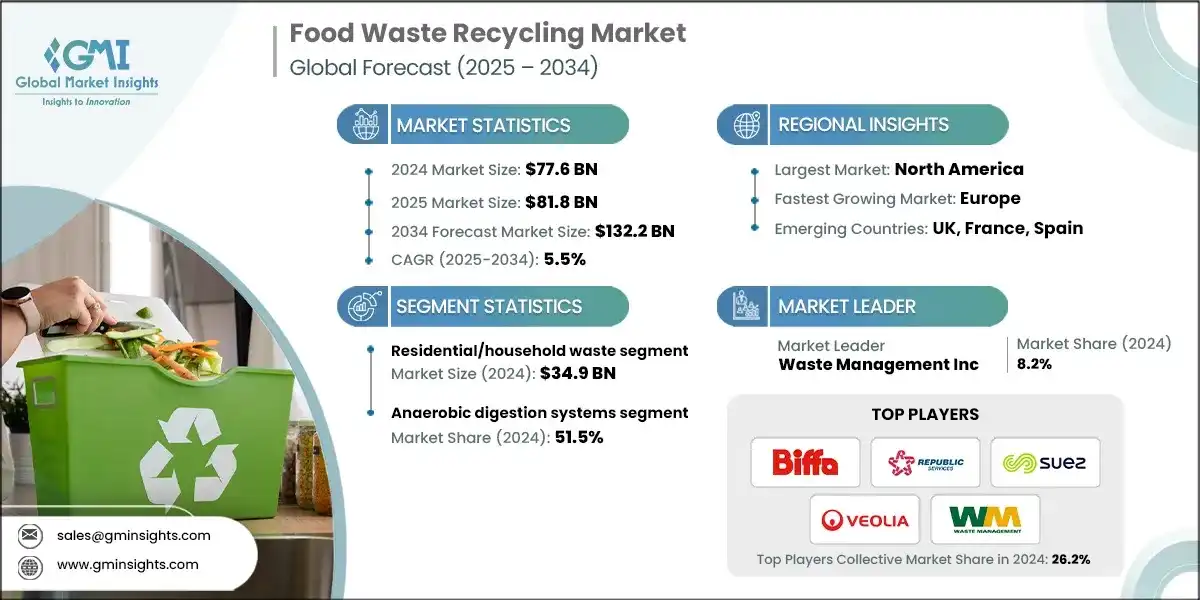
The global food waste recycling market was valued at USD 77.6 billion in 2024. The market is expected to grow from USD 81.8 billion in 2025 to USD 132.2 billion in 2034, at a CAGR of 5.5%, according to latest report published by Global Market Insights Inc.
Food Waste Recycling Market Key Takeaways
Market Size & Growth
- 2024 Market Size: USD 77.6 Billion
- 2025 Market Size: USD 81.8 Billion
- 2034 Forecast Market Size: USD 132.2 Billion
- CAGR (2025–2034): 5.5%
Regional Dominance
- Largest Market: North America
- Fastest Growing Region: Europe
Key Market Drivers
- Rising landfill costs & restrictions.
- Regulatory mandates & policy support.
- Circular economy adoption.
Challenges
- Feedstock quality & contamination issues.
- Technology standardization gaps.
Opportunity
- Digital platform development.
- Emerging technology integration.
Key Players
- Market Leader: Waste Management Inc led with over 8.2% market share in 2024.
- Leading Players: Top 5 players in this market include Waste Management Inc, Veolia, SUEZ Group, Republic Services, Biffa, which collectively held a market share of 26.2% in 2024.
Get Market Insights & Growth Opportunities
- Food waste recycling converts the food waste into compost, biogas, or animal feed-usable products, minimizing the volume of waste deposited in landfills and promoting sustainable waste management.
- According to the Environmental Protection Agency, generation of total municipal solid waste in 2018 was 292.4 million tons, in which food contributed 21.59% in total waste. This market has been growing considerably due to the rise in concerns surrounding the environment and better management of food waste. Other key driving factors include high costs of landfill operations and increasing restrictions as governments all over the world are implementing stringent regulations for controlling landfill emissions and encourage recycling. Many countries have passed laws for imposing high taxes on landfills and setting very aggressive targets for waste diversion, forcing the industries to take up food waste recycling solutions.
- Awareness about the environmental impact of food waste, such as methane emitted from landfills, has led the governments to endorse recycling programs. North America leads the global market, supported by developed infrastructure and proactive regulatory frameworks that promote recycling initiatives.
- Europe is the fastest-growing market owing to strict sustainability regulations and increasing investments in innovative waste processing technologies. These factors create a favorably advancing platform for the food waste recycling industry on a global scale, with governments being undoubtedly strong forces in formulating policies to ensure sustainable waste management practices.
To get key market trends
Food Waste Recycling Market Trends
- Transformational advancements are in anaerobic digestion, composting, and bioenergy technologies. These are set to revolutionize food waste recycling from a process efficiency, time saving and quality end-product such as biogas and organic fertilizer perspective. Mechanisms of real-time monitoring and automation through the integration of IoT and AI are optimizing the recycling process to adopt better scalability and cost-effectiveness, thus prompting wider industry acceptance.
- This industry trend is towards embedding circular economy principles in such a way to minimize waste and maximize recovery. More and more, companies have begun designing their products for reusability and recycle convenience as well as developing secondary raw materials from food waste. This is all due to the consumer demands shifted to sustainable products coupled with corporate promises to greener commitments: this innovation is brought about in packaging, product lifecycle management, and waste valorization.
- Governments and regulatory bodies have begun to evolve policies that would endorse sustainable waste management practices with many considering EPR schemes where producers assume responsibility for the entire lifecycle of their products, including waste management. It also drives companies towards adopting proactive measures for recycling and managing food waste.
- As awareness increases among consumers about environmental issues, they tend to gravitate toward brands with sustainable practices, hence forcing companies to adopt increasingly effective waste management strategies for food products. CSR initiatives now emphasize zero waste goals; many companies are integrating food waste recycling into their broader environmental, social, and governance (ESG) strategies.
- New technologies such as enzymatic breakdown, microbial fuel cells, and biorefinery processes show additional potential for improving the efficiency of recycling foods with waste. In turn, these technologies strive to create processes to produce better-end products through decreased input costs and environmental impacts. Progress and novel innovations synthesized in this area are expected to continually speed up growth and technological uptake against the backdrop of increased funding directed toward sustainable innovations.
Food Waste Recycling Market Analysis
Learn more about the key segments shaping this market
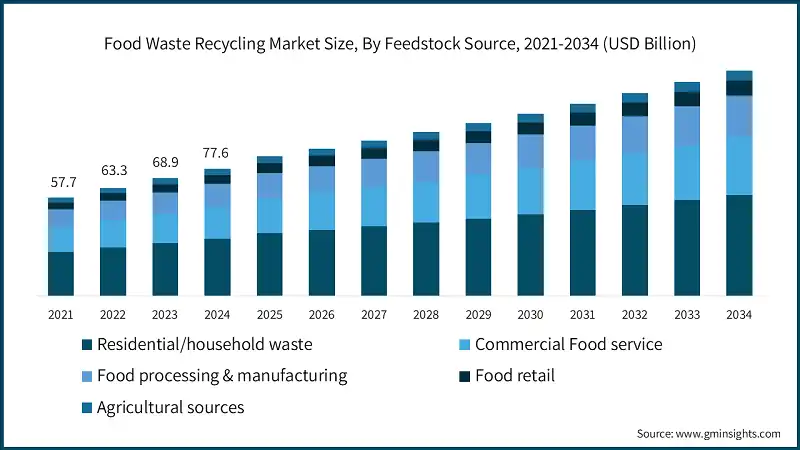
Based on feedstock source, market is segmented into residential/household waste, commercial food service, food processing & manufacturing, food retail and agricultural sources. The residential/household waste generated USD 34.9 billion revenue in 2024.
- Waste generated at the residential household dominate the market segment due to its large volume contributing to a major portion of the total food waste worldwide. Increasing urbanization and consumer awareness regarding sustainability prompt an increasing number of households to adopt composting and small-scale recycling. Additionally, household food waste diversion is promoted in many areas through government incentives and community programs, adding fuel to the growth. In addition, the easy and inexpensive nature of residential recycling solutions makes it attractive to market players.
- Food service establishments like restaurants or cafeterias as well as catering companies input to the market, but at a lesser scale than household waste. There are tougher regulations imposed on the disposal of waste in the hospitality sector, and this encourages establishments to adopt modern recycling systems.
- Food processing and manufacturing industries are perhaps the most important generators of food waste, although their recycling tends to be a process in terms of waste valorization rather than diversion. They tend to generate lots of organic waste, and capital investment within the industry on advanced processing technologies, such as biogas plants, is on the rise. This segment is driven by the growing need for sustainable waste practices and the ability to recover valuable by-products, creating the potential for future technological advancements as well as collaboration.
- Food wastages from food retailing outlets, mainly supermarkets and, to a lesser extent, hypermarkets, are still significant but are from unsold or expired items. Agricultural sources are much smaller within the entire market context but critical regarding compost and organic fertilizer production. Farms and agricultural ventures generate certain food wastes that are suitable to be repurposed back as soil amendment, which would create a sustainable form of farming.
Learn more about the key segments shaping this market
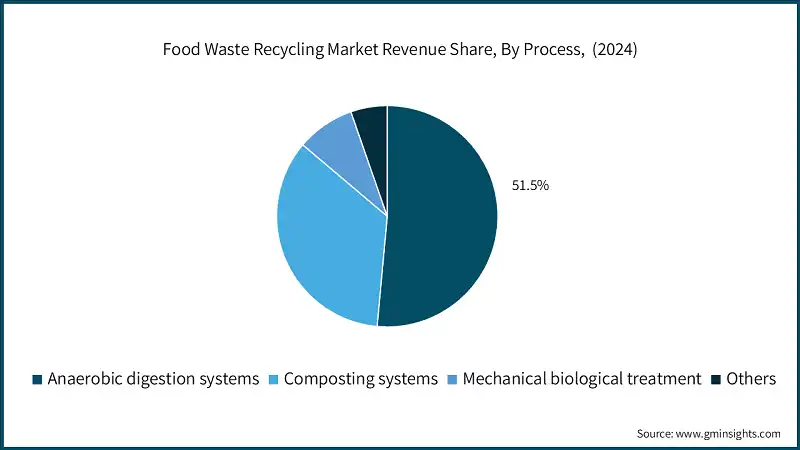
Based on process, the market is segmented into anaerobic digestion systems, composting system, mechanical biological treatment and others. The anaerobic digestion systems accounted for 51.5% of market share in 2024.
- Anaerobic digestion systems dominate mainly because of their ability to efficiently convert organic waste into biogas and nutrient-rich digestate. The process has many environmental benefits, including abating greenhouse gas emissions, and hence supports sustainability goals, fostering adoption in various regions. With energy recovery possibilities, it is favoured and, as such, fueling rapid growth and innovations in this area.
- Composting offers ease of operation, crude cost, and fitting ill with organic waste management. Innovations such as in-vessel composting and odour control technology are widening the scope, permitting even larger-scale composting operations.
Based on end use, the market is segmented into energy products, soil amendment products, feed & protein products, industrial products and others.
- Energy products dominates the market. This includes the biogas, biomethane, and electricity generated from anaerobic digestion processes and other thermal processing technologies. Resources related to energy production have a safe, long-term revenue generation mechanism, which includes power purchase agreements, renewable energy credits, and natural gas sales contracts.
- Soil improvement goods such as compost and digestate are gushing in volume due to the stimuli of increased demand for organic soil amendment products to agriculture, landscaping, and urban farming.
- The feed and protein products growing rapidly include insect protein, animal feed supplement products, and aquaculture feeds derived from the food waste processing. Industrial products represent the smallest share, while biochemicals, bioplastics, and specialty chemicals are created through advanced biorefinery processes.
Looking for region specific data?
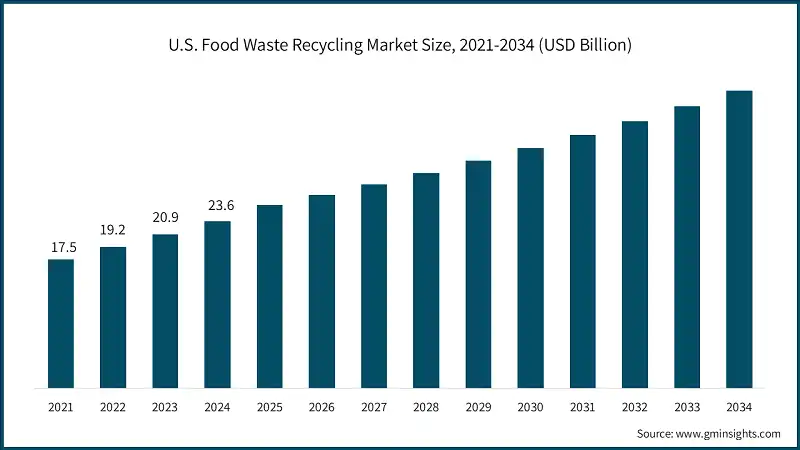
The food waste recycling market in North America will grow at a notable CAGR approximately 5.5% between 2025 and 2034.
- Sustainable waste management practices are being accepted more and more by the consumers and industries that are becoming increasingly conscious of sustainable living, waste minimization, and environmental conservation. The growing awareness among consumers is fueling demand for modern recycling techniques that transform organic waste into marketable products in the form of biogas, organic fertilizers, and renewable energy sources.
- The technological advances toward safer, reliable, and affordable alternatives that are aiding the enhancement of existing processing techniques like anaerobic digestion, composting, and thermal treatment to enter new applications in agricultural waste management, municipal waste management, and the industrial food processing sector.
The Germany food waste recycling markets is expected to grow at a CAGR of 5.4 % from 2025 to 2034.
- Stringent environmental regulations and strong initiatives are nurturing environmentally sustainable waste treatment methods. Preference is shifting toward bio-based and eco-friendly alternatives, notably in Germany, where such environmental standards are well above the global average.
- The R&D activities aim at optimizing composting and anaerobic digesting, and innovations in biogas upgrading technologies widen the application of technologies in natural extracts, pharmaceuticals, and organic farming industries.
- Clean-label formulations, as well as sustainable and allergen-free and vegan products, are popular in the European market, thus giving a investment opportunity to green food waste recycling technologies that comply with the consumers' demands of health and sustainability.
The food waste recycling market in China and India is expected to have lucrative growth between 2025 and 2034, with CAGR 5.6% in the Asia Pacific region.
- Rapid urbanization and increasing per capita disposable income, has driven the demand for organic fertilizers, biogas, and natural extracts produced through recycling processes.
- Government policies on the sustainable management of waste and initiatives for green energy, eco-friendly manufacturing, all have become the key drivers of investments in food waste valorization projects.
- The growing adoption of natural and organic products, together with growth of the healthcare and wellness sectors, will drive demand of bio-based ingredients for pharmaceuticals and dietary supplements from food waste recycling processes.
Between 2025 and 2034, the market for food waste recycling in the Middle East is projected to grow significantly during this period.
- Rapid development in the hospitality and tourism sector with rising wellness trends has elevated the demand for high-quality eco-friendly food waste treatment solutions.
- Government interventions towards eco-friendly practices, sustainable living, and healthier lifestyles shall enhance the growing possibility of integrating food waste recycling into markets dealing with food, dietary supplements, and cosmetics.
Between 2025 and 2034, a promising expansion of the food waste recycling sector is foreseen in the Latin America.
- Growing awareness of environmental sustainability and organic recycling is driving consumers and industries toward ecological practices, especially in cosmetics and functional foods.
- Rising disposable incomes extracts will make adoption of eco-friendly waste management and sourcing of natural ingredients become an integral part of the region's industries.
Food Waste Recycling Market Share
- Food waste recycling industry is moderately consolidated with players like Biffa, Republic Services, SUEZ Group, Veolia and Waste Management Inc accounted for 26.2% market share in 2024.
- The food waste recycling market consists of such leading companies operating mostly in their regional areas. Their long years of experience with waste recycling allow these companies to maintain a strong market position worldwide. Their product offerings are diverse and majorly supported by production capacities and distribution networks, which can serve the increasing demand for food waste recycling in various regions.
Food Waste Recycling Market Companies
Major players operating in the food waste recycling industry includes:
- Alfa Therm Limited
- Biffa
- Clear Earth Recycling
- FoodCycler
- Republic Services
- Ridan food waste composters
- Skip Shapiro Enterprises, LLC
- SUEZ Group
- Veolia
- Waste Management Inc.
Waste Management offers the organic waste management solutions across America. Its services encompass the collection, processing, and marketing of the final product. Waste Management operates many anaerobic digestion and composting sites. The focused strategy for the company being placed in energy generation from renewables, and thereby creating a form of sustainable waste resolve more suitable to regulatory compliances and corporate resolutions.
Veolia combines its regional presence with technical expertise to deliver comprehensive organic waste solutions. The company excels in both anaerobic digestion and composting projects, backed by the firm's experience in biogas upgrading and related technologies. Veolia's water and waste management capabilities facilitate environmental service solutions to both institutional and industrial customers.
Republic Services, shipping and operating plenty of anaerobic digestion plants and composting sites with a wealth of opportunities for good-quality final product development and customer service performance. Republic Services has a chain backbone of collection networks and municipal alliances, ensuring consistent feedstock supply that guarantees long-term opportunities to earn good revenues.
SUEZ Group synergizes water and waste management to make integrated organic waste solutions available in Europe and emerging markets. The technologies they promote revolve around advanced biological treatment systems and resource-saving technologies.
Biffa mainly focuses on organic waste processing, especially crushing and anaerobic digestion. The clear focus of the management, for which regulatory compliance is linked, has provided Biffa secure positions in the best regional markets.
Food Waste Recycling Market Report Attributes
| Key Takeaway | Details |
|---|---|
| Market Size & Growth | |
| Base Year | 2024 |
| Market Size in 2024 | USD 77.6 Billion |
| Market Size in 2025 | USD 81.8 Billion |
| Forecast Period 2025 – 2034 CAGR | 5.5% |
| Market Size in 2034 | USD 132.2 Billion |
| Key Market Trends | |
| Drivers | Impact |
| Rising landfill costs & restrictions | Drive increased investment and innovation in food waste recycling solutions to reduce landfill dependency |
| Regulatory mandates & policy support | Accelerate market growth through mandated recycling practices and supportive policies. |
| Circular economy adoption | Promote sustainable practices that enhance resource efficiency and create new value streams in food waste management |
| Pitfalls & Challenges | Impact |
| Feedstock quality & contamination issues | Hinder process efficiency and increase operational costs, posing challenges to market scalability |
| Technology standardization gaps | Limit interoperability and slow down adoption of advanced recycling technologies across different regions |
| Opportunities: | Impact |
| Digital platform development | Enhance data management, process optimization, and stakeholder collaboration within the food waste recycling ecosystem |
| Emerging technology integration | Facilitate more efficient, cost-effective, and innovative recycling methods, expanding market potential |
| Market Leaders (2024) | |
| Market Leaders |
8.2% |
| Top Players |
Collective market share in 2024 is 26.2% |
| Competitive Edge |
|
| Regional Insights | |
| Largest Market | North America |
| Fastest growing market | Europe |
| Emerging countries | UK, France, Spain |
| Future outlook |
|
What are the growth opportunities in this market?
Food Waste Recycling Market News
- In August 2025, My Green Michigan acquired Oakland County-based CO Sustainability to promote food waste recycling across Southeast Michigan, thus strengthening services to businesses, schools, and universities, and furthering sustainability endeavours with increase in organics collection and community engagement.
- In April 2025, California-based Mill launched a workplace food waste recycling bin and gained revenues of USD 20 million. The facility promotes sustainability, real-time waste reporting, and upcycling to help companies solve challenges related to food waste and landfill contribution.
- In October 2023, UCU set up a food waste recycling plant in Uganda, which focuses on nurturing sustainable waste management practices towards conserving the environment.
The food waste recycling market research report includes an in-depth coverage of the industry with estimates and forecast in terms of revenue in USD Billion and volume in terms of Kilo Tons from 2021-2034 for the following segments:
Market, By Feedstock Source
- Residential/household waste
- Commercial food service
- Restaurants & cafeterias
- Hotels & hospitality
- Institutional kitchens
- Catering services
- Food retail
- Grocery stores & supermarkets
- Convenience stores
- Farmers markets
- Food processing & manufacturing
- Fruit & vegetable processing
- Meat & poultry processing
- Dairy processing
- Beverage manufacturing
- Agricultural sources
- On-farm crop residues
- Livestock manure
- Aquaculture waste
Market, By Process
- Anaerobic digestion systems
- Composting system
- Mechanical biological treatment
- Others
Market, By End Use
- Energy products
- Biogas & biomethane
- Renewable natural gas (RNG)
- Electricity generation
- Soil amendment products
- Compost
- Digestate
- Biochar
- Liquid fertilizers
- Feed & protein products
- Insect protein meal
- Animal feed
- Aquaculture feed
- Industrial products
- Bioplastics & polymers
- Biochemicals
- Packaging materials
- Others
The above information is provided for the following regions and countries:
- North America
- U.S.
- Canada
- Europe
- Germany
- UK
- France
- Spain
- Italy
- Rest of Europe
- Asia Pacific
- China
- India
- Japan
- Australia
- South Korea
- Rest of Asia Pacific
- Latin America
- Brazil
- Mexico
- Argentina
- Rest of Latin America
- Middle East and Africa
- Saudi Arabia
- South Africa
- UAE
- Rest of Middle East & Africa
Frequently Asked Question(FAQ) :
What is the market size of the food waste recycling in 2024?
The market size was USD 77.6 billion in 2024, with a CAGR of 5.5% expected through 2034 driven by rising conversion of waste into compost, biogas, and other sustainable products.
What is the projected value of the food waste recycling market by 2034?
The food waste recycling market is expected to reach USD 132.2 billion by 2034, propelled by regulatory mandates, circular economy adoption, and technological advancements in waste processing.
What is the current food waste recycling market size in 2025?
The market size is projected to reach USD 81.8 billion in 2025.
How much revenue did the residential/household waste segment generate in 2024?
Residential/household waste generated USD 34.9 billion in 2024, dominating the feedstock source segment due to its large volume and increasing consumer awareness regarding sustainability.
What was the valuation of anaerobic digestion systems segment in 2024?
Anaerobic digestion systems held 51.5% market share in 2024, leading due to their ability to efficiently convert organic waste into biogas and nutrient-rich digestate.
Which region leads the food waste recycling market?
The food waste recycling market in North America will grow at a notable CAGR of approximately 5.5% between 2025 and 2034, supported by developed infrastructure and proactive regulatory frameworks that promote recycling initiatives.
What are the upcoming trends in the food waste recycling market?
Key trends include transformational advancements in anaerobic digestion and composting technologies, integration of IoT and AI for real-time monitoring, circular economy principles adoption, and development of emerging technologies like enzymatic breakdown and microbial fuel cells.
Who are the key players in the food waste recycling market?
Key players include Alfa Therm Limited, Biffa, Clear Earth Recycling, FoodCycler, Republic Services, Ridan food waste composters, Skip Shapiro Enterprises LLC, SUEZ Group, Veolia, and Waste Management Inc.
Food Waste Recycling Market Scope
Related Reports