Summary
Table of Content

Fan Motors Market
Get a free sample of this report
Form submitted successfully!
Error submitting form. Please try again.
Thank you!
Your inquiry has been received. Our team will reach out to you with the required details via email. To ensure that you don't miss their response, kindly remember to check your spam folder as well!
Request Sectional Data
Thank you!
Your inquiry has been received. Our team will reach out to you with the required details via email. To ensure that you don't miss their response, kindly remember to check your spam folder as well!
Form submitted successfully!
Error submitting form. Please try again.
Fan Motors Market Size
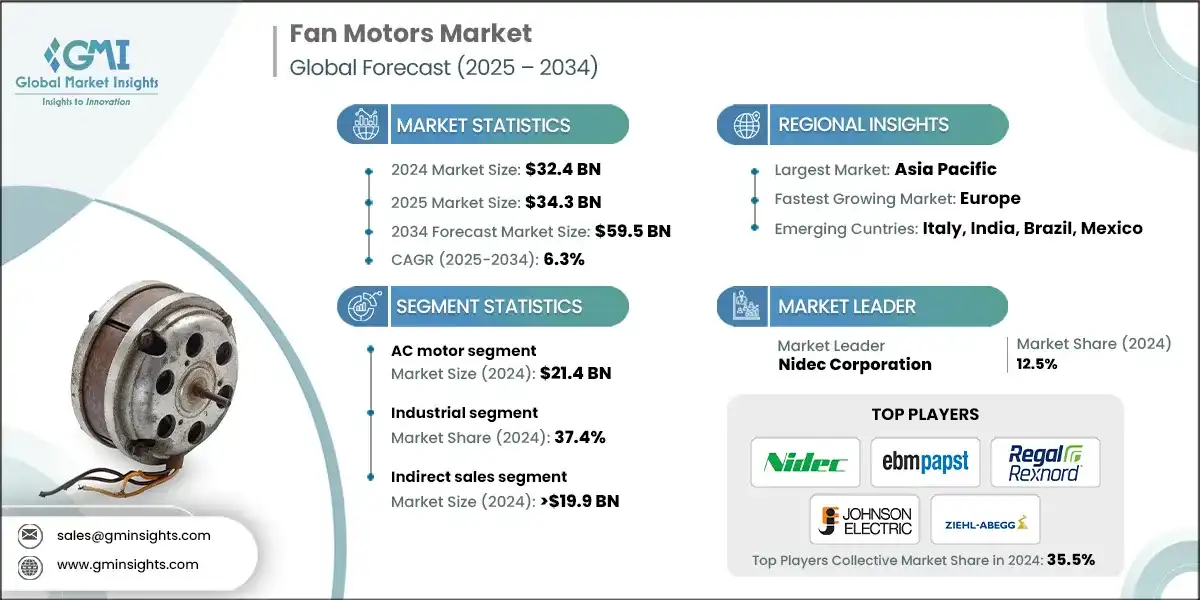
The fan motors market was estimated at USD 32.4 billion in 2024. The market is expected to grow from USD 34.3 billion in 2025 to USD 59.5 billion in 2034, at a CAGR of 6.3%, according to latest report published by Global Market Insights Inc.
Fan Motors Market Key Takeaways
Market Size & Growth
- 2024 Market Size: USD 32.4 Billion
- 2025 Market Size: USD 34.3 Billion
- 2034 Forecast Market Size: USD 59.5 Billion
- CAGR (2025–2034): 6.3%
Regional Dominance
- Largest Market: Asia Pacific
- Fastest Growing Region: Europe
Key Market Drivers
- Rising demand for energy efficient appliances.
- Technological advancements.
- Growth of smart home devices.
Challenges
- High capital investment requirements.
- Material complexity and detection limitations.
Opportunity
- Rising demand for sustainability.
- Technological advancements in AI.
Key Players
- Market Leader: Nidec Corporation led with over 12.5% market share in 2024.
- Leading Players: Top 5 players in this market include Nidec Corporation, ebm-papst, Regal Rexnord, Johnson Electric Holdings Ltd., Ziehl Abegg, which collectively held a market share of 35.5% in 2024.
Get Market Insights & Growth Opportunities
The fan motor market is experiencing strong growth, spurred largely by the increased demand for energy savings. The International Energy Agency (IEA) noted a global improvement in energy efficiency of 2.2% in 2023, indicating that many countries across the world are transitioning to energy-efficient habits. Recently, for example, Nidec Corporation launched a high-efficiency fan motor for HVAC systems designed specifically to improve energy savings.
Advancements in technology, specifically brushless DC motors, have also contributed to the growth of the fan motor market. Due to their energy savings, compact structure and enhanced function, brushless DC motors are in increasing demand. For instance, Johnson Electric Holdings Ltd. has integrated brushless DC motors into its product offering for the automotive and home appliance sectors. In parallel, Mitsumi Electric Co. Ltd. has launched compact brushless motors for use in ceiling fans to improve efficiency and sound, while maintaining power savings.
Finally, the market will also be supported in the future with the adoption of the integration of IoT and advanced monitoring functionalities. The developments in smart technologies in the consumer electronics market, since 2020, have facilitated the ability to monitor data in real-time and improve efficiencies. For example, Panasonic Corporation has integrated IoT-enabled fan motors into its smart home offering so users can monitor operative performance, energy usage and identify facility performance.
Although the market is making strides, it still must contend with issues of price-sensitive consumers. Smaller-sized manufacturers, sometimes local manufacturers in growing countries, are facing pressure to lower costs while continuing to achieve quality and performance. For example, Crompton Greaves Consumer Electricals Ltd. are selling inexpensive fan motors that also consider energy efficiency into their design for budget-conscious consumers to consider remaining competitive in this market and meticulously watch the developments that can impact the brand and/or the consumer.
The consumer mindset is shifting rapidly, spurred by changing lifestyles and technology. The Consumer Technology Association cited in a 2023 report that 68% of surveyed consumers said sustainability was important when purchasing electronics. Havells India Ltd., for example, is marketing new ceiling fans with energy efficient BLDC motors to appeal to consumers interested in eco-friendly purchases. This indicates that consumers are increasing scrutiny of sustainable and energy-efficient fan motors that should be considered the consumer in the market.
To get key market trends
Fan Motors Market Trends
The fan motors industry is focusing on innovation and efficiency of motor applications across industries.
- Urbanization and population growth have had a considerable impact on the fan motors market, increasing the desire for lightweight and compact fan motor designs. The 2024 report by the United Nations indicates that 56.2% of the world population as of 2024 lives in urban areas (United Nations). Therefore, fan motor manufacturers such as Johnson Electric, and Nidec, are focusing on miniaturizing fan motors from larger designs to cater to a smaller home footprint. For instance, Nidec manufactures ultra-compact fan motors specifically catered to modern urban life in households with limited living space.
- Energy efficiency has emerged as a significant trend in the fan motors market. It has been driven in part by stricter Government regulation of fan motor design but, also by consumer need for sustainable solutions. The European Union's Ecodesign Directive mandates electric motors achieve higher energy efficiency standards including fan motors designed and produced by manufacturers. For example, manufacturers including Panasonic have successfully developed fan motors to meet the energy efficiency classification, like their DC motor fans, which achieve energy efficiency ratings much better than older traditional AC motor fans.
- Smart and connected fan motors are trending and rapidly emerging as a major segment of the market, spurred by developments in IoT. The International Data Corporation (IDC) indicates that the global IoT market is projected to reach USD 1.1 Trillion come 2024 and a substantial part of that growth can be attributed to smart home applications. Some major fan makers like Havells, have created IoT enabled ceiling fans, such as the Havells Carnesia-I, that can be remotely controlled and operated through hybrid smart home technology.
- Noise reduction continues to be a major focus for fan motor manufacturers, as consumer preference increasingly shifts to quieter appliances. An example of a manufacturer is Dyson, which includes advanced noise-reduction technologies in their bladeless fans. An example of such a product is the Dyson Pure Cool, which utilizes aerodynamic engineering to create minimal noise when in operation. This would indicate that there is a trend toward more noise-sensitive applications within residential and commercial applications.
Fan Motors Market Analysis

Learn more about the key segments shaping this market
Based on motor type, the market is segmented DC motors, AC motors and EC motors. The AC motor segment generating a revenue of USD 21.4 billion in 2024.
- AC induction motors are the most widely used in the fan motors market due to their cost effectiveness, reliability, and flexibility. The U.S. Department of Energy (DOE) states that AC motors are used in over 70% of motor applications in industry because of the lower capital cost and maintenance. For example, AC motors like the Siemens SIMOTICS GP series work well with industrial fans because they are robust and less expensive to use.
- Regulatory agencies and those involved with energy efficiency have increased the popularity of AC motors. For example, the Ecodesign Directive from the European Union requires motors to meet minimum standards for energy performance, which entails increasing the use of energy efficient AC motors used in the applications of fans for example. Products like the ABB IE3 motors comply with the directive and provide a low-cost solution.
- In addition, the AC motor industry is naturally more dominant than their DC motor counterparts because of the versatility of the AC motor for specific application. The International Electrotechnical Commission describes application in smaller and larger applications quite broadly, as residential and industrial with applications ranging from a small fan in an HVAC to large industrial blowers found in the industrial market. For example, an AC motors you may find in the HVAC application would be a Baldor-Reliance Super-E motor that may be plugged directly into standard AC.
- Engineers have constantly innovated their products to improve AC motors, ultimately assisting with the AC motor market dominance. As indicated in a report conducted by the National Electrical Manufacturers Association (NEMA), AC motors are being designed and produced with new materials to improve efficiency and durability. For instance, the WEG W22 motors series, include advanced cooling systems and is designed with unique materials for greater performance.
- Organizations such as the European Union Aviation Safety Agency promote the ease of operation of AC motors for reducing down time and maintenance. The unique design and simplicity of repair allows for easy diagnostics using standard tools. For that reason, AC motors are often the go to for industries where continued operations are essential. For example, Ac motors are commonly used in the mining market that rely on reliability and maintenance issues that cannot impact production efficiencies.
Learn more about the key segments shaping this market
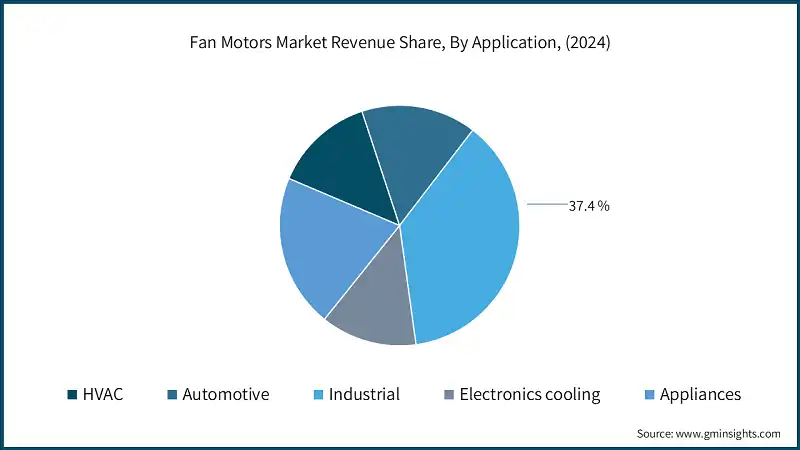
Based on applications, the market is segmented HVAC, automotive, industrial, electronics cooling and appliances. The industrial segment accounted for around 37.4% of the market share in 2024.
- The industrial sector is the leading area for the fan motors market because of the high energy consumption and diverse applications of fans and motors in general. Nearly 50% of the use of electricity in industrial facilities occurs in systems powered by fan motors, and the International Energy Agency estimates this to be the case globally. For example, high efficiency fan motors developed by ABB are often used in industrial cooling systems, saving companies up to 30% on their electricity bills.
- Government programs reinforce the dominance of the industrial sector. For instance, the European Union's Green Deal, which seeks to reach carbon neutrality by 2050, is incentivizing industries to adopt energy efficient motor systems. Likewise, the Chinese government’s “Made in China 2025” policy, related to modernization efforts of industrial facilities is increasing the demand for advanced fan motors.
- Example applications of the industrial sector can highlight its superiority. For example, Siemens’ SIMOTICS motors are used for heating, ventilation, and air conditioning (HVAC) systems in pharmaceutical cleanrooms that met rigorous U.S. Food and Drug Administration (FDA) air quality requirements. These motors are manufactured exclusively for controlled environment (cleanroom) purposes which is key for sensitive manufacturing applications.
- Regional organizations are also an influential factor in the advancement of the industrial fan motors industry. The Better Plants Program operated by the U.S. Department of Energy partners with manufacturers to improve energy efficiency, with participants reporting an average energy savings of 2% per year. The program has resulted in the increased implementation of smart fan motors in industrial facilities.
- Furthermore, the resistors are introducing innovations that support an increase in demand for smart motor systems. Schneider Electric's Altivar Process drives connect with SCADA, allowing real-time monitoring and control of fan motor operation in industrial plants. The connection will drive greater efficiency in operations and support the advancement of Industry 4.0 objectives.
Based on distribution channel, the fan motor market is segmented direct and indirect channels. The indirect sales segment crossed USD 19.9 billion in 2024
- Indirect sales dominate the fan motor industry because they can meet varying customer needs through established distribution networks. These networks-consisting of wholesalers and retailers, as well as e-commerce platforms- ensure the availability of fan motors and make them accessible around the world. The EU Ecodesign Directive encouraged the use of energy-efficient motors and increased the number of indirect sales channels allowing these products to reach the final consumer.
- Government regulation and regional policy have played a major role in the indirect sales towards the consumer. For example, the U.S. Department of Energy requires fan motors to meet energy efficiency standards; thus, the demand for compliant (indirect) sales has increased.
- There is indirect sales demand for energy efficient products such as brushless DC (BLDC) motors. Due to their efficiency and energy savings, BLDC motors are found in all HVAC equipment, industrial equipment, and appliances. Manufacturers sell them through retail stores and e-commerce websites, which provides consumers with ease of access and competitive pricing.
- National Electrical Manufacturers Association (NEMA) estimates that greater than 70% of fan motor sales in 2024 will occur in indirect channels, highlighting the relevance of indirect channels for complying with regulations and market demand. Distributors serve as the intermediary between manufacturers and end users to make the transition easier for both parties.
- Moreover, the rapid growth of e-commerce will represent a material opportunity for indirect sales in the fan motors market. With increasing internet penetration and consumer preference for online shopping, indirect sales of fan motors through e-commerce are projected to increase during the period, overwhelming promoting the strength of indirect sales channels.

Looking for region specific data?
In 2024, the U.S contributed significantly to the fan motors market growth in North America, accounting for 74.3% share in the region.
- North American corporations in the fan motors sector are progressively investing in new technologies to enhance resource utilization and increase operational efficiency. According to the Association for Advancing Automation (A3), there is a 15% annual adoption growth of automation technologies in manufacturing processes, indicating a strong inclination for modernization and improvement of productivity in the fan motors space.
- Furthermore, associations in the sector note a rising focus on sustainability. The National Electrical Manufacturers Association (NEMA) issued findings that said more than 60% of manufacturers are putting dollars toward sustainable designs on fan motors, because it is meeting energy efficiency methods that are worldwide, and due to their customers looking for greener options.
Asia Pacific market for fan motors is expected to grow at 6.9% CAGR during the forecast period.
- The growth of the fan motors market in the region is primarily driven by a significant population increase, which has strengthened the consumer base. Moreover, rising disposable incomes in key countries such as China, India, and Japan have boosted the demand for appliances that utilize fan motors, including refrigerators, air conditioners, and washing machines. Improved purchasing power and shifting consumer lifestyles are further contributing to the market's expansion.
Europe fan motors market is expected to grow at a 5.8% CAGR during the forecast period.
- Europe's fan motors industry is well-established, benefiting from a robust supply chain and a skilled workforce. The presence of key manufacturers and suppliers in the region ensures a steady flow of high-quality components. Furthermore, government initiatives promoting energy efficiency and sustainability are encouraging the adoption of advanced electric motors. These factors collectively position Europe as a significant player in the global market.
Fan Motors Market Share
The top companies in the fan motors industry include Nidec, ebm-papst, Regal Rexnord, Ziehl-Abegg and Johnson Electric and collectively hold a share of 35.5% in the market. These prominent players are proactively involved in strategic endeavors, such as mergers & acquisitions, facility expansions & collaborations, to expand their product portfolios, extend their reach to a broad customer base, and strengthen their market position.
Nidec specializes in producing ultra-compact, high-performance motors tailored for applications such as HVAC systems, electronics cooling, and industrial ventilation. Its focus on miniaturization, noise reduction, and energy efficiency has positioned Nidec as a preferred supplier for OEMs globally. Leveraging agile manufacturing processes and a strong commitment to innovation, Nidec effectively addresses the evolving demands and design trends within the fan motors market.
ebm-papst is a global company in energy-efficient fan motor solutions, specializing in EC technology for HVAC, refrigeration, and industrial ventilation. The company emphasizes low-noise operation, smart control integration, and sustainability, making its products ideal for modern building systems. With strong R&D capabilities and advanced manufacturing, ebm-papst consistently sets benchmarks for innovation in air movement technologies.
Regal Rexnord delivers high-performance fan motors through its brands like Genteq and Fasco, serving residential, commercial, and industrial HVAC markets. Known for electronically commutated motors (ECM) and advanced control systems, the company focuses on energy efficiency and reliability. Its broad product portfolio and engineering expertise position Regal Rexnord as a trusted partner for OEMs and aftermarket solutions.
Fan Motors Market Size Companies
Major players operating in the global fan motors industry are:
- Ametek
- Emerson Electric
- ebm papst
- Fantech
- Johnson Electric
- Mitsumi Electric
- Nidec
- New York Blower
- Orion Fans
- Revcor
- Sanyo Denki
- Sunon
- TECO Westinghouse
- Toshiba
- ZIEHL-ABEGG
ZIEHL-ABEGG is recognized for premium fan motors integrated into axial and centrifugal ventilation systems for HVAC and industrial applications. The company prioritizes aerodynamic efficiency, quiet operation, and smart connectivity, aligning with global sustainability standards. Its commitment to innovation and precision engineering ensures superior performance in demanding environments.
Johnson Electric offers advanced fan motor solutions leveraging brushless DC technology and intelligent control systems for HVAC, air purification, and smart home devices. The company focuses on compact design, low noise, and energy optimization to meet evolving consumer and industrial needs. With global manufacturing and strong innovation capabilities, Johnson Electric remains a key player in the fan motor segment.
Fan Motors Market Report Attributes
| Key Takeaway | Details |
|---|---|
| Market Size & Growth | |
| Base Year | 2024 |
| Market Size in 2024 | USD 32.4 Billion |
| Market Size in 2025 | USD 34.3 Billion |
| Forecast Period 2025 - 2034 CAGR | 6.3% |
| Market Size in 2034 | USD 59.5 Billion |
| Key Market Trends | |
| Drivers | Impact |
| Rising demand for energy efficient appliances | Encourages manufacturers to innovate in low-power technologies, boosting adoption of sustainable products and compliance with global energy standards. |
| Technological advancements | Accelerates product differentiation and lifecycle upgrades, enabling smarter, faster, and more multifunctional devices that meet evolving consumer expectations. |
| Growth of smart home devices | Drives integration of IoT and AI capabilities, expanding the ecosystem of connected electronics and creating new revenue streams through interoperability and data-driven services. |
| Pitfalls & Challenges | Impact |
| High capital investment requirements | Limit market entry for smaller players and slow innovation cycles, as firms must allocate substantial resources to R&D and manufacturing infrastructure. |
| Material complexity and detection limitations | Hinder quality control and product reliability, increasing operational costs and posing challenges in scaling advanced electronics production. |
| Opportunities: | Impact |
| Rising demand for sustainability | Drives innovation in eco-friendly materials and energy-efficient designs, positioning brands to meet regulatory standards and appeal to environmentally conscious consumers. |
| Technological advancements in AI | Enhance device intelligence and automation, enabling smarter user interfaces, predictive maintenance, and personalized experiences that boost customer engagement and loyalty. |
| Market Leaders (2024) | |
| Market Leaders |
12.5% market share |
| Top Players |
Collective market share in 2024 is 35.5% |
| Competitive Edge |
|
| Regional Insights | |
| Largest market | Asia Pacific |
| Fastest growing market | Europe |
| Emerging countries | Italy, India, Brazil, Mexico |
| Future outlook |
|
What are the growth opportunities in this market?
Fan Motors Market News
- In October 2025, ebm-papst introduced a new line of EC fan motors tailored for cleanroom environments and smart buildings. These motors feature antimicrobial surfaces and ultra-quiet operation, aligning with healthcare and high-tech facility standards. The launch reinforces ebm-papst’s leadership in energy-efficient and application-specific fan motor solutions.
- In October 2025, Sunon expanded its smart EC fan portfolio to serve data centers and healthcare ventilation systems. The new models incorporate IoT connectivity, low-noise operation, and precision cooling capabilities. This strategic expansion supports growing demand for intelligent airflow solutions in mission-critical environments.
- In September 2025, ZIEHL-ABEGG unveiled its next-generation industrial fan motors with integrated IoT and predictive maintenance features. These motors are designed for HVAC and industrial ventilation systems, offering real-time diagnostics and energy optimization. The innovation positions ZIEHL-ABEGG as a forward-looking player in smart air movement technologies
- In August 2025, Nidec introduced its KINEX precision gearbox at the TAIROS Automation & Robot Exhibition. Designed for robotics and smart consumer devices, the gearbox improves motion control and energy efficiency. It addresses the needs of compact electronics requiring precision and quiet operation, aligning with evolving industry demands.
- In July 2025, Johnson Electric announced increased investments in brushless DC motors and motion subsystems. The company is focusing on personal care and smart home devices, leveraging AI-driven motor controls to enhance responsiveness and energy efficiency, meeting the growing demand for smarter solutions.
The fan motors market research report includes in-depth coverage of the industry, with estimates & forecast in terms of revenue and volume (USD Billion) (Million Units) from 2021-2034, for the following segments:
Market, By Type
- DC Motors
- AC Motors
- EC Motors
Market, By Power Ratings
- Small Motors (Less than 0.5 HP)
- Medium Motors (Between 0.5 and 5 HP)
- Large Motors (Greater than 5 HP)
Market, By Application
- HVAC
- Automotive
- Industrial
- Electronics cooling
- Appliances
Market, By Distribution Channel
- Direct
- Indirect
The above information is provided for the following regions and countries:
- North America
- U.S.
- Canada
- Europe
- Germany
- UK
- France
- Spain
- Italy
- Asia Pacific
- China
- Japan
- India
- Australia
- South Korea
- Latin America
- Brazil
- Mexico
- Argentina
- MEA
- South Africa
- Saudi Arabia
- UAE
Frequently Asked Question(FAQ) :
What is the market size of the fan motors in 2024?
The market size was USD 32.4 billion in 2024, with a CAGR of 6.3% expected through 2034 driven by rising demand for energy-efficient appliances, technological advancements, and growth of smart home devices.
What is the projected value of the fan motors market by 2034?
The fan motors market is expected to reach USD 59.5 billion by 2034, propelled by energy efficiency regulations, IoT integration, and increasing adoption of brushless DC motors across various applications.
What is the current fan motors market size in 2025?
The market size is projected to reach USD 34.3 billion in 2025.
How much revenue did the AC motors segment generate in 2024?
AC motors generated USD 21.4 billion in 2024, dominating the market due to their cost-effectiveness, reliability, and widespread use in over 70% of industrial motor applications.
What was the market share of the industrial application segment in 2024?
The industrial segment held 37.4% market share in 2024, driven by high energy consumption and diverse applications of fan motors in industrial facilities globally.
What is the growth outlook for the Asia Pacific fan motors market from 2025 to 2034?
Asia Pacific fan motors market is projected to grow at a 6.9% CAGR till 2034, driven by significant population growth, rising disposable incomes, and increased demand for appliances in countries like China, India, and Japan.
Which region leads the fan motors market in North America?
The U.S. held 74.3% share in North America in 2024, fueled by progressive investments in automation technologies and growing focus on sustainability, with over 60% of manufacturers investing in sustainable fan motor designs.
What are the upcoming trends in the fan motors market?
Key trends include adoption of AI-driven smart motors with embedded sensors, IoT-enabled connectivity for real-time monitoring, ultra-compact designs for urban living, advanced noise reduction technologies, and integration of predictive maintenance features.
Who are the key players in the fan motors market?
Key players include Nidec Corporation, ebm-papst, Regal Rexnord, Johnson Electric Holdings Ltd., ZIEHL-ABEGG, Ametek, Emerson Electric, Fantech, Mitsumi Electric, New York Blower, Orion Fans, Revcor, Sanyo Denki, Sunon, TECO Westinghouse, and Toshiba.
Fan Motors Market Scope
Related Reports