Summary
Table of Content

Facial Mask Market
Get a free sample of this report
Form submitted successfully!
Error submitting form. Please try again.
Thank you!
Your inquiry has been received. Our team will reach out to you with the required details via email. To ensure that you don't miss their response, kindly remember to check your spam folder as well!
Request Sectional Data
Thank you!
Your inquiry has been received. Our team will reach out to you with the required details via email. To ensure that you don't miss their response, kindly remember to check your spam folder as well!
Form submitted successfully!
Error submitting form. Please try again.
Facial Mask Market Size
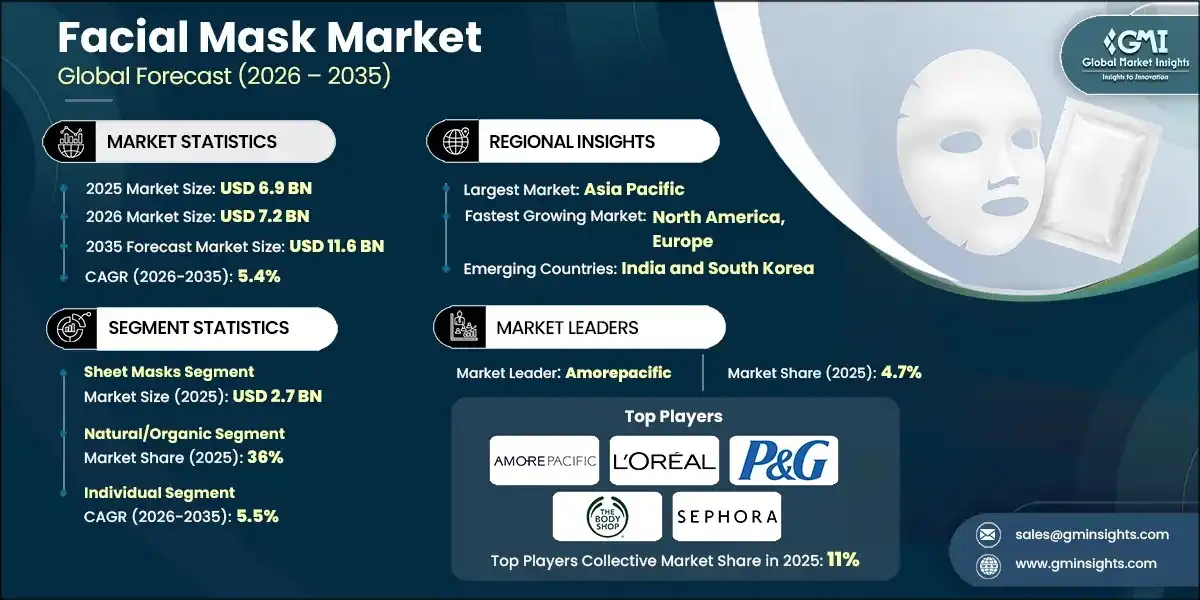
The global facial mask market was estimated at USD 6.9 billion in 2025. The market is expected to grow from USD 7.2 billion in 2026 to USD 11.6 billion in 2035, at a CAGR of 5.4%, according to latest report published by Global Market Insights Inc.
Facial Mask Market Key Takeaways
Market Size & Growth
- 2025 Market Size: USD 6.9 billion
- 2026 Market Size: USD 7.2 billion
- 2035 Forecast Market Size: USD 11.6 billion
- CAGR (2026–2035): 5.4%
Key Market Drivers
- Increasing consumer awareness regarding skincare and personal grooming.
- Rising demand for natural and organic facial mask products.
Challenges
- High competition among market players leading to price wars.
- Concerns over the environmental impact of single-use facial masks.
Opportunity
- Development of innovative and sustainable facial mask products.
- Expansion into untapped markets, particularly in developing regions.
Key Players
- Market Leader: Amorepacific led with over 4.7% market share in 2025.
- Leading Players: Top 5 players in this market include Amorepacific, LOreal (Garnier), Procter & Gamble (Olay), The Body Shop, Sephora, which collectively held a market share of 11% in 2025.
Get Market Insights & Growth Opportunities
The market for facial masks is expanding due to the increasing consumer awareness regarding skincare and the rising demand for convenient and effective beauty solutions.
Consumers have become more informed with regard to skincare and recognized its significance in health and well-being. Rising skin related concerns such as acne across the globe are also propelling the demand for facial mask market.
The American Academy of Dermatology Association estimates indicate there are 50 million Americans that suffer from acne annually, making it the most widespread skin ailment in the US. Especially among adult women, a condition termed as adult acne has afflicted approximately 15%.
A significant number, 85%, experience at minimum minor acne issues between the ages of 12 to 24. In America, more than 6 billion dollars are spent trying to deal with acne and its effects every single year. But only 10% of the people make the effort to consult a dermatologist. The rest rely on commercially available solutions.
Increasing demand for natural and organic products is majorly boosting the growth in the global market. Consumers are becoming more aware of the ingredients used in their skincare products and hence are demanding products that are natural and organic in nature, as they are perceived to be safer and healthier for the skin.
Growing awareness of potential side effects from synthetic ingredients has led consumers to prefer products formulated with natural ingredients, which are often seen as gentler and less irritating.
According to Ulta’s Beauty Consumer Insights survey for the year 2023, it found that 90% of Gen Z and younger millennials expect to buy into the products offered in the clean beauty category over the next few years. More than 50% of Gen Z is cautiously evaluating the ingredients of beauty products before making a purchase.
To get key market trends
Facial Mask Market Trends
- Sheet masks quickly gain popularity now because of the capability to attain the required outcome within a shorter duration of 10-20 mins, application ease, adaptability, ease of portability, among several factors.
- Sheet masks provide several benefits like skin hydrating, balancing, moisturizing, calming, and brightening. This product has its origins in South Korea. Unlike paste face masks, the sheet face masks do not dry out, which is a benefit to the skin.
- Studies by L’Oreal research prove that some of the probiotics which are alive include Bifidobacterium, Lactobacillus, and Vitreoscilla. These probiotics help the skin by offering protection to the dermal layer between the toxins and the surface of the skin by forming a barrier with the probiotics present between the skin surface and the issues pertaining to the use of single-use materials and the disposal of packaging have pushed the agenda of sustainability from a niche to a strategic priority.
- Asia-Pacific remains a key market for facial masks, with countries like South Korea and Japan leading in innovation and product launches. The region's influence on global beauty trends, coupled with a strong emphasis on skincare routines, has bolstered market growth. Meanwhile, North America and Europe are witnessing steady demand, driven by the increasing adoption of premium and luxury skincare products.
- Technological advancements, such as the incorporation of active ingredients and the use of biodegradable materials in mask production, are shaping the market's future. E-commerce platforms have also played a pivotal role in expanding the market's reach, offering consumers easy access to a wide range of products.
Facial Mask Market Analysis
Learn more about the key segments shaping this market
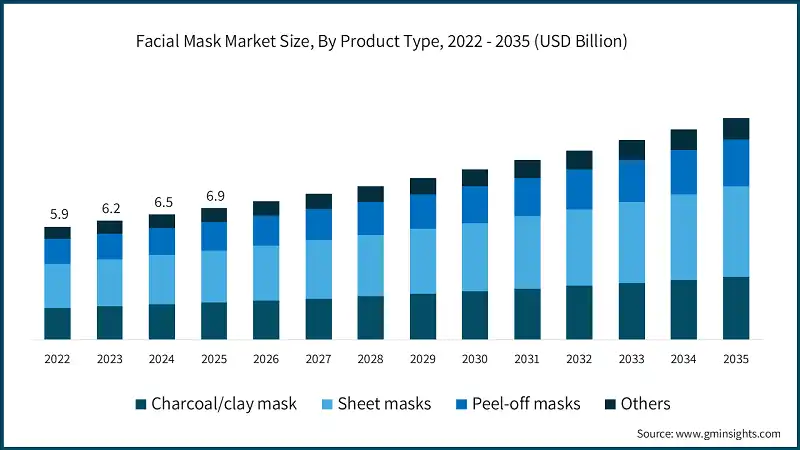
Based on the product type, the market is divided into charcoal/clay mask, sheet masks, peel-off masks, and others. In 2025, sheet masks dominated the market generating revenue of USD 2.7 billion.
- The materials commonly used in the production of face mask sheets that would contain nutrients or bioactive compounds would include non-woven fabric, cotton, microfiber, cupra, tencel, pulp, lyocell, hydrogels, or biocellulose. Sheet masks are composed of extremely thin facial sheets that contain a nourishing serum consisting of nutrients like vitamins, minerals, probiotics, cannabidiol (CBD), and so on.
- It has been found that using skin products containing probiotics and prebiotics is helpful in achieving the balanced level of skin microbiota. Probiotics, when used as topical products, are helpful in curing various skin problems such as eczema, acne, dry skin, and even wrinkles, as well as the risk of skin cancer due to UV exposure.
Learn more about the key segments shaping this market
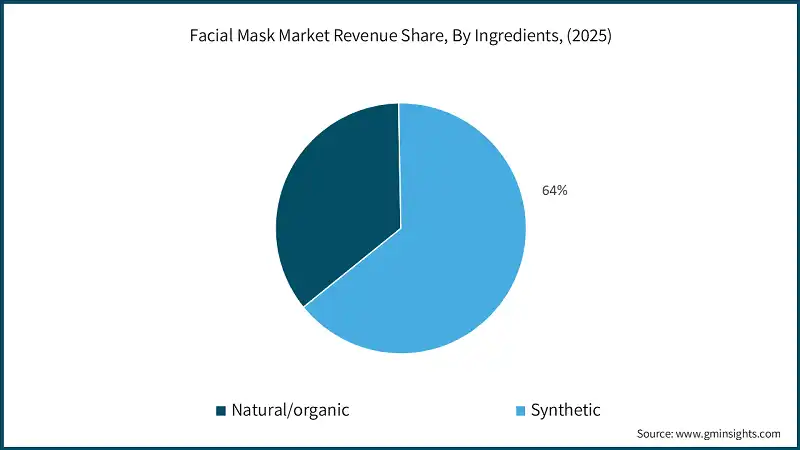
Based on ingredients, the facial mask market is segmented into natural/organic and synthetic. In 2025, natural/organic segment dominates the market with 36% market share, and the segment is expected to grow at a CAGR of 5.8% from 2026 to 2035.
- The natural ingredients segment is growing rapidly due to the global "clean beauty" trend, increased skepticism among consumers regarding the use of artificial ingredients, and rising knowledge about the safety of natural ingredients.
- Consumer health awareness and worries related to exposure to various synthetic chemicals such as parabens, sulfates, phthalates, and fragrance are boosting the popularity of alternatives that are recognized as being gentler and safer.
- For instance, regulation in the major markets, such as the EU ban on some synthetic preservatives and skin lightening substances, has driven the movement towards natural substitutes. Social media campaigns promoting the "clean beauty" movement have increased public awareness and social pressure to switch to natural options.
Based on end users, the facial mask market is segmented into individual and commercial. In 2025, the individual segment dominates the market and is expected to grow at a CAGR of 5.5% from 2026 to 2035.
- Increasing consumer awareness regarding skincare routines and the rising adoption of facial masks for personal use are driving this segment. The growing influence of social media and beauty influences has further boosted demand among individuals.
- The increasing adoption of facial masks in spas, salons, and dermatology clinics is a key driver for this segment. Professional establishments are leveraging facial masks to enhance their service offerings, catering to a growing customer seeking premium skincare treatments.
Looking for region specific data?
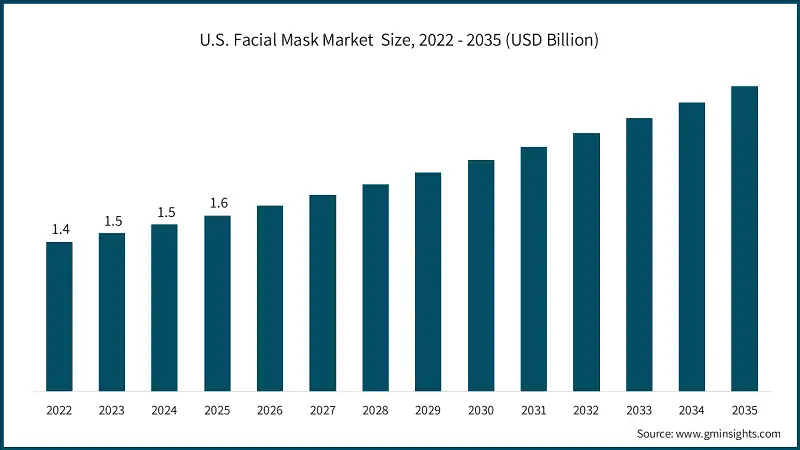
In terms of country, the United States led the facial mask market with 80% of the North American market share and estimated USD 1.6 billion in revenue during 2025.
- The key factor responsible for the development of the facials mask market in the United States is the rising awareness among people about taking care of their skin.
- The trend of using natural & organic ingredients to formulate skincare is further fueling the growth of this market. In addition to this, the trend of social influences through social networks is encouraging consumers to use facial masks.
- The market is also experiencing the benefits of developments in product formulation, such as sheet masks, clay masks, and peel-off masks, which address a variety of skin types and problems.
The Europe facial mask market was valued at USD 1.8 billion in 2025 and is projected to grow at a CAGR of 5% between 2026 and 2035.
- Consumer awareness about skin care, increasing spending, and the trend towards natural and organic products are factors that contribute to the growth of this market.
- Germany, France, and the United Kingdom are currently driving the market owing to their well-established presence of high-end skincare brands and per capita spending on personal care.
The Asia Pacific facial mask market was valued at USD 2.2 billion in 2025 and is projected to grow at a CAGR of 5.9% between 2026 and 2035.
- Countries such as China, Japan, and South Korea are currently dominating the market because of their developed sectors in the beauty and personal care industry. The rising popularity of the “K-beauty” and “J-beauty” trend has also increased the demand for unique and effective facial masks.
- Moreover, the growing number of e-commerce businesses in this region has increased the reach of these products. Also, keeping in mind the natural and organic composition, these products meet the demands of the consumers, resulting in a growing market.
The Middle East and Africa facial mask market was valued at USD 410.4 million in 2025 and is projected to grow at a CAGR of 4.5% between 2026 and 2035.
- The growing consumer knowledge regarding skin care, rising disposable income levels, and an increasing effect of social media on the world of skin care are the factors accelerating the growth of the market.
- Regions such as UAE, Kingdom of Saudi Arabia, and South Africa represent emerging markets because of their developing retail infrastructure and an increasing demand for high-quality skin care products.
Facial Mask Market Share
- The top 5 companies in the market are Amorepacific, L'Oreal (Garnier), Procter & Gamble (Olay), The Body Shop and Sephora collectively hold a share of 11% in the market.
- These companies continue to acquire and merge with others, expand facilities, and make various collaborations to increase their product offerings, access customer bases, and secure their market positions.
- Amorepacific is utilizing its R&D strengths to bring innovative facial masks with natural ingredients to market. The company is concentrating on high-end products as well as proper marketing strategies in order to increase its market share in the global facial mask market, in the Asia-Pacific market.
- Procter & Gamble leverages its widespread distribution channels and portfolio of brands to create a competitive advantage in the sheet face mask industry. This company prioritizes innovative products to suit various consumer needs in the market. This factor acts as an advantage to the company.
- Taiki enhances its products with technological developments in the raw materials used for sheet masks, including bio-cellulose and hydrogel. The firm partners with top brands to supply the best masks on the market. Taiki's technical knowledge and innovation enable the firm to capture considerable market share.
Facial Mask Market Companies
Major players operating in the facial mask industry are:
- Allure
- Amorepacific
- Beauty Barn
- Dr.Jart+
- HCP Wellness
- Lessonia
- Loops Beauty
- L'Oreal (Garnier)
- Mirabelle
- Procter & Gamble (Olay)
- Renee Cosmetics
- Revlon
- Sephora
- Taiki
- The Body Shop
To improve the product and market share key players are constantly investing in technological activities and are also entering into partnerships to provide improved and better solutions for the customers. These investments are benefiting both companies and customers as they help develop and offer solutions as per the changing technological trends and thus the customer requirements.
Amorepacific is a popular Korean cosmetics firm that has been making waves globally in the skincare industry through innovative solutions. This company provides a wide range of facial masks that are developed through extensive research work and effective use of natural ingredients. Being a well-established entity within the Asia-Pacific region, this company has been focusing on sustainability.
L'Oreal, through their brand name Garnier, is one of the key players in the global facial mask market. Garnier is a brand that focuses on providing affordable and high-quality skincare products such as sheet masks and clay masks. The products are made from natural ingredients and are dermatologically tested.
Olay, which is owned by Procter & Gamble, is a trusted name in the industry that has established itself in the skin care industry offering a line of skincare products that are intended to improve one’s skin. One such product that has caught much attention lately is its line of face masks that are meant to improve the appearance of one’s skin.
Facial Mask Market Report Attributes
| Key Takeaway | Details |
|---|---|
| Market Size & Growth | |
| Base Year | 2025 |
| Market Size in 2025 | USD 6.9 billion |
| Market Size in 2026 | USD 7.2 billion |
| Forecast Period 2026-2035 CAGR | 5.4% |
| Market Size in 2035 | USD 11.6 billion |
| Key Market Trends | |
| Drivers | Impact |
| Increasing consumer awareness regarding skincare and personal grooming | This is driving the demand for facial masks, contributing to consistent market growth. |
| Rising demand for natural and organic facial mask products | The preference for chemical-free products is boosting the adoption of organic facial masks, positively impacting market expansion. |
| Pitfalls & Challenges | Impact |
| High competition among market players leading to price wars | This is pressuring profit margins and creating challenges for smaller players to sustain in the market |
| Concerns over the environmental impact of single-use facial masks | Growing awareness about sustainability is compelling manufacturers to innovate, which may increase production costs. |
| Opportunities: | Impact |
| Development of innovative and sustainable facial mask products | This presents a chance for companies to differentiate their offerings and capture environmentally conscious consumers, driving market growth. |
| Expansion into untapped markets, particularly in developing regions | Entering new markets can help companies increase their customer base and revenue streams, fostering market expansion. |
| Market Leaders (2025) | |
| Market Leaders |
4.7% market share |
| Top Players |
|
| Competitive Edge |
|
| Regional Insights | |
| Largest Market | Asia Pacific |
| Fastest Growing Market | North America, Europe |
| Emerging Country | India and South Korea |
| Future Outlook |
|
What are the growth opportunities in this market?
Facial Mask Industry News
- In December 2025, Revlon launched its new Lip Balm & Mask this brings deep hydration, smoother lips and a youthful boost due a “powerhouse” peptide formula that doubles as a daily balm and overnight mask.
- In September 2025, Amorepacific participate in IFA 2025 for the first time, Amorepacific unveil 'ONFACE,' a premium micro-LED mask from its AI-powered beauty device brand 'makeON.' With its single-panel LED design and flexible, lightweight materials, the mask fits closely with facial contours for maximum effectiveness.
- In September 2025, Olay is redefining skincare for Indian women by launching its new, affordable 7-in-1 Serum and Gel Moisturizer, featuring Niacinamide, Vitamin C, and Peptides to tackle common aging concerns like dullness and uneven tone in a simple, science-backed routine, addressing a gap where many Indian women want anti-aging solutions but find them complex or costly.
The facial mask market research report includes in-depth coverage of the industry with estimates & forecasts in terms of revenue (USD Billion) and volume (Million Units) from 2022 to 2035, for the following segments:
Market, By Product Type
- Charcoal/clay mask
- Sheet masks
- Peel-off masks
- Others (leave-on masks etc.)
Market, By Ingredients
- Natural/organic
- Synthetic
Market, By Packaging Format
- Tubes
- Bottle
- Box
- Jar
- Others (sachets etc.)
Market, By Skin Type
- Dry
- Combination
- Sensitive
- Normal
- Oily
- All skin types
Market, By Price
- Up to $10
- $10 to $15
- $15 to $20
- $20 & above
Market, By Application
- Moisturizing
- Cleansing
- Anti-aging
- Acne
- Brightening
- Others (soothing etc.)
Market, By Consumer Group
- Men
- Women
- Unisex
Market, By End Use
- Individual
- Commercial
- Professional beauty salons
- Wellness centers
- Beauty institute
- Others
Market, By Distribution Channel
- Online
- E-commerce
- Company websites
- Offline
- Supermarkets/hypermarket
- Specialty retail stores
- Others (independent retailer etc.)
The above information is provided for the following regions and countries:
- North America
- U.S.
- Canada
- Europe
- Germany
- UK
- France
- Spain
- Italy
- Netherlands
- Asia Pacific
- China
- Japan
- India
- Australia
- South Korea
- Latin America
- Brazil
- Mexico
- Argentina
- MEA
- South Africa
- Saudi Arabia
- UAE
Frequently Asked Question(FAQ) :
What was the market size of the facial mask market in 2025?
The global facial mask industry was valued at USD 6.9 billion in 2025, driven by increasing consumer demand for skincare products and innovations in mask formulations.
What is the projected value of the facial mask market by 2035?
The market is expected to reach USD 11.6 billion by 2035, growing at a CAGR of 5.4%, fueled by rising awareness of skincare benefits and the popularity of sheet masks.
What is the projected size of the facial mask market in 2026?
The market is projected to reach USD 7.2 billion in 2026, continuing its steady growth trajectory.
How much revenue did the sheet mask segment generate in 2025?
The sheet mask segment generated USD 2.7 billion in revenue in 2025, dominating the market due to its convenience and effectiveness.
What was the market share of the natural/organic segment in 2025?
The natural/organic segment held a 36% market share in 2025 and is expected to grow at a CAGR of 5.8% from 2026 to 2035.
Which end-user segment led the facial mask market in 2025?
The individual segment led the market in 2025 and is projected to grow at a CAGR of 5.5% from 2026 to 2035.
Which country dominated the facial mask market in 2025?
The United States dominated the market in 2025, accounting for 80% of the North American market share and generating USD 1.6 billion in revenue.
What are the key trends in the facial mask industry?
Key trends include the rising popularity of sheet masks due to their convenience and effectiveness, the growing demand for natural/organic ingredients, and the increasing focus on sustainability in packaging and materials.
Who are the major players in the facial mask market?
Major players include Allure, Amorepacific, Beauty Barn, Dr.Jart+, HCP Wellness, Lessonia, Loops Beauty, L'Oreal (Garnier), Mirabelle, and Procter & Gamble (Olay).
Facial Mask Market Scope
Related Reports