Summary
Table of Content

Faba Bean Ingredients Market
Get a free sample of this report
Form submitted successfully!
Error submitting form. Please try again.
Thank you!
Your inquiry has been received. Our team will reach out to you with the required details via email. To ensure that you don't miss their response, kindly remember to check your spam folder as well!
Request Sectional Data
Thank you!
Your inquiry has been received. Our team will reach out to you with the required details via email. To ensure that you don't miss their response, kindly remember to check your spam folder as well!
Form submitted successfully!
Error submitting form. Please try again.
Faba Bean Ingredients Market Size
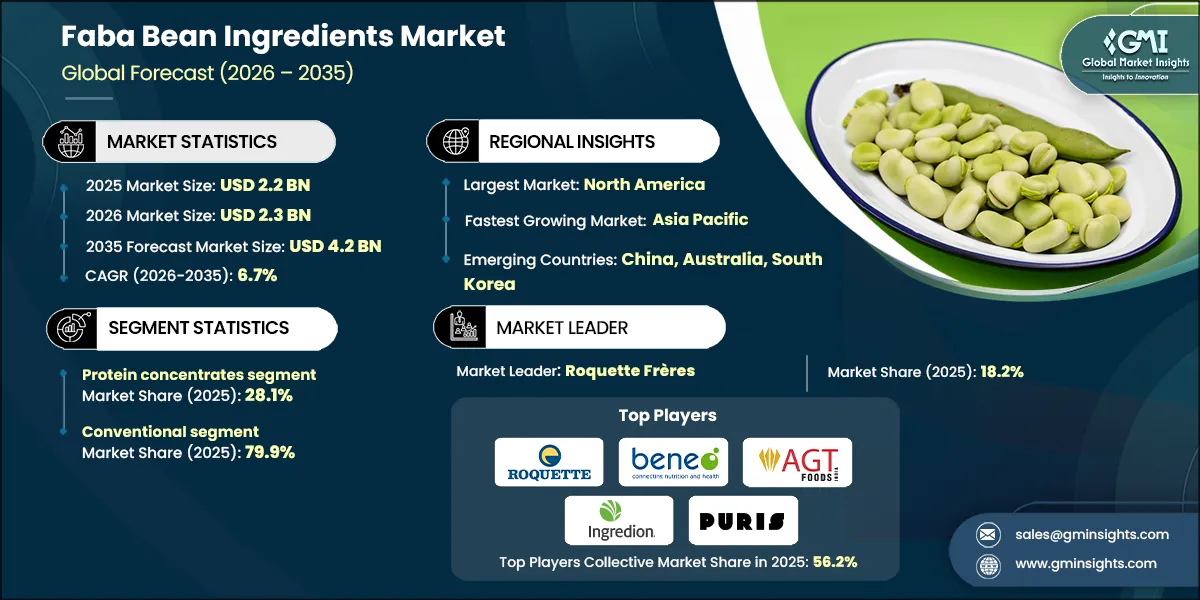
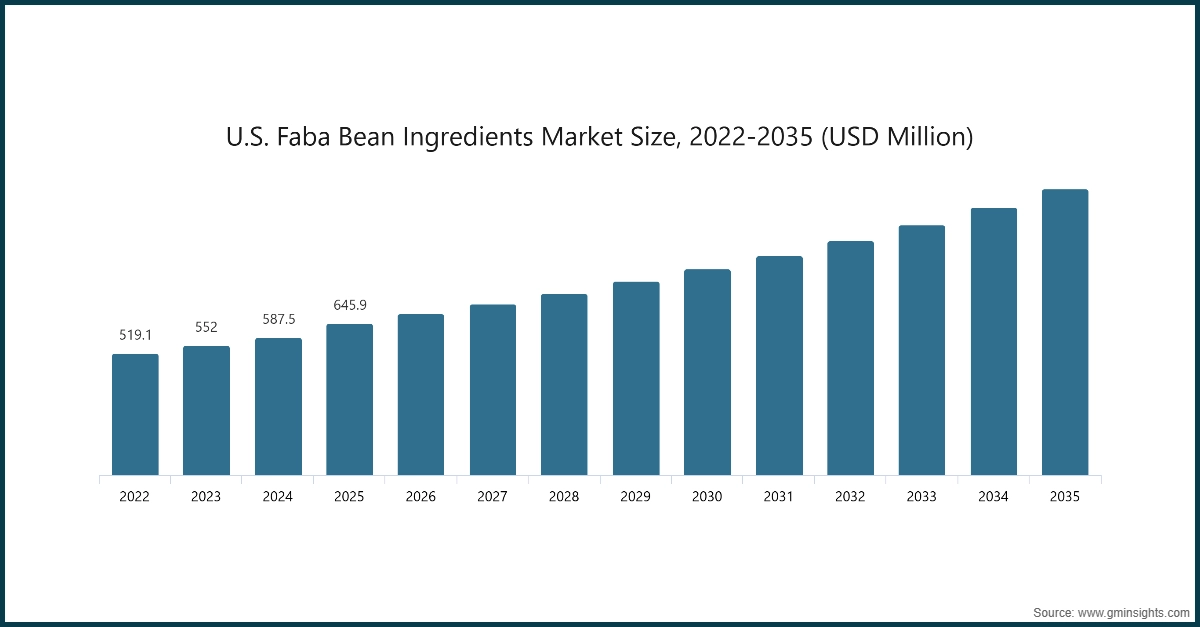
The global faba bean ingredients market was valued at USD 2.2 billion in 2025. The market is expected to grow from USD 2.3 billion in 2026 to USD 4.2 billion in 2035, at a CAGR of 6.7% according to latest report published by Global Market Insights Inc.
Faba Bean Ingredients Market Key Takeaways
Market Size & Growth
- 2025 Market Size: USD 2.2 Billion
- 2026 Market Size: USD 2.3 Billion
- 2035 Forecast Market Size: USD 4.2 Billion
- CAGR (2026–2035): 6.7%
Regional Dominance
- Largest Market: North America
- Fastest Growing Region: Asia Pacific
Key Market Drivers
- Rising consumer demand for plant-based proteins.
- Sustainability & environmental benefits (nitrogen fixation, lower carbon footprint).
- Allergen-free alternative to soy & dairy proteins.
Challenges
- Antinutritional factors (vicine, convicine) limiting consumption.
- Off-flavors & beany taste challenges.
Opportunity
- Organic faba bean ingredient premium segment.
- Animal feed & aquaculture protein demand.
Key Players
- Market Leader: Roquette Frères led with over marker share: 18.2% in 2025.
- Leading Players: Top 5 players in this market include Roquette Frères, BENEO GmbH, AGT Food & Ingredients, Ingredion Incorporated, Puris Foods, which collectively held a market share of 56.2% in 2025.
Get Market Insights & Growth Opportunities
- The faba bean (Vicia faba) serves as the source for faba bean ingredients because this legume plant contains high levels of protein and fiber together with vital nutrients, which makes it suitable for plant-based food production ,animal feed and aquaculture applications.
- The global market for faba bean ingredients which provide sustainable and nutritious protein sources experiences substantial growth because multiple interrelated factors drive this expansion. The rising consumer demand for plant-based proteins exists as the primary catalyst which drives this trend forward because people now understand health advantages and traditional animal-based products are becoming less popular.
- Faba beans provide nitrogen to the soil through their natural growth process, hence reduces the requirement for chemical fertilizers. Faba beans serve as an advantageous substitute for soy and dairy proteins as they do not contain allergens, which limits their market access in different regions.
- North America currently leads the global market, owing to its advanced manufacturing infrastructure, established supply chains, and supportive regulatory frameworks that facilitate innovation and product development. The Asia-Pacific region has become the fastest-growing market because of its rising plant-based technology investments and increasing consumer health and sustainability awareness.
To get key market trends
Faba Bean Ingredients Market Trends
- The development of processing technologies allows producers to create faba bean protein isolates and concentrates with high purity. Faba bean ingredients demonstrate superior product performance and enhanced taste and texture, which makes them suitable for various applications in plant-based meat products and dairy replacements. The processing industry develops advanced techniques for pure ingredient processing because customers prefer products with simplified ingredient lists and unprocessed options, which leads to increased product consumption among health-conscious consumers.
- The new regulatory systems establish sustainable and healthy food systems through their various regulations, which governments worldwide use to promote plant-based food production. The government supports plant-based protein products through three methods, which include providing financial assistance and establishing product labeling requirements and safety testing procedures, so that customers trust the products.
- The market offers a broad range of faba bean-based products, which include flours and protein powders and texturized proteins and functional ingredients for different dietary requirements. Companies are investing in R&D to develop allergen-free gluten-free and non-GMO variants to match the changing needs of customers. The product development process creates new applications, which allow products to be used in bakery items and snack foods and dietary supplements, thereby expanding the market.
Faba Bean Ingredients Market Analysis
Learn more about the key segments shaping this market
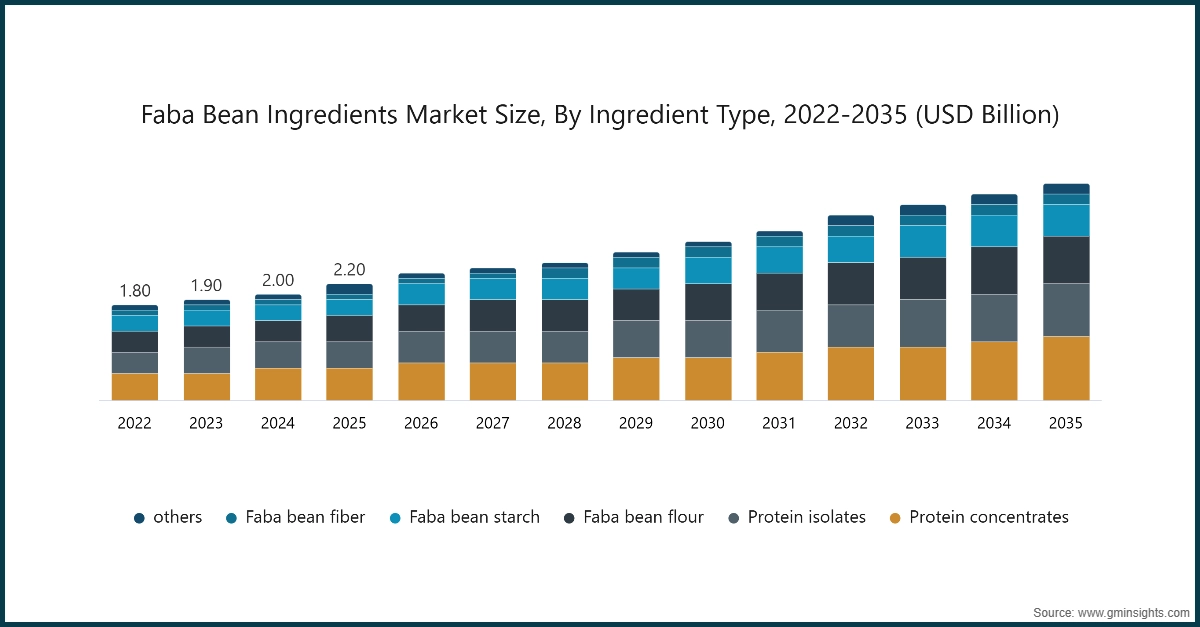
Based on ingredient type, the market is segmented into protein concentrates, protein isolates, faba bean flour, faba bean starch, faba bean fiber and others. Protein concentrates dominated the market with an approximate market share of 28.1% in 2025 and is expected to grow with a CAGR of 6.7% by 2035.
- The faba bean ingredients marketplace protein concentrates as the leading ingredient because it holds the highest share of market revenue. The product's nutritional balance together with its affordable price and multiple uses for food production leads to its widespread market availability. The protein content of protein concentrates remains intact while their enhanced functionality serves as a better choice for creating plant-based meat substitutes and dairy products and nutritional bars. Food manufacturers prefer concentrates because they present cheaper processing expenses than isolates which results in better economic viability for large-scale production.
- Protein isolates hold a significant share due to their high purity and functional benefits. Faba bean flour is gaining traction because it provides an affordable option which traditional bakers and snack producers can easily utilize. The market growth for the product occurs because manufacturers who need gluten-free products and allergen-friendly products will start using it. The ingredient offers cost advantages because it requires less processing work but its market presence remains lower than concentrates and isolates.
- The faba bean starch and fiber segments are currently developing into new markets due to rising consumer demand for functional ingredients that enhance texture and viscosity and provide dietary fiber in processed foods.
Learn more about the key segments shaping this market
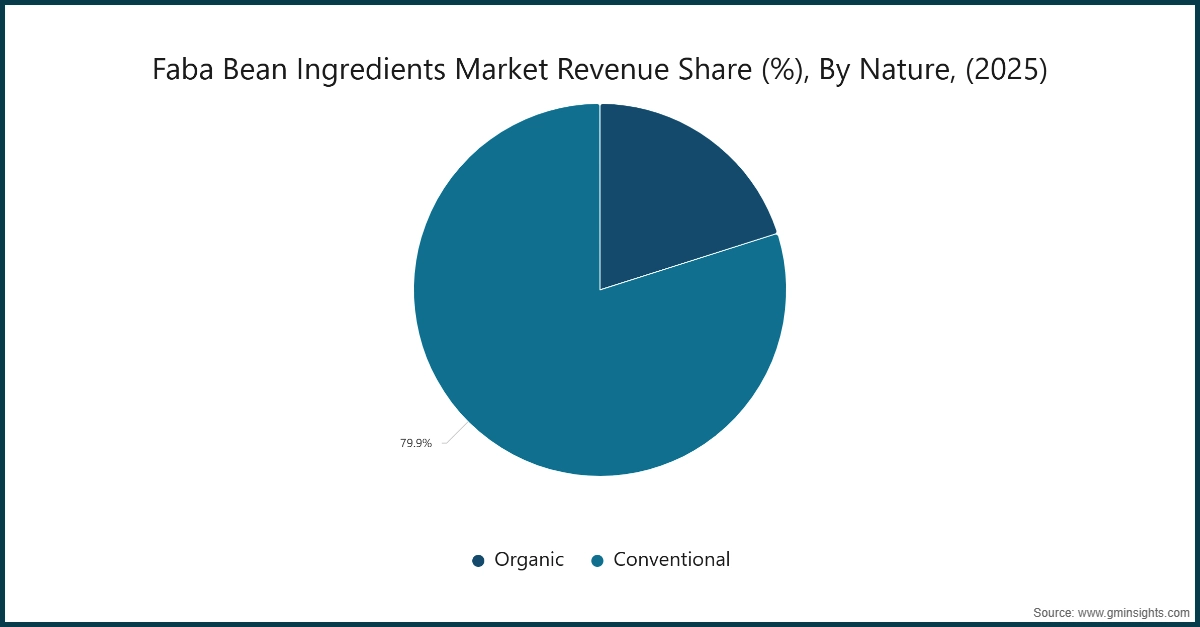
Based on nature, the market is segmented into organic and conventional. Conventional held the largest market share of 79.9% in 2025.
- Conventional faba bean ingredients are easily accessible and result in cheaper production expenses and their supply chains have reached established status. The widespread use of traditional farming methods together with large-scale processing plants enables consumers and manufacturers to access conventional products at lower prices which leads to their market dominance.
- The market for organic faba bean ingredients exists as a specialized sector that is experiencing rapid growth because more consumers choose products which have clean labels and sustainable farming methods. In the premium market organic products are increasing their market share, but their market share remains lower than conventional products because of their higher production costs and limited distribution networks. The organic and eco-friendly product category will experience strong market expansion in the near future according to current market trends.
Based on application, the faba bean ingredients market is segmented into bakery & cereals, meat alternatives & plant‑based proteins, dairy alternatives, beverages, snacks & confectionery, animal feed & pet food and others.
- Meat alternatives & plant-based proteins lead the market because people become more health-conscious while veganism becomes more popular and environmental protection needs to grow, which drives faba bean ingredient requirements.
- Consumers want allergen-free, lactose-free dairy alternatives which makes dairy alternatives a major market segment because faba bean proteins deliver sustainable, premium-quality dairy replacements. Faba bean ingredients provide bakery and cereal products with extra protein content according to clean-label requirements.
- The beverage market shows potential for growth because companies develop innovative plant-based protein drinks yet the industry must overcome formulation obstacles before widespread adoption can occur.
- Snack and confectionery manufacturers use faba bean ingredients to create products that offer both functional benefits and high protein content, but these products fall under a niche market when compared to primary plant-based protein categories.
- Animal feed and pet food represent an expanding market segment which requires sustainable protein sources to meet the growing demand for livestock and pet food, yet human food products remain more widely used.
Based on distribution channel, the faba bean ingredients market is segmented into supermarkets & hypermarkets, convenience stores, specialty stores and online retailers.
- Supermarkets & hypermarkets serve as the main distribution channels because their widespread network together with consumer trust, enables all retail locations to sell faba bean ingredients, which results in increased sales and greater brand recognition.
- Convenience stores are experiencing growth because urban consumers want quick access to plant-based ingredients which they can use as portable food items, which leads to increased sales of both impulse items and smaller products.
- Specialty stores target health-focused consumers and niche market segments by selling premium organic faba bean products which do not contain allergens, attracting customers who want high-quality functional ingredients.
- Online retailers experience rapid development because customers can access numerous products through online shopping and their shopping experience is improved through product details and home delivery services which enable their market expansion.
Looking for region specific data?
The faba bean ingredients market in North America will grow at a CAGR from approximately 6.6% between 2026 and 2035.
- The market expansion of faba bean-derived ingredients in food cosmetics and pharmaceuticals results from rising consumer awareness about environmental impacts of synthetic additives together with growing demand for plant-based sustainable ingredients.
The faba bean ingredients markets in Europe, especially in a few countries like Germany, are expected to grow with a rapid pace in the coming years.
- The rising consumer demand for clean-label products which do not contain allergens and meet sustainability requirements is driving industries to implement processing methods that protect the environment, which in turn supports health and sustainability requirements across the food industry, personal care sector, and healthcare field.
The faba bean ingredients market in China and India is expected to have lucrative growth between 2026 and 2035, with CAGR 6.9% in the Asia Pacific region.
- The increasing urban population together with rising disposable incomes is driving the adoption of advanced processing equipment which produces natural plant-based ingredients that include faba bean proteins for food and packaging and healthcare products.
- The market demand for sustainable processing solutions to produce pharmaceutical and nutraceutical-grade ingredients is driving the development of new manufacturing methods and bio-based product development in this industry.
Between 2026 and 2035, the market for faba bean ingredients in the Middle East is projected to grow significantly during this period.
- The operational costs of sustainable energy-efficient production systems are reduced through these methods which enable their implementation in various sectors that benefit from technological innovations which include thermal and UV-based extraction methods and waste valorization techniques.
Between 2025 and 2035, a promising expansion of the faba bean ingredients sector is foreseen in the Latin America.
- People are now more environmentally conscious and waste recycling policies together with sustainable practices lead to increased use of faba bean ingredients in meat alternatives and functional foods and cosmetics.
- The rising demand for eco-friendly processing technologies which support growth across food and pharmaceutical and personal care industries is driven by rising disposable incomes together with ongoing scientific research into bio-based and natural extracts.
Faba Bean Ingredients Market Share
Faba bean ingredients industry is moderately consolidated with players like Roquette Frères BENEO GmbH, AGT Food & Ingredients, Ingredion Incorporated and Puris Foods which accounts for 56.2% market share in 2025.
The faba bean ingredients market consists of such leading companies operating mostly in their regional areas. Their long years of experience with faba bean ingredients have allowed these companies to maintain a strong market position worldwide. Their product offerings are diverse and majorly supported by production capacities and distribution networks, which can serve the increasing demand for faba bean ingredients in various regions.
Faba Bean Ingredients Market Companies
Major players operating in the faba bean ingredients industry includes:
- AGT Food & Ingredients
- BENEO GmbH
- Bunge
- Ingredion Incorporated
- Puris Foods
- Roquette Frères
- Royal Ingredients Group
- Scoular Company
- Seedea
- Vestkorn Milling AS
Roquette Frères provides faba bean protein products together with plant-based ingredients which help create sustainable food products that meet clean-label requirements.
BENEO GmbH creates functional proteins from faba beans which serve both animal feed and food production while delivering health benefits and ingredient worth.
AGT Food & Ingredients provides multiple faba bean ingredient solutions which include flours and proteins that food, feed, and industrial customers need to drive plant-based product development.
Ingredion Incorporated develops pulse-based flours and ingredients which include faba bean products to create food products that improve texture while delivering nutritional benefits and fulfilling sustainability requirements.
Puris Foods produces high-quality faba bean protein isolates and concentrates which companies use to create plant-based products that meet clean-label and allergen-free standards.
Faba Bean Ingredients Market Report Attributes
| Key Takeaway | Details |
|---|---|
| Market Size & Growth | |
| Base Year | 2025 |
| Market Size in 2025 | USD 2.2 Billion |
| Market Size in 2026 | USD 2.3 Billion |
| Forecast Period 2026-2035 CAGR | 6.7% |
| Market Size in 2035 | USD 4.2 Billion |
| Key Market Trends | |
| Drivers | Impact |
| Rising consumer demand for plant-based proteins | This trend is driving increased adoption of faba bean ingredients as a sustainable, protein-rich alternative, expanding market opportunities and boosting sales globally. |
| Sustainability & environmental benefits (nitrogen fixation, lower carbon footprint) | Faba beans nitrogen-fixing ability and lower carbon footprint contribute to eco-friendly farming practices, encouraging their use in sustainable food product development and reducing environmental impact. |
| Allergen-free alternative to soy & dairy proteins | The allergen-free nature of faba bean proteins positions them as a safe, inclusive option, attracting consumers with allergies and sensitivities, thereby expanding their market share. |
| Pitfalls & Challenges | Impact |
| Antinutritional factors (vicine, convicine) limiting consumption | Antinutritional factors may limit consumer acceptance and restrict market growth of faba bean ingredients globally. |
| Off-flavors & beany taste challenges | Challenges could reduce product appeal, hindering broader adoption and market expansion worldwide. |
| Opportunities: | Impact |
| Organic faba bean ingredient premium segment | Offers high-value potential, driving growth in health-conscious and sustainable markets globally |
| Animal feed & aquaculture protein demand | Rising demand for plant-based protein in animal feed and aquaculture presents significant opportunities for expanding faba bean ingredient applications worldwide. |
| Market Leaders (2025) | |
| Market Leader |
Marker share: 18.2% |
| Top Players |
Collective market share of 56.2% in 2025 |
| Competitive Edge |
|
| Regional Insights | |
| Largest Market | North America |
| Fastest growing market | Asia Pacific |
| Emerging countries | China, Australia, South Korea |
| Future outlook |
|
| Companies covered: | 10 |
| Tables, Charts & Figures: | 210 |
| Countries covered: | 22 |
| No of Pages: | 180 |
What are the growth opportunities in this market?
Faba Bean Ingredients Industry News
- In September 2025, BENEO's faba bean protein concentrate showed its value as a sustainable, affordable substitute for animal blood plasma in wet pet food, because it delivered the same functional benefits of blood plasma while improving pet food development with plant-based binding strength.
- In June 2024, Bunge started its plant-based protein product expansion by launching pea and faba concentrates, which Golden Fields developed with Bunge to create non-GMO allergen-free ingredients in Latvia.
- In May 2024, Roquette introduced NUTRALYS Fava S900M as its initial fava bean protein isolate product, which added to its plant-based ingredient portfolio through a premium protein solution that enables the creation of sustainable nutritious functional plant-based foods for European and North American markets.
- In July 2022, A&B Ingredients introduced its Texta Feve product n as a new plant protein addition to its portfolio, which includes textured faba bean proteins that provide a clean taste and allergen-free nature while offering high-water-binding properties and multiple uses for plant-based meats and sustainable food product development.
This faba bean ingredients market research report includes in-depth coverage of the industry, with estimates & forecasts in terms of revenue (USD Billion) and volume (Kilo Tons) from 2022 to 2035, for the following segments:
Market, By Ingredient Type
Protein concentrates
Protein isolates
- Faba bean flour
- Faba bean starch
- Faba bean fiber
- Others
Market, By Nature
- Organic
- Conventional
Market, By Application
- Bakery & cereals
- Bread & baked goods
- Pasta & noodles
- Breakfast cereals
- Others
- Meat alternatives & plant‑based proteins
- Burgers & patties
- Sausages & hot dogs
- Nuggets & strips
- Others
- Dairy alternatives
- Plant‑based milk
- Plant‑based yogurt
- Plant‑based cheese
- Plant‑based ice cream
- Others
- Beverages
- Protein shakes & rtd beverages
- Smoothies
- Nutritional drinks
- Others
- Snacks & confectionery
- Protein bars & energy bars
- Extruded snacks & chips
- Confectionery products
- Others
- Animal feed & pet food
- Others
Market, By Distribution Channel
- Supermarkets & hypermarkets
- Convenience stores
- Specialty stores
- Online retailers
The above information is provided for the following regions and countries:
- North America
- U.S.
- Canada
- Europe
- Germany
- UK
- France
- Spain
- Italy
- Rest of Europe
- Asia Pacific
- China
- India
- Japan
- Australia
- South Korea
- Rest of Asia Pacific
- Latin America
- Brazil
- Mexico
- Argentina
- Rest of Latin America
- Middle East and Africa
- Saudi Arabia
- South Africa
- UAE
- Rest of Middle East and Africa
Frequently Asked Question(FAQ) :
What is the faba bean ingredients market size in 2025?
The market size for faba bean ingredients was valued at USD 2.2 billion in 2025. Increasing demand for plant-based proteins and sustainable food products is driving market growth.
What is the market size of the faba bean ingredients industry in 2026?
The market size for faba bean ingredients reached USD 2.3 billion in 2026, reflecting steady growth driven by rising consumer interest in allergen-free and eco-friendly protein sources.
What is the projected value of the faba bean ingredients market by 2035?
The market size for faba bean ingredients is expected to reach USD 4.2 billion by 2035, growing at a CAGR of 6.7%. This growth is fueled by increasing adoption in plant-based food products, animal feed, and aquaculture applications.
What was the market share of protein concentrates in 2025?
Protein concentrates dominated the market with a 28.1% share in 2025. Their popularity is attributed to their high protein content and versatility in various food applications.
What was the market share of conventional faba bean ingredients in 2025?
Conventional faba bean ingredients held the largest market share of 79.9% in 2025, driven by their widespread availability and cost-effectiveness compared to organic alternatives.
What is the growth outlook for the North American faba bean ingredients market from 2026 to 2035?
The faba bean ingredients market in North America is projected to grow at a CAGR of approximately 6.6% from 2026 to 2035. Increasing demand for plant-based proteins and sustainable farming practices is driving this growth.
What are the upcoming trends in the faba bean ingredients industry?
Key trends include the rising demand for organic faba bean ingredients, increasing use in animal feed and aquaculture, and growing consumer preference for allergen-free and sustainable protein alternatives. Additionally, advancements in processing technologies to address off-flavors and antinutritional factors are shaping the market.
Who are the key players in the faba bean ingredients market?
Key players include Roquette Frères, BENEO GmbH, AGT Food & Ingredients, Ingredion Incorporated, Puris Foods, Bunge, Royal Ingredients Group, Scoular Company, Seedea, and Vestkorn Milling AS.
Faba Bean Ingredients Market Scope
Related Reports